Introduction
AI Marketing Content Generators are software platforms that leverage artificial intelligence to automate the creation of marketing materials. This includes blog posts, social media content, email campaigns, ad copy, product descriptions, and even multimedia assets. Unlike generic AI writing tools, these platforms are purpose-built for marketing teams and emphasize brand voice, conversion optimization, and campaign-specific outputs.
Why it matters
- High-volume personalization: Businesses need to create large amounts of tailored content quickly.
- Consistency across channels: Maintains brand voice across blogs, emails, ads, and social media.
- Faster campaign execution: Reduces time-to-market for marketing initiatives.
- Cost efficiency: Lowers manual copywriting overhead.
- SEO and engagement optimization: AI can optimize content for keywords, readability, and conversions.
- Support for multimodal content: Modern platforms generate text, images, and video for integrated campaigns.
Real-world use cases include:
- Automating blog content for inbound marketing and SEO.
- Generating personalized email campaigns based on customer segments.
- Producing ad copy variations for A/B testing on social platforms.
- Creating product descriptions for eCommerce catalogs.
- Drafting social media posts with brand-specific tone.
- Supporting landing pages and promotional campaigns with AI-optimized content.
Evaluation Criteria for Buyers
- Content quality and relevance: How well the AI output aligns with brand voice and marketing goals.
- AI model support: Proprietary, BYO, multi-model routing, or open-source flexibility.
- Integration capabilities: Ability to connect with CMS, CRM, eCommerce, and automation tools.
- Customization and brand voice: Support for tone, style, and audience segmentation.
- Guardrails and safety: Protection against plagiarism, hallucinations, prompt injection, and inappropriate content.
- Evaluation tools: Built-in testing, A/B testing, and human review workflows.
- Observability and metrics: Token usage, latency, cost, and performance dashboards.
- Cost and scalability: Token pricing, subscription tiers, and ability to scale without exploding costs.
- Deployment flexibility: Cloud, hybrid, or self-hosted options.
- Security and compliance: Data encryption, access control, audit logs, and industry-specific privacy standards.
Best for: marketing teams, content agencies, eCommerce brands, startups, and enterprises needing high-volume, consistent, and personalized content creation.
Not ideal for: organizations requiring highly specialized or regulated technical content, or where human creative nuance is irreplaceable. Traditional copywriting may still outperform AI in these cases.
What’s Changed in AI Marketing Content Generators
- Support for multimodal content: text, images, video, and voice integrated into campaigns.
- Agentic workflows enable AI to autonomously research, draft, and optimize content.
- Improved evaluation tools to detect hallucinations, biased outputs, and tone inconsistencies.
- Enhanced guardrails to prevent prompt injection, plagiarism, and brand voice deviation.
- Enterprise-grade privacy and data residency controls for sensitive customer data.
- Cost and latency optimizations with dynamic model routing and hybrid deployment options.
- Observability dashboards with token-level metrics, latency, and cost reporting.
- Customizable AI models with BYO options for proprietary brand language.
- Seamless integration with CRM, CMS, social platforms, and marketing automation.
- Increased adoption of AI evaluation harnesses for A/B testing content variations.
- Emphasis on governance, auditability, and compliance with industry standards.
Quick Buyer Checklist
- Ensure strong data privacy, retention, and compliance controls.
- Check if model support allows proprietary, BYO, or multi-model routing.
- Verify RAG/connectors or knowledge integration for brand-specific content.
- Assess evaluation features: prompt tests, offline evaluation, regression tracking.
- Evaluate guardrails for brand voice, plagiarism, and prompt injection defense.
- Review latency, token/cost metrics, and scaling efficiency.
- Confirm auditability, admin controls, and role-based access.
- Understand vendor lock-in risk and API extensibility.
- Examine deployment flexibility: cloud, hybrid, or self-hosted.
- Evaluate support for multimodal content if needed (image/video/voice).
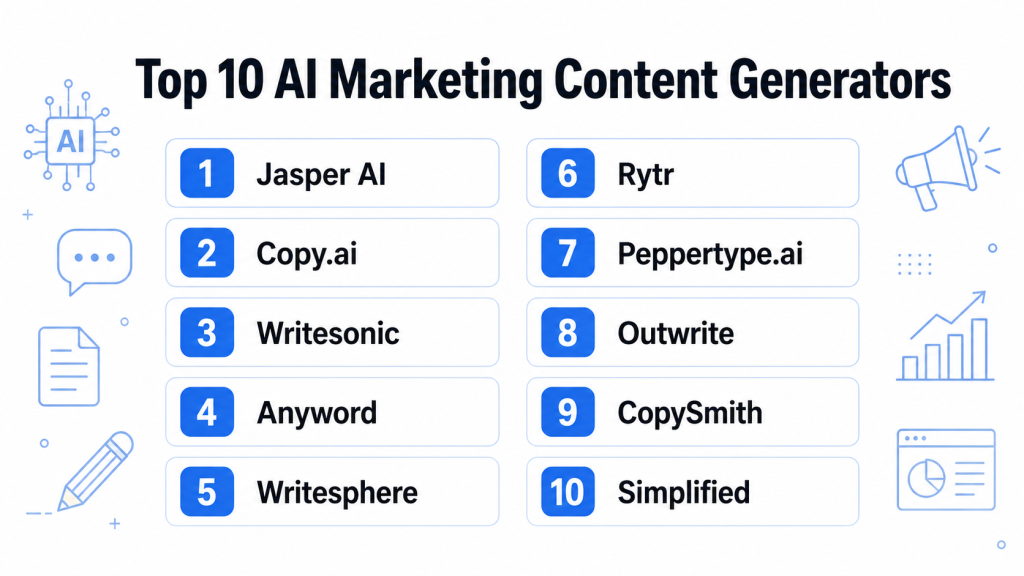
Top 10 AI Marketing Content Generators
1 — Jasper AI
One-line verdict: Best for marketing teams seeking versatile content across multiple channels with brand consistency.
Short description: Jasper AI automates blog posts, social media content, and ad copy for marketing teams, offering brand voice customization and campaign optimization.
Standout Capabilities
- Templates for ads, emails, and blogs
- Multilingual support for global campaigns
- AI-powered SEO optimization tools
- Integration with CMS and marketing automation platforms
- Customizable brand voice settings
- Tone and sentiment adjustment
- Team collaboration features
- Plagiarism detection
AI-Specific Depth
- Model support: Proprietary + BYO model options
- RAG / knowledge integration: CRM and CMS connectors
- Evaluation: Prompt tests, human review
- Guardrails: Brand tone enforcement, prompt injection detection
- Observability: Token usage and cost metrics
Pros
- Scales content production efficiently
- Strong brand voice consistency
- Easy-to-use interface for marketers
Cons
- Can generate repetitive content if prompts are generic
- Requires manual oversight for technical accuracy
- Higher-tier plans may be costly
Security & Compliance
- SSO/SAML, RBAC, encryption, audit logs
- Data retention controls available
- Certifications: Not publicly stated
Deployment & Platforms
- Web, Windows, macOS, iOS, Android
- Cloud-based
Integrations & Ecosystem
Supports CMS, CRM, and automation tools; extensible with APIs.
- WordPress, HubSpot, Salesforce, Zapier, Shopify, Slack
Pricing Model
- Tiered subscription, usage-based on output volume
Best-Fit Scenarios
- Large marketing teams scaling content production
- Agencies managing multiple client campaigns
- Businesses needing multilingual content
2 — Copy.ai
One-line verdict: Ideal for small-to-mid-size businesses creating marketing content with minimal manual effort.
Short description: Copy.ai provides AI-assisted copywriting for social posts, product descriptions, and ads with templates and real-time editing.
Standout Capabilities
- Automated social media post generation
- eCommerce product description templates
- Ad copy with conversion-oriented prompts
- Tone and style adjustments
- Campaign-specific content generation
- Real-time collaboration
- Multichannel support
AI-Specific Depth
- Model support: Proprietary models
- RAG / knowledge integration: N/A
- Evaluation: Human review, prompt testing
- Guardrails: Tone enforcement
- Observability: Basic token metrics
Pros
- Fast content creation for SMBs
- User-friendly interface
- Flexible content templates
Cons
- Limited integrations for enterprise systems
- May require frequent human editing
- Fewer analytics and evaluation features
Security & Compliance
- Encryption at rest and in transit
- Not publicly stated on certifications
Deployment & Platforms
- Web, iOS, Android
- Cloud
Integrations & Ecosystem
Integrates with social scheduling, eCommerce platforms:
- Shopify, HubSpot, Slack, Zapier
Pricing Model
- Tiered subscription, usage-based options
Best-Fit Scenarios
- SMBs generating marketing campaigns quickly
- Social media managers
- eCommerce product content automation
3 — Writesonic
One-line verdict: Optimal for content teams needing a mix of marketing and long-form SEO content generation.
Short description: Writesonic combines AI content creation for ads, blogs, and landing pages with SEO tools for improved search performance.
Standout Capabilities
- AI-generated blog posts and landing pages
- SEO optimization integration
- Ad copy templates for multiple platforms
- Social media content generation
- Brand voice customization
- Content rephrasing and expansion
- Team collaboration
- Multilingual outputs
AI-Specific Depth
- Model support: Proprietary + OpenAI models
- RAG / knowledge integration: N/A
- Evaluation: Prompt testing, regression checks
- Guardrails: Plagiarism detection, tone enforcement
- Observability: Token and cost metrics
Pros
- Balanced marketing and SEO support
- Flexible long-form content creation
- Brand tone control
Cons
- Limited advanced analytics
- Requires human review for sensitive content
- Cloud-only deployment
Security & Compliance
- SSO and encryption
- Not publicly stated on formal certifications
Deployment & Platforms
- Web, Windows, macOS, iOS, Android
- Cloud
Integrations & Ecosystem
APIs and platform connectors:
- WordPress, HubSpot, Shopify, Zapier
Pricing Model
- Tiered subscription, credits for output
Best-Fit Scenarios
- SEO-driven marketing teams
- Agencies handling multiple clients
- Content-heavy websites
4 — Anyword
One-line verdict: Designed for marketers emphasizing conversion-focused AI copy and performance prediction.
Short description: Anyword generates ad copy, emails, and landing page content with predictive performance scoring to optimize campaigns.
Standout Capabilities
- Predictive performance scoring
- Marketing-focused templates
- Ad copy optimization for multiple channels
- Customizable tone and style
- Audience-targeted copy generation
- Multilingual support
- Real-time editing
- Analytics dashboards
AI-Specific Depth
- Model support: Proprietary AI
- RAG / knowledge integration: N/A
- Evaluation: Performance prediction, A/B testing support
- Guardrails: Tone & style enforcement
- Observability: Token metrics, campaign tracking
Pros
- Focus on conversion optimization
- Predictive insights improve ROI
- Simple to use
Cons
- Limited to marketing-focused outputs
- Fewer long-form writing capabilities
- Cloud-only
Security & Compliance
- SSO/SAML, encryption
- Data retention controls Not publicly stated
Deployment & Platforms
- Web, iOS, Android
- Cloud
Integrations & Ecosystem
Connects to marketing platforms:
- HubSpot, Salesforce, Mailchimp, Zapier, Shopify
Pricing Model
- Tiered subscription based on features and output
Best-Fit Scenarios
- PPC campaign managers
- Email marketing teams
- Performance-driven ad campaigns
5 — Writesphere
One-line verdict: Suitable for enterprises needing brand-safe AI content with governance and approval workflows.
Short description: Writesphere focuses on enterprise content production with AI-assisted approvals, compliance checks, and team management features.
Standout Capabilities
- Enterprise content governance workflows
- Approval and compliance checkpoints
- Multi-channel content automation
- Brand safety filters
- Custom AI model integration
- Collaboration dashboards
- Analytics & evaluation
- Version tracking
AI-Specific Depth
- Model support: BYO model, proprietary
- RAG / knowledge integration: CRM/CMS connectors
- Evaluation: Human + AI review
- Guardrails: Policy enforcement, brand safety
- Observability: Token usage, latency metrics
Pros
- Enterprise-grade compliance
- Workflow integration for teams
- Brand safety management
Cons
- Steeper learning curve
- Higher cost than SMB-focused tools
- Limited creative flexibility
Security & Compliance
- SSO/SAML, RBAC, encryption, audit logs
- Data residency & retention controls
- Certifications: Not publicly stated
Deployment & Platforms
- Web, Windows, macOS
- Cloud / Hybrid
Integrations & Ecosystem
APIs, CRM, CMS, marketing automation:
- Salesforce, HubSpot, Marketo, WordPress, Slack
Pricing Model
- Enterprise subscription, usage-based options
Best-Fit Scenarios
- Large enterprises producing regulated content
- Brand-sensitive industries
- Teams needing approval workflows
6 — Rytr
One-line verdict: Affordable AI content generator for small businesses and individual marketers producing short-form content quickly.
Short description: Rytr automates ad copy, social posts, and short-form marketing content for small businesses and solo marketers.
Standout Capabilities
- Templates for social media and ads
- Tone and style adjustment
- Content rephrasing and expansion
- Multilingual support
- Simple UI
- AI-assisted grammar and style
- Quick content turnaround
AI-Specific Depth
- Model support: Proprietary + OpenAI
- RAG / knowledge integration: N/A
- Evaluation: Human review recommended
- Guardrails: Tone adjustment only
- Observability: Token metrics
Pros
- Cost-effective
- Easy to use
- Quick content generation
Cons
- Limited long-form capabilities
- Fewer integrations
- Minimal governance tools
Security & Compliance
- Encryption at rest
- Not publicly stated on certifications
Deployment & Platforms
- Web, iOS, Android
- Cloud
Integrations & Ecosystem
- Shopify, WordPress, Slack, Zapier
Pricing Model
- Tiered subscription, free plan available
Best-Fit Scenarios
- Small businesses or freelancers
- Social media content generation
- Low-volume ad campaigns
7 — Peppertype.ai
One-line verdict: Designed for marketers needing AI-powered idea generation and short-form marketing content at scale.
Short description: Peppertype.ai produces blogs, ad copy, social media posts, and content ideas with AI-assisted suggestions for creative teams.
Standout Capabilities
- AI content idea generation
- Templates for ads and social media
- Brand tone alignment
- Multilingual support
- Collaboration features
- Rewriting and summarization
- Team dashboard
AI-Specific Depth
- Model support: Proprietary
- RAG / knowledge integration: N/A
- Evaluation: Prompt tests, human review
- Guardrails: Tone enforcement
- Observability: Token metrics
Pros
- Supports idea generation
- Quick short-form content creation
- Team-friendly interface
Cons
- Limited long-form support
- Cloud-only
- Advanced analytics limited
Security & Compliance
- SSO, encryption
- Not publicly stated on certifications
Deployment & Platforms
- Web
- Cloud
Integrations & Ecosystem
- Shopify, HubSpot, Zapier, Slack
Pricing Model
- Subscription-based
Best-Fit Scenarios
- Social media managers
- Marketing agencies
- Content ideation for campaigns
8 — Outwrite
One-line verdict: Focuses on grammar, tone, and readability optimization for AI-generated marketing content.
Short description: Outwrite enhances AI-generated content with grammar correction, readability scoring, and style improvement for marketers and writers.
Standout Capabilities
- Grammar and style correction
- Tone and readability scoring
- AI writing assistant
- Content rephrasing
- Plagiarism detection
- Chrome and Word integrations
- Multilingual support
AI-Specific Depth
- Model support: Proprietary + OpenAI
- RAG / knowledge integration: N/A
- Evaluation: Human review, automated checks
- Guardrails: Tone enforcement, plagiarism detection
- Observability: Basic metrics
Pros
- Improves content quality
- Easy to integrate into workflow
- Supports multiple languages
Cons
- Not focused on content generation at scale
- Limited marketing-specific templates
- Cloud-only
Security & Compliance
- Encryption, user account control
- Not publicly stated
Deployment & Platforms
- Web, Windows, macOS, Chrome Extension
- Cloud
Integrations & Ecosystem
- Word, Google Docs, Chrome extension, Zapier
Pricing Model
- Subscription-based, usage tiers
Best-Fit Scenarios
- Marketing writers optimizing content
- Teams needing grammar and tone enforcement
- Educational content or blog editing
9 — CopySmith
One-line verdict: Enterprise-oriented tool for bulk marketing content creation with AI workflow automation.
Short description: CopySmith automates bulk ad copy, emails, and product descriptions, suitable for enterprise marketing teams requiring scale.
Standout Capabilities
- Bulk content generation
- Ad copy optimization for multiple channels
- AI workflow automation
- Brand voice management
- API access for integration
- Multilingual support
- Collaboration dashboard
AI-Specific Depth
- Model support: Proprietary
- RAG / knowledge integration: CRM/CMS connectors
- Evaluation: Prompt testing and A/B analysis
- Guardrails: Tone enforcement, brand safety
- Observability: Token/cost metrics
Pros
- Scales enterprise campaigns
- Supports brand consistency
- Workflow automation
Cons
- Higher learning curve
- Cloud-only
- Cost may be significant
Security & Compliance
- SSO, encryption, RBAC
- Data retention controls
- Certifications: Not publicly stated
Deployment & Platforms
- Web
- Cloud
Integrations & Ecosystem
- Salesforce, HubSpot, Shopify, Zapier, Slack
Pricing Model
- Tiered subscription, usage-based credits
Best-Fit Scenarios
- Enterprise eCommerce teams
- Marketing departments managing large campaigns
- Agencies producing bulk content
10 — Simplified
One-line verdict: All-in-one marketing platform with AI content, design, and video generation for multi-channel campaigns.
Short description: Simplified combines AI text, graphics, and video creation to streamline multi-channel marketing campaigns for teams of any size.
Standout Capabilities
- AI writing assistant for marketing content
- Graphic and video AI tools
- Templates for ads, posts, and emails
- Collaboration dashboard
- Brand kit management
- Multilingual support
- Social media scheduling
- Analytics and insights
AI-Specific Depth
- Model support: Proprietary + BYO options
- RAG / knowledge integration: N/A
- Evaluation: Prompt tests, human review
- Guardrails: Brand kit enforcement
- Observability: Token usage, cost metrics
Pros
- Multi-channel content creation
- Combines text, visuals, and video
- User-friendly for teams
Cons
- Less depth in text-only AI compared to competitors
- Cloud-only
- Some features require higher-tier subscription
Security & Compliance
- SSO, encryption, audit logs
- Not publicly stated
Deployment & Platforms
- Web, Windows, macOS, iOS, Android
- Cloud
Integrations & Ecosystem
APIs and platform integrations for multi-channel marketing:
- Facebook, Instagram, LinkedIn, Twitter, Shopify, Zapier
Pricing Model
- Tiered subscription, usage-based
Best-Fit Scenarios
- Marketing teams needing multi-channel content
- Agencies producing integrated campaigns
- Small teams leveraging AI for visuals and copy
Comparison Table
| Tool Name | Best For | Deployment | Model Flexibility | Strength | Watch-Out | Public Rating |
|---|---|---|---|---|---|---|
| Jasper AI | Marketing teams | Cloud | Proprietary/BYO | Brand consistency | Higher cost | N/A |
| Copy.ai | SMBs | Cloud | Proprietary | Easy short-form | Limited integrations | N/A |
| Writesonic | Content teams | Cloud | Proprietary/OpenAI | SEO + long-form | Cloud-only | N/A |
| Anyword | Conversion-focused marketers | Cloud | Proprietary | Predictive scoring | Limited long-form | N/A |
| Writesphere | Enterprises | Cloud/Hybrid | BYO/Proprietary | Governance | Learning curve | N/A |
| Rytr | Small business/freelancers | Cloud | Proprietary/OpenAI | Cost-effective | Limited long-form | N/A |
| Peppertype.ai | Marketing idea generation | Cloud | Proprietary | Creative ideas | Limited long-form | N/A |
| Outwrite | Writers/marketers | Cloud | Proprietary/OpenAI | Readability/grammar | Not bulk-focused | N/A |
| CopySmith | Enterprise bulk marketing | Cloud | Proprietary | Workflow automation | Costly | N/A |
| Simplified | Multi-channel marketing | Cloud | Proprietary/BYO | Text + visuals + video | Some depth trade-offs | N/A |
Scoring & Evaluation (Transparent Rubric)
The following scoring compares tools relative to each other across multiple criteria. Weighted totals reflect feature emphasis for marketing teams.
| Tool | Core | Reliability/Eval | Guardrails | Integrations | Ease | Perf/Cost | Security/Admin | Support | Weighted Total |
|---|---|---|---|---|---|---|---|---|---|
| Jasper AI | 9 | 8 | 8 | 8 | 9 | 7 | 8 | 7 | 8.2 |
| Copy.ai | 7 | 7 | 7 | 6 | 9 | 8 | 7 | 6 | 7.3 |
| Writesonic | 8 | 8 | 8 | 7 | 8 | 7 | 7 | 7 | 7.6 |
| Anyword | 8 | 7 | 7 | 6 | 8 | 7 | 7 | 6 | 7.1 |
| Writesphere | 8 | 8 | 9 | 8 | 7 | 7 | 8 | 7 | 7.9 |
| Rytr | 6 | 6 | 6 | 6 | 8 | 8 | 6 | 6 | 6.6 |
| Peppertype.ai | 7 | 7 | 7 | 6 | 8 | 7 | 6 | 6 | 6.8 |
| Outwrite | 6 | 7 | 7 | 6 | 8 | 7 | 6 | 6 | 6.7 |
| CopySmith | 8 | 7 | 8 | 7 | 7 | 7 | 7 | 7 | 7.5 |
| Simplified | 8 | 8 | 7 | 7 | 8 | 7 | 7 | 7 | 7.5 |
Top 3 for Enterprise: Writesphere, Jasper AI, CopySmith
Top 3 for SMB: Copy.ai, Rytr, Peppertype.ai
Top 3 for Developers: Writesonic, Jasper AI, Simplified
Which AI Marketing Content Generator Tool Is Right for You?
Solo / Freelancer
Rytr or Copy.ai for low-cost, fast short-form content generation.
SMB
Writesonic or Peppertype.ai for balanced SEO and social media content needs.
Mid-Market
Simplified or Anyword for multi-channel marketing and predictive content scoring.
Enterprise
Writesphere or Jasper AI for governance, workflow integration, and brand safety.
Regulated industries
Writesphere for compliance checks, approvals, and secure content pipelines.
Budget vs premium
Rytr or Copy.ai for tight budgets; Jasper AI or Writesphere for premium enterprise capabilities.
Build vs buy
Buy when speed, scalability, and governance are critical; build custom AI models only if highly specialized brand or data requirements exist.
Implementation Playbook (30 / 60 / 90 Days)
30 days – Pilot & Initial Evaluation
- Identify core content workflows and target channels.
- Select 1–2 tools to pilot.
- Define success metrics (quality, engagement, speed).
- Train marketing team on tool usage.
- Run small campaigns for blogs, emails, or social posts.
- Evaluate AI output quality, tone, and brand alignment.
60 days – Security, Evaluation, & Integration
- Implement guardrails for brand tone, plagiarism, and compliance.
- Integrate with CMS, CRM, social platforms, and analytics.
- Establish AI evaluation harness for prompt testing and regression.
- Conduct human-in-the-loop review for high-value content.
- Track observability metrics: token usage, latency, cost.
- Set up approval workflows for sensitive or regulated content.
90 days – Scale, Optimize & Govern
- Expand AI content production to all relevant channels.
- Optimize model routing for latency and cost efficiency.
- Conduct full A/B testing for content performance.
- Establish formal governance and auditing processes.
- Document prompt/version control and red-teaming procedures.
- Monitor ongoing AI reliability, bias, and hallucination checks.
- Optimize workflows for multi-language and multimodal content.
- Plan for next-generation AI integration or BYO models.
Beyond 90 days – Continuous Improvement
- Regularly update prompts, templates, and AI models.
- Integrate AI insights into overall marketing analytics.
- Conduct quarterly reviews of cost, quality, and compliance.
- Train teams on advanced AI features and best practices.
Common Mistakes & How to Avoid Them
- Relying solely on AI-generated content without human review
- Skipping evaluation and performance testing
- Unmanaged data retention or privacy violations
- Lack of observability and usage monitoring
- Unexpected cost overruns due to token usage
- Over-automation without approval workflows
- Vendor lock-in without abstraction layer
- Ignoring brand safety and tone guidelines
- Using generic prompts causing repetitive outputs
- Not integrating with analytics for performance insights
- Ignoring multi-channel content alignment
- Neglecting guardrails for regulated industries
- Overlooking multilingual content needs
- Failing to maintain AI model updates and versioning
FAQs
- What data privacy measures do AI marketing content generators provide?
Most tools implement encryption, access control, and some offer data residency options, though specific certifications are often not publicly stated. - Can I use my own models with these platforms?
Some tools support BYO models; others rely entirely on proprietary AI. Check vendor capabilities before adoption. - How is content evaluation performed?
Evaluation may include prompt testing, regression checks, human review, and predictive performance scoring depending on the platform. - Are guardrails effective against prompt injection or plagiarism?
Guardrails enforce tone, brand voice, and content safety; effectiveness varies by vendor and must be supplemented with human oversight. - Can these tools handle multilingual campaigns?
Many support multiple languages, but quality may vary by language and content type. - How do pricing models work?
Typically subscription-based, tiered plans, or usage-based credits; exact costs vary and should be confirmed with vendors. - Can I integrate these tools with my existing CMS/CRM?
Yes, most provide API access and prebuilt integrations for platforms like Shopify, WordPress, Salesforce, HubSpot, and Zapier. - Are enterprise governance and approval workflows available?
Enterprise-focused platforms like Writesphere offer compliance checks, approval workflows, and audit logs. - How reliable is AI-generated SEO content?
Reliability depends on AI evaluation, human oversight, and alignment with SEO guidelines; testing is recommended. - What is the typical deployment option?
Most tools are cloud-based; some offer hybrid options; self-hosted deployment is rare. - Can I scale content creation without increasing cost exponentially?
Monitoring token usage, optimizing prompts, and choosing the right tier or BYO model can help manage scaling costs. - What are the alternatives to AI content generators?
Traditional copywriting, in-house content teams, and hybrid AI-human collaboration models remain alternatives for specialized needs.
Conclusion
AI Marketing Content Generators are indispensable for scaling high-quality, personalized marketing campaigns. The category now supports multimodal content, predictive performance, brand safety, and enterprise-grade governance. Selecting the right tool depends on team size, industry, budget, and workflow complexity. Enterprises benefit from compliance-focused platforms, SMBs from efficient easy-to-use tools, and mid-market teams from predictive scoring and multi-channel support. Always pilot, validate outputs, and enforce guardrails to maximize ROI while protecting brand voice. By shortlisting appropriate tools, piloting campaigns, and verifying security and evaluation, organizations can safely scale AI-driven content creation and measure marketing impact.
Next steps:
- Shortlist tools based on content type, scale, and integration needs
- Pilot campaigns to measure output quality and ROI
- Validate security, governance, and evaluation workflows before full-scale adoption
Excellent and energetic write-up on AI marketing content generators. The article was insightful, professional, and highly valuable for modern digital marketing teams.