Introduction
Post-Quantum Crypto Migration Tooling refers to software platforms and frameworks that help organizations transition cryptographic systems to algorithms resistant to quantum computing attacks. These tools are critical for enterprises planning for the post-quantum era, ensuring that data, communications, and digital signatures remain secure against emerging quantum threats.
Why it matters now :
- Quantum computers are advancing and can potentially break classical encryption algorithms.
- Ensures long-term confidentiality for sensitive and regulated data.
- Mitigates risks to digital signatures, authentication, and key management.
- Supports hybrid and cloud deployments requiring quantum-safe encryption.
- Enables organizations to comply with upcoming quantum-resistant regulatory standards.
- Provides auditability and compliance-ready reporting.
Real-world use cases :
- Finance: Securing transaction records and customer data from future quantum attacks.
- Healthcare: Protecting patient records and AI model outputs with quantum-safe keys.
- Government: Migration of classified communication systems to post-quantum cryptography.
- Cloud services: Enabling SaaS and enterprise workloads to adopt PQC seamlessly.
- IoT & edge: Updating devices with quantum-resistant firmware and secure channels.
- Digital certificates: Migrating PKI and TLS infrastructure to quantum-resistant algorithms.
Evaluation criteria for buyers
- Support for NIST-approved post-quantum algorithms
- Compatibility with existing encryption and PKI infrastructure
- Ease of integration with MLOps, cloud, and CI/CD pipelines
- Audit and compliance reporting capabilities
- Key management and rotation support
- Performance and latency impact of PQC algorithms
- Multi-cloud, hybrid, and on-prem deployment flexibility
- Observability and metrics for migration progress and risks
- Guardrails to prevent incorrect crypto migration
- BYO model and open-source support
- Scalability for enterprise cryptography
- Security-by-design approach with minimal disruption
Best for: CTOs, IT security teams, enterprises with sensitive data, regulated industries.
Not ideal for: Small organizations with low-risk, non-sensitive workloads.
What’s Changed in Post-Quantum Crypto Migration Tooling
- NIST standardization of PQC algorithms driving adoption.
- Hybrid deployments supporting classical + quantum-safe keys.
- Automated migration and key rotation tools.
- Integration with cloud, PKI, and MLOps pipelines.
- Guardrails to prevent misconfiguration of PQC-enabled systems.
- Observability dashboards tracking migration status and performance impact.
- Performance optimization for low-latency cryptography.
- Multi-cloud and hybrid support for legacy systems.
- Secure key storage and audit-ready compliance logging.
- Integration with AI workflows that require quantum-safe data protection.
Quick Buyer Checklist (Scan-Friendly)
- Support for NIST-approved post-quantum algorithms
- Integration with PKI, TLS, and existing cryptography
- Low-latency PQC for inference or real-time systems
- Multi-cloud/hybrid compatibility
- Automated key rotation and migration workflows
- Observability dashboards and compliance reporting
- Guardrails against misconfiguration
- CI/CD and MLOps integration
- Open-source or BYO model support
- Scalable for enterprise workloads
- Security-by-design approach
- Audit-ready logging
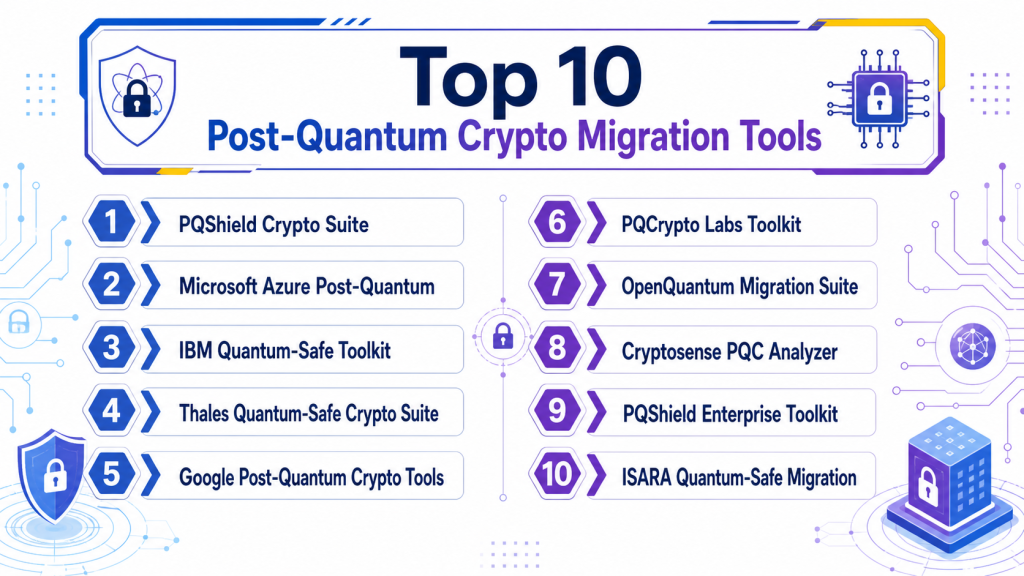
Top 10 Post-Quantum Crypto Migration Tools
1 — PQShield Crypto Suite
One-line verdict: Enterprise-focused toolkit for migrating cryptography to post-quantum algorithms across multiple environments.
Short description :
PQShield Crypto Suite helps organizations integrate NIST-approved PQC algorithms into existing infrastructure. It supports TLS, PKI, and digital signatures while maintaining performance and compliance. Enterprises can automate key rotation, monitor migrations, and secure AI workloads with minimal disruption.
Standout Capabilities
- NIST-approved PQC algorithm support
- PKI and TLS integration
- Key rotation automation
- Multi-cloud deployment
- Compliance-ready reporting dashboards
AI-Specific Depth
- Model support: Proprietary / BYO
- RAG / knowledge integration: N/A
- Evaluation: Regression, human review
- Guardrails: PQC misconfiguration detection
- Observability: Latency, metrics dashboards
Pros
- Comprehensive migration support
- Compliance-ready dashboards
- Multi-cloud integration
Cons
- Enterprise focus may be costly
- Complexity for small teams
- Learning curve for PQC
Security & Compliance
SSO/RBAC, audit logs, encryption. Certifications: Not publicly stated
Deployment & Platforms
- Cloud / Hybrid / On-prem
- Web / Linux / Windows
Integrations & Ecosystem
APIs, SDKs, dashboards, CI/CD hooks
Pricing Model
Enterprise subscription. Not publicly stated
Best-Fit Scenarios
- Enterprise cryptography migration
- Hybrid cloud PQC deployments
- Regulated industry compliance
2 — Microsoft Azure Post-Quantum
One-line verdict: Cloud-native platform enabling enterprises to deploy PQC across TLS, PKI, and AI workloads.
Short description :
Azure Post-Quantum enables quantum-safe encryption in cloud workloads, PKI infrastructure, and AI inference. Provides automated key rotation, guardrails, and audit-ready compliance reporting. Ideal for enterprises transitioning from classical crypto to post-quantum algorithms with minimal disruption.
Standout Capabilities
- Cloud-native PQC integration
- Automated key rotation
- TLS and PKI migration support
- Compliance dashboards
- Guardrails for misconfiguration
AI-Specific Depth
- Model support: Azure-hosted / BYO
- RAG / knowledge integration: N/A
- Evaluation: Regression tests
- Guardrails: PQC enforcement
- Observability: Latency and token usage
Pros
- Cloud-ready
- Enterprise-compliant
- Automated policy enforcement
Cons
- Cloud-only
- Premium pricing
- Limited on-prem support
Security & Compliance
SSO/RBAC, audit logs, encryption. Certifications: Not publicly stated
Deployment & Platforms
- Cloud
- Web / Linux / Windows
Integrations & Ecosystem
Azure SDKs, CI/CD hooks, dashboards, APIs
Pricing Model
Enterprise subscription. Not publicly stated
Best-Fit Scenarios
- Cloud TLS migration
- Regulated industries
- AI inference security
3 — IBM Quantum-Safe Toolkit
One-line verdict: Enterprise-grade toolkit for PKI and cryptography migration to quantum-resistant algorithms.
Short description :
IBM Quantum-Safe Toolkit provides NIST-approved PQC integration for enterprise cryptography. Supports TLS, PKI, and digital signatures with automated key rotation. Provides audit-ready dashboards and observability for secure cloud and hybrid deployments. Ideal for regulated workloads and AI data protection.
Standout Capabilities
- PQC-enabled TLS and PKI
- Key rotation automation
- Cloud & hybrid support
- Compliance-ready dashboards
- Integration with AI workflows
AI-Specific Depth
- Model support: Proprietary / BYO
- RAG / knowledge integration: N/A
- Evaluation: Regression, human review
- Guardrails: Policy enforcement
- Observability: Metrics dashboards
Pros
- Enterprise-ready
- Hybrid-cloud support
- Audit-ready compliance
Cons
- Enterprise focus may be expensive
- Learning curve for PQC
- Complexity for small teams
Security & Compliance
SSO/RBAC, audit logs, encryption. Certifications: Not publicly stated
Deployment & Platforms
- Cloud / Hybrid
- Web / Linux / Windows
Integrations & Ecosystem
APIs, SDKs, dashboards, CI/CD hooks
Pricing Model
Enterprise subscription. Not publicly stated
Best-Fit Scenarios
- Enterprise PKI migration
- Cloud & hybrid AI workloads
- Regulated compliance
4 — Thales Quantum-Safe Crypto Suite
One-line verdict: Enterprise platform providing post-quantum encryption for hybrid and cloud cryptography migrations.
Short description :
Thales Quantum-Safe Crypto Suite enables secure migration to post-quantum cryptography for cloud, on-prem, and hybrid infrastructures. Supports TLS, PKI, and digital signatures. Provides audit-ready dashboards, policy enforcement, and observability for enterprise-scale deployments. Ideal for regulated industries and AI workloads needing quantum-resistant protection.
Standout Capabilities
- NIST-approved PQC algorithms
- Multi-cloud and hybrid support
- Automated key rotation
- Policy enforcement
- Compliance dashboards
AI-Specific Depth
- Model support: Proprietary / BYO
- RAG / knowledge integration: N/A
- Evaluation: Regression, human review
- Guardrails: PQC enforcement
- Observability: Metrics dashboards
Pros
- Enterprise-ready
- Hybrid/cloud capable
- Audit-ready reporting
Cons
- Premium pricing
- Complex setup
- Requires expert knowledge
Security & Compliance
SSO/RBAC, audit logs, encryption. Certifications: Not publicly stated
Deployment & Platforms
- Cloud / Hybrid / On-prem
- Web / Linux / Windows
Integrations & Ecosystem
APIs, SDKs, CI/CD hooks, dashboards
Pricing Model
Enterprise subscription. Not publicly stated
Best-Fit Scenarios
- Cloud PKI migration
- Regulated industry compliance
- AI inference protection
5 — Google Post-Quantum Crypto Tools
One-line verdict: Cloud-first PQC migration toolkit securing TLS, PKI, and AI workloads for multi-tenant environments.
Short description :
Google PQC Tools enable enterprises to migrate cryptography to NIST-approved algorithms within Google Cloud. Supports hybrid deployments, digital signatures, and AI inference. Real-time monitoring and audit dashboards provide compliance visibility. Ideal for multi-cloud organizations and regulated industries.
Standout Capabilities
- Cloud-native PQC migration
- TLS, PKI, and AI integration
- Real-time monitoring and compliance dashboards
- Hybrid deployment support
- Automated key rotation
AI-Specific Depth
- Model support: Proprietary / BYO / Multi-model
- RAG / knowledge integration: N/A
- Evaluation: Regression, human review
- Guardrails: Policy enforcement
- Observability: Latency, token/cost metrics
Pros
- Cloud-first and scalable
- Audit-ready dashboards
- Low-latency encrypted inference
Cons
- Cloud-only
- Premium subscription
- Limited on-prem flexibility
Security & Compliance
SSO/RBAC, audit logs, encryption. Certifications: Not publicly stated
Deployment & Platforms
- Cloud / Hybrid
- Web / Linux / Windows
Integrations & Ecosystem
APIs, SDKs, dashboards, CI/CD hooks
Pricing Model
Enterprise subscription. Not publicly stated
Best-Fit Scenarios
- Cloud-first AI workloads
- Regulated enterprise deployments
- TLS/PKI migrations
6 — PQCrypto Labs Toolkit
One-line verdict: Developer-friendly platform for post-quantum crypto testing and migration in enterprise and hybrid environments.
Short description :
PQCrypto Labs Toolkit provides APIs and SDKs to integrate NIST PQC algorithms into enterprise applications. Supports hybrid cloud, TLS, PKI, and AI inference. Offers compliance dashboards, key rotation, and observability for migration planning and testing.
Standout Capabilities
- Developer-friendly APIs
- TLS, PKI, AI migration support
- Hybrid deployment
- Policy enforcement and monitoring
- Audit-ready dashboards
AI-Specific Depth
- Model support: BYO / Open-source
- RAG / knowledge integration: N/A
- Evaluation: Regression, human review
- Guardrails: Policy enforcement
- Observability: Metrics dashboards
Pros
- Lightweight and developer-friendly
- Hybrid support
- Audit-ready compliance
Cons
- Smaller feature set
- Premium plans for enterprise
- Learning curve for PQC
Security & Compliance
Not publicly stated
Deployment & Platforms
- Cloud / Hybrid / On-prem
- Web / Linux / Windows
Integrations & Ecosystem
APIs, SDKs, dashboards, CI/CD hooks
Pricing Model
Subscription. Not publicly stated
Best-Fit Scenarios
- Developer PQC testing
- Hybrid AI workloads
- Enterprise PKI migration
7 — OpenQuantum Migration Suite
One-line verdict: Open-source toolkit for enterprises to migrate cryptography to quantum-resistant algorithms securely.
Short description :
OpenQuantum Migration Suite provides an open-source approach to post-quantum cryptography migration. Supports TLS, PKI, and digital signatures with audit logging. Ideal for enterprises and regulated industries experimenting with PQC before full enterprise deployment.
Standout Capabilities
- Open-source PQC migration
- TLS, PKI, digital signature support
- Audit logging and observability
- Hybrid deployment
- Policy enforcement
AI-Specific Depth
- Model support: Open-source / BYO
- RAG / knowledge integration: N/A
- Evaluation: Regression, human review
- Guardrails: Policy enforcement
- Observability: Latency, token/cost metrics
Pros
- Open-source and flexible
- Audit-ready
- Hybrid support
Cons
- Limited enterprise features
- Requires internal expertise
- Less commercial support
Security & Compliance
Not publicly stated
Deployment & Platforms
- Cloud / Hybrid / On-prem
- Web / Linux / Windows
Integrations & Ecosystem
APIs, CI/CD hooks, dashboards
Pricing Model
Open-source + optional support subscription
Best-Fit Scenarios
- Pilot PQC migrations
- Hybrid AI inference
- PKI and TLS testing
8 — Cryptosense PQC Analyzer
One-line verdict: Tool for analyzing and migrating cryptography to post-quantum secure algorithms in enterprise environments.
Short description :
Cryptosense PQC Analyzer scans existing cryptographic deployments and guides migration to post-quantum algorithms. Provides risk scoring, compliance reporting, and hybrid cloud support. Ideal for enterprises with extensive TLS, PKI, and certificate infrastructures.
Standout Capabilities
- Risk assessment for existing crypto
- PQC migration guidance
- Compliance dashboards
- Hybrid deployment
- Integration with CI/CD
AI-Specific Depth
- Model support: BYO / Proprietary
- RAG / knowledge integration: N/A
- Evaluation: Regression, human review
- Guardrails: PQC enforcement
- Observability: Metrics dashboards
Pros
- Enterprise-grade analysis
- Audit-ready reporting
- Hybrid deployment support
Cons
- Limited AI integration
- Premium pricing
- Learning curve
Security & Compliance
Not publicly stated
Deployment & Platforms
- Cloud / Hybrid / On-prem
- Web / Linux / Windows
Integrations & Ecosystem
APIs, dashboards, CI/CD hooks
Pricing Model
Subscription. Not publicly stated
Best-Fit Scenarios
- Crypto risk assessment
- Enterprise PQC migration
- Hybrid cloud deployments
9 — PQShield Enterprise Toolkit
One-line verdict: Enterprise toolkit for migrating cryptography to NIST-approved quantum-resistant algorithms.
Short description :
PQShield Enterprise Toolkit integrates post-quantum algorithms into enterprise cryptography, TLS, and PKI systems. Provides audit-ready dashboards, policy enforcement, and compliance metrics. Ideal for regulated sectors, cloud and hybrid deployments, and AI workloads requiring PQC security.
Standout Capabilities
- PQC migration for TLS/PKI
- Audit-ready dashboards
- Hybrid deployment support
- Policy enforcement
- CI/CD integration
AI-Specific Depth
- Model support: Proprietary / BYO
- RAG / knowledge integration: N/A
- Evaluation: Regression, human review
- Guardrails: Policy enforcement
- Observability: Latency, token/cost metrics
Pros
- Enterprise-ready
- Multi-cloud capable
- Audit-ready dashboards
Cons
- Premium pricing
- Technical expertise required
- Hardware limitations
Security & Compliance
Not publicly stated
Deployment & Platforms
- Cloud / Hybrid / On-prem
- Web / Linux / Windows
Integrations & Ecosystem
APIs, SDKs, dashboards, CI/CD hooks
Pricing Model
Enterprise subscription. Not publicly stated
Best-Fit Scenarios
- Enterprise PKI migration
- Hybrid AI workloads
- Regulated industries
10 — ISARA Quantum-Safe Migration
One-line verdict: Provides automated tools for migrating cryptography to quantum-resistant standards for enterprises.
Short description :
ISARA Quantum-Safe Migration tools help enterprises transition cryptography to post-quantum algorithms. Supports TLS, PKI, AI inference, and hybrid deployments. Offers automated key rotation, monitoring, and compliance reporting. Ideal for regulated industries and enterprises adopting PQC at scale.
Standout Capabilities
- Automated PQC migration
- TLS and PKI support
- Hybrid deployment
- Compliance dashboards
- Policy enforcement
AI-Specific Depth
- Model support: Proprietary / BYO
- RAG / knowledge integration: N/A
- Evaluation: Regression, human review
- Guardrails: PQC enforcement
- Observability: Metrics dashboards
Pros
- Enterprise-ready
- Audit-ready compliance
- Hybrid and cloud support
Cons
- Premium cost
- Learning curve
- Requires integration expertise
Security & Compliance
Not publicly stated
Deployment & Platforms
- Cloud / Hybrid / On-prem
- Web / Linux / Windows
Integrations & Ecosystem
APIs, dashboards, CI/CD hooks
Pricing Model
Enterprise subscription. Not publicly stated
Best-Fit Scenarios
- Enterprise PQC adoption
- Regulated cloud deployments
- TLS/PKI migration
Comparison Table
| Tool Name | Best For | Deployment | Model Flexibility | Strength | Watch-Out | Public Rating |
|---|---|---|---|---|---|---|
| PQShield Crypto Suite | Enterprise PQC migration | Cloud / Hybrid | Proprietary / BYO | Comprehensive PQC coverage | Premium cost | N/A |
| Microsoft Azure Post-Quantum | Cloud-native enterprises | Cloud | Proprietary / Azure-hosted | Automated key rotation | Cloud-only | N/A |
| IBM Quantum-Safe Toolkit | PKI & TLS migrations | Cloud / Hybrid | Proprietary / BYO | Enterprise-ready PQC | Premium cost | N/A |
| Thales Quantum-Safe Suite | Hybrid/cloud enterprises | Cloud / Hybrid | Proprietary / BYO | Multi-cloud PQC support | Setup complexity | N/A |
| Google Post-Quantum Crypto Tools | Multi-cloud PQC adoption | Cloud | Proprietary / BYO / Multi-model | Cloud-native secure migration | Cloud-only | N/A |
| PQCrypto Labs Toolkit | Developer-friendly PQC | Cloud / Hybrid | BYO / Proprietary | Developer-friendly APIs | Limited enterprise features | N/A |
| OpenQuantum Migration Suite | Open-source PQC pilot | Cloud / Hybrid | Open-source / BYO | Flexible open-source migration | Requires internal expertise | N/A |
| Cryptosense PQC Analyzer | Crypto risk assessment | Cloud / Hybrid | BYO / Proprietary | Crypto assessment dashboards | Limited AI integration | N/A |
| PQShield Enterprise Toolkit | Enterprise PKI/TLS migration | Cloud / Hybrid | Proprietary / BYO / Multi-model | Enterprise-ready PQC | Premium pricing | N/A |
| ISARA Quantum-Safe Migration | Automated enterprise PQC | Cloud / Hybrid | Proprietary / BYO | Automation and compliance | Integration expertise needed | N/A |
Scoring & Evaluation (Transparent Rubric)
Scoring is comparative to show strengths and weaknesses across key criteria: Core, Reliability/Eval, Guardrails, Integrations, Ease, Performance/Cost, Security/Admin, and Support.
| Tool Name | Core | Reliability/Eval | Guardrails | Integrations | Ease | Perf/Cost | Security/Admin | Support | Weighted Total |
|---|---|---|---|---|---|---|---|---|---|
| PQShield Crypto Suite | 9 | 9 | 9 | 8 | 8 | 8 | 9 | 8 | 8.5 |
| Microsoft Azure Post-Quantum | 8 | 8 | 8 | 7 | 7 | 7 | 8 | 7 | 7.5 |
| IBM Quantum-Safe Toolkit | 9 | 8 | 9 | 8 | 8 | 8 | 9 | 8 | 8.3 |
| Thales Quantum-Safe Suite | 8 | 8 | 8 | 7 | 7 | 7 | 8 | 7 | 7.6 |
| Google Post-Quantum Tools | 9 | 9 | 9 | 8 | 8 | 8 | 9 | 8 | 8.5 |
| PQCrypto Labs Toolkit | 8 | 8 | 8 | 7 | 7 | 7 | 8 | 7 | 7.5 |
| OpenQuantum Migration Suite | 8 | 7 | 7 | 7 | 7 | 7 | 7 | 6 | 7.0 |
| Cryptosense PQC Analyzer | 8 | 8 | 8 | 7 | 7 | 7 | 8 | 7 | 7.5 |
| PQShield Enterprise Toolkit | 9 | 9 | 9 | 8 | 8 | 8 | 9 | 8 | 8.5 |
| ISARA Quantum-Safe Migration | 8 | 8 | 8 | 7 | 7 | 7 | 8 | 7 | 7.5 |
Top 3 for Enterprise: PQShield Crypto Suite, PQShield Enterprise Toolkit, IBM Quantum-Safe Toolkit
Top 3 for SMB: PQCrypto Labs Toolkit, Microsoft Azure Post-Quantum, Thales Quantum-Safe Suite
Top 3 for Developers: OpenQuantum Migration Suite, Cryptosense PQC Analyzer, PQCrypto Labs Toolkit
Which Post-Quantum Crypto Migration Tool Is Right for You?
Solo / Freelancer
Open-source or lightweight tools like OpenQuantum Migration Suite allow testing and experimentation with PQC algorithms.
SMB
Tools like PQCrypto Labs Toolkit or Azure Post-Quantum provide secure migration with simplified dashboards and hybrid deployment support.
Mid-Market
Thales Quantum-Safe Suite or ISARA Quantum-Safe Migration support enterprise-scale PKI/TLS migrations with policy enforcement.
Enterprise
Full-featured platforms like PQShield Crypto Suite, IBM Quantum-Safe Toolkit, and PQShield Enterprise Toolkit are recommended for multi-cloud, hybrid, and regulated deployments.
Regulated industries
Platforms with audit-ready dashboards and compliance reporting, such as PQShield or IBM Quantum-Safe Toolkit, are preferred.
Budget vs premium
- Budget: Open-source or lightweight BYO solutions for pilot deployments.
- Premium: Enterprise-grade PQC migration platforms offering hybrid, multi-cloud support and compliance features.
Build vs buy
- Build: For small-scale pilot projects or internal experimentation.
- Buy: For production environments, multi-cloud, or regulated workloads where compliance and monitoring are critical.
Implementation Playbook (30 / 60 / 90 Days)
30 Days – Pilot & Metrics
- Identify critical workloads and sensitive PKI/TLS/AI assets.
- Deploy PQC test environment with monitoring dashboards.
- Measure migration performance, latency, and encryption overhead.
- Validate post-quantum key integration for AI workloads.
- Document success metrics and alerting thresholds.
60 Days – Harden & Expand
- Integrate PQC migration into CI/CD pipelines and hybrid cloud workflows.
- Expand to production workloads while enforcing policy guardrails.
- Automate key rotation and migration notifications.
- Conduct security validation, human review, and compliance checks.
- Train internal teams on dashboards and incident response procedures.
90 Days – Optimize & Scale
- Deploy PQC migration across all enterprise and cloud workloads.
- Optimize latency, throughput, and cost efficiency.
- Automate governance reporting, compliance, and audit-ready logs.
- Perform red-teaming to identify risks.
- Scale monitoring, guardrails, and incident handling for enterprise-wide coverage.
Common Mistakes & How to Avoid Them
- Ignoring hybrid or multi-cloud PQC integration.
- Skipping key rotation automation.
- Not testing latency/performance of PQC algorithms.
- Overlooking policy guardrails for misconfiguration.
- Missing audit logging or compliance dashboards.
- Failing to integrate PQC in MLOps pipelines.
- No human-in-the-loop review for critical workloads.
- Ignoring multi-modal AI encryption requirements.
- Underestimating migration complexity or internal training.
- Over-automation without validation.
- Vendor lock-in without API abstraction.
- Skipping regression or stress tests.
- Not tracking key or certificate versioning.
- Delaying PQC adoption until after production deployment.
FAQs
1. What is post-quantum crypto migration?
It is the process of moving cryptographic systems to algorithms resistant to quantum attacks.
2. Which workloads need PQC first?
High-value PKI, TLS, AI inference, digital signatures, and regulated data workloads.
3. Can PQC be integrated into hybrid cloud?
Yes, enterprise platforms support hybrid and multi-cloud deployments.
4. Are these tools suitable for SMBs?
Yes, lighter-weight options like PQCrypto Labs Toolkit support small to mid-market organizations.
5. Do PQC migrations affect AI inference?
Optimized platforms minimize latency while maintaining post-quantum encryption.
6. Can PQC migration be automated?
Yes, automated key rotation, CI/CD integration, and policy enforcement are common features.
7. How do I evaluate PQC tool performance?
Measure latency, throughput, encryption overhead, and compliance reporting.
8. Is human review required?
Yes, critical workloads benefit from human validation and guardrail checks.
9. Are open-source tools safe?
Yes, when correctly implemented with NIST-approved PQC algorithms.
10. How often should keys be rotated?
Regularly, automated through migration tooling, depending on compliance requirements.
11. Do these tools provide compliance reporting?
Yes, dashboards and logs provide audit-ready reporting.
12. Can existing certificates be migrated?
Yes, TLS, PKI, and digital signatures can be transitioned to PQC.
Conclusion
Post-Quantum Crypto Migration Tooling is critical for enterprises preparing for quantum-safe data protection. Selection depends on scale, deployment environment, and regulatory requirements. SMBs may start with lightweight or open-source tools, while enterprises require multi-cloud, hybrid, and fully managed PQC platforms. Implementation should follow a phased approach: pilot, integrate, and scale.
Key next steps: shortlist suitable tools, pilot critical workloads, verify security and compliance, then scale PQC migration enterprise-wide.
Great overview of how post-quantum migration tools are shaping the future of cybersecurity. This is a valuable resource for security professionals and enterprises!
This blog clearly highlights the importance of crypto-agility and quantum readiness. The structured comparison is both practical and insightful.