Introduction
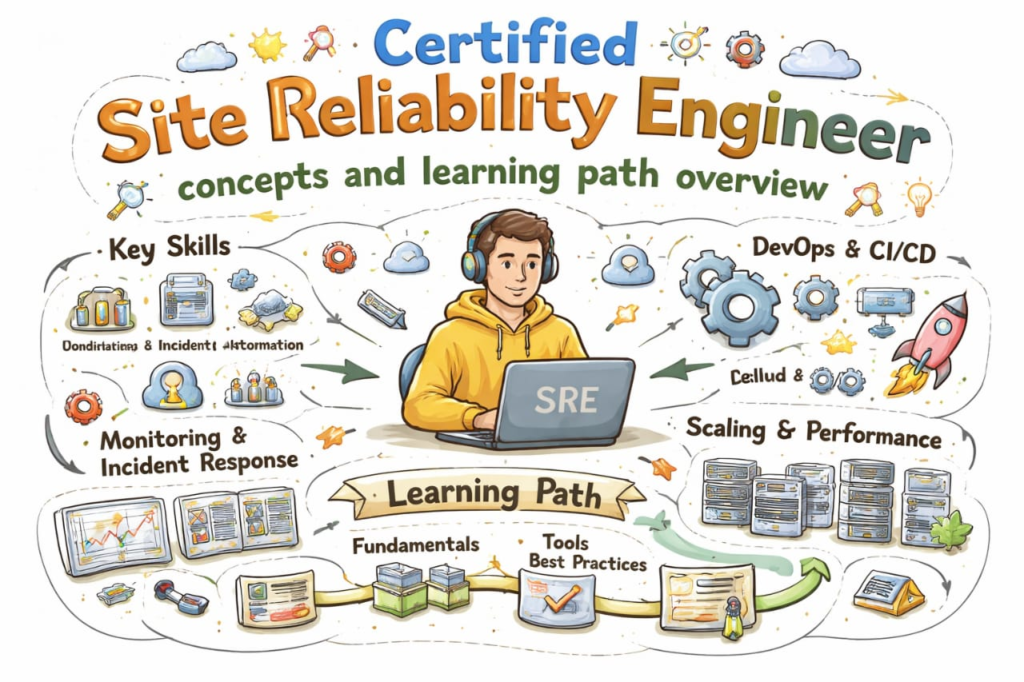
The Certified Site Reliability Engineer is a comprehensive professional standard designed for engineers who want to master the art of balancing system reliability with the pace of software delivery. This guide is crafted for technical professionals navigating the complex landscape of cloud-native infrastructure, platform engineering, and modern DevOps practices. By focusing on the intersection of software engineering and systems operations, this certification helps individuals bridge the gap between development speed and production stability. As organizations transition toward highly distributed systems, understanding these core principles is no longer optional for high-growth career trajectories. This guide provides an unbiased roadmap to help engineers and managers evaluate the curriculum, understand the industry impact, and make informed decisions about their professional development through Sreschool.
What is the Certified Site Reliability Engineer?
The Certified Site Reliability Engineer represents a rigorous validation of an engineer’s ability to apply software engineering mindsets to IT operations challenges. It exists to formalize the diverse skill set required to manage large-scale, complex systems where manual intervention is no longer sustainable or efficient. Unlike traditional certifications that focus on specific tool syntax, this program emphasizes production-focused learning, focusing on how to build resilient systems that can self-heal and scale. It aligns perfectly with modern enterprise workflows by treating operations as a software problem, ensuring that reliability is baked into the lifecycle of an application rather than being an afterthought. Professionals who hold this credential demonstrate they can manage “toil,” implement meaningful observability, and maintain high availability in volatile cloud environments.
Who Should Pursue Certified Site Reliability Engineer?
This certification is designed for a broad spectrum of technical roles, ranging from software engineers looking to understand production nuances to systems administrators transitioning into DevOps or Platform Engineering. Cloud professionals who need to manage infrastructure at scale and security engineers who want to integrate “Security as Code” will find the principles of automation and monitoring highly applicable. It is equally relevant for data engineers and MLOps professionals who must ensure the reliability of data pipelines and model deployment frameworks. For beginners, it provides a structured entry point into the world of high-scale systems, while experienced engineers and managers can use it to standardize practices across their global teams. In the Indian market and across global tech hubs, this credential serves as a benchmark for hiring managers seeking talent capable of handling mission-critical enterprise workloads.
Why Certified Site Reliability Engineer is Valuable and Beyond
The demand for reliability expertise continues to outpace the supply of qualified engineers as digital transformation projects move from simple cloud migration to complex cloud-native architectures. This certification offers long-term career longevity because it focuses on fundamental engineering principles rather than fleeting tool versions, allowing professionals to stay relevant even as the underlying technology stack evolves. Enterprises are increasingly adopting SRE models to reduce downtime and improve customer satisfaction, making the ability to define and defend Service Level Objectives (SLOs) a high-value skill. The return on time and career investment is significant, as it positions professionals for roles in high-paying sectors like fintech, e-commerce, and SaaS. By mastering these competencies, engineers move from being “firefighters” to architects of stability, which is a critical requirement for any organization operating at a global scale.
Certified Site Reliability Engineer Certification Overview
The Certified Site Reliability Engineer program is delivered via the official portal at Certified Site Reliability Engineer and is hosted on the Sreschool platform. This certification is structured into distinct tiers to cater to different stages of professional growth, utilizing a performance-based assessment approach that tests practical application rather than rote memorization. The curriculum is owned and curated by industry veterans who ensure that the lab exercises and theoretical components reflect current industry challenges and best practices. It covers a wide range of topics, including infrastructure as code, continuous deployment, monitoring, and incident management, all framed within the SRE philosophy. By providing a clear roadmap from foundational concepts to advanced architectural strategies, the program ensures that learners gain a holistic understanding of the SRE ecosystem.
Certified Site Reliability Engineer Certification Tracks & Levels
The certification is organized into Foundation, Professional, and Advanced levels to provide a clear path for career progression. The Foundation level introduces core terminology, the history of SRE, and basic automation concepts, making it ideal for those new to the domain. The Professional level dives deeper into implementation details, such as managing error budgets, designing for failure, and optimizing distributed systems for performance and cost. The Advanced level is reserved for architects and leads who are responsible for cultural transformation, chaos engineering, and overseeing the reliability of multi-cloud environments. These levels are designed to align with typical career milestones, allowing an individual to move from a contributor role to a strategic leadership position within an SRE organization.
Complete Certified Site Reliability Engineer Certification Table
| Track | Level | Who it’s for | Prerequisites | Skills Covered | Recommended Order |
| Core SRE | Foundation | Junior Engineers, Students | Basic Linux & Networking | SLOs, SLIs, Automation Basics | 1st |
| Core SRE | Professional | SREs, DevOps Engineers | 2+ years experience | Observability, Incident Response | 2nd |
| Core SRE | Advanced | Senior SREs, Architects | Professional Cert + Exp | Chaos Engineering, Scalability | 3rd |
| Operations | Platform | Infrastructure Engineers | Cloud Fundamentals | Kubernetes, Terraform, GitOps | Concurrent |
| Reliability | Management | Engineering Managers | Leadership Experience | SRE Culture, Budgeting, Hiring | Post-Professional |
Detailed Guide for Each Certified Site Reliability Engineer Certification
Certified Site Reliability Engineer – Foundation
What it is
This level validates a basic understanding of Site Reliability Engineering principles and the cultural shift required to implement them effectively. It ensures the candidate understands the difference between traditional operations and the SRE model.
Who should take it
It is suitable for university graduates, junior system administrators, and software developers who are new to production environments and want to build a strong theoretical base.
Skills you’ll gain
- Understanding of SLIs, SLOs, and SLAs
- Principles of eliminating toil through automation
- Basics of monitoring and alerting strategies
- Understanding the importance of blameless post-mortems
Real-world projects you should be able to do
- Define and document Service Level Objectives for a simple web application.
- Automate a repetitive manual task using Python or Bash scripting.
- Set up basic health checks and alerts for a cloud-hosted service.
Preparation plan
- 7-14 days: Review official documentation and focus on core terminology and the SRE manifesto.
- 30 days: Complete the foundational lab exercises and participate in community study groups.
- 60 days: Not typically required for this level unless the candidate is entirely new to IT.
Common mistakes
- Confusing SLAs with SLOs in a business context.
- Underestimating the cultural aspects of SRE compared to the technical tools.
Best next certification after this
- Same-track option: Certified Site Reliability Engineer – Professional
- Cross-track option: Certified Cloud Practitioner
- Leadership option: ITIL Foundation
Certified Site Reliability Engineer – Professional
What it is
This certification validates the ability to implement and manage SRE practices in a real-world production environment. It focuses on the technical execution of reliability strategies and managing complex distributed systems.
Who should take it
This is intended for practicing DevOps engineers, SREs, and cloud architects with at least two years of experience in managing production workloads and infrastructure.
Skills you’ll gain
- Implementation of advanced observability (Logs, Metrics, Traces)
- Management of error budgets and rollout policies
- Incident response coordination and forensic analysis
- Performance tuning of containerized applications
Real-world projects you should be able to do
- Build a full-stack observability dashboard that correlates application performance with infrastructure health.
- Create a CI/CD pipeline that automatically rolls back deployments based on SLO violations.
- Conduct a complex incident retrospective and implement preventative automation.
Preparation plan
- 7-14 days: Review advanced monitoring patterns and incident management frameworks.
- 30 days: Focus on hands-on labs involving Kubernetes, Prometheus, and Grafana.
- 60 days: Conduct deep dives into distributed system design and disaster recovery testing.
Common mistakes
- Focusing too much on a single tool rather than the underlying reliability patterns.
- Neglecting the financial and business impact of technical downtime.
Best next certification after this
- Same-track option: Certified Site Reliability Engineer – Advanced
- Cross-track option: Certified Kubernetes Administrator (CKA)
- Leadership option: Project Management Professional (PMP)
Certified Site Reliability Engineer – Advanced
What it is
The Advanced level validates the expertise required to design resilient global architectures and lead organizational change toward an SRE-first mindset. It covers complex topics like chaos engineering and multi-region failover.
Who should take it
Senior SREs, Principal Engineers, and Technical Architects who are responsible for the uptime of large-scale, mission-critical enterprise systems.
Skills you’ll gain
- Designing and executing chaos engineering experiments
- Architecting multi-region and multi-cloud high availability
- Capacity planning and cost optimization at scale
- Mentoring and scaling SRE teams across an organization
Real-world projects you should be able to do
- Design a “Cell-based” architecture to minimize the blast radius of infrastructure failures.
- Implement a continuous chaos testing framework within a production environment.
- Develop a long-term reliability roadmap for a global enterprise application.
Preparation plan
- 7-14 days: Study white papers on large-scale distributed systems and Google’s SRE books.
- 30 days: Build complex failure scenarios in a lab environment and document recovery strategies.
- 60 days: Refine architectural patterns and focus on the leadership and cultural pillars of SRE.
Common mistakes
- Designing overly complex solutions that increase cognitive load for the team.
- Failing to align reliability goals with the actual needs of the business stakeholders.
Best next certification after this
- Same-track option: Specialized Chaos Engineering Professional
- Cross-track option: Solutions Architect Professional (AWS/Azure/GCP)
- Leadership option: CTO or VPE leadership training programs
Choose Your Learning Path
DevOps Path
This path is designed for those who want to integrate reliability into the development lifecycle. It focuses on building robust CI/CD pipelines, automating infrastructure provisioning, and ensuring that code quality translates into production stability. Engineers on this path will learn how to shift reliability “left” by implementing automated testing and deployment gates that respect error budgets.
DevSecOps Path
The DevSecOps path emphasizes the intersection of reliability and security, ensuring that automated systems are not only stable but also secure against threats. It covers the automation of security scans, compliance as code, and building resilient security monitoring systems. Professionals here learn to treat security vulnerabilities as critical bugs that directly impact the reliability and trust of the platform.
SRE Path
The pure SRE path focuses heavily on production engineering and the operational health of live systems. It prioritizes the development of software to manage systems, focusing on observability, incident management, and performance engineering. This is the ideal route for those who want to specialize in high-scale infrastructure and become experts in maintaining system uptime through code.
AIOps Path
This path explores the use of artificial intelligence and machine learning to enhance operational efficiency and system reliability. It covers the implementation of predictive monitoring, automated root cause analysis, and anomaly detection. Engineers will learn how to use data-driven insights to manage the increasing complexity of modern IT environments where human intervention is too slow.
MLOps Path
The MLOps path is tailored for those managing the lifecycle of machine learning models in production. It bridges the gap between data science and reliable operations, focusing on model monitoring, versioning, and automated retraining pipelines. Reliability in this context involves ensuring the consistency of model predictions and the stability of the underlying data infrastructure.
DataOps Path
DataOps focuses on the reliability and agility of data pipelines and large-scale data processing systems. This path covers the automation of data quality checks, pipeline monitoring, and ensuring high availability for data warehouses and lakes. It is essential for organizations that rely on real-time data for decision-making and require 24/7 data availability.
FinOps Path
The FinOps path combines reliability engineering with cloud financial management to ensure that systems are not only stable but also cost-effective. It covers cloud resource optimization, cost-aware architecture, and the implementation of automated policies to prevent budget overruns. Engineers learn to balance performance and reliability with the economic realities of cloud spending.
Role → Recommended Certified Site Reliability Engineer Certifications
| Role | Recommended Certifications |
| DevOps Engineer | Foundation, Professional, Platform Specialization |
| SRE | Foundation, Professional, Advanced |
| Platform Engineer | Professional, Advanced, Infrastructure as Code Track |
| Cloud Engineer | Foundation, Professional, Cloud Native Track |
| Security Engineer | Foundation, DevSecOps Specialization |
| Data Engineer | Foundation, DataOps Specialization |
| FinOps Practitioner | Foundation, FinOps Specialization |
| Engineering Manager | Foundation, Management & Culture Track |
Next Certifications to Take After Certified Site Reliability Engineer
Same Track Progression
Once you have mastered the Core SRE levels, the natural progression is to move toward deep specialization in specific domains such as Chaos Engineering or Performance Engineering. These deep dives allow you to become the go-to expert for specific high-impact problems within your organization. You might also look into specialized vendor certifications for the monitoring or automation tools your company uses most heavily to gain granular technical expertise.
Cross-Track Expansion
Broadening your skills into adjacent areas like Security (DevSecOps) or Financial Management (FinOps) can make you a more versatile leader. Understanding how reliability interacts with other business constraints allows you to design more holistic systems. For instance, a Professional SRE with FinOps knowledge can architect a system that is both highly reliable and optimized for cloud consumption costs, providing dual value to the enterprise.
Leadership & Management Track
For those looking to move away from individual contributor roles, transitioning into engineering management or technical leadership is a viable path. This involves shifting focus from “how to build” to “how to lead teams that build.” Certifications in project management, agile leadership, or executive technical management can complement your SRE background, helping you build and scale high-performing reliability organizations.
Training & Certification Support Providers for Certified Site Reliability Engineer
DevOpsSchool
DevOpsSchool provides an extensive array of training programs specifically tailored for the Site Reliability Engineering domain. They focus on providing hands-on experience through real-world scenarios and industry-standard toolsets. Their curriculum is updated frequently to reflect the latest shifts in the DevOps and SRE ecosystem, ensuring that students are learning relevant skills. With a strong presence in the Indian market, they offer both online and classroom-based training options. Their instructors are typically working professionals with significant industry experience, which adds a layer of practical insight to their theoretical lessons. DevOpsSchool also provides placement assistance and resume-building workshops for their graduates.
Cotocus
Cotocus is known for its intensive bootcamp-style training that aims to transform engineers into production-ready SRE professionals in a short timeframe. They emphasize a “learning by doing” philosophy, where students spend a majority of their time working on actual infrastructure projects. Their labs are designed to simulate complex production failures, teaching students how to troubleshoot under pressure. Cotocus offers specialized tracks for different cloud providers, allowing learners to tailor their education to their specific work environment. Their mentorship program connects students with senior engineers who provide guidance throughout the certification process. This personalized approach makes them a popular choice for professionals looking for a deep dive.
Scmgalaxy
Scmgalaxy is a community-driven platform that has evolved into a major training provider for SRE and DevOps certifications. They offer a vast library of tutorials, blog posts, and video courses that cover almost every aspect of the modern software delivery lifecycle. Their training programs for the Site Reliability Engineer certification are comprehensive and focus on the technical implementation of automation and monitoring. Scmgalaxy is particularly well-regarded for its deep dives into specific tools like Jenkins, Ansible, and Prometheus. They also host regular webinars and workshops where industry experts share their experiences. This community-first approach ensures that learners have access to a wealth of peer-support resources.
BestDevOps
BestDevOps focuses on high-quality, curated training content that helps professionals navigate the complexities of SRE and platform engineering. Their courses are designed to be concise yet thorough, respecting the busy schedules of working engineers. They offer a blend of self-paced learning and live sessions, allowing for flexibility while still providing access to expert instructors. The BestDevOps curriculum is aligned closely with enterprise requirements, focusing on the skills that are most in-demand by top-tier tech companies. They provide detailed study guides and practice exams to help candidates prepare for the certification assessment. Their focus on quality over quantity has earned them a loyal following among serious learners.
devsecopsschool.com
DevSecOpsSchool focuses on the critical intersection of security and reliability. Their training programs are designed to teach SREs how to integrate security into every stage of the automated pipeline. They cover topics like automated vulnerability scanning, secure container orchestration, and compliance monitoring. By emphasizing the “Security as Code” mindset, they help professionals build systems that are resilient to both failures and attacks. Their courses often include labs on penetration testing tools and security auditing frameworks. DevSecOpsSchool is an ideal choice for engineers who want to specialize in building secure, reliable infrastructure for regulated industries like finance and healthcare.
sreschool.com
Sreschool is the primary authority and hosting site for the Site Reliability Engineer certification. They provide the most direct and authentic learning path for this specific credential, with a curriculum designed by the architects of the certification itself. Their platform offers a seamless experience from learning to assessment, with integrated labs that mirror the certification’s practical requirements. Sreschool focuses on the core pillars of SRE as defined by industry leaders, ensuring a standardized and rigorous education. They offer tiered learning paths that cater to all skill levels, from foundation to advanced. As the official provider, they offer the most up-to-date resources and direct support for the certification.
aiopsschool.com
AIOpsSchool specializes in the future of operations, focusing on the integration of artificial intelligence and machine learning into SRE workflows. Their courses cover how to build and maintain the data pipelines required for AI-driven operations. They teach students how to use algorithmic insights to automate incident response and capacity planning. As systems become more complex, the skills taught at AIOpsSchool become increasingly vital for managing scale. Their curriculum includes practical exercises on using machine learning models to detect anomalies and predict system failures. This is the premier destination for SREs looking to stay ahead of the curve in automated system management.
dataopsschool.com
DataOpsSchool addresses the growing need for reliability in the world of data engineering and analytics. Their training programs apply SRE principles to data pipelines, ensuring that data is delivered accurately and on time. They focus on the automation of data testing, versioning, and deployment, similar to how DevOps handles application code. Students learn how to build resilient data architectures that can handle massive volumes of information without downtime. DataOpsSchool is essential for professionals working in data-heavy organizations where data quality and availability are critical to business operations. Their courses bridge the gap between traditional database administration and modern site reliability engineering.
finopsschool.com
FinOpsSchool focuses on the economic side of cloud-native infrastructure, teaching SREs how to balance performance with cost. Their curriculum covers the technical and cultural aspects of cloud financial management, including tagging strategies, cost allocation, and automated waste reduction. They provide tools and frameworks for engineers to take ownership of their cloud spend, turning cost into a first-class engineering metric. In an era where cloud bills can spiral out of control, the expertise provided by FinOpsSchool is highly valued by enterprise leadership. Their training helps SREs design architectures that are not only reliable but also financially sustainable over the long term.
Frequently Asked Questions (General)
1. Is this certification suitable for someone with no coding experience?
While the Foundation level covers basic concepts, a working knowledge of at least one scripting language like Python or Go is highly recommended for the Professional and Advanced levels.
2. How long does it typically take to complete the training?
Completion time varies by level; the Foundation level can often be completed in a few weeks, while the Professional level may take 2-3 months of focused study.
3. Are there any prerequisites for the Foundation exam?
There are no formal prerequisites for the Foundation level, although a basic understanding of Linux and computer networking is very helpful.
4. Is the certification exam proctored or open-book?
Most levels involve a proctored environment to ensure the integrity of the credential, though some practical lab portions may allow access to official documentation.
5. How long is the certification valid?
The certification is typically valid for two to three years, after which professionals are encouraged to recertify to stay current with evolving industry standards.
6. Does this certification help with career transitions from SysAdmin to DevOps?
Yes, it is specifically designed to provide the software engineering mindset and automation skills necessary for such a career transition.
7. Are the labs included in the course fee?
On the official Sreschool platform, the labs are usually integrated into the course package to provide a cohesive learning experience.
8. Can I take the Professional level without the Foundation level?
While possible for very experienced engineers, it is generally recommended to follow the levels sequentially to ensure no foundational gaps exist.
9. Is this certification recognized internationally?
Yes, the principles and skills covered are based on global industry standards and are recognized by multinational corporations and tech startups worldwide.
10. What is the format of the assessment?
The assessment is a blend of multiple-choice questions focusing on theory and performance-based tasks in a live lab environment.
11. Is there a community or forum for students?
Yes, Sreschool and its partners maintain active communities where students can collaborate, share knowledge, and ask questions during their preparation.
12. How does this differ from cloud-provider specific certifications?
This certification focuses on the SRE philosophy and vendor-neutral patterns, whereas cloud-provider certs focus on the specific tools of that platform.
FAQs on Certified Site Reliability Engineer
1. How does Certified Site Reliability Engineer handle modern observability?
The program goes beyond simple monitoring to teach deep observability, including how to instrument code for tracing and how to correlate disparate data points to find root causes in microservices.
2. What role does automation play in the curriculum?
Automation is the backbone of the program, focusing on “Toil” reduction. It covers everything from infrastructure as code to automated incident remediation and deployment safety.
3. Does the certification cover Chaos Engineering?
Yes, particularly at the Advanced level, where students learn how to safely inject failures into systems to test resilience and improve recovery time objectives.
4. How are SLIs and SLOs weighted in the exam?
They are core components. Candidates must demonstrate the ability to define meaningful metrics that align with user experience rather than just hardware health.
5. Is container orchestration like Kubernetes covered?
Kubernetes is used as the primary environment for most practical labs, ensuring students are proficient in the industry’s most common orchestration platform.
6. How does the program address incident management?
It teaches the full incident lifecycle, including technical troubleshooting, communication protocols, and the creation of blameless post-mortems to drive continuous improvement.
7. Can this certification help with FinOps and cost management?
The Professional and specialized tracks include modules on resource efficiency and cost-aware architecting, which are essential for modern cloud-native operations.
8. Is there a focus on the cultural aspects of SRE?
Absolutely. The program emphasizes the shared responsibility between dev and ops teams and the importance of a blameless culture for system reliability.
Conclusion
In the current engineering landscape, the title of “Site Reliability Engineer” has become one of the most sought-after and respected roles in the industry. However, the path to becoming a proficient SRE is often fragmented and inconsistent across different companies. The Certified Site Reliability Engineer program provides a much-needed standardized framework for what it actually means to operate systems at scale. If you are an engineer who enjoys solving complex puzzles, automating away the mundane, and ensuring that systems perform under pressure, this certification is a solid investment. It moves you away from the reactive “firefighting” mode and empowers you to be a proactive architect of stability. For managers, it offers a way to benchmark the skills of their team and ensure everyone is speaking the same language of reliability. It is not a magic bullet, but it is a rigorous, practical, and highly relevant roadmap for anyone serious about a career in modern infrastructure and operations.
Great learning resource! I liked how the article connects theoretical concepts with practical implementation, which is crucial for real-world SRE roles.
This is a solid overview of the Certified SRE Engineer learning path, making core concepts of reliability and system design easy to understand and follow.