Introduction
AI Performance Review Writing Assistants are becoming increasingly useful for organizations that want to make employee performance reviews more consistent, efficient, structured, and evidence-based. Writing performance reviews can be a time-consuming responsibility for managers and HR teams, particularly in organizations where managers oversee multiple employees and are expected to provide detailed feedback several times a year. Managers often need to collect information from goals, project outcomes, feedback, achievements, development activities, and performance discussions before turning that information into a clear and constructive review.The challenge is not simply writing more quickly. A high-quality performance review needs to communicate what an employee accomplished, how their work contributed to team or organizational objectives, where they performed strongly, and which areas may require further development. Reviews also need to maintain an appropriate professional tone and avoid vague, overly generic, or emotionally charged language. AI writing assistants can help managers transform structured performance information and manager-provided notes into clearer review drafts while allowing the manager to retain responsibility for the final assessment.
Modern AI performance review assistants can support activities such as drafting review comments, summarizing achievements, converting notes into professional feedback, suggesting development language, improving clarity, organizing feedback around competencies, and generating different versions of performance commentary. When connected to broader performance-management systems, they may also use goals, feedback, employee achievements, and review frameworks as context.
What Are AI Performance Review Writing Assistants?
AI Performance Review Writing Assistants are software capabilities that use artificial intelligence to help managers and HR professionals create, edit, summarize, or improve employee performance review content.
They can take information such as:
- Manager notes
- Employee accomplishments
- Goals and objectives
- Competency assessments
- Project outcomes
- Feedback
- Development activities
- Performance highlights
- Areas for improvement
- Employee self-assessments
and help convert that information into structured performance commentary.
For example, a manager may provide several brief notes about an employee’s project delivery, collaboration, communication, and development progress. The assistant can organize those notes into a professional draft that the manager can review and edit.
The important distinction is that AI assists with communication and organization; the manager remains responsible for the underlying assessment.
Why AI Performance Review Writing Assistants Matter
Performance reviews often require managers to communicate nuanced information in a concise and constructive manner. This becomes difficult when managers have limited time or when organizations use multiple review cycles throughout the year.
AI writing assistance can help reduce some of the administrative burden associated with review preparation.
Faster Review Preparation
Managers can turn rough notes into structured drafts instead of writing every section from scratch.
More Consistent Communication
AI can help managers maintain a professional tone and consistent review structure.
Better Feedback Clarity
Managers can use AI to make feedback more specific, readable, and actionable.
Reduced Administrative Work
Automated drafting and editing can reduce time spent on repetitive writing tasks.
Better Development Feedback
AI can help managers frame development opportunities in constructive language.
Easier Review Standardization
Organizations can establish templates, competencies, rating frameworks, and writing guidelines that assistants follow.
Improved Manager Experience
Managers who struggle with written communication can use AI to create clearer initial drafts.
Key Features
AI Review Drafting
The assistant generates an initial performance review draft based on manager-provided information.
Feedback Rewriting
Managers can rewrite unclear notes into more professional and constructive language.
Achievement Summarization
AI can summarize employee accomplishments and project contributions.
Goal-Based Review Writing
The assistant can organize commentary around employee goals and objectives.
Competency-Based Feedback
Review content can be structured according to predefined competencies.
Development Feedback
AI can help managers communicate development opportunities constructively.
Tone Adjustment
Managers can modify writing to make it more concise, professional, direct, supportive, or developmental.
Review Templates
Organizations can create standardized structures for different review cycles and employee groups.
Employee Self-Assessment Integration
Some platforms can incorporate employee self-review information into the manager’s review workflow.
Continuous Feedback Integration
Performance-review assistants can use feedback collected throughout the review period as contextual information.
Goal and Performance Data Integration
AI can work with performance-management data to help organize relevant information.
Writing Quality Improvement
The system can improve grammar, clarity, structure, and readability.
Bias and Language Guidance
Some systems can help identify potentially problematic or overly subjective language.
Human Editing
Managers should be able to review, modify, and approve AI-generated content before it becomes part of an employee record.
Common Use Cases
Annual Performance Reviews
Managers can use AI to prepare structured annual review narratives.
Mid-Year Reviews
AI can help create shorter progress reviews based on goals and recent performance information.
Quarterly Reviews
Organizations using frequent performance cycles can reduce repetitive writing effort.
Self-Assessment Support
Employees can use AI assistance to organize accomplishments and prepare self-review drafts.
Manager Feedback
Managers can convert informal notes into constructive feedback.
Goal Reviews
AI can help summarize progress against individual objectives.
Development Planning
Managers can create clearer development-focused feedback and recommendations.
Promotion Documentation
AI can help organize documented achievements and contributions for review by decision-makers.
Performance Improvement Documentation
AI can help managers communicate documented performance concerns clearly and professionally, while requiring careful human and HR oversight.
Benefits
Saves Manager Time
AI can reduce the time required to transform notes and performance information into written drafts.
Improves Writing Quality
Managers can produce clearer and more structured feedback.
Encourages Specific Feedback
Well-designed prompts and templates can encourage managers to include evidence and examples.
Supports Consistency
Standardized language and review structures can improve consistency across teams.
Helps Managers Write Constructively
AI can help turn overly blunt or vague notes into more appropriate workplace language.
Supports Frequent Reviews
Lower writing effort can make regular feedback cycles easier to maintain.
Improves Documentation
Structured review drafts can make performance documentation easier to understand and maintain.
Helps Non-Native English Speakers
Managers who are less comfortable writing in English can use AI to improve clarity while retaining their own assessment.
Challenges
Accuracy
AI-generated text may introduce claims that were not present in the manager’s original notes.
Hallucinations
AI can generate plausible but unsupported statements if the system is poorly designed or insufficient context is provided.
Bias
AI-generated language may reproduce biases present in training data, prompts, historical reviews, or organizational information.
Privacy
Performance reviews contain sensitive employee information and require strong data protection.
Confidentiality
Organizations need to understand how employee information is processed, stored, accessed, and retained.
Over-Automation
Managers may become overly dependent on AI instead of providing meaningful personal feedback.
Generic Feedback
Poorly configured assistants may produce polished but vague language that does not accurately describe employee performance.
Accountability
Managers and organizations remain responsible for performance assessments even when AI assists with writing.
Employee Trust
Employees may have concerns about AI being used to generate or influence their performance reviews.
Responsible Use of AI in Performance Reviews
AI performance review writing should be designed around human oversight.
Organizations should consider the following practices:
- Require managers to review AI-generated drafts
- Verify factual claims before finalizing reviews
- Avoid allowing AI to independently determine performance ratings
- Use documented evidence wherever possible
- Protect employee information
- Limit access to sensitive performance data
- Maintain clear AI-use policies
- Monitor for biased or inappropriate language
- Provide employees with appropriate transparency
- Keep humans responsible for consequential decisions
AI should help managers communicate their observations more effectively rather than replace managerial judgment.
Evaluation Criteria
AI Performance Review Writing Assistants can be evaluated using:
- AI writing quality
- Review drafting
- Feedback rewriting
- Goal integration
- Competency support
- Development feedback
- Performance-management integration
- Customization
- Privacy
- Security
- Bias controls
- Ease of use
- Reporting
- Scalability
- Human oversight
Key Trends
Generative AI for Performance Management
Generative AI is increasingly being used to create first drafts, summarize feedback, and improve review language.
Continuous Performance Management
Organizations are moving away from relying exclusively on annual reviews and toward continuous feedback.
Evidence-Based Reviews
AI assistants can encourage managers to reference goals, outcomes, projects, and documented feedback rather than relying on generic statements.
Personalized Feedback
AI can help managers tailor feedback to individual employees while maintaining organizational review frameworks.
AI-Powered Coaching
Some platforms are expanding from writing assistance into manager coaching, helping managers prepare for performance conversations.
Bias-Aware Writing
Organizations are increasingly interested in identifying subjective, vague, or potentially biased language in reviews.
Integrated Performance Intelligence
AI writing capabilities are increasingly being embedded into broader performance management platforms.
Human-in-the-Loop Workflows
Organizations are emphasizing manager review and approval before AI-generated content becomes part of an employee record.
Secure Enterprise AI
Enterprise customers increasingly expect strong privacy, security, access controls, and data governance for employee-related AI features.
Methodology
The platforms below were selected based on their relevance to AI-assisted performance review writing, performance management, employee feedback, goal management, manager workflows, and people analytics.
The comparison considers:
- AI writing assistance
- Performance review workflows
- Feedback management
- Goal integration
- Development planning
- Performance analytics
- AI capabilities
- Integrations
- Ease of use
- Scalability
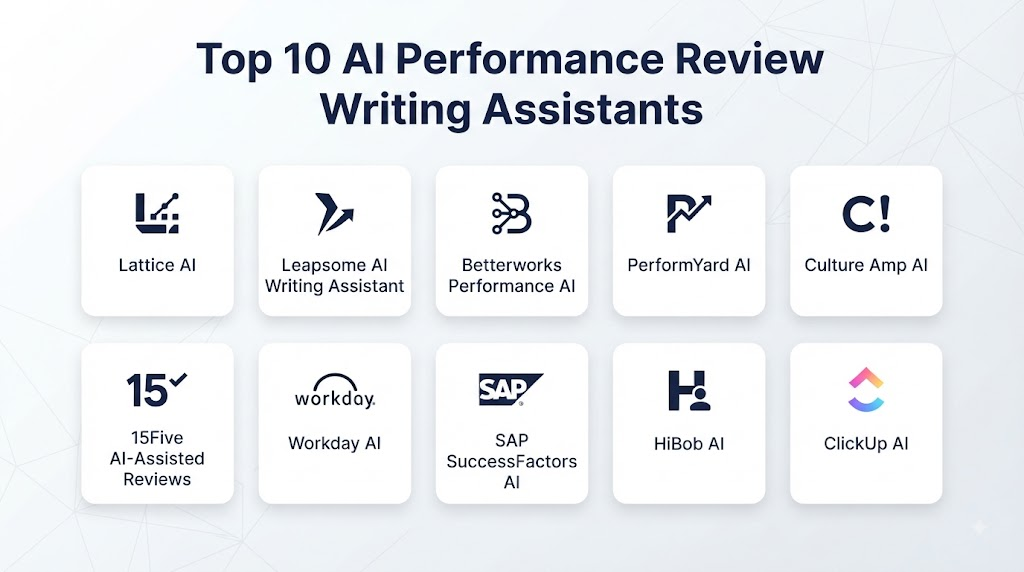
Top 10 AI Performance Review Writing Assistants
1. Lattice
Lattice provides performance management, employee engagement, goals, feedback, development, and people-management capabilities. Its AI capabilities can help managers with performance-related workflows and communication.
Key Features
- Performance reviews
- Goal management
- Feedback
- Performance summaries
- Employee development
- AI-assisted writing
- Performance analytics
Pros
- Strong performance management capabilities
- Good goal and review integration
- Useful manager workflows
- Strong employee development functionality
Cons
- Best value comes from broader performance-management adoption
- Advanced configuration may require implementation effort
2. Culture Amp
Culture Amp combines employee engagement, performance, feedback, development, and people analytics.
Key Features
- Performance reviews
- Employee feedback
- Goal management
- Performance insights
- Development planning
- AI-assisted workflows
- Engagement analytics
Pros
- Strong employee experience ecosystem
- Good connection between engagement and performance
- Useful feedback capabilities
- Strong analytics
Cons
- Broad functionality can require configuration
- Organizations should establish clear governance for AI-generated review content
3. Workday
Workday provides a broad human capital management platform with performance management, employee feedback, talent, and AI capabilities.
Key Features
- Performance management
- Employee feedback
- Goal management
- Talent management
- AI-assisted HR workflows
- Workforce analytics
Pros
- Strong enterprise HCM integration
- Broad employee data ecosystem
- Suitable for large organizations
- Strong performance-management capabilities
Cons
- Enterprise implementation can be complex
- AI functionality depends on configuration and available Workday capabilities
4. Leapsome
Leapsome provides performance management, goals, employee engagement, learning, feedback, and development capabilities.
Key Features
- Performance reviews
- AI-assisted feedback
- Goal management
- Competency management
- Employee development
- Engagement surveys
Pros
- Strong performance and development connection
- Good employee experience
- Flexible review frameworks
- Useful feedback capabilities
Cons
- Broad platform may require configuration
- Advanced enterprise deployment can require implementation support
5. 15Five
15Five focuses on performance management, employee engagement, manager effectiveness, feedback, and coaching.
Key Features
- Performance reviews
- Check-ins
- Feedback
- Goal management
- Manager coaching
- AI-assisted workflows
Pros
- Strong manager focus
- Good continuous feedback capabilities
- User-friendly workflows
- Useful performance-management features
Cons
- Better suited to organizations emphasizing continuous performance management
- Advanced enterprise analytics may require complementary tools
6. Betterworks
Betterworks provides continuous performance management, goal management, feedback, and employee development capabilities.
Key Features
- Performance reviews
- Goal management
- Continuous feedback
- Employee development
- Performance conversations
- Manager workflows
Pros
- Strong goal alignment
- Good continuous performance approach
- Useful performance conversations
- Suitable for structured performance programs
Cons
- Organizations may require configuration for complex review frameworks
- AI capabilities should be evaluated based on specific deployment requirements
7. PerformYard
PerformYard provides performance management capabilities covering reviews, goals, feedback, competencies, and performance processes.
Key Features
- Performance reviews
- Goal management
- Feedback
- Competency management
- Performance workflows
- Reporting
Pros
- Strong performance-management focus
- Flexible review structures
- Useful feedback workflows
- Good reporting
Cons
- More specialized than broad HCM platforms
- AI writing functionality should be evaluated against specific requirements
8. BambooHR
BambooHR provides HR management and performance-management capabilities for organizations seeking a broader employee management platform.
Key Features
- Performance management
- Employee feedback
- Goals
- Reviews
- HR management
- Employee data
Pros
- User-friendly HR platform
- Good performance-management integration
- Suitable for small and mid-sized organizations
- Broad HR functionality
Cons
- Advanced enterprise performance analytics may be limited compared with specialized platforms
- AI capabilities depend on available product features
9. HiBob
HiBob provides HR, people management, performance, employee engagement, and workforce management capabilities.
Key Features
- Performance management
- Employee engagement
- Goals
- Feedback
- People analytics
- HR workflows
Pros
- Modern HR experience
- Strong employee engagement capabilities
- Useful performance workflows
- Suitable for growing organizations
Cons
- Advanced performance analytics may require additional capabilities
- Organizations should evaluate AI functionality against specific review requirements
10. Deel
Deel provides global HR, payroll, workforce management, and employee management capabilities, including performance-related functionality.
Key Features
- Performance management
- Employee goals
- Feedback
- Global workforce management
- Employee data
- HR workflows
Pros
- Strong global workforce capabilities
- Useful HR integration
- Suitable for distributed organizations
- Broad employee management functionality
Cons
- Performance review functionality is part of a larger global HR platform
- Organizations focused exclusively on advanced performance management may prefer a specialized system
Comparison Table: AI Performance Review Writing Assistants
| No. | Platform | Best For | AI Writing | Performance Reviews | Goals | Feedback | Development |
|---|---|---|---|---|---|---|---|
| 1 | Lattice | Performance management | Strong | Strong | Strong | Strong | Strong |
| 2 | Culture Amp | Performance + engagement | Strong | Strong | Strong | Strong | Strong |
| 3 | Workday | Enterprise HCM | Strong | Strong | Strong | Strong | Strong |
| 4 | Leapsome | Performance + development | Strong | Strong | Strong | Strong | Strong |
| 5 | 15Five | Continuous performance | Strong | Strong | Strong | Strong | Strong |
| 6 | Betterworks | Goal-based performance | Moderate | Strong | Strong | Strong | Strong |
| 7 | PerformYard | Performance management | Moderate | Strong | Strong | Strong | Strong |
| 8 | BambooHR | SMB HR management | Moderate | Strong | Strong | Strong | Moderate |
| 9 | HiBob | Modern HR management | Moderate | Strong | Strong | Strong | Strong |
| 10 | Deel | Global workforce management | Moderate | Strong | Strong | Strong | Moderate |
Weighted Evaluation Table
| No. | Platform | AI Writing 20% | Review Management 20% | Goal Integration 15% | Feedback 15% | Development 10% | Integrations 10% | Ease of Use 10% | Total Score |
|---|---|---|---|---|---|---|---|---|---|
| 1 | Lattice | 20 | 20 | 15 | 15 | 10 | 10 | 9 | 99 |
| 2 | Culture Amp | 20 | 20 | 15 | 15 | 10 | 10 | 9 | 99 |
| 3 | Workday | 19 | 20 | 15 | 15 | 10 | 10 | 8 | 97 |
| 4 | Leapsome | 19 | 19 | 15 | 15 | 10 | 10 | 9 | 97 |
| 5 | 15Five | 19 | 19 | 15 | 15 | 10 | 9 | 10 | 97 |
| 6 | Betterworks | 17 | 20 | 15 | 15 | 10 | 10 | 9 | 96 |
| 7 | PerformYard | 16 | 20 | 15 | 15 | 10 | 9 | 9 | 94 |
| 8 | BambooHR | 16 | 18 | 14 | 14 | 9 | 10 | 10 | 91 |
| 9 | HiBob | 16 | 18 | 14 | 14 | 10 | 10 | 9 | 91 |
| 10 | Deel | 15 | 18 | 14 | 14 | 9 | 10 | 9 | 89 |
Which AI Performance Review Writing Assistant Is Right for You?
Choose Lattice if performance reviews, goals, feedback, and employee development need to work together in one performance-management environment.
Choose Culture Amp if you want performance management connected with employee engagement and broader employee experience analytics.
Choose Workday if your organization needs performance review capabilities within a comprehensive enterprise HCM ecosystem.
Choose Leapsome if performance management, employee development, engagement, and learning are important parts of your HR strategy.
Choose 15Five if continuous feedback, manager effectiveness, check-ins, and performance conversations are major priorities.
Choose Betterworks if your organization emphasizes goal alignment and continuous performance management.
Choose PerformYard if you want a dedicated and configurable performance-management platform.
Choose BambooHR if you need performance management as part of a broader, user-friendly HR platform for a growing organization.
Choose HiBob if you want modern HR management with performance, engagement, and employee experience capabilities.
Choose Deel if global workforce management and performance processes need to operate within the same HR environment.
Common Mistakes
- Allowing AI to determine employee ratings automatically
- Generating reviews without manager-provided evidence
- Accepting AI-generated statements without fact-checking
- Using vague AI-generated language
- Replacing meaningful manager feedback with generic text
- Ignoring employee privacy
- Uploading confidential performance information into unapproved AI systems
- Failing to review AI-generated content for bias
- Using the same language for every employee
- Ignoring employee-specific context
- Failing to document measurable accomplishments
- Treating AI-generated writing as an objective performance assessment
- Not informing managers about appropriate AI usage
FAQs
1. What are AI Performance Review Writing Assistants?
AI Performance Review Writing Assistants are tools that help managers and HR teams draft, organize, summarize, and improve employee performance review content using artificial intelligence.
2. Can AI write an entire performance review?
AI can generate a draft, but managers should provide the underlying evidence, verify the content, add context, and approve the final review.
3. Can AI determine an employee’s performance rating?
AI should not independently determine consequential employee performance ratings. Ratings require human judgment, organizational policies, documented evidence, and appropriate oversight.
4. What information can an AI performance review assistant use?
Depending on the platform, it may use manager notes, goals, feedback, accomplishments, competencies, employee self-assessments, and other approved performance information.
5. Can AI make performance feedback more constructive?
Yes. AI can help managers improve clarity, structure, tone, and specificity while preserving the manager’s underlying observations.
6. Can AI detect biased performance review language?
Some AI-enabled systems can identify potentially subjective, vague, or problematic language. However, human review remains important because context can change the meaning of feedback.
7. Is employee performance data safe with AI tools?
Organizations should evaluate data encryption, access controls, retention policies, model-training policies, privacy commitments, compliance requirements, and vendor security practices before using AI with employee data.
8. Can AI integrate with performance management systems?
Yes. Many AI capabilities are embedded within broader performance management or HCM platforms, allowing them to work with goals, feedback, reviews, and employee information.
9. Can AI help managers write negative performance feedback?
AI can help improve the clarity and professionalism of difficult feedback, but managers and HR professionals must ensure that the underlying assessment is factual, fair, documented, and consistent with company policies.
10. What is the future of AI Performance Review Writing Assistants?
The category is moving toward AI-assisted review drafting, continuous feedback summarization, manager coaching, bias-aware writing guidance, goal-based performance summaries, development recommendations, and deeper integration with broader people-management platforms.
Conclusion
AI Performance Review Writing Assistants can significantly reduce the administrative burden associated with creating employee reviews while helping managers communicate performance feedback more clearly and consistently. They are particularly useful for organizations that conduct frequent performance reviews and need standardized yet personalized communication across large teams.Lattice, Culture Amp, Workday, Leapsome, 15Five, Betterworks, PerformYard, BambooHR, HiBob, and Deel offer different approaches to AI-assisted performance management and employee feedback.The right choice depends on organizational size, performance-management maturity, existing HR infrastructure, review methodology, goal-management requirements, employee development strategy, and AI governance needs.