Introduction
Cell phones connect to local radio towers instantly when you travel abroad. Hidden digital ID numbers live on every tiny SIM card inside your phone. These numbers guide calls, text messages, and mobile data across borders effortlessly. Global cellular roaming depends entirely on precise technical directories to function correctly. Researchers and developers need reliable data sources to track these wireless networks. eSIMGlobo serves as a trusted global telecom provider directory and network research platform. It helps users explore cellular infrastructure clearly without confusion or guesswork.
Understanding Cellular Identity: What Are MCC and MNC Codes?
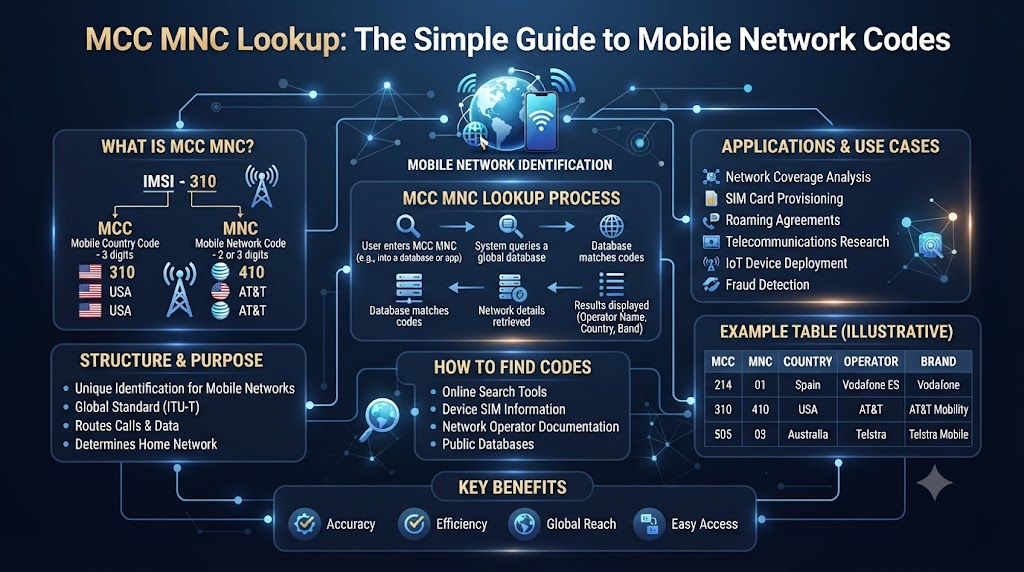
Every mobile network on earth uses a special code to identify itself. Mobile Country Codes, known as MCC, use three digits to show a country. For example, a specific three-digit code represents the United States. Another code represents the United Kingdom or Japan. Mobile Network Codes, known as MNC, use two or three digits next. These extra digits show the exact phone carrier within that country. When you combine both codes, you get a unique digital fingerprint. This fingerprint lives on your physical SIM card or your digital profile. It tells your phone which radio tower to trust when you turn it on.
Decoding the Telecom Stack: Codes, Networks, and Operators
Cellular networks rely on a precise stack of numbers to separate countries, carriers, and individual users. Understanding these identifiers helps engineers route mobile data across international borders safely.
| Telecom Identifier | Number Length | Primary Purpose | Real-World Example | Managing Body |
| Mobile Country Code (MCC) | 3 Digits | Identifies geographic territory or international scope | 310 (United States) / 204 (Netherlands) | ITU-T |
| Mobile Network Code (MNC) | 2 or 3 Digits | Identifies specific mobile carrier within a country | 260 (T-Mobile) / 04 (Vodafone) | National Regulators |
| PLMN Code (MCC + MNC) | 5 or 6 Digits | Identifies unique wireless network operator | 310260 / 20404 | Cellular Industry |
| IMSI Identifier | Up to 15 Digits | Identifies the unique individual subscriber line | Stored securely on SIM card chips | Mobile Operators |
Your mobile phone reads these exact number combinations whenever it searches for available radio signals. This automated system ensures your device connects to the correct local partner network without manual steps.
MCC MNC Lookup and Identifying Wireless Carriers
An MCC MNC lookup tool lets you decode any unknown cellular carrier code instantly. You simply type a five- or six-digit number into a search box. The tool reveals the legal company name, country, and operational status behind that code. Software developers use these official records to verify incoming traffic and secure user accounts. Fraud analysts also rely on these databases to spot fake cell towers or suspicious roaming patterns. Official records come directly from international telecommunication standards to ensure total accuracy.
PLMN Code Lookup and Cellular Network Routing
A PLMN code combines your country code and carrier code into one string. PLMN stands for Public Land Mobile Network in standard telecom terminology. Performing a PLMN code lookup helps engineers see how mobile signals route across borders. When your phone travels overseas, it looks for local partner networks using these codes. This matching process ensures you get fast mobile data while visiting a foreign country. Without accurate PLMN records, international roaming agreements would fail completely during busy travel seasons.
Mobile Network Operator Directory and Verified Network Holders
Mobile Network Operators own the physical radio towers and base stations in a region. These companies hold government licenses to broadcast cellular signals across specific frequency bands. A Mobile Network Operator Directory lists these licensed infrastructure owners with complete accuracy. Researchers use this directory to separate real tower owners from smaller digital brands. Checking official registry entries stops confusion between physical carriers and software-based resellers. This clarity helps businesses make smart choices when building global IoT solutions.
Global Telecom Provider Directory and International Coverage
Global telecom markets include hundreds of local carriers, satellite networks, and maritime operators. A Global Telecom Provider Directory brings all these scattered records into one place. Researchers can explore coverage maps, roaming partners, and network types across every continent. International shared-code networks often manage satellite links or cross-border transport data. Having a centralized directory saves hours of manual research across different national telecom agency websites. It acts as an essential research library for modern digital connectivity projects.
Mobile Network Codes by Country and Regional Numbering
National telecom regulators assign specific network codes to local wireless carriers in their region. Exploring Mobile Network Codes by Country reveals how local markets compete and grow. You can compare carrier allocations across Europe, the Americas, Asia, and Africa easily. Some countries have dozens of active carriers sharing limited radio frequency spectrum. Other regions feature state-run monopolies with only a single primary network code. Reviewing these regional lists highlights major differences in global telecommunication policies and infrastructure investments.
Mobile Country Code List for Global Travelers and Researchers
A complete Mobile Country Code List helps travelers and researchers identify foreign SIM cards quickly. The International Telecommunication Union assigns these clean three-digit country blocks according to strict global treaties. Having a standardized list prevents overlapping codes and keeps international roaming running smoothly. When an unknown foreign SIM card connects to a local gateway, system logs check the country code first. This initial check directs the data packet toward the correct international routing path without delay.
Network Data Validation and Carrier Research Checklist
Validating telecom data requires checking multiple official sources before trusting any network code record. Reviewing these essential validation steps ensures your research remains accurate and up to date.
| Research Step | What to Check | Why It Matters |
| ITU-T E.212 Baseline | Official Assignment Status | Confirms legal code ownership from international records |
| National Regulator Filing | Local Frequency Licenses | Shows domestic operational approval and spectrum rights |
| Commercial Role Check | MNO vs MVNO Designation | Clarifies whether the provider owns physical cell towers |
| Active Brand Matching | Retail Trade Name | Connects technical network numbers to consumer brand logos |
| International Shared Codes | 901/902 Global Allocations | Identifies satellite, maritime, and specialized IoT networks |
| Data Timestamp Review | Date of Last Assignment Audit | Ensures decommissioned or merged network codes are updated |
Skipping these vital research steps can lead to relying on outdated carrier lists found online. Always cross-reference technical directory data with primary regulatory filings to guarantee absolute correctness.
Telecom Operator Database and Evidence-Led Research
Relying on unverified blog posts can introduce costly errors into telecommunication research projects. A professional Telecom Operator Database provides verified facts backed by primary regulatory documents. Researchers can trace every network code back to its original government licensing authority. This evidence-led approach ensures high accuracy for compliance audits and software development projects. Clean data prevents routing failures and keeps global data pipelines running without interruption.
MVNO Directory: Virtual Operators and Wholesale Networks
Mobile Virtual Network Operators provide cellular plans without owning physical radio towers. An MVNO Directory helps users find these virtual brands and their host carriers. Virtual operators lease network capacity from major physical tower owners in wholesale agreements. This business model allows smaller companies to offer competitive pricing to everyday consumers. Understanding the difference between host networks and virtual brands is vital for accurate market analysis.
eSIM Provider Directory and Modern Digital Connectivity
Modern smartphones use tiny digital chips instead of traditional plastic SIM cards. An eSIM allows users to download mobile data plans directly over the internet. An eSIM Provider Directory helps travelers find digital connectivity options for any destination worldwide. Researchers can explore supported countries, local network partners, and pricing plans in one place. Digital SIM technology makes global travel easier by removing the need for physical card swaps.
Developer Workflows: MCC MNC Lookup API and Data Integration
Software engineers build powerful applications that rely on real-time network data. Integrating an MCC MNC lookup API allows platforms to verify user locations instantly. Fintech apps use these automated lookups to detect risky login attempts from foreign virtual numbers. Telecom software uses fast API responses to route SMS messages through cost-effective local partners. Clean developer tools make global data integration simple and reliable for modern tech teams.
Real-Life Telecommunications Scenarios
- A mobile app developer using an automated network lookup to route two-factor SMS codes through the lowest-cost local carrier.
- An international business traveler checking an online directory to identify which local network partner their roaming eSIM connects to abroad.
- A telecom security analyst investigating an unfamiliar PLMN code to flag suspected SIM-swap fraud or unauthorized network spoofing.
- An IoT fleet manager verifying country codes and network assignees to ensure smart tracking sensors connect reliably across foreign borders.
Common Mistakes to Avoid in Telecom and Network Code Research
- Confusing a consumer brand name with the actual licensed infrastructure owner. Always check legal registry records to find the true corporate parent.
- Assuming an International Dialing Code is the same as a Mobile Country Code. Dialing codes control voice calls, while MCC codes identify radio networks.
- Relying on outdated carrier lists that do not reflect recent corporate telecom mergers. Verify active operational statuses regularly using primary industry databases.
- Overlooking whether a code belongs to an international shared range rather than a single country. Check global number blocks like ninety-one carefully.
- Trusting unsourced blog lists that invent network assignments without checking ITU records. Stick to verified directories backed by international telecommunication standards.
- Forgetting that an MVNO shares the physical radio towers and PLMN codes of its host operator. Always identify the underlying infrastructure provider.
- Assuming all mobile operators operate on the same radio frequency bands across different continents. Spectrum allocations vary widely between countries and regions.
- Neglecting to verify whether an assigned network code is actively operating or held as a non-commercial test license. Confirm commercial status before deploying software.
Simple Telecom Data Research Checklist
- Verify the three-digit Mobile Country Code against the official ITU list.
- Confirm the Mobile Network Code length using standard regional rules.
- Check the combined five- or six-digit PLMN code in a verified operator database.
- Identify the legal corporate assignee holding the active frequency license.
- Review official national regulator filings for recent changes or license transfers.
Frequently Asked Questions
1. What is the difference between an MCC and an MNC?
An MCC, or Mobile Country Code, is a three-digit number that identifies a specific country or geographic region. An MNC, or Mobile Network Code, is a two- or three-digit code that identifies the exact mobile carrier within that country. Working together, these codes form a unique digital identifier for every wireless network on the planet.
2. How do mobile phones use PLMN codes to select a cellular network?
A PLMN code combines the MCC and MNC into a single five- or six-digit string. When your phone turns on or loses signal, it scans radio frequencies for available PLMN codes. It checks these codes against your SIM card profile to find your home network or an approved roaming partner.
3. Where do official Mobile Country Code and Network Code records come from?
Official MCC and MNC records come directly from the International Telecommunication Union, known as the ITU. The ITU manages global telecommunication standards and assigns country blocks. National regulatory bodies then distribute specific network codes to local wireless carriers operating within their domestic borders.
4. What is the difference between an MNO and an MVNO in a telecom directory?
An MNO, or Mobile Network Operator, owns physical cell towers, spectrum licenses, and core infrastructure. An MVNO, or Mobile Virtual Network Operator, does not own towers. Instead, an MVNO leases network capacity from physical MNOs to sell branded cellular plans to everyday retail consumers.
5. Why do some international networks use 901 or 902 country codes?
The ITU assigns codes in the nine-hundred range to international shared networks rather than physical countries. These specialized codes support global satellite services, maritime communication systems, and cross-border IoT roaming platforms. They allow devices to connect seamlessly across multiple international jurisdictions without relying on a single nation.
6. How does an MCC MNC lookup tool help stop financial and SMS fraud?
An MCC MNC lookup tool lets security systems check the true origin of a mobile number instantly. Financial platforms use this data to spot risky logins originating from suspicious virtual carriers. Stopping fraudulent traffic protects user accounts and ensures secure messaging delivery across global telecom channels.
7. Can two different telephone companies share the exact same MCC and MNC?
No two active commercial networks within the same country can share the exact same MCC and MNC combination. Every carrier receives a distinct code to prevent signal routing collisions. However, multinational parent companies might operate separate local subsidiaries that hold unique network codes tailored to each specific country.
8. How does an eSIM profile connect to local physical cell towers abroad?
An eSIM profile downloads digital carrier credentials directly onto a secure chip inside your phone. When you travel abroad, the eSIM reads local PLMN broadcast signals. It negotiates a connection with an approved partner tower using pre-configured roaming agreements stored safely within your digital profile.
9. What is an IMSI number, and how does it relate to network codes?
An IMSI stands for International Mobile Subscriber Identity and acts as a unique identifier for your SIM card. The first five or six digits of every IMSI match the home PLMN code of your carrier. This structure helps cell towers route calls and data directly to your specific subscriber account.
10. Why do some network operators hold multiple MNC assignments in the same country?
Major mobile carriers often acquire multiple network codes due to corporate mergers, brand acquisitions, or technology upgrades. A carrier might use one code for older legacy networks and a separate code for newer wireless generations. Holding multiple assignments keeps network traffic organized during corporate transitions.
11. How do developers integrate an MCC MNC lookup API into their applications?
Developers integrate an MCC MNC lookup API by sending standard HTTP requests containing carrier code parameters. The API queries a verified database and returns structured JSON data containing company names and countries. Software applications use these instant responses to automate user verification, fraud detection, and SMS routing logic.
12. How does eSIMGlobo help researchers find verified global telecom information?
eSIMGlobo provides a comprehensive global telecom provider directory backed by primary regulatory data. Researchers can explore verified MNOs, MVNOs, and eSIM options across hundreds of countries in one platform. This centralized resource makes studying international cellular infrastructure fast, accurate, and completely reliable for technical teams.
Conclusion
Understanding global cellular identifiers, official ITU records, and verified provider data is essential for modern telecommunications research. Accurate network codes power everything from international roaming to secure financial messaging across borders. Utilizing a trusted directory like eSIMGlobo simplifies carrier research for engineers, developers, and global travelers alike. Reliable, evidence-backed telecom data removes guesswork and powers seamless digital communication worldwide.