Introduction
AI Misinformation Detection Tools use artificial intelligence, machine learning, natural language processing, computer vision, knowledge graphs, and automated verification technologies to help identify potentially false, misleading, manipulated, or unsupported information.
The rapid growth of social media, generative AI, deepfakes, synthetic news, automated content creation, and viral online narratives has made information verification more challenging than ever. A misleading claim can spread across multiple platforms before journalists, researchers, or fact-checkers have enough time to investigate it.
AI-powered misinformation detection tools can help analyze large amounts of content and identify information that deserves further investigation.
However, AI detection should not be treated as an automatic truth machine. A tool can flag content as suspicious without proving that it is false. Human judgment, reliable evidence, and contextual analysis remain important.
What Is AI Misinformation Detection?
AI Misinformation Detection refers to the use of artificial intelligence to analyze information and identify potentially inaccurate, misleading, manipulated, or unsupported claims.
AI systems may analyze:
- Articles
- Social-media posts
- News reports
- Images
- Videos
- Audio
- Websites
- Sources
- Citations
- Metadata
- Online conversations
- Historical claims
Depending on the platform, AI may identify factual claims, compare them against available evidence, evaluate source signals, detect manipulated media, and help researchers investigate suspicious narratives.
Misinformation vs Disinformation
Misinformation
Misinformation generally refers to inaccurate or false information that is shared without necessarily intending to deceive.
Disinformation
Disinformation generally involves deliberately created or distributed false information intended to mislead.
Malinformation
Malinformation generally involves genuine information being used in a misleading, harmful, or inappropriate context.
AI can help detect potentially misleading information, but determining someone’s intent is much more difficult and usually requires contextual human investigation.
Why AI Misinformation Detection Matters
The amount of digital information generated every day is enormous.
Journalists, researchers, businesses, governments, and users can struggle to manually verify everything they encounter.
AI can help by:
- Processing information at scale
- Identifying claims quickly
- Finding related evidence
- Detecting suspicious media
- Monitoring online narratives
- Comparing information across sources
- Prioritizing content for human investigation
The main value is often speed and scale, rather than replacing professional fact-checkers.
How AI Misinformation Detection Works
Natural Language Processing
NLP models analyze written content to identify claims, entities, topics, relationships, and context.
Claim Extraction
AI can separate factual statements from opinions, questions, predictions, and commentary.
Fact Verification
The system can compare claims with available evidence and previously verified information.
Semantic Search
AI can identify related information even when different sources use different wording.
Source Analysis
Systems can evaluate source characteristics, publication patterns, citations, and other credibility signals.
Knowledge Graphs
Knowledge graphs connect entities and facts to identify relationships and potential inconsistencies.
Computer Vision
Computer-vision models can examine images and videos for manipulation or synthetic-generation signals.
Deepfake Detection
Specialized models can analyze audio, faces, movements, lighting, and other patterns to identify potentially synthetic media.
Network Analysis
AI can examine how content spreads between websites, accounts, and platforms.
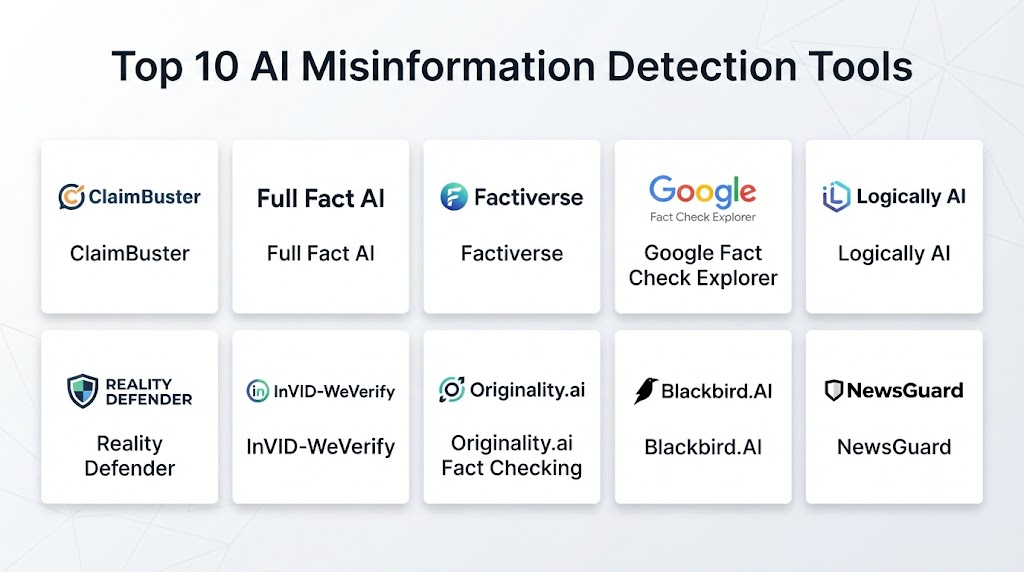
Top 10 AI Misinformation Detection Tools
1. Logically
Best for: Information-integrity monitoring and misinformation analysis.
Logically focuses on technologies for detecting and analyzing misinformation, disinformation, and online narratives.
Key Features
- Claim analysis
- Misinformation detection
- Narrative monitoring
- Social-media analysis
- Information classification
- Threat intelligence
- Research workflows
AI Capabilities
- Natural-language processing
- Machine learning
- Automated claim analysis
- Narrative detection
- Information classification
Pros
- Strong information-integrity focus
- Supports large-scale monitoring
- Useful for organizations
- Supports multiple types of information analysis
Cons
- More enterprise-oriented
- May require specialized implementation
- AI findings require contextual review
Best For
- Governments
- Media organizations
- Researchers
- Enterprises
- Trust and safety teams
2. Full Fact AI
Best for: Automated fact-checking and claim monitoring.
Full Fact AI focuses on technologies that help identify and monitor factual claims and support fact-checking workflows.
Key Features
- Claim detection
- Claim matching
- Fact-checking workflows
- Speech analysis
- Text analysis
- Evidence discovery
- Content monitoring
AI Capabilities
- NLP
- Claim recognition
- Semantic matching
- Speech processing
- Automated content analysis
Pros
- Strong fact-checking orientation
- Useful for newsrooms
- Helps process large amounts of content
- Supports claim-monitoring workflows
Cons
- Complex claims may require human research
- Verification depends on available evidence
- Automated systems can make mistakes
Best For
- Fact-checking organizations
- Journalists
- Researchers
- Newsrooms
3. NewsGuard
Best for: News-source credibility analysis.
NewsGuard focuses on evaluating news and information sources and providing credibility-related intelligence.
Key Features
- Website credibility ratings
- Source evaluation
- News-source intelligence
- Misinformation monitoring
- Reliability indicators
- Research tools
AI Capabilities
Automated technologies and data analysis can support large-scale information monitoring and source evaluation.
Pros
- Strong source-level analysis
- Useful for organizations
- Structured credibility information
- Helpful for researchers and media teams
Cons
- A source rating does not prove individual claims are true
- Primarily focused on source-level assessment
- Some capabilities require subscription access
Best For
- Media organizations
- Researchers
- Businesses
- Educators
- Information-risk teams
4. InVID-WeVerify
Best for: Investigating images and videos.
InVID-WeVerify provides tools that help journalists and researchers investigate online visual content.
Key Features
- Reverse-image investigation
- Video verification
- Keyframe extraction
- Metadata analysis
- Image analysis
- Source investigation
AI Capabilities
AI-assisted visual analysis can help identify suspicious images and videos and support broader verification workflows.
Pros
- Strong visual-investigation capabilities
- Useful for journalists
- Supports image and video research
- Helpful for investigative workflows
Cons
- Requires human investigation
- Not a universal misinformation classifier
- Advanced verification requires expertise
Best For
- Journalists
- Fact-checkers
- Researchers
- Investigative teams
5. Hive
Best for: AI-generated content and manipulated-media detection.
Hive provides AI-powered content-analysis and moderation technologies.
Key Features
- AI-generated content detection
- Image analysis
- Video analysis
- Content moderation
- Content classification
- Synthetic-media detection
AI Capabilities
- Computer vision
- Machine learning
- Image classification
- Synthetic-content analysis
Pros
- Strong multimodal capabilities
- Supports image and video analysis
- Suitable for large-scale workflows
- Useful for trust-and-safety teams
Cons
- Detection accuracy is not guaranteed
- New generative models can challenge detection systems
- Enterprise deployment may require technical integration
Best For
- Online platforms
- Media organizations
- Developers
- Trust and safety teams
6. TrueMedia.org
Best for: Detecting potentially manipulated media.
TrueMedia.org focuses on helping identify deceptive and manipulated digital content.
Key Features
- Media verification
- AI-generated-content analysis
- Image analysis
- Video analysis
- Deepfake detection
- Evidence assessment
AI Capabilities
- Computer vision
- Synthetic-media detection
- Automated media analysis
Pros
- Strong misinformation focus
- Useful for researchers and journalists
- Supports multimedia analysis
- Helps investigate manipulated content
Cons
- Results should be independently verified
- New manipulation techniques can be difficult to detect
- Detection capabilities may vary by content type
Best For
- Journalists
- Researchers
- Fact-checkers
- Media organizations
7. Google Fact Check Tools
Best for: Finding existing fact checks.
Google’s fact-checking tools help users discover fact-checking information related to claims.
Key Features
- Fact-check search
- Claim discovery
- Existing fact-check identification
- Structured fact-check information
AI and Search Capabilities
Search and automated information systems help locate relevant fact checks and supporting information.
Pros
- Useful for finding existing fact checks
- Large search ecosystem
- Easy to use
- Helpful for researchers
Cons
- Does not independently verify every new claim
- Coverage depends on existing fact checks
- Emerging claims may not yet have available verification
Best For
- Journalists
- Students
- Researchers
- General users
8. Reality Defender
Best for: Deepfake and synthetic-media detection.
Reality Defender focuses on detecting AI-generated and manipulated content across different media types.
Key Features
- Deepfake detection
- Synthetic-image detection
- Audio analysis
- Video analysis
- Media verification
- Risk scoring
AI Capabilities
- Computer vision
- Audio analysis
- Machine learning
- Multimodal detection
Pros
- Strong synthetic-media focus
- Supports multiple media types
- Useful for enterprise environments
- Designed for real-time detection use cases
Cons
- Primarily focused on manipulated media
- Detection models require continuous improvement
- False positives and false negatives are possible
Best For
- Media companies
- Enterprises
- Government organizations
- Security teams
9. Sensity AI
Best for: Deepfake intelligence and synthetic-media detection.
Sensity AI focuses on detecting and analyzing manipulated and synthetic visual media.
Key Features
- Deepfake detection
- Face manipulation analysis
- Synthetic-media monitoring
- Image analysis
- Video analysis
- Threat intelligence
AI Capabilities
- Computer vision
- Deep learning
- Synthetic-media detection
- Image and video analysis
Pros
- Strong deepfake specialization
- Useful for enterprise investigations
- Supports visual-media analysis
- Security-oriented capabilities
Cons
- Primarily focused on synthetic media
- Detection accuracy varies by manipulation method
- Requires ongoing model updates
Best For
- Security teams
- Enterprises
- Media organizations
- Researchers
10. ClaimBuster
Best for: Identifying check-worthy claims.
ClaimBuster uses machine learning and NLP to identify claims that may deserve fact-checking.
Key Features
- Claim detection
- Claim ranking
- Text analysis
- Check-worthiness scoring
- Fact-checking research support
AI Capabilities
- Machine learning
- NLP
- Semantic analysis
- Claim classification
Pros
- Useful for prioritizing claims
- Helps researchers process large quantities of content
- Strong claim-focused approach
Cons
- A score does not prove a claim is false
- Requires additional verification
- Context can influence results
Best For
- Journalists
- Researchers
- Fact-checkers
- Academic projects
AI Misinformation Detection Scoring Table
| No. | Tool | AI Capability /10 | Fact-Checking /10 | Source Analysis /10 | Image & Video Detection /10 | Ease of Use /10 | Overall Score /10 |
|---|---|---|---|---|---|---|---|
| 1 | Logically | 9.5 | 9.5 | 9.5 | 9.0 | 8.0 | 9.1 |
| 2 | Full Fact AI | 9.5 | 10.0 | 8.5 | 6.0 | 8.0 | 8.8 |
| 3 | NewsGuard | 9.0 | 9.0 | 10.0 | 6.5 | 9.0 | 8.7 |
| 4 | InVID-WeVerify | 8.0 | 9.0 | 9.0 | 9.5 | 8.0 | 8.6 |
| 5 | Hive | 9.5 | 7.0 | 7.5 | 10.0 | 8.5 | 8.5 |
| 6 | TrueMedia.org | 9.0 | 8.5 | 7.5 | 9.5 | 8.0 | 8.5 |
| 7 | Google Fact Check Tools | 8.5 | 9.5 | 8.5 | 5.0 | 9.5 | 8.2 |
| 8 | Reality Defender | 9.5 | 6.5 | 7.0 | 10.0 | 8.0 | 8.2 |
| 9 | Sensity AI | 9.5 | 6.5 | 7.0 | 10.0 | 8.0 | 8.2 |
| 10 | ClaimBuster | 9.0 | 9.5 | 7.5 | 4.0 | 8.5 | 7.8 |
Overall Ranking
| Rank | Tool | Overall Score |
|---|---|---|
| 1 | Logically | 9.1/10 |
| 2 | Full Fact AI | 8.8/10 |
| 3 | NewsGuard | 8.7/10 |
| 4 | InVID-WeVerify | 8.6/10 |
| 5 | Hive | 8.5/10 |
| 6 | TrueMedia.org | 8.5/10 |
| 7 | Google Fact Check Tools | 8.2/10 |
| 8 | Reality Defender | 8.2/10 |
| 9 | Sensity AI | 8.2/10 |
| 10 | ClaimBuster | 7.8/10 |
Feature Comparison
| No. | Tool | Claim Detection | Source Analysis | Fact Checking | Deepfake Detection | Image Analysis | Video Analysis |
|---|---|---|---|---|---|---|---|
| 1 | Logically | Strong | Strong | Strong | Yes | Yes | Yes |
| 2 | Full Fact AI | Very Strong | Yes | Very Strong | Limited | Limited | Limited |
| 3 | NewsGuard | Yes | Very Strong | Strong | Limited | Limited | Limited |
| 4 | InVID-WeVerify | Limited | Strong | Strong | Medium | Very Strong | Very Strong |
| 5 | Hive | Medium | Medium | Medium | Strong | Very Strong | Strong |
| 6 | TrueMedia.org | Medium | Medium | Strong | Very Strong | Very Strong | Very Strong |
| 7 | Google Fact Check Tools | Strong | Medium | Very Strong | Limited | Limited | Limited |
| 8 | Reality Defender | Limited | Limited | Limited | Very Strong | Very Strong | Very Strong |
| 9 | Sensity AI | Limited | Medium | Medium | Very Strong | Very Strong | Very Strong |
| 10 | ClaimBuster | Very Strong | Medium | Strong | No | No | No |
Pros and Cons Comparison
| No. | Tool | Pros | Cons |
|---|---|---|---|
| 1 | Logically | Strong information-integrity analysis, large-scale monitoring, multimodal capabilities | Enterprise-oriented |
| 2 | Full Fact AI | Excellent claim monitoring, strong fact-checking focus | Complex claims require human review |
| 3 | NewsGuard | Strong source credibility analysis and structured ratings | Source rating does not prove individual claims |
| 4 | InVID-WeVerify | Excellent visual investigation and verification tools | Requires human expertise |
| 5 | Hive | Strong image, video, and AI-content analysis | Detection accuracy can vary |
| 6 | TrueMedia.org | Strong multimedia verification capabilities | New manipulation methods remain challenging |
| 7 | Google Fact Check Tools | Easy access to existing fact checks | Depends on available fact-check coverage |
| 8 | Reality Defender | Strong synthetic-media detection | Mainly focused on manipulated media |
| 9 | Sensity AI | Strong deepfake detection and threat intelligence | Primarily focused on synthetic media |
| 10 | ClaimBuster | Strong claim identification and prioritization | Does not independently prove claims false |
AI Misinformation Detection for Social Media
Social media platforms generate enormous amounts of content every minute.
AI can help organizations monitor:
- Posts
- Comments
- Images
- Videos
- Links
- Hashtags
- Accounts
- Narratives
- Engagement patterns
Machine-learning systems can identify unusual patterns and rapidly spreading claims that deserve investigation.
However, high engagement does not automatically mean that content is misinformation. Popular legitimate information can spread quickly as well.
AI Misinformation Detection for Newsrooms
Newsrooms can use AI to support:
- Breaking-news verification
- Claim identification
- Fact-check research
- Source analysis
- Image verification
- Video verification
- Deepfake detection
- Evidence gathering
- Narrative monitoring
AI can reduce repetitive research and help journalists prioritize which claims require deeper investigation.
AI Misinformation Detection for Businesses
Businesses increasingly face misinformation involving their:
- Brands
- Products
- Executives
- Employees
- Financial information
- Corporate announcements
AI tools can help organizations monitor online information and identify potentially damaging false claims.
Potential applications include:
- Brand monitoring
- Reputation management
- Executive impersonation detection
- Deepfake detection
- Crisis monitoring
- Social-media analysis
- Threat intelligence
AI Misinformation Detection for Government
Government organizations can use AI to understand information environments and monitor potentially misleading narratives.
Potential applications include:
- Emergency communication monitoring
- Public-information analysis
- Crisis communication
- Election-related monitoring
- Narrative tracking
- Public communication analysis
Government deployments require particularly strong safeguards. AI systems should not automatically classify legitimate political expression, criticism, journalism, or protected speech as misinformation.
AI Misinformation Detection for Education
Schools and universities can use these technologies to teach students how to evaluate online information.
AI-assisted verification can help students learn:
- Source evaluation
- Evidence checking
- Media literacy
- Fact-checking
- Digital research
- Critical thinking
Students should learn that an AI-generated credibility score is only one piece of evidence.
Deepfake Detection
Deepfakes are an increasingly important misinformation challenge.
AI can examine:
- Facial movements
- Lighting
- Audio characteristics
- Lip synchronization
- Image artifacts
- Frame-level inconsistencies
- Synthetic speech patterns
- Compression patterns
Specialized tools such as Reality Defender and Sensity AI focus heavily on synthetic-media detection.
However, deepfake detection is an ongoing technological competition. As generative AI becomes more sophisticated, detection models must continuously evolve.
AI-Generated Text Detection
AI-generated text presents another challenge.
Detection systems may examine:
- Writing patterns
- Probability distributions
- Sentence structure
- Repetition
- Vocabulary
- Semantic patterns
However, AI-generated text detection can produce false positives and should not be used as definitive proof that a person used AI.
AI Image Verification
Image verification systems can examine:
- Metadata
- Image history
- Visual inconsistencies
- Editing artifacts
- Synthetic-generation patterns
- Similar images
- Reverse-search results
Image verification becomes especially important when old photographs are presented as new events or when genuine images are placed in misleading contexts.
AI Video Verification
Video misinformation can involve:
- Old footage presented as current
- Videos from another location
- Edited clips
- Missing context
- Manipulated audio
- AI-generated video
- Deepfake faces
AI can help extract frames, analyze visual information, identify similarities, and support source investigation.
AI Audio Verification
Synthetic voice technology can create convincing audio impersonations.
AI-based audio analysis may examine:
- Voice characteristics
- Speech patterns
- Acoustic artifacts
- Audio consistency
- Synthetic-generation signals
This can be useful for investigating impersonation and manipulated recordings.
Challenges of AI Misinformation Detection
False Positives
A legitimate claim can be incorrectly flagged.
False Negatives
Sophisticated misinformation can evade automated detection.
Lack of Context
AI may misunderstand satire, sarcasm, cultural references, or historical context.
Rapidly Changing Information
A claim can change from uncertain to confirmed as new evidence becomes available.
Incomplete Evidence
A lack of evidence does not necessarily mean that a claim is false.
Source Bias
Different sources may interpret the same event differently.
Emerging AI Techniques
New generative models can produce increasingly convincing synthetic media.
Adversarial Manipulation
Bad actors may intentionally modify content to evade detection systems.
How to Choose the Best AI Misinformation Detection Tool
Organizations should evaluate:
- Accuracy
- Evidence quality
- Claim coverage
- Source coverage
- Media support
- Deepfake detection
- Explainability
- False-positive rates
- False-negative rates
- Real-time capabilities
- API access
- Human review workflows
- Auditability
- Security
- Privacy
- Language support
- Geographic coverage
- Cost
Best Tools by Use Case
Best Overall for Information Integrity
Logically
Its broad information-integrity capabilities make it a strong choice for organizations monitoring misinformation and online narratives.
Best for Automated Fact-Checking
Full Fact AI
A strong option for organizations focused primarily on detecting and checking factual claims.
Best for News-Source Credibility
NewsGuard
Useful for organizations that need structured information about news and information sources.
Best for Visual Investigation
InVID-WeVerify
Particularly useful for journalists investigating suspicious images and videos.
Best for AI-Generated Content
Hive
A strong option for analyzing potentially AI-generated images, videos, and other digital content.
Best for Deepfake Detection
Reality Defender
Designed specifically around synthetic and manipulated-media detection.
Best for Existing Fact Checks
Google Fact Check Tools
Useful when the goal is to find fact checks that have already been published.
Best for Synthetic Media Intelligence
Sensity AI
Strong for organizations focused on deepfake and synthetic-media threats.
Best for Check-Worthy Claims
ClaimBuster
Useful for identifying claims that should receive fact-checking attention.
Responsible AI Misinformation Detection
AI should be used as an investigation assistant rather than a final authority.
A responsible verification process combines:
AI analysis + reliable evidence + source evaluation + human judgment
Organizations should provide reviewers with enough information to understand:
- What claim was analyzed
- Why it was flagged
- What evidence was found
- Which sources were considered
- How confident the system is
- Whether contradictory evidence exists
This is particularly important when misinformation labels can affect a person’s reputation, business, political participation, or access to information.
Future of AI Misinformation Detection
The future of misinformation detection is likely to become increasingly multimodal.
Instead of analyzing only text, advanced systems will combine:
- Text
- Images
- Video
- Audio
- Metadata
- Websites
- Social networks
- Historical information
- Content provenance
Emerging capabilities may include:
- Real-time claim verification
- Multilingual fact checking
- Automated evidence graphs
- Cross-platform narrative analysis
- Synthetic-media detection
- Provenance verification
- Real-time newsroom assistants
- Automated source comparison
- AI-generated-content labeling
The industry will likely move toward systems that explain why content appears suspicious rather than simply assigning a numerical score.
FAQs
What are AI misinformation detection tools?
AI misinformation detection tools use artificial intelligence to identify potentially false, misleading, manipulated, or unsupported information.
Can AI detect fake news?
AI can identify suspicious claims, analyze sources, and locate supporting or contradictory evidence, but it cannot guarantee that every piece of fake news will be detected.
Can AI determine whether a claim is true?
AI can assist with evidence-based verification, but complicated or disputed claims may require human fact-checkers and subject-matter experts.
Can AI detect deepfakes?
Yes. Specialized AI systems can analyze images, videos, and audio for signs of synthetic or manipulated content.
What is the best AI misinformation detection tool?
There is no single best tool for every use case. Logically is a strong overall option, Full Fact AI is strong for fact-checking, NewsGuard focuses on source credibility, while Reality Defender, Hive, and Sensity AI specialize more heavily in manipulated and synthetic media.
Can AI detect misinformation on social media?
Yes. AI can process large quantities of social-media content and identify claims, narratives, unusual patterns, and potentially manipulated media.
Can AI detect AI-generated content?
Some AI systems can identify signals associated with AI-generated content, but detection is imperfect and should not be treated as definitive proof.
Why can misinformation detectors make mistakes?
AI systems can misunderstand context, encounter incomplete information, fail to recognize new manipulation techniques, or incorrectly classify legitimate content.
Can journalists use AI for fact-checking?
Yes. AI can help journalists identify check-worthy claims, locate evidence, analyze sources, and investigate images and videos.
Can AI verify images?
AI can assist with image verification by analyzing visual characteristics, metadata, similarities, and potential manipulation indicators.
Can AI verify videos?
Yes. AI can analyze video frames, audio, metadata, and visual patterns to support verification.
What is claim detection?
Claim detection is the process of identifying factual statements within content that can potentially be verified.
Is AI misinformation detection 100% accurate?
No. No misinformation detection system should be considered 100% accurate. Human review and reliable evidence remain important.
Can misinformation detection tools detect satire?
They may struggle with satire, sarcasm, parody, and other forms of intentionally nonliteral content.
Should businesses use AI misinformation detection?
Businesses can use these systems for brand monitoring, reputation management, deepfake detection, crisis monitoring, and information-risk analysis.
Conclusion
AI Misinformation Detection Tools are becoming increasingly important as digital information grows more complex and generative AI makes it easier to produce convincing synthetic content.The top solutions serve different purposes. Logically offers broad information-integrity capabilities, Full Fact AI focuses heavily on automated fact-checking, NewsGuard provides source-level credibility intelligence, and InVID-WeVerify supports visual investigations. Hive, Reality Defender, TrueMedia.org, and Sensity AI are particularly relevant to manipulated and synthetic media.ClaimBuster is useful for identifying check-worthy claims, while Google Fact Check Tools can help users discover existing fact-checking information.The most important consideration is that AI detection does not equal truth verification. A suspicious-content score is not proof that information is false, and a low-risk score does not guarantee that information is accurate.