Introduction
AI Whistleblower Report Triage tools help organizations receive, classify, prioritize, route, and manage whistleblower and ethics reports more efficiently. These platforms can use artificial intelligence, natural-language processing, rules, workflow automation, and analytics to help compliance teams understand incoming allegations and determine which cases may require immediate human attention.
Whistleblower reports can contain highly sensitive information involving fraud, corruption, conflicts of interest, harassment, retaliation, financial misconduct, policy violations, regulatory breaches, or other ethical concerns. The challenge is not simply collecting reports. Organizations also need a consistent way to assess urgency, assign cases, protect confidentiality, preserve evidence, and document investigation decisions.
Best for: Enterprise compliance teams, ethics officers, internal audit departments, legal teams, HR investigation teams, risk departments, financial institutions, multinational companies, and organizations managing large volumes of sensitive reports.
Not ideal for: Very small organizations receiving only a handful of reports, teams with straightforward manual workflows, or organizations that are not prepared to maintain strict human oversight over automated case prioritization.
What Is AI Whistleblower Report Triage?
AI whistleblower report triage is the use of AI-assisted technology to analyze incoming ethics, compliance, and whistleblower reports and help determine how those reports should be handled.
A typical workflow might look like:
Report submitted → Data protected → AI-assisted classification → Risk indicators identified → Priority assigned → Human review → Case routed → Investigation → Resolution → Audit record
AI can analyze the language used in a report and identify potentially relevant characteristics.
For example, a report could mention:
- Financial fraud
- Bribery
- Insider information
- Retaliation
- Workplace harassment
- Procurement misconduct
- Conflict of interest
- Data misuse
- Regulatory violations
- Safety concerns
The system may then help compliance personnel categorize the report and identify whether it requires escalation.
The important distinction is that AI should support triage rather than replace investigative judgment.
A model may help identify patterns, but a qualified human should generally determine whether an allegation is credible, how it should be investigated, and what action should ultimately be taken.
Why AI Whistleblower Report Triage Matters
Large organizations can receive reports from employees, contractors, suppliers, customers, and other stakeholders.
Reports may arrive through:
- Web forms
- Hotlines
- Mobile applications
- Chat
- Telephone conversations
- Managers
- Compliance portals
- Third-party reporting channels
The information may be incomplete, duplicated, multilingual, emotional, ambiguous, or highly technical.
Manual triage can create several challenges:
- Inconsistent prioritization
- Slow escalation
- Duplicate cases
- Poor routing
- Investigator overload
- Missed risk indicators
- Inconsistent documentation
- Difficulty analyzing historical trends
AI-assisted triage can help organize this information while allowing investigators to retain control over important decisions.
What to Evaluate Before Choosing a Platform
Organizations should evaluate:
- Report intake capabilities
- AI-assisted classification
- Risk scoring
- Case prioritization
- Duplicate detection
- Natural-language processing
- Multilingual support
- Case routing
- Anonymous reporting
- Investigator workflows
- Evidence management
- Audit trails
- Role-based access control
- Encryption
- SSO
- Data-retention controls
- Data residency
- Human-review workflows
- AI explainability
- Model governance
- API access
- Reporting and analytics
- Third-party integrations
- Cost and scalability
What Has Changed in AI Whistleblower Report Triage
- AI-assisted intake is becoming more practical: Organizations can use NLP to organize large volumes of free-text allegations.
- Risk-based prioritization is becoming more important: Compliance teams can focus attention on potentially high-impact reports.
- Multilingual reporting is increasingly valuable: Global organizations may need to process allegations across multiple languages.
- Duplicate detection can reduce investigator workload: Multiple reports about the same incident can potentially be linked.
- AI agents introduce additional risk: Autonomous workflows must not be allowed to make irreversible decisions without appropriate human controls.
- Explainability matters: Investigators should understand why a report was classified or prioritized in a particular way.
- Privacy requirements are critical: Whistleblower reports can contain extremely sensitive personal and organizational information.
- Bias testing is essential: AI classification can unintentionally prioritize certain language patterns or types of reports.
- Human-in-the-loop workflows are increasingly important: High-impact cases should have qualified human review.
- Auditability is becoming a core requirement: Organizations need records of classifications, routing decisions, investigator actions, and case outcomes.
- Security-by-design matters: Report data should be protected throughout intake, processing, storage, investigation, and retention.
- Continuous evaluation is necessary: AI classification should be tested against real-world cases and reviewed as policies change.
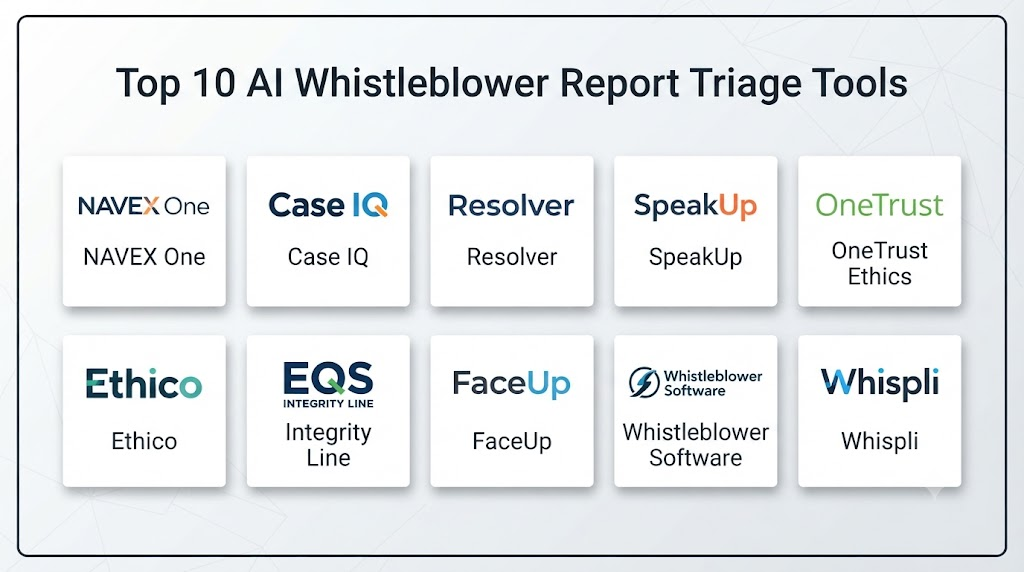
Top 10 AI Whistleblower Report Triage Tools
1 — NAVEX
One-line verdict: Best for enterprises building comprehensive whistleblower, ethics, compliance, case-management, and reporting programs.
Short description:
NAVEX provides ethics and compliance technology covering incident reporting, case management, investigations, risk management, and related workflows. It is particularly relevant to organizations operating formal whistleblower and ethics programs.
Standout Capabilities
- Ethics reporting
- Whistleblower intake
- Case management
- Investigation workflows
- Risk management
- Compliance analytics
- Policy management
- Reporting
AI-Specific Depth
- Model support: AI capabilities vary by product and implementation; specific underlying models are not publicly stated.
- RAG / knowledge integration: Knowledge and compliance integrations vary.
- Evaluation: AI-specific evaluation capabilities vary and should be verified for the selected product.
- Guardrails: Workflow permissions and human-review controls; detailed AI guardrail architecture is not publicly stated.
- Observability: Case analytics and reporting; model-level tracing and token metrics are not publicly stated.
Pros
- Strong focus on ethics and compliance
- Mature case-management workflows
- Suitable for large organizations
Cons
- Enterprise implementation can be complex
- AI functionality varies by product
- Pricing is generally not publicly standardized
Security & Compliance
Security capabilities vary by service and configuration. Organizations should verify current SSO, RBAC, encryption, audit logging, retention, residency, and certification information before procurement.
Deployment & Platforms
- Deployment: Cloud
- Platforms: Web and supported reporting channels
- Self-hosted: Varies / N/A
Integrations & Ecosystem
NAVEX can connect ethics reporting with broader enterprise compliance processes.
- HR systems
- GRC platforms
- Compliance workflows
- Identity systems
- Reporting systems
- APIs
- Enterprise applications
Pricing Model
Enterprise subscription; exact pricing is not publicly stated.
Best-Fit Scenarios
- Enterprise whistleblower programs
- Ethics and compliance teams
- Global investigation workflows
2 — EQS Integrity Line
One-line verdict: Best for organizations seeking structured whistleblower reporting, case management, and compliance workflows.
Short description:
EQS Integrity Line is designed around whistleblowing and compliance reporting. It supports organizations that need secure reporting channels and structured handling of incoming cases.
Standout Capabilities
- Whistleblower reporting
- Anonymous reporting
- Case management
- Compliance workflows
- Communication with reporters
- Investigation support
- Reporting
- Multilingual workflows
AI-Specific Depth
- Model support: Specific AI model information is not publicly stated.
- RAG / knowledge integration: N/A or varies.
- Evaluation: AI-specific evaluation capabilities are not publicly stated.
- Guardrails: Access and workflow controls; detailed AI-specific guardrails are not publicly stated.
- Observability: Case and workflow reporting; model-level observability is not publicly stated.
Pros
- Dedicated whistleblowing focus
- Useful for international organizations
- Structured reporting workflows
Cons
- AI depth may be less important than reporting functionality
- Advanced analytics vary
- Enterprise configuration may be required
Security & Compliance
Verify current security controls, encryption, SSO, RBAC, audit logging, retention, data residency, and certifications applicable to the deployment.
Deployment & Platforms
- Deployment: Cloud
- Platforms: Web and reporting channels
- Self-hosted: Varies / N/A
Integrations & Ecosystem
- HR systems
- Compliance systems
- Case-management workflows
- APIs
- Reporting tools
- Enterprise applications
Pricing Model
Commercial subscription; exact pricing varies.
Best-Fit Scenarios
- Global whistleblower programs
- Compliance departments
- Anonymous reporting programs
3 — EthicsPoint
One-line verdict: Best for organizations needing established ethics reporting, hotline intake, and compliance case-management capabilities.
Short description:
EthicsPoint is associated with ethics and compliance reporting programs, providing mechanisms for organizations to receive and manage concerns and allegations.
Standout Capabilities
- Ethics reporting
- Hotline intake
- Anonymous reporting
- Case management
- Compliance workflows
- Investigator communication
- Reporting
- Program administration
AI-Specific Depth
- Model support: Not publicly stated.
- RAG / knowledge integration: N/A.
- Evaluation: AI-specific evaluation is not publicly stated.
- Guardrails: Access and workflow controls; AI-specific guardrails are not publicly stated.
- Observability: Case reporting and analytics.
Pros
- Established ethics-reporting use case
- Useful reporting channels
- Supports structured compliance workflows
Cons
- Not primarily an AI development platform
- AI-specific capabilities should be validated
- Advanced customization may require configuration
Security & Compliance
Verify current service-specific security, encryption, SSO, RBAC, audit logging, retention, residency, and certification details.
Deployment & Platforms
- Deployment: Cloud
- Platforms: Web and supported reporting channels
- Self-hosted: Varies / N/A
Integrations & Ecosystem
- HR
- Compliance
- Legal
- GRC
- Case-management systems
- APIs
Pricing Model
Enterprise/commercial subscription; exact pricing varies.
Best-Fit Scenarios
- Ethics hotline programs
- Corporate compliance
- Large reporting programs
4 — Case IQ
One-line verdict: Best for organizations needing flexible investigation and case-management workflows across compliance and workplace matters.
Short description:
Case IQ provides investigation and case-management software designed to help organizations manage incidents, investigations, allegations, and related workflows.
Standout Capabilities
- Investigation management
- Case management
- Incident tracking
- Workflow automation
- Evidence management
- Reporting
- Configurable workflows
- Analytics
AI-Specific Depth
- Model support: Varies / N/A.
- RAG / knowledge integration: Varies / N/A.
- Evaluation: AI-specific evaluation capabilities are not publicly stated.
- Guardrails: Workflow permissions and controls.
- Observability: Case-level analytics and reporting.
Pros
- Flexible investigation workflows
- Useful beyond whistleblower cases
- Strong case-management orientation
Cons
- Requires configuration
- AI-specific functionality should be validated
- May require integration with reporting channels
Security & Compliance
Verify current SSO, RBAC, encryption, audit logging, retention, residency, and certifications.
Deployment & Platforms
- Deployment: Cloud
- Platforms: Web
- Self-hosted: Varies / N/A
Integrations & Ecosystem
- HR systems
- Compliance platforms
- Legal systems
- GRC
- APIs
- Enterprise applications
Pricing Model
Enterprise subscription; exact pricing varies.
Best-Fit Scenarios
- Corporate investigations
- Compliance case management
- Multi-department investigations
5 — Convercent by OneTrust
One-line verdict: Best for organizations connecting ethics reporting with broader compliance, privacy, risk, and governance programs.
Short description:
Convercent is an ethics and compliance management solution associated with reporting, case management, and ethics program workflows. Its relationship with the broader OneTrust ecosystem can be relevant for organizations consolidating governance operations.
Standout Capabilities
- Ethics reporting
- Compliance case management
- Whistleblower intake
- Investigation workflows
- Policy management
- Compliance analytics
- Risk workflows
- Reporting
AI-Specific Depth
- Model support: Specific model information is not publicly stated.
- RAG / knowledge integration: Varies / N/A.
- Evaluation: AI-specific evaluation is not publicly stated.
- Guardrails: Governance and access controls; detailed AI guardrails are not publicly stated.
- Observability: Case analytics and reporting.
Pros
- Strong ethics and compliance orientation
- Useful case-management workflows
- Potential fit for broader governance programs
Cons
- Product packaging and capabilities may change
- AI-specific functionality varies
- Enterprise configuration may be required
Security & Compliance
Verify current security and compliance information for the exact service and deployment.
Deployment & Platforms
- Deployment: Cloud
- Platforms: Web
- Self-hosted: Varies / N/A
Integrations & Ecosystem
- OneTrust ecosystem
- HR systems
- GRC
- Compliance tools
- APIs
- Enterprise applications
Pricing Model
Enterprise subscription; exact pricing is not publicly stated.
Best-Fit Scenarios
- Enterprise ethics programs
- Compliance departments
- Integrated governance environments
6 — Whispli
One-line verdict: Best for organizations prioritizing secure reporting, anonymous communication, and streamlined whistleblower case management.
Short description:
Whispli focuses on whistleblower and secure reporting workflows. It can help organizations communicate with reporters while maintaining structured case records.
Standout Capabilities
- Anonymous reporting
- Secure communication
- Whistleblower intake
- Case management
- Reporter interaction
- Investigation workflows
- Notifications
- Reporting
AI-Specific Depth
- Model support: Not publicly stated.
- RAG / knowledge integration: N/A.
- Evaluation: AI-specific evaluation is not publicly stated.
- Guardrails: Privacy and access controls; detailed AI guardrail architecture is not publicly stated.
- Observability: Case-level reporting.
Pros
- Strong whistleblower focus
- Secure reporter communication
- Useful for confidential reporting programs
Cons
- AI capabilities should be verified
- May require complementary investigation technology
- Enterprise integrations vary
Security & Compliance
Verify current encryption, access controls, SSO, RBAC, retention, residency, audit logs, and certification information.
Deployment & Platforms
- Deployment: Cloud
- Platforms: Web and supported reporting channels
- Self-hosted: Varies / N/A
Integrations & Ecosystem
- HR
- Compliance
- Case-management systems
- APIs
- Enterprise applications
- Reporting workflows
Pricing Model
Commercial subscription; exact pricing varies.
Best-Fit Scenarios
- Whistleblower programs
- Anonymous reporting
- Global organizations
7 — Vault Platform
One-line verdict: Best for organizations seeking secure whistleblower reporting combined with compliance, investigation, and governance workflows.
Short description:
Vault Platform provides technology for whistleblowing, compliance, and related governance processes. It can support organizations that want structured intake and case management.
Standout Capabilities
- Whistleblower reporting
- Compliance management
- Case management
- Anonymous communication
- Risk management
- Investigation workflows
- Reporting
- Governance
AI-Specific Depth
- Model support: Not publicly stated.
- RAG / knowledge integration: N/A or varies.
- Evaluation: AI-specific evaluation is not publicly stated.
- Guardrails: Workflow and access controls.
- Observability: Case and compliance reporting.
Pros
- Strong compliance orientation
- Structured whistleblower workflows
- Useful for regulated environments
Cons
- AI capabilities should be validated
- Implementation may require configuration
- Advanced AI triage may require complementary tooling
Security & Compliance
Verify current product-specific security, encryption, SSO, RBAC, audit logging, retention, residency, and certification information.
Deployment & Platforms
- Deployment: Cloud
- Platforms: Web
- Self-hosted: Varies / N/A
Integrations & Ecosystem
- HR
- Compliance
- GRC
- Legal
- APIs
- Enterprise applications
Pricing Model
Enterprise subscription; exact pricing varies.
Best-Fit Scenarios
- Regulated organizations
- Compliance reporting
- Whistleblower management
8 — GAN Integrity
One-line verdict: Best for organizations connecting whistleblowing and ethics processes with broader compliance and risk-management programs.
Short description:
GAN Integrity provides compliance-management technology covering ethics, compliance, reporting, risk, and related workflows.
Standout Capabilities
- Compliance management
- Ethics reporting
- Risk management
- Case management
- Policy management
- Training
- Third-party risk
- Reporting
AI-Specific Depth
- Model support: Specific AI model information is not publicly stated.
- RAG / knowledge integration: Varies / N/A.
- Evaluation: AI-specific evaluation capabilities are not publicly stated.
- Guardrails: Compliance and workflow controls.
- Observability: Compliance reporting and analytics.
Pros
- Broader compliance ecosystem
- Useful risk-management capabilities
- Can connect ethics to compliance operations
Cons
- Not solely focused on AI triage
- AI capabilities should be verified
- Broad platform scope may require configuration
Security & Compliance
Verify current security, encryption, SSO, RBAC, audit logs, retention, residency, and certification details.
Deployment & Platforms
- Deployment: Cloud
- Platforms: Web
- Self-hosted: Varies / N/A
Integrations & Ecosystem
- HR systems
- GRC
- Third-party risk
- Compliance systems
- APIs
- Enterprise applications
Pricing Model
Enterprise subscription; exact pricing varies.
Best-Fit Scenarios
- Enterprise compliance
- Ethics programs
- Integrated risk management
9 — IntegrityLog
One-line verdict: Best for organizations seeking dedicated whistleblower reporting and structured case-management capabilities.
Short description:
IntegrityLog is designed around ethics and whistleblower reporting workflows. Such systems can help organizations collect reports and manage subsequent investigation processes.
Standout Capabilities
- Whistleblower intake
- Anonymous reporting
- Case management
- Secure communication
- Investigation workflows
- Report tracking
- Compliance workflows
- Notifications
AI-Specific Depth
- Model support: Not publicly stated.
- RAG / knowledge integration: N/A.
- Evaluation: AI-specific evaluation is not publicly stated.
- Guardrails: Access and workflow controls.
- Observability: Case reporting.
Pros
- Focused reporting workflow
- Straightforward case-management use case
- Useful for formal reporting programs
Cons
- Advanced AI triage capabilities should be verified
- Enterprise integration depth may vary
- May require complementary analytics
Security & Compliance
Verify current encryption, RBAC, SSO, audit logs, retention, data residency, and certifications before deployment.
Deployment & Platforms
- Deployment: Cloud / varies
- Platforms: Web
- Self-hosted: Varies / N/A
Integrations & Ecosystem
- Compliance systems
- HR
- Legal
- Case-management tools
- APIs
- Reporting platforms
Pricing Model
Commercial subscription; exact pricing varies.
Best-Fit Scenarios
- Whistleblower programs
- Ethics reporting
- Smaller compliance teams
10 — ServiceNow
One-line verdict: Best for enterprises integrating ethics cases with broader workflow automation, risk, compliance, and enterprise operations.
Short description:
ServiceNow provides a broad enterprise workflow platform that can support case management, risk, compliance, employee workflows, and AI-enabled enterprise operations.
It is particularly relevant when whistleblower triage needs to connect with existing enterprise processes.
Standout Capabilities
- Case management
- Workflow automation
- Risk management
- Compliance workflows
- Enterprise integrations
- AI-assisted workflows
- Reporting
- Governance
AI-Specific Depth
- Model support: AI capabilities vary by ServiceNow product and configuration.
- RAG / knowledge integration: Enterprise knowledge-management capabilities.
- Evaluation: AI evaluation capabilities vary by product.
- Guardrails: Enterprise workflow and governance controls.
- Observability: Workflow analytics and AI-related monitoring vary.
Pros
- Strong enterprise workflow engine
- Broad integration ecosystem
- Useful for complex approval and routing processes
Cons
- Can be complex to implement
- Not a dedicated whistleblower platform
- Requires careful configuration for sensitive investigations
Security & Compliance
ServiceNow offers enterprise security capabilities, but organizations should verify the exact controls and certifications applicable to their deployment.
Deployment & Platforms
- Deployment: Cloud
- Platforms: Web
- Self-hosted: Not generally the primary model
Integrations & Ecosystem
- HR
- GRC
- Security
- Identity platforms
- Enterprise applications
- APIs
- Workflow systems
Pricing Model
Enterprise/module-based subscription; exact pricing varies.
Best-Fit Scenarios
- Large enterprise workflows
- Integrated risk and compliance
- Complex case-routing requirements
Comparison Table
| Tool | Best For | Deployment | Model Flexibility | Strength | Watch-Out | Public Rating |
|---|---|---|---|---|---|---|
| NAVEX | Enterprise ethics programs | Cloud | Hosted / varies | Ethics and compliance | Configuration complexity | N/A |
| EQS Integrity Line | Whistleblower reporting | Cloud | Hosted / varies | Reporting workflows | AI depth varies | N/A |
| EthicsPoint | Ethics hotlines | Cloud | Hosted / varies | Established reporting workflows | AI specialization | N/A |
| Case IQ | Investigations | Cloud | Varies | Case management | Requires configuration | N/A |
| Convercent | Ethics and compliance | Cloud | Hosted / varies | Integrated compliance | AI depth varies | N/A |
| Whispli | Anonymous reporting | Cloud | Hosted / varies | Secure communication | Integration depth | N/A |
| Vault Platform | Compliance reporting | Cloud | Hosted / varies | Governance workflows | AI capabilities vary | N/A |
| GAN Integrity | Compliance programs | Cloud | Hosted / varies | Risk and compliance | Broad platform | N/A |
| IntegrityLog | Whistleblower reporting | Cloud / varies | Varies | Focused reporting | Advanced AI depth | N/A |
| ServiceNow | Enterprise workflow | Cloud | Multi-model / varies | Workflow automation | Not whistleblower-specific | N/A |
Scoring & Evaluation
The following scores are comparative editorial assessments based on general product positioning and category fit, not independent benchmark measurements.
For an actual procurement decision, organizations should run their own proof-of-concept using representative whistleblower reports and realistic investigation workflows.
| Tool | Core | Reliability/Eval | Guardrails | Integrations | Ease | Perf/Cost | Security/Admin | Support | Weighted Total |
|---|---|---|---|---|---|---|---|---|---|
| NAVEX | 10 | 8 | 10 | 9 | 8 | 7 | 10 | 9 | 9.00 |
| EQS Integrity Line | 9 | 8 | 10 | 8 | 9 | 8 | 10 | 9 | 8.95 |
| EthicsPoint | 9 | 8 | 10 | 8 | 9 | 8 | 10 | 9 | 8.95 |
| Case IQ | 9 | 8 | 9 | 9 | 8 | 8 | 10 | 9 | 8.85 |
| Convercent | 9 | 8 | 10 | 9 | 8 | 7 | 10 | 9 | 8.90 |
| Whispli | 9 | 7 | 10 | 8 | 9 | 8 | 10 | 8 | 8.70 |
| Vault Platform | 9 | 8 | 10 | 8 | 8 | 8 | 10 | 9 | 8.85 |
| GAN Integrity | 9 | 8 | 9 | 9 | 8 | 7 | 10 | 9 | 8.75 |
| IntegrityLog | 8 | 7 | 9 | 7 | 9 | 9 | 9 | 8 | 8.15 |
| ServiceNow | 8 | 9 | 10 | 10 | 7 | 7 | 10 | 10 | 9.00 |
Top 3 for Enterprise
- NAVEX
- ServiceNow
- Convercent
Top 3 for SMB
- Whispli
- EQS Integrity Line
- IntegrityLog
Top 3 for Developers
- ServiceNow
- Case IQ
- NAVEX
Which AI Whistleblower Report Triage Tool Is Right for You?
Solo / Freelancer
Most freelancers and very small organizations do not need an advanced AI whistleblower platform.
A simple confidential reporting workflow may be enough when report volume is low.
However, organizations working with sensitive client data should still have:
- Confidential intake
- Secure storage
- Clear escalation procedures
- Investigation ownership
- Retention rules
- Access controls
AI should not be introduced simply because it is available.
SMB
SMBs should prioritize simplicity and confidentiality.
Important capabilities include:
- Anonymous reporting
- Easy report intake
- Secure communication
- Case management
- Basic categorization
- Investigator assignment
- Audit logs
A dedicated whistleblower platform is generally more practical than building a custom AI system from scratch.
Mid-Market
Mid-market organizations can benefit from automated triage when report volume increases.
Prioritize:
- AI-assisted classification
- Risk indicators
- Duplicate detection
- Automated routing
- Multilingual support
- Investigation workflows
- Reporting dashboards
Human investigators should remain responsible for significant case decisions.
Enterprise
Enterprises need deeper governance.
An enterprise architecture should connect:
Reporting → AI triage → Human review → Investigation → Legal/HR escalation → Resolution → Retention
Important capabilities include:
- Centralized case management
- Global reporting channels
- Role-based access
- Segregation of duties
- Audit trails
- Data residency
- AI governance
- Risk scoring
- Integration with HR and GRC
- Evidence management
Regulated Industries
Financial services, healthcare, insurance, government, and other regulated sectors should emphasize:
- Confidentiality
- Strong access controls
- Auditability
- Data residency
- Retention management
- Legal holds
- Evidence preservation
- Human review
- Bias testing
- Explainability
- Controlled automation
Budget vs Premium
Budget-focused organizations should first solve secure intake and case management.
Premium platforms become more attractive when organizations need:
- High-volume triage
- Global reporting
- Multilingual processing
- Advanced analytics
- Enterprise integrations
- Automated routing
- Formal investigation workflows
Build vs Buy
Build when:
- You already have a mature case-management platform.
- Your triage logic is highly specialized.
- You have strong AI engineering resources.
- You require deep integration with proprietary systems.
Buy when:
- You need a whistleblower program quickly.
- Confidentiality is critical.
- You need established investigation workflows.
- You need enterprise support.
- You lack specialist compliance engineering resources.
For most organizations, buying the reporting and case-management layer while adding carefully controlled AI capabilities is safer than building an autonomous investigation system.
Implementation Playbook: 30 / 60 / 90 Days
First 30 Days: Establish the Foundation
Define:
- Report categories
- Risk levels
- Investigation owners
- Escalation procedures
- Data-retention policies
- Access controls
- Anonymous reporting requirements
- Legal requirements
Create a small evaluation dataset using appropriately protected historical or synthetic cases.
Define success metrics such as:
- Classification accuracy
- Routing accuracy
- Time to assignment
- Duplicate detection rate
- False-positive rate
- Human-review rate
Days 31–60: Pilot AI-Assisted Triage
Start with AI assisting investigators rather than making final decisions.
The system can suggest:
- Case category
- Priority
- Relevant policy
- Potential risk indicators
- Similar cases
- Suggested routing
- Missing information
Investigators should approve or reject the recommendations.
Test the system for:
- Bias
- Hallucinations
- Misclassification
- Sensitive-data exposure
- Prompt injection
- Incorrect escalation
- Unauthorized information disclosure
Days 61–90: Scale Governance
Introduce controlled automation for low-risk tasks.
For example:
Report received → Categorized → Duplicate check → Suggested priority → Human approval → Assigned investigator
Create audit records for AI-assisted decisions.
Establish reassessment triggers when:
- The AI model changes
- Classification policies change
- New report categories are introduced
- New jurisdictions are added
- Case volume increases significantly
- New integrations are enabled
Common Mistakes and How to Avoid Them
- Allowing AI to determine whether an allegation is true: Triage is not investigation.
- Automating high-impact decisions: Significant cases should receive human review.
- Ignoring confidentiality: Whistleblower reports can contain extremely sensitive information.
- Failing to protect reporter identity: Access controls must prevent unnecessary exposure.
- Using biased classification models: Test outcomes across different writing styles, languages, and report categories.
- Ignoring false negatives: A high-risk allegation incorrectly categorized as low risk can have serious consequences.
- Ignoring false positives: Excessive escalation can overwhelm investigators.
- Not testing multilingual reports: Translation or language processing can change meaning.
- Failing to detect duplicate cases: Multiple reports may describe the same underlying incident.
- No audit trail: Organizations should document AI recommendations and human decisions.
- Keeping sensitive reports indefinitely: Retention should follow legal, regulatory, and organizational requirements.
- Overusing autonomous agents: AI agents should have restricted permissions and clear approval boundaries.
- Ignoring prompt injection: AI systems processing untrusted report text must treat that text as data, not instructions.
- No model evaluation: Classification systems should be tested regularly against representative cases.
FAQs
What is AI whistleblower report triage?
It is the use of AI-assisted technology to classify, prioritize, route, and organize whistleblower and ethics reports before or during human investigation.
Can AI determine whether a whistleblower allegation is true?
It should not be treated as a substitute for an investigation. AI can identify patterns and assist triage, but qualified investigators should evaluate evidence and credibility.
Can AI automatically prioritize whistleblower reports?
It can suggest priorities based on predefined criteria and detected risk indicators. High-impact decisions should generally remain subject to human review.
Are whistleblower reports suitable for generative AI?
They can be processed using AI, but organizations must carefully evaluate privacy, confidentiality, retention, security, vendor data usage, and access controls.
Can anonymous reports be processed by AI?
Yes, but the system must be designed carefully so AI processing does not inadvertently expose identifying information or compromise reporter confidentiality.
Can AI detect fraud allegations?
AI can identify language and patterns associated with fraud-related allegations, but detecting a potential indicator is different from proving fraud.
Can AI identify duplicate whistleblower reports?
Potentially. NLP and similarity analysis can help identify reports that may describe the same event or related allegations.
How should AI triage accuracy be measured?
Organizations should measure classification precision, recall, false positives, false negatives, routing accuracy, escalation accuracy, and human-review outcomes.
Should investigators be able to override AI decisions?
Yes. A strong workflow should allow investigators to accept, modify, or reject AI recommendations and preserve an audit record of important decisions.
Can AI triage multilingual whistleblower reports?
Some systems can support multilingual workflows, but language coverage and translation quality vary. Organizations should test important languages using representative cases.
What security controls should whistleblower platforms have?
Organizations should evaluate encryption, RBAC, SSO, audit logging, data retention, data residency, access segregation, anonymous communication, and administrative controls.
Can these tools integrate with HR and legal systems?
Many enterprise case-management platforms provide integrations or APIs, although the exact integration capabilities vary.
Should whistleblower data be retained permanently?
Not necessarily. Retention should be based on legal requirements, investigation needs, organizational policy, litigation requirements, and applicable privacy obligations.
Can organizations build their own AI triage system?
Yes, but building a secure system for highly sensitive allegations requires expertise in AI, privacy, security, compliance, case management, and investigation workflows.
What is the biggest AI risk in whistleblower triage?
One of the biggest risks is incorrect prioritization. A serious allegation could be incorrectly classified as low priority, while excessive false positives could overwhelm investigators.
Conclusion
AI Whistleblower Report Triage can help organizations manage growing volumes of ethics and compliance reports without forcing investigators to manually perform every repetitive intake task.The strongest systems should not attempt to replace investigators. Instead, they should make investigators faster and more consistent by helping with classification, prioritization, duplicate detection, routing, summarization, and case organization.NAVEX, EQS Integrity Line, EthicsPoint, Convercent, Whispli, Vault Platform, Case IQ, and other specialized platforms are relevant when whistleblower reporting and investigation management are the primary requirements. Broader enterprise platforms such as ServiceNow can become attractive when whistleblower workflows need to connect with existing risk, compliance, HR, and enterprise-service processes.