Introduction
AI KYC Identity Verification with ML refers to identity-verification technology that uses machine learning, computer vision, document analysis, biometric matching, and automated risk detection to verify whether a person is who they claim to be. These systems are commonly used during customer onboarding, account creation, financial services registration, fintech applications, digital banking, insurance, marketplaces, and other situations where businesses need to establish customer identity.
Instead of relying entirely on manual document checks, AI-powered KYC platforms can analyze identity documents, extract information, detect suspicious alterations, compare a person’s face with their identity document, and identify signals associated with f Banks, fintech companies, payment providers, insurance companies, marketplaces, cryptocurrency businesses, lenders, and enterprises that need scalable remote identity verificatiVery small organizations with occasional verification requirements, businesses operating in environments where manual verification is sufficient, or use cases where biometric processing creates unnecessary privacy or regulatory complexity.
What Is AI KYC Identity Verification with ML?
KYC, or Know Your Customer, is the process organizations use to establish and verify the identity of customers.
AI-powered KYC systems automate portions of this process by analyzing information supplied during onboarding.
A typical workflow can involve:
- Customer submits identity information.
- Customer photographs or uploads an identity document.
- Machine learning analyzes the document.
- Optical character recognition extracts relevant information.
- Security features and document consistency are evaluated.
- Customer may provide a selfie or video.
- Facial biometric technology compares the selfie with the document photo.
- Liveness technology can evaluate whether the person appears to be physically present.
- Additional risk signals may be analyzed.
- The system produces a verification result for automated or human review.
The exact workflow differs significantly between providers and jurisdictions.
AI does not eliminate the need for compliance policies or human oversight. Instead, it can make identity verification faster and more scalable while helping organizations detect suspicious activity.
Why AI KYC Identity Verification Matters
Digital businesses increasingly need to verify customers remotely. Manual verification can become expensive and difficult to scale when thousands or millions of customers need onboarding.
Machine learning can help process large numbers of verification requests consistently.
Potential benefits include:
- Faster onboarding
- Reduced manual document review
- Automated document classification
- Fraud detection
- Improved operational scalability
- Better customer experience
- Automated identity matching
- Continuous risk assessment
- More consistent verification workflows
However, organizations must balance automation with privacy, fairness, security, regulatory requirements, and the risk of false positives or false negatives.
Key Features to Evaluate
When comparing AI KYC identity-verification platforms, evaluate:
- Identity-document coverage
- OCR accuracy
- Document authenticity analysis
- Facial verification
- Liveness detection
- Fraud detection
- Address verification
- Age verification
- Database verification
- Watchlist screening
- AML integration
- Risk scoring
- Manual review workflows
- API quality
- SDK availability
- Mobile support
- Developer experience
- Data privacy
- Data retention
- Geographic coverage
What Has Changed in AI KYC Identity Verification with ML
- More sophisticated document fraud detection: Machine learning can analyze visual and structural characteristics of identity documents rather than relying only on OCR.
- Improved biometric workflows: Face matching and liveness detection are increasingly integrated into a single onboarding experience.
- AI-generated identity fraud: Organizations increasingly need defenses against synthetic identities, manipulated documents, deepfakes, and presentation attacks.
- Multimodal verification: Modern systems can combine documents, selfies, video, device signals, behavioral information, and other inputs.
- Real-time decisioning: Verification results increasingly need to be delivered quickly enough for digital onboarding.
- Risk-based verification: Not every customer needs the same level of verification. Risk signals can help determine when additional checks are appropriate.
- Human-in-the-loop review: Ambiguous cases increasingly need escalation rather than forced automated decisions.
- Privacy-aware biometrics: Businesses need stronger controls around biometric information, storage, retention, and processing.
- Developer-first APIs: Identity verification is increasingly embedded directly into applications instead of being handled through separate manual portals.
- Fraud and identity convergence: KYC systems are increasingly connected to broader fraud-detection workflows.
- Global document coverage: International businesses require support for different document types, languages, formats, and regulatory environments.
- Explainability: Compliance teams increasingly need to understand why a verification attempt was rejected or escalated.
Quick Buyer Checklist
- Does the platform support your target countries?
- Does it support the required identity documents?
- Does it provide document authenticity checks?
- Does it support OCR?
- Does it offer facial verification?
- Does it provide liveness detection?
- Can it detect manipulated documents?
- Does it support mobile SDKs?
- Is there a reliable API?
- Can failed verifications be manually reviewed?
- Can verification rules be customized?
- Are decision logs available?
- Can verification data be retained or deleted according to policy?
- Is biometric data protected appropriately?
- Does the provider explain its data-processing practices?
- Does it integrate with AML and fraud systems?
- Can the platform scale during onboarding spikes?
- Does it provide useful developer documentation?
- Can verification results be exported?
- Does the platform support your regulatory requirements?
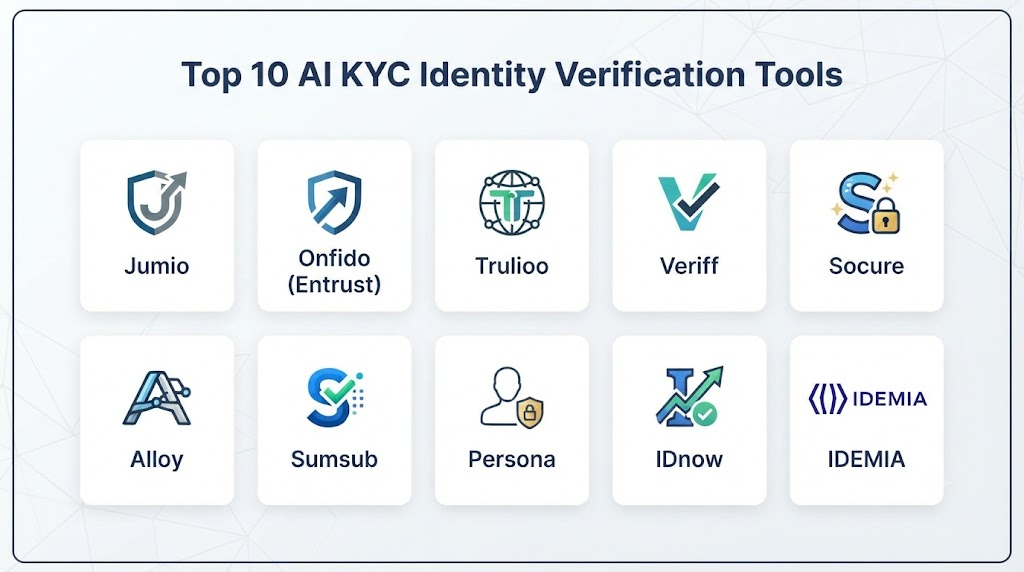
Top 10 AI KYC Identity Verification Tools
1 — Jumio
One-line verdict: Best for organizations needing mature digital identity verification, document analysis, biometrics, and fraud-prevention capabilities.
Short description:
Jumio provides digital identity-verification and fraud-prevention technology for organizations conducting remote customer onboarding. Its platform combines document verification, biometric technologies, and risk signals.
Standout Capabilities
- Identity document verification
- Facial verification
- Liveness detection
- Automated document analysis
- Identity risk assessment
- Fraud detection
- Digital onboarding
- Global identity verification
AI-Specific Depth
- Model support: Proprietary machine-learning and AI capabilities; exact models are not publicly stated.
- RAG / knowledge integration: N/A for the core identity-verification workflow.
- Evaluation: Vendor-specific evaluation methods are not publicly stated in full.
- Guardrails: Fraud and identity verification controls; implementation varies.
- Observability: Verification outcomes and workflow reporting; detailed model telemetry is not publicly stated.
Pros
- Mature identity-verification offering
- Broad document and biometric capabilities
- Designed for large-scale digital onboarding
Cons
- Enterprise-oriented
- Pricing can be complex
- Implementation may require integration work
Security & Compliance
Security controls, privacy practices, data retention, and certifications should be verified against current contractual and regional requirements.
Deployment & Platforms
- Deployment: Cloud
- Platforms: Web and mobile integrations
- Self-hosted: Not publicly stated
Integrations & Ecosystem
Jumio is designed to integrate identity verification into digital customer journeys.
- APIs
- Mobile SDKs
- Web integrations
- Identity workflows
- Fraud systems
- Customer onboarding platforms
Pricing Model
Enterprise and usage-based pricing; exact pricing varies.
Best-Fit Scenarios
- Digital banking
- Fintech onboarding
- Global customer verification
2 — Onfido
One-line verdict: Best for developers and businesses embedding document and biometric identity verification directly into digital onboarding experiences.
Short description:
Onfido provides automated identity verification technology focused on document verification, facial biometrics, and digital onboarding. It is particularly relevant to applications requiring remote identity checks.
Standout Capabilities
- Document verification
- Face verification
- Biometric checks
- Liveness capabilities
- Digital onboarding
- Identity workflows
- Fraud detection
- Developer integrations
AI-Specific Depth
- Model support: Proprietary AI and machine-learning technology; exact model architecture is not publicly stated.
- RAG / knowledge integration: N/A.
- Evaluation: Detailed model evaluation methodology is not publicly stated.
- Guardrails: Identity and fraud controls.
- Observability: Verification workflow results; model-level telemetry is not publicly stated.
Pros
- Developer-oriented integrations
- Strong digital onboarding focus
- Supports biometric verification
Cons
- Pricing varies by usage
- Regulatory requirements may require additional workflows
- Exact AI implementation details are proprietary
Security & Compliance
Security and privacy capabilities vary by service and region. Customers should verify current requirements directly with the provider.
Deployment & Platforms
- Deployment: Cloud
- Platforms: Web and mobile
- Self-hosted: Not publicly stated
Integrations & Ecosystem
- APIs
- Mobile SDKs
- Web SDKs
- Identity systems
- Fraud platforms
- Customer onboarding applications
Pricing Model
Usage-based and enterprise pricing; exact rates vary.
Best-Fit Scenarios
- Mobile onboarding
- Fintech applications
- Digital marketplaces
3 — Veriff
One-line verdict: Best for global businesses requiring automated identity verification combined with fraud detection and risk analysis.
Short description:
Veriff provides online identity verification technology designed to help businesses verify users remotely. Its capabilities cover identity documents, biometrics, fraud signals, and verification workflows.
Standout Capabilities
- Identity document verification
- Facial verification
- Liveness checks
- Fraud detection
- Identity risk signals
- Automated onboarding
- Global verification
- Workflow management
AI-Specific Depth
- Model support: Proprietary AI and machine learning; exact model architecture is not publicly stated.
- RAG / knowledge integration: N/A.
- Evaluation: Vendor evaluation methodology is not fully publicly stated.
- Guardrails: Fraud and verification controls.
- Observability: Verification results and analytics; detailed model telemetry varies.
Pros
- Strong global identity focus
- Combines verification and fraud signals
- Useful for digital onboarding
Cons
- Enterprise-oriented
- Pricing varies by usage
- Regulatory requirements differ by market
Security & Compliance
Customers should verify current security controls, certifications, retention policies, and regional data-processing arrangements.
Deployment & Platforms
- Deployment: Cloud
- Platforms: Web and mobile
- Self-hosted: Not publicly stated
Integrations & Ecosystem
- APIs
- SDKs
- Web applications
- Mobile applications
- Fraud workflows
- Customer onboarding systems
Pricing Model
Usage-based and enterprise pricing; exact pricing varies.
Best-Fit Scenarios
- Global fintech
- Online marketplaces
- Digital financial services
4 — Trulioo
One-line verdict: Best for organizations combining identity verification, business verification, and global customer onboarding capabilities.
Short description:
Trulioo provides digital identity verification and verification infrastructure for businesses operating across multiple markets. Its platform supports identity workflows and broader verification use cases.
Standout Capabilities
- Identity verification
- Document verification
- Global identity data
- Business verification
- Digital onboarding
- Fraud prevention
- Risk workflows
- API integrations
AI-Specific Depth
- Model support: AI and machine-learning capabilities vary; exact models are not publicly stated.
- RAG / knowledge integration: N/A.
- Evaluation: Not publicly stated.
- Guardrails: Identity and fraud controls.
- Observability: Verification and workflow reporting; model-level telemetry is not publicly stated.
Pros
- Global verification focus
- Broad verification ecosystem
- Useful API-oriented architecture
Cons
- Global coverage can require configuration
- Pricing depends on verification requirements
- Complex compliance programs may need additional systems
Security & Compliance
Security and privacy controls should be evaluated according to geography and intended use.
Deployment & Platforms
- Deployment: Cloud
- Platforms: Web and API
- Self-hosted: Not publicly stated
Integrations & Ecosystem
- APIs
- Identity systems
- Business verification
- Fraud tools
- Onboarding platforms
- Enterprise applications
Pricing Model
Usage-based and enterprise pricing.
Best-Fit Scenarios
- Global onboarding
- Marketplaces
- Financial services
5 — Persona
One-line verdict: Best for companies building customizable identity-verification and fraud-prevention workflows into modern applications.
Short description:
Persona provides identity infrastructure designed to let organizations create customizable verification workflows. It supports identity verification and fraud-related processes through APIs and developer integrations.
Standout Capabilities
- Identity verification
- Document verification
- Biometric verification
- Workflow customization
- Fraud detection
- Case management
- Developer APIs
- Digital onboarding
AI-Specific Depth
- Model support: Proprietary AI capabilities; exact models are not publicly stated.
- RAG / knowledge integration: N/A.
- Evaluation: Detailed AI evaluation methodology is not publicly stated.
- Guardrails: Verification workflows and configurable controls.
- Observability: Workflow-level reporting; detailed model metrics are not publicly stated.
Pros
- Flexible workflows
- Developer-friendly architecture
- Strong customization potential
Cons
- Configuration can require technical resources
- Pricing varies
- Compliance teams may require additional governance
Security & Compliance
Security and privacy controls should be reviewed according to the organization’s requirements and the specific Persona configuration.
Deployment & Platforms
- Deployment: Cloud
- Platforms: Web and mobile
- Self-hosted: Not publicly stated
Integrations & Ecosystem
- APIs
- SDKs
- Identity workflows
- Case management
- Fraud systems
- Customer applications
Pricing Model
Usage-based and enterprise pricing; exact pricing varies.
Best-Fit Scenarios
- Fintech applications
- Customized onboarding
- Developer-led identity workflows
6 — Socure
One-line verdict: Best for organizations focused on digital identity verification, fraud prevention, and risk-based customer onboarding.
Short description:
Socure provides digital identity verification and fraud-prevention technology. Its approach combines identity signals and machine learning to help organizations assess customers during digital onboarding.
Standout Capabilities
- Identity verification
- Fraud detection
- Digital identity risk
- Document verification
- Customer screening
- Risk assessment
- Automated decisioning
- Identity intelligence
AI-Specific Depth
- Model support: Proprietary machine-learning models; exact architectures are not publicly stated.
- RAG / knowledge integration: N/A.
- Evaluation: Vendor-specific methodology is not publicly stated.
- Guardrails: Risk and identity controls.
- Observability: Decision and verification reporting; model-level telemetry varies.
Pros
- Strong fraud-prevention orientation
- Machine-learning focused
- Useful for risk-based onboarding
Cons
- More enterprise-oriented
- Fraud and identity workflows can be complex
- Pricing is not generally standardized publicly
Security & Compliance
Organizations should verify current security certifications, privacy practices, data-processing terms, and retention options.
Deployment & Platforms
- Deployment: Cloud
- Platforms: Web and API
- Self-hosted: Not publicly stated
Integrations & Ecosystem
- APIs
- Fraud platforms
- Identity systems
- Customer onboarding
- Risk engines
- Enterprise applications
Pricing Model
Enterprise and usage-based pricing.
Best-Fit Scenarios
- Financial services
- Fraud-sensitive onboarding
- Digital lending
7 — Sumsub
One-line verdict: Best for businesses seeking a broad KYC, AML, identity verification, and transaction-monitoring ecosystem.
Short description:
Sumsub provides compliance and verification technology covering KYC, AML, identity verification, and related risk workflows. It is particularly relevant to fintech, marketplaces, and digital platforms.
Standout Capabilities
- KYC verification
- Identity document verification
- Biometric checks
- AML screening
- Fraud prevention
- Transaction monitoring
- Business verification
- Compliance workflows
AI-Specific Depth
- Model support: Proprietary AI and machine-learning capabilities; exact models are not publicly stated.
- RAG / knowledge integration: N/A for core KYC verification.
- Evaluation: Detailed AI evaluation methodology is not publicly stated.
- Guardrails: Risk, fraud, and compliance controls.
- Observability: Compliance and verification reporting.
Pros
- Broad compliance functionality
- Combines KYC and AML
- Suitable for international platforms
Cons
- Broad feature set can increase implementation complexity
- Pricing varies by use case
- Regulatory configuration requires careful review
Security & Compliance
Organizations should verify specific certifications, security controls, retention settings, and data residency for their jurisdiction.
Deployment & Platforms
- Deployment: Cloud
- Platforms: Web and mobile
- Self-hosted: Not publicly stated
Integrations & Ecosystem
- APIs
- SDKs
- KYC systems
- AML workflows
- Fraud tools
- Business verification
- Transaction monitoring
Pricing Model
Usage-based and enterprise pricing.
Best-Fit Scenarios
- Fintech
- Cryptocurrency platforms
- Global marketplaces
8 — IDnow
One-line verdict: Best for organizations requiring digital identity verification with options supporting automated and assisted verification workflows.
Short description:
IDnow provides identity verification technology for digital customer onboarding and identity-related compliance processes. Its ecosystem includes automated and human-assisted verification approaches.
Standout Capabilities
- Identity verification
- Document analysis
- Biometric verification
- Digital onboarding
- Fraud prevention
- Video-based verification options
- Compliance workflows
- Identity management
AI-Specific Depth
- Model support: Proprietary AI and machine-learning technology; exact models are not publicly stated.
- RAG / knowledge integration: N/A.
- Evaluation: Not publicly stated.
- Guardrails: Identity and fraud controls.
- Observability: Verification reporting; detailed AI telemetry is not publicly stated.
Pros
- Combination of automation and assisted verification
- Strong identity focus
- Useful for regulated onboarding
Cons
- Regional requirements may affect implementation
- Enterprise pricing
- Some use cases may require manual review
Security & Compliance
Security and compliance capabilities should be verified based on the exact product and target market.
Deployment & Platforms
- Deployment: Cloud
- Platforms: Web and mobile
- Self-hosted: Not publicly stated
Integrations & Ecosystem
- APIs
- Mobile SDKs
- Web integrations
- Identity systems
- Fraud platforms
- Customer onboarding
Pricing Model
Enterprise and usage-based pricing.
Best-Fit Scenarios
- European financial services
- Digital onboarding
- Regulated customer verification
9 — iDenfy
One-line verdict: Best for businesses seeking integrated identity verification, fraud prevention, and compliance workflows through APIs.
Short description:
iDenfy provides identity verification and compliance technology designed for digital businesses. Its services can support identity-document verification, biometric verification, and related onboarding processes.
Standout Capabilities
- Identity verification
- Document verification
- Facial verification
- Liveness
- Fraud prevention
- KYC workflows
- AML-related processes
- API integration
AI-Specific Depth
- Model support: Machine-learning and automated verification capabilities; exact models are not publicly stated.
- RAG / knowledge integration: N/A.
- Evaluation: Not publicly stated.
- Guardrails: KYC and fraud controls.
- Observability: Verification workflow reporting.
Pros
- Broad identity functionality
- API-oriented integration
- Useful for digital businesses
Cons
- Less suitable for highly customized enterprise GRC requirements
- Pricing varies
- Regional coverage should be verified
Security & Compliance
Verify applicable security controls, certifications, data processing, retention, and residency requirements before deployment.
Deployment & Platforms
- Deployment: Cloud
- Platforms: Web and mobile
- Self-hosted: Not publicly stated
Integrations & Ecosystem
- APIs
- SDKs
- KYC platforms
- Fraud tools
- AML workflows
- Customer onboarding
Pricing Model
Usage-based and enterprise pricing.
Best-Fit Scenarios
- Online marketplaces
- Fintech onboarding
- Digital services
10 — Veridas
One-line verdict: Best for organizations emphasizing biometric identity verification, document analysis, and secure digital identity experiences.
Short description:
Veridas specializes in biometric identity technology, including facial and voice biometrics, identity verification, and related authentication applications.
Standout Capabilities
- Face biometrics
- Identity verification
- Document analysis
- Liveness-related capabilities
- Voice biometrics
- Authentication
- Digital identity
- Fraud prevention
AI-Specific Depth
- Model support: Proprietary AI and biometric models; exact architectures are not publicly stated.
- RAG / knowledge integration: N/A.
- Evaluation: Detailed model evaluation is not publicly stated.
- Guardrails: Biometric and authentication controls.
- Observability: Verification and authentication results; model-level telemetry varies.
Pros
- Strong biometric specialization
- Multiple biometric modalities
- Useful for identity and authentication workflows
Cons
- Biometric deployments require careful privacy governance
- Not a complete compliance-management platform
- Implementation requirements vary
Security & Compliance
Organizations should independently evaluate biometric-data handling, retention, encryption, access controls, regional processing, and applicable certifications.
Deployment & Platforms
- Deployment: Cloud / deployment options vary
- Platforms: Web and mobile integrations
- Self-hosted: Varies / N/A
Integrations & Ecosystem
- APIs
- SDKs
- Identity platforms
- Authentication systems
- Mobile applications
- Enterprise security systems
Pricing Model
Enterprise and usage-based pricing; exact pricing varies.
Best-Fit Scenarios
- Biometric identity
- Digital authentication
- High-assurance onboarding
Comparison Table
| Tool | Best For | Deployment | Model Flexibility | Strength | Watch-Out | Public Rating |
|---|---|---|---|---|---|---|
| Jumio | Enterprise KYC | Cloud | Proprietary / managed | Mature verification | Enterprise complexity | N/A |
| Onfido | Digital onboarding | Cloud | Proprietary / managed | Developer integration | Pricing varies | N/A |
| Veriff | Global verification | Cloud | Proprietary / managed | Fraud + identity | Regional requirements | N/A |
| Trulioo | Global identity | Cloud | Managed | Broad verification | Complex configurations | N/A |
| Persona | Custom identity workflows | Cloud | Proprietary / managed | Flexibility | Technical setup | N/A |
| Socure | Fraud-aware identity | Cloud | Proprietary / managed | Risk intelligence | Enterprise focus | N/A |
| Sumsub | KYC + AML | Cloud | Managed | Broad compliance | Implementation complexity | N/A |
| IDnow | Assisted + automated KYC | Cloud | Managed | Verification options | Regional variation | N/A |
| iDenfy | API-based KYC | Cloud | Managed | Integrated workflows | Coverage varies | N/A |
| Veridas | Biometrics | Cloud / varies | Proprietary | Biometric specialization | Privacy complexity | N/A |
Scoring & Evaluation
The scores below are comparative editorial assessments rather than independently audited benchmarks. Actual performance depends heavily on geography, document types, customer population, fraud patterns, integration quality, and configuration.
| Tool | Core | Reliability/Eval | Guardrails | Integrations | Ease | Perf/Cost | Security/Admin | Support | Weighted Total |
|---|---|---|---|---|---|---|---|---|---|
| Jumio | 10 | 9 | 9 | 9 | 8 | 8 | 9 | 9 | 8.95 |
| Onfido | 9 | 9 | 9 | 10 | 9 | 8 | 9 | 9 | 9.00 |
| Veriff | 9 | 9 | 9 | 9 | 9 | 8 | 9 | 9 | 8.90 |
| Trulioo | 9 | 8 | 9 | 10 | 8 | 8 | 9 | 9 | 8.80 |
| Persona | 9 | 9 | 9 | 10 | 8 | 8 | 9 | 9 | 8.95 |
| Socure | 10 | 9 | 9 | 9 | 8 | 8 | 9 | 9 | 8.95 |
| Sumsub | 10 | 8 | 9 | 9 | 8 | 8 | 9 | 9 | 8.80 |
| IDnow | 9 | 8 | 9 | 9 | 8 | 8 | 9 | 9 | 8.65 |
| iDenfy | 8 | 8 | 9 | 9 | 9 | 8 | 8 | 9 | 8.55 |
| Veridas | 9 | 9 | 9 | 8 | 8 | 8 | 9 | 9 | 8.65 |
Top 3 for Enterprise
- Jumio
- Socure
- Veriff
Top 3 for SMB
- iDenfy
- Onfido
- Persona
Top 3 for Developers
- Persona
- Onfido
- Veriff
Which AI KYC Identity Verification Tool Is Right for You?
Solo / Freelancer
Most freelancers do not need a full KYC infrastructure platform unless identity verification is central to their product.
Consider a managed API if you need:
- Customer identity checks
- Age verification
- Marketplace seller verification
- Basic fraud controls
Avoid building biometric infrastructure from scratch unless you have a strong technical and compliance reason.
SMB
SMBs should prioritize:
- Easy API integration
- Transparent verification workflows
- Reasonable per-verification economics
- Document coverage
- Mobile support
- Manual review
- Fraud detection
Onfido, Persona, iDenfy, and similar API-focused platforms can be worth evaluating.
Mid-Market
Mid-market businesses often need more advanced capabilities.
Prioritize:
- Multiple document types
- International coverage
- Risk signals
- Liveness
- Fraud detection
- Workflow customization
- Reporting
- Case management
- AML integrations
Enterprise
Large organizations should evaluate the complete identity ecosystem rather than only document verification.
Look for:
- Global coverage
- High-volume processing
- Multiple verification methods
- Advanced fraud detection
- Risk scoring
- Strong APIs
- SDKs
- Enterprise administration
- Auditability
- Data governance
- Regional processing options
- Disaster recovery
- Vendor risk controls
Jumio, Veriff, Socure, Trulioo, and other established providers are suitable candidates for enterprise evaluations.
Regulated Industries
Banks, lenders, insurers, payment companies, and other regulated businesses should evaluate KYC technology as part of a larger compliance architecture.
Consider:
- KYC requirements
- AML requirements
- Data-protection laws
- Biometric regulations
- Record retention
- Human-review requirements
- Audit trails
- Model governance
- Explainability
- False-positive management
A technically impressive model is not enough if the overall workflow cannot meet regulatory obligations.
Budget vs Premium
Budget-conscious businesses should focus on:
- Per-verification cost
- Failure rates
- Manual review costs
- Integration effort
- Document coverage
- Fraud losses avoided
Premium platforms can make more sense when:
- Customer volumes are high
- Fraud is expensive
- International coverage is required
- Multiple verification methods are needed
- Compliance requirements are complex
Build vs Buy
Build when:
- Identity verification is a strategic core capability.
- You have specialist ML and biometric expertise.
- You need highly customized decisioning.
- You have strong security and compliance engineering resources.
Buy when:
- You need rapid deployment.
- You require broad document coverage.
- You need maintained biometric models.
- You operate internationally.
- Regulatory requirements change frequently.
For most organizations, buying core identity-verification infrastructure and integrating it into an internal risk platform is more practical than building everything from scratch.
Implementation Playbook: 30 / 60 / 90 Days
First 30 Days: Pilot
Select one onboarding workflow.
Define:
- Customer types
- Target countries
- Accepted documents
- Verification steps
- Fraud scenarios
- Manual review criteria
- Escalation procedures
Measure:
- Verification completion rate
- False rejection rate
- Manual review rate
- Average verification time
- Customer drop-off
- Fraud detection rate
Create a representative test set containing legitimate and suspicious verification attempts.
Days 31–60: Harden Security and Evaluation
Test:
- Poor-quality documents
- Damaged documents
- Expired documents
- Altered documents
- Screenshots
- Printed photographs
- Replay attacks
- Deepfake-like inputs
- Face mismatches
- Unusual lighting
- Different devices
Establish:
- Access controls
- Audit logs
- Data retention policies
- Incident procedures
- Human-review workflows
- Model monitoring
- Privacy controls
Evaluate performance separately across relevant customer populations and document types.
Days 61–90: Optimize and Scale
Expand the workflow after validating the pilot.
Integrate:
- Fraud systems
- AML screening
- Customer-risk engines
- CRM
- Case-management tools
- Account-opening systems
- Transaction monitoring
Monitor:
- Verification latency
- Failure rates
- Fraud trends
- False positives
- False negatives
- Manual-review volume
- Cost per verification
Create governance procedures for vendor changes, model changes, verification rules, and new geographic markets.
Common Mistakes and How to Avoid Them
- Treating KYC as only document OCR: Identity verification requires broader identity and fraud signals.
- Ignoring presentation attacks: Test against photographs, screens, replays, and manipulated inputs.
- Over-relying on facial recognition: Biometrics should be one component of a broader risk framework.
- Ignoring false positives: Rejected legitimate customers can create serious business and customer-experience problems.
- No human-review process: Ambiguous cases should have an escalation path.
- Poor data retention practices: Do not retain identity information longer than necessary.
- Ignoring biometric privacy: Biometric information can create additional legal and security obligations.
- No regional testing: Document formats and verification requirements vary across countries.
- Ignoring accessibility: Verification workflows should account for users with different accessibility needs.
- No fraud testing: Test the platform using realistic attack scenarios before production.
- Assuming high accuracy everywhere: Model performance can vary by document type, image quality, population, and environment.
- Weak API security: Protect API keys, webhooks, credentials, and verification results.
- No audit trail: Record important verification decisions and workflow events.
- Automating every decision: High-risk or ambiguous cases may require human intervention.
- Ignoring vendor dependency: Maintain contingency procedures if the verification provider becomes unavailable.
- Optimizing only for conversion: A higher approval rate is not necessarily better if fraud increases.
FAQs
What is AI KYC identity verification?
AI KYC identity verification uses machine learning, computer vision, document analysis, biometrics, and automated risk signals to help businesses verify customer identities.
How does machine learning improve KYC?
Machine learning can help identify document anomalies, classify documents, compare faces, detect suspicious patterns, and automate portions of identity-verification workflows.
Can AI verify an identity document?
Yes. AI-powered systems can analyze identity documents and check information, visual characteristics, and other signals. Exact capabilities vary by provider and document type.
What is facial verification?
Facial verification compares a person’s facial characteristics with an identity reference, such as a photograph on an identity document. It is different from simply identifying a person from a large database.
What is liveness detection?
Liveness detection is designed to help determine whether a biometric sample appears to come from a live person rather than a presentation attack such as a photograph or replay.
Can AI KYC detect fake IDs?
AI can help detect suspicious or manipulated identity documents, but no technology should be treated as infallible. Detection performance depends on document type, image quality, attack method, and system configuration.
Is biometric KYC secure?
Biometric KYC can be secure when appropriately designed, but biometric data introduces significant privacy and security considerations. Organizations should carefully evaluate storage, encryption, access, retention, processing, and regulatory requirements.
Can KYC platforms be self-hosted?
Most mainstream KYC providers primarily offer cloud-based services. Self-hosting availability varies by vendor and product.
Can I integrate AI KYC through an API?
Yes. Many identity-verification providers offer APIs and software-development kits for integrating verification directly into web and mobile applications.
How much does AI KYC cost?
Pricing commonly depends on verification volume, verification type, geography, integrations, and additional screening services. Exact pricing varies by provider.
Can AI KYC replace compliance officers?
No. AI can automate repetitive verification tasks, but compliance teams remain responsible for policies, exceptions, risk decisions, regulatory interpretation, and oversight.
What should I test before choosing a KYC platform?
Test real-world documents, verification completion, false rejection, manual review rates, fraud scenarios, latency, API reliability, geographic coverage, privacy controls, and total cost.
What is the difference between KYC and AML?
KYC focuses heavily on establishing and verifying customer identity. AML covers broader processes designed to identify and manage money-laundering and related financial-crime risks. The two processes often work together.
Can AI KYC work internationally?
Yes, many platforms support international identity verification, but document coverage and verification quality can vary significantly between countries.
Should KYC decisions be fully automated?
Not necessarily. Low-risk straightforward cases may be automated, while ambiguous or high-risk cases should have appropriate human review and escalation.
Conclusion
AI KYC Identity Verification with ML is becoming an important component of modern digital onboarding. By combining document analysis, machine learning, biometrics, liveness detection, and fraud signals, these platforms can help organizations verify customers faster while reducing manual operational work.best choice depends heavily on the business model. A fintech startup may prioritize an easy API and fast onboarding, while a multinational financial institution may need global document coverage, advanced fraud detection, extensive auditability, and strong governance.Platforms such as Jumio, Onfido, Veriff, Persona, Trulioo, Socure, Sumsub, IDnow, iDenfy, and Veridas represent different approaches to digital identity verification.