Introduction
AI Litigation Outcome Prediction tools use artificial intelligence, machine learning, legal analytics, and historical case data to help legal professionals estimate how a lawsuit or dispute might develop. Instead of relying only on intuition or manually reviewing large collections of past cases, attorneys can use analytical systems to identify patterns in case outcomes, judges, courts, claims, damages, procedural events, and other factors.
These platforms can support early case assessment, litigation strategy, settlement analysis, legal research, risk management, and resource planning. They are particularly useful when a legal team needs to evaluate many cases or compare a current matter with historical litigaLitigation attorneys, law firms, corporate legal departments, legal operations teams, insurers, financial institutions, and organizations managing significant litigation portfo Very small matters with limited historical data, cases involving highly unusual facts, or situations where users expect AI to provide a guaranteed prediction of a court’s decision.
What Is AI Litigation Outcome Prediction?
AI Litigation Outcome Prediction refers to the use of data-driven technologies to estimate potential litigation outcomes based on historical and current case information.
Depending on the platform, analysis may incorporate:
- Historical case outcomes
- Court decisions
- Judge behavior
- Court characteristics
- Case types
- Claims and allegations
- Procedural history
- Damages
- Parties
- Attorneys
- Jurisdiction
- Filing patterns
- Settlement information where available
- Legal authorities
- Case similarities
The output may take different forms, including:
- Probability estimates
- Risk scores
- Similar-case analysis
- Outcome trends
- Judge analytics
- Settlement insights
- Damages ranges
- Case comparisons
- Litigation portfolio analytics
A prediction should be treated as decision support rather than a substitute for legal judgment. Litigation outcomes depend on facts, evidence, law, procedural developments, judicial decisions, advocacy, settlement negotiations, and factors that may not be represented in historical datasets.
How AI Litigation Outcome Prediction Works
1. Data Collection
The system gathers relevant legal information from available datasets.
This may include:
- Court opinions
- Case dockets
- Litigation records
- Judicial decisions
- Case metadata
- Public records
- User-provided case information
2. Data Normalization
Legal datasets often contain inconsistent terminology and formatting. AI systems normalize information so cases can be compared more effectively.
3. Feature Extraction
The system identifies potentially relevant characteristics, such as:
- Court
- Judge
- Case type
- Legal claims
- Procedural stage
- Parties
- Historical outcomes
4. Similarity Analysis
Machine-learning and semantic-analysis techniques can identify cases that resemble the current matter.
5. Predictive Modeling
The platform may use historical patterns to estimate potential outcomes or identify litigation risks.
6. Human Interpretation
Attorneys review the results in the context of the specific facts, evidence, applicable law, and procedural circumstances.
This final step is essential because historical correlation does not guarantee future legal outcomes.
Why AI Litigation Outcome Prediction Matters
Litigation can be expensive, unpredictable, and resource-intensive.
AI-assisted analytics can help legal teams:
- Identify cases requiring deeper analysis
- Prioritize litigation resources
- Prepare settlement strategies
- Understand historical court patterns
- Compare similar cases
- Analyze potential damages
- Identify litigation risks
- Support portfolio-level decisions
- Improve consistency in early case assessment
The greatest value often comes from better-informed decision-making rather than attempting to produce a perfectly accurate prediction.
Key Features to Evaluate
When evaluating litigation outcome prediction platforms, look for:
- Historical case databases
- Court analytics
- Judge analytics
- Case similarity search
- Outcome analytics
- Damages analysis
- Natural-language search
- AI-assisted research
- Predictive analytics
- Litigation portfolio analysis
- Data visualization
- Explainability
- Source citations
- Data freshness
- Jurisdiction coverage
- Export capabilities
- API access
- Security controls
- Access management
- Auditability
What Has Changed in AI Litigation Outcome Prediction
- Natural-language case analysis is becoming easier: Users can increasingly describe a matter conversationally rather than relying only on structured filters.
- Semantic similarity is improving: AI can compare cases based on meaning rather than exact keyword matches.
- Generative AI is being combined with legal analytics: Predictive data can increasingly be paired with AI-generated explanations and summaries.
- Multimodal analysis is expanding: Future workflows can combine case text with documents, tables, evidence, and other structured information.
- Explainability is becoming more important: Legal professionals need to understand why an analytical result was produced.
- Data provenance matters more: Buyers should know where case information originates and how frequently it is updated.
- Bias monitoring is increasingly important: Historical datasets can contain biases that may influence analytical outputs.
- Human oversight remains essential: Predictions should inform legal judgment rather than replace it.
- Privacy and confidentiality are major concerns: Matter-specific information requires strong data governance.
- AI evaluation is becoming a procurement requirement: Organizations should test predictions against historical cases before production use.
- Model changes can affect results: Teams should understand how updates may change analytical outputs.
- Portfolio-level analytics are becoming more valuable: Large organizations can analyze patterns across many disputes instead of treating every matter independently.
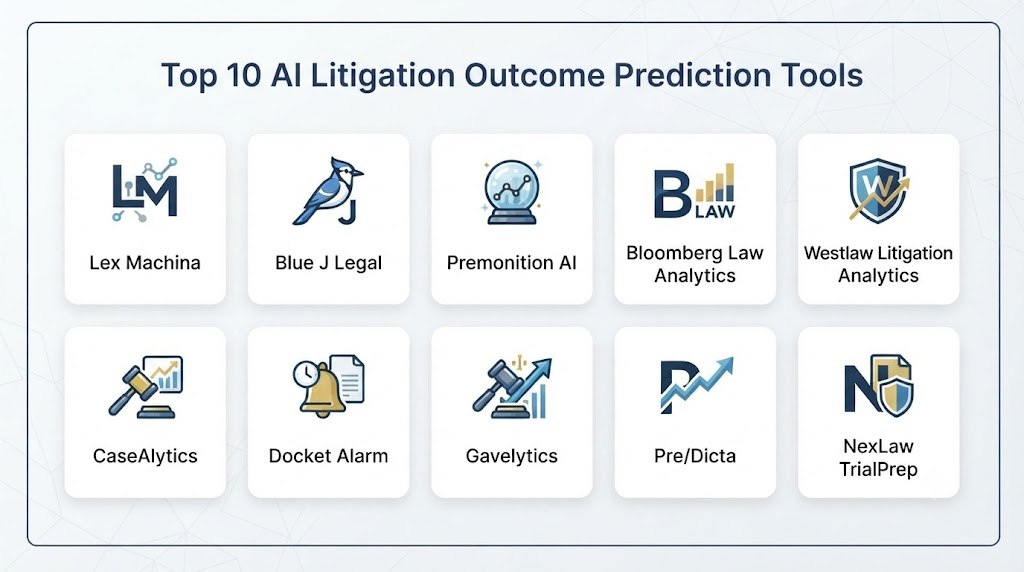
Top 10 AI Litigation Outcome Prediction Tools
1 — Lex Machina
One-line verdict: Best for litigation analytics, judge insights, case trends, and data-driven early assessment of legal disputes.
Short description:
Lex Machina is a legal analytics platform focused on litigation data. It provides analytics around cases, judges, attorneys, parties, and outcomes, helping legal teams analyze historical litigation patterns.
Standout Capabilities
- Litigation analytics
- Judge analytics
- Attorney analytics
- Party analytics
- Case outcome analysis
- Damages information
- Case search
- Litigation trends
AI-Specific Depth
- Model support: Proprietary analytics and machine-learning capabilities; exact underlying models are not publicly stated.
- RAG / knowledge integration: Legal case data rather than a traditional enterprise RAG architecture.
- Evaluation: Historical data analysis and analytics validation; exact internal evaluation methodology is not publicly stated.
- Guardrails: Professional legal research workflow and access controls.
- Observability: Analytics and reporting are available; detailed model telemetry is not publicly stated.
Pros
- Strong litigation-specific focus
- Useful judge and case analytics
- Valuable for early case assessment
Cons
- Primarily designed for professional legal users
- Coverage varies by jurisdiction and case type
- Predictive outputs should not be treated as guarantees
Security & Compliance
Security and administrative capabilities vary by enterprise configuration. Specific certifications and retention controls should be verified directly.
Deployment & Platforms
- Deployment: Cloud
- Platforms: Web
- Self-hosted: Not publicly stated
Integrations & Ecosystem
Lex Machina is designed around legal analytics and litigation research.
- Case analytics
- Judge analytics
- Attorney analytics
- Party analytics
- Litigation research
- Legal workflows
Pricing Model
Enterprise or subscription-oriented pricing; exact pricing is not publicly standardized.
Best-Fit Scenarios
- Early case assessment
- Litigation strategy
- Judge and court research
2 — Premonition
One-line verdict: Best for litigation teams analyzing historical attorney and judge performance to support case strategy and selection.
Short description:
Premonition focuses on legal analytics involving judges, attorneys, courts, and litigation outcomes. Its data-driven approach can help organizations examine historical performance patterns.
Standout Capabilities
- Judge analytics
- Attorney analytics
- Litigation data
- Court analysis
- Case outcome analysis
- Historical comparisons
- Legal intelligence
- Litigation strategy support
AI-Specific Depth
- Model support: Proprietary analytics; exact AI model architecture is not publicly stated.
- RAG / knowledge integration: Legal datasets and case information.
- Evaluation: Historical litigation analysis; detailed evaluation methodology is not publicly stated.
- Guardrails: Professional analytics workflows.
- Observability: Detailed model-level observability is not publicly stated.
Pros
- Strong focus on litigation performance
- Useful for strategy development
- Data-driven attorney and judge analysis
Cons
- Historical data does not guarantee future outcomes
- Exact methodology can be difficult for users to independently assess
- Availability varies by jurisdiction
Security & Compliance
Enterprise security details and certifications should be verified for the intended deployment.
Deployment & Platforms
- Deployment: Cloud
- Platforms: Web
- Self-hosted: Not publicly stated
Integrations & Ecosystem
- Litigation data
- Judge analytics
- Attorney analytics
- Court analytics
- Legal intelligence
Pricing Model
Not publicly standardized.
Best-Fit Scenarios
- Litigation strategy
- Attorney selection
- Historical judge analysis
3 — Gavelytics
One-line verdict: Best for legal professionals seeking court and judge analytics to improve litigation strategy and case preparation.
Short description:
Gavelytics provides legal analytics designed to help attorneys understand judges, courts, motions, and litigation patterns.
Standout Capabilities
- Judge analytics
- Motion analytics
- Court insights
- Litigation research
- Case analysis
- Judicial trends
- Data visualization
- Legal intelligence
AI-Specific Depth
- Model support: Proprietary analytics; exact model architecture is not publicly stated.
- RAG / knowledge integration: Legal case and court information.
- Evaluation: Historical legal data analysis.
- Guardrails: Professional legal workflow controls.
- Observability: Detailed AI telemetry is not publicly stated.
Pros
- Strong judicial analytics
- Useful for litigation preparation
- Focused analytics interface
Cons
- Geographic coverage may vary
- Not a complete legal research platform
- Predictive interpretation requires legal expertise
Security & Compliance
Specific certifications and enterprise security details should be verified with the provider.
Deployment & Platforms
- Deployment: Cloud
- Platforms: Web
- Self-hosted: Not publicly stated
Integrations & Ecosystem
- Court data
- Judge analytics
- Motion analytics
- Litigation research
- Legal intelligence
Pricing Model
Not publicly standardized.
Best-Fit Scenarios
- Judge research
- Motion strategy
- Litigation preparation
4 — Blue J
One-line verdict: Best for legal professionals using predictive analytics to explore potential outcomes across selected legal questions and scenarios.
Short description:
Blue J provides legal analytics and predictive tools intended to help professionals analyze legal outcomes using historical data and structured legal reasoning.
Standout Capabilities
- Legal prediction
- Scenario analysis
- Outcome estimation
- Legal research
- Explainable analytics
- Historical data analysis
- Decision support
- Legal education and professional workflows
AI-Specific Depth
- Model support: Proprietary predictive analytics.
- RAG / knowledge integration: Legal datasets and structured legal information.
- Evaluation: Predictive analytics based on historical legal data.
- Guardrails: Legal-domain workflow and professional review.
- Observability: Detailed model telemetry is not publicly stated.
Pros
- Strong predictive-analysis orientation
- Scenario-based reasoning
- Designed around legal questions
Cons
- Coverage depends on supported legal areas
- Predictions require contextual interpretation
- Not a replacement for legal advice
Security & Compliance
Specific enterprise security and certification details are not uniformly publicly stated.
Deployment & Platforms
- Deployment: Cloud
- Platforms: Web
- Self-hosted: Not publicly stated
Integrations & Ecosystem
- Legal research
- Predictive analytics
- Scenario analysis
- Case assessment
- Legal education
Pricing Model
Not publicly standardized.
Best-Fit Scenarios
- Outcome analysis
- Legal scenario evaluation
- Early case assessment
5 — Westlaw Precision with AI
One-line verdict: Best for legal teams combining advanced legal research with AI-assisted case analysis and litigation preparation.
Short description:
Westlaw Precision combines extensive legal research capabilities with AI-assisted workflows. It can support litigation research, case analysis, document review, and legal reasoning.
Standout Capabilities
- Legal research
- Case-law analysis
- AI-assisted research
- Natural-language queries
- Litigation research
- Document analysis
- Legal drafting support
- Source-based research
AI-Specific Depth
- Model support: Vendor-managed AI; exact model architecture varies.
- RAG / knowledge integration: Extensive legal information and user-provided material depending on workflow.
- Evaluation: Source-oriented legal research and professional validation.
- Guardrails: Legal research controls and source-oriented workflows.
- Observability: Detailed model telemetry is not publicly stated.
Pros
- Broad legal research ecosystem
- Strong source coverage
- Useful beyond prediction alone
Cons
- Broader than a dedicated litigation prediction platform
- Subscription complexity
- AI results require verification
Security & Compliance
Enterprise security and administrative capabilities are available depending on the product and contract. Specific requirements should be verified.
Deployment & Platforms
- Deployment: Cloud
- Platforms: Web
- Self-hosted: Not publicly stated
Integrations & Ecosystem
- Legal research
- Case law
- Litigation workflows
- Legal documents
- AI research
- Enterprise legal systems
Pricing Model
Subscription and enterprise licensing; exact pricing varies.
Best-Fit Scenarios
- Litigation research
- Case assessment
- Enterprise legal research
6 — vLex Vincent AI
One-line verdict: Best for global legal research teams combining AI analysis with broad legal information and case-law discovery.
Short description:
Vincent is an AI-powered legal research and analysis environment associated with vLex. It can assist with legal research, document analysis, and synthesis of legal information.
Standout Capabilities
- AI legal research
- Case analysis
- Legal document analysis
- Natural-language questions
- Cross-jurisdiction research
- Legal summarization
- Source discovery
- Comparative analysis
AI-Specific Depth
- Model support: Vendor-managed AI; exact model configuration varies.
- RAG / knowledge integration: Legal information and user-provided documents.
- Evaluation: Source-grounded legal research workflows.
- Guardrails: Legal-domain controls and source references.
- Observability: Detailed model telemetry is not publicly stated.
Pros
- Broad legal information
- Useful for complex research
- AI-assisted synthesis
Cons
- Not solely focused on outcome prediction
- Output still needs legal review
- Features vary by subscription
Security & Compliance
Security and enterprise controls vary. Specific certifications should be confirmed for the intended deployment.
Deployment & Platforms
- Deployment: Cloud
- Platforms: Web
- Self-hosted: Not publicly stated
Integrations & Ecosystem
- Legal research
- Case law
- Legal documents
- Cross-border research
- AI analysis
- Enterprise workflows
Pricing Model
Subscription and enterprise options; exact pricing varies.
Best-Fit Scenarios
- Global litigation
- Comparative legal research
- Early case assessment
7 — Harvey
One-line verdict: Best for enterprise legal teams creating customized AI workflows around litigation analysis and complex legal matters.
Short description:
Harvey provides AI-powered legal workflows for professional legal teams. Its capabilities can be adapted to legal research, document analysis, drafting, and litigation-related work.
Standout Capabilities
- Legal analysis
- Document review
- Legal research
- Summarization
- Workflow customization
- Enterprise AI
- Natural-language interaction
- Complex matter analysis
AI-Specific Depth
- Model support: Multiple AI technologies may be supported; exact configurations vary.
- RAG / knowledge integration: Matter-specific and organization-specific information depending on workflow.
- Evaluation: Enterprise teams can create workflow-specific evaluations.
- Guardrails: Enterprise controls and workflow governance.
- Observability: Detailed model telemetry is not publicly stated.
Pros
- Highly adaptable
- Strong legal orientation
- Suitable for enterprise workflows
Cons
- Enterprise-focused
- Pricing is not publicly standardized
- Requires governance and validation
Security & Compliance
Enterprise security controls are available, but current certifications, retention, residency, and other controls should be verified.
Deployment & Platforms
- Deployment: Cloud
- Platforms: Web
- Self-hosted: Not publicly stated
Integrations & Ecosystem
- Legal documents
- Enterprise knowledge
- Legal research
- AI workflows
- Litigation materials
- Document management
Pricing Model
Enterprise pricing; exact pricing is not publicly standardized.
Best-Fit Scenarios
- Enterprise litigation
- Custom legal AI
- Large legal departments
8 — CoCounsel
One-line verdict: Best for legal professionals using AI to accelerate research, document analysis, summarization, and litigation workflows.
Short description:
CoCounsel is an AI legal assistant designed to support professional legal work. It can assist with research, document analysis, summarization, and other litigation-related tasks.
Standout Capabilities
- Legal research
- Document analysis
- Summarization
- AI-assisted reasoning
- Litigation support
- Natural-language interaction
- Legal workflow automation
- Structured outputs
AI-Specific Depth
- Model support: Vendor-managed AI; exact models vary.
- RAG / knowledge integration: Legal information and user-provided documents depending on workflow.
- Evaluation: Legal workflow validation and professional review.
- Guardrails: Legal-domain workflow controls.
- Observability: Detailed model-level metrics are not publicly stated.
Pros
- Strong legal workflow orientation
- Easy natural-language interaction
- Useful across multiple litigation tasks
Cons
- Not a dedicated statistical prediction engine
- AI results require review
- Enterprise pricing varies
Security & Compliance
Security and administrative controls vary by deployment and contract.
Deployment & Platforms
- Deployment: Cloud
- Platforms: Web
- Self-hosted: Not publicly stated
Integrations & Ecosystem
- Legal research
- Legal documents
- Litigation workflows
- Document analysis
- Enterprise legal systems
Pricing Model
Subscription or enterprise pricing; exact pricing varies.
Best-Fit Scenarios
- Litigation research
- Case assessment
- Legal document analysis
9 — Relativity
One-line verdict: Best for enterprise litigation teams combining AI-assisted analytics with large-scale eDiscovery and case data.
Short description:
Relativity is primarily an eDiscovery and legal data platform rather than a standalone litigation prediction engine. Its analytics and AI capabilities can support broader litigation assessment workflows.
Standout Capabilities
- eDiscovery
- Document review
- Search
- Analytics
- Technology-assisted review
- Investigation
- AI-assisted workflows
- Large-scale evidence analysis
AI-Specific Depth
- Model support: Platform and ecosystem AI capabilities; exact models vary.
- RAG / knowledge integration: Matter-specific legal data.
- Evaluation: Human review and workflow validation.
- Guardrails: Strong access and governance capabilities.
- Observability: Workflow and matter reporting.
Pros
- Excellent litigation data foundation
- Strong enterprise ecosystem
- Useful for large cases
Cons
- Not primarily a prediction product
- Implementation can be complex
- Requires specialized workflows for predictive analysis
Security & Compliance
Enterprise security and administrative controls are available. Exact certifications and deployment configurations should be verified.
Deployment & Platforms
- Deployment: Cloud and other configurations
- Platforms: Web
- Self-hosted: Varies
Integrations & Ecosystem
- eDiscovery
- Document review
- Legal holds
- Data processing
- Analytics
- APIs
- Legal technology integrations
Pricing Model
Enterprise and matter-based pricing; exact pricing varies.
Best-Fit Scenarios
- Enterprise litigation
- Large evidence collections
- Litigation portfolio analysis
10 — Everlaw
One-line verdict: Best for litigation teams combining AI-assisted document analytics with collaborative case review and investigation workflows.
Short description:
Everlaw is a cloud eDiscovery platform that provides document processing, review, analytics, collaboration, and AI-assisted legal workflows.
Standout Capabilities
- eDiscovery
- Document review
- Search
- Analytics
- Predictive coding
- Collaboration
- Investigation
- AI-assisted review
AI-Specific Depth
- Model support: Managed AI; exact models vary.
- RAG / knowledge integration: Matter-specific document collections.
- Evaluation: Review workflows and human validation.
- Guardrails: Access and workflow controls.
- Observability: Review and matter analytics.
Pros
- Strong cloud collaboration
- Useful for complex evidence
- Good broader litigation workflow
Cons
- Not dedicated exclusively to outcome prediction
- Requires configuration for advanced analytics
- Pricing varies
Security & Compliance
Security and administrative capabilities should be verified according to the organization’s requirements.
Deployment & Platforms
- Deployment: Cloud
- Platforms: Web
- Self-hosted: Not publicly stated
Integrations & Ecosystem
- eDiscovery
- Document processing
- Analytics
- Review
- Production
- APIs
- Legal workflows
Pricing Model
Enterprise or matter-based pricing; exact pricing varies.
Best-Fit Scenarios
- Litigation teams
- eDiscovery
- Evidence-heavy case analysis
Comparison Table
| Tool | Best For | Deployment | Model Flexibility | Strength | Watch-Out | Public Rating |
|---|---|---|---|---|---|---|
| Lex Machina | Litigation analytics | Cloud | Managed analytics | Case and judge intelligence | Coverage varies | N/A |
| Premonition | Attorney/judge analytics | Cloud | Managed analytics | Litigation performance data | Methodology can be difficult to assess | N/A |
| Gavelytics | Court analytics | Cloud | Managed analytics | Judge and motion insights | Geographic coverage | N/A |
| Blue J | Predictive legal analysis | Cloud | Proprietary analytics | Scenario analysis | Supported areas vary | N/A |
| Westlaw Precision with AI | Legal research | Cloud | Managed AI | Legal information ecosystem | Broader than prediction | N/A |
| vLex Vincent AI | Global legal research | Cloud | Managed AI | Cross-jurisdiction analysis | Not prediction-only | N/A |
| Harvey | Enterprise legal AI | Cloud | Managed AI / varies | Custom workflows | Enterprise focus | N/A |
| CoCounsel | Legal AI assistance | Cloud | Managed AI | Litigation workflow support | Not a pure prediction engine | N/A |
| Relativity | Enterprise litigation data | Cloud / varies | Managed / varies | eDiscovery ecosystem | Complexity | N/A |
| Everlaw | Collaborative litigation | Cloud | Managed AI | Cloud review and analytics | Not prediction-only | N/A |
Scoring & Evaluation
These scores are comparative assessments rather than guarantees of real-world predictive accuracy. A platform should be evaluated using historical cases that resemble the organization’s actual matters.
| Tool | Core | Reliability/Eval | Guardrails | Integrations | Ease | Perf/Cost | Security/Admin | Support | Weighted Total |
|---|---|---|---|---|---|---|---|---|---|
| Lex Machina | 10 | 9 | 9 | 9 | 9 | 8 | 9 | 9 | 9.05 |
| Premonition | 9 | 8 | 8 | 8 | 8 | 8 | 8 | 8 | 8.15 |
| Gavelytics | 9 | 8 | 8 | 8 | 9 | 8 | 8 | 8 | 8.25 |
| Blue J | 9 | 9 | 9 | 8 | 8 | 8 | 8 | 8 | 8.45 |
| Westlaw Precision with AI | 10 | 9 | 9 | 10 | 8 | 8 | 10 | 9 | 9.15 |
| vLex Vincent AI | 9 | 9 | 9 | 9 | 9 | 8 | 9 | 9 | 8.95 |
| Harvey | 9 | 9 | 9 | 9 | 8 | 8 | 9 | 9 | 8.75 |
| CoCounsel | 9 | 9 | 9 | 9 | 9 | 8 | 9 | 9 | 8.90 |
| Relativity | 10 | 9 | 9 | 10 | 7 | 8 | 10 | 9 | 9.00 |
| Everlaw | 9 | 9 | 9 | 9 | 9 | 8 | 9 | 9 | 8.90 |
Top 3 for Enterprise
- Westlaw Precision with AI
- Lex Machina
- Relativity
Top 3 for SMB
- Lex Machina
- Gavelytics
- CoCounsel
Top 3 for Developers
- Harvey
- Relativity
- Everlaw
Which AI Litigation Outcome Prediction Tool Is Right for You?
Solo / Freelancer
Individual attorneys generally need a practical analytics platform rather than a complex enterprise legal-data stack.
Prioritize:
- Case similarity
- Judge analytics
- Court analytics
- Easy search
- Clear data sources
- Simple reports
- Predictable costs
Do not rely on a probability score without examining the underlying cases.
SMB
Small and mid-sized firms should focus on tools that can improve early case assessment without requiring extensive implementation.
Look for:
- Litigation analytics
- Similar-case research
- Judge analytics
- Outcome trends
- Natural-language research
- Easy exports
- Simple administration
Mid-Market
Mid-market firms and legal departments may need analytics across multiple matters.
Prioritize:
- Portfolio analysis
- Historical outcome data
- Judge and court analytics
- Damages information
- API capabilities
- Matter integration
- Data governance
- Reporting
Enterprise
Enterprise legal departments should evaluate the entire analytics architecture.
Important requirements include:
- Large-scale data processing
- Portfolio analytics
- Enterprise authentication
- RBAC
- Audit logging
- APIs
- Data governance
- Model evaluation
- Explainability
- Data residency
- Retention controls
- Integration with legal operations systems
Regulated Industries
Financial institutions, healthcare organizations, public-sector bodies, and other regulated organizations should verify:
- Confidentiality controls
- Encryption
- Access management
- Retention
- Data residency
- Vendor data usage
- Auditability
- Incident response
- AI governance
- Human oversight
Budget vs Premium
Budget-oriented teams should focus on:
- Case search
- Similarity analysis
- Judge analytics
- Basic litigation trends
- Exportable reports
Premium platforms become more attractive when organizations need:
- Large datasets
- Portfolio analytics
- Enterprise integrations
- Advanced litigation intelligence
- Multiple jurisdictions
- Sophisticated reporting
Build vs Buy
Build when:
- You have a large proprietary litigation dataset.
- Your prediction problem is highly specialized.
- You have experienced legal and machine-learning teams.
- You require complete control over the analytical pipeline.
Buy when:
- You need validated legal data.
- You want rapid deployment.
- You need broad court coverage.
- You require legal-specific analytics.
- You lack an internal data-engineering team.
Building a model is only one part of the problem. Data quality, labeling, historical bias, legal interpretation, explainability, monitoring, and governance can be substantially more difficult.
Implementation Playbook: 30 / 60 / 90 Days
First 30 Days: Pilot
Start with historical matters where the actual outcomes are already known.
Create a test dataset containing:
- Case type
- Jurisdiction
- Court
- Judge
- Claims
- Procedural history
- Outcome
- Damages where available
Define measurable objectives.
For example:
- Can the system identify relevant similar cases?
- Are the historical cases genuinely comparable?
- Are predictions consistent?
- Can attorneys understand the reasoning?
- Are underlying sources available?
Days 31–60: Security and Evaluation
Build a formal evaluation process.
Test:
- Accuracy
- Precision
- Recall where appropriate
- Calibration
- False positives
- False negatives
- Data freshness
- Jurisdiction differences
- Bias
- Explainability
Also conduct security testing for:
- Unauthorized access
- Cross-matter data leakage
- Prompt injection
- Sensitive information exposure
- Incorrect permissions
Maintain:
- Evaluation datasets
- Prompt versions
- Model versions
- Decision logs
- Human-review records
Days 61–90: Scale
After successful validation:
- Expand to additional practice areas
- Integrate matter-management systems
- Build reporting dashboards
- Establish model monitoring
- Track prediction performance
- Review data quality
- Monitor costs
- Establish governance reviews
Prediction models should be periodically recalibrated because legal environments, court practices, laws, and datasets can change.
Common Mistakes and How to Avoid Them
- Treating predictions as guarantees: A probability is not a court ruling.
- Ignoring historical bias: Historical legal data can reflect structural or procedural biases.
- Using irrelevant comparison cases: Similarity should be assessed carefully.
- Ignoring jurisdiction: Outcomes can vary dramatically between jurisdictions.
- Ignoring data freshness: Old cases may not represent current legal conditions.
- Overlooking small datasets: Predictions based on limited examples can be unstable.
- Confusing correlation with causation: Historical relationships do not necessarily explain outcomes.
- Failing to evaluate calibration: A system can appear accurate while producing poorly calibrated probabilities.
- Ignoring explainability: Attorneys should understand the evidence behind an analytical result.
- No human review: Important litigation decisions require professional judgment.
- Ignoring privacy: Matter-specific data requires careful handling.
- No model monitoring: Performance can degrade as legal conditions change.
- Over-automating settlement decisions: AI should support rather than independently determine settlement strategy.
- Ignoring data provenance: Users need confidence in where the underlying information comes from.
- Assuming every case is predictable: Novel legal questions can fall outside historical patterns.
FAQs
What is AI litigation outcome prediction?
AI litigation outcome prediction uses historical legal data, machine learning, analytics, and sometimes generative AI to estimate potential litigation outcomes or identify relevant historical patterns.
Can AI accurately predict court decisions?
No system can guarantee a court decision. AI can identify patterns in historical data, but actual outcomes depend on facts, law, evidence, procedure, advocacy, and judicial decision-making.
What data does litigation prediction AI use?
Depending on the platform, data may include court decisions, case records, judge information, attorney information, claims, procedural events, parties, and historical outcomes.
Can AI predict whether a case will settle?
Some analytics workflows can provide information relevant to settlement strategy, but settlement decisions involve negotiation, economics, risk tolerance, and facts that may not be captured in historical datasets.
Can AI predict damages?
Some legal analytics platforms provide historical damages information or analytics. These should be treated as comparative evidence rather than guaranteed estimates.
Can AI analyze judges?
Yes. Several legal analytics platforms provide historical information about judges, courts, motions, decisions, or case outcomes.
Can AI compare similar lawsuits?
Yes. Semantic search and legal analytics can identify cases with similar facts, claims, procedural characteristics, or outcomes.
Is AI litigation prediction biased?
It can be. Models trained on historical legal data may reproduce biases present in those datasets. Buyers should evaluate coverage, methodology, fairness, and model performance across relevant case groups.
Can I use confidential case information with an AI platform?
That depends on the provider’s data-processing terms, retention policies, security architecture, and contract. Confidential information should not be uploaded until these requirements have been verified.
Can litigation prediction tools be self-hosted?
Some legal technology platforms offer different deployment models, but many are cloud-based. Self-hosting availability varies and should be confirmed during procurement.
Can organizations use their own AI models?
Some enterprise platforms may support different AI architectures or integrations, but BYO-model functionality varies significantly.
How expensive are litigation prediction platforms?
Pricing varies based on data access, users, jurisdictions, matter volume, analytics capabilities, and enterprise requirements. Exact pricing should be obtained directly from the provider.
What is the best AI litigation prediction tool?
There is no universal best tool. Lex Machina is particularly relevant for litigation analytics, while broader legal AI and eDiscovery platforms may be better for organizations needing a larger litigation workflow.
Can AI replace litigation attorneys?
No. AI can assist with research, analytics, comparison, and decision support, but legal judgment, advocacy, strategy, ethics, and professional responsibility remain human responsibilities.
How should a law firm evaluate prediction accuracy?
Use historical cases with known outcomes, compare AI predictions against those outcomes, evaluate calibration and errors, and have experienced attorneys assess whether the comparison cases and reasoning are legally meaningful.
What is the difference between legal analytics and litigation prediction?
Legal analytics describes patterns in legal data, such as judge or case trends. Litigation prediction goes further by estimating potential outcomes or risks based on those patterns.
Conclusion
AI Litigation Outcome Prediction can help legal teams make more informed decisions by turning large amounts of historical litigation data into actionable insights. Instead of reviewing every historical case manually, attorneys can use AI and legal analytics to identify similar matters, study judges and courts, analyze outcomes, evaluate damages, and support early case assessment.The strongest tools are not necessarily those that produce the most confident prediction. The better platform is usually the one that provides relevant data, transparent methodology, useful comparisons, reliable source information, strong security, and practical workflows for human legal review.For litigation analytics, platforms such as Lex Machina, Premonition, Gavelytics, and Blue J can be particularly relevant. Broader legal AI platforms such as Westlaw Precision with AI, vLex Vincent AI, Harvey, and CoCounsel can support research and analysis, while Relativity and Everlaw are valuable when litigation prediction needs to operate alongside large-scale eDiscovery.