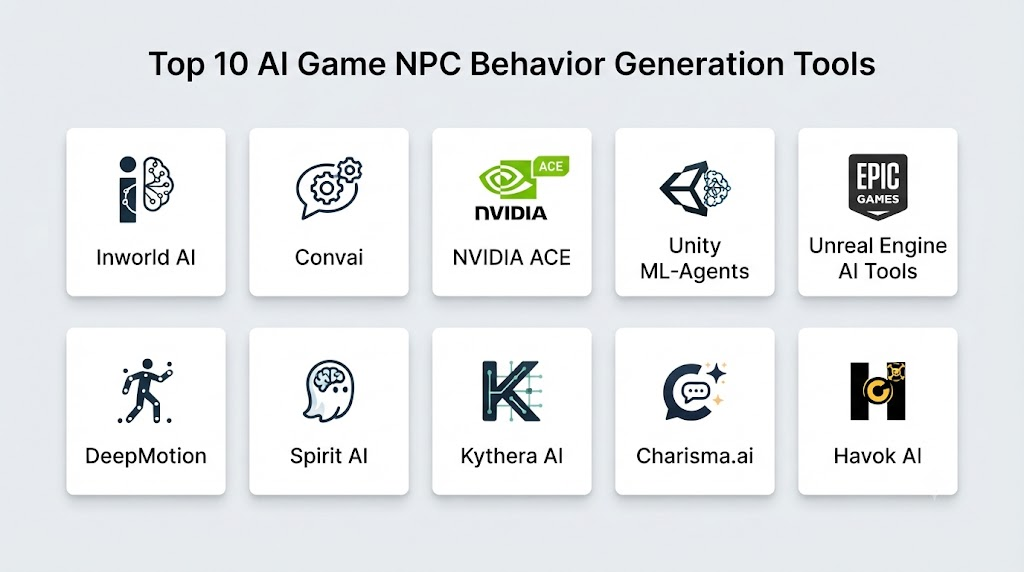
Introduction
AI Game NPC Behavior Generation refers to the use of artificial intelligence to create, control, and adapt the behavior of non-player characters in video games. Instead of relying entirely on manually scripted dialogue trees, state machines, and fixed behavior rules, developers can use AI to make NPCs react dynamically to players, environments, events, and other characters.
Modern NPC systems can support adaptive conversations, goal-driven decision-making, navigation, combat behavior, social interactions, procedural reactions, and context-aware dialogue. Some systems combine traditional game AI with machine learning, generative AI, large language models, speech systems, and animation technol Game studios, indie developers, AAA teams, simulation developers, interactive entertainment companies, virtual-world creators, and teams building games with highly dynamic charactersSimple arcade games, highly deterministic games, small projects where traditional scripted behavior is sufficient, or experiences where unpredictable NPC behavior could negatively affect gameplay.
What Is AI Game NPC Behavior Generation?
Traditional NPC behavior is often created with techniques such as:
- Finite-state machines.
- Behavior trees.
- Utility systems.
- Navigation meshes.
- Scripted events.
- Dialogue trees.
- Rule-based systems.
These approaches remain extremely useful.
AI behavior generation adds another layer by allowing NPCs to make decisions based on goals, context, memory, perception, and changing game states.
For example, a traditional guard might follow this sequence:
Patrol → Detect Player → Chase → Attack → Return to Patrol
An AI-driven guard could potentially consider:
- How dangerous the player appears.
- Whether allies are nearby.
- Available weapons.
- Current health.
- Previous encounters.
- Environmental conditions.
- Mission objectives.
- Player reputation.
- Whether retreat is strategically useful.
The result can be a more flexible character system.
However, generative AI should not automatically replace conventional game AI. The most reliable architectures often combine deterministic systems with AI components.
Why AI NPC Behavior Matters
Players increasingly expect game characters to feel responsive rather than mechanical.
A character becomes more believable when it can:
- React appropriately to unexpected situations.
- Remember relevant interactions.
- Pursue meaningful goals.
- Change tactics.
- Respond differently to different players.
- Participate in dynamic conversations.
- Coordinate with other NPCs.
- React to changes in the game world.
AI can also reduce the amount of manually authored content required for certain systems.
Instead of writing every possible response or behavior individually, developers can create a framework that generates or selects appropriate behaviors within controlled boundaries.
This is particularly valuable in:
- Open-world games.
- Role-playing games.
- Simulation games.
- Social games.
- Narrative games.
- Strategy games.
- Multiplayer environments.
How AI NPC Behavior Generation Works
A modern AI NPC architecture can contain several layers.
1. Perception
The NPC receives information about the game world.
Examples include:
- Player location.
- Nearby characters.
- Objects.
- Threats.
- Environmental changes.
- Missions.
- Events.
2. Memory
The system can store relevant information about previous interactions.
Memory may include:
- Previous conversations.
- Player actions.
- Faction relationships.
- Important events.
- Current objectives.
Not every event should be permanently remembered. Developers need memory policies to control what is retained.
3. Goals
NPCs need objectives.
Examples:
- Protect a location.
- Find food.
- Escape danger.
- Help the player.
- Complete a mission.
- Gather resources.
- Defend another NPC.
4. Decision-Making
The AI determines what the NPC should do next.
Possible approaches include:
- Behavior trees.
- Utility AI.
- Planning systems.
- State machines.
- Machine learning.
- LLM-based decision support.
- Hybrid architectures.
5. Action Selection
The system converts the decision into a game action.
For example:
Goal: Protect merchant
Decision: Move toward threat
Action: Navigate to location
Follow-up: Attack or negotiate depending on context
6. Dialogue
Generative AI can produce dialogue when appropriate.
However, dialogue should generally be constrained by:
- Character identity.
- Lore.
- Game state.
- Allowed topics.
- Safety rules.
- Quest requirements.
7. Animation and Voice
The final behavior can trigger:
- Facial animation.
- Body animation.
- Gesture.
- Voice generation.
- Camera changes.
- Effects.
This creates a complete character experience rather than just generating text.
Key Features to Evaluate
When choosing an AI NPC behavior platform or technology stack, evaluate:
- Behavior-tree compatibility.
- Utility AI support.
- Goal-based planning.
- LLM integration.
- Memory systems.
- Context management.
- Dialogue generation.
- Voice interaction.
- Animation integration.
- Navigation support.
- Tool calling.
- Game-engine compatibility.
- Local inference.
- Cloud inference.
- Latency.
- Token usage.
- NPC scalability.
- Debugging.
- Deterministic fallback behavior.
- Safety controls.
- Prompt-injection protection.
- Evaluation tools.
- Observability.
- Multiplayer compatibility.
Top 10 AI Game NPC Behavior Generation Tools
1. Inworld AI
One-line verdict: Best for developers creating AI-powered characters with conversation, personality, memory, and interactive behavior.
Short description:
Inworld AI focuses on interactive characters designed for games and virtual experiences. Its technology can support conversational characters and contextual interactions while connecting AI behavior with game environments.
Standout Capabilities
- AI character creation.
- Character personalities.
- Conversational interactions.
- Context-aware responses.
- Character memory.
- Game-engine integrations.
- Voice interaction.
- Character orchestration.
AI-Specific Depth
- Model support: Proprietary AI stack and model integrations vary.
- RAG / knowledge integration: Character knowledge and contextual information can be incorporated depending on implementation.
- Evaluation: Testing and quality controls vary by product configuration.
- Guardrails: Character and application-level controls.
- Observability: Platform and integration-level monitoring varies.
Pros
- Built specifically around interactive characters.
- Useful for conversational NPC experiences.
- Reduces the need to build every AI character system from scratch.
Cons
- Requires careful control of generated behavior.
- Cloud dependencies may affect latency.
- Complex gameplay behavior still requires conventional game systems.
Security & Compliance
Enterprise security capabilities depend on the applicable product and deployment configuration. Specific certifications should be verified directly with the vendor.
Deployment & Platforms
- Deployment: Primarily cloud-oriented.
- Game engines: Integration options available.
- Self-hosted: Varies / N/A.
Integrations & Ecosystem
The platform is designed to connect AI characters with interactive applications.
- Game engines.
- APIs.
- Character systems.
- Voice technologies.
- Game logic.
- External services.
Pricing Model
Pricing varies by product and usage model.
Best-Fit Scenarios
- AI-driven RPG characters.
- Interactive storytelling.
- Conversational companions.
2. Convai
One-line verdict: Best for developers who want conversational game characters capable of voice interaction and contextual responses.
Short description:
Convai provides technology for creating conversational AI characters and integrating them into interactive 3D environments. It is particularly relevant for NPCs that communicate with players using natural language.
Standout Capabilities
- Conversational NPCs.
- Voice interaction.
- Character personalities.
- Context-aware conversations.
- Game-engine integration.
- AI character creation.
- Knowledge management.
- Interactive environments.
AI-Specific Depth
- Model support: Managed AI capabilities; specific model choices vary.
- RAG / knowledge integration: Character knowledge and contextual information are supported.
- Evaluation: Platform-specific testing capabilities vary.
- Guardrails: Character and application controls.
- Observability: Platform monitoring capabilities vary.
Pros
- Strong focus on conversational NPCs.
- Voice interaction can create immersive experiences.
- Designed for game developers.
Cons
- Primarily focused on conversational behavior.
- Complex tactical AI still requires traditional game AI.
- AI-generated responses need testing.
Security & Compliance
Security and enterprise controls vary by product configuration. Specific certifications should be independently verified.
Deployment & Platforms
- Deployment: Cloud-oriented.
- Game engines: Supported through integrations.
- Self-hosting: Varies / N/A.
Integrations & Ecosystem
- Game engines.
- APIs.
- Voice interfaces.
- Character systems.
- 3D environments.
- External game logic.
Pricing Model
Free, usage-based, subscription, or enterprise options may vary over time.
Best-Fit Scenarios
- Voice-enabled NPCs.
- Interactive RPG characters.
- Immersive 3D experiences.
3. NVIDIA ACE
One-line verdict: Best for studios building advanced digital humans and AI NPC experiences using NVIDIA’s AI ecosystem.
Short description:
NVIDIA ACE is a collection of technologies designed to enable interactive digital humans and AI-powered characters. It can combine language, speech, animation, and AI components to create responsive characters.
Standout Capabilities
- AI-powered characters.
- Speech recognition.
- Natural-language interaction.
- Conversational AI.
- Digital human technologies.
- Animation integration.
- GPU acceleration.
- Enterprise AI infrastructure.
AI-Specific Depth
- Model support: NVIDIA and third-party model ecosystem depending on implementation.
- RAG / knowledge integration: Can be incorporated through surrounding AI architecture.
- Evaluation: Requires implementation-specific evaluation.
- Guardrails: Application-level controls and AI safety mechanisms.
- Observability: NVIDIA and infrastructure monitoring can support production deployments.
Pros
- Strong AI infrastructure.
- Broad speech and character technology ecosystem.
- Suitable for technically sophisticated teams.
Cons
- More complex than a simple NPC plugin.
- GPU infrastructure may be required.
- Requires significant engineering for custom gameplay behavior.
Security & Compliance
Security depends on deployment architecture, selected services, and infrastructure.
Deployment & Platforms
- Deployment: Cloud, local, or hybrid depending on components.
- Hardware: NVIDIA GPU ecosystem.
- Game engines: Integration options vary.
Integrations & Ecosystem
- NVIDIA AI technologies.
- Game engines.
- Speech systems.
- LLMs.
- Animation technologies.
- GPU infrastructure.
Pricing Model
Technology and infrastructure costs vary by deployment and components.
Best-Fit Scenarios
- AAA game development.
- Digital humans.
- Advanced conversational NPCs.
4. Unity AI
One-line verdict: Best for Unity developers exploring integrated AI-assisted workflows for game creation and interactive experiences.
Short description:
Unity has been developing AI capabilities aimed at helping game developers work with game content, workflows, and interactive experiences. Its ecosystem is particularly relevant to developers already using Unity.
Standout Capabilities
- AI-assisted development.
- Unity ecosystem integration.
- Game-development workflows.
- AI experimentation.
- Character-related workflows.
- Editor integration.
- Asset workflows.
- Game-engine connectivity.
AI-Specific Depth
- Model support: Varies by Unity AI feature and integration.
- RAG / knowledge integration: Varies.
- Evaluation: Depends on implementation.
- Guardrails: Platform and project-level controls.
- Observability: Varies by AI feature.
Pros
- Strong Unity ecosystem integration.
- Familiar development environment.
- Useful for teams already building with Unity.
Cons
- AI capabilities continue to evolve.
- Not every NPC behavior problem is solved by generative AI.
- Advanced autonomous NPC systems may require custom development.
Security & Compliance
Security features vary across Unity services and deployment models.
Deployment & Platforms
- Deployment: Game-engine based.
- Platforms: Unity-supported game platforms.
- Cloud/local: Varies by AI capability.
Integrations & Ecosystem
- Unity Editor.
- Unity game engine.
- Scripts.
- Game objects.
- Asset workflows.
- External AI services.
Pricing Model
Varies by Unity product and AI feature.
Best-Fit Scenarios
- Unity game studios.
- Prototyping AI NPCs.
- AI-assisted game development.
5. Unreal Engine + AI Frameworks
One-line verdict: Best for teams creating complex NPC systems using Unreal Engine’s mature gameplay and AI architecture.
Short description:
Unreal Engine provides extensive native gameplay AI capabilities, including behavior trees, blackboards, navigation, perception, and related systems. Developers can extend these capabilities with machine learning or generative AI technologies.
Standout Capabilities
- Behavior trees.
- AI perception.
- Navigation.
- Blackboard systems.
- Gameplay AI.
- Blueprint integration.
- C++ extensibility.
- Generative AI integration through external systems.
AI-Specific Depth
- Model support: Custom and external model integration.
- RAG / knowledge integration: Requires custom implementation.
- Evaluation: Developer-controlled.
- Guardrails: Developer-controlled.
- Observability: Unreal debugging and custom monitoring.
Pros
- Powerful traditional game AI.
- Highly customizable.
- Excellent for complex gameplay behavior.
Cons
- Requires experienced developers.
- Generative AI requires additional integration.
- Complex systems can become difficult to maintain.
Security & Compliance
Depends on the game’s architecture and external AI services.
Deployment & Platforms
- Deployment: Local/cloud/hybrid.
- Platforms: Broad game-platform support.
- Self-hosted: Supported for many game AI components.
Integrations & Ecosystem
- Blueprints.
- C++.
- Behavior trees.
- Navigation systems.
- External AI APIs.
- Custom ML models.
Pricing Model
Depends on Unreal Engine licensing and project circumstances.
Best-Fit Scenarios
- AAA games.
- Large open-world games.
- Complex enemy AI.
6. Replica Studios
One-line verdict: Best for developers interested in AI-generated character voices and audio workflows for interactive experiences.
Short description:
Replica Studios focuses on AI voice technology for games and interactive media. Voice generation can complement NPC behavior systems by giving dynamically generated dialogue a more natural delivery.
Standout Capabilities
- AI voice generation.
- Character voices.
- Game development workflows.
- Voice customization.
- Dialogue production.
- Interactive media support.
- Audio workflows.
- Developer integration.
AI-Specific Depth
- Model support: Proprietary AI voice technology.
- RAG / knowledge integration: N/A as a primary feature.
- Evaluation: Audio and workflow testing varies.
- Guardrails: Voice and content controls vary.
- Observability: Varies.
Pros
- Focused on game voice production.
- Useful for dynamic NPC dialogue.
- Can reduce manual voice-production requirements.
Cons
- Voice generation alone does not provide complete NPC behavior.
- Voice quality depends on context and implementation.
- Licensing and usage requirements need careful review.
Security & Compliance
Specific security and compliance details vary by product and agreement.
Deployment & Platforms
- Deployment: Cloud-oriented.
- Game engines: Integration options vary.
- Self-hosted: Varies / N/A.
Integrations & Ecosystem
- Game engines.
- Audio pipelines.
- APIs.
- Dialogue systems.
- Character systems.
Pricing Model
Usage and subscription structures may vary.
Best-Fit Scenarios
- Dynamic NPC dialogue.
- Prototyping character voices.
- Interactive storytelling.
7. Behavior3
One-line verdict: Best for developers seeking flexible behavior-tree foundations that can be combined with modern AI systems.
Short description:
Behavior3 is an open-source behavior-tree framework that can be used to construct AI decision systems. It is not a generative AI platform by itself but can provide a deterministic foundation around which AI-powered NPC systems can be built.
Standout Capabilities
- Behavior trees.
- Modular AI logic.
- Custom actions.
- Decision systems.
- Developer control.
- Open-source architecture.
- Extensibility.
- Deterministic behavior.
AI-Specific Depth
- Model support: Custom integration.
- RAG / knowledge integration: N/A.
- Evaluation: Developer-controlled.
- Guardrails: Developer-controlled.
- Observability: Developer-controlled.
Pros
- Flexible.
- Lightweight foundation.
- Useful for deterministic NPC behavior.
Cons
- Not a generative AI platform.
- Requires custom development.
- AI integration is developer responsibility.
Security & Compliance
Depends on implementation.
Deployment & Platforms
- Deployment: Self-hosted.
- Platforms: Depends on implementation.
- Cloud: Optional.
Integrations & Ecosystem
- JavaScript.
- Game engines.
- Custom game logic.
- AI models.
- Application APIs.
Pricing Model
Open-source.
Best-Fit Scenarios
- Indie development.
- Custom NPC architecture.
- Hybrid AI behavior systems.
8. Inference-Based Custom LLM NPC Stack
One-line verdict: Best for advanced teams wanting complete control over LLM-powered NPC planning, memory, and game-state integration.
Short description:
A custom LLM NPC architecture can combine a language model with game APIs, memory, retrieval, behavior systems, and deterministic controls. This approach provides maximum flexibility but requires substantial engineering.
Standout Capabilities
- Custom NPC personalities.
- Dynamic dialogue.
- Tool calling.
- Long-term memory.
- Retrieval.
- Goal planning.
- Custom game-state integration.
- Model routing.
AI-Specific Depth
- Model support: Hosted, open-source, or multi-model.
- RAG / knowledge integration: Fully customizable.
- Evaluation: Fully customizable.
- Guardrails: Fully customizable.
- Observability: Can include traces, latency, cost, and model metrics.
Pros
- Maximum control.
- Flexible architecture.
- Can combine multiple AI models.
Cons
- High engineering requirements.
- More security responsibilities.
- Cost and latency need careful management.
Security & Compliance
Entirely dependent on the chosen infrastructure, models, vendors, and architecture.
Deployment & Platforms
- Deployment: Cloud/self-hosted/hybrid.
- Platforms: Any platform capable of running the game’s backend or client architecture.
Integrations & Ecosystem
- LLM APIs.
- Vector databases.
- Game engines.
- Databases.
- Observability systems.
- Game backend services.
Pricing Model
Infrastructure and model usage costs.
Best-Fit Scenarios
- Large studios.
- Experimental AI games.
- Highly customized NPC systems.
9. LLM + Utility AI Hybrid Architecture
One-line verdict: Best for teams that need generative NPC flexibility while preserving deterministic gameplay and predictable decision-making.
Short description:
A hybrid architecture combines conventional utility AI with generative AI. The utility system decides which goals are appropriate, while an AI model can assist with dialogue, planning, or contextual actions.
Standout Capabilities
- Goal-based behavior.
- Dynamic dialogue.
- Deterministic decision layers.
- Contextual planning.
- Personality systems.
- Safety constraints.
- Model fallback.
- Predictable gameplay.
AI-Specific Depth
- Model support: Hosted or open-source models.
- RAG / knowledge integration: Optional.
- Evaluation: Automated and human evaluation can be implemented.
- Guardrails: Strong developer control.
- Observability: Custom tracing and metrics.
Pros
- Balances creativity and control.
- Easier to debug than fully autonomous agents.
- Suitable for production games.
Cons
- Requires architectural expertise.
- More components must be maintained.
- AI behavior still needs extensive testing.
Security & Compliance
Depends on model and infrastructure choices.
Deployment & Platforms
- Deployment: Cloud/self-hosted/hybrid.
- Platforms: Broadly adaptable.
Integrations & Ecosystem
- Game engines.
- Utility AI.
- LLM APIs.
- Memory databases.
- Analytics.
- Game backends.
Pricing Model
Depends on models and infrastructure.
Best-Fit Scenarios
- Production RPGs.
- AI companions.
- Complex simulation games.
10. Generative Agents Research Architecture
One-line verdict: Best for experimental games and simulations exploring autonomous agents, memory, planning, and emergent social behavior.
Short description:
Generative-agent architectures use language models, memory, reflection, planning, and environmental observations to simulate characters that behave more autonomously.
Standout Capabilities
- Autonomous agents.
- Memory.
- Reflection.
- Planning.
- Social interactions.
- Emergent behavior.
- Natural-language reasoning.
- Multi-agent simulation.
AI-Specific Depth
- Model support: Hosted or open-source LLMs.
- RAG / knowledge integration: Commonly used.
- Evaluation: Research-oriented and custom.
- Guardrails: Must be designed by developers.
- Observability: Custom tracing and simulation monitoring.
Pros
- Highly flexible.
- Powerful for experimentation.
- Can produce complex social behaviors.
Cons
- High computational cost.
- Unpredictable behavior.
- Difficult to balance for commercial gameplay.
Security & Compliance
Depends entirely on implementation.
Deployment & Platforms
- Deployment: Cloud/self-hosted/hybrid.
- Platforms: Depends on implementation.
Integrations & Ecosystem
- LLMs.
- Vector databases.
- Game engines.
- Simulation frameworks.
- Memory systems.
- Agent orchestration.
Pricing Model
Open-source research implementations may be available; model and infrastructure costs vary.
Best-Fit Scenarios
- AI game research.
- Simulation environments.
- Experimental interactive worlds.
Comparison Table
| Tool / Approach | Best For | Deployment | Model Flexibility | Strength | Watch-Out |
|---|---|---|---|---|---|
| Inworld AI | AI characters | Cloud | Managed/varies | Character intelligence | Requires behavior controls |
| Convai | Conversational NPCs | Cloud | Managed/varies | Voice interaction | Primarily conversational |
| NVIDIA ACE | Digital humans | Cloud/Hybrid | Multi-model/varies | AI character stack | Engineering complexity |
| Unity AI | Unity developers | Engine/Cloud | Varies | Unity integration | Capabilities evolve |
| Unreal Engine AI | Complex gameplay AI | Local/Hybrid | Custom | Behavior control | Requires expertise |
| Replica Studios | AI NPC voices | Cloud | Managed | Voice generation | Not full behavior AI |
| Behavior3 | Behavior trees | Self-hosted | Custom | Deterministic logic | No built-in generative AI |
| Custom LLM NPC Stack | Full customization | Cloud/Self-hosted | Multi-model | Maximum flexibility | High engineering effort |
| Utility AI + LLM | Production hybrid NPCs | Hybrid | Multi-model | Control + creativity | Architecture complexity |
| Generative Agent Architecture | Experimental NPCs | Cloud/Self-hosted | Multi-model | Emergent behavior | Cost and unpredictability |
Scoring & Evaluation
The following scores are comparative rather than official vendor ratings. They emphasize production suitability for AI-generated NPC behavior.
| Tool / Approach | Core | Reliability/Eval | Guardrails | Integrations | Ease | Perf/Cost | Security/Admin | Support | Weighted Total |
|---|---|---|---|---|---|---|---|---|---|
| Inworld AI | 9 | 8 | 8 | 9 | 9 | 8 | 8 | 8 | 8.45 |
| Convai | 9 | 8 | 8 | 9 | 9 | 8 | 8 | 8 | 8.45 |
| NVIDIA ACE | 10 | 9 | 9 | 10 | 6 | 9 | 9 | 9 | 8.95 |
| Unity AI | 8 | 7 | 8 | 10 | 9 | 8 | 8 | 9 | 8.30 |
| Unreal Engine AI | 10 | 9 | 10 | 10 | 7 | 9 | 9 | 10 | 9.20 |
| Replica Studios | 7 | 7 | 8 | 8 | 9 | 8 | 8 | 8 | 7.85 |
| Behavior3 | 8 | 8 | 9 | 8 | 7 | 10 | 7 | 7 | 8.00 |
| Custom LLM Stack | 10 | 10 | 10 | 10 | 5 | 7 | 9 | 6 | 8.60 |
| Utility AI + LLM | 10 | 10 | 10 | 10 | 6 | 9 | 9 | 7 | 8.95 |
| Generative Agents | 9 | 8 | 6 | 8 | 5 | 5 | 6 | 6 | 7.00 |
Top 3 for Enterprise
- Unreal Engine AI
- NVIDIA ACE
- Utility AI + LLM hybrid architecture
Top 3 for SMB
- Inworld AI
- Convai
- Unity AI
Top 3 for Developers
- Unreal Engine AI
- Behavior3
- Custom LLM NPC architecture
Which AI Game NPC Behavior Generation Tool Is Right for You?
Solo / Freelancer
Solo developers should avoid building a massive autonomous-agent architecture immediately.
Start with:
- Behavior trees.
- Utility AI.
- Simple memory.
- Controlled dialogue generation.
- Limited AI calls.
For conversational characters, a specialized platform can reduce development time.
SMB
Small studios should prioritize simplicity.
Look for:
- Game-engine integration.
- Easy APIs.
- Predictable AI behavior.
- Low infrastructure overhead.
- Reasonable inference costs.
A hybrid architecture can be particularly effective because traditional AI handles critical gameplay while generative AI handles dialogue and contextual interactions.
Mid-Market
Mid-sized studios can build more sophisticated systems.
A good architecture may contain:
Perception → Memory → Goals → Utility AI → LLM planning → Action validation → Game engine
The LLM should not necessarily control every action.
Enterprise
Large studios can support multiple AI layers.
For example:
Game state → Perception → Candidate actions → Planner → Policy layer → NPC controller → Animation/voice
This makes it easier to test, debug, and control AI behavior.
Regulated Industries
Games are generally less regulated than healthcare or financial systems, but enterprise simulations and training applications may involve sensitive data.
Organizations should consider:
- Player privacy.
- Voice data.
- Character interaction logs.
- Data retention.
- Model providers.
- Content moderation.
- User-generated prompts.
Budget vs Premium
Managed platforms reduce engineering requirements.
Custom AI architectures provide greater control but can introduce substantial costs from:
- Model inference.
- GPU infrastructure.
- Storage.
- Monitoring.
- Engineering.
- Evaluation.
For most smaller teams, a hybrid approach is likely to provide a better cost-to-control balance.
Build vs Buy
Buy when:
- You need AI characters quickly.
- Your requirements are primarily conversational.
- Your team lacks ML expertise.
- You want managed infrastructure.
Build when:
- NPC behavior is central to the game.
- You require unusual decision systems.
- You need complete control over models.
- You need offline or local inference.
- You have specialized AI engineering expertise.
Implementation Playbook
30 Days: Pilot + Success Metrics
Choose one NPC.
Do not start with an entire world.
Define:
- Character personality.
- Goals.
- Memory rules.
- Allowed actions.
- Dialogue boundaries.
- Failure behavior.
Create measurable success criteria:
- Response latency.
- Behavioral consistency.
- Dialogue relevance.
- Player satisfaction.
- Token cost.
- NPC action accuracy.
Create a deterministic fallback for every important gameplay action.
60 Days: Security + Evaluation
Build an NPC evaluation harness.
Test:
- Character consistency.
- Lore accuracy.
- Instruction following.
- Game-state awareness.
- Memory accuracy.
- Prompt injection.
- Unexpected player inputs.
- Toxic or inappropriate responses.
- Tool misuse.
Run simulated conversations before deploying the NPC to players.
Use version control for:
- System prompts.
- Character definitions.
- Tools.
- Memory schemas.
- Model configurations.
90 Days: Optimize + Scale
Once the prototype works:
- Reduce unnecessary model calls.
- Cache stable information.
- Route simple requests to smaller models.
- Use deterministic logic for predictable actions.
- Use larger models only when necessary.
- Monitor latency.
- Monitor inference cost.
- Track player feedback.
- Add model fallbacks.
- Expand NPC behavior gradually.
The goal is not maximum AI autonomy.
The goal is maximum player value with controlled AI behavior.
Common Mistakes & How to Avoid Them
- Letting an LLM control everything: Keep critical gameplay deterministic.
- No evaluation harness: Test NPC behavior systematically.
- Ignoring latency: Players notice slow responses immediately.
- Unlimited memory: Store only useful information.
- No character constraints: NPC personalities can drift.
- No lore grounding: AI can invent information that contradicts the game world.
- No prompt-injection defense: Player input can manipulate AI systems.
- Overusing large models: Smaller models can handle simpler tasks.
- Ignoring inference costs: Millions of NPC interactions can become expensive.
- No fallback behavior: Network or model failures should not break gameplay.
- No observability: Track model calls, latency, errors, and decisions.
- Over-automation: Not every NPC action needs generative AI.
- Ignoring multiplayer synchronization: AI decisions must work reliably in networked environments.
- No safety testing: Dynamic dialogue requires content controls.
- Treating NPC intelligence as a chatbot problem: Gameplay behavior requires integration with world state and game mechanics.
FAQs
What is AI Game NPC Behavior Generation?
It is the use of AI to generate or control NPC decisions, dialogue, reactions, goals, and interactions dynamically within a game.
Can AI completely replace traditional NPC systems?
Usually, no. Traditional behavior trees, utility systems, navigation, and scripted rules remain valuable because they provide predictable and controllable gameplay.
What is the best approach for AI NPCs?
There is no universal winner. A hybrid architecture combining deterministic game AI with generative AI is often a practical production approach.
Can AI NPCs remember players?
Yes. Developers can implement short-term or long-term memory systems that store selected interactions, preferences, relationships, or events.
Can AI NPCs have personalities?
Yes. Character instructions, memory, goals, knowledge, and behavioral constraints can be combined to create distinct personalities.
Can NPCs use voice AI?
Yes. Speech recognition and AI voice generation can enable spoken conversations with game characters.
Can AI NPCs react to the game world?
Yes. An AI system can receive structured game-state information and use it to make contextual decisions.
Is AI NPC behavior expensive?
It can be. Inference costs increase with model size, interaction frequency, context length, and the number of AI-controlled characters.
Can AI NPCs run locally?
Yes, depending on the model and hardware requirements. Local inference can reduce cloud dependency but may increase hardware and optimization requirements.
What is an LLM NPC?
An LLM NPC uses a large language model to support natural-language interaction, reasoning, planning, or other character behaviors.
What is the role of RAG in NPC systems?
RAG can provide NPCs with information from a controlled knowledge base, such as lore, locations, quests, character history, or game documentation.
How can developers prevent NPC hallucinations?
Use grounded knowledge, structured game-state data, constrained prompts, validation layers, tool restrictions, and deterministic fallback behavior.
Can players manipulate AI NPCs?
Yes. Players can intentionally provide misleading or adversarial inputs. NPC systems should therefore treat player messages as untrusted input.
Should every NPC use an LLM?
No. Basic NPCs can often use conventional AI. Generative models are most valuable when dynamic reasoning, conversation, or contextual behavior provides meaningful gameplay value.
How do developers test AI NPCs?
They can use automated scenarios, simulated conversations, behavioral tests, human review, adversarial testing, and gameplay telemetry.
Can AI NPCs work in multiplayer games?
Yes, but multiplayer systems introduce additional challenges involving synchronization, latency, server authority, consistency, and cheating prevention.
What is hybrid NPC AI?
Hybrid NPC AI combines conventional game AI with generative or machine-learning systems. For example, a behavior tree can control combat while an LLM handles dialogue.
What is the biggest benefit of AI NPCs?
The biggest potential benefit is creating characters that can respond to players and game situations in ways that are more dynamic than fixed scripts.
What is the biggest limitation?
Unpredictability is a major challenge. AI-generated behavior can be inconsistent, difficult to test, expensive, or unsuitable for critical gameplay decisions.
Should AI NPCs have unlimited autonomy?
Generally, no. Production games benefit from clear boundaries around what an NPC can say, remember, decide, and do.
Conclusion
AI Game NPC Behavior Generation is changing how developers think about interactive characters. Instead of relying exclusively on fixed dialogue trees and scripted behavior, studios can combine traditional game AI with language models, memory, retrieval, speech, planning, and other AI technologies.Platforms such as Inworld AI, Convai, and NVIDIA ACE are particularly relevant for AI-driven characters and conversational experiences. Unity and Unreal Engine provide powerful foundations for integrating AI into broader game-development workflows, while technologies such as NVIDIA Merlin, custom LLM architectures, behavior trees, and utility AI provide additional flexibility for specialized systems.The most effective strategy is rarely to give an AI model unrestricted control over the game.