Introduction
AI Voice Cloning Tools use artificial intelligence to create a synthetic voice that resembles a real person’s vocal characteristics. Depending on the platform, users can clone an authorized voice from recordings and then generate new speech from text, translate existing speech, create multilingual voice-overs, or build interactive voice applications.
Voice cloning can significantly reduce the time and cost involved in recording large amounts of spoken content. It is particularly useful when a company needs consistent narration across videos, training materials, podcasts, games, advertisements, customer experiences, or localized content.
Best for: Content creators, media companies, publishers, e-learning teams, game studios, marketing agencies, software developers, and enterprises with legitimate rights to use the source voice.
Not ideal for: Unauthorized impersonation, deceptive communications, identity-sensitive applications without strong controls, or organizations that cannot establish clear consent and rights for the voices they want to reproduce.
What’s Changed in AI Voice Cloning
- Voice cloning has become more accessible: Modern platforms can create convincing synthetic voices from relatively limited recordings, depending on the service and voice.
- Consent is becoming a core requirement: Responsible platforms increasingly emphasize authorization and restrictions around cloning real people.
- Multilingual cloning is expanding: A single authorized voice can potentially be used to generate speech across multiple supported languages.
- Speech quality continues to improve: Modern systems can reproduce more natural pacing, pronunciation, intonation, and expressive characteristics.
- Real-time voice applications are growing: Low-latency synthetic speech is becoming increasingly relevant for conversational AI, customer-service systems, and interactive applications.
- Voice cloning is moving into multimodal workflows: Voice can be combined with text, video, avatars, images, and other AI-generated media.
- AI dubbing is becoming more practical: Businesses can localize content while attempting to preserve a consistent voice identity across languages.
- Emotional control is improving: Some systems provide controls or models designed to produce different expressive speaking styles.
- Voice consistency matters more at scale: Businesses need the same approved voice to remain stable across thousands of generated assets.
- API-first deployment is becoming important: Developers can integrate voice cloning and speech generation directly into applications rather than manually creating every recording.
- Security and identity risks are increasing: A convincing synthetic voice can potentially be abused for impersonation, fraud, social engineering, or misleading content.
- Deepfake governance is becoming a business requirement: Organizations need documented rules for consent, approval, access, disclosure, and revocation.
- Audio provenance is gaining importance: Businesses increasingly need to track where a synthetic voice came from and how it was used.
- Human review remains essential: Important communications should not automatically be published simply because the generated audio sounds convincing.
- Cost and latency are becoming operational metrics: High-volume voice generation and real-time applications require predictable performance.
- Model routing is becoming relevant: Larger applications may eventually combine different speech models based on language, quality, latency, and cost.
- Privacy requirements are becoming stricter: Voice recordings may contain personally identifiable or commercially sensitive information and therefore require careful handling.
Quick Buyer Checklist
Before selecting an AI voice cloning platform, evaluate:
- Explicit voice-consent requirements.
- Identity verification.
- Voice ownership policies.
- Voice-cloning restrictions.
- Anti-impersonation safeguards.
- Abuse prevention.
- Content moderation.
- Text-to-speech quality.
- Voice naturalness.
- Pronunciation.
- Accent handling.
- Emotional expression.
- Speaking-style controls.
- Voice consistency.
- Multilingual cloning.
- Translation support.
- Dubbing.
- Voice conversion.
- Speech-to-speech.
- Real-time generation.
- Streaming support.
- API access.
- SDK availability.
- Batch generation.
- Webhooks where applicable.
- Model selection.
- Hosted versus self-hosted deployment.
- BYO-model options.
- RAG integration for application workflows.
- Evaluation capabilities.
- Prompt testing.
- Voice-quality testing.
- Latency monitoring.
- Usage monitoring.
- Cost controls.
- Data retention.
- Data deletion.
- Data residency.
- Encryption.
- SSO.
- RBAC.
- Audit logs.
- Administrative controls.
- Commercial-use rights.
- Licensing.
- Vendor lock-in.
- Export options.
- Voice revocation procedures.
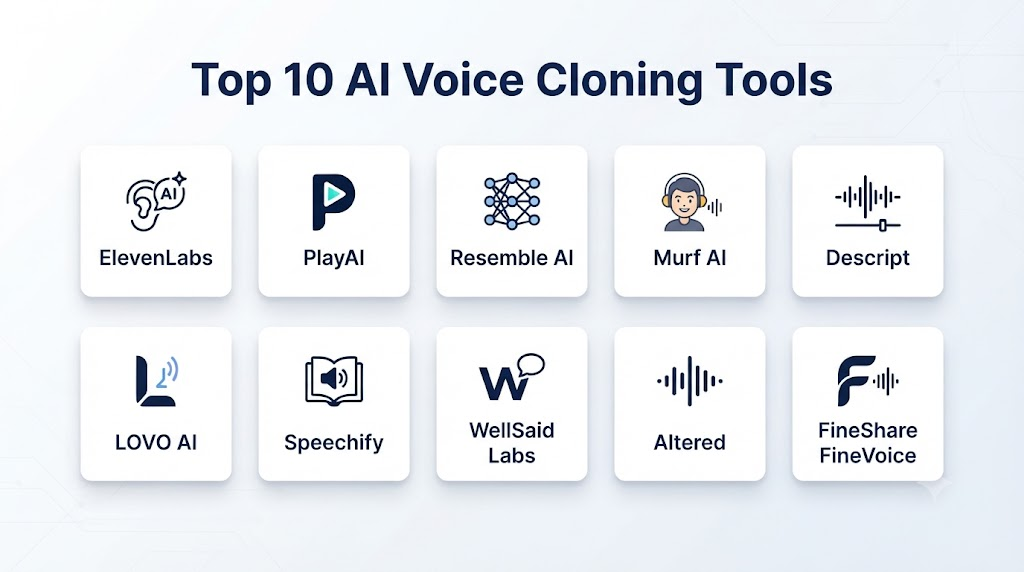
Top 10 AI Voice Cloning Tools
1. ElevenLabs
One-line verdict: Best for high-quality voice cloning, multilingual speech, dubbing, narration, and developer-focused voice applications.
Short description:
ElevenLabs is one of the most prominent AI voice platforms, with capabilities covering synthetic speech, voice cloning, dubbing, multilingual audio, and developer APIs. It is useful for creators as well as organizations building voice-powered applications.
Standout Capabilities
- AI voice cloning.
- Text-to-speech.
- Multilingual speech.
- Voice customization.
- Dubbing.
- Voice design.
- Conversational voice applications.
- Developer APIs.
AI-Specific Depth
- Model support: Proprietary platform-managed speech models; available models vary.
- RAG / knowledge integration: Not a core RAG platform, but can be integrated with RAG applications through APIs.
- Evaluation: Voice quality, pronunciation, consistency, latency, and application-level evaluation can be implemented.
- Guardrails: Platform policies and safeguards addressing synthetic voice use and abuse.
- Observability: Usage and API-level metrics are available to varying degrees depending on the workflow.
Pros
- Strong synthetic voice quality.
- Broad voice and localization capabilities.
- Useful for both creators and developers.
Cons
- High-volume generation can increase costs.
- Voice cloning requires strict consent management.
- Hosted infrastructure creates platform dependency.
Security & Compliance
Enterprise security features, administrative controls, data retention, and certifications vary by offering. Specific certifications should be verified before procurement.
Deployment & Platforms
- Cloud.
- Web.
- API.
- Custom applications.
Integrations & Ecosystem
ElevenLabs can be incorporated into broader content and software workflows.
- Video production.
- Podcasts.
- E-learning.
- AI assistants.
- Developer applications.
- Dubbing.
- Content-management workflows.
Pricing Model
Subscription and usage-based models vary.
Best-Fit Scenarios
- Professional voice cloning.
- Multilingual narration.
- AI voice applications.
2. Resemble AI
One-line verdict: Best for businesses and developers requiring customizable synthetic voices, voice cloning, and application-level voice workflows.
Short description:
Resemble AI focuses on synthetic voice creation and voice-related AI applications. It is relevant to enterprises, developers, media teams, and organizations building custom voice experiences.
Standout Capabilities
- Voice cloning.
- Custom AI voices.
- Text-to-speech.
- Speech-to-speech.
- Voice transformation.
- Multilingual capabilities.
- API integration.
- Real-time voice applications.
AI-Specific Depth
- Model support: Platform-managed voice models; exact options vary.
- RAG / knowledge integration: Can be integrated into RAG and agentic applications.
- Evaluation: Developers can evaluate pronunciation, consistency, latency, and voice quality.
- Guardrails: Voice-safety and platform-level controls.
- Observability: Application and API monitoring can be implemented; exact features vary.
Pros
- Developer-oriented.
- Broad voice customization.
- Useful for enterprise applications.
Cons
- Advanced workflows may require technical expertise.
- Voice governance remains the customer’s responsibility.
- Pricing can become usage-sensitive at scale.
Security & Compliance
Security, privacy, administrative controls, and certifications vary by product and plan and should be verified before deployment.
Deployment & Platforms
- Cloud.
- API.
- Enterprise applications.
Integrations & Ecosystem
- AI assistants.
- Gaming.
- Media.
- Customer-service systems.
- Software applications.
- Voice interfaces.
- Developer platforms.
Pricing Model
Usage-based and subscription models vary.
Best-Fit Scenarios
- Custom voice applications.
- Enterprise voice workflows.
- Developer integrations.
3. PlayHT
One-line verdict: Best for creators and developers looking for AI voice generation, cloning, multilingual speech, and API-driven narration.
Short description:
PlayHT provides AI speech-generation capabilities with a focus on synthetic voices, voice cloning, multilingual speech, and developer integration. It can support content creation as well as application-level speech generation.
Standout Capabilities
- AI voice cloning.
- Text-to-speech.
- Multilingual voices.
- Voice customization.
- Speech APIs.
- Voice-over production.
- Conversational applications.
- Audio generation.
AI-Specific Depth
- Model support: Platform-managed speech models; exact availability varies.
- RAG / knowledge integration: Can be incorporated into RAG-powered applications.
- Evaluation: Application-level quality testing.
- Guardrails: Platform policies and safety controls.
- Observability: Usage and API metrics vary.
Pros
- Broad synthetic-speech functionality.
- Developer API capabilities.
- Useful for multilingual content.
Cons
- Exact capabilities vary between plans.
- Voice-cloning governance is important.
- High-volume usage requires cost management.
Security & Compliance
Specific security features, certifications, and data controls should be verified against the current offering.
Deployment & Platforms
- Cloud.
- Web.
- API.
- Custom applications.
Integrations & Ecosystem
- Websites.
- AI applications.
- Video production.
- E-learning.
- Podcasts.
- Voice assistants.
- Developer applications.
Pricing Model
Subscription and usage-based options vary.
Best-Fit Scenarios
- AI narration.
- Multilingual content.
- Voice application development.
4. Descript
One-line verdict: Best for content teams combining voice cloning with podcast editing, transcription, video production, and text-based workflows.
Short description:
Descript combines AI voice capabilities with transcription, audio editing, video editing, and content-production features. It is particularly useful when voice cloning is one component of a broader media workflow.
Standout Capabilities
- AI voice capabilities.
- Voice cloning.
- Text-to-speech.
- Transcription.
- Podcast editing.
- Video editing.
- Text-based audio editing.
- Content repurposing.
AI-Specific Depth
- Model support: Platform-managed AI capabilities.
- RAG / knowledge integration: Not a dedicated RAG platform.
- Evaluation: Human review and workflow-level testing.
- Guardrails: Platform policies and safety controls.
- Observability: Usage and project metrics vary.
Pros
- Strong audio and video workflow.
- Convenient for podcast creators.
- Combines editing and AI generation.
Cons
- Not primarily a dedicated voice-cloning platform.
- Advanced voice requirements may require specialist tools.
- AI capabilities vary by offering.
Security & Compliance
Security and enterprise administration vary by offering. Specific certifications should be verified before procurement.
Deployment & Platforms
- Cloud.
- Web.
- Desktop workflows.
Integrations & Ecosystem
- Podcasts.
- Video.
- Transcription.
- Marketing.
- Social content.
- E-learning.
- Collaborative production.
Pricing Model
Subscription-based plans with varying capabilities.
Best-Fit Scenarios
- Podcast production.
- Video production.
- AI-assisted editing.
5. Murf AI
One-line verdict: Best for businesses creating professional voice-overs, training content, presentations, and marketing material with synthetic voices.
Short description:
Murf AI focuses on AI-generated voice-over and narration. Its business-oriented workflow makes it useful for teams producing presentations, training materials, marketing videos, and other spoken content.
Standout Capabilities
- AI voice generation.
- Voice customization.
- Text-to-speech.
- Voice-over creation.
- Multilingual narration.
- Presentation narration.
- Training content.
- Audio editing.
AI-Specific Depth
- Model support: Platform-managed speech models.
- RAG / knowledge integration: Can be incorporated into broader AI workflows.
- Evaluation: Human review and application-level testing.
- Guardrails: Platform policies and usage controls.
- Observability: Usage metrics vary.
Pros
- Easy for business users.
- Strong narration workflow.
- Useful for training and marketing.
Cons
- More focused on voice-over than advanced voice engineering.
- Cloning capabilities and controls may vary.
- Enterprise requirements should be validated.
Security & Compliance
Specific security controls and certifications should be verified for the relevant plan.
Deployment & Platforms
- Cloud.
- Web.
- Business workflows.
Integrations & Ecosystem
- E-learning.
- Presentations.
- Marketing.
- Training.
- Video.
- Corporate communications.
- Content production.
Pricing Model
Subscription-based plans vary.
Best-Fit Scenarios
- Corporate narration.
- Training videos.
- Marketing voice-over.
6. Microsoft Azure AI Speech
One-line verdict: Best for enterprises building voice applications within Microsoft-oriented cloud and AI environments.
Short description:
Azure AI Speech provides speech technologies for enterprise applications, including synthetic speech and voice-related capabilities. It is particularly relevant for organizations already using Azure infrastructure.
Standout Capabilities
- Synthetic speech.
- Neural voices.
- Voice customization.
- Speech APIs.
- Multilingual speech.
- Conversational applications.
- Enterprise integration.
- Cloud-based deployment.
AI-Specific Depth
- Model support: Microsoft-managed speech models.
- RAG / knowledge integration: Can integrate with broader Azure AI and RAG architectures.
- Evaluation: Application-level speech and task evaluation.
- Guardrails: Azure security and AI governance capabilities.
- Observability: Azure monitoring and application telemetry.
Pros
- Strong enterprise ecosystem.
- Good cloud integration.
- Suitable for scalable applications.
Cons
- Requires cloud expertise.
- Configuration can be complex.
- Voice-cloning capabilities and requirements vary by service.
Security & Compliance
Azure provides extensive security and governance capabilities. Specific controls and certifications depend on service configuration and should be verified for the intended deployment.
Deployment & Platforms
- Cloud.
- APIs.
- Enterprise applications.
- Web and mobile applications.
Integrations & Ecosystem
- Azure.
- AI assistants.
- Customer-service applications.
- Enterprise software.
- Contact centers.
- Accessibility applications.
- Voice interfaces.
Pricing Model
Usage-based cloud pricing.
Best-Fit Scenarios
- Enterprise voice applications.
- Microsoft environments.
- Large-scale speech workflows.
7. Google Cloud Text-to-Speech
One-line verdict: Best for developers and enterprises requiring scalable synthetic speech within Google Cloud application architectures.
Short description:
Google Cloud’s text-to-speech services provide programmatic synthetic speech for applications and services. They are useful for developers building voice-enabled software and automated narration systems.
Standout Capabilities
- Text-to-speech.
- AI-generated voices.
- Multilingual speech.
- Speech APIs.
- Cloud integration.
- Application automation.
- Voice configuration.
- Developer workflows.
AI-Specific Depth
- Model support: Google-managed speech technologies.
- RAG / knowledge integration: Can integrate with RAG-based applications.
- Evaluation: Application-level quality evaluation.
- Guardrails: Cloud and application-level security controls.
- Observability: Cloud monitoring and application telemetry.
Pros
- Strong cloud ecosystem.
- Developer-friendly.
- Enterprise-scale infrastructure.
Cons
- Cloud architecture can be complex.
- Advanced voice workflows may require additional services.
- Primarily a speech platform rather than a creative voice-production suite.
Security & Compliance
Google Cloud provides enterprise security and governance capabilities. Specific certifications and configurations should be verified for the selected service.
Deployment & Platforms
- Cloud.
- APIs.
- Web applications.
- Mobile applications.
- Enterprise systems.
Integrations & Ecosystem
- Google Cloud.
- AI applications.
- Customer-service systems.
- Mobile apps.
- Websites.
- Enterprise applications.
- Accessibility systems.
Pricing Model
Usage-based cloud pricing.
Best-Fit Scenarios
- Cloud application development.
- Enterprise speech.
- Automated narration.
8. Amazon Polly
One-line verdict: Best for AWS developers who need scalable synthetic speech integrated into existing cloud applications.
Short description:
Amazon Polly provides cloud-based text-to-speech capabilities for developers building voice-enabled applications. It is especially relevant to teams already using AWS infrastructure.
Standout Capabilities
- Text-to-speech.
- Synthetic voices.
- Multiple languages.
- Speech APIs.
- Application integration.
- Streaming speech.
- Cloud scalability.
- Voice-enabled applications.
AI-Specific Depth
- Model support: AWS-managed speech technologies.
- RAG / knowledge integration: Can be integrated into RAG and agentic applications.
- Evaluation: Application-level evaluation.
- Guardrails: AWS security controls plus application-level safeguards.
- Observability: AWS monitoring and application telemetry.
Pros
- Strong AWS integration.
- Scalable cloud infrastructure.
- Developer-friendly.
Cons
- More focused on synthetic speech than advanced creative voice cloning.
- Cloud expertise may be required.
- Advanced voice workflows may require other services.
Security & Compliance
AWS offers extensive security and compliance capabilities. Specific certifications and configurations depend on the architecture and selected services.
Deployment & Platforms
- Cloud.
- API.
- AWS applications.
- Web and mobile applications.
Integrations & Ecosystem
- AWS services.
- AI applications.
- Websites.
- Mobile applications.
- Accessibility.
- Customer-service systems.
- Enterprise software.
Pricing Model
Usage-based pricing.
Best-Fit Scenarios
- AWS voice applications.
- Automated speech.
- Enterprise software.
9. LOVO AI
One-line verdict: Best for creators and businesses seeking AI voice-over production, voice customization, and multilingual content creation.
Short description:
LOVO AI provides synthetic voice and voice-over capabilities aimed at content creators, marketers, educators, and businesses. Its focus is on producing professional spoken content without traditional recording workflows.
Standout Capabilities
- AI voice generation.
- Voice cloning.
- Text-to-speech.
- Voice-over creation.
- Multilingual voices.
- Voice customization.
- Content production.
- Audio workflows.
AI-Specific Depth
- Model support: Platform-managed AI voice models.
- RAG / knowledge integration: Not a core RAG platform.
- Evaluation: Human review and application-level evaluation.
- Guardrails: Platform policies.
- Observability: Usage metrics vary.
Pros
- Creator-friendly.
- Broad voice-over use cases.
- Useful for multilingual content.
Cons
- Advanced enterprise controls require verification.
- Voice cloning needs strong consent governance.
- High-volume usage may require cost management.
Security & Compliance
Specific security features and certifications should be verified for the applicable offering.
Deployment & Platforms
- Cloud.
- Web.
- Content-production workflows.
Integrations & Ecosystem
- Marketing.
- E-learning.
- Video production.
- Presentations.
- Social media.
- Advertising.
- Corporate training.
Pricing Model
Subscription plans vary.
Best-Fit Scenarios
- Marketing voice-over.
- E-learning.
- Video narration.
10. PlayAI
One-line verdict: Best for developers and businesses building conversational voice experiences, synthetic voices, and AI-powered voice interfaces.
Short description:
PlayAI focuses on conversational AI and synthetic voice experiences. It can be relevant to teams building voice agents, assistants, and interactive applications where natural speech and low-latency interaction are important.
Standout Capabilities
- AI voice generation.
- Voice cloning.
- Conversational AI.
- Real-time voice interaction.
- Voice agents.
- Speech APIs.
- Multilingual capabilities.
- Developer integrations.
AI-Specific Depth
- Model support: Platform-managed AI models.
- RAG / knowledge integration: Can be integrated with RAG-powered voice agents.
- Evaluation: Application-level testing for latency, accuracy, task completion, and speech quality.
- Guardrails: Platform and application-level safeguards.
- Observability: Application and API monitoring can be implemented.
Pros
- Strong conversational focus.
- Relevant to voice agents.
- Developer-friendly.
Cons
- Real-time voice applications require careful latency engineering.
- Voice cloning introduces additional identity risks.
- Enterprise requirements should be validated.
Security & Compliance
Specific certifications, data retention controls, and enterprise administrative features should be verified before deployment.
Deployment & Platforms
- Cloud.
- APIs.
- Voice applications.
- Custom software.
Integrations & Ecosystem
- Voice agents.
- AI assistants.
- Customer-service systems.
- RAG applications.
- APIs.
- Websites.
- Enterprise applications.
Pricing Model
Usage-based and subscription options vary.
Best-Fit Scenarios
- Conversational AI.
- Voice agents.
- Interactive voice applications.
Comparison Table
| Tool Name | Best For | Deployment | Model Flexibility | Strength | Watch-Out | Public Rating |
|---|---|---|---|---|---|---|
| ElevenLabs | Voice cloning and narration | Cloud | Hosted | Voice quality | Consent governance | |
| Resemble AI | Custom enterprise voices | Cloud | Hosted | Customization | Technical setup | |
| PlayHT | Voice generation and APIs | Cloud | Hosted | Developer integration | Usage costs | |
| Descript | Media production | Cloud / Desktop | Hosted | Audio + video workflow | Less specialized | |
| Murf AI | Business voice-over | Cloud | Hosted | Ease of use | Voice-focused | |
| Azure AI Speech | Enterprise applications | Cloud | Hosted | Microsoft integration | Cloud complexity | |
| Google Cloud Text-to-Speech | Cloud speech applications | Cloud | Hosted | Scalability | Technical complexity | |
| Amazon Polly | AWS applications | Cloud | Hosted | AWS ecosystem | Speech-focused | |
| LOVO AI | Voice-over production | Cloud | Hosted | Creator workflow | Enterprise controls vary | |
| PlayAI | Conversational voice agents | Cloud | Hosted | Real-time voice | Latency engineering |
Scoring & Evaluation
The following scores are comparative editorial assessments rather than official vendor benchmarks. The weighting considers voice capabilities, AI reliability, safety, integrations, usability, performance, security, and support.
| Tool | Core | Reliability/Eval | Guardrails | Integrations | Ease | Perf/Cost | Security/Admin | Support | Weighted Total |
|---|---|---|---|---|---|---|---|---|---|
| ElevenLabs | 10 | 9 | 9 | 9 | 9 | 8 | 8 | 9 | 8.95 |
| Resemble AI | 9 | 9 | 9 | 9 | 8 | 8 | 8 | 8 | 8.65 |
| PlayHT | 9 | 9 | 8 | 9 | 9 | 8 | 8 | 8 | 8.65 |
| Descript | 8 | 9 | 8 | 9 | 10 | 8 | 8 | 9 | 8.70 |
| Murf AI | 9 | 9 | 9 | 8 | 10 | 8 | 8 | 9 | 8.85 |
| Azure AI Speech | 9 | 9 | 9 | 10 | 8 | 9 | 10 | 9 | 9.10 |
| Google Cloud Text-to-Speech | 9 | 9 | 9 | 10 | 8 | 9 | 10 | 9 | 9.10 |
| Amazon Polly | 8 | 9 | 9 | 10 | 8 | 9 | 10 | 9 | 8.95 |
| LOVO AI | 9 | 8 | 8 | 8 | 9 | 8 | 7 | 8 | 8.25 |
| PlayAI | 9 | 9 | 9 | 9 | 8 | 8 | 8 | 8 | 8.60 |
Top 3 for Enterprise
- Azure AI Speech — Strong fit for Microsoft-centric enterprise environments.
- Google Cloud Text-to-Speech — Strong option for cloud-native applications.
- Amazon Polly — Useful for organizations operating extensively on AWS.
Top 3 for SMB
- ElevenLabs — Strong for voice cloning and professional narration.
- Murf AI — Good for business-focused voice-over production.
- Descript — Useful when voice generation is part of a broader content workflow.
Top 3 for Developers
- ElevenLabs — Strong voice-focused developer capabilities.
- Resemble AI — Useful for custom voice applications.
- PlayAI — Relevant for conversational and real-time voice experiences.
Which AI Voice Cloning Tool Is Right for You?
Solo / Freelancer
Solo creators should prioritize:
- Voice quality.
- Easy voice creation.
- Affordable usage.
- Fast generation.
- Commercial rights.
- Simple editing.
- Multilingual support.
ElevenLabs, Murf AI, LOVO AI, and Descript can be suitable depending on whether the priority is voice cloning, narration, or complete content production.
SMB
SMBs should focus on:
- Consistent brand voices.
- Voice authorization.
- Commercial rights.
- Content localization.
- Team collaboration.
- Usage management.
- Data privacy.
For professional narration, ElevenLabs and Murf AI are strong candidates. For broader multimedia production, Descript may be more appropriate.
Mid-Market
Mid-market organizations should evaluate:
- API capabilities.
- Workflow automation.
- Voice governance.
- Access controls.
- Usage monitoring.
- Localization.
- Data handling.
- Quality evaluation.
- Cost management.
At this stage, voice generation should become part of a documented production workflow.
Enterprise
Enterprise buyers should prioritize:
- SSO.
- RBAC.
- Audit logging.
- Data retention.
- Data residency.
- Encryption.
- Voice-consent management.
- Identity verification.
- Voice revocation.
- API scalability.
- Monitoring.
- Incident response.
- Vendor risk.
- Commercial licensing.
Cloud speech platforms such as Azure AI Speech, Google Cloud Text-to-Speech, and Amazon Polly are particularly relevant when synthetic speech must be embedded into larger enterprise systems.
Regulated Industries
Organizations in regulated sectors should treat voice recordings as potentially sensitive information.
Establish rules for:
- Recording uploads.
- Voice cloning.
- Employee voices.
- Customer conversations.
- Retention.
- Data access.
- Consent.
- Synthetic voice publication.
- Third-party processing.
Healthcare, financial services, government, and customer-service organizations should conduct appropriate privacy and security reviews before deployment.
Budget vs Premium
Budget
Prioritize:
- Basic voice generation.
- Limited cloning.
- Short-form content.
- Simple exports.
- Low-volume usage.
Premium
Consider:
- High-fidelity cloning.
- Multilingual voice generation.
- Real-time speech.
- APIs.
- Enterprise administration.
- High-volume generation.
- Voice governance.
- Advanced customization.
Build vs Buy
Build when:
- Voice technology is central to your product.
- You need highly customized workflows.
- You have ML engineering expertise.
- You need infrastructure control.
- You require custom voice-management logic.
Buy when:
- Voice is supporting rather than core.
- You need rapid implementation.
- You prefer managed infrastructure.
- You need ready-made voices.
- You lack specialist speech-AI expertise.
Hybrid Approach
A hybrid architecture can combine:
- Commercial voice APIs.
- Open-source speech models.
- Internal applications.
- RAG systems.
- Voice-approval workflows.
- Human review.
- Monitoring.
- Governance controls.
Implementation Playbook: 30 / 60 / 90 Days
First 30 Days: Pilot + Success Metrics
Start with low-risk use cases:
- Internal training.
- Product videos.
- Marketing drafts.
- E-learning.
- Podcast narration.
- Internal presentations.
Do not begin with highly sensitive customer communications.
Create a representative evaluation set containing:
- Short scripts.
- Long scripts.
- Difficult names.
- Technical terms.
- Brand terminology.
- Multiple languages.
- Different speaking styles.
Measure:
- Voice similarity.
- Naturalness.
- Pronunciation.
- Intelligibility.
- Emotional quality.
- Consistency.
- Latency.
- Generation cost.
- Human preference.
Days 31–60: Security + Evaluation + Rollout
Create an AI voice evaluation harness.
Test:
- Pronunciation.
- Accent.
- Speaking rate.
- Pauses.
- Emotional delivery.
- Language quality.
- Voice consistency.
- Dubbing quality.
- Audio artifacts.
- Latency.
For voice cloning, establish:
- Written consent.
- Identity verification.
- Authorized-use records.
- Access controls.
- Voice approval.
- Voice revocation.
- Usage monitoring.
Maintain version control for:
- Scripts.
- Prompts.
- Voices.
- Models.
- Generation settings.
- Audio assets.
Days 61–90: Optimize + Scale
Move successful workflows into production.
Potential applications include:
- Automated video narration.
- Multilingual content.
- E-learning.
- Audiobooks.
- Customer-service assistants.
- Game characters.
- Marketing content.
- Accessibility solutions.
Monitor:
- Cost.
- Latency.
- Quality.
- Failure rate.
- Abuse attempts.
- Voice misuse.
- User satisfaction.
- Model changes.
Common Mistakes & How to Avoid Them
- Cloning someone’s voice without permission: Require explicit authorization.
- Ignoring voice identity risks: Treat cloned voices as sensitive assets.
- No consent documentation: Maintain records showing who authorized the voice.
- Using cloned voices for deception: Establish clear restrictions on impersonation.
- Ignoring data retention: Understand how recordings and voice models are stored.
- Uploading sensitive recordings: Review privacy and security requirements before processing.
- No voice-access controls: Restrict who can generate audio using approved voices.
- No evaluation: Test representative scripts before production.
- Ignoring pronunciation: Validate names, terminology, and brand language.
- Ignoring multilingual quality: Evaluate each target language separately.
- No human review: Important public communications should receive human approval.
- Ignoring latency: Real-time applications need much tighter performance requirements.
- No cost controls: High-volume generation can produce unexpected expenses.
- No fallback mechanism: Real-time applications should handle API or generation failures.
- Ignoring vendor lock-in: Preserve source scripts and audio assets independently.
- No audit trail: Track who generated important synthetic audio and when.
- Ignoring model changes: Hosted systems may change output behavior over time.
- Assuming every cloned voice is commercially usable: Verify rights and licensing.
- No incident-response plan: Establish procedures for unauthorized voice use.
- Over-automating sensitive communication: Human approval remains important in high-impact scenarios.
FAQs
1. What Are AI Voice Cloning Tools?
AI Voice Cloning Tools use machine-learning technology to reproduce characteristics of a person’s voice and generate new speech that resembles that voice.
2. How Does AI Voice Cloning Work?
A voice-cloning system analyzes characteristics in audio recordings and uses a trained speech model to generate new speech with similar vocal characteristics.
3. How Much Audio Is Needed to Clone a Voice?
The amount varies significantly by platform, model, quality requirements, and whether the system uses instant or more extensive voice-cloning workflows.
4. Is AI Voice Cloning Legal?
Voice cloning can be legal when properly authorized, but laws and contractual requirements vary by jurisdiction and situation. Unauthorized impersonation can create significant legal and ethical risks.
5. Do I Need Permission to Clone Someone’s Voice?
You should obtain appropriate authorization before cloning another person’s voice. For commercial applications, written consent and clearly defined usage rights are especially important.
6. Can I Clone My Own Voice?
Yes. Many voice-cloning platforms support workflows for users who want to create a synthetic version of their own voice.
7. Can AI Voice Cloning Generate Different Languages?
Some platforms can generate speech in multiple languages using a cloned or customized voice, although language availability and voice quality vary.
8. Can AI Voice Cloning Be Used for Dubbing?
Yes. Voice cloning can be combined with translation and speech generation to produce localized versions of videos and other audio content.
9. Can AI Voice Cloning Be Used for Audiobooks?
Yes. Authorized synthetic voices can be used for narration workflows, subject to applicable platform terms, publishing requirements, and rights considerations.
10. Can AI Voice Cloning Be Used in Games?
Yes. Game developers can use synthetic voices for characters, narration, prototypes, and interactive experiences, provided the necessary rights and safeguards are in place.
11. Can AI Voice Cloning Be Used in Customer Service?
Yes. Synthetic voices can power conversational AI and automated customer-service systems. Sensitive or high-impact interactions may still require human escalation.
12. Can AI Voice Cloning Work in Real Time?
Some platforms support low-latency or real-time speech generation. Performance depends on the model, infrastructure, network, and application architecture.
13. Can AI Voice Cloning Be Integrated Through an API?
Yes. Several providers offer APIs for speech generation and voice-related applications. API functionality varies by provider and plan.
14. Can AI Voice Cloning Work With RAG?
Yes. A RAG system can retrieve relevant information and pass the resulting text to a voice-generation system. RAG provides the knowledge while the speech model provides the voice output.
15. How Should Voice-Cloning Quality Be Evaluated?
Evaluate voice similarity, naturalness, pronunciation, intelligibility, emotional expression, consistency, language performance, latency, and audio artifacts.
16. What Are Voice-Cloning Guardrails?
Guardrails are technical and policy controls designed to reduce misuse, unauthorized cloning, impersonation, harmful content, and other risks associated with synthetic voices.
17. Can AI Voice Cloning Be Used for Fraud?
Synthetic voices can potentially be misused for impersonation and fraud. Organizations should therefore implement identity verification, transaction controls, authentication, and voice-specific safeguards rather than treating a voice as proof of identity.
18. Should a Voice Be Used as a Security Credential?
A synthetic voice should not be treated as a standalone proof of identity because modern voice-generation technology can potentially imitate people convincingly.
19. Can AI-Generated Voice Be Detected?
Detection technologies exist, but no detection method should be assumed to be perfectly reliable in every situation. Important decisions should use multiple authentication signals.
20. How Can Businesses Protect a Cloned Voice?
Use access controls, consent records, authentication, generation logging, approved-use policies, monitoring, and procedures for disabling or revoking unauthorized use.
21. Is AI Voice Cloning Expensive?
Costs vary according to provider, model, audio duration, generation volume, quality, API usage, and subscription plan.
22. How Can Companies Control Voice-Generation Costs?
Use quotas, usage monitoring, caching, efficient models, batch processing, appropriate quality settings, and automated controls for high-volume generation.
23. Can AI Voice Cloning Replace Professional Voice Actors?
It can reduce the need for human recording in some routine workflows, but professional voice actors remain important for nuanced performances, distinctive characters, emotional interpretation, and projects where human performance is central.
24. Can AI Preserve the Same Voice Across Thousands of Recordings?
A voice-cloning system can maintain a selected synthetic voice across many generations, although exact consistency depends on the model, settings, language, and recording context.
25. Can AI Clone Accents?
Some systems can reproduce accent characteristics, but quality varies across languages, accents, voices, and generation conditions.
26. Can AI Clone Singing Voices?
Some generative-audio systems can reproduce or transform singing characteristics, but singing-voice workflows involve additional technical and rights considerations beyond ordinary speech cloning.
27. Can AI Clone a Celebrity’s Voice?
Attempting to reproduce a recognizable person’s voice without appropriate authorization can create serious legal, ethical, and platform-policy issues. Businesses should avoid unauthorized impersonation.
28. Can AI Voice Cloning Be Self-Hosted?
Some open or independently deployable speech models can potentially be self-hosted. Hardware requirements, model capabilities, licensing, and engineering requirements vary.
29. Is Self-Hosted Voice Cloning More Private?
Self-hosting can provide greater control over infrastructure and data, but privacy still depends on how the system, storage, networking, logs, and access controls are configured.
30. What Should Enterprises Check Before Buying a Voice-Cloning Tool?
Enterprises should evaluate consent controls, identity verification, security, data retention, residency, SSO, RBAC, audit logs, API capabilities, commercial rights, abuse prevention, scalability, and vendor risk.
31. How Can Companies Prevent Unauthorized Voice Cloning?
Use documented consent, identity verification, restricted access, monitoring, platform safeguards, approved voice libraries, and procedures for detecting and responding to unauthorized use.
32. What Is the Best AI Voice Cloning Tool?
There is no universal winner. ElevenLabs is a strong choice for high-quality voice generation and cloning, Resemble AI is useful for customizable applications, while Azure AI Speech, Google Cloud Text-to-Speech, and Amazon Polly are strong options for enterprise cloud environments.
33. Which AI Voice Cloning Tool Is Best for Beginners?
Creators often benefit from easy-to-use platforms such as ElevenLabs, Murf AI, LOVO AI, or Descript, depending on whether the primary need is cloning, narration, or multimedia production.
34. How Can Developers Build Voice Agents With Voice Cloning?
A typical architecture can combine a language model, retrieval system, application logic, speech recognition, a voice-generation API, authentication, monitoring, and safety controls.
35. What Is the Biggest Risk of AI Voice Cloning?
Unauthorized impersonation is one of the most significant risks. Other concerns include privacy, fraud, identity misuse, consent violations, misleading synthetic media, and inappropriate use of personal recordings.
Conclusion
AI Voice Cloning Tools are becoming an important part of modern content, media, accessibility, and conversational-AI workflows. They can transform authorized voice recordings into reusable synthetic voices that support narration, localization, dubbing, podcasts, games, e-learning, marketing, and interactive applications.ElevenLabs is particularly strong for high-quality synthetic voices and voice cloning. Resemble AI is relevant for customizable developer and enterprise workflows, while PlayHT provides broad speech-generation capabilities. Murf AI, LOVO AI, and Descript are useful for creators and business content production. Azure AI Speech, Google Cloud Text-to-Speech, and Amazon Polly are especially relevant when speech needs to become part of larger cloud applications.However, voice cloning should not be evaluated purely as an audio-quality problem. It is also an identity, privacy, security, consent, and governance problem.