Introduction
AI Inventory Optimization for Plants uses artificial intelligence, machine learning, forecasting, optimization algorithms, and operational data to help manufacturing facilities maintain the right inventory levels at the right time. Instead of relying primarily on spreadsheets, fixed reorder points, or manual estimates, AI-based systems can analyze demand patterns, supplier performance, production schedules, lead times, inventory movements, and other operational signals to recommend better purchasing and stocking decisions.
For manufacturing plants, inventory optimization covers much more than finished products. It can include raw materials, components, spare parts, consumables, maintenance supplies, work-in-progress, packaging materials, and safety stock.
Best for: Manufacturing plants, supply-chain teams, procurement departments, operations managers, maintenance organizations, automotive manufacturers, electronics companies, industrial manufacturers, consumer-goods producers, and enterprises managing complex multi-location inventories.
Not ideal for: Very small operations with simple inventories, highly stable demand, limited SKU counts, or organizations without reliable inventory, purchasing, production, and supplier data. In those situations, a well-configured ERP or traditional inventory-management system may be sufficient.
What’s Changed in AI Inventory Optimization for Plants
- Demand forecasting is becoming more dynamic: AI can incorporate historical demand alongside production schedules, supplier behavior, seasonality, lead times, and other operational signals.
- AI is moving beyond forecasting: Modern systems increasingly combine forecasting with optimization, recommendations, scenario analysis, and automated workflows.
- Multi-echelon optimization is gaining importance: Plants with warehouses, distribution centers, suppliers, and multiple production sites need inventory decisions across the entire network rather than at one location.
- AI agents can support supply-chain workflows: Agentic systems can investigate stockout risks, summarize supplier issues, compare inventory scenarios, and prepare recommended actions.
- Natural-language interfaces are becoming more practical: Supply-chain professionals can ask questions such as which materials are at risk and why without manually building complex reports.
- Multimodal data can improve planning: AI workflows may incorporate structured ERP data alongside documents, supplier communications, production information, and operational reports.
- Supplier risk can be incorporated into inventory decisions: Lead-time variability, late deliveries, and supplier reliability can influence safety-stock recommendations.
- Real-time signals matter more: Inventory optimization can react to production changes, purchase-order updates, demand changes, and supply disruptions.
- Explainability is becoming a buying requirement: Planners need to understand why an AI system recommends increasing, reducing, or delaying inventory.
- Human-in-the-loop planning remains important: High-impact purchasing decisions should not automatically execute without appropriate approval controls.
- Cloud and edge architectures are becoming more flexible: Organizations can combine centralized analytics with local plant systems.
- Cost optimization extends beyond inventory quantity: AI can balance holding costs, shortage costs, ordering costs, transportation, supplier risk, and working capital.
Quick Buyer Checklist
Before selecting an AI inventory optimization platform, evaluate:
- ERP compatibility.
- MRP integration.
- MES integration.
- WMS integration.
- Procurement integration.
- Inventory-history ingestion.
- Demand forecasting.
- Safety-stock optimization.
- Reorder-point optimization.
- Multi-echelon planning.
- Supplier lead-time analysis.
- Stockout prediction.
- Excess-inventory detection.
- Slow-moving inventory analysis.
- Spare-parts optimization.
- Scenario planning.
- What-if analysis.
- AI model flexibility.
- Hosted-model support.
- BYO-model support.
- Multi-model support.
- RAG and enterprise knowledge integration.
- AI evaluation.
- Forecast accuracy monitoring.
- Model-drift detection.
- Guardrails.
- Human approval workflows.
- Audit logs.
- Role-based access.
- Data retention controls.
- Data residency requirements.
- API availability.
- Workflow automation.
- Cost controls.
- Latency.
- Vendor lock-in risk.
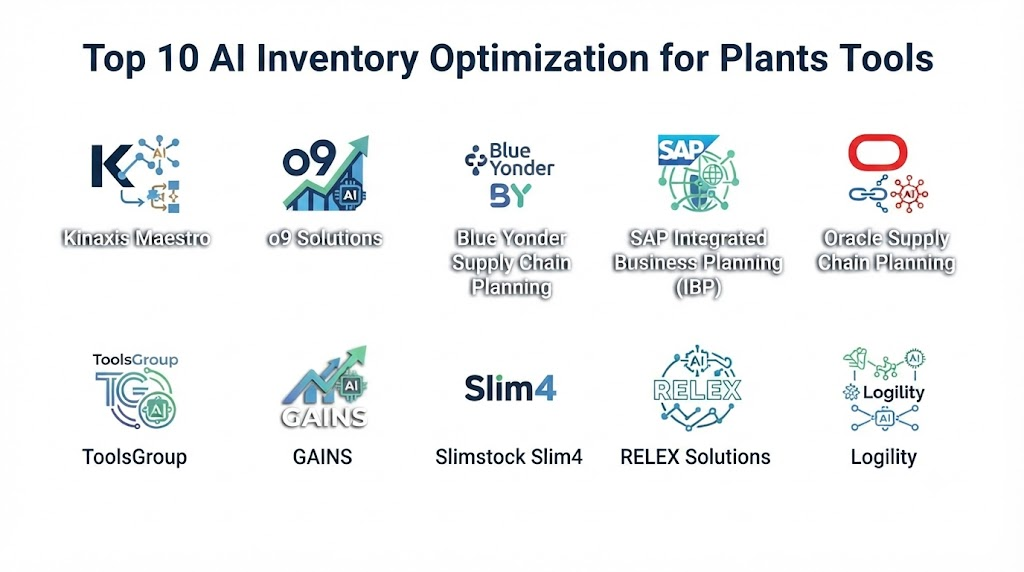
Top 10 AI Inventory Optimization for Plants Tools
1. Kinaxis Maestro
One-line verdict: Best for large manufacturers needing concurrent planning, supply-chain orchestration, and AI-assisted inventory decisions.
Short description:
Kinaxis provides supply-chain planning and orchestration capabilities designed for complex manufacturing and distribution environments. Its platform can support demand planning, supply planning, inventory decisions, scenario analysis, and supply-chain coordination.
Standout Capabilities
- Supply-chain planning.
- Inventory optimization.
- Demand planning.
- Supply planning.
- Scenario analysis.
- Supply-chain orchestration.
- Exception management.
- AI-assisted planning.
AI-Specific Depth
- Model support: AI and machine-learning capabilities vary by application.
- RAG / knowledge integration: Enterprise data and contextual integration vary by implementation.
- Evaluation: Forecasting and AI evaluation capabilities depend on the selected functionality.
- Guardrails: Workflow and enterprise controls vary.
- Observability: Planning and supply-chain monitoring capabilities.
Pros
- Strong fit for complex manufacturing networks.
- Good scenario-planning capabilities.
- Designed around supply-chain decision-making.
Cons
- More appropriate for larger organizations.
- Implementation can be complex.
- Exact capabilities depend on the deployed modules.
Security & Compliance
Enterprise identity, access, security, and governance capabilities vary by product and deployment. Specific certifications should be verified during procurement.
Deployment & Platforms
- Cloud.
- Enterprise environments.
- Hybrid integration architectures.
Integrations & Ecosystem
Kinaxis can integrate supply-chain data across enterprise systems.
- ERP.
- MES.
- Procurement.
- Supplier systems.
- Planning systems.
- APIs.
- Enterprise data platforms.
Pricing Model
Enterprise/custom pricing; exact pricing is Not publicly stated.
Best-Fit Scenarios
- Global manufacturing networks.
- Complex supply planning.
- Multi-location inventory optimization.
2. o9 Solutions
One-line verdict: Best for enterprises seeking an AI-enabled digital planning platform spanning demand, supply, inventory, and business scenarios.
Short description:
o9 Solutions provides an integrated planning and decision-making platform for supply chains and enterprises. Its capabilities can connect demand, supply, inventory, procurement, and operational planning.
Standout Capabilities
- Demand planning.
- Supply planning.
- Inventory planning.
- Scenario modeling.
- Digital supply-chain modeling.
- AI-assisted planning.
- Supply-chain analytics.
- Collaborative planning.
AI-Specific Depth
- Model support: AI/ML capabilities vary across applications.
- RAG / knowledge integration: Enterprise information integration varies.
- Evaluation: Forecasting and planning evaluation capabilities vary.
- Guardrails: Enterprise workflow controls vary.
- Observability: Supply-chain analytics and planning monitoring.
Pros
- Broad planning scope.
- Strong scenario-analysis capabilities.
- Suitable for complex enterprise supply chains.
Cons
- Can require substantial implementation work.
- May be more platform than a simple inventory tool.
- Enterprise pricing can be difficult to compare.
Security & Compliance
Security, access management, and governance capabilities depend on deployment and contract. Certifications should be verified directly for the relevant environment.
Deployment & Platforms
- Cloud.
- Enterprise applications.
- Hybrid integrations.
Integrations & Ecosystem
- ERP.
- MES.
- WMS.
- Procurement.
- Supplier data.
- APIs.
- Enterprise data systems.
Pricing Model
Enterprise/custom pricing; exact pricing is Not publicly stated.
Best-Fit Scenarios
- Enterprise inventory planning.
- Complex manufacturing networks.
- Cross-functional supply-chain planning.
3. Blue Yonder
One-line verdict: Best for manufacturers and distributors seeking AI-assisted planning across inventory, demand, supply, and fulfillment.
Short description:
Blue Yonder provides supply-chain planning and execution technologies covering demand planning, supply planning, inventory, warehouse operations, transportation, and fulfillment.
Standout Capabilities
- Inventory planning.
- Demand forecasting.
- Supply planning.
- Replenishment.
- Warehouse management.
- Transportation management.
- Supply-chain analytics.
- AI-enabled decision support.
AI-Specific Depth
- Model support: AI and machine-learning functionality varies by solution.
- RAG / knowledge integration: Varies / N/A.
- Evaluation: Forecast and planning evaluation capabilities vary.
- Guardrails: Workflow and enterprise controls vary.
- Observability: Supply-chain monitoring and analytics.
Pros
- Broad supply-chain coverage.
- Strong inventory-planning capabilities.
- Suitable for complex operations.
Cons
- Large platform footprint.
- Implementation can be demanding.
- Not every organization needs the entire ecosystem.
Security & Compliance
Enterprise security and administration capabilities vary by deployment. Specific certifications should be confirmed for the selected service.
Deployment & Platforms
- Cloud.
- Enterprise systems.
- Hybrid integrations.
Integrations & Ecosystem
- ERP.
- WMS.
- TMS.
- MES.
- Procurement.
- Supplier platforms.
- APIs.
Pricing Model
Enterprise/custom pricing; exact pricing is Not publicly stated.
Best-Fit Scenarios
- Large manufacturing organizations.
- Complex replenishment.
- Multi-location inventory management.
4. SAP Integrated Business Planning
One-line verdict: Best for SAP-centric manufacturers that want inventory, demand, supply, and planning intelligence integrated with enterprise processes.
Short description:
SAP Integrated Business Planning provides supply-chain planning capabilities covering demand, response and supply, inventory, and related planning processes. It is particularly relevant for organizations already operating within the SAP ecosystem.
Standout Capabilities
- Demand planning.
- Inventory planning.
- Supply planning.
- Response planning.
- Scenario analysis.
- Supply-chain analytics.
- Enterprise integration.
- AI-enabled planning capabilities.
AI-Specific Depth
- Model support: SAP AI and planning capabilities vary by product and configuration.
- RAG / knowledge integration: Enterprise data integration varies.
- Evaluation: Forecasting and planning evaluation varies.
- Guardrails: Enterprise governance and access controls vary.
- Observability: Planning analytics and monitoring capabilities.
Pros
- Strong SAP ecosystem integration.
- Suitable for enterprise manufacturing.
- Broad planning capabilities.
Cons
- Most attractive for SAP-centric organizations.
- Implementation can be complex.
- Licensing and architecture can require specialist expertise.
Security & Compliance
SAP provides enterprise security and governance capabilities, with specific controls and certifications dependent on the selected deployment and services.
Deployment & Platforms
- Cloud.
- Enterprise environments.
- Hybrid integrations.
Integrations & Ecosystem
- SAP ERP.
- SAP manufacturing applications.
- Procurement.
- Warehouse systems.
- Supplier data.
- APIs.
- Enterprise data platforms.
Pricing Model
Enterprise/subscription pricing varies by configuration.
Best-Fit Scenarios
- SAP-based manufacturing plants.
- Enterprise inventory planning.
- Integrated supply-chain planning.
5. Microsoft Dynamics 365 Supply Chain Management
One-line verdict: Best for Microsoft-oriented manufacturers seeking AI-assisted inventory, procurement, planning, and supply-chain workflows.
Short description:
Dynamics 365 Supply Chain Management supports manufacturing, inventory, procurement, planning, warehouse, and supply-chain operations. Microsoft’s broader AI ecosystem can also support intelligent analysis and automation around supply-chain data.
Standout Capabilities
- Inventory management.
- Master planning.
- Procurement.
- Warehouse management.
- Manufacturing.
- Demand forecasting.
- Supply planning.
- AI-assisted workflows.
AI-Specific Depth
- Model support: Microsoft AI capabilities vary by service and configuration.
- RAG / knowledge integration: Available through applicable Microsoft data and AI services.
- Evaluation: Depends on the AI functionality used.
- Guardrails: Enterprise security and AI controls vary.
- Observability: Application and cloud monitoring capabilities.
Pros
- Strong Microsoft ecosystem.
- Broad ERP and supply-chain integration.
- Suitable for manufacturers already using Dynamics.
Cons
- AI capabilities may span multiple services.
- Advanced optimization may require additional configuration.
- Full implementation can be complex.
Security & Compliance
Microsoft provides extensive enterprise identity, access, security, and compliance capabilities. Specific certification applicability depends on the service and deployment.
Deployment & Platforms
- Cloud.
- Hybrid integrations.
- Web-based enterprise applications.
Integrations & Ecosystem
- ERP.
- Power Platform.
- Azure.
- MES.
- WMS.
- Procurement.
- APIs.
Pricing Model
Subscription and enterprise licensing; exact costs vary by configuration.
Best-Fit Scenarios
- Microsoft-centric manufacturing organizations.
- SMB and mid-market manufacturers.
- Integrated ERP and inventory planning.
6. Oracle Fusion Cloud Supply Chain & Manufacturing
One-line verdict: Best for Oracle-centric enterprises managing complex manufacturing, inventory, procurement, and supply-chain operations.
Short description:
Oracle Fusion Cloud Supply Chain & Manufacturing provides enterprise capabilities for inventory, manufacturing, procurement, planning, logistics, and supply-chain operations.
Standout Capabilities
- Inventory management.
- Supply planning.
- Manufacturing.
- Procurement.
- Demand management.
- Supply-chain planning.
- Analytics.
- AI-enabled enterprise workflows.
AI-Specific Depth
- Model support: Oracle AI capabilities vary by service.
- RAG / knowledge integration: Available through applicable Oracle data and AI services.
- Evaluation: Varies by AI application.
- Guardrails: Enterprise security and AI controls vary.
- Observability: Cloud and application monitoring capabilities.
Pros
- Strong enterprise ecosystem.
- Broad manufacturing capabilities.
- Good fit for Oracle customers.
Cons
- Enterprise implementation complexity.
- Advanced capabilities can require specialist knowledge.
- Less suitable for very small manufacturers.
Security & Compliance
Enterprise security, identity, access, and governance capabilities are available. Specific certifications should be confirmed for the applicable cloud services and regions.
Deployment & Platforms
- Cloud.
- Hybrid enterprise integrations.
Integrations & Ecosystem
- Oracle ERP.
- Manufacturing.
- Procurement.
- WMS.
- MES.
- Analytics.
- APIs.
Pricing Model
Enterprise subscription and implementation pricing varies.
Best-Fit Scenarios
- Oracle-based enterprises.
- Complex manufacturing.
- Integrated procurement and inventory planning.
7. ToolsGroup
One-line verdict: Best for organizations focused specifically on AI-driven demand forecasting, inventory optimization, and service-level improvement.
Short description:
ToolsGroup specializes in supply-chain planning and inventory optimization. Its technologies focus on demand forecasting, inventory planning, replenishment, and decision support.
Standout Capabilities
- Demand forecasting.
- Inventory optimization.
- Replenishment.
- Service-level optimization.
- Supply-chain planning.
- Scenario analysis.
- Forecast analytics.
- Inventory segmentation.
AI-Specific Depth
- Model support: Proprietary forecasting and optimization approaches; exact model options vary.
- RAG / knowledge integration: Varies / N/A.
- Evaluation: Forecast-performance measurement and planning evaluation capabilities.
- Guardrails: Workflow controls vary.
- Observability: Forecast and inventory analytics.
Pros
- Strong inventory focus.
- Useful for complex demand patterns.
- Good fit for optimization-oriented projects.
Cons
- Integration effort may be required.
- Exact capabilities vary by implementation.
- May require specialist supply-chain expertise.
Security & Compliance
Security and compliance details depend on deployment and contractual configuration. Specific certifications should be verified.
Deployment & Platforms
- Cloud.
- Enterprise environments.
Integrations & Ecosystem
- ERP.
- WMS.
- Supply-chain systems.
- Demand data.
- Procurement.
- APIs.
- Enterprise databases.
Pricing Model
Enterprise/custom pricing; exact pricing is Not publicly stated.
Best-Fit Scenarios
- Inventory optimization.
- Demand variability.
- Replenishment planning.
8. E2open
One-line verdict: Best for companies requiring connected planning across suppliers, inventory, procurement, logistics, and trading partners.
Short description:
E2open provides supply-chain planning and execution technologies that connect multiple supply-chain participants. Its platform is relevant for manufacturers managing supplier networks, inventory, demand, and logistics.
Standout Capabilities
- Supply-chain planning.
- Inventory planning.
- Demand planning.
- Supplier collaboration.
- Procurement.
- Logistics.
- Network visibility.
- Supply-chain analytics.
AI-Specific Depth
- Model support: AI/ML capabilities vary by application.
- RAG / knowledge integration: Varies / N/A.
- Evaluation: Planning and forecasting evaluation varies.
- Guardrails: Enterprise workflow controls vary.
- Observability: Supply-chain visibility and analytics.
Pros
- Strong supply-network connectivity.
- Useful for supplier collaboration.
- Broad supply-chain scope.
Cons
- Platform complexity.
- Enterprise implementation may be substantial.
- Inventory optimization is part of a wider platform.
Security & Compliance
Enterprise security capabilities vary by product and deployment. Certifications should be verified for the selected services.
Deployment & Platforms
- Cloud.
- Enterprise integrations.
Integrations & Ecosystem
- ERP.
- Suppliers.
- Logistics.
- Procurement.
- WMS.
- Manufacturing systems.
- APIs.
Pricing Model
Enterprise/custom pricing; exact pricing is Not publicly stated.
Best-Fit Scenarios
- Global supply chains.
- Supplier-heavy manufacturing.
- Multi-enterprise inventory planning.
9. Anaplan
One-line verdict: Best for organizations needing flexible connected planning and scenario modeling around inventory and supply-chain decisions.
Short description:
Anaplan provides a connected planning platform used for planning and scenario modeling across business functions. Supply-chain teams can use it to model inventory, demand, supply, and operational scenarios.
Standout Capabilities
- Connected planning.
- Scenario modeling.
- Supply planning.
- Inventory planning.
- Forecasting.
- Collaboration.
- Business analytics.
- Workflow automation.
AI-Specific Depth
- Model support: AI capabilities vary by platform and application.
- RAG / knowledge integration: Varies / N/A.
- Evaluation: Planning and forecasting evaluation varies.
- Guardrails: Enterprise administration and workflow controls.
- Observability: Planning analytics and monitoring.
Pros
- Flexible planning architecture.
- Strong scenario analysis.
- Useful across departments.
Cons
- Requires model design.
- Not a dedicated plant inventory application.
- Implementation can become complex.
Security & Compliance
Enterprise security and administrative controls vary by service and deployment.
Deployment & Platforms
- Cloud.
- Web.
- Enterprise integrations.
Integrations & Ecosystem
- ERP.
- CRM.
- Supply-chain systems.
- Data warehouses.
- APIs.
- Enterprise databases.
Pricing Model
Enterprise subscription/custom pricing; exact pricing is Not publicly stated.
Best-Fit Scenarios
- Scenario planning.
- Cross-functional inventory planning.
- Complex enterprise planning models.
10. SAP Business Network and AI-Enabled Supply Chain Ecosystem
One-line verdict: Best for manufacturers wanting supplier collaboration, procurement visibility, and inventory intelligence around an SAP-centered ecosystem.
Short description:
SAP’s broader supply-chain ecosystem includes technologies for supplier collaboration, procurement, business networks, planning, and enterprise data. Combined with relevant AI capabilities, these tools can support more intelligent inventory decisions.
Standout Capabilities
- Supplier collaboration.
- Procurement.
- Supply-chain visibility.
- Enterprise data integration.
- Inventory workflows.
- Planning.
- Supplier information.
- AI-enabled analysis.
AI-Specific Depth
- Model support: Varies across SAP AI products and services.
- RAG / knowledge integration: Enterprise data and knowledge integration varies.
- Evaluation: Varies by AI service.
- Guardrails: Enterprise governance and access controls vary.
- Observability: Application and supply-chain monitoring varies.
Pros
- Strong supplier ecosystem.
- Useful for SAP-centered organizations.
- Supports broader procurement and supply-chain processes.
Cons
- Not a standalone inventory optimizer.
- Capabilities are distributed across the SAP ecosystem.
- Implementation can require multiple components.
Security & Compliance
SAP provides enterprise security and governance capabilities, but exact controls and certifications depend on the selected services and deployment.
Deployment & Platforms
- Cloud.
- Enterprise.
- Hybrid integrations.
Integrations & Ecosystem
- SAP ERP.
- Procurement.
- Supplier systems.
- Manufacturing.
- Inventory systems.
- APIs.
- Enterprise data platforms.
Pricing Model
Enterprise/custom pricing; exact pricing is Not publicly stated.
Best-Fit Scenarios
- SAP-based manufacturing plants.
- Supplier-driven inventory environments.
- Enterprise procurement optimization.
Comparison Table
| Tool | Best For | Deployment | Model Flexibility | Strength | Watch-Out | Public Rating |
|---|---|---|---|---|---|---|
| Kinaxis Maestro | Complex manufacturing networks | Cloud / Hybrid | Multi-model / Varies | Concurrent supply-chain planning | Implementation complexity | N/A |
| o9 Solutions | Enterprise planning | Cloud / Hybrid | Multi-model / Varies | Integrated planning | Broad platform scope | N/A |
| Blue Yonder | Inventory + supply-chain planning | Cloud / Hybrid | Multi-model / Varies | End-to-end supply chain | Large platform footprint | N/A |
| SAP IBP | SAP-centric manufacturing | Cloud / Hybrid | Multi-model / Varies | SAP integration | SAP ecosystem complexity | N/A |
| Microsoft Dynamics 365 SCM | Microsoft-oriented manufacturers | Cloud / Hybrid | Multi-model / Varies | ERP integration | Configuration effort | N/A |
| Oracle Fusion SCM | Oracle enterprises | Cloud / Hybrid | Multi-model / Varies | Enterprise SCM | Implementation complexity | N/A |
| ToolsGroup | Inventory optimization | Cloud | Varies | Inventory specialization | Integration requirements | N/A |
| E2open | Supplier-connected networks | Cloud | Multi-model / Varies | Supply-chain connectivity | Enterprise complexity | N/A |
| Anaplan | Connected planning | Cloud | Multi-model / Varies | Scenario modeling | Requires model design | N/A |
| SAP Business Network Ecosystem | Supplier collaboration | Cloud / Hybrid | Multi-model / Varies | Supplier visibility | Not standalone | N/A |
Scoring & Evaluation
The following scores are comparative assessments for plant inventory-optimization use cases rather than official vendor ratings.
The weighting is:
- Core features – 20%
- AI reliability & evaluation – 15%
- Guardrails & safety – 10%
- Integrations & ecosystem – 15%
- Ease of use – 10%
- Performance & cost controls – 15%
- Security & admin – 10%
- Support & community – 5%
| Tool | Core | Reliability/Eval | Guardrails | Integrations | Ease | Perf/Cost | Security/Admin | Support | Weighted Total |
|---|---|---|---|---|---|---|---|---|---|
| Kinaxis Maestro | 10 | 9 | 9 | 10 | 7 | 9 | 10 | 9 | 9.15 |
| o9 Solutions | 10 | 9 | 9 | 10 | 7 | 8 | 10 | 9 | 9.00 |
| Blue Yonder | 10 | 9 | 9 | 10 | 8 | 8 | 10 | 9 | 9.10 |
| SAP IBP | 10 | 9 | 10 | 10 | 7 | 8 | 10 | 10 | 9.20 |
| Microsoft Dynamics 365 SCM | 9 | 8 | 9 | 10 | 8 | 9 | 10 | 10 | 9.00 |
| Oracle Fusion SCM | 10 | 9 | 10 | 10 | 7 | 8 | 10 | 10 | 9.20 |
| ToolsGroup | 9 | 9 | 8 | 9 | 8 | 9 | 9 | 9 | 8.80 |
| E2open | 9 | 8 | 9 | 10 | 7 | 8 | 9 | 9 | 8.75 |
| Anaplan | 8 | 8 | 9 | 9 | 8 | 8 | 9 | 9 | 8.55 |
| SAP Business Network Ecosystem | 8 | 8 | 9 | 10 | 7 | 8 | 10 | 10 | 8.75 |
Top 3 for Enterprise
- SAP Integrated Business Planning — Strong choice for enterprises operating deeply within the SAP ecosystem.
- Oracle Fusion Cloud Supply Chain & Manufacturing — Strong enterprise manufacturing and supply-chain integration.
- Kinaxis Maestro — Particularly compelling for complex, highly dynamic supply networks.
Top 3 for SMB
- Microsoft Dynamics 365 Supply Chain Management — Good fit for organizations already using Microsoft business technologies.
- ToolsGroup — Stronger focus on inventory and demand optimization.
- Anaplan — Useful where flexible planning and scenario modeling are priorities.
Top 3 for Developers
- Microsoft Dynamics 365 SCM — Broad integration possibilities through the Microsoft ecosystem.
- Anaplan — Flexible connected-planning architecture.
- o9 Solutions — Suitable for sophisticated enterprise planning architectures.
Which AI Inventory Optimization Tool Is Right for You?
Solo / Freelancer
For small operations or consulting projects, a complete enterprise platform is usually unnecessary.
Focus on:
- Reliable inventory data.
- Demand history.
- Supplier lead times.
- Simple forecasting.
- Reorder recommendations.
- Spreadsheet or database integration.
A lightweight forecasting and optimization workflow may be sufficient.
SMB
SMBs should prioritize simplicity and measurable ROI.
Start with:
- High-value materials.
- Frequently used components.
- Critical spare parts.
- Stockout-prone SKUs.
- Slow-moving inventory.
Avoid implementing advanced multi-echelon optimization before basic inventory data quality is under control.
Mid-Market
Mid-market plants should connect:
ERP → Inventory → Procurement → Production → Supplier Data → AI Optimization
The objective should be a unified view of inventory position, demand, supply, and risk.
Enterprise
Large manufacturers should prioritize:
- Multi-site inventory.
- Multi-echelon optimization.
- Supplier collaboration.
- Scenario planning.
- AI governance.
- Model monitoring.
- ERP integration.
- MES integration.
- WMS integration.
- Procurement automation.
- Human approval workflows.
Enterprise organizations should also establish standardized inventory definitions across plants.
Regulated Industries
Manufacturers operating in highly controlled sectors should pay close attention to:
- Data residency.
- Access control.
- Auditability.
- Supplier data protection.
- Retention policies.
- Encryption.
- AI governance.
- Human approval.
- Segregation of duties.
Budget vs Premium
A lower-cost solution may be appropriate when:
- SKU counts are limited.
- Demand is relatively predictable.
- Suppliers are reliable.
- Plants operate independently.
Premium optimization platforms become more attractive when:
- Thousands of SKUs are involved.
- Multiple plants share inventory.
- Lead times fluctuate.
- Stockouts are expensive.
- Excess inventory consumes significant working capital.
- Supplier risk is high.
Build vs Buy
Build when:
- You have strong data-science capabilities.
- Inventory data is already centralized.
- Business rules are highly specialized.
- Your organization needs proprietary optimization.
Buy when:
- You need rapid deployment.
- Planning processes are complex.
- Integration with ERP/MES/WMS is important.
- Your organization lacks supply-chain data-science expertise.
A hybrid approach can work well: use an established planning platform while developing proprietary AI models for specialized inventory decisions.
Implementation Playbook: 30 / 60 / 90 Days
First 30 Days: Pilot + Success Metrics
Select one plant and one inventory category.
Possible pilots include:
- Raw materials.
- Critical spare parts.
- High-value components.
- Packaging.
- Frequently consumed consumables.
Collect:
- SKU.
- Inventory quantity.
- Historical demand.
- Purchase orders.
- Supplier.
- Lead time.
- Lead-time variability.
- Minimum order quantity.
- Production schedule.
- Safety stock.
- Stockout events.
- Inventory carrying cost.
Establish baseline metrics:
- Inventory turnover.
- Stockout rate.
- Excess inventory.
- Service level.
- Forecast accuracy.
- Working capital.
- Emergency purchases.
Days 31–60: Harden Security + Evaluation + Rollout
Create a representative evaluation dataset.
Test:
- Demand forecasts.
- Safety-stock recommendations.
- Reorder recommendations.
- Supplier-delay scenarios.
- Demand spikes.
- Demand declines.
- Production interruptions.
For AI assistants, evaluate:
- Hallucination.
- Incorrect inventory information.
- Unauthorized data access.
- Prompt injection.
- Incorrect recommendations.
- Retrieval accuracy.
Implement:
- Data-access controls.
- Model versioning.
- Prompt/version control.
- Audit logging.
- Human approval.
- Incident procedures.
- Forecast monitoring.
Days 61–90: Optimize Cost, Latency + Governance + Scale
After validating the pilot, optimize:
- Forecast frequency.
- Model selection.
- Data-processing costs.
- API usage.
- Batch versus real-time processing.
- Alert thresholds.
- Inventory-policy parameters.
Establish governance around:
- Model changes.
- Forecast overrides.
- Supplier changes.
- New SKUs.
- Demand shocks.
- AI recommendations.
- Human overrides.
- Model drift.
Then expand into additional plants and inventory categories.
Common Mistakes & How to Avoid Them
- Poor inventory data quality: AI cannot compensate for incorrect stock balances.
- Ignoring supplier lead-time variability: Average lead time alone may produce unsafe recommendations.
- Using historical demand without production context: Plant demand is often driven by production schedules.
- Ignoring minimum-order quantities: AI recommendations must respect purchasing constraints.
- Ignoring shelf life: Perishable or time-sensitive materials require specialized optimization.
- No evaluation framework: Forecasts and recommendations need continuous measurement.
- No human review: High-impact procurement decisions should have appropriate approval workflows.
- Ignoring model drift: Demand patterns and supply conditions change.
- Excessive automation: AI should not automatically create large purchase orders without controls.
- No explainability: Planners need to understand why inventory recommendations changed.
- Ignoring supplier risk: A low-cost supplier with unreliable delivery may require more safety stock.
- No scenario testing: Systems should be tested against demand spikes and supply disruptions.
- Ignoring cost-to-serve: Inventory quantity alone does not represent total inventory economics.
- Creating excessive alerts: Too many warnings can lead to planner fatigue.
- Ignoring cybersecurity: Connected ERP, procurement, and supply-chain systems increase the importance of access controls.
- Creating vendor lock-in: Maintain clear data-export and integration strategies.
FAQs
1. What is AI inventory optimization for plants?
AI inventory optimization uses machine learning, forecasting, optimization, and operational data to determine appropriate inventory levels, reorder quantities, safety stock, and replenishment timing.
2. How does AI optimize manufacturing inventory?
AI can analyze demand, production schedules, supplier lead times, inventory history, purchasing constraints, and other signals to recommend inventory policies and replenishment actions.
3. Can AI reduce excess inventory?
Yes. AI can identify overstocked or slow-moving materials and optimize safety-stock levels while considering service-level requirements.
4. Can AI prevent material stockouts?
It can reduce stockout risk by forecasting demand, monitoring inventory levels, analyzing supplier lead times, and identifying materials that may become unavailable.
5. What data does an AI inventory optimization system need?
Common data includes inventory balances, demand history, purchase orders, supplier lead times, production schedules, SKU information, minimum-order quantities, and historical stockouts.
6. Can AI inventory optimization integrate with ERP systems?
Yes. ERP integration is a common requirement. The exact integration approach depends on the ERP platform, APIs, middleware, and selected inventory solution.
7. Can these systems work with MES and plant-floor data?
Yes. Connecting MES and production information can improve inventory decisions by providing context about production schedules, consumption, downtime, and manufacturing requirements.
8. Does AI inventory optimization require cloud deployment?
No. Cloud deployment is common, but on-premises and hybrid architectures may be appropriate for organizations with strict data, latency, or network requirements.
9. Can manufacturers use their own AI models?
Some platforms support integration with external models or customized analytics, while others rely more heavily on their own forecasting and optimization technologies. Exact capabilities vary.
10. How does AI decide how much safety stock a plant needs?
It can consider demand variability, supplier lead-time variability, service-level targets, replenishment constraints, and other operational factors. The precise optimization method depends on the system.
11. Can AI optimize spare-parts inventory?
Yes. Spare-parts optimization is a useful application because plants must balance equipment availability against the cost of storing rarely used parts.
12. Can AI optimize inventory across multiple plants?
Yes. Multi-site and multi-echelon optimization can determine where inventory should be positioned across plants, warehouses, distribution centers, and other locations.
13. Can generative AI help inventory planners?
Yes. Generative AI can help planners investigate inventory risks, summarize exceptions, retrieve relevant information, explain recommendations, and create natural-language reports.
14. Are AI agents safe for automated purchasing?
AI agents can assist with purchasing workflows, but they should operate within defined permissions, approval limits, validation rules, and audit processes.
15. How should AI inventory forecasts be evaluated?
Useful metrics include forecast accuracy, bias, stockout reduction, service level, excess inventory, inventory turnover, working capital, and the financial impact of recommendations.
16. What is the biggest challenge in AI inventory optimization?
Data quality is often one of the biggest challenges. Incorrect inventory balances, missing lead times, inconsistent SKU definitions, and incomplete demand history can significantly reduce model usefulness.
17. Can AI handle sudden demand changes?
Modern forecasting systems can incorporate changing patterns, but extreme disruptions can still challenge any model. Scenario planning and human judgment remain important.
18. Should AI automatically change inventory policies?
Not necessarily. Organizations should establish approval controls, especially when changes could materially affect production continuity, working capital, or supplier commitments.
19. How can manufacturers protect inventory data?
Use appropriate identity controls, encryption, network security, least-privilege access, audit logging, retention policies, and secure integrations with ERP and supply-chain systems.
20. What is the best way to start an AI inventory optimization project?
Choose a high-impact inventory category, validate the underlying data, establish baseline metrics, run a controlled pilot, measure business outcomes, and expand only after the results are validated.
Conclusion
AI Inventory Optimization for Plants can help manufacturers make more informed decisions about what to stock, how much to stock, where to position inventory, and when to replenish it. The biggest value comes from connecting inventory decisions with demand, production, procurement, supplier performance, and operational constraints.Kinaxis, o9 Solutions, Blue Yonder, SAP, Oracle, Microsoft, and other enterprise platforms are well suited to organizations managing complex supply-chain environments. ToolsGroup is particularly relevant when inventory optimization and forecasting are central priorities, while Anaplan can be useful for flexible scenario planning.However, buying an AI platform does not automatically create optimized inventory. The quality of ERP, procurement, production, supplier, and inventory data remains fundamental. Organizations should also evaluate AI reliability, explainability, security, human oversight, integration quality, model drift, and long-term operating costs.