Introduction
AI SPC (Statistical Process Control) Automation tools help manufacturers monitor process variation, identify abnormal patterns, detect potential quality problems, and respond to production issues faster. Traditional SPC relies on statistical techniques such as control charts, process capability analysis, sampling, and predefined control limits. AI can extend these methods by analyzing larger datasets, identifying nonlinear relationships, detecting subtle patterns, and supporting automated quality decisions.These solutions are increasingly relevant for manufacturers operating complex production environments where data comes from PLCs, sensors, laboratory systems, MES platforms, historians, inspection equipment, and quality-management systems.When evaluating AI SPC automation software, buyers should consider statistical capabilities, anomaly detection, multivariate analysis, real-time processing, sensor integration, MES/QMS connectivity, explainability, alert management, AI evaluation, cybersecurity, deployment architecture, scalability, and total cost of ownership.
What’s Changed in AI SPC Automation
- AI is complementing traditional SPC: Machine learning can identify patterns that traditional univariate control charts may miss.
- Multivariate monitoring is becoming more important: Manufacturers can evaluate relationships among multiple process variables rather than monitoring each parameter independently.
- Real-time SPC is replacing periodic analysis: Modern systems can evaluate production data continuously.
- Sensor data is increasingly incorporated: IIoT devices can provide high-frequency measurements for process monitoring.
- AI anomaly detection can identify subtle deviations: Models can detect unusual combinations of values before conventional thresholds are exceeded.
- Predictive quality is becoming connected to SPC: Systems can estimate the likelihood of future quality deviations.
- Automated root-cause analysis is becoming more practical: AI can correlate process parameters with quality outcomes.
- Computer vision can complement SPC: Visual inspection data can be combined with numerical process measurements.
- Generative AI can make statistical results easier to interpret: Quality teams can interact with complex analyses using natural language.
- Human oversight remains essential: Automated recommendations should not replace engineering judgment for critical production decisions.
- Model drift matters: Production conditions can change, making ongoing model evaluation necessary.
- Edge analytics can reduce latency: Some industrial environments can process quality data closer to production equipment.
Quick Buyer Checklist
Before selecting an AI SPC automation platform, check:
- Traditional control-chart support.
- X-bar and R charts.
- X-bar and S charts.
- Individual and moving-range charts.
- Attribute control charts.
- Process capability analysis.
- Cp/Cpk analysis.
- Pp/Ppk analysis.
- Multivariate SPC.
- Automated anomaly detection.
- Predictive quality.
- Sensor integration.
- PLC connectivity.
- Historian integration.
- MES integration.
- QMS integration.
- ERP integration.
- Computer-vision integration.
- Real-time alerts.
- Automated escalation.
- AI explainability.
- Human approval.
- Model monitoring.
- Evaluation and validation.
- Data retention controls.
- Role-based access.
- Audit trails.
- API availability.
- Cloud/edge deployment.
- Vendor lock-in risk.
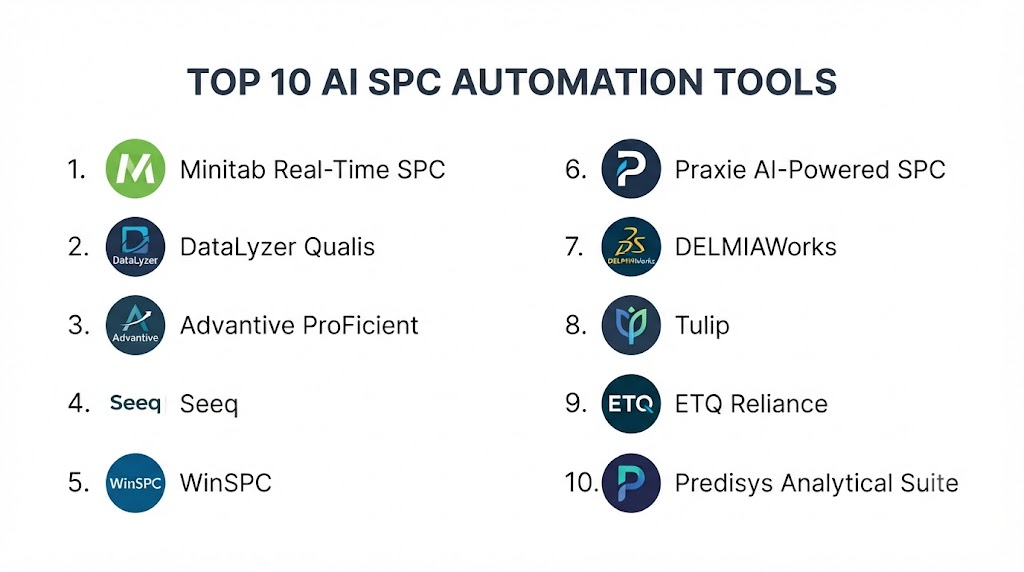
Top 10 AI SPC Automation Tools
1. InfinityQS ProFicient
One-line verdict: Best for manufacturers seeking enterprise statistical process control, quality monitoring, and centralized manufacturing data analysis.
Short description:
InfinityQS ProFicient is designed around manufacturing quality and statistical process control. It supports organizations that need to collect production data, monitor process performance, identify variation, and standardize quality analysis across facilities.
Standout Capabilities
- Statistical process control.
- Real-time process monitoring.
- Quality data collection.
- Control charts.
- Process capability analysis.
- Manufacturing analytics.
- Multi-site quality management.
- Automated quality alerts.
AI-Specific Depth
- Model support: AI/advanced analytics capabilities vary by product configuration.
- RAG / knowledge integration: N/A or varies.
- Evaluation: Statistical process validation and quality analytics; AI-specific evaluation varies.
- Guardrails: Administrative and workflow controls vary by deployment.
- Observability: Process and quality metrics are available; AI-specific observability varies.
Pros
- Strong SPC focus.
- Designed for manufacturing environments.
- Suitable for multi-site quality programs.
Cons
- More specialized than a general analytics platform.
- Implementation can require quality-engineering expertise.
- Advanced AI functionality varies.
Security & Compliance
Security capabilities depend on deployment and configuration. Specific certifications should be verified for the applicable environment.
Deployment & Platforms
- Enterprise deployment.
- Cloud options may vary.
- Manufacturing environments.
- Web-based access may vary by implementation.
Integrations & Ecosystem
ProFicient can connect manufacturing data with quality-management workflows.
- Manufacturing equipment.
- Databases.
- MES.
- ERP systems.
- APIs.
- Data collection systems.
- Enterprise reporting.
Pricing Model
Enterprise/custom pricing; exact pricing is Not publicly stated.
Best-Fit Scenarios
- Large manufacturing organizations.
- Multi-site quality programs.
- Plants with mature SPC processes.
2. Minitab
One-line verdict: Best for quality professionals combining established statistical analysis with modern manufacturing analytics and process improvement.
Short description:
Minitab is widely associated with statistical analysis, quality improvement, process capability, SPC, design of experiments, and manufacturing analytics. It provides a broad statistical toolkit for engineers and quality teams.
Standout Capabilities
- Statistical process control.
- Control charts.
- Process capability.
- Regression.
- Design of experiments.
- Statistical quality analysis.
- Predictive analytics.
- Quality improvement workflows.
AI-Specific Depth
- Model support: Statistical and predictive analytics; exact generative-AI/model flexibility varies.
- RAG / knowledge integration: N/A.
- Evaluation: Extensive statistical analysis and model validation capabilities.
- Guardrails: User and organizational controls vary.
- Observability: Statistical and process analytics rather than dedicated AI observability.
Pros
- Strong statistical foundation.
- Broad quality-engineering functionality.
- Useful for Six Sigma and continuous-improvement teams.
Cons
- Some advanced capabilities require expertise.
- Not primarily an autonomous AI platform.
- Industrial integration varies by deployment.
Security & Compliance
Specific enterprise security features and certifications should be verified for the applicable deployment.
Deployment & Platforms
- Desktop.
- Web/cloud offerings vary.
- Enterprise environments.
Integrations & Ecosystem
- Manufacturing datasets.
- Databases.
- Statistical workflows.
- APIs/integration capabilities.
- Enterprise analytics.
- Quality systems.
Pricing Model
Commercial subscription/licensing model; exact pricing varies.
Best-Fit Scenarios
- Quality engineering teams.
- Six Sigma programs.
- Manufacturers needing advanced statistical analysis.
3. JMP
One-line verdict: Best for engineers and data scientists performing advanced statistical analysis, experimentation, and process optimization.
Short description:
JMP provides statistical discovery and visualization capabilities used in manufacturing, engineering, research, and quality improvement. It can support SPC, process analysis, experimentation, and modeling.
Standout Capabilities
- Statistical analysis.
- Control charts.
- Process capability.
- Design of experiments.
- Predictive modeling.
- Interactive visualization.
- Multivariate analysis.
- Process optimization.
AI-Specific Depth
- Model support: Statistical and machine-learning capabilities; exact AI model options vary.
- RAG / knowledge integration: N/A.
- Evaluation: Strong statistical model assessment.
- Guardrails: Varies / N/A.
- Observability: Statistical and analytical monitoring.
Pros
- Powerful statistical toolkit.
- Excellent for engineering analysis.
- Strong experimentation capabilities.
Cons
- Requires statistical expertise.
- Not primarily a shop-floor work-management platform.
- Automation capabilities vary by implementation.
Security & Compliance
Enterprise security details vary by deployment and should be verified.
Deployment & Platforms
- Desktop.
- Enterprise environments.
- Web capabilities vary.
Integrations & Ecosystem
- Databases.
- Manufacturing datasets.
- Statistical workflows.
- Scripting.
- APIs/integration options.
- Enterprise data environments.
Pricing Model
Commercial licensing/subscription; exact pricing varies.
Best-Fit Scenarios
- Engineering teams.
- Advanced quality analysis.
- Process optimization projects.
4. Seeq
One-line verdict: Best for industrial organizations analyzing time-series process data and building advanced analytics workflows.
Short description:
Seeq focuses on industrial time-series analytics and process data. It can help engineers investigate process behavior, identify patterns, monitor production performance, and develop advanced analytical workflows.
Standout Capabilities
- Time-series analytics.
- Industrial data analysis.
- Process monitoring.
- Anomaly detection.
- Advanced analytics.
- Data contextualization.
- Collaboration.
- Industrial-system integration.
AI-Specific Depth
- Model support: Supports analytical and machine-learning workflows; exact model flexibility varies.
- RAG / knowledge integration: Varies.
- Evaluation: Analytical model evaluation varies by implementation.
- Guardrails: Enterprise controls vary.
- Observability: Time-series and process monitoring capabilities.
Pros
- Strong industrial time-series focus.
- Useful for complex process data.
- Good fit for engineering analytics.
Cons
- Requires quality/process-data expertise.
- Not a traditional QMS.
- SPC implementation may require configuration.
Security & Compliance
Enterprise security and compliance capabilities depend on deployment and contract. Specific certifications should be verified.
Deployment & Platforms
- Cloud.
- Enterprise.
- Industrial data environments.
Integrations & Ecosystem
- Historians.
- IIoT platforms.
- Process-control systems.
- Databases.
- APIs.
- Industrial data sources.
Pricing Model
Enterprise/custom pricing; exact pricing is Not publicly stated.
Best-Fit Scenarios
- Process manufacturing.
- Industrial analytics.
- Time-series-heavy environments.
5. Tulip
One-line verdict: Best for manufacturers combining frontline applications, machine data, quality workflows, and operational intelligence.
Short description:
Tulip provides a manufacturing operations platform focused on frontline applications, connected work, machine data, quality workflows, and operational improvement. It can be used to build customized manufacturing applications that incorporate SPC and analytics.
Standout Capabilities
- Frontline manufacturing applications.
- Quality workflows.
- Machine connectivity.
- Data collection.
- Manufacturing analytics.
- Digital work instructions.
- No-code application development.
- Operational dashboards.
AI-Specific Depth
- Model support: AI capabilities vary; connected AI services can differ by implementation.
- RAG / knowledge integration: Can support contextual operational information depending on application design.
- Evaluation: Application and analytics evaluation varies.
- Guardrails: Workflow and permissions can provide operational controls.
- Observability: Manufacturing application and machine metrics.
Pros
- Flexible manufacturing applications.
- Strong frontline focus.
- Can connect shop-floor workflows with data.
Cons
- SPC may require application configuration.
- Advanced statistical analysis may require additional tools.
- Large implementations require governance.
Security & Compliance
Security controls and certifications should be verified for the selected deployment.
Deployment & Platforms
- Cloud.
- Web.
- Industrial devices.
- Connected shop-floor environments.
Integrations & Ecosystem
- PLCs.
- Machines.
- Databases.
- MES.
- ERP.
- APIs.
- Industrial applications.
Pricing Model
Commercial subscription model; exact pricing varies.
Best-Fit Scenarios
- Digital manufacturing programs.
- Connected factories.
- Frontline quality workflows.
6. Instrumental
One-line verdict: Best for manufacturers seeking automated data collection, quality monitoring, and AI-assisted production intelligence.
Short description:
Instrumental combines manufacturing data collection with AI-powered analysis and monitoring. Its approach is particularly relevant to organizations wanting automated visibility into production and product-quality signals.
Standout Capabilities
- Manufacturing data collection.
- Automated inspection.
- AI-powered analysis.
- Production monitoring.
- Quality analytics.
- Defect detection.
- Process visibility.
- Manufacturing intelligence.
AI-Specific Depth
- Model support: Platform-provided AI/ML; exact BYO-model capabilities vary.
- RAG / knowledge integration: Varies / N/A.
- Evaluation: AI inspection and quality model performance can be evaluated; exact mechanisms vary.
- Guardrails: Operational controls vary.
- Observability: Production and quality monitoring.
Pros
- Strong manufacturing orientation.
- Useful for automated quality monitoring.
- Can combine production and inspection information.
Cons
- Not a traditional SPC package.
- Requires appropriate manufacturing data.
- Deployment depends on production environment.
Security & Compliance
Specific security and certification information should be verified for the applicable offering.
Deployment & Platforms
- Cloud.
- Manufacturing environments.
- Connected production equipment.
Integrations & Ecosystem
- Cameras.
- Production equipment.
- Manufacturing systems.
- APIs.
- Data platforms.
- Quality workflows.
Pricing Model
Enterprise/custom pricing; exact pricing is Not publicly stated.
Best-Fit Scenarios
- Electronics manufacturing.
- High-volume production.
- Automated quality monitoring.
7. Honeywell Forge
One-line verdict: Best for industrial organizations connecting process data, operational analytics, asset information, and manufacturing performance.
Short description:
Honeywell Forge provides industrial data and analytics capabilities across operational environments. Depending on implementation, it can support monitoring, analytics, asset performance, and manufacturing optimization.
Standout Capabilities
- Industrial analytics.
- Process monitoring.
- Asset performance.
- Operational intelligence.
- Data integration.
- Performance dashboards.
- Predictive analytics.
- Industrial workflow support.
AI-Specific Depth
- Model support: Platform AI/analytics capabilities; flexibility varies.
- RAG / knowledge integration: Varies.
- Evaluation: Analytics and model evaluation depend on the application.
- Guardrails: Enterprise controls vary.
- Observability: Operational and asset analytics.
Pros
- Strong industrial ecosystem.
- Suitable for complex operations.
- Broad operational-data capabilities.
Cons
- Enterprise implementation complexity.
- SPC may not be the platform’s sole focus.
- Cost and deployment effort can be significant.
Security & Compliance
Security and compliance depend on deployment. Specific certifications should be verified for the selected environment.
Deployment & Platforms
- Cloud.
- Enterprise.
- Industrial environments.
Integrations & Ecosystem
- Industrial control systems.
- Sensors.
- Historians.
- ERP.
- MES.
- APIs.
- Enterprise data systems.
Pricing Model
Enterprise/custom licensing; exact pricing is Not publicly stated.
Best-Fit Scenarios
- Process manufacturing.
- Industrial enterprises.
- Honeywell-centered technology environments.
8. AVEVA PI System / AVEVA Data Infrastructure
One-line verdict: Best for industrial organizations building data-driven SPC and analytics on top of large operational time-series datasets.
Short description:
AVEVA’s industrial data infrastructure is widely used to collect, store, contextualize, and analyze operational time-series information. It can provide an important data foundation for AI-enabled SPC and quality analytics.
Standout Capabilities
- Industrial time-series data.
- Historian capabilities.
- Data contextualization.
- Process monitoring.
- Operational analytics.
- Industrial integration.
- Data visualization.
- Enterprise data access.
AI-Specific Depth
- Model support: AI capabilities depend on connected analytics and AI systems.
- RAG / knowledge integration: Varies.
- Evaluation: Depends on connected analytical models.
- Guardrails: Enterprise access and governance controls vary.
- Observability: Strong operational-data monitoring capabilities.
Pros
- Strong industrial data foundation.
- Useful for time-series-heavy SPC.
- Broad industrial ecosystem.
Cons
- Not a complete standalone AI SPC solution.
- Requires analytics configuration.
- Advanced AI may require additional tools.
Security & Compliance
Security and compliance depend on architecture and deployment.
Deployment & Platforms
- Cloud.
- On-premises.
- Hybrid.
- Industrial environments.
Integrations & Ecosystem
- PLCs.
- Historians.
- SCADA.
- MES.
- Industrial databases.
- APIs.
- Analytics platforms.
Pricing Model
Enterprise/custom licensing; exact pricing varies.
Best-Fit Scenarios
- Large industrial plants.
- Process manufacturing.
- Enterprises with extensive historian data.
9. Cognite Data Fusion
One-line verdict: Best for industrial organizations contextualizing operational data for AI, analytics, quality, and process optimization.
Short description:
Cognite Data Fusion is an industrial data-contextualization platform designed to make operational data more accessible for analytics and AI applications. It can serve as a data layer supporting advanced SPC and manufacturing intelligence.
Standout Capabilities
- Industrial data contextualization.
- Time-series data.
- AI-ready data infrastructure.
- Data integration.
- Asset context.
- Operational analytics.
- Industrial knowledge graphs.
- AI application enablement.
AI-Specific Depth
- Model support: Designed to support AI/analytics workflows; exact model options vary.
- RAG / knowledge integration: Strong industrial-data contextualization capabilities.
- Evaluation: Depends on the connected AI application.
- Guardrails: Enterprise data access and governance controls vary.
- Observability: Industrial data monitoring and application analytics.
Pros
- Strong industrial data architecture.
- Useful for AI-enabled manufacturing applications.
- Supports complex data integration.
Cons
- Not a dedicated SPC application.
- Requires implementation expertise.
- Value depends heavily on data architecture.
Security & Compliance
Security capabilities depend on deployment and configuration. Specific certifications should be verified before procurement.
Deployment & Platforms
- Cloud.
- Enterprise.
- Industrial data environments.
Integrations & Ecosystem
- Historians.
- ERP.
- MES.
- IoT.
- Databases.
- APIs.
- Industrial applications.
Pricing Model
Enterprise/custom pricing; exact pricing is Not publicly stated.
Best-Fit Scenarios
- Large industrial enterprises.
- AI transformation programs.
- Complex manufacturing data environments.
10. Siemens Insights Hub
One-line verdict: Best for manufacturers seeking industrial IoT, machine data, analytics, and AI-enabled process improvement within Siemens environments.
Short description:
Siemens Insights Hub provides industrial IoT and analytics capabilities for connected assets, production systems, and manufacturing operations. It can support SPC automation when integrated with appropriate process and quality data.
Standout Capabilities
- Industrial IoT.
- Machine-data collection.
- Production analytics.
- Asset monitoring.
- Manufacturing intelligence.
- Predictive analytics.
- Industrial applications.
- Siemens ecosystem integration.
AI-Specific Depth
- Model support: Siemens and connected AI/ML capabilities; exact flexibility varies.
- RAG / knowledge integration: Varies.
- Evaluation: AI/ML evaluation depends on application.
- Guardrails: Enterprise governance and access controls vary.
- Observability: Industrial telemetry and operational analytics.
Pros
- Strong industrial IoT capabilities.
- Good Siemens ecosystem fit.
- Useful for connected-factory initiatives.
Cons
- SPC may require additional configuration.
- Best value may come within broader Siemens environments.
- Enterprise implementation can be complex.
Security & Compliance
Security controls depend on architecture and deployment. Specific certifications should be verified for the selected environment.
Deployment & Platforms
- Cloud.
- Industrial environments.
- Enterprise systems.
- Hybrid architecture may vary.
Integrations & Ecosystem
- Siemens automation systems.
- PLCs.
- Sensors.
- MES.
- ERP.
- APIs.
- Industrial applications.
Pricing Model
Enterprise/custom pricing; exact pricing is Not publicly stated.
Best-Fit Scenarios
- Siemens-based factories.
- Smart manufacturing programs.
- Industrial IoT deployments.
Comparison Table
| Tool | Best For | Deployment | Model Flexibility | Strength | Watch-Out | Public Rating |
|---|---|---|---|---|---|---|
| InfinityQS ProFicient | Enterprise SPC | Cloud / Enterprise | Hosted / Varies | Dedicated SPC | Implementation effort | N/A |
| Minitab | Quality engineering | Desktop / Cloud varies | Statistical / ML | Statistical depth | Requires expertise | N/A |
| JMP | Advanced engineering analysis | Desktop / Enterprise | Statistical / ML | Experimentation | Less shop-floor focused | N/A |
| Seeq | Industrial time-series analytics | Cloud / Enterprise | Multi-model varies | Process analytics | Requires configuration | N/A |
| Tulip | Connected manufacturing | Cloud | Hosted / Varies | Frontline applications | SPC may require configuration | N/A |
| Instrumental | Automated manufacturing intelligence | Cloud | Platform AI | AI quality monitoring | Manufacturing-specific deployment | N/A |
| Honeywell Forge | Industrial analytics | Cloud / Enterprise | Platform AI | Industrial ecosystem | Enterprise complexity | N/A |
| AVEVA Data Infrastructure | Industrial data foundation | Cloud / Hybrid | BYO/Connected AI | Time-series data | Needs analytics layer | N/A |
| Cognite Data Fusion | Industrial AI data | Cloud | Multi-model varies | Data contextualization | Not dedicated SPC | N/A |
| Siemens Insights Hub | Smart manufacturing | Cloud / Hybrid | Platform / Connected AI | Industrial IoT | Ecosystem dependency | N/A |
Scoring & Evaluation
The scoring below is a comparative framework rather than an official vendor ranking. A dedicated SPC platform can score strongly in statistical capabilities, while an industrial data platform may score better for AI integration and scalability.
The weighted model uses:
- Core features – 20%
- AI reliability & evaluation – 15%
- Guardrails & safety – 10%
- Integrations & ecosystem – 15%
- Ease of use – 10%
- Performance & cost controls – 15%
- Security & admin – 10%
- Support & community – 5%
| Tool | Core | Reliability/Eval | Guardrails | Integrations | Ease | Perf/Cost | Security/Admin | Support | Weighted Total |
|---|---|---|---|---|---|---|---|---|---|
| InfinityQS ProFicient | 10 | 9 | 8 | 9 | 8 | 8 | 9 | 9 | 8.85 |
| Minitab | 10 | 10 | 8 | 8 | 8 | 8 | 8 | 9 | 8.85 |
| JMP | 9 | 10 | 8 | 8 | 7 | 8 | 8 | 9 | 8.50 |
| Seeq | 9 | 9 | 8 | 10 | 8 | 8 | 9 | 8 | 8.75 |
| Tulip | 8 | 7 | 8 | 9 | 9 | 8 | 8 | 8 | 8.20 |
| Instrumental | 8 | 9 | 8 | 8 | 8 | 8 | 8 | 8 | 8.25 |
| Honeywell Forge | 9 | 9 | 9 | 10 | 7 | 8 | 10 | 9 | 8.95 |
| AVEVA Data Infrastructure | 9 | 9 | 9 | 10 | 7 | 9 | 10 | 9 | 9.00 |
| Cognite Data Fusion | 9 | 9 | 9 | 10 | 7 | 9 | 10 | 9 | 9.00 |
| Siemens Insights Hub | 9 | 9 | 9 | 10 | 8 | 8 | 10 | 9 | 9.05 |
Top 3 for Enterprise
- Siemens Insights Hub — Strong connected-manufacturing ecosystem and industrial integration.
- AVEVA Data Infrastructure — Strong foundation for industrial data and analytics.
- Honeywell Forge — Broad industrial analytics and operational capabilities.
Top 3 for SMB
- Minitab — Strong statistical capabilities.
- JMP — Powerful engineering analysis.
- Tulip — Practical connected-manufacturing workflows.
Top 3 for Developers
- Cognite Data Fusion — Strong industrial data-contextualization architecture.
- AVEVA Data Infrastructure — Useful foundation for industrial analytics applications.
- Seeq — Strong time-series analytical workflows.
Which AI SPC Automation Tool Is Right for You?
Solo / Freelancer
For a quality consultant or small engineering team, start with a statistical platform rather than a large industrial AI architecture.
Prioritize:
- Control charts.
- Process capability.
- Statistical testing.
- Regression.
- Data visualization.
- Easy dataset import.
- Repeatable analysis.
Minitab or JMP-style solutions can be a practical starting point.
SMB
SMBs should focus on automating the quality processes that currently consume the most engineering time.
Look for:
- Automated control charts.
- Alerts.
- Process capability.
- Data collection.
- Simple dashboards.
- Quality reporting.
- Basic anomaly detection.
Avoid buying a highly complex industrial data platform unless there is a clear need for it.
Mid-Market
Mid-market manufacturers can begin connecting SPC with production systems.
Important capabilities include:
- MES connectivity.
- Historian data.
- Sensor integration.
- Multivariate SPC.
- Automated anomaly detection.
- Process capability.
- Quality dashboards.
- Automated alerts.
Enterprise
Enterprise manufacturers should think about SPC as part of a larger industrial data architecture.
Prioritize:
- Multi-site support.
- Industrial historians.
- MES integration.
- QMS integration.
- ERP connectivity.
- Edge processing.
- AI model governance.
- Role-based access.
- Auditability.
- Data lineage.
- Centralized analytics.
Regulated Industries
Organizations operating in highly controlled environments should pay particular attention to:
- Data integrity.
- Audit trails.
- Electronic records.
- Change control.
- Validation.
- Access management.
- Model governance.
- Human approval.
- Traceability.
AI should augment statistical quality processes without bypassing established quality controls.
Budget vs Premium
A statistical desktop platform may be sufficient when the primary objective is analysis.
An enterprise industrial analytics platform becomes more attractive when you need:
- Real-time data.
- Thousands of process variables.
- Multiple production sites.
- Automated alerts.
- Machine connectivity.
- AI-driven anomaly detection.
- Centralized governance.
Build vs Buy
Build a custom AI SPC solution when you already have:
- Industrial data infrastructure.
- Data scientists.
- Quality engineers.
- Strong software engineering resources.
- Specialized statistical requirements.
Buy a commercial platform when you need:
- Faster implementation.
- Established SPC functionality.
- Production-ready integrations.
- Support.
- Governance.
- Quality-engineering workflows.
A hybrid architecture can be particularly effective: use an established SPC system for statistical control and add a machine-learning layer for anomaly detection and predictive quality.
Implementation Playbook: 30 / 60 / 90 Days
First 30 Days: Pilot + Success Metrics
Start with one production line or process.
Collect:
- Process measurements.
- Quality measurements.
- Control limits.
- Product specifications.
- Production batches.
- Machine states.
- Sensor readings.
- Defect records.
- Operator observations.
Establish baseline metrics:
- Defect rate.
- Scrap rate.
- Rework rate.
- Process capability.
- Out-of-control events.
- False alarms.
- Mean time to detection.
Create a controlled SPC pilot.
Days 31–60: Harden Security + Evaluation + Rollout
Introduce AI carefully.
Test:
- Anomaly detection.
- Multivariate relationships.
- False positives.
- False negatives.
- Process drift.
- Model stability.
- Prediction accuracy.
Create an evaluation dataset containing known process deviations.
Add:
- Human approval.
- Alert escalation.
- Model/version tracking.
- Audit logs.
- Data-retention rules.
- Access controls.
- AI red-team testing where generative AI is used.
Days 61–90: Optimize Cost, Latency + Governance + Scale
Expand successful workflows.
Add:
- Additional process lines.
- More sensors.
- Quality-system integration.
- MES data.
- Computer-vision information.
- Predictive-quality models.
Monitor:
- Model performance.
- Alert quality.
- Processing latency.
- Infrastructure costs.
- Engineer acceptance.
- Production outcomes.
Create a formal AI quality-governance process.
Common Mistakes & How to Avoid Them
- Replacing SPC with AI: AI should complement proven statistical methods rather than automatically replace them.
- Poor measurement systems: Bad sensor or inspection data creates unreliable analysis.
- Ignoring process context: Statistical anomalies require engineering interpretation.
- Using fixed thresholds everywhere: Different products and processes may require different control strategies.
- No baseline: Measure current quality performance before introducing AI.
- No model evaluation: Test AI against known historical process events.
- Too many alerts: Excessive alarms create alert fatigue.
- Ignoring false positives: An AI system that constantly raises incorrect alerts will quickly lose operator trust.
- No explainability: Quality engineers need to understand why an anomaly was detected.
- Ignoring drift: Process conditions can change over time.
- Unmanaged data retention: Production data should have defined retention policies.
- Over-automation: Keep humans involved in significant quality decisions.
- No integration strategy: SPC automation is much more valuable when connected to MES, QMS, historians, and production systems.
- Ignoring cybersecurity: Connected industrial analytics can introduce additional attack surfaces.
FAQs
1. What is AI SPC Automation?
AI SPC automation combines traditional statistical process control with machine learning, anomaly detection, industrial data, and automated workflows to monitor manufacturing processes.
2. How is AI SPC different from traditional SPC?
Traditional SPC primarily uses statistical rules and control limits. AI can analyze more complex patterns, nonlinear relationships, and combinations of variables that may not be captured by conventional SPC alone.
3. Can AI replace control charts?
Generally, AI should complement rather than replace control charts. Traditional SPC remains valuable because its statistical logic is transparent and well understood by quality professionals.
4. What data is required for AI SPC?
Useful data includes process measurements, product specifications, quality results, machine states, sensor readings, production batches, inspection data, and historical defect information.
5. Can AI SPC work in real time?
Yes. Industrial AI and SPC platforms can process streaming or frequently updated production data when the required infrastructure and integrations are available.
6. Can AI detect process drift?
AI-based anomaly detection and statistical monitoring can help identify changes in process behavior. The exact capability depends on the model and implementation.
7. What is multivariate SPC?
Multivariate SPC monitors several process variables together. This can be useful when quality depends on interactions between temperature, pressure, speed, flow, vibration, or other parameters.
8. Can AI SPC reduce manufacturing defects?
It can help detect process deviations earlier and support faster corrective action. Actual improvement depends on data quality, process control, engineering response, and implementation.
9. Does AI SPC require sensors?
Not always. Basic SPC can use manually collected or database-stored measurements. Sensor integration becomes more valuable for high-frequency and real-time monitoring.
10. Can AI SPC integrate with MES?
Many industrial analytics and quality platforms can integrate with MES or related manufacturing systems, although the exact integration method varies.
11. Can AI analyze technician or operator notes?
Generative AI and natural-language processing can potentially analyze unstructured production notes, comments, and inspection observations when the platform supports those capabilities.
12. What should manufacturers do about false alarms?
Track false positives and false negatives as part of the evaluation process. Alert thresholds and models should be adjusted based on actual production outcomes.
13. Is cloud-based AI SPC appropriate for factories?
Cloud deployment can work well, but factories should evaluate network reliability, latency, cybersecurity, data residency, operational continuity, and edge-processing requirements.
14. Can AI SPC work at the edge?
Yes, depending on the platform architecture. Edge processing can be useful when low latency, limited connectivity, or local operational continuity is important.
15. How should AI SPC models be evaluated?
Use historical datasets containing both normal and abnormal production conditions. Measure detection accuracy, false alarms, missed events, response time, and process-quality outcomes.
16. Can computer vision be combined with SPC?
Yes. Visual inspection results can be combined with process measurements to identify relationships between machine parameters and product defects.
17. Should manufacturers build their own AI SPC platform?
Building can make sense for organizations with mature industrial data infrastructure and specialized requirements. For most organizations, buying the core SPC platform and extending it with AI can reduce implementation complexity.
18. What is the difference between SPC and predictive quality?
SPC generally focuses on detecting whether a process is behaving abnormally. Predictive quality attempts to estimate future quality outcomes based on current and historical process information.
19. Can AI SPC reduce scrap?
Potentially. Earlier detection of process deviations can allow operators and engineers to intervene before large quantities of defective products are produced.
20. What is the biggest challenge when implementing AI SPC?
Data quality is often one of the biggest challenges. Reliable measurements, consistent process definitions, accurate specifications, and historical quality records are essential for useful AI analysis.
Conclusion
AI SPC Automation is becoming an important part of modern manufacturing quality management because it can combine proven statistical techniques with machine learning, real-time industrial data, anomaly detection, predictive analytics, and automated workflows.Dedicated statistical platforms such as Minitab and JMP remain valuable for quality engineers who need rigorous statistical analysis. InfinityQS is particularly relevant to organizations looking for a dedicated manufacturing SPC environment. Industrial analytics platforms such as Seeq, AVEVA, Cognite, Siemens, and Honeywell can be more appropriate when SPC needs to operate as part of a broader connected-factory architecture.The most effective approach is rarely to eliminate traditional SPC. Instead, manufacturers can use AI to extend SPC by detecting subtle patterns, connecting multiple data sources, identifying emerging process risks, and helping engineers investigate abnormalities faster.