Introduction
AI Auto-Remediation platforms use artificial intelligence, machine learning, observability data, automation, and predefined operational policies to detect technology problems and take corrective action with limited human intervention. Instead of simply alerting an engineer that a service is unhealthy, an auto-remediation platform can investigate the available evidence, identify a likely problem, select an approved response, execute a remediation action, and verify whether the system recovered.Typical actions may include restarting a failed service, scaling resources, clearing a queue, rolling back a deployment, replacing an unhealthy instance, adjusting capacity, triggering a runbook, or opening an incident for human investigation.The category is particularly relevant to modern cloud and Kubernetes environments where infrastructure changes rapidly and operational teams must manage large numbers of services, workloads, alerts, and dependencies.When evaluating an AIOps auto-remediation platform, buyers should examine more than its ability to execute scripts. Important criteria include observability coverage, AI investigation quality, remediation accuracy, workflow automation, guardrails, approval mechanisms, rollback support, auditability, security, integrations, cost controls, latency, explainability, model flexibility, and vendor lock-in.
What’s Changed in AI Auto-Remediation (AIOps) Platforms
AI-powered remediation is evolving from rule-based automation toward context-aware operational decision-making.
- Agentic remediation: Modern AIOps systems can increasingly perform investigation steps before recommending or executing an action.
- Closed-loop operations: The workflow can move from detection to diagnosis, remediation, and verification rather than stopping at an alert.
- Natural-language investigation: Engineers can describe an operational problem conversationally and ask an AI system to investigate telemetry and recommend next actions.
- Multi-signal correlation: AI can combine logs, metrics, traces, alerts, deployments, infrastructure changes, and service dependencies.
- Automated runbook execution: Existing operational procedures can be turned into controlled automated workflows.
- Change-aware remediation: Recent deployments, configuration changes, and infrastructure events can influence remediation decisions.
- Kubernetes automation: Containerized environments create many opportunities for automated recovery, scaling, rollout management, and workload remediation.
- Human-in-the-loop controls: Mature platforms increasingly distinguish between actions that can happen automatically and actions requiring approval.
- Verification after remediation: Good systems should not assume an action worked. They should check service health after execution.
- Rollback and safety controls: Automated production changes require clear boundaries, rollback mechanisms, rate limits, and failure handling.
- Security-aware automation: Remediation systems often have powerful production permissions, making credential management and least-privilege access essential.
- AI guardrails: AI-generated actions need controls that prevent arbitrary commands, unsafe tool usage, and prompt-injection attacks through operational data.
- Cost-aware automation: Automated scaling can solve availability problems while creating unexpected infrastructure costs if policies are poorly configured.
- Observability of the AI itself: Organizations increasingly need visibility into which model, workflow, tool call, or rule produced a remediation decision.
- Governance is becoming operational: Automated changes need ownership, approval policies, audit trails, and clear accountability.
The biggest change is the move from “automate a known fix” toward “investigate, decide, act, and verify within controlled boundaries.”
That distinction matters because automated remediation can create enormous value when the problem is predictable, but it can also amplify an incorrect decision if safeguards are weak.
Quick Buyer Checklist
When shortlisting an AI auto-remediation platform, evaluate:
- Observability integrations
- Metrics, logs, and traces
- Infrastructure monitoring
- Kubernetes support
- Cloud-platform support
- Service dependency awareness
- Incident correlation
- AI-assisted investigation
- Root-cause analysis
- Automated runbook execution
- Workflow automation
- Natural-language investigation
- Human approval controls
- Read-only mode
- Dry-run capability
- Rollback support
- Action timeouts
- Rate limits
- Blast-radius controls
- Least-privilege access
- Secrets management
- RBAC
- SSO
- Audit logs
- Data retention
- Data residency
- AI guardrails
- Prompt-injection defenses
- Model flexibility
- BYO-model options
- API and SDK support
- Cost monitoring
- Action verification
- Incident escalation
- Vendor lock-in risk
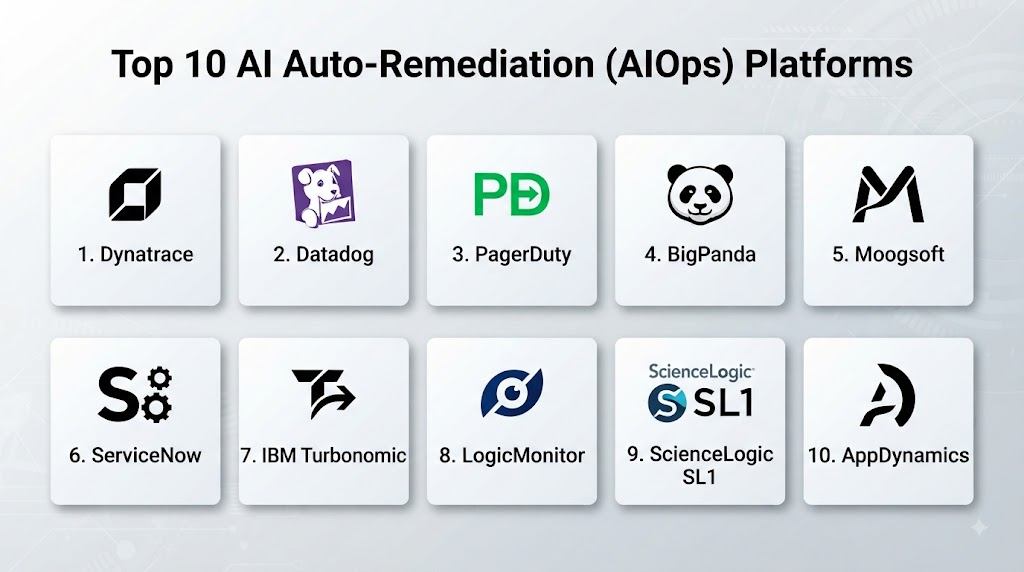
Top 10 AI Auto-Remediation (AIOps) Platforms
1 — PagerDuty
One-line verdict: Best for organizations combining AI-assisted incident response, automated workflows, on-call operations, and controlled remediation.
Short description:
PagerDuty is an incident-management and operations platform that connects alerts, responders, workflows, automation, and operational context. Its automation capabilities can execute predefined operational actions, while AI-assisted capabilities can help responders investigate and manage incidents.
Standout Capabilities
- Incident management
- On-call orchestration
- Event intelligence
- Incident response workflows
- Automation
- Runbook-style operational actions
- AI-assisted incident investigation
- Escalation management
AI-Specific Depth
- Model support: Hosted AI capabilities; underlying model configuration varies.
- RAG / knowledge integration: Incident context, operational information, and connected knowledge can support investigations.
- Evaluation: Incident outcomes and human review provide practical validation; formal model-evaluation infrastructure varies.
- Guardrails: Workflow permissions, approvals, and automation controls help restrict operational actions.
- Observability: Strong incident and operational visibility; detailed model-level token tracing varies.
Pros
- Strong incident-response ecosystem.
- Automation is connected directly to operational workflows.
- Suitable for organizations with mature on-call processes.
Cons
- Can be more extensive than smaller teams need.
- Advanced automation requires careful workflow design.
- Not primarily a raw infrastructure automation platform.
Security & Compliance
Enterprise security and administrative capabilities are available. Organizations should verify the exact SSO, RBAC, audit logging, retention, encryption, residency, and certification requirements for their deployment.
Deployment & Platforms
- Web: Yes
- Windows/macOS/Linux: Browser-based
- Mobile: Available
- Deployment: Cloud/SaaS
Integrations & Ecosystem
PagerDuty is designed to connect incident management with operational systems.
- Monitoring platforms
- Observability systems
- Cloud platforms
- Collaboration tools
- Ticketing systems
- Automation tools
- IT operations systems
Pricing Model
Tiered SaaS and enterprise pricing. Exact pricing varies by plan and usage.
Best-Fit Scenarios
- Enterprise SRE teams
- Organizations with formal incident-response processes
- Teams wanting incident management and controlled automation together
2 — Dynatrace
One-line verdict: Best for enterprises seeking AI-assisted operations, dependency intelligence, automated analysis, and controlled remediation.
Short description:
Dynatrace combines observability, application performance monitoring, infrastructure monitoring, service topology, AI-assisted analysis, and automation. Its broad operational context makes it particularly useful for environments where remediation decisions depend on understanding application and infrastructure relationships.
Standout Capabilities
- Full-stack observability
- Service dependency mapping
- AI-assisted problem analysis
- Automated operations
- Infrastructure monitoring
- Application monitoring
- Kubernetes visibility
- Workflow automation
AI-Specific Depth
- Model support: Platform-specific AI capabilities and proprietary analytics.
- RAG / knowledge integration: Operational context and organizational information can support analysis.
- Evaluation: Remediation outcomes and observability data provide operational validation.
- Guardrails: Enterprise permissions, workflow policies, and automation controls can restrict actions.
- Observability: Extensive application and infrastructure telemetry.
Pros
- Strong context for complex remediation decisions.
- Deep dependency awareness.
- Suitable for large distributed environments.
Cons
- Implementation can be substantial.
- Broad functionality creates a learning curve.
- Automated actions require careful policy design.
Security & Compliance
Enterprise security and governance capabilities are available. Exact certifications, retention, residency, encryption, and administrative controls should be verified for the intended deployment.
Deployment & Platforms
- Web: Yes
- Windows/macOS/Linux: Browser-based
- Mobile: Varies
- Deployment: Cloud and environment-specific options
Integrations & Ecosystem
- Cloud providers
- Kubernetes
- Databases
- Applications
- Infrastructure
- CI/CD systems
- Incident-management tools
Pricing Model
Enterprise subscription and usage-based pricing vary according to environment and contract.
Best-Fit Scenarios
- Large distributed enterprises
- Complex application environments
- Organizations wanting AI-assisted operations connected to observability
3 — Datadog
One-line verdict: Best for cloud-native teams wanting observability, incident investigation, workflow automation, and infrastructure remediation in one ecosystem.
Short description:
Datadog provides metrics, logs, traces, infrastructure monitoring, application performance monitoring, cloud monitoring, and operational workflows. Its broad telemetry environment can provide the context required for AI-assisted investigation and automated operational actions.
Standout Capabilities
- Infrastructure monitoring
- Application monitoring
- Logs
- Metrics
- Distributed tracing
- Kubernetes monitoring
- Workflow automation
- Incident management
AI-Specific Depth
- Model support: Hosted AI capabilities; exact model routing varies.
- RAG / knowledge integration: Observability data and connected operational information can provide investigation context.
- Evaluation: Remediation outcomes can be validated using service health and telemetry.
- Guardrails: Access controls and workflow permissions can restrict actions; detailed AI-specific prompt-injection defenses vary.
- Observability: Extensive telemetry and monitoring capabilities.
Pros
- Strong telemetry foundation.
- Good fit for cloud-native environments.
- Automation can operate close to existing monitoring data.
Cons
- Large telemetry volumes can increase costs.
- Broad functionality may require significant configuration.
- Automated remediation must be carefully governed.
Security & Compliance
Enterprise security capabilities are available. Specific certifications and controls should be verified for the relevant service and subscription.
Deployment & Platforms
- Web: Yes
- Windows/macOS/Linux: Browser-based
- Mobile: Available
- Deployment: Cloud/SaaS
Integrations & Ecosystem
Datadog supports a broad infrastructure ecosystem.
- Cloud providers
- Kubernetes
- Databases
- CI/CD platforms
- Infrastructure tools
- Collaboration platforms
- Incident-management systems
Pricing Model
Usage-based and subscription components vary by service. Exact cost depends heavily on monitored resources and telemetry volume.
Best-Fit Scenarios
- Cloud-native organizations
- Kubernetes teams
- Engineering organizations already using Datadog
4 — BigPanda
One-line verdict: Best for IT operations teams that need event correlation, incident intelligence, noise reduction, and automated response workflows.
Short description:
BigPanda focuses on IT operations intelligence by correlating events from multiple monitoring systems and helping teams identify meaningful incidents. Its automation capabilities can connect operational intelligence with predefined response actions.
Standout Capabilities
- Event correlation
- Alert-noise reduction
- Incident intelligence
- Operational analytics
- Service dependency context
- Incident enrichment
- Automation
- IT operations workflows
AI-Specific Depth
- Model support: Hosted AI capabilities; exact model architecture varies.
- RAG / knowledge integration: Operational data and incident context can provide investigation information.
- Evaluation: Operational outcomes and event-correlation quality provide practical validation.
- Guardrails: Administrative permissions and workflow policies can restrict actions.
- Observability: Strong event and incident visibility; detailed AI token observability is not publicly stated.
Pros
- Strong event-correlation capabilities.
- Useful for reducing alert fatigue.
- Connects multiple monitoring sources.
Cons
- Requires underlying monitoring integrations.
- Less focused on application telemetry collection itself.
- Advanced automation requires configuration.
Security & Compliance
Enterprise security capabilities are available. Specific certifications and controls should be verified for the applicable contract.
Deployment & Platforms
- Web: Yes
- Windows/macOS/Linux: Browser-based
- Mobile: Varies
- Deployment: Cloud/SaaS
Integrations & Ecosystem
BigPanda is designed to aggregate operational signals.
- Monitoring tools
- Cloud platforms
- ITSM systems
- Observability platforms
- Automation systems
- Infrastructure monitoring
- Application monitoring
Pricing Model
Enterprise/custom pricing. Exact pricing varies.
Best-Fit Scenarios
- IT operations centers
- Enterprises with high alert volumes
- Teams struggling with alert fatigue
5 — Shoreline
One-line verdict: Best for mature operations teams seeking automated infrastructure remediation and resilient cloud operations.
Short description:
Shoreline focuses heavily on autonomous cloud operations and remediation. Its approach connects operational monitoring with automated corrective actions, making it particularly relevant for teams dealing with recurring infrastructure problems.
Standout Capabilities
- Automated remediation
- Infrastructure operations
- Service health monitoring
- Operational automation
- Incident response
- Remediation workflows
- Cloud operations
- Resilience management
AI-Specific Depth
- Model support: Platform-specific AI capabilities; exact underlying models vary.
- RAG / knowledge integration: Operational and infrastructure context can support analysis.
- Evaluation: Remediation outcomes provide direct operational feedback.
- Guardrails: Action controls and infrastructure permissions are important; detailed prompt-injection defenses are not publicly stated.
- Observability: Infrastructure and operational telemetry are central.
Pros
- Strong remediation orientation.
- Can automate repetitive infrastructure recovery.
- Useful for mature cloud operations.
Cons
- Automated production changes create additional operational risk.
- Requires careful permission management.
- Better suited to mature SRE organizations.
Security & Compliance
Security should be a major procurement focus because the platform may interact with production infrastructure. Specific certifications and controls should be verified directly for the intended deployment.
Deployment & Platforms
- Web: Yes
- Windows/macOS/Linux: Browser and infrastructure components
- Mobile: Varies / N/A
- Deployment: Cloud/hybrid capabilities vary
Integrations & Ecosystem
- Cloud infrastructure
- Kubernetes
- Monitoring platforms
- Infrastructure-management systems
- Automation workflows
- Incident-management systems
Pricing Model
Enterprise/custom pricing. Exact pricing varies.
Best-Fit Scenarios
- Mature SRE teams
- Large cloud environments
- Organizations with repetitive infrastructure failures
6 — Rootly
One-line verdict: Best for engineering organizations that want incident automation and remediation workflows integrated into collaborative incident response.
Short description:
Rootly is an incident-management platform designed around engineering and SRE workflows. It combines incident response, automation, collaboration, timelines, and operational processes, making it useful for organizations that want controlled remediation actions connected to incident management.
Standout Capabilities
- Incident management
- Workflow automation
- Incident timelines
- Automated actions
- AI-assisted investigation
- Collaboration
- Post-incident workflows
- Runbook-oriented processes
AI-Specific Depth
- Model support: Hosted AI capabilities; exact configuration varies.
- RAG / knowledge integration: Incident information, runbooks, and connected operational context can support investigations.
- Evaluation: Human review and post-incident outcomes provide practical evaluation.
- Guardrails: Workflow permissions and approval mechanisms can limit actions.
- Observability: Strong incident-level visibility; detailed model-level observability is not publicly stated.
Pros
- Strong engineering-team focus.
- Good collaboration workflows.
- Automation can reduce repetitive incident-response work.
Cons
- Requires integrations with monitoring and observability platforms.
- Not primarily an infrastructure telemetry platform.
- Remediation actions still require careful governance.
Security & Compliance
Enterprise controls vary by plan. Specific certifications, retention, residency, and access controls should be verified before deployment.
Deployment & Platforms
- Web: Yes
- Windows/macOS/Linux: Browser-based
- Mobile: Varies
- Deployment: Cloud/SaaS
Integrations & Ecosystem
- Chat platforms
- Monitoring systems
- Observability tools
- Ticketing systems
- Runbooks
- Engineering workflows
- Incident-management systems
Pricing Model
Tiered and enterprise-oriented SaaS pricing. Exact pricing varies.
Best-Fit Scenarios
- Engineering organizations
- DevOps and SRE teams
- Teams seeking collaborative incident automation
7 — Harness
One-line verdict: Best for engineering teams connecting deployment automation, observability, incident response, and controlled remediation.
Short description:
Harness provides software delivery, continuous delivery, cloud cost, security, and engineering automation capabilities. Its relevance to auto-remediation comes from connecting operational signals with deployment and infrastructure workflows.
Standout Capabilities
- Continuous delivery
- Deployment automation
- Kubernetes workflows
- Infrastructure automation
- Cloud operations
- Service reliability workflows
- Workflow orchestration
- Automated operational actions
AI-Specific Depth
- Model support: Platform AI capabilities vary by product.
- RAG / knowledge integration: Engineering and operational context can support AI workflows.
- Evaluation: Deployment and operational outcomes can provide practical validation.
- Guardrails: Approval gates, policies, permissions, and workflow controls are important safeguards.
- Observability: Engineering and operational telemetry depends on connected products and integrations.
Pros
- Strong connection between deployments and operations.
- Useful for teams automating software delivery and infrastructure.
- Approval gates help control production changes.
Cons
- Broader platform may be more than a remediation-only requirement.
- Implementation can require workflow engineering.
- Exact AI capabilities vary across products.
Security & Compliance
Enterprise security and administrative capabilities vary by product and plan. Specific certifications should be verified before procurement.
Deployment & Platforms
- Web: Yes
- Windows/macOS/Linux: Browser-based
- Mobile: Varies
- Deployment: Cloud/SaaS with product-specific deployment options
Integrations & Ecosystem
- Kubernetes
- Cloud platforms
- CI/CD systems
- Infrastructure-as-Code
- Monitoring tools
- Security platforms
- Engineering systems
Pricing Model
Tiered SaaS and enterprise pricing. Exact pricing varies.
Best-Fit Scenarios
- DevOps organizations
- Platform engineering teams
- Businesses connecting deployment automation with operations
8 — Moogsoft
One-line verdict: Best for organizations focused on event correlation, noise reduction, and automated IT operations response.
Short description:
Moogsoft has historically focused on AIOps, event management, anomaly detection, correlation, and operational intelligence. It is particularly relevant where large volumes of monitoring events need to be consolidated before response automation is applied.
Standout Capabilities
- Event correlation
- Anomaly detection
- Alert reduction
- Incident intelligence
- Operational analytics
- Service context
- Automation
- IT operations workflows
AI-Specific Depth
- Model support: Proprietary AIOps and machine-learning capabilities.
- RAG / knowledge integration: Operational data and incident context can support investigation.
- Evaluation: Operational outcomes and event-correlation quality can be measured.
- Guardrails: Workflow controls can restrict automated actions.
- Observability: Strong event-level operational visibility.
Pros
- Strong AIOps heritage.
- Useful for high-volume event environments.
- Helps reduce operational noise.
Cons
- Requires integration with existing monitoring tools.
- Event correlation is more central than deep application observability.
- Advanced remediation requires careful workflow design.
Security & Compliance
Security and enterprise controls should be verified for the relevant deployment and product configuration.
Deployment & Platforms
- Web: Yes
- Windows/macOS/Linux: Browser-based
- Mobile: Varies
- Deployment: Cloud and deployment options vary
Integrations & Ecosystem
- Monitoring systems
- ITSM platforms
- Infrastructure tools
- Cloud environments
- Application monitoring
- Automation platforms
- Incident-management systems
Pricing Model
Enterprise/custom pricing. Exact pricing is not publicly assumed.
Best-Fit Scenarios
- Large IT operations environments
- Teams experiencing alert overload
- Organizations needing event correlation before remediation
9 — Elastic Observability
One-line verdict: Best for technical teams wanting flexible telemetry analysis, automation, search, and customizable operational workflows.
Short description:
Elastic provides observability, search, security, and machine-data capabilities across cloud and self-managed environments. Its flexibility can be useful for organizations building customized AIOps and remediation workflows around their own operational data.
Standout Capabilities
- Log analysis
- Metrics
- Distributed tracing
- Search
- Observability
- Security analytics
- Automation possibilities
- Flexible deployment
AI-Specific Depth
- Model support: Supported AI model options vary by configuration.
- RAG / knowledge integration: Strong search and knowledge-integration possibilities.
- Evaluation: Remediation workflows can be tested against telemetry and historical incidents.
- Guardrails: Access controls and security capabilities can help constrain workflows.
- Observability: Strong metrics, logs, traces, and machine-data capabilities.
Pros
- Flexible architecture.
- Strong search capabilities.
- Suitable for teams wanting greater control over telemetry and workflows.
Cons
- Advanced implementations require technical expertise.
- AI remediation often requires additional workflow design.
- Governance becomes the organization’s responsibility when building custom automation.
Security & Compliance
Enterprise security controls are available depending on product and deployment. Exact certifications and controls should be verified before procurement.
Deployment & Platforms
- Web: Yes
- Windows/macOS/Linux: Supported
- Mobile: Varies
- Deployment: Cloud, self-managed, and hybrid options vary
Integrations & Ecosystem
- Kubernetes
- Cloud platforms
- Applications
- Databases
- Infrastructure
- Security systems
- AI model providers
Pricing Model
Open and commercial offerings vary by product, deployment, and usage.
Best-Fit Scenarios
- Technically sophisticated SRE teams
- Organizations wanting flexible observability
- Enterprises building customized AIOps workflows
10 — IBM Concert
One-line verdict: Best for enterprises seeking AI-assisted application operations, observability context, automation, and operational decision support.
Short description:
IBM Concert is positioned around application management and operational intelligence across enterprise environments. It can help teams understand application health, dependencies, risks, and operational information while connecting insights with broader enterprise operations.
Standout Capabilities
- Application inventory
- Application health insights
- Dependency awareness
- Operational intelligence
- Risk analysis
- AI-assisted recommendations
- Enterprise application management
- Automation integration
AI-Specific Depth
- Model support: IBM enterprise AI capabilities; exact underlying model configuration varies.
- RAG / knowledge integration: Enterprise application and operational information can provide context.
- Evaluation: Operational outcomes and human validation are appropriate evaluation mechanisms.
- Guardrails: Enterprise permissions and workflow controls can constrain actions.
- Observability: Application and operational visibility depend on connected environments.
Pros
- Strong enterprise application-management orientation.
- Useful for complex application estates.
- Can connect operational insights with enterprise workflows.
Cons
- Enterprise-oriented implementation.
- May be more than smaller teams need.
- Automation capabilities depend heavily on connected systems and workflows.
Security & Compliance
Enterprise security and administrative controls are available. Exact certifications, retention, residency, encryption, and access controls should be verified for the intended deployment.
Deployment & Platforms
- Web: Yes
- Windows/macOS/Linux: Browser-based
- Mobile: Varies
- Deployment: Cloud and enterprise deployment options vary
Integrations & Ecosystem
- Enterprise applications
- Cloud infrastructure
- Observability systems
- Automation platforms
- IT operations
- Application management
- Enterprise workflows
Pricing Model
Enterprise/custom pricing. Exact pricing varies by environment and contract.
Best-Fit Scenarios
- Large enterprises
- Complex application estates
- Organizations using IBM enterprise technology
Comparison Table
| Tool | Best For | Deployment | Model Flexibility | Strength | Watch-Out | Public Rating |
|---|---|---|---|---|---|---|
| PagerDuty | Incident response automation | Cloud | Hosted | Incident workflows | Not primarily infrastructure automation | N/A |
| Dynatrace | Enterprise AIOps | Cloud / hybrid options vary | Hosted / proprietary | Context-aware operations | Implementation complexity | N/A |
| Datadog | Cloud-native operations | Cloud | Hosted | Observability + automation | Telemetry costs | N/A |
| BigPanda | Event correlation | Cloud | Hosted | Noise reduction | Requires monitoring integrations | N/A |
| Shoreline | Automated remediation | Cloud / hybrid varies | Specialized | Infrastructure recovery | Automation risk | N/A |
| Rootly | Engineering incident automation | Cloud | Hosted | Collaborative workflows | Less raw telemetry depth | N/A |
| Harness | DevOps automation | Cloud / product-dependent | Hosted | Deployment + operations | Broad platform scope | N/A |
| Moogsoft | AIOps event management | Cloud / varies | Proprietary | Event correlation | Requires integrations | N/A |
| Elastic Observability | Flexible AIOps | Cloud / self-managed | Multi-model options vary | Search and flexibility | Requires technical expertise | N/A |
| IBM Concert | Enterprise application operations | Cloud / enterprise options | Enterprise AI | Application intelligence | Enterprise complexity | N/A |
Scoring & Evaluation
The scores below are comparative editorial assessments rather than official product ratings. They measure suitability for an AI auto-remediation use case rather than overall product quality.
The weighting gives the greatest importance to remediation capabilities, AI reliability, safety, integrations, operational usability, cost, security, and support.
| Tool | Core | Reliability/Eval | Guardrails | Integrations | Ease | Perf/Cost | Security/Admin | Support | Weighted Total |
|---|---|---|---|---|---|---|---|---|---|
| PagerDuty | 9.1 | 8.7 | 9.2 | 9.5 | 8.6 | 8.0 | 9.2 | 8.9 | 8.9 |
| Dynatrace | 9.4 | 9.2 | 9.1 | 9.5 | 7.7 | 7.8 | 9.4 | 8.9 | 8.9 |
| Datadog | 9.2 | 8.9 | 8.8 | 9.7 | 8.4 | 7.6 | 9.1 | 8.9 | 8.7 |
| BigPanda | 8.9 | 8.7 | 8.6 | 9.3 | 8.1 | 7.9 | 8.9 | 8.5 | 8.6 |
| Shoreline | 9.3 | 8.8 | 9.0 | 8.6 | 7.5 | 8.5 | 9.0 | 8.3 | 8.7 |
| Rootly | 8.7 | 8.5 | 8.6 | 9.2 | 8.8 | 8.2 | 8.7 | 8.5 | 8.6 |
| Harness | 8.8 | 8.5 | 9.0 | 9.5 | 7.8 | 8.2 | 9.0 | 8.6 | 8.7 |
| Moogsoft | 8.7 | 8.5 | 8.5 | 9.0 | 7.9 | 8.0 | 8.7 | 8.3 | 8.5 |
| Elastic Observability | 8.8 | 8.6 | 8.8 | 9.5 | 7.5 | 8.5 | 9.1 | 8.7 | 8.6 |
| IBM Concert | 8.6 | 8.6 | 9.0 | 9.0 | 7.5 | 7.8 | 9.3 | 8.8 | 8.5 |
Top 3 for Enterprise
- Dynatrace — excellent combination of observability context, AI-assisted analysis, automation, and enterprise controls.
- PagerDuty — particularly strong for incident-response orchestration and controlled operational automation.
- Datadog — strong for organizations wanting remediation close to broad observability data.
Top 3 for SMB
- Datadog — strong all-around observability and automation ecosystem.
- Rootly — useful for collaborative incident response and workflow automation.
- PagerDuty — a good option for teams formalizing on-call and incident operations.
Top 3 for Developers
- Datadog — broad telemetry and operational integrations.
- Elastic Observability — flexible and customizable for technical teams.
- Harness — particularly useful where deployments and infrastructure automation are closely connected.
Which AI Auto-Remediation Platform Is Right for You?
Solo / Small Engineering Team
Small teams should not begin with fully autonomous production remediation.
Start with read-only AI investigation and controlled automation.
Prioritize:
- Monitoring
- Logs
- Metrics
- Basic incident management
- Runbook automation
- Human approval
- Simple integrations
- Cost visibility
Datadog, Rootly, or PagerDuty can be practical options depending on the team’s existing stack.
The first objective should be eliminating repetitive manual work rather than giving an AI unrestricted production access.
SMB
SMBs should identify their most repetitive operational incidents.
Examples include:
- Service restarts
- Failed deployments
- Stuck queues
- Resource exhaustion
- Certificate problems
- Unhealthy instances
- Kubernetes workload failures
Document the response procedure and automate only those workflows that have predictable outcomes.
A platform such as Datadog, PagerDuty, or Rootly can provide a foundation for this approach.
Mid-Market
Mid-market organizations should begin connecting incident response with infrastructure and deployment workflows.
Evaluate:
- Alert correlation
- AI investigation
- Service topology
- Change intelligence
- Runbook automation
- Approval gates
- Rollback
- Kubernetes automation
- Incident communication
- Post-incident learning
Datadog, Dynatrace, BigPanda, Rootly, and Harness can be evaluated depending on the existing infrastructure.
Enterprise
Enterprise environments require strong governance because automated remediation can directly affect production systems.
Prioritize:
- SSO
- RBAC
- Least-privilege access
- Audit logs
- Approval workflows
- Action policies
- Blast-radius limits
- Rollback
- Secrets management
- Data residency
- Retention controls
- AI governance
- Model monitoring
- Incident accountability
Dynatrace, PagerDuty, Datadog, and IBM Concert are particularly relevant for large enterprise environments, while Shoreline is especially interesting where infrastructure remediation is a primary objective.
Regulated Industries
Regulated organizations should treat automated remediation as a privileged operational capability.
Before deployment, verify:
- Data-processing requirements
- Telemetry privacy
- Customer-data exposure
- Secret handling
- Data residency
- Encryption
- SSO
- RBAC
- Audit trails
- Retention
- Model-provider relationships
- Human approval requirements
- Automated-action boundaries
Start with read-only investigation.
Move toward remediation only after the AI has been evaluated against historical incidents and the organization has established reliable safety mechanisms.
Budget vs Premium
Budget-conscious teams should automate a small number of repetitive incidents rather than purchasing the largest AIOps platform available.
A simple workflow such as:
Detect → Verify → Restart → Check health → Escalate if unsuccessful
can provide meaningful value without introducing autonomous decision-making across the entire environment.
Premium platforms become easier to justify when:
- Incident volume is high.
- Infrastructure is complex.
- Engineer time is expensive.
- Multiple monitoring platforms exist.
- Alert noise is substantial.
- The organization operates globally.
- Production downtime is costly.
- There are many repetitive incidents.
- Governance and auditability are required.
Build vs Buy
Building an internal auto-remediation system can make sense for organizations with:
- Strong SRE teams
- Infrastructure-as-Code
- Existing observability APIs
- Mature runbooks
- AI engineering expertise
- Custom operational requirements
- Strict data-control requirements
A custom system might combine:
- Monitoring APIs
- Incident-management APIs
- Service topology
- Deployment systems
- Runbooks
- Internal knowledge
- AI reasoning
- Automation tools
- Verification checks
However, building the AI decision layer is only part of the challenge.
A production-grade remediation platform also needs:
- Identity management
- Secrets management
- Least-privilege access
- Audit logging
- Rollback
- Rate limits
- Action validation
- Evaluation
- Model monitoring
- Incident handling
- Cost controls
For many teams, buying the operational platform and extending it through APIs is more practical.
Implementation Playbook
First 30 Days: Pilot + Success Metrics
Do not begin by giving AI permission to modify production systems.
Choose one low-risk incident category.
Examples:
- Restarting an unhealthy stateless service
- Clearing a known-safe temporary queue
- Re-running a failed non-production job
- Triggering an existing diagnostic workflow
- Scaling a controlled test workload
Establish baseline metrics:
- Mean time to detect
- Mean time to investigate
- Mean time to resolve
- Number of repetitive incidents
- Engineer intervention time
- Failed remediation attempts
- Escalation frequency
- Recovery rate
Connect the system to:
- Metrics
- Logs
- Traces
- Alerts
- Deployment history
- Runbooks
- Service ownership
- Incident records
Start with read-only AI investigation.
Then compare the AI’s recommendations with known historical incidents.
Days 31–60: Security + Evaluation + Rollout
Create a structured evaluation harness.
Use historical incidents to test:
- Diagnosis quality
- Evidence selection
- Recommended action
- Safety
- False positives
- False negatives
- Recovery verification
- Escalation behavior
Create adversarial tests.
Examples include:
- Malicious instructions inside logs
- Misleading monitoring messages
- Conflicting telemetry
- Incomplete telemetry
- Fake remediation commands
- Unexpected service dependencies
- Repeated failure after remediation
The AI should treat logs, tickets, user-provided text, and monitoring events as untrusted data, not instructions.
Establish clear action categories:
Read-only actions
- Query metrics
- Search logs
- Inspect deployments
- Retrieve service status
Low-risk actions
- Restart approved stateless services
- Re-run safe diagnostic checks
- Trigger approved runbooks
High-risk actions
- Database changes
- Production configuration changes
- Security-policy changes
- Data deletion
- Network-policy modifications
- Broad infrastructure changes
High-risk actions should normally require explicit human approval.
Days 61–90: Cost, Latency, Governance + Scale
Once controlled remediation is reliable:
- Expand the number of supported incident types.
- Track remediation success rates.
- Measure AI investigation latency.
- Track model and workflow costs.
- Monitor false-remediation events.
- Establish automated rollback.
- Add action-level audit logs.
- Version prompts and workflows.
- Create model evaluation datasets.
- Establish AI incident-response policies.
- Introduce service-level ownership.
- Create escalation policies.
Use smaller models for predictable tasks such as:
- Log classification
- Incident categorization
- Event deduplication
- Simple summaries
- Formatting
Use more capable reasoning systems for:
- Complex incident analysis
- Multi-service investigations
- Ambiguous failures
- Change-impact analysis
The goal should be progressive autonomy, not unrestricted autonomy.
Common Mistakes & How to Avoid Them
- Giving AI production write access immediately: Begin with read-only investigation and carefully controlled actions.
- Automating unclear incidents: Automate only scenarios with predictable remediation paths.
- Ignoring prompt injection: Logs, tickets, and monitoring data can contain malicious instructions.
- Using excessive permissions: Give the automation system only the minimum access required.
- No rollback: Every significant automated action should have a recovery strategy.
- No verification: Never assume a remediation succeeded simply because a command completed.
- Ignoring blast radius: Restrict how many services or resources one automated action can affect.
- No approval boundaries: Define which actions can be autonomous and which require human approval.
- Poor observability: AI cannot make reliable decisions without useful telemetry.
- Ignoring change context: Recent deployments and configuration changes are often critical evidence.
- No historical evaluation: Test AI behavior against previous incidents before relying on it.
- No cost controls: Automated scaling or repeated remediation can unexpectedly increase infrastructure spending.
- No action timeouts: A failed automation should not continue indefinitely.
- Ignoring recurring failure patterns: Repeated incidents should lead to permanent engineering fixes rather than endless automated recovery.
- No audit trail: Record what the AI observed, decided, executed, and verified.
- Treating AI recommendations as facts: AI can produce plausible but incorrect explanations.
- No fallback: Define what happens when the AI service or automation platform becomes unavailable.
- Vendor lock-in: Keep important runbooks, policies, and operational knowledge portable where possible.
FAQs
What is AI auto-remediation?
AI auto-remediation uses artificial intelligence and automation to detect operational problems, investigate available evidence, recommend or execute corrective actions, and verify whether the system recovered.
Is AI auto-remediation the same as traditional automation?
No. Traditional automation generally follows predefined rules. AI-assisted remediation can add contextual analysis, anomaly interpretation, investigation, and dynamic decision support before executing an approved workflow.
Can AI automatically fix production incidents?
Yes, some platforms can execute automated remediation actions. However, autonomous production changes should be limited to well-understood scenarios with strong controls, verification, rollback, and least-privilege access.
Does AI auto-remediation replace SRE engineers?
No. It can reduce repetitive operational work, but engineers remain responsible for architecture, reliability strategy, incident judgment, risk management, and permanent fixes.
What can an AIOps platform automatically remediate?
Potential actions include restarting services, scaling workloads, triggering runbooks, rerunning jobs, replacing unhealthy instances, rolling back approved deployments, or initiating predefined recovery workflows.
Should every incident be automatically remediated?
No. Some incidents are ambiguous, high-risk, security-sensitive, or potentially destructive. These should be escalated to human responders.
What is human-in-the-loop remediation?
It means the AI can investigate and recommend an action, but a human must approve selected operations before the platform executes them.
What is progressive autonomy?
Progressive autonomy means gradually increasing what the AI can do as confidence and reliability improve. A typical path is read-only investigation, recommendation, approval-based execution, and eventually limited autonomous remediation.
How can prompt injection affect AIOps?
Operational data can contain malicious or misleading text. An attacker could place instructions inside logs, tickets, or other inputs and attempt to manipulate the AI into performing an unsafe action.
How can organizations defend against prompt injection?
Treat external and operational data as untrusted input, separate data from instructions, restrict tool permissions, validate proposed actions, use allowlists, require approval for sensitive actions, and maintain detailed audit logs.
Does AI auto-remediation require observability?
Effective remediation generally requires strong operational visibility. Metrics, logs, traces, events, deployment history, and service relationships give the system the context needed to make better decisions.
Can AIOps work with Kubernetes?
Yes. Kubernetes is an important use case because workloads can fail, restart, scale, become unhealthy, or encounter resource constraints. Automation can help recover predictable failure conditions.
Is AI auto-remediation expensive?
Costs vary according to the platform, telemetry volume, AI usage, infrastructure size, automation frequency, and subscription model. Automated actions can also create indirect costs if poorly controlled.
How should remediation accuracy be measured?
Track successful recovery rate, false-remediation rate, escalation rate, mean time to recovery, engineer intervention time, rollback frequency, and the percentage of incidents correctly classified.
Should AI remediation have access to secrets?
Only when absolutely necessary, and preferably through controlled secret-management mechanisms. AI systems should not receive unrestricted access to credentials or sensitive configuration.
Can organizations build their own AIOps remediation platform?
Yes. A mature engineering organization can combine observability APIs, incident management, runbooks, infrastructure automation, an AI model, and an evaluation framework.
When should a company build instead of buy?
Build when the organization has unique operational requirements, strong engineering resources, proprietary workflows, or strict infrastructure constraints that commercial platforms cannot satisfy.
What is the biggest risk of AI auto-remediation?
The largest operational risk is allowing an incorrect AI decision to trigger a high-impact production change. Strong permissions, validation, blast-radius controls, rollback, and human approval can reduce this risk.
Can AI auto-remediation prevent incidents?
It can reduce the impact of recurring or predictable failures and may identify problems earlier. However, it should complement preventative engineering practices rather than replace them.
How does AI remediation differ from incident management?
Incident management coordinates detection, communication, escalation, responders, and resolution. AI remediation adds automated investigation and corrective actions to that broader process.
What is the best way to start?
Start with one repetitive, low-risk incident category. Measure the existing manual process, automate the diagnosis and remediation workflow in a controlled environment, evaluate the results, and expand gradually.
Conclusion
AI Auto-Remediation is becoming an important part of modern AIOps, SRE, DevOps, and platform engineering.The most useful platforms are moving beyond basic alert automation toward a closed-loop operational model:PagerDuty is strong for incident-response orchestration and operational automation. Dynatrace provides deep observability context for complex environments. Datadog connects broad telemetry with operational workflows. BigPanda focuses heavily on event correlation and alert-noise reduction. Shoreline stands out for infrastructure remediation. Rootly emphasizes engineering-focused incident automation. Harness connects delivery workflows with operations. Moogsoft provides an AIOps-oriented approach to event correlation. Elastic Observability offers flexible telemetry and customizable operational workflows. IBM Concert targets enterprise application operations and intelligence.