Introduction
AI portfolio optimization tools combine quantitative finance, machine learning, statistical analysis, and automation to help investors build, analyze, and manage investment portfolios. These platforms can evaluate asset allocation, portfolio risk, diversification, factor exposure, historical performance, and potential portfolio combinations based on defined objectives and constraints.The category matters because modern investment teams increasingly work with large datasets, multiple asset classes, changing market conditions, and increasingly complex portfolio requirements. AI can support research and decision-making by processing information faster and helping analysts test more portfolio scenarios.
Common use cases include asset allocation, portfolio rebalancing, risk modeling, factor analysis, scenario testing, strategy research, portfolio construction, and investment reporting.
When evaluating a platform, buyers should consider optimization methodology, data quality, model transparency, backtesting, risk controls, explainability, integrations, security, scalability, cost, latency, and human oversight.
What’s Changed in AI Portfolio Optimization Tools
- Machine learning is increasingly being combined with traditional quantitative portfolio models rather than replacing them completely.
- AI can process larger collections of market, fundamental, alternative, and portfolio datasets for research.
- Natural-language interfaces can make complex portfolio analytics easier for investment professionals who are not quantitative developers.
- Automated portfolio workflows can reduce repetitive analysis and rebalancing tasks.
- AI-assisted scenario analysis can help investment teams explore different market and portfolio conditions.
- Explainability is becoming more important when AI-generated recommendations influence portfolio decisions.
- Out-of-sample validation and robust backtesting remain essential for detecting overfitting.
- Portfolio systems increasingly need stronger controls around automated recommendations and execution.
- Data quality and data lineage are becoming increasingly important because poor inputs can produce unreliable portfolio recommendations.
- API-based architectures allow optimization engines to connect with internal portfolio-management and investment systems.
- Cloud infrastructure makes computationally intensive simulations and optimization workflows easier to scale.
- Governance is becoming increasingly important as financial organizations introduce AI into research and portfolio-management processes.
Quick Buyer Checklist
When comparing AI portfolio optimization platforms, focus on the following areas:
- Data quality and availability.
- Portfolio optimization methodology.
- Supported asset classes.
- Risk-model capabilities.
- Backtesting functionality.
- Out-of-sample testing.
- Scenario and stress testing.
- Factor analysis.
- Portfolio constraints.
- Model transparency.
- Explainability.
- Human approval workflows.
- Data privacy and retention.
- Security and access management.
- API and integration capabilities.
- Cloud, hybrid, or self-hosted deployment.
- Model flexibility.
- Custom-model support.
- Performance and latency.
- Cost controls.
- Auditability.
- Vendor lock-in risk.
- Scalability.
- Technical support.
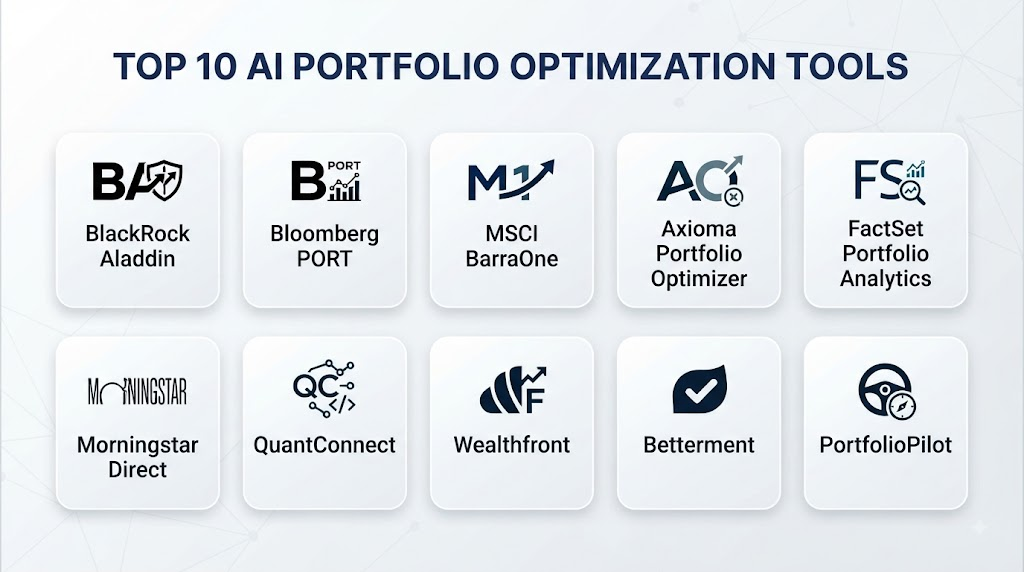
Top 10 AI Portfolio Optimization Tools
1. BlackRock Aladdin
One-line verdict: Best for institutional investors requiring comprehensive portfolio construction, risk management, analytics, and investment workflows.
Short description
BlackRock Aladdin is an institutional investment platform that combines portfolio management, risk analytics, investment operations, data, and decision-support capabilities. It is primarily designed for sophisticated investment organizations managing complex portfolios.
Standout Capabilities
- Portfolio risk analytics.
- Portfolio construction.
- Asset allocation workflows.
- Scenario analysis.
- Risk-factor analysis.
- Investment operations.
- Performance analytics.
- Enterprise investment infrastructure.
AI-Specific Depth
- Model support: Proprietary quantitative analytics and models; specific BYO-model capabilities vary.
- RAG / knowledge integration: Enterprise data integration is supported; generic RAG capabilities are not publicly stated.
- Evaluation: Quantitative model validation and investment analytics are supported; detailed generative-AI evaluation capabilities vary.
- Guardrails: Investment controls, portfolio constraints, and governance capabilities are available.
- Observability: Portfolio and risk analytics are supported; token-level AI observability is not publicly stated.
Pros
- Comprehensive institutional investment capabilities.
- Strong portfolio and risk-management ecosystem.
- Suitable for complex investment organizations.
Cons
- Can be excessive for small investment teams.
- Implementation can require significant organizational resources.
- Exact pricing is not publicly stated.
Security & Compliance
Enterprise security, governance, access management, and operational controls are available. Specific certifications and configurations should be verified directly during procurement.
Deployment & Platforms
- Enterprise cloud infrastructure.
- Web-based interfaces.
- Institutional deployment.
- Exact architecture varies by implementation.
Integrations & Ecosystem
The platform is designed to connect portfolio, risk, investment, operational, and data workflows.
- Portfolio-management systems.
- Market-data systems.
- Risk infrastructure.
- Investment operations.
- Analytics.
- Reporting.
- Enterprise data systems.
Pricing Model
Custom enterprise pricing. Exact pricing is not publicly stated.
Best-Fit Scenarios
- Large asset managers.
- Institutional investment teams.
- Complex multi-asset portfolios.
2. MSCI Analytics
One-line verdict: Best for investment teams requiring advanced portfolio analytics, factor analysis, risk modeling, and optimization capabilities.
Short description
MSCI provides investment analytics, risk models, portfolio construction tools, factor analysis, and optimization capabilities for professional investment organizations. Its products are particularly relevant to institutional investors managing complex portfolios.
Standout Capabilities
- Portfolio optimization.
- Factor analysis.
- Risk modeling.
- Asset allocation.
- Scenario analysis.
- Portfolio attribution.
- Investment analytics.
- Quantitative research.
AI-Specific Depth
- Model support: Proprietary quantitative and risk models.
- RAG / knowledge integration: Investment-data integration is supported; generic RAG functionality is not publicly stated.
- Evaluation: Quantitative methodologies can be evaluated against investment data; specific AI evaluation frameworks vary.
- Guardrails: Portfolio constraints and investment controls are supported.
- Observability: Risk and portfolio analytics are available; token-level AI metrics are not publicly stated.
Pros
- Strong quantitative investment analytics.
- Deep factor and risk capabilities.
- Suitable for institutional portfolio construction.
Cons
- Primarily targeted toward professional investment organizations.
- May require quantitative expertise.
- Exact pricing is not publicly stated.
Security & Compliance
Enterprise security and governance capabilities are available. Specific certifications and configurations should be verified for the relevant product and deployment.
Deployment & Platforms
- Cloud.
- Enterprise analytics.
- Web-based interfaces.
- API capabilities vary by product.
Integrations & Ecosystem
MSCI products can support institutional investment workflows involving portfolio data, risk, research, and analytics.
- Market data.
- Portfolio systems.
- Risk systems.
- Analytics platforms.
- Research workflows.
- Reporting systems.
Pricing Model
Custom enterprise pricing.
Best-Fit Scenarios
- Institutional asset managers.
- Quantitative investment teams.
- Multi-asset portfolio management.
3. Bloomberg PORT
One-line verdict: Best for professional investors needing portfolio analytics, risk analysis, optimization, and investment research workflows.
Short description
Bloomberg PORT provides portfolio analytics and risk-management capabilities within the broader Bloomberg investment environment. It can help professional investment teams evaluate portfolio exposures, performance, risk, and construction decisions.
Standout Capabilities
- Portfolio analysis.
- Risk analytics.
- Performance attribution.
- Scenario analysis.
- Portfolio comparison.
- Factor exposure analysis.
- Investment research integration.
- Market-data connectivity.
AI-Specific Depth
- Model support: Proprietary analytics and quantitative models.
- RAG / knowledge integration: Broad investment-data integration; generic RAG compatibility is not publicly stated.
- Evaluation: Portfolio analytics and quantitative methodologies are available; detailed AI evaluation methodology is not publicly stated.
- Guardrails: Portfolio controls and professional workflows are available.
- Observability: Portfolio and risk analytics are available; token-level AI metrics are not publicly stated.
Pros
- Strong professional market-data ecosystem.
- Comprehensive portfolio analytics.
- Useful for institutional investment research.
Cons
- Primarily designed for professional users.
- The wider ecosystem can introduce additional complexity.
- Exact pricing is not publicly stated.
Security & Compliance
Enterprise security and access-management capabilities are available. Specific controls depend on the selected services and configuration.
Deployment & Platforms
- Cloud-based services.
- Professional desktop and web workflows.
- Enterprise environment.
Integrations & Ecosystem
Bloomberg PORT benefits from its connection to the broader Bloomberg investment ecosystem.
- Market data.
- Portfolio data.
- Research.
- Risk analytics.
- Trading workflows.
- Reporting.
Pricing Model
Enterprise subscription pricing. Exact pricing is not publicly stated.
Best-Fit Scenarios
- Asset managers.
- Institutional portfolio managers.
- Professional investment teams.
4. FactSet
One-line verdict: Best for asset managers combining portfolio analytics, quantitative research, risk management, and investment data.
Short description
FactSet provides portfolio analytics, investment research, risk analysis, quantitative tools, and data services. Its ecosystem supports professional investment organizations that want research and portfolio-management workflows within a connected environment.
Standout Capabilities
- Portfolio analytics.
- Risk analysis.
- Quantitative research.
- Portfolio construction.
- Factor analysis.
- Performance attribution.
- Market-data integration.
- Investment workflow support.
AI-Specific Depth
- Model support: Proprietary analytics and quantitative models; AI capabilities vary by product.
- RAG / knowledge integration: Extensive investment-data integration; specific RAG functionality varies.
- Evaluation: Quantitative analytics and research workflows support testing; detailed AI evaluation methodology is not publicly stated.
- Guardrails: Enterprise controls and portfolio constraints are available.
- Observability: Portfolio and analytics monitoring are supported.
Pros
- Broad investment-data ecosystem.
- Strong research and portfolio capabilities.
- Useful for institutional workflows.
Cons
- Can be expensive for smaller teams.
- Advanced functionality may require specialist knowledge.
- Exact pricing varies.
Security & Compliance
Enterprise security and administrative controls are available. Specific configurations and certifications should be verified during procurement.
Deployment & Platforms
- Cloud.
- Web.
- Desktop/professional applications.
- APIs and data services.
Integrations & Ecosystem
FactSet supports investment research, portfolio analysis, risk, and reporting workflows.
- Portfolio-management systems.
- Market data.
- Research.
- APIs.
- Risk systems.
- Reporting.
- Data platforms.
Pricing Model
Subscription and enterprise pricing. Exact pricing varies by product and agreement.
Best-Fit Scenarios
- Asset managers.
- Investment research teams.
- Institutional portfolio managers.
5. Morningstar Direct
One-line verdict: Best for investment professionals needing portfolio analytics, research, risk analysis, and manager evaluation.
Short description
Morningstar Direct provides investment research, portfolio analytics, performance analysis, and investment evaluation capabilities. It is designed for asset managers, wealth managers, and other investment professionals.
Standout Capabilities
- Portfolio analysis.
- Investment research.
- Risk analytics.
- Performance analysis.
- Manager research.
- Asset allocation.
- Portfolio comparison.
- Investment reporting.
AI-Specific Depth
- Model support: Proprietary analytics and quantitative methodologies.
- RAG / knowledge integration: Investment research and data integration are available; generic RAG capabilities are not publicly stated.
- Evaluation: Investment analytics and research methodologies are available; detailed AI evaluation methodology is not publicly stated.
- Guardrails: Portfolio constraints and professional review workflows are available.
- Observability: Portfolio and performance analytics are supported.
Pros
- Strong investment research ecosystem.
- Useful portfolio-analysis functionality.
- Suitable for professional wealth and asset-management teams.
Cons
- More research-oriented than a pure optimization engine.
- Professional subscriptions may not suit casual users.
- Exact pricing is not publicly stated.
Security & Compliance
Enterprise security and access controls are available. Specific certification and retention details should be confirmed during procurement.
Deployment & Platforms
- Cloud.
- Web-based platform.
- Enterprise access.
Integrations & Ecosystem
Morningstar Direct connects investment research, portfolio information, performance analysis, and reporting workflows.
- Portfolio data.
- Investment research.
- Performance data.
- Risk analysis.
- Reporting.
- Investment databases.
Pricing Model
Subscription and enterprise pricing.
Best-Fit Scenarios
- Wealth managers.
- Asset managers.
- Investment research teams.
6. QuantConnect
One-line verdict: Best for quantitative developers building, testing, and optimizing algorithmic investment strategies programmatically.
Short description
QuantConnect is a quantitative investment development platform focused on algorithmic strategy research, development, and backtesting. It provides a developer-oriented environment for researchers who want control over models, data, and strategy implementation.
Standout Capabilities
- Algorithm development.
- Backtesting.
- Quantitative research.
- Strategy optimization.
- Historical market data.
- Cloud research environments.
- Python-based development.
- Algorithmic trading workflows.
AI-Specific Depth
- Model support: Developer-controlled quantitative and machine-learning models.
- RAG / knowledge integration: Not a primary portfolio-optimization capability.
- Evaluation: Strong emphasis on backtesting and quantitative evaluation.
- Guardrails: Strategy-level controls depend significantly on developer implementation.
- Observability: Backtesting and strategy analytics are available.
Pros
- High developer flexibility.
- Strong backtesting capabilities.
- Suitable for custom quantitative research.
Cons
- Programming knowledge is required.
- Users are responsible for model quality.
- Production workflows require careful engineering.
Security & Compliance
Security capabilities depend on the selected service and deployment configuration. Users should independently evaluate requirements for sensitive financial data and execution workflows.
Deployment & Platforms
- Cloud.
- Web-based development environment.
- Programmatic workflows.
Integrations & Ecosystem
QuantConnect supports developer-oriented quantitative investment workflows.
- Python.
- Quantitative libraries.
- Market data.
- Backtesting.
- APIs.
- Algorithmic strategies.
Pricing Model
Tiered and usage-based options may apply. Exact pricing varies.
Best-Fit Scenarios
- Quant developers.
- Investment researchers.
- Advanced systematic investors.
7. Composer
One-line verdict: Best for investors wanting visual portfolio construction and automated strategy workflows without extensive programming.
Short description
Composer provides a strategy-building environment designed to simplify systematic investing. Users can create investment strategies using defined rules and automate parts of portfolio management.
Standout Capabilities
- Visual strategy construction.
- Automated portfolio management.
- Portfolio rebalancing.
- Strategy building.
- Quantitative rules.
- Backtesting.
- Automated investment workflows.
AI-Specific Depth
- Model support: Strategy-based automation; specific proprietary AI model architecture is not publicly stated.
- RAG / knowledge integration: N/A for core portfolio construction.
- Evaluation: Backtesting and historical strategy evaluation are supported.
- Guardrails: Portfolio rules and strategy constraints are available.
- Observability: Strategy and portfolio performance analytics are available.
Pros
- Accessible to non-programmers.
- Visual strategy design.
- Automation simplifies systematic investing.
Cons
- Less flexible than developer-first quantitative platforms.
- May not meet complex institutional requirements.
- Exact pricing and capabilities can vary.
Security & Compliance
Users should verify current security, data-handling, account, and regulatory arrangements for their particular use case.
Deployment & Platforms
- Web.
- Cloud-based investment service.
- Platform availability varies.
Integrations & Ecosystem
Composer focuses primarily on strategy creation and portfolio-management workflows.
- Portfolio data.
- Strategy rules.
- Backtesting.
- Automated investing.
- Account workflows.
Pricing Model
Service-based or subscription pricing may vary.
Best-Fit Scenarios
- Individual systematic investors.
- Advisors exploring automated strategies.
- Users seeking low-code portfolio construction.
8. Portfolio Visualizer
One-line verdict: Best for investors and researchers wanting accessible portfolio analysis, optimization, backtesting, and risk comparison.
Short description
Portfolio Visualizer provides quantitative portfolio research tools covering asset allocation, optimization, backtesting, factor analysis, Monte Carlo analysis, and risk evaluation.
Standout Capabilities
- Portfolio optimization.
- Backtesting.
- Asset allocation analysis.
- Monte Carlo analysis.
- Factor analysis.
- Risk analysis.
- Portfolio comparison.
- Scenario analysis.
AI-Specific Depth
- Model support: Primarily quantitative and statistical methods; generative AI is not the core focus.
- RAG / knowledge integration: N/A.
- Evaluation: Historical analysis and backtesting capabilities are available.
- Guardrails: Portfolio constraints vary by analysis.
- Observability: Portfolio performance and risk analytics are available.
Pros
- Accessible quantitative analysis.
- Broad portfolio research functionality.
- Useful for comparing allocation strategies.
Cons
- Not a full institutional investment-management platform.
- AI functionality is less central.
- Enterprise integration capabilities may be limited.
Security & Compliance
Specific enterprise security and compliance capabilities are not publicly stated.
Deployment & Platforms
- Web-based.
- Cloud service.
Integrations & Ecosystem
The platform focuses primarily on portfolio research and analysis.
- Portfolio datasets.
- Historical market data.
- Backtesting.
- Optimization.
- Risk analysis.
Pricing Model
Subscription options may apply. Exact pricing is not publicly stated.
Best-Fit Scenarios
- Portfolio researchers.
- Financial professionals.
- Advanced individual investors.
9. TuringTrader
One-line verdict: Best for quantitative investors seeking flexible portfolio research, backtesting, optimization, and strategy development.
Short description
TuringTrader provides quantitative portfolio research and strategy-development capabilities. Its developer-oriented approach can appeal to users who want more control over research methodologies and portfolio experiments.
Standout Capabilities
- Portfolio optimization.
- Backtesting.
- Strategy research.
- Quantitative modeling.
- Portfolio analytics.
- Python-oriented workflows.
- Custom strategy development.
- Research experimentation.
AI-Specific Depth
- Model support: Developer-controlled models and quantitative methods.
- RAG / knowledge integration: N/A for core functionality.
- Evaluation: Backtesting and quantitative experimentation.
- Guardrails: Primarily developer-controlled.
- Observability: Research and backtesting metrics are available.
Pros
- Developer flexibility.
- Transparent research approach.
- Useful for experimentation.
Cons
- Technical knowledge is required.
- Not a turnkey enterprise platform.
- Production infrastructure requires additional engineering.
Security & Compliance
Security depends on the environment where the software is deployed. Self-managed implementations require appropriate security controls.
Deployment & Platforms
- Open-source/software-based workflows.
- Local development.
- User-managed cloud environments.
Integrations & Ecosystem
TuringTrader can be incorporated into custom quantitative research environments.
- Python.
- Market data.
- Backtesting.
- Quantitative libraries.
- Custom strategies.
Pricing Model
Open-source availability; infrastructure costs depend on deployment.
Best-Fit Scenarios
- Quantitative developers.
- Researchers.
- Technically advanced investors.
10. Alphalens
One-line verdict: Best for quantitative researchers evaluating factor signals and their contribution to systematic portfolio strategies.
Short description
Alphalens is an open-source Python library for analyzing the performance of predictive investment factors. It is not a complete portfolio-management platform but can be useful as part of a broader quantitative research workflow.
Standout Capabilities
- Factor analysis.
- Signal evaluation.
- Quantitative research.
- Return analysis.
- Portfolio-sorting analysis.
- Research visualization.
- Python integration.
- Open-source workflows.
AI-Specific Depth
- Model support: Not an AI platform itself; can analyze factors generated by machine-learning models.
- RAG / knowledge integration: N/A.
- Evaluation: Strong factor and signal evaluation capabilities.
- Guardrails: N/A.
- Observability: Research metrics and analytical outputs are available.
Pros
- Open-source.
- Useful for quantitative research.
- Can evaluate machine-learning-generated investment signals.
Cons
- Not a complete portfolio-management platform.
- Python knowledge is required.
- Users must build surrounding infrastructure.
Security & Compliance
Security depends on the environment in which the software is deployed.
Deployment & Platforms
- Python.
- Local development.
- User-managed cloud environments.
Integrations & Ecosystem
Alphalens fits into a broader quantitative Python ecosystem.
- Python.
- Pandas.
- Quantitative research tools.
- Machine-learning workflows.
- Backtesting systems.
Pricing Model
Open-source.
Best-Fit Scenarios
- Quantitative researchers.
- Data scientists.
- Developers building custom investment workflows.
Comparison Table
| Tool Name | Best For | Deployment | Model Flexibility | Strength | Watch-Out | Public Rating |
|---|---|---|---|---|---|---|
| BlackRock Aladdin | Institutional investors | Cloud/Enterprise | Proprietary / Configurable | Enterprise portfolio and risk management | Complex implementation | N/A |
| MSCI Analytics | Quantitative investment teams | Cloud/Enterprise | Proprietary / Configurable | Factor and risk analytics | Specialist expertise | N/A |
| Bloomberg PORT | Professional investors | Cloud/Enterprise | Proprietary | Portfolio analytics | Professional pricing | N/A |
| FactSet | Asset managers | Cloud/Web | Proprietary / Configurable | Investment data ecosystem | Cost and complexity | N/A |
| Morningstar Direct | Wealth and asset managers | Cloud/Web | Proprietary | Research and portfolio analytics | Less developer-focused | N/A |
| QuantConnect | Quant developers | Cloud | BYO/Custom | Algorithmic research | Programming required | N/A |
| Composer | Systematic investors | Cloud/Web | Strategy-based | Visual portfolio automation | Limited institutional depth | N/A |
| Portfolio Visualizer | Portfolio researchers | Web/Cloud | Quantitative | Accessible optimization | Limited enterprise integration | N/A |
| TuringTrader | Quant developers | Local/Cloud | Open/Custom | Flexible research | Technical setup | N/A |
| Alphalens | Factor researchers | Local/Cloud | Open/Custom | Factor evaluation | Not a complete platform | N/A |
Scoring & Evaluation
The scoring framework below is comparative rather than an absolute measure of investment quality. A high score means the platform aligns well with the criteria used for this evaluation.
The scores are intended to help readers structure a shortlist rather than predict future investment performance.
Actual suitability depends on portfolio complexity, asset classes, data requirements, technical resources, regulatory obligations, and investment objectives.
Backtesting results should never be interpreted as guarantees of future returns.
| Tool | Core | Reliability/Eval | Guardrails | Integrations | Ease | Perf/Cost | Security/Admin | Support | Weighted Total |
|---|---|---|---|---|---|---|---|---|---|
| BlackRock Aladdin | 10 | 10 | 10 | 10 | 7 | 9 | 10 | 10 | 9.55 |
| MSCI Analytics | 10 | 10 | 9 | 10 | 7 | 8 | 9 | 10 | 9.25 |
| Bloomberg PORT | 10 | 9 | 9 | 10 | 8 | 8 | 9 | 10 | 9.15 |
| FactSet | 9 | 9 | 9 | 10 | 8 | 8 | 9 | 10 | 9.00 |
| Morningstar Direct | 9 | 9 | 8 | 9 | 9 | 8 | 9 | 9 | 8.80 |
| QuantConnect | 9 | 10 | 7 | 9 | 6 | 9 | 7 | 9 | 8.30 |
| Composer | 8 | 8 | 8 | 7 | 10 | 9 | 8 | 8 | 8.35 |
| Portfolio Visualizer | 9 | 9 | 7 | 6 | 9 | 10 | 6 | 8 | 8.20 |
| TuringTrader | 8 | 9 | 6 | 8 | 6 | 10 | 6 | 8 | 7.90 |
| Alphalens | 7 | 10 | 5 | 9 | 6 | 10 | 6 | 8 | 7.75 |
Top 3 for Enterprise
- BlackRock Aladdin — Strong fit for complex institutional portfolio and risk-management workflows.
- MSCI Analytics — Strong option for factor analysis, risk modeling, and quantitative portfolio workflows.
- Bloomberg PORT — Strong professional portfolio analytics and investment-data capabilities.
Top 3 for SMB
- Composer — Accessible systematic portfolio construction.
- Portfolio Visualizer — Practical portfolio research and analysis.
- QuantConnect — Strong option for technically capable investment teams.
Top 3 for Developers
- QuantConnect — Strong development and backtesting environment.
- TuringTrader — Flexible quantitative research workflows.
- Alphalens — Useful for factor and machine-learning signal evaluation.
Which AI Portfolio Optimization Tool Is Right for You?
Solo / Freelancer
Individual investors and independent researchers should prioritize affordability, usability, transparent methodologies, backtesting, and practical portfolio analytics.
Portfolio Visualizer and Composer can be suitable for users who prefer accessible interfaces. QuantConnect, TuringTrader, and Alphalens are better choices for technically capable users who want greater control.
SMB
Small investment teams should look for portfolio analytics, risk management, data integration, reporting, and systematic strategy capabilities without unnecessary enterprise complexity.
A smaller team should avoid selecting an institutional platform solely because it offers the largest number of features. Excessive complexity can increase implementation and operational costs.
Mid-Market
Mid-market asset managers should consider platforms that combine portfolio construction, risk analytics, data integration, model testing, and workflow automation.
API capabilities become increasingly important when optimization tools need to communicate with internal portfolio-management systems.
Enterprise
Large investment organizations should prioritize:
- Multi-asset support.
- Portfolio constraints.
- Risk modeling.
- Scenario analysis.
- Model governance.
- Data quality.
- Security.
- Access controls.
- Auditability.
- Integration.
- Scalability.
- Operational resilience.
- Human oversight.
Regulated Industries
Financial organizations should place particular emphasis on explainability, model validation, documentation, governance, audit trails, human approval, reproducibility, and controlled access.
AI-generated portfolio recommendations should be treated as decision-support outputs rather than automatically correct investment instructions.
Budget vs Premium
Budget-oriented platforms can be effective for research, portfolio experimentation, and smaller investment operations.
Premium platforms become more attractive when organizations need institutional data, complex constraints, centralized governance, advanced risk analytics, extensive integrations, and dedicated support.
Build vs Buy
Building a portfolio optimization system can make sense when an organization has strong quantitative researchers, software engineers, proprietary investment models, and unique portfolio requirements.
Buying is generally more practical when developing reliable data pipelines, risk models, governance systems, portfolio workflows, and support infrastructure internally would require significant resources.
A hybrid approach can also be effective. An organization can use an established portfolio analytics platform while maintaining proprietary signals or optimization models internally.
Implementation Playbook
30 Days: Pilot + Success Metrics
Start with a limited portfolio and a clearly defined optimization objective.
Key activities include:
- Define investment objectives.
- Establish portfolio constraints.
- Select appropriate benchmarks.
- Identify data requirements.
- Build historical datasets.
- Establish baseline portfolio performance.
- Define evaluation metrics.
- Compare automated recommendations with existing methods.
- Define human-review requirements.
- Document model assumptions.
Useful measurements can include:
- Volatility.
- Maximum drawdown.
- Risk-adjusted performance.
- Tracking error.
- Turnover.
- Transaction costs.
- Concentration.
- Model stability.
- Computational cost.
60 Days: Harden Security + Evaluation + Rollout
Move from experimentation toward a controlled production workflow.
Key tasks include:
- Validate model assumptions.
- Perform out-of-sample testing.
- Conduct stress testing.
- Test extreme market scenarios.
- Review data quality.
- Implement access controls.
- Establish model versioning.
- Create audit trails.
- Establish approval workflows.
- Document model limitations.
- Test AI-generated explanations.
- Red-team automated workflows.
AI components should also be tested for hallucinations, prompt injection, unauthorized tool access, data leakage, and misleading investment explanations.
90 Days: Optimize Cost/Latency + Governance + Scale
Once the system demonstrates acceptable performance, focus on operational efficiency and governance.
Key activities include:
- Improve data pipelines.
- Optimize computational workloads.
- Monitor latency.
- Track model performance.
- Review portfolio drift.
- Monitor data drift.
- Establish governance reviews.
- Create incident-management procedures.
- Expand to additional portfolios.
- Automate appropriate reporting.
- Review vendor dependency.
- Establish periodic model validation.
Common Mistakes & How to Avoid Them
- Optimizing only for historical returns: Historical results do not guarantee future performance.
- Overfitting models: Use out-of-sample and walk-forward testing.
- Ignoring transaction costs: A theoretical portfolio may become impractical after realistic trading costs.
- Ignoring liquidity: Portfolio construction should account for realistic liquidity constraints.
- Using poor-quality data: Data errors can significantly affect optimization results.
- Treating AI explanations as proof: Explanations should be independently validated.
- Ignoring portfolio constraints: Real portfolios have limits around concentration, turnover, liquidity, and risk.
- Excessive automation: Human oversight remains important for high-impact investment decisions.
- Failing to monitor model drift: Relationships between signals and market outcomes can change.
- Ignoring stress testing: Historical backtests alone may not expose weaknesses under unusual conditions.
- Neglecting cybersecurity: Investment data and connected systems require appropriate protection.
- Giving AI excessive permissions: Automated systems should have carefully controlled access to sensitive tools and data.
- Ignoring vendor lock-in: Organizations should maintain appropriate access to important data and analytical outputs.
- Measuring only one metric: Portfolio quality should be evaluated using multiple risk, return, cost, and stability measures.
FAQs
What are AI portfolio optimization tools?
AI portfolio optimization tools use machine learning, quantitative models, statistical methods, and automation to help investors analyze and construct portfolios. They can support allocation, risk management, rebalancing, scenario analysis, and investment research.
How does AI improve portfolio optimization?
AI can process large datasets, identify relationships between variables, estimate potential risks, evaluate portfolio combinations, and automate repetitive research tasks. Its effectiveness depends heavily on data quality and model validation.
Can AI automatically manage an investment portfolio?
Some platforms can automate portfolio construction, monitoring, or rebalancing. The degree of automation varies, so organizations should establish appropriate risk controls and human-review procedures before enabling automated actions.
Are AI portfolio optimization tools suitable for individual investors?
Some are designed to be accessible to individual investors, while others are built for professional investment organizations. The right choice depends on portfolio complexity, technical knowledge, investment objectives, and desired automation.
Do AI portfolio optimization tools guarantee better returns?
No. These tools cannot guarantee investment performance. Historical backtests can also produce misleading conclusions when assumptions are unrealistic or models are overfit.
What data do portfolio optimization systems use?
Depending on the platform, data can include market prices, returns, volatility, fundamentals, factor exposures, macroeconomic information, portfolio holdings, and alternative datasets.
Can investors use their own AI models?
Developer-oriented platforms generally provide greater flexibility for custom models. Enterprise platforms may also support model integration, but BYO-model capabilities vary by product.
What is the difference between portfolio optimization and portfolio management?
Portfolio optimization focuses on identifying portfolio allocations that satisfy specific objectives and constraints. Portfolio management is broader and can include research, trading, monitoring, reporting, risk management, and rebalancing.
How important is backtesting?
Backtesting is an important way to evaluate how an investment methodology behaved historically. It should be combined with out-of-sample testing, stress testing, realistic transaction costs, and appropriate liquidity assumptions.
Should investors use generative AI for investment decisions?
Generative AI can assist with research, summarization, and analysis, but it can produce incorrect or unsupported information. High-impact investment decisions should use validated quantitative methods and appropriate human review.
Are open-source portfolio optimization tools useful?
Yes. Open-source tools can provide transparency and flexibility for researchers and developers. However, users are typically responsible for integration, maintenance, security, data pipelines, and model validation.
How much do AI portfolio optimization tools cost?
Pricing varies considerably. Some tools use subscriptions or usage-based models, while institutional platforms often use customized enterprise agreements. Buyers should evaluate total cost rather than focusing only on software licensing.
Can AI portfolio optimization tools support multiple asset classes?
Some institutional platforms support multiple asset classes, while specialized or developer-oriented tools may focus on particular markets. Supported assets should be verified against the portfolio requirements before implementation.
How do I evaluate an AI portfolio optimization model?
Evaluate it using historical and out-of-sample data, realistic transaction costs, stress scenarios, portfolio constraints, risk metrics, stability tests, and benchmark comparisons. Model performance should also be monitored after deployment.
What are alternatives to AI portfolio optimization platforms?
Alternatives include traditional mean-variance optimization, factor-based allocation, rules-based portfolio construction, spreadsheet-based analysis, custom quantitative software, and traditional portfolio-management platforms.
Conclusion
AI portfolio optimization tools can make investment research and portfolio analysis more systematic, scalable, and efficient. Their value comes from combining quantitative methodologies with reliable data, robust testing, risk controls, and practical investment workflows.Institutional investors generally need comprehensive portfolio, risk, data, governance, and integration capabilities, while smaller teams may benefit from simpler optimization and research platforQuantitative developers and researchers often benefit from programmable or open-source tools that provide greater control over models, datasets, and testing environments.
Portfolio optimization models should also account for liquidity constraints. An allocation may look optimal mathematically but become difficult to execute when assets have limited trading volume. Including realistic liquidity assumptions can make optimization results much closer to real investment conditions.