Introduction
AI Accounts Receivable Prediction tools help finance teams forecast customer payments, identify delayed invoices, estimate cash collections, and improve working-capital visibility. Accounts receivable teams often manage large volumes of invoices with different payment terms, customer behaviors, collection histories, and outstanding balances.Traditional receivables forecasting frequently depends on spreadsheets, historical averages, manual reports, and finance-team judgment. While these methods can work for smaller organizations, they become increasingly difficult as transaction volumes and customer portfolios grow.AI-powered AR prediction systems use historical payment behavior, invoice data, customer information, aging reports, credit indicators, and other financial signals to identify patterns that may influence future collections. These predictions can help finance teams prioritize collection activities and improve cash-flow planning.
What Are AI Accounts Receivable Prediction Tools?
AI Accounts Receivable Prediction tools use machine learning, predictive analytics, and financial data to estimate future customer payments and receivables outcomes.
They can analyze:
- Invoice history
- Payment history
- Customer behavior
- Outstanding balances
- Aging reports
- Payment terms
- Invoice amounts
- Credit information
- Dispute history
- Collection activity
- Seasonal patterns
- Customer segments
The resulting predictions can help finance teams estimate when invoices are likely to be paid and which receivables may require additional attention.
Key Features
Payment Prediction
Estimate when customers are likely to pay outstanding invoices.
Delinquency Prediction
Identify invoices or customers with a higher probability of late payment.
Cash-Flow Forecasting
Estimate future cash inflows from outstanding receivables.
Customer Risk Scoring
Rank customers based on payment behavior and collection risk.
Aging Analysis
Analyze receivables across current, overdue, and severely delinquent categories.
Collection Prioritization
Help collection teams determine which accounts require immediate attention.
Dispute Analysis
Identify receivables that may be delayed because of disputes or exceptions.
Predictive Analytics
Use historical data to identify payment patterns and trends.
Automated Reporting
Provide dashboards and forecasts for finance teams.
ERP Integration
Connect predictions with accounting and financial systems.
Benefits
AI-based AR prediction can help organizations:
- Improve cash-flow forecasting
- Identify collection risks earlier
- Prioritize collection activities
- Reduce overdue receivables
- Improve working-capital planning
- Reduce manual forecasting
- Improve customer segmentation
- Increase collection-team productivity
- Strengthen financial visibility
Challenges
AI receivables prediction also presents several challenges:
- Incomplete historical data
- Changing customer behavior
- Unpredictable disputes
- Economic volatility
- Inconsistent accounting data
- Limited explainability
- Integration complexity
- False-positive risk predictions
- Privacy and financial-data security
Methodology
The platforms below were selected based on their relevance to accounts receivable automation, payment prediction, cash-flow forecasting, collections intelligence, customer risk analysis, and financial analytics.
The comparison considers:
- AR prediction
- Payment forecasting
- Collection intelligence
- Customer risk analysis
- Automation
- Financial integrations
- Reporting
- Scalability
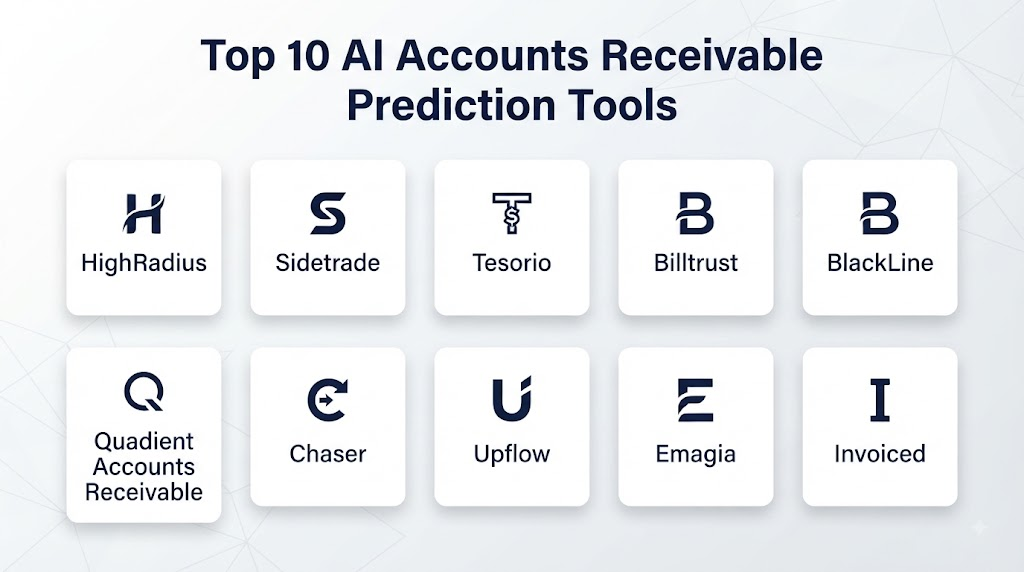
Top 10 AI Accounts Receivable Prediction Tools
1. HighRadius
HighRadius provides accounts receivable and order-to-cash automation with AI-powered capabilities for payment prediction, collections, credit, and cash application.
Key Features
- Payment prediction
- Collections automation
- Cash application
- Credit management
- Customer risk analysis
- AR analytics
- Cash-flow forecasting
Pros
- Strong AR automation
- Broad order-to-cash capabilities
- Advanced analytics
- Enterprise-oriented platform
Cons
- Implementation can be complex
- Best suited to organizations with substantial AR operations
2. Billtrust
Billtrust provides accounts receivable automation, invoicing, payments, collections, and customer payment intelligence.
Key Features
- AR automation
- Payment prediction
- Electronic invoicing
- Collections
- Customer payment insights
- Payment processing
Pros
- Strong B2B receivables focus
- Good payment automation
- Useful customer insights
- Broad AR functionality
Cons
- Advanced functionality may require configuration
- Primarily focused on business receivables
3. BlackLine
BlackLine provides financial close and accounting automation with capabilities supporting accounts receivable and cash-related processes.
Key Features
- AR automation
- Financial analytics
- Reconciliation
- Cash management
- Accounting automation
- Workflow management
Pros
- Strong financial operations ecosystem
- Enterprise capabilities
- Good accounting integration
- Broad automation
Cons
- Broader platform may be more than smaller organizations need
- Implementation may require specialist expertise
4. Invoiced
Invoiced provides accounts receivable automation focused on invoicing, payments, collections, and receivables management.
Key Features
- Automated invoicing
- Payment processing
- Collections
- Customer portals
- AR analytics
- Receivables management
Pros
- Strong AR focus
- Useful automation
- Good customer payment workflows
- Suitable for growing businesses
Cons
- Advanced predictive capabilities may depend on available data
- Complex enterprise requirements may need additional configuration
5. Versapay
Versapay combines accounts receivable automation, electronic invoicing, payment acceptance, and customer collaboration.
Key Features
- AR automation
- Payment processing
- Invoicing
- Collections
- Customer collaboration
- AR analytics
Pros
- Strong customer-payment experience
- Useful collaboration features
- Good AR automation
- Payment integration
Cons
- Best suited to organizations focused on broader AR transformation
- Some advanced workflows may require configuration
6. Tesorio
Tesorio focuses on cash-flow management, accounts receivable forecasting, and payment prediction.
Key Features
- Cash-flow forecasting
- Payment prediction
- AR analytics
- Customer risk analysis
- Collections insights
- Financial dashboards
Pros
- Strong cash forecasting focus
- Useful predictive analytics
- Good visibility into receivables
- Designed for finance teams
Cons
- More focused on forecasting than full accounting
- Data quality can significantly affect prediction performance
7. YayPay
YayPay provides accounts receivable automation, collections management, customer communication, and receivables analytics.
Key Features
- AR automation
- Collections management
- Customer segmentation
- Payment tracking
- AR dashboards
- Predictive analytics
Pros
- Strong collections capabilities
- Useful customer insights
- Good workflow automation
- Focused AR functionality
Cons
- Organizations may require integrations with existing financial systems
- Complex AR environments may require configuration
8. Quadient AR by YayPay
Quadient AR by YayPay supports accounts receivable automation, collections management, customer communication, and receivables analytics.
Key Features
- Collections automation
- AR analytics
- Payment monitoring
- Customer communication
- Workflow automation
- Reporting
Pros
- Strong collections focus
- Useful analytics
- Good automation capabilities
- Customer communication tools
Cons
- Advanced enterprise workflows can require implementation planning
- Prediction quality depends on available financial history
9. Esker
Esker provides finance automation across accounts receivable, accounts payable, order management, and other business processes.
Key Features
- AR automation
- Collections
- Payment management
- Cash forecasting
- Financial analytics
- Workflow automation
Pros
- Broad finance automation
- Good AR capabilities
- Strong workflow support
- Useful analytics
Cons
- Broader platform may require more configuration
- Advanced capabilities can require implementation resources
10. Sidetrade
Sidetrade specializes in AI-powered order-to-cash and accounts receivable automation, including payment prediction and collection optimization.
Key Features
- Payment prediction
- Collections automation
- Customer risk scoring
- Cash-flow forecasting
- AR analytics
- Credit management
Pros
- Strong AI-driven AR capabilities
- Excellent focus on payment prediction
- Useful collections intelligence
- Strong order-to-cash functionality
Cons
- Best suited to organizations with mature AR processes
- Enterprise deployments may require significant planning
Comparison Table
| Platform | Payment Prediction | Cash-Flow Forecasting | Collections | Customer Risk Analysis | AR Automation | Analytics |
|---|---|---|---|---|---|---|
| HighRadius | Strong | Strong | Strong | Strong | Strong | Strong |
| Billtrust | Strong | Strong | Strong | Strong | Strong | Strong |
| BlackLine | Moderate | Strong | Strong | Moderate | Strong | Strong |
| Invoiced | Strong | Moderate | Strong | Moderate | Strong | Strong |
| Versapay | Strong | Moderate | Strong | Moderate | Strong | Strong |
| Tesorio | Strong | Strong | Strong | Strong | Strong | Strong |
| YayPay | Strong | Strong | Strong | Strong | Strong | Strong |
| Quadient AR by YayPay | Strong | Strong | Strong | Strong | Strong | Strong |
| Esker | Strong | Strong | Strong | Strong | Strong | Strong |
| Sidetrade | Strong | Strong | Strong | Strong | Strong | Strong |
Weighted Evaluation Table
| Platform | Prediction 20% | Forecasting 20% | Collections 15% | Risk Analytics 15% | Automation 10% | Integrations 10% | Ease of Use 5% | Scalability 5% | Total |
|---|---|---|---|---|---|---|---|---|---|
| HighRadius | 20 | 19 | 15 | 15 | 10 | 10 | 4 | 5 | 98 |
| Billtrust | 19 | 18 | 15 | 14 | 10 | 10 | 4 | 5 | 95 |
| BlackLine | 17 | 19 | 14 | 13 | 10 | 10 | 4 | 5 | 92 |
| Invoiced | 18 | 16 | 14 | 13 | 10 | 9 | 5 | 4 | 89 |
| Versapay | 18 | 16 | 15 | 13 | 10 | 9 | 5 | 4 | 90 |
| Tesorio | 20 | 20 | 14 | 15 | 9 | 9 | 4 | 5 | 96 |
| YayPay | 19 | 18 | 15 | 15 | 10 | 9 | 4 | 5 | 95 |
| Quadient AR by YayPay | 19 | 18 | 15 | 15 | 10 | 9 | 4 | 5 | 95 |
| Esker | 18 | 18 | 15 | 14 | 10 | 10 | 4 | 5 | 94 |
| Sidetrade | 20 | 19 | 15 | 15 | 10 | 10 | 4 | 5 | 98 |
How to Choose the Right AI Accounts Receivable Prediction Tool
Choose HighRadius for comprehensive enterprise order-to-cash and receivables automation.
Choose Billtrust for B2B invoicing, payments, and receivables intelligence.
Choose BlackLine if AR automation needs to operate within a broader financial close and accounting environment.
Choose Invoiced for focused accounts receivable and customer-payment workflows.
Choose Versapay when customer collaboration and digital payment experiences are important.
Choose Tesorio if cash-flow forecasting and payment prediction are your primary priorities.
Choose YayPay for collections automation and customer payment intelligence.
Choose Quadient AR by YayPay for broader AR and collections workflows.
Choose Esker if you want AR prediction capabilities alongside broader finance automation.
Choose Sidetrade if AI-driven payment prediction and collections optimization are central to your AR strategy.
Common Mistakes
- Treating payment predictions as guarantees
- Using incomplete payment histories
- Ignoring invoice disputes
- Failing to account for seasonal payment patterns
- Relying exclusively on historical averages
- Ignoring customer-specific payment behavior
- Failing to validate customer risk scores
- Not connecting predictions with collection workflows
- Ignoring data quality problems
- Failing to monitor prediction accuracy
FAQs
1. What are AI Accounts Receivable Prediction tools?
They use AI and predictive analytics to estimate customer payment behavior, future collections, and receivables risk.
2. Can AI predict when an invoice will be paid?
Yes. AI can analyze historical payment behavior, invoice characteristics, customer patterns, and other available data to estimate likely payment timing.
3. Can these tools predict late payments?
Many platforms can identify invoices or customers with a higher likelihood of delayed payment.
4. Can AI improve cash-flow forecasting?
Yes. Payment predictions can help finance teams estimate future receivables and expected cash inflows.
5. Can AI prioritize collection activities?
Yes. Predictive risk scores can help collections teams focus on accounts that may require earlier intervention.
6. What data is required for AR prediction?
Common inputs include invoice history, payment history, customer information, payment terms, outstanding balances, aging data, and collection activity.
7. Are AI payment predictions always accurate?
No. Predictions depend on data quality and customer behavior. Unexpected disputes, financial problems, or economic changes can affect actual payment timing.
8. Can AR prediction tools integrate with ERP systems?
Yes. Many platforms can connect with accounting and ERP systems to access financial and receivables data.
9. Can AI help reduce overdue receivables?
It can help finance teams identify collection risks earlier and prioritize accounts that require attention.
10. What is the future of AI AR prediction?
The market is moving toward real-time payment prediction, autonomous collections, predictive cash-flow management, customer risk intelligence, and increasingly integrated order-to-cash automation.
Conclusion
AI Accounts Receivable Prediction tools give finance teams a more data-driven approach to forecasting customer payments and managing outstanding receivables. Instead of relying solely on spreadsheets and historical averages, organizations can use predictive models to identify payment patterns, estimate collection timing, and prioritize potential risks.HighRadius, Billtrust, BlackLine, Invoiced, Versapay, Tesorio, YayPay, Quadient AR by YayPay, Esker, and Sidetrade offer different approaches to receivables forecasting, collections, payment intelligence, and broader financial automation.The right platform depends on the organization’s AR complexity, invoice volume, customer base, ERP environment, collection strategy, and forecasting requirements.