Introduction
AI Org Design & Span-of-Control Analytics tools help organizations understand how their workforce structure affects management capacity, reporting relationships, organizational efficiency, decision-making, and employee experience. As companies grow through hiring, restructuring, acquisitions, geographic expansion, and new business initiatives, organizational structures can become increasingly complicated.Traditional organizational design often relies on spreadsheets, static organizational charts, manual workforce analysis, and periodic restructuring exercises. These approaches can make it difficult for HR, finance, and business leaders to understand how changes in reporting relationships may affect management layers, team sizes, operating costs, and organizational effectiveness.
AI-powered organizational design analytics provides a more data-driven approach. These platforms can analyze workforce structures, reporting relationships, job levels, managerial relationships, compensation information, workforce costs, and organizational attributes to identify patterns and potential design opportunities.
What Are AI Org Design & Span-of-Control Analytics Tools?
AI Org Design & Span-of-Control Analytics tools use workforce data, organizational structures, analytics, machine learning, and scenario modeling to help organizations evaluate and improve organizational design.
They can analyze:
- Reporting relationships
- Manager-to-employee ratios
- Organizational layers
- Span of control
- Job levels
- Workforce costs
- Team structures
- Organizational hierarchy
- Position data
- Workforce demographics
- Department structures
- Business units
- Organizational changes
The objective is to help leaders understand organizational structure and evaluate potential improvements.
Why Org Design Analytics Matters
Organizational structures directly influence how information flows, decisions are made, managers operate, and teams collaborate.
AI-powered organizational analytics can help organizations:
- Identify unusually narrow spans
- Detect excessively broad spans
- Analyze management layers
- Identify organizational bottlenecks
- Evaluate restructuring scenarios
- Estimate workforce cost impacts
- Improve organizational transparency
- Support workforce planning
- Identify redundant management structures
- Compare organizational structures
Key Features
Span-of-Control Analysis
Analyze the number of direct reports managed by individual leaders.
Organizational Layer Analysis
Identify the number of management layers between employees and senior leadership.
Organizational Network Analysis
Analyze relationships and connections across teams and business units.
Scenario Modeling
Simulate organizational changes before implementing them.
Workforce Cost Analysis
Evaluate potential financial impacts of organizational changes.
Management Structure Analysis
Identify patterns in manager distribution and organizational hierarchy.
Organizational Benchmarking
Compare organizational structures across business units or relevant benchmarks.
AI-Powered Recommendations
Identify potential organizational design opportunities based on workforce data.
Organizational Chart Analytics
Convert organizational charts into actionable structural insights.
Position Analysis
Analyze vacant, filled, planned, and potentially redundant positions.
Restructuring Support
Help organizations evaluate alternative reporting structures.
Workforce Planning Integration
Connect organizational design analysis with broader workforce planning.
Common Use Cases
Management Layer Analysis
Identify organizations or departments with unusually high numbers of management layers.
Span Optimization
Identify teams where management spans may warrant further review.
Restructuring
Evaluate potential reporting structures during reorganizations.
Mergers and Acquisitions
Compare organizational structures across acquired organizations.
Cost Optimization
Model workforce cost implications of organizational changes.
Leadership Planning
Understand management capacity and organizational dependencies.
Workforce Planning
Connect organizational structure with future workforce requirements.
Organizational Benchmarking
Compare structural characteristics across departments or business units.
Benefits
Better Organizational Visibility
Leaders can gain a clearer view of complex organizational structures.
Data-Driven Design
Workforce decisions can be supported by quantitative organizational information.
Faster Analysis
Automation can reduce the effort required to analyze large organizational hierarchies.
Scenario Evaluation
Organizations can test potential structures before making major changes.
Improved Management Insights
Leaders can identify unusual management patterns that may deserve further investigation.
Cost Awareness
Organizational scenarios can be evaluated alongside workforce cost information.
Challenges and Risks
No Universal Span-of-Control Target
Different roles and teams require different management structures.
Data Quality
Incorrect reporting relationships or outdated position data can distort analysis.
Oversimplification
Organizational effectiveness cannot be reduced to a single ratio.
Employee Impact
Organizational restructuring can affect employee workload, career paths, morale, and retention.
Algorithmic Bias
AI recommendations may reproduce biases present in historical organizational data.
Privacy
Workforce analytics involves sensitive employee and organizational information.
Change Management
A technically efficient structure may still fail if employees and managers do not understand or support the change.
Responsible AI Practices
Organizations should use AI organizational design analytics carefully.
Recommended practices include:
- Use AI recommendations as decision support
- Keep human leaders involved
- Validate organizational data
- Avoid rigid span-of-control targets
- Protect employee information
- Explain important recommendations
- Test restructuring scenarios
- Consider role complexity
- Evaluate employee impact
- Monitor outcomes after organizational changes
Key Trends
AI-Powered Organizational Modeling
AI is increasingly being used to identify patterns across complex organizational structures.
Scenario-Based Org Design
Organizations are moving toward simulations that allow leaders to compare alternative organizational structures.
Workforce Cost Integration
Org design analytics is increasingly being combined with compensation and workforce cost information.
Skills-Based Organizational Design
Organizations are increasingly considering skills, capabilities, and workforce capacity alongside traditional hierarchy analysis.
Dynamic Organizational Structures
Companies are exploring more flexible structures that can adapt to changing business requirements.
Organizational Network Analytics
Relationship and collaboration data can provide additional context beyond formal reporting structures.
Continuous Organization Planning
Instead of redesigning organizations only during major restructuring, companies are increasingly monitoring organizational health continuously.
Methodology
The tools below were selected based on their relevance to organizational design, workforce planning, organizational network analysis, span-of-control analysis, scenario planning, workforce analytics, and enterprise HR decision-making.
The evaluation considers:
- Org design capabilities
- Span-of-control analysis
- Workforce analytics
- Scenario modeling
- Organizational network insights
- Workforce planning
- Data integration
- Security and governance
- Ease of use
- Enterprise scalability
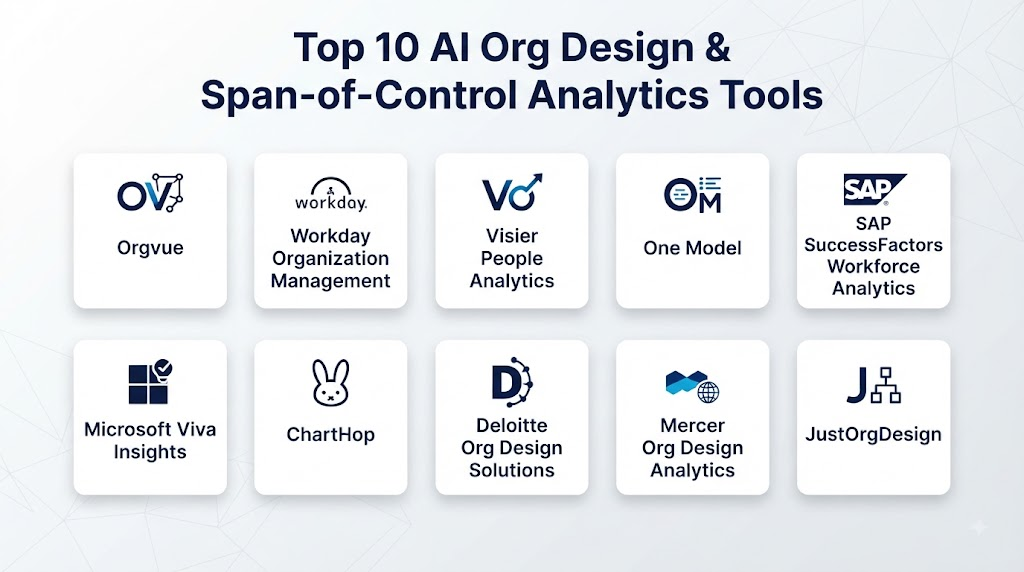
Top 10 AI Org Design & Span-of-Control Analytics Tools
1. Orgvue
Orgvue focuses on organizational design, workforce planning, organizational visualization, and scenario modeling.
Key Features
- Organizational visualization
- Workforce analytics
- Span-of-control analysis
- Scenario modeling
- Organizational restructuring
- Workforce planning
Pros
- Strong organizational design focus
- Useful scenario planning
- Detailed workforce visualization
- Supports complex organizational structures
Cons
- Advanced capabilities may require specialist expertise
- Enterprise implementations can require significant planning
2. ChartHop
ChartHop provides organizational management and people analytics capabilities designed to help organizations visualize workforce structures and understand organizational data.
Key Features
- Organizational charts
- People analytics
- Workforce planning
- Organizational visualization
- Compensation analytics
- Reporting relationships
Pros
- Strong organizational visualization
- User-friendly interface
- Useful workforce insights
- Supports organizational planning
Cons
- Advanced organizational modeling may require additional configuration
- Best fit depends on organizational data maturity
3. Visier
Visier provides people analytics and workforce intelligence capabilities that can help organizations analyze organizational structures, workforce trends, management patterns, and employee data.
Key Features
- Workforce analytics
- Organizational analysis
- Manager analytics
- Workforce planning
- People insights
- Scenario analysis
Pros
- Strong people analytics
- Broad workforce intelligence
- Useful management insights
- Enterprise scalability
Cons
- Broad analytics functionality can require configuration
- Advanced use cases may require analytical expertise
4. One Model
One Model provides workforce planning, people analytics, and organizational data capabilities that can support organizational design decisions.
Key Features
- Workforce analytics
- Organizational reporting
- Workforce planning
- Scenario modeling
- HR data integration
- Organizational insights
Pros
- Strong workforce analytics
- Flexible data model
- Useful planning capabilities
- Supports complex HR environments
Cons
- Implementation may require technical expertise
- Data integration can be substantial for complex organizations
5. Workday
Workday provides enterprise human capital management and workforce planning capabilities that organizations can use to analyze organizational structures and workforce information.
Key Features
- Organizational management
- Workforce planning
- People analytics
- Reporting structures
- Position management
- Workforce data
Pros
- Strong enterprise HR ecosystem
- Broad workforce data availability
- Extensive organizational information
- Useful integration with HR processes
Cons
- Advanced organizational design analysis may require additional configuration
- Best value often comes from broader Workday adoption
6. SAP SuccessFactors
SAP SuccessFactors provides HCM, workforce planning, organizational management, and people analytics capabilities.
Key Features
- Organizational management
- Workforce planning
- People analytics
- Workforce reporting
- Position management
- HR data integration
Pros
- Strong enterprise HCM capabilities
- Broad workforce data
- Useful organizational management
- Suitable for global organizations
Cons
- Enterprise implementations can be complex
- Advanced analytics may require configuration and integration
7. Anaplan
Anaplan provides connected planning capabilities that can support workforce planning, financial planning, and organizational scenario modeling.
Key Features
- Workforce planning
- Scenario modeling
- Financial modeling
- Organizational planning
- Workforce cost analysis
- Cross-functional planning
Pros
- Strong scenario planning
- Useful workforce and financial modeling
- Supports complex planning environments
- Flexible modeling capabilities
Cons
- Requires planning expertise
- Implementation can become complex for large models
8. Nakisa
Nakisa provides organizational management and workforce structure solutions designed to help organizations understand organizational relationships and workforce structures.
Key Features
- Organizational visualization
- Workforce structure analysis
- Organizational management
- Position analysis
- Workforce insights
- Organizational planning
Pros
- Strong organizational structure focus
- Useful visualization
- Enterprise-oriented capabilities
- Supports organizational analysis
Cons
- Advanced scenarios may require configuration
- Organizations should evaluate integration requirements carefully
9. Syndio
Syndio provides workforce equity and organizational analytics capabilities that can support analysis of organizational structures, workforce patterns, and fairness-related organizational decisions.
Key Features
- Workforce analytics
- Organizational analysis
- Pay equity
- Workforce structure insights
- Equity analytics
- Reporting
Pros
- Strong workforce equity focus
- Useful organizational analytics
- Supports evidence-based workforce decisions
- Enterprise-oriented platform
Cons
- More focused on workforce equity than dedicated org-design modeling
- May require complementary organizational design capabilities
10. Lightcast
Lightcast provides workforce intelligence and labor-market data that can support organizational planning, skills analysis, and workforce strategy.
Key Features
- Workforce intelligence
- Skills analytics
- Labor-market data
- Workforce planning
- Job and skills analysis
- Talent insights
Pros
- Strong labor-market intelligence
- Useful skills data
- Supports workforce planning
- Broad workforce strategy applications
Cons
- Not primarily a dedicated span-of-control platform
- Organizational structure analysis may require complementary systems
Comparison Table
| No. | Platform | Best For | Org Design | Span Analysis | Scenario Planning | Workforce Analytics | Org Visualization |
|---|---|---|---|---|---|---|---|
| 1 | Orgvue | Organizational design | Strong | Strong | Strong | Strong | Strong |
| 2 | ChartHop | Org visualization | Strong | Strong | Moderate | Strong | Strong |
| 3 | Visier | People analytics | Strong | Strong | Strong | Strong | Strong |
| 4 | One Model | Workforce analytics | Strong | Strong | Strong | Strong | Strong |
| 5 | Workday | Enterprise HCM | Strong | Moderate | Strong | Strong | Strong |
| 6 | SAP SuccessFactors | Enterprise HCM | Strong | Moderate | Strong | Strong | Strong |
| 7 | Anaplan | Workforce planning | Strong | Moderate | Strong | Strong | Moderate |
| 8 | Nakisa | Organizational management | Strong | Strong | Strong | Strong | Strong |
| 9 | Syndio | Workforce equity analytics | Moderate | Moderate | Moderate | Strong | Moderate |
| 10 | Lightcast | Workforce intelligence | Moderate | Limited | Strong | Strong | Moderate |
Weighted Evaluation Table
| No. | Platform | Org Design 20% | Span Analysis 15% | Workforce Analytics 15% | Scenario Planning 15% | Integrations 10% | Data Governance 10% | Ease of Use 5% | Scalability 10% | Total Score |
|---|---|---|---|---|---|---|---|---|---|---|
| 1 | Orgvue | 20 | 15 | 15 | 15 | 9 | 9 | 4 | 10 | 97 |
| 2 | ChartHop | 18 | 14 | 14 | 13 | 9 | 9 | 5 | 9 | 91 |
| 3 | Visier | 19 | 15 | 15 | 14 | 10 | 9 | 4 | 10 | 96 |
| 4 | One Model | 19 | 14 | 15 | 15 | 10 | 9 | 4 | 10 | 96 |
| 5 | Workday | 19 | 13 | 15 | 14 | 10 | 10 | 4 | 10 | 95 |
| 6 | SAP SuccessFactors | 19 | 13 | 15 | 14 | 10 | 10 | 4 | 10 | 95 |
| 7 | Anaplan | 17 | 12 | 15 | 15 | 10 | 9 | 4 | 10 | 92 |
| 8 | Nakisa | 19 | 15 | 14 | 14 | 9 | 9 | 4 | 10 | 94 |
| 9 | Syndio | 16 | 12 | 15 | 12 | 9 | 10 | 4 | 9 | 87 |
| 10 | Lightcast | 15 | 8 | 15 | 14 | 9 | 9 | 4 | 10 | 84 |
How to Choose the Right AI Org Design Platform
Choose Orgvue if organizational design, span-of-control analysis, and restructuring scenario modeling are your primary requirements.
Choose ChartHop if you need accessible organizational visualization combined with workforce and people analytics.
Choose Visier if you want broad people analytics and organizational intelligence.
Choose One Model if workforce data modeling and connected workforce planning are central to your strategy.
Choose Workday if your organization already uses Workday and wants organizational analysis integrated with its broader HCM environment.
Choose SAP SuccessFactors if you operate a large enterprise SAP environment and need organizational management integrated with HCM.
Choose Anaplan if workforce and financial scenario planning are major priorities.
Choose Nakisa if organizational structure visualization and organizational management are key requirements.
Choose Syndio if organizational structure analysis needs to be considered alongside workforce equity and fairness.
Choose Lightcast if labor-market intelligence, skills data, and broader workforce planning are the primary requirements.
Common Mistakes
- Applying the same span-of-control target to every department
- Ignoring job complexity
- Focusing only on cost reduction
- Treating AI recommendations as final decisions
- Using outdated organizational data
- Ignoring informal organizational relationships
- Failing to consider employee experience
- Ignoring career progression implications
- Overlooking workload differences between managers
- Failing to model multiple restructuring scenarios
- Making organizational decisions solely from hierarchy data
- Neglecting change management
FAQs
1. What is span-of-control analytics?
Span-of-control analytics evaluates the number of direct reports managed by individual leaders and examines whether management structures may require further review.
2. What is organizational design analytics?
Organizational design analytics uses workforce and organizational data to understand reporting structures, management layers, workforce distribution, and potential organizational improvements.
3. Is there an ideal span of control?
No. The appropriate span depends on factors such as work complexity, employee experience, manager responsibilities, team maturity, geographic distribution, and operational requirements.
4. Can AI recommend organizational changes?
AI can identify patterns and potential design opportunities, but organizational changes should be evaluated and approved by qualified human leaders.
5. Can these tools model restructuring scenarios?
Many organizational design and workforce planning platforms provide scenario modeling capabilities that allow organizations to compare alternative structures.
6. Can org design analytics reduce workforce costs?
It can help identify structural opportunities that may affect management layers and workforce costs, but cost reduction should not be the sole measure of organizational effectiveness.
7. What data is needed for span-of-control analysis?
Common inputs include employee records, manager relationships, organizational units, job levels, positions, workforce costs, and reporting structures.
8. Can AI detect excessive management layers?
Analytics can identify organizations with unusually large numbers of management layers compared with defined organizational patterns or benchmarks.
9. Are organizational analytics tools secure?
Security depends on the platform and implementation. Organizations should evaluate encryption, access controls, data governance, auditability, privacy controls, and integration security.
10. What is the future of AI organizational design?
The category is moving toward continuous organizational modeling, AI-assisted restructuring, skills-based organization design, workforce scenario simulation, organizational network analytics, and integrated workforce-cost planning.
Conclusion
AI Org Design & Span-of-Control Analytics tools can help organizations move beyond static organizational charts and manual workforce analysis toward more dynamic, data-driven organizational planning. By analyzing reporting relationships, management layers, workforce distribution, costs, and organizational patterns, these platforms can provide valuable insights for HR and business leaders.Orgvue, ChartHop, Visier, One Model, Workday, SAP SuccessFactors, Anaplan, Nakisa, Syndio, and Lightcast each address different aspects of organizational design and workforce intelligence.The best platform depends on whether the organization prioritizes dedicated organizational design, workforce analytics, scenario modeling, HCM integration, workforce equity, or labor-market intelligence.