Introduction
AI Pipeline Forecasting with ML tools help sales organizations predict future revenue by analyzing pipeline data, historical sales performance, customer activity, deal stages, and other business signals. Instead of relying only on manual forecasts from sales representatives, machine learning can identify patterns across large volumes of sales data and provide data-driven predictions.Traditional forecasting often depends heavily on representative judgment and spreadsheet-based calculations. While human experience remains valuable, AI and machine learning can provide additional insight by continuously analyzing changing pipeline conditions.
What Is AI Pipeline Forecasting with ML?
AI Pipeline Forecasting with ML uses machine learning models and sales data to estimate the likelihood and timing of future revenue.
The system can analyze factors such as:
- Deal stage
- Deal value
- Sales cycle length
- Historical win rates
- Customer engagement
- Email activity
- Meeting activity
- Opportunity age
- Pipeline movement
- Representative performance
- Account characteristics
- Previous purchase behavior
Machine learning models can use these signals to identify patterns that may not be obvious through manual forecasting.
For example, an opportunity that appears to be in a late sales stage may still have a low probability of closing if customer engagement has declined, important stakeholders are missing, or the opportunity has remained unchanged for too long.
Why AI Pipeline Forecasting Matters
Accurate forecasting is important for revenue planning and business decision-making.
Sales leaders use forecasts to make decisions about:
- Hiring
- Budgeting
- Sales targets
- Resource allocation
- Inventory
- Marketing investments
- Business growth
- Revenue expectations
Poor forecasting can result in overestimating revenue, missing targets, or making resource decisions based on unreliable information.
AI can help improve forecasting by continuously evaluating pipeline signals rather than relying exclusively on periodic manual reviews.
Key Features of AI Pipeline Forecasting Tools
Revenue Forecasting
AI predicts expected revenue based on current opportunities and historical patterns.
Deal Probability
Machine learning can estimate the probability that individual opportunities will close.
Pipeline Health
Platforms can identify weak, aging, stalled, or insufficient opportunities.
Risk Detection
AI can flag deals that may be at risk of slipping or being lost.
Forecast Categories
Tools can organize opportunities into categories such as:
- Commit
- Best case
- Pipeline
- Closed
- At risk
Historical Analysis
AI can compare current pipeline behavior with previous sales patterns.
Scenario Forecasting
Sales leaders can model different revenue scenarios based on pipeline changes.
Rep-Level Forecasting
Managers can compare forecasts across individual representatives and teams.
Account Intelligence
Some platforms combine account activity with opportunity information.
CRM Integration
AI forecasting tools typically depend heavily on CRM and sales activity data.
Common Use Cases
Revenue Forecasting
Sales leaders can estimate future revenue based on pipeline activity.
Sales Management
Managers can identify deals that need attention.
Pipeline Reviews
Teams can focus reviews on opportunities with significant risk or uncertainty.
Quarterly Planning
Organizations can use predictive forecasts for quarterly revenue planning.
Enterprise Sales
Large organizations can analyze complex pipelines across regions, teams, and business units.
Sales Performance Management
Leaders can compare individual and team forecasting patterns.
Benefits of AI Pipeline Forecasting with ML
More Data-Driven Forecasts
Machine learning can analyze large amounts of sales information.
Continuous Monitoring
AI can continuously evaluate changing pipeline conditions.
Earlier Risk Detection
Potentially problematic opportunities can be identified before they significantly affect forecasts.
Reduced Manual Work
Sales leaders can spend less time manually calculating and consolidating forecasts.
Better Pipeline Visibility
AI can highlight pipeline gaps and unusual patterns.
Improved Planning
More informed forecasts can support budgeting and resource allocation.
Consistent Forecasting
Machine learning can apply consistent analytical methods across teams.
Challenges
Data Quality
Poor CRM data can significantly reduce forecast reliability.
Historical Bias
Machine learning models can inherit patterns and biases from historical sales data.
Changing Market Conditions
A model trained on previous conditions may struggle when markets change significantly.
Explainability
Sales leaders may want to understand why a model considers a deal likely or unlikely to close.
CRM Adoption
Forecasting quality depends on sales representatives consistently updating opportunity information.
Overconfidence in Predictions
AI forecasts should be treated as decision-support information rather than guaranteed outcomes.
Integration Complexity
Large organizations may need significant effort to connect CRM, sales engagement, marketing, and revenue systems.
Evaluation Criteria
AI Pipeline Forecasting with ML platforms can be evaluated using:
- Forecast accuracy
- Machine learning capabilities
- Deal prediction
- Pipeline analysis
- Risk detection
- Revenue intelligence
- Scenario planning
- CRM integration
- Analytics
- Explainability
- Ease of use
- Scalability
Key Trends
Predictive Deal Scoring
AI is increasingly evaluating individual opportunities based on multiple sales signals.
Continuous Forecasting
Instead of producing forecasts only at fixed intervals, AI systems can continuously update predictions.
Real-Time Pipeline Intelligence
Modern platforms increasingly combine CRM information with activity and engagement signals.
Scenario-Based Forecasting
Sales leaders can model different outcomes based on changes in deal progression and pipeline coverage.
AI Revenue Assistants
Forecasting capabilities are increasingly becoming part of broader AI revenue assistants.
Explainable Forecasts
Organizations increasingly want to understand which signals influence a forecast.
Automated Pipeline Inspection
AI can identify stalled deals, missing information, unusual sales-cycle behavior, and potential forecast risks.
Methodology
The platforms below were selected based on their relevance to AI-powered sales forecasting, machine learning, pipeline analysis, revenue intelligence, deal prediction, and sales planning.
The comparison considers:
- AI and ML capabilities
- Forecasting
- Pipeline intelligence
- Deal risk analysis
- Revenue analytics
- Scenario planning
- CRM integration
- Ease of use
- Scalability
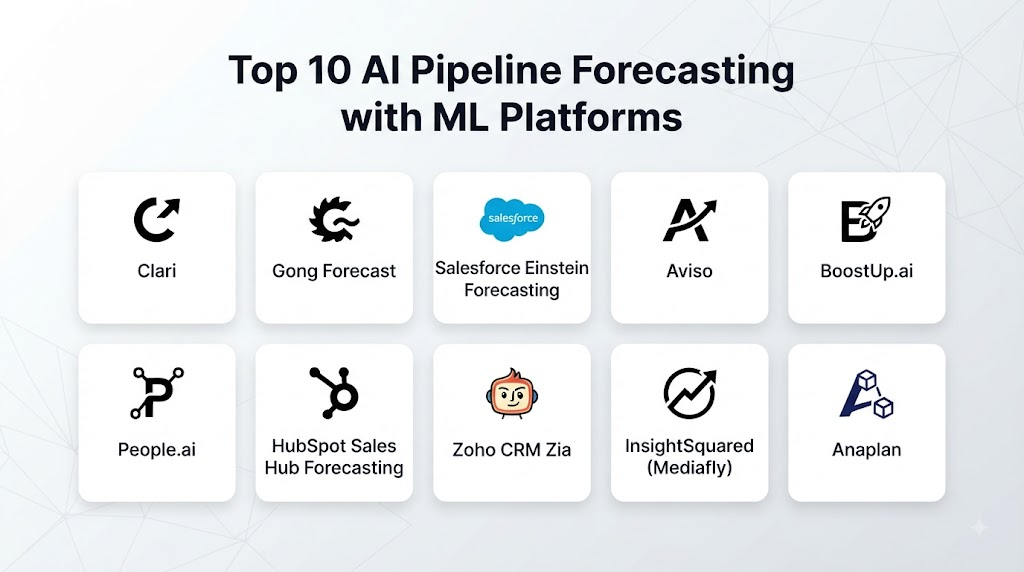
Top 10 AI Pipeline Forecasting with ML Platforms
1. Clari
Clari is a revenue intelligence platform focused on forecasting, pipeline inspection, deal management, and revenue operations.
Key Features
- AI forecasting
- Pipeline inspection
- Deal intelligence
- Revenue analytics
- Forecast management
- Scenario planning
Pros
- Strong revenue intelligence
- Excellent forecasting capabilities
- Useful pipeline visibility
- Strong enterprise functionality
Cons
- Primarily suited to revenue organizations
- Implementation can require planning
2. Salesforce Sales Cloud
Salesforce Sales Cloud provides CRM, opportunity management, sales analytics, and AI-powered capabilities that can support sales forecasting.
Key Features
- Opportunity management
- Sales forecasting
- AI assistance
- Pipeline analytics
- Revenue reporting
- CRM integration
Pros
- Strong CRM ecosystem
- Extensive sales data
- Enterprise scalability
- Broad integration capabilities
Cons
- Can be complex to configure
- Advanced functionality may require additional setup
3. Gong
Gong combines conversation intelligence with revenue intelligence and can use customer interaction data to provide insights into deals and pipeline performance.
Key Features
- Revenue intelligence
- Deal analysis
- Forecasting support
- Conversation intelligence
- Pipeline insights
- AI summaries
Pros
- Strong customer interaction data
- Good deal intelligence
- Useful revenue insights
- Strong enterprise capabilities
Cons
- More comprehensive than a dedicated forecasting tool
- Implementation can require planning
4. HubSpot Sales Hub
HubSpot Sales Hub combines CRM, opportunity management, sales analytics, and AI features for forecasting and pipeline management.
Key Features
- Sales forecasting
- Pipeline management
- AI assistance
- Deal tracking
- Sales analytics
- CRM integration
Pros
- User-friendly
- Strong CRM integration
- Good for growing sales teams
- Broad sales functionality
Cons
- Advanced features depend on plan
- Complex forecasting requirements may need additional configuration
5. 6sense
6sense combines predictive intelligence, account signals, intent data, and revenue analytics to help sales organizations understand pipeline and future revenue opportunities.
Key Features
- Predictive analytics
- Intent intelligence
- Account intelligence
- Pipeline analysis
- Revenue insights
- Deal prioritization
Pros
- Strong predictive capabilities
- Excellent B2B account intelligence
- Useful intent signals
- Good account-level analysis
Cons
- Primarily focused on B2B organizations
- Can require significant implementation
6. Aviso
Aviso provides AI-powered revenue intelligence, forecasting, pipeline management, and sales analytics.
Key Features
- AI forecasting
- Pipeline analytics
- Deal intelligence
- Revenue planning
- Risk detection
- Sales analytics
Pros
- Strong AI forecasting focus
- Useful pipeline insights
- Good revenue analytics
- Enterprise capabilities
Cons
- More suitable for structured sales organizations
- Requires quality CRM data
7. BoostUp.ai
BoostUp.ai focuses on revenue intelligence, pipeline forecasting, deal risk analysis, and sales performance.
Key Features
- AI forecasting
- Pipeline inspection
- Deal risk analysis
- Revenue intelligence
- Sales analytics
- Forecast management
Pros
- Strong forecasting capabilities
- Good pipeline visibility
- Useful risk detection
- Revenue-focused approach
Cons
- Primarily suited to B2B sales organizations
- Implementation may require planning
8. People.ai
People.ai captures sales activity and uses revenue intelligence to provide visibility into pipeline, account engagement, and sales performance.
Key Features
- Revenue intelligence
- Sales activity capture
- Pipeline insights
- Account intelligence
- CRM enrichment
- Sales analytics
Pros
- Strong activity intelligence
- Useful CRM data enrichment
- Good account visibility
- Enterprise capabilities
Cons
- More focused on revenue operations
- Forecasting may work best as part of a broader revenue stack
9. InsightSquared
InsightSquared provides sales analytics and forecasting capabilities designed to help sales teams understand pipeline performance and revenue trends.
Key Features
- Sales forecasting
- Pipeline analytics
- Revenue reporting
- Sales performance
- Deal analysis
- Historical trends
Pros
- Strong sales analytics
- Useful forecasting
- Good pipeline reporting
- Accessible sales insights
Cons
- Requires quality sales data
- Advanced requirements may require configuration
10. Revenue.io
Revenue.io combines revenue intelligence, sales engagement, conversation intelligence, and analytics to help sales teams improve pipeline performance.
Key Features
- Revenue intelligence
- Pipeline analytics
- Sales engagement
- Conversation intelligence
- Forecasting support
- Sales analytics
Pros
- Combines multiple sales capabilities
- Strong activity intelligence
- Useful sales analytics
- Good integration potential
Cons
- Broader platform can require configuration
- Forecasting is part of a wider sales ecosystem
Comparison Table: AI Pipeline Forecasting with ML Platforms
| No. | Platform | Best For | AI Forecasting | Pipeline Analysis | Deal Risk | Revenue Intelligence | Scenario Planning |
|---|---|---|---|---|---|---|---|
| 1 | Clari | Revenue forecasting | Strong | Strong | Strong | Strong | Strong |
| 2 | Salesforce Sales Cloud | CRM-based forecasting | Strong | Strong | Strong | Strong | Strong |
| 3 | Gong | Deal and revenue intelligence | Strong | Strong | Strong | Strong | Strong |
| 4 | HubSpot Sales Hub | CRM and sales teams | Strong | Strong | Strong | Strong | Moderate |
| 5 | 6sense | Predictive B2B sales | Strong | Strong | Strong | Strong | Strong |
| 6 | Aviso | AI revenue forecasting | Strong | Strong | Strong | Strong | Strong |
| 7 | BoostUp.ai | Pipeline forecasting | Strong | Strong | Strong | Strong | Strong |
| 8 | People.ai | Sales activity intelligence | Strong | Strong | Strong | Strong | Moderate |
| 9 | InsightSquared | Sales analytics | Strong | Strong | Strong | Strong | Strong |
| 10 | Revenue.io | Revenue intelligence | Strong | Strong | Strong | Strong | Moderate |
Weighted Evaluation Table
| No. | Platform | AI/ML 20% | Forecasting 20% | Pipeline Intelligence 15% | Deal Risk 15% | Integrations 10% | Ease of Use 10% | Scalability 10% | Total Score |
|---|---|---|---|---|---|---|---|---|---|
| 1 | Clari | 20 | 20 | 15 | 15 | 10 | 9 | 10 | 99 |
| 2 | Salesforce Sales Cloud | 19 | 19 | 15 | 14 | 10 | 8 | 10 | 95 |
| 3 | Gong | 20 | 19 | 15 | 15 | 10 | 9 | 10 | 98 |
| 4 | HubSpot Sales Hub | 18 | 18 | 14 | 13 | 10 | 10 | 9 | 92 |
| 5 | 6sense | 20 | 19 | 15 | 15 | 9 | 8 | 10 | 96 |
| 6 | Aviso | 20 | 20 | 15 | 15 | 9 | 8 | 10 | 97 |
| 7 | BoostUp.ai | 20 | 20 | 15 | 15 | 9 | 8 | 10 | 97 |
| 8 | People.ai | 18 | 17 | 14 | 13 | 10 | 8 | 10 | 90 |
| 9 | InsightSquared | 18 | 18 | 14 | 14 | 9 | 9 | 9 | 91 |
| 10 | Revenue.io | 18 | 17 | 14 | 13 | 10 | 9 | 9 | 90 |
Which AI Pipeline Forecasting Platform Is Right for You?
Choose Clari if forecasting accuracy, pipeline inspection, and revenue management are your main priorities.
Choose Salesforce Sales Cloud if you want forecasting tightly connected to a broad CRM ecosystem.
Choose Gong if you want to combine deal intelligence and customer conversation data with revenue insights.
Choose HubSpot Sales Hub for an accessible CRM-based approach to pipeline management and forecasting.
Choose 6sense if predictive B2B account intelligence and intent signals are important to your forecasting process.
Choose Aviso for an AI-focused revenue forecasting and pipeline intelligence platform.
Choose BoostUp.ai if deal risk detection and pipeline forecasting are central requirements.
Choose People.ai if sales activity capture and revenue intelligence are important parts of your sales operations.
Choose InsightSquared for sales analytics, historical trends, and forecasting visibility.
Choose Revenue.io if you want forecasting support as part of a broader revenue intelligence and sales engagement environment.
Common Mistakes
- Treating AI forecasts as guaranteed revenue
- Using incomplete CRM data
- Ignoring stalled opportunities
- Relying only on sales representative opinions
- Failing to update opportunity stages
- Ignoring changes in customer engagement
- Using historical data without considering market changes
- Focusing only on total pipeline value
- Ignoring sales-cycle length
- Failing to investigate forecast changes
- Not comparing predicted results with actual outcomes
- Using overly complex models without sufficient data quality
FAQs
1. What is AI Pipeline Forecasting with ML?
AI Pipeline Forecasting with ML uses machine learning and sales data to predict future revenue, deal outcomes, pipeline performance, and potential sales risks.
2. How does machine learning improve sales forecasting?
Machine learning can analyze historical sales patterns and current pipeline signals to identify relationships that may be difficult to detect through manual forecasting.
3. What data is needed for AI sales forecasting?
Common inputs include opportunity values, deal stages, historical win rates, sales-cycle information, customer engagement, CRM activity, and representative performance.
4. Can AI predict whether a deal will close?
AI can estimate the probability of a deal closing based on available sales signals, but the prediction is not a guarantee.
5. Can AI identify risky opportunities?
Yes. Many platforms analyze signals such as stalled activity, aging opportunities, reduced engagement, and unusual deal behavior to identify potential risks.
6. Does AI forecasting replace sales managers?
No. AI provides analytical support, while sales managers remain responsible for understanding deal context, coaching representatives, and making business decisions.
7. How important is CRM data quality?
CRM data quality is extremely important. Incomplete, outdated, or inconsistent opportunity information can reduce the usefulness of machine learning forecasts.
8. Can AI forecasting support scenario planning?
Yes. Some platforms allow sales leaders to evaluate different pipeline scenarios and estimate how changes could affect expected revenue.
9. How should companies measure AI forecasting accuracy?
Organizations can compare predicted revenue and deal outcomes with actual results over time using consistent forecasting metrics and historical benchmarks.
10. What is the future of AI Pipeline Forecasting with ML?
The category is moving toward continuous forecasting, real-time pipeline monitoring, predictive deal scoring, explainable AI predictions, automated risk detection, scenario modeling, and AI revenue assistants.
Conclusion
AI Pipeline Forecasting with ML can help sales organizations move from manual, judgment-heavy forecasting toward more data-driven revenue planning. By analyzing pipeline activity, historical sales patterns, deal behavior, and customer engagement, these platforms can provide additional visibility into future revenue.Clari, Salesforce Sales Cloud, Gong, HubSpot Sales Hub, 6sense, Aviso, BoostUp.ai, People.ai, InsightSquared, and Revenue.io offer different approaches to forecasting and revenue intelligence.The right platform depends on CRM infrastructure, sales-team size, forecasting complexity, data quality, account structure, and the level of predictive intelligence required.However, machine learning should support human judgment rather than replace it. Sales leaders still need to understand customer relationships, market conditions, competitive situations, and deal-specific circumstances that may not be fully represented in historical data.