Introduction
AI marketing content generators help teams create campaign copy, social posts, landing-page text, product descriptions, email content, ad variations, blog drafts, and other marketing assets faster. Instead of writing every piece manually, marketers can use these platforms to generate first drafts, adapt tone, repurpose content, create multiple variants, and support campaign production at scale.
Modern tools go beyond simple text generation. Many can work with brand guidelines, customer segments, campaign goals, product information, and existing content to produce more relevant outputs. Some platforms also support images, video, SEO workflows, collaboration, approval processes, and campaign experimentation.
Common use cases include social media content, email campaigns, ad copy, landing pages, ecommerce descriptions, blog ideation, campaign personalization, content repurposing, product marketing, and brand messaging.
What’s Changing in AI Marketing Content Generators
- Marketing generation is moving from single prompts toward reusable brand and campaign context.
- Brand voice controls are becoming more important.
- Multimodal generation increasingly combines text, image, and video workflows.
- Teams are using AI to create many campaign variants for testing.
- Content repurposing is becoming a major use case.
- AI can increasingly turn long-form content into social posts, emails, and ad copy.
- Product data can increasingly be used to generate ecommerce content automatically.
- Customer-segment information can influence campaign messaging.
- AI-assisted SEO workflows are becoming more integrated with content creation.
- Marketing platforms increasingly combine generation with collaboration and approvals.
- Enterprise teams need stronger controls over what source information models can use.
- Fact-checking remains important for product, pricing, and competitive claims.
- Generative outputs increasingly need brand, legal, and policy review.
- Content teams are paying more attention to repetitive phrasing and generic outputs.
- Personalization is becoming more valuable when based on approved first-party data.
- AI can help generate localization variants, but important markets still need human review.
- Teams increasingly measure content performance rather than generation volume.
- Prompt libraries and reusable templates are becoming more operationally important.
- Model flexibility matters for organizations trying to avoid lock-in.
- The strongest workflows combine human strategy with AI-assisted execution.
Quick Buyer Checklist
Before selecting an AI marketing content generator, check whether it can:
- Generate blog drafts.
- Create social media posts.
- Create ad copy.
- Generate email content.
- Create landing-page copy.
- Generate product descriptions.
- Repurpose long-form content.
- Support brand voice.
- Use reusable templates.
- Create multiple variants.
- Support collaboration.
- Support approval workflows.
- Generate multilingual content.
- Integrate with CMS platforms.
- Integrate with marketing automation.
- Integrate with CRM.
- Support APIs.
- Work with product data.
- Support SEO workflows.
- Support campaign briefs.
- Maintain version history.
- Apply role-based permissions.
- Protect confidential marketing information.
- Support human review.
- Reduce repetitive content.
- Track content performance.
- Support multiple models where relevant.
- Allow export.
- Avoid hallucinated claims.
- Scale across multiple brands or teams.
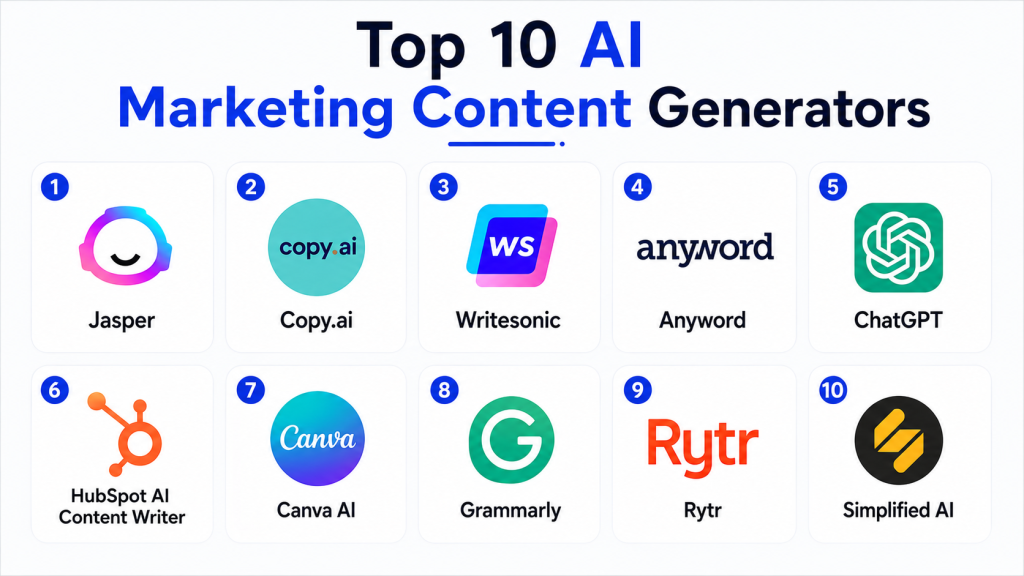
Top 10 AI Marketing Content Generators
1 — Jasper
One-line verdict: Best for marketing teams wanting structured brand-aware content generation across campaigns and channels.
Jasper is focused specifically on marketing content generation rather than general-purpose writing. It is designed for teams creating campaign assets, product messaging, brand content, and reusable marketing workflows.
Standout Capabilities
- Brand voice.
- Campaign content generation.
- Marketing templates.
- Long-form content assistance.
- Social content generation.
- Ad copy.
- Team collaboration.
- Reusable campaign workflows.
AI-Specific Depth
- Model support: Platform-managed AI with model flexibility varying by product.
- RAG / knowledge integration: Brand and company knowledge can be used as context.
- Evaluation: Human review, campaign performance, and editorial QA.
- Guardrails: Brand controls, workspace permissions, and approval processes.
- Observability: Content usage and team analytics vary by plan.
Pros
- Strong marketing specialization.
- Useful brand controls.
- Good for repeatable campaign workflows.
Cons
- Less useful for teams needing only occasional content.
- Outputs still require editorial review.
- Cost can be harder to justify for small teams.
Security & Compliance
Verify SSO, RBAC, auditability, encryption, retention, residency, and relevant certifications for the chosen plan.
Deployment & Platforms
- Cloud: Available.
- Web: Available.
- Browser-based workflows: Available.
Integrations & Ecosystem
- CMS workflows
- Marketing teams
- Browser extensions
- Collaboration tools
- Campaign workflows
- APIs and integrations
Pricing Model
Tiered commercial SaaS.
Best-Fit Scenarios
- Brand-controlled campaign generation.
- Agency content production.
- Enterprise marketing teams.
2 — Copy.ai
One-line verdict: Best for go-to-market teams wanting marketing content generation combined with repeatable workflow automation.
Copy.ai combines content generation with GTM-focused workflows. It is useful for marketers who want to automate repetitive campaign and sales-content tasks rather than only generate standalone copy.
Standout Capabilities
- Marketing copy generation.
- Workflow automation.
- Sales and marketing content.
- Brand-style assistance.
- Content repurposing.
- Campaign variants.
- Team workflows.
- Structured content processes.
AI-Specific Depth
- Model support: Platform-managed AI; flexibility varies.
- RAG / knowledge integration: Company and workflow context may be used.
- Evaluation: Human review and campaign outcomes.
- Guardrails: Workspace controls and workflow structure.
- Observability: Workflow and usage analytics vary.
Pros
- Strong workflow orientation.
- Useful for GTM teams.
- Good for repetitive content operations.
Cons
- Can be broader than pure content-generation needs.
- Quality depends on input context.
- Some teams may prefer simpler writing tools.
Security & Compliance
Verify SSO, RBAC, audit logs, encryption, retention, residency, and required certifications.
Deployment & Platforms
- Cloud: Available.
- Web: Available.
- Team workflows: Available.
Integrations & Ecosystem
- CRM
- Marketing workflows
- Sales tools
- Content operations
- APIs
- Business applications
Pricing Model
Commercial SaaS.
Best-Fit Scenarios
- GTM automation.
- Sales and marketing content.
- Repetitive campaign workflows.
3 — Writer
One-line verdict: Best for enterprises needing controlled, brand-consistent content generation with strong governance and team workflows.
Writer focuses on enterprise generative AI and content workflows. It is particularly relevant when marketing teams need brand consistency, approved terminology, governance, and reusable company context.
Standout Capabilities
- Brand governance.
- Style controls.
- Enterprise content generation.
- Approved terminology.
- Team collaboration.
- Knowledge-grounded writing.
- Workflow automation.
- Enterprise administration.
AI-Specific Depth
- Model support: Platform-managed models and enterprise AI options vary.
- RAG / knowledge integration: Enterprise knowledge and approved company sources.
- Evaluation: Human review and enterprise quality workflows.
- Guardrails: Brand, policy, and permissions controls.
- Observability: Enterprise usage and workflow analytics.
Pros
- Strong governance.
- Good for large organizations.
- Useful for controlled brand language.
Cons
- More enterprise-focused than SMB-oriented.
- Setup requires governance effort.
- Can be excessive for simple campaign writing.
Security & Compliance
Verify SSO, RBAC, audit logs, encryption, retention, residency, model data handling, and certifications.
Deployment & Platforms
- Cloud: Available.
- Web: Available.
- Enterprise application workflows: Available.
Integrations & Ecosystem
- Enterprise knowledge
- Marketing teams
- Productivity applications
- APIs
- Content workflows
- Business systems
Pricing Model
Enterprise commercial model.
Best-Fit Scenarios
- Enterprise brand governance.
- Regulated marketing teams.
- Large distributed content organizations.
4 — HubSpot AI Content Assistant
One-line verdict: Best for HubSpot users wanting content generation directly inside CRM, email, landing-page, and marketing workflows.
HubSpot integrates AI-assisted content creation into its broader marketing and CRM environment. This makes it useful for teams that want to generate content where campaigns are already being built and measured.
Standout Capabilities
- Email content generation.
- Blog assistance.
- Social content.
- Landing-page copy.
- CRM context.
- Campaign workflows.
- Content repurposing.
- Marketing automation integration.
AI-Specific Depth
- Model support: Platform-managed AI.
- RAG / knowledge integration: CRM and marketing context.
- Evaluation: Campaign engagement and human review.
- Guardrails: CRM permissions and workflow controls.
- Observability: Marketing and content performance analytics.
Pros
- Strong CRM connection.
- Convenient for existing HubSpot teams.
- Good campaign-to-content workflow.
Cons
- Best value depends on HubSpot adoption.
- Less model flexibility than standalone platforms.
- Advanced content teams may want deeper editorial tooling.
Security & Compliance
Verify SSO, RBAC, auditing, encryption, retention, residency, and certifications for selected products.
Deployment & Platforms
- Cloud: Available.
- Web: Available.
- HubSpot marketing environment: Available.
Integrations & Ecosystem
- CRM
- Marketing automation
- CMS
- Social publishing
- Campaign analytics
- Sales workflows
Pricing Model
Tiered SaaS depending on HubSpot products and features.
Best-Fit Scenarios
- Inbound marketing.
- CRM-centered campaigns.
- SMB and mid-market content teams.
5 — Canva Magic Studio
One-line verdict: Best for marketing teams needing fast multimodal content creation across copy, graphics, presentations, and campaign assets.
Canva combines design, content creation, and AI-assisted workflows. It is particularly useful when teams need both written and visual marketing assets rather than text alone.
Standout Capabilities
- Marketing copy.
- Social graphics.
- Presentation creation.
- Image generation.
- Design templates.
- Brand kits.
- Content resizing.
- Team collaboration.
AI-Specific Depth
- Model support: Platform-managed AI capabilities.
- RAG / knowledge integration: Limited / varies.
- Evaluation: Human review and campaign performance.
- Guardrails: Brand kits, team permissions, and content controls.
- Observability: Design and usage analytics vary.
Pros
- Strong multimodal workflow.
- Easy for non-designers.
- Excellent for social and campaign assets.
Cons
- Text generation is not as deep as specialist writing platforms.
- Complex brand governance may require additional systems.
- Long-form content workflows are lighter.
Security & Compliance
Verify SSO, RBAC, auditability, encryption, retention, residency, and required certifications.
Deployment & Platforms
- Cloud: Available.
- Web: Available.
- Desktop: Available.
- Mobile: Available.
Integrations & Ecosystem
- Social platforms
- Brand assets
- Presentation workflows
- Marketing teams
- Cloud storage
- Content publishing
Pricing Model
Free and commercial tiers.
Best-Fit Scenarios
- Social campaigns.
- Small marketing teams.
- Multimodal campaign production.
6 — Writesonic
One-line verdict: Best for growth and SEO teams wanting long-form content, landing pages, ad copy, and marketing workflows.
Writesonic focuses on AI-assisted marketing and content creation. It is particularly useful for teams producing SEO-oriented articles and digital campaign assets.
Standout Capabilities
- Blog generation.
- SEO-oriented content.
- Ad copy.
- Landing-page copy.
- Product descriptions.
- Content rewriting.
- Brand voice.
- Marketing templates.
AI-Specific Depth
- Model support: Platform-managed AI; model options vary.
- RAG / knowledge integration: Brand and contextual inputs vary.
- Evaluation: Editorial review and SEO/campaign outcomes.
- Guardrails: Workspace and content controls.
- Observability: Usage analytics vary.
Pros
- Broad marketing use cases.
- Good long-form workflow.
- Useful for growth teams.
Cons
- Generated SEO content still requires fact-checking.
- Repetition can appear without strong prompting.
- Brand governance is lighter than some enterprise tools.
Security & Compliance
Verify permissions, encryption, retention, residency, and applicable certifications.
Deployment & Platforms
- Cloud: Available.
- Web: Available.
Integrations & Ecosystem
- SEO workflows
- Marketing content
- Browser-based writing
- CMS workflows
- APIs and integrations
Pricing Model
Tiered commercial SaaS.
Best-Fit Scenarios
- SEO content.
- Growth marketing.
- Campaign asset production.
7 — Anyword
One-line verdict: Best for performance marketers wanting generated copy variants connected with predicted messaging performance.
Anyword focuses on marketing copy and performance-oriented messaging. It is useful for teams producing multiple variations of ads, landing pages, and campaign copy.
Standout Capabilities
- Ad copy generation.
- Marketing variants.
- Performance-oriented messaging.
- Landing-page copy.
- Email content.
- Audience-based messaging.
- Brand voice.
- Campaign experimentation support.
AI-Specific Depth
- Model support: Platform-managed AI.
- RAG / knowledge integration: Brand and campaign context.
- Evaluation: Campaign and copy performance.
- Guardrails: Brand controls and human review.
- Observability: Marketing performance analytics vary.
Pros
- Strong performance-marketing focus.
- Good for copy experimentation.
- Useful for high-volume ad teams.
Cons
- Less focused on long-form editorial content.
- Predicted performance should not replace real experiments.
- Best suited to campaign-heavy teams.
Security & Compliance
Verify SSO, RBAC, auditing, encryption, retention, residency, and certifications.
Deployment & Platforms
- Cloud: Available.
- Web: Available.
Integrations & Ecosystem
- Advertising workflows
- Marketing teams
- Landing pages
- Campaign operations
- Analytics
- Business applications
Pricing Model
Commercial SaaS.
Best-Fit Scenarios
- Paid advertising.
- Conversion copy.
- Campaign testing.
8 — Persado
One-line verdict: Best for large enterprises optimizing marketing language and customer messaging across high-volume campaigns.
Persado focuses on AI-generated and optimized marketing language for enterprise customer engagement. It is particularly relevant to organizations running large-scale digital campaigns.
Standout Capabilities
- Marketing language generation.
- Message optimization.
- Audience targeting.
- Campaign variants.
- Enterprise personalization.
- Performance analysis.
- Cross-channel messaging.
- Brand controls.
AI-Specific Depth
- Model support: Platform-managed AI.
- RAG / knowledge integration: Campaign and enterprise context varies.
- Evaluation: Campaign uplift and experiment results.
- Guardrails: Enterprise messaging controls.
- Observability: Campaign and message performance analytics.
Pros
- Strong enterprise marketing focus.
- Useful for large campaign volumes.
- Performance-oriented messaging.
Cons
- Enterprise-oriented.
- Less suitable for small teams.
- Requires enough campaign volume to justify complexity.
Security & Compliance
Verify SSO, RBAC, auditability, encryption, retention, residency, and certifications.
Deployment & Platforms
- Cloud: Available.
- Web: Available.
- Enterprise campaign workflows: Available.
Integrations & Ecosystem
- Marketing automation
- Customer engagement
- Digital campaigns
- Enterprise data
- Analytics
Pricing Model
Enterprise commercial model.
Best-Fit Scenarios
- Large-scale customer engagement.
- Enterprise campaign optimization.
- Performance-focused messaging.
9 — Adobe Firefly and Adobe Express
One-line verdict: Best for creative marketing teams needing branded image, design, and campaign content workflows inside Adobe environments.
Adobe Firefly and Adobe Express support generative creative workflows across images, design, and marketing assets. They are particularly useful for teams already using Adobe’s creative ecosystem.
Standout Capabilities
- Image generation.
- Creative asset generation.
- Marketing templates.
- Social content.
- Brand assets.
- Content resizing.
- Visual campaign workflows.
- Creative editing.
AI-Specific Depth
- Model support: Adobe-managed generative models.
- RAG / knowledge integration: Limited for standard creative generation.
- Evaluation: Human creative review and campaign performance.
- Guardrails: Brand and enterprise controls vary by product.
- Observability: Creative usage analytics vary.
Pros
- Strong visual-content workflow.
- Fits Adobe creative environments.
- Useful for campaign asset production.
Cons
- Less focused on long-form marketing writing.
- Broader Adobe ecosystem may be expensive.
- Requires human creative direction.
Security & Compliance
Verify SSO, RBAC, audit logs, encryption, retention, residency, and enterprise usage terms.
Deployment & Platforms
- Cloud: Available.
- Web: Available.
- Creative desktop integration: Available depending on product.
- Mobile: Available for some workflows.
Integrations & Ecosystem
- Adobe Creative Cloud
- Marketing assets
- Social content
- Brand workflows
- Design teams
- Enterprise creative processes
Pricing Model
Commercial subscription model varying by Adobe product.
Best-Fit Scenarios
- Creative campaigns.
- Social visuals.
- Enterprise design teams.
10 — Custom Marketing Content Generation Platform
One-line verdict: Best for mature organizations needing private models, custom brand rules, workflow control, and proprietary marketing context.
Organizations can build internal marketing content systems using language models, RAG, brand guidelines, CRM data, campaign briefs, product information, workflow engines, and content repositories.
Standout Capabilities
- Custom brand voice.
- BYO models.
- Multi-model routing.
- Proprietary product context.
- Campaign generation.
- Custom approvals.
- Private deployment.
- Custom evaluation.
AI-Specific Depth
- Model support: Proprietary / open-source / BYO / multi-model.
- RAG / knowledge integration: Fully customizable.
- Evaluation: Brand adherence, factuality, conversion, editorial review, and regression testing.
- Guardrails: Custom claims policies, legal review, permissions, and approval controls.
- Observability: Cost, latency, model usage, content quality, and human corrections.
Pros
- Maximum control.
- Strong privacy options.
- Can use proprietary company knowledge.
Cons
- High engineering effort.
- Requires ongoing evaluation.
- Content operations must be maintained internally.
Security & Compliance
Architecture-dependent. Organizations must implement identity, access controls, encryption, retention, auditing, residency, model governance, and content approval.
Deployment & Platforms
- Cloud: Possible.
- Self-hosted: Possible.
- Hybrid: Possible.
- Private models: Possible.
Integrations & Ecosystem
- CRM
- CMS
- Product information
- Marketing automation
- Brand systems
- Data warehouses
- Internal APIs
Pricing Model
Model, engineering, infrastructure, storage, evaluation, and maintenance costs.
Best-Fit Scenarios
- Regulated marketing teams.
- Large multi-brand organizations.
- Companies with highly proprietary content workflows.
Comparison Table
| Tool Name | Best For | Deployment | Model Flexibility | Strength | Watch-Out | Public Rating |
|---|---|---|---|---|---|---|
| Jasper | Marketing teams | Cloud | Hosted / Varies | Brand-aware campaigns | Cost for small teams | N/A |
| Copy.ai | GTM teams | Cloud | Hosted / Varies | Workflow automation | Broader than pure writing | N/A |
| Writer | Enterprises | Cloud | Hosted / Varies | Governance and brand control | Enterprise focus | N/A |
| HubSpot AI Content Assistant | CRM-driven teams | Cloud | Hosted | Campaign integration | HubSpot-centric | N/A |
| Canva Magic Studio | Creative teams | Cloud | Hosted | Multimodal content | Lighter long-form depth | N/A |
| Writesonic | Growth and SEO teams | Cloud | Hosted | Long-form marketing | Requires fact-checking | N/A |
| Anyword | Performance marketing | Cloud | Hosted | Copy variants | Less editorial depth | N/A |
| Persado | Large enterprises | Cloud | Hosted | Performance messaging | Enterprise complexity | N/A |
| Adobe Firefly + Express | Creative marketing | Cloud | Hosted | Visual generation | Less writing-focused | N/A |
| Custom Platform | Mature enterprises | Cloud / Self-hosted / Hybrid | BYO / Multi-model | Maximum control | Engineering overhead | N/A |
Scoring & Evaluation
The scores below are comparative editorial assessments rather than official vendor ratings. Marketing content platforms should be evaluated on whether they improve content quality, consistency, campaign speed, and measurable performance rather than simply producing large amounts of copy.
| Tool | Core | Reliability/Eval | Guardrails | Integrations | Ease | Perf/Cost | Security/Admin | Support | Weighted Total |
|---|---|---|---|---|---|---|---|---|---|
| Jasper | 10 | 9 | 9 | 9 | 9 | 8 | 9 | 9 | 9.00 |
| Copy.ai | 9 | 9 | 9 | 10 | 9 | 8 | 9 | 9 | 9.00 |
| Writer | 10 | 10 | 10 | 10 | 8 | 7 | 10 | 9 | 9.20 |
| HubSpot AI | 9 | 9 | 9 | 10 | 10 | 8 | 9 | 10 | 9.15 |
| Canva Magic Studio | 9 | 8 | 8 | 9 | 10 | 10 | 8 | 9 | 8.85 |
| Writesonic | 9 | 8 | 8 | 9 | 9 | 9 | 8 | 8 | 8.50 |
| Anyword | 9 | 9 | 9 | 9 | 9 | 8 | 9 | 8 | 8.80 |
| Persado | 10 | 9 | 10 | 10 | 7 | 7 | 10 | 9 | 8.95 |
| Adobe Firefly + Express | 9 | 9 | 9 | 10 | 9 | 8 | 9 | 10 | 9.00 |
| Custom Platform | 10 | 10 | 10 | 10 | 5 | 7 | 10 | 6 | 8.85 |
Which AI Marketing Content Generator Is Right for You?
Solo / Freelancer
Solo marketers usually need:
- Blog assistance.
- Social posts.
- Email copy.
- Product descriptions.
- Basic visuals.
A simple all-purpose tool may be more practical than a complex enterprise platform.
SMB
Small businesses should prioritize:
- Ease of use.
- Brand voice.
- Campaign templates.
- Social content.
- Email content.
- Product copy.
- Affordable pricing.
Canva, HubSpot AI, Writesonic, or similar tools can be practical depending on the existing marketing stack.
Mid-Market
Mid-market teams should connect generation with:
- CRM.
- CMS.
- Marketing automation.
- Product information.
- Brand guidelines.
- Approval workflows.
- Campaign analytics.
The goal should be reducing production time without losing editorial control.
Enterprise
Enterprise buyers should evaluate:
- SSO.
- RBAC.
- Audit logs.
- Brand governance.
- Approval workflows.
- Knowledge permissions.
- Model data handling.
- Data residency.
- Multiple brands.
- Multiple regions.
- API access.
- Content evaluation.
- Legal review.
- Version control.
- Model flexibility.
AI-generated content should not bypass existing brand or legal processes.
Regulated Industries
Finance, healthcare, insurance, legal, and other regulated sectors should be especially careful with generated claims.
Marketing outputs involving:
- Financial performance.
- Health benefits.
- Regulatory claims.
- Guarantees.
- Legal statements.
should receive qualified review before publication.
Budget vs Premium
Low-cost tools are often enough for simple social and blog content.
Premium platforms become more useful when teams require:
- Brand governance.
- Multiple business units.
- Workflow automation.
- Enterprise security.
- High-volume campaigns.
- Team collaboration.
- Advanced personalization.
Measure time saved and campaign performance rather than generation volume.
Build vs Buy
Buying is usually faster for standard marketing-content workflows.
Building may make sense when an organization needs:
- Private models.
- Proprietary product data.
- Custom claims rules.
- Specialized approval workflows.
- Multi-model routing.
- Large internal content repositories.
A custom platform should still include human editorial review.
Implementation Playbook: 30 / 60 / 90 Days
First 30 Days — Content Pilot
Select a few repetitive content types:
- Social posts.
- Email subject lines.
- Product descriptions.
- Ad variants.
- Blog outlines.
Create clear brand guidelines.
Measure:
- Drafting time.
- Editing time.
- Brand consistency.
- Factual errors.
- Human acceptance rate.
Do not automate publishing initially.
Days 31–60 — Brand and Evaluation Controls
Connect approved brand context:
- Product information.
- Messaging guides.
- Tone rules.
- Customer segments.
- Existing high-performing content.
Create evaluation criteria for:
- Accuracy.
- Brand voice.
- Repetition.
- Clarity.
- Claims.
- Compliance.
- Conversion relevance.
Require human approval before publication.
Days 61–90 — Workflow Automation
Connect content generation with:
- CMS.
- Marketing automation.
- Social publishing.
- CRM.
- Campaign planning.
Automate low-risk production tasks such as:
- Content repurposing.
- Variant generation.
- Summaries.
- Metadata.
- Draft creation.
Track:
- Content production time.
- Editing rate.
- Campaign conversion.
- Engagement.
- Cost.
- Reuse.
- Error rate.
Scale only where performance is measurable.
Common Mistakes and How to Avoid Them
- Publishing generated content without review.
- Using vague prompts.
- Ignoring brand voice.
- Generating unsupported product claims.
- Creating large volumes of repetitive content.
- Treating AI output as finished copy.
- Ignoring audience context.
- Overusing generic phrases.
- Failing to check facts.
- Ignoring SEO quality.
- Generating content only for volume.
- Using confidential data without reviewing privacy requirements.
- Ignoring copyright and brand-asset rules.
- Failing to maintain content ownership.
- Using one tone for every campaign.
- Failing to test campaign variants.
- Measuring output quantity instead of performance.
- Ignoring multilingual review.
- Allowing AI to invent customer testimonials.
- Assuming AI can replace marketing strategy.
Frequently Asked Questions
1. What is an AI marketing content generator?
It is software that uses generative AI to create or assist with marketing assets such as ads, emails, social posts, landing pages, product descriptions, blogs, and campaign copy.
2. Can AI marketing tools create full campaigns?
Yes. Some tools can generate related emails, ads, social posts, landing-page copy, and campaign variants from one brief, although human planning and review remain important.
3. Can AI follow a brand voice?
Many platforms allow teams to provide brand guidelines, approved examples, terminology, or style instructions to improve consistency.
4. Can AI generate SEO content?
Yes. Many platforms can assist with keyword-focused outlines, drafts, titles, and content optimization. Human review is still important for quality, search intent, and factual accuracy.
5. Can AI marketing generators create images too?
Some platforms support both text and visual generation, while others specialize in writing. Multimodal platforms are especially useful for social and campaign asset creation.
6. Are AI-generated marketing claims always accurate?
No. Models can invent or misstate product capabilities, statistics, pricing, or competitive claims. Important factual statements should always be verified before publication.
7. Can AI marketing tools personalize content for different audiences?
Yes. Customer segments, lifecycle stage, product interest, account context, or other approved information can be used to create more relevant variants.
8. Can AI replace marketing writers?
AI can reduce repetitive drafting work, but strategy, positioning, research, storytelling, fact-checking, creative judgment, and brand decisions still benefit from human expertise.
9. How should AI-generated marketing content be evaluated?
Evaluate factual accuracy, brand consistency, clarity, originality, audience relevance, compliance, editing effort, campaign engagement, conversion, and measurable business impact.
10. How do I choose the best AI marketing content generator?
Compare content types, brand controls, integrations, collaboration, multilingual support, model flexibility, security, workflow automation, factuality controls, pricing, and whether the platform improves real campaign performance rather than simply producing more content.
Conclusion
AI marketing content generators help teams produce campaign assets faster by assisting with drafting, rewriting, repurposing, visual creation, and message variation. They can reduce repetitive production work and make it easier to adapt content across channels, audiences, and campaigns.Different platforms fit different needs. Jasper and Copy.ai are strong for marketing-specific generation and workflows. Writer is particularly useful for enterprises that require governance and brand controls. HubSpot AI works well for teams already using CRM-centered marketing workflows, while Canva and Adobe are strong for multimodal creative production. Writesonic is useful for growth and SEO teams, Anyword focuses on performance-oriented copy, and Persado is better suited to large-scale enterprise messaging. Custom systems offer maximum flexibility for organizations with proprietary data and specialized governance requirements.