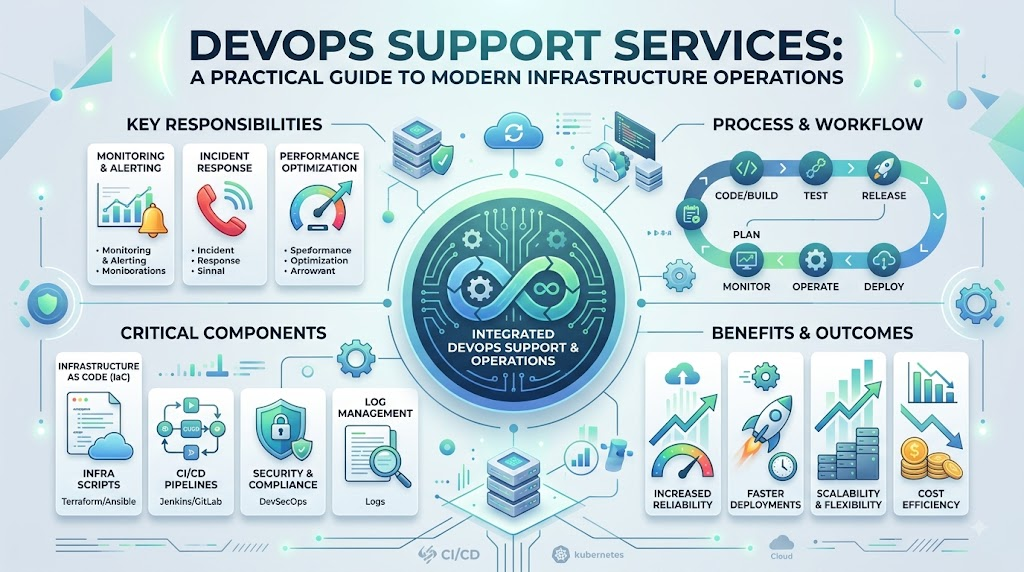
Introduction
Modern engineering teams rarely struggle because they cannot deploy software. The harder problem is keeping production environments stable while releases, cloud resources, security requirements, containers, and workloads change. A failed pipeline can delay a release, a configuration mistake can affect production, and a missing alert can turn a small issue into a longer incident. Kubernetes adds another operational layer, while cloud platforms require regular attention to capacity, access, monitoring, and resource management. These pressures become more visible as a company grows. Internal engineers may be capable of building the platform but may not have enough time to watch every environment, troubleshoot deployments, maintain automation, and respond to operational events. This is where DevOps Support Services can provide an ongoing operational layer around engineering teams. DevOps support is not simply about fixing incidents after something breaks. A useful support model combines monitoring, automation, troubleshooting, infrastructure management, release assistance, security practices, and continuous improvement. The right approach can help teams maintain dependable operations without forcing every recurring responsibility onto application developers.
What Are DevOps Support Services?
DevOps support services are ongoing technical activities that help teams operate software delivery systems and infrastructure after an initial implementation is complete. The work may cover cloud resources, CI/CD pipelines, infrastructure as code, containers, monitoring, deployments, backups, configuration, and production troubleshooting.
The main difference between implementation and support is continuity. A one-time project might establish a pipeline or build a Kubernetes cluster. Ongoing support keeps that environment usable as applications, dependencies, and requirements change.
Support teams may investigate failed builds, review deployment problems, tune monitoring, manage infrastructure changes, assist with releases, and automate repetitive tasks. They can also work with internal engineers during incidents or maintenance.
Why Organizations Need Ongoing DevOps Support
Production systems are never truly static. New application versions change deployment patterns, cloud resources are added or removed, certificates and secrets need attention, dependencies are updated, and monitoring requirements evolve. Even a well-designed environment needs regular operational work.
A common challenge is the gap between platform responsibility and available engineering time. Developers may spend hours investigating infrastructure problems instead of improving the product. Platform teams may balance roadmap work with alerts, upgrades, access requests, and release support.
Ongoing support can complement an internal team by taking responsibility for agreed operational tasks while keeping architectural and product decisions with the organization. A good model defines ownership clearly: who changes infrastructure, who approves production releases, who responds to incidents, and who maintains documentation.
24/7 DevOps Support Services
24/7 DevOps Support Services are designed for environments where operational issues can occur outside normal working hours. The support model should define monitoring, alert handling, escalation, communication, and response responsibilities.
Typical activities include continuous infrastructure and application monitoring, investigation of production alerts, deployment assistance, emergency troubleshooting, and escalation to the appropriate technical owner. Runbooks are especially useful because they give engineers a consistent way to handle known operational conditions.
Round-the-clock coverage can be relevant for global applications, customer-facing SaaS platforms, and systems where delays could create operational difficulties. Organizations should evaluate coverage, alert priorities, escalation paths, and shift handovers.
Managed DevOps Services
Managed DevOps Services generally involve an external team taking responsibility for defined recurring operational activities. Instead of providing advice for a single project, the provider may continuously manage selected parts of CI/CD, infrastructure automation, cloud administration, monitoring, configuration, releases, backups, and operational maintenance.
This model can help organizations that need consistent operational coverage without building a large internal platform team. It is not automatically right for every company; teams with strong internal platform capabilities may prefer to keep responsibilities in-house. The key is whether the model improves ownership, visibility, and engineering focus without creating unhealthy dependency.
Kubernetes Support Services
Kubernetes provides a powerful platform for running containerized workloads, but operating a production cluster involves more than deploying containers. Teams need to consider cluster upgrades, workload scheduling, resource limits, networking, access control, storage, observability, scaling, and failure recovery.
Kubernetes Support Services can assist with cluster administration, troubleshooting, upgrades, workload management, monitoring, security, and production optimization. Support may be relevant when a cluster experiences repeated scheduling failures, resource pressure, networking problems, difficult upgrades, or unclear application behavior.
These practices apply across managed Kubernetes environments such as AWS EKS, Azure AKS, and Google GKE. The operating model should reflect workload requirements and responsibilities already handled by the cloud provider. Clear runbooks and change procedures also prevent fixes from becoming undocumented one-off actions.
AWS DevOps Support Services
AWS environments can combine compute, containers, serverless workloads, networking, storage, identity, monitoring, and deployment services. Supporting such environments requires attention to both individual services and how they interact.
AWS DevOps Support Services may involve EC2, EKS, ECS, Lambda, Terraform, CloudFormation, CI/CD pipelines, monitoring, and infrastructure automation. Practical work can include investigating deployment failures, reviewing infrastructure changes, maintaining automation, supporting container workloads, and improving operational visibility.
There is no universal AWS architecture that fits every workload. A small event-driven service may use serverless components, while a complex container platform may rely on Kubernetes or ECS. Support decisions should follow application behavior, operational needs, security requirements, and team capabilities rather than assuming one AWS service is always preferred.
Azure DevOps Support Services
Organizations running workloads on Microsoft Azure may have recurring responsibilities around Azure Pipelines, AKS, infrastructure, releases, monitoring, and automation. As environments grow, these tasks can become difficult to manage alongside application development.
Azure DevOps support can help teams maintain CI/CD workflows, assist with deployment automation, troubleshoot production environments, manage infrastructure changes, and improve monitoring practices. It can also provide operational continuity for recurring release and platform tasks.
Some teams may need help mainly with pipelines, while others require broader AKS and Azure infrastructure support. Clear boundaries should show which changes require approval and which routine activities are delegated.
DevSecOps Support Services
Security is most effective when it is integrated into the delivery lifecycle rather than added immediately before production. DevSecOps Support Services can help organizations build security checks into normal engineering workflows.
Relevant practices include SAST, DAST, dependency scanning, container security, secrets management, vulnerability management, and security automation. These controls can identify different classes of risk, but they should be configured according to the application’s technology stack and risk profile.
Support teams can help maintain scanning pipelines, investigate security findings, manage secrets safely, and document remediation processes. Security should still remain a shared responsibility. Tools can surface issues, but engineering teams need defined ownership for reviewing, prioritizing, and fixing them.
SRE Support Services
Site Reliability Engineering focuses on applying engineering practices to system reliability. SRE Support Services can help organizations establish measurable reliability objectives and improve the way incidents and operational risks are handled.
Important concepts include service-level indicators, service-level objectives, service-level agreements, error budgets, observability, incident management, capacity planning, performance engineering, and root-cause analysis. An SLI measures an aspect of service behavior, while an SLO defines a target for that behavior. An SLA is generally a formal commitment that may include customer or contractual expectations.
SRE practices help teams discuss reliability using evidence rather than assumptions. Incident reviews can identify recurring failure patterns, while capacity analysis can expose resource constraints before they become production emergencies. Reliability work should remain balanced with the need to deliver useful software.
MLOps Support Services
Machine-learning systems introduce operational requirements that continue after a model has been trained. Models need deployment processes, version control, infrastructure, monitoring, resource management, and repeatable pipelines.
MLOps Support Services can assist with model deployment, ML infrastructure, ML pipelines, monitoring, automation, version management, and production operations. The goal is to connect machine-learning development with dependable software and infrastructure practices.
Operational support becomes particularly important when multiple models, data pipelines, environments, or compute resources are involved. Teams need clear processes for deploying new model versions, tracking changes, monitoring production behavior, and handling failures. The exact design should reflect the organization’s ML workloads rather than applying a single template to every project.
DevOps Support Technology Areas
| Area | Common Technologies / Practices | Primary Purpose |
|---|---|---|
| CI/CD | Jenkins, GitHub Actions, GitLab CI/CD, Azure Pipelines | Automated delivery |
| Cloud | AWS, Azure, Google Cloud | Infrastructure operations |
| Containers | Docker, Kubernetes | Application consistency |
| Infrastructure as Code | Terraform, CloudFormation | Repeatable infrastructure |
| Monitoring | Metrics, logs, traces | Operational visibility |
| Security | SAST, DAST, secrets management | Secure delivery |
| SRE | SLI, SLO, error budgets | Reliability |
| MLOps | ML pipelines, model monitoring | Production ML operations |
These are examples rather than a complete list. Tool selection should follow architecture, team skills, compliance needs, workload characteristics, and existing investments.
Benefits of Continuous DevOps Support
Continuous support can create several practical improvements. Faster troubleshooting can reduce the time engineers spend searching for the source of operational problems. Automation can remove repetitive manual tasks and make routine changes more consistent.
Better monitoring gives teams earlier visibility into infrastructure and application behavior. Consistent deployment practices can reduce avoidable release errors, while structured incident response helps teams coordinate during production problems. Security checks can become part of normal delivery rather than isolated activities.
The broader benefit is operational focus. With clear ownership, application engineers can spend more time on product work while platform specialists focus on infrastructure, reliability, and delivery. Results vary by environment, so support should be evaluated using practical measures such as incident patterns, operational workload, deployment quality, and documentation maturity.
Common DevOps Support Challenges
- Poor documentation: Without current architecture diagrams, runbooks, and deployment procedures, support engineers spend more time reconstructing how systems work.
- Unclear ownership: Incidents become harder to resolve when nobody knows who approves changes, owns a service, or handles escalation.
- Weak escalation procedures: A support model needs clear paths for moving complex incidents to the right technical experts.
- Limited observability: Missing metrics, logs, or traces make troubleshooting slower and can hide recurring failure patterns.
- Excessive manual work: Manual deployments and configuration changes increase the chance of inconsistency and human error.
- Inconsistent configurations: Differences between environments can cause failures that are difficult to reproduce.
- Poor communication: Technical support is less effective when incident updates, maintenance plans, and handovers are unclear.
- Lack of knowledge transfer: Internal teams should understand important operational decisions rather than relying permanently on external specialists.
- Overdependence on external teams: Delegating too much without retaining internal ownership can create long-term operational risk.
- Weak security processes: Unmanaged secrets, delayed vulnerability reviews, or missing access controls can create avoidable exposure.
How to Choose a DevOps Support Company
Choosing a support provider should be treated as a technical and operational decision, not simply a procurement exercise. Start by reviewing expertise in the organization’s actual environment. Relevant experience may include cloud platforms, Kubernetes, CI/CD, infrastructure as code, security, SRE, and MLOps.
Ask how incidents are monitored, prioritized, escalated, documented, and reviewed. Understand support coverage, handover procedures, communication channels, and SLA structure. The provider should be able to explain how routine changes are approved and how emergency changes are controlled.
Documentation and knowledge transfer are equally important. A healthy support relationship should gradually improve the organization’s operational understanding rather than keep critical knowledge hidden outside the company. Security practices should also be reviewed, including access management, secrets handling, auditability, and least-privilege principles.
Finally, evaluate compatibility with the internal engineering team. The strongest arrangement is usually one where responsibilities are clear, communication is direct, and external support strengthens internal capability instead of replacing it without a plan.
DevOps Support Area and Business Need
| Support Area | Typical Business Need |
| DevOps Support | Ongoing infrastructure and delivery assistance |
| 24/7 DevOps Support | Continuous operational monitoring and incident response |
| Managed DevOps | Reduce recurring operational workload |
| Kubernetes Support | Manage containerized production environments |
| AWS DevOps Support | Support AWS infrastructure and deployments |
| Azure DevOps Support | Manage Azure-based DevOps operations |
| DevSecOps Support | Integrate security into delivery and operations |
| SRE Support | Improve reliability and operational practices |
| MLOps Support | Operate ML systems in production |
Frequently Asked Questions
1. What are DevOps Support Services?
They are ongoing technical activities covering areas such as infrastructure, CI/CD, cloud operations, monitoring, automation, deployments, troubleshooting, and production support.
2. Why do companies need ongoing DevOps support?
Production environments continually change. Ongoing support helps teams manage recurring operational work, incidents, infrastructure changes, monitoring, and deployments while complementing internal engineering resources.
3. What do 24/7 DevOps Support Services include?
They can include continuous monitoring, alert handling, incident response, production troubleshooting, deployment assistance, escalation, and operational handovers. The exact coverage depends on the support agreement.
4. What is the difference between managed DevOps and DevOps support?
DevOps support can cover specific assistance or operational responsibilities, while managed DevOps generally means an external team continuously manages an agreed set of recurring DevOps activities.
5. When is Kubernetes support useful?
It is useful when teams need help with cluster administration, upgrades, scaling, networking, monitoring, security, troubleshooting, or production workload management.
6. What does AWS DevOps support involve?
It can cover AWS infrastructure, EKS, ECS, EC2, Lambda, Terraform, CloudFormation, CI/CD, monitoring, automation, and deployment operations, depending on the environment.
7. How does DevSecOps support improve security?
It integrates security practices into delivery and operations through activities such as code scanning, dependency checks, container security, secrets management, vulnerability handling, and security automation.
8. What is the role of SRE and MLOps support?
SRE support focuses on reliability, observability, incident management, capacity, and performance. MLOps support applies similar operational discipline to machine-learning infrastructure, pipelines, model deployment, and monitoring.
Conclusion
Modern production environments require more than a successful initial deployment. Cloud infrastructure, CI/CD pipelines, Kubernetes clusters, security controls, monitoring systems, and machine-learning workloads all need attention as applications and business requirements evolve. DevOps support provides a structured way to handle this ongoing operational work. A suitable support model can connect infrastructure management with automation, release operations, observability, security, reliability engineering, and production response. It can also help internal teams establish clearer ownership and reduce repetitive operational pressure. The right approach depends on technical maturity, infrastructure complexity, security requirements, internal skills, operational coverage, and long-term goals. Some organizations need targeted assistance, while others may benefit from a broader managed operating model. The important part is to define responsibilities clearly and preserve internal understanding of critical systems.