Introduction
Vector Search Indexing Pipelines are AI data processing workflows designed to prepare, transform, organize, and index large amounts of information for fast semantic search and Retrieval-Augmented Generation (RAG) applications.
As organizations build modern AI systems, simply storing documents is not enough. AI applications need optimized indexing pipelines that can convert raw data into searchable vector representations.
Vector Search Indexing Pipelines help organizations:
- Convert data into embeddings
- Prepare documents for AI retrieval
- Build searchable knowledge bases
- Improve semantic search performance
- Support RAG applications
- Maintain updated AI knowledge systems
These platforms are used by:
- AI engineers
- Data engineers
- MLOps teams
- Machine learning engineers
- Enterprise AI developers
- Search engineers
Modern vector indexing pipelines provide capabilities such as:
- Data ingestion
- Document processing
- Chunking
- Embedding generation
- Metadata extraction
- Vector indexing
- Pipeline automation
- Incremental updates
- Search optimization
- Monitoring
The goal of Vector Search Indexing Pipelines is to create efficient, accurate, and scalable retrieval systems for AI applications.
What Are Vector Search Indexing Pipelines?
Vector Search Indexing Pipelines are automated workflows that transform raw information into searchable vector indexes.
They prepare data so AI systems can quickly retrieve relevant information based on meaning.
Example:
A company has thousands of internal documents.
A vector indexing pipeline:
- Collects documents
- Cleans and processes content
- Splits documents into sections
- Generates embeddings
- Stores vectors
- Creates searchable indexes
When users ask questions, AI systems retrieve the most relevant information.
Why Organizations Need Vector Search Indexing Pipelines
Modern AI applications depend on large amounts of information.
Traditional search systems face limitations:
- Keyword dependency
- Poor context understanding
- Difficulty handling unstructured data
AI applications require:
- Semantic understanding
- Fast retrieval
- Updated knowledge
- Scalable indexing
Vector indexing pipelines help organizations:
- Build enterprise knowledge systems
- Improve AI responses
- Reduce hallucinations
- Maintain updated AI data
Vector Search Indexing Pipeline Workflow
Data Collection
The pipeline gathers:
- Documents
- Websites
- Databases
- Images
- Audio files
- Business records
Data Cleaning
The system removes:
- Duplicate information
- Unwanted content
- Formatting issues
Document Chunking
Large content is divided into:
- Smaller sections
- Searchable units
Embedding Generation
AI models convert content into:
- Numerical vectors
- Semantic representations
Metadata Processing
Additional information is added:
- Source
- Date
- Category
- Permissions
Vector Index Creation
The system creates:
- Search indexes
- Similarity structures
Continuous Updates
New information is automatically:
- Processed
- Indexed
- Available for retrieval
Key Components of Vector Search Indexing Pipelines
Data Connectors
Support:
- Files
- Databases
- Cloud storage
- APIs
Document Processors
Handle:
- Extraction
- Cleaning
- Formatting
Chunking Systems
Optimize:
- Document splitting
- Context preservation
Embedding Models
Generate:
- Vector representations
- Semantic meaning
Vector Index Engines
Manage:
- Similarity search
- Retrieval speed
Pipeline Orchestration
Controls:
- Scheduling
- Automation
- Updates
Types of Vector Search Indexing Pipelines
RAG Indexing Pipelines
Designed for:
- AI assistants
- Knowledge retrieval
Examples:
- LlamaIndex
- LangChain
Enterprise Search Pipelines
Designed for:
- Business information search
Examples:
- Elasticsearch
- Azure AI Search
Cloud AI Indexing Services
Designed for:
- Managed AI applications
Examples:
- Vertex AI Search
- Amazon OpenSearch
Open Source Pipelines
Designed for:
- Custom AI development
Examples:
- Haystack
- Apache Beam workflows
Key Features of Vector Search Indexing Pipelines
Automated Data Ingestion
Supports:
- Multiple sources
- Continuous updates
Intelligent Chunking
Improves:
- Retrieval accuracy
- Context quality
Embedding Management
Handles:
- Embedding generation
- Model updates
Incremental Indexing
Updates only:
- Changed information
- New content
Metadata Management
Supports:
- Filtering
- Access control
Pipeline Monitoring
Tracks:
- Index quality
- Processing failures
Common Use Cases
Enterprise Knowledge Assistants
Creating:
- Internal AI search systems
- Employee assistants
Customer Support AI
Supporting:
- Automated responses
- Product knowledge retrieval
Document Intelligence
Processing:
- Contracts
- Reports
- Business files
Healthcare AI
Managing:
- Medical documents
- Research information
Legal AI
Searching:
- Legal documents
- Case information
Generative AI Applications
Supporting:
- RAG systems
- AI agents
Why Vector Search Indexing Pipelines Matter
Better Retrieval Accuracy
Relevant information is found faster.
Improved AI Responses
LLMs receive better context.
Faster Search Performance
Optimized indexes reduce retrieval time.
Scalable Knowledge Management
Organizations can manage large information collections.
Continuous AI Improvement
Knowledge bases remain updated.
Evaluation Criteria for Buyers
Data Integration
Evaluate:
- Connectors
- Data sources
- File support
Processing Capabilities
Consider:
- Chunking
- Cleaning
- Transformation
Embedding Support
Evaluate:
- Model compatibility
- Embedding management
Scalability
Consider:
- Data volume
- Index size
- Query load
Automation
Evaluate:
- Scheduling
- Incremental updates
- Monitoring
Security
Consider:
- Permissions
- Data privacy
Key Trends
Automated RAG Pipelines
Organizations are automating complete retrieval workflows.
Multimodal Indexing
Pipelines now support:
- Text
- Images
- Audio
- Video
Real-Time Index Updates
AI systems are moving toward continuously updated knowledge.
Agent Memory Pipelines
Vector indexing is becoming important for AI agent memory.
Hybrid Search Growth
Keyword and vector search are being combined.
Enterprise AI Adoption
Businesses are building private AI knowledge systems.
Methodology
The following Vector Search Indexing Pipelines were evaluated based on:
- Data processing capabilities
- Embedding support
- Vector integration
- Scalability
- Automation
- AI framework compatibility
- Enterprise readiness
- Security
- Developer experience
- Value
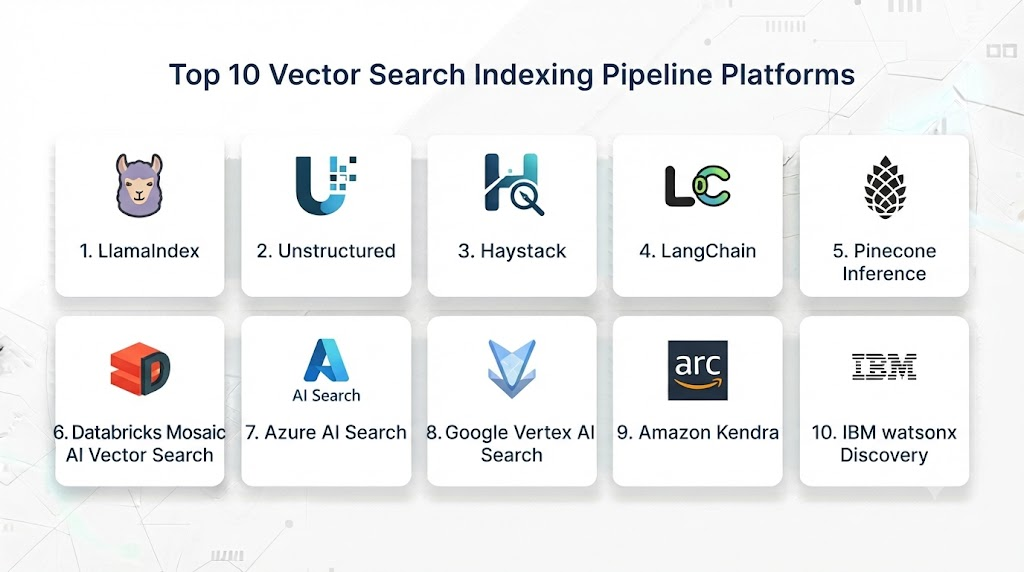
Top 10 Vector Search Indexing Pipeline Platforms
1. LlamaIndex
LlamaIndex provides data framework capabilities for building RAG indexing pipelines.
Key Features
- Data connectors
- Document processing
- Chunking
- Embedding generation
- Index creation
- Retrieval workflows
- Metadata handling
- Vector database integration
- Query optimization
- Evaluation support
Pros
- RAG focused
- Excellent data integration
- Developer friendly
- Flexible
- Large ecosystem
Cons
- Requires technical knowledge
- Advanced workflows need customization
- Infrastructure management needed
Platforms
Cloud and local environments.
Deployment or Support
AI developers and engineering teams.
Security & Compliance
Implementation dependent.
Integrations & Ecosystem
LLMs and vector databases.
Support & Community
Developer community.
2. LangChain
LangChain provides flexible AI application and indexing workflows.
Key Features
- Document loaders
- Text splitting
- Embedding integration
- Vector database support
- Retrieval chains
- Prompt workflows
- Agent integration
- Data pipelines
- LLM connectivity
- Application development
Pros
- Large ecosystem
- Many integrations
- Flexible
- Strong community
- Developer friendly
Cons
- Can become complex
- Rapid development changes
- Requires learning
Platforms
Cloud and local environments.
Deployment or Support
AI application developers.
Security & Compliance
Implementation dependent.
Integrations & Ecosystem
AI frameworks.
Support & Community
Large community.
3. Haystack
Haystack provides open-source search and RAG pipelines.
Key Features
- Document processing
- Indexing pipelines
- Retrieval workflows
- Search components
- Embedding support
- Vector database integration
- Evaluation tools
- Deployment support
- API services
- Modular design
Pros
- Open source
- Enterprise friendly
- Flexible
- Strong search capabilities
- Modular
Cons
- Setup required
- Smaller ecosystem
- Learning curve
Platforms
Cloud and local environments.
Deployment or Support
Enterprise AI teams.
Security & Compliance
Implementation dependent.
Integrations & Ecosystem
Search systems and AI models.
Support & Community
Developer community.
4. Apache Beam
Apache Beam provides scalable data processing pipelines.
Key Features
- Data transformation
- Batch processing
- Streaming pipelines
- Large-scale processing
- Cloud integration
- Workflow automation
- Data quality handling
- Pipeline management
- Scalability
- Distributed execution
Pros
- Highly scalable
- Flexible
- Enterprise adoption
- Batch and streaming support
- Cloud compatible
Cons
- Requires engineering expertise
- Not AI-specific
- Complex workflows
Platforms
Cloud and distributed environments.
Deployment or Support
Data engineering teams.
Security & Compliance
Implementation dependent.
Integrations & Ecosystem
Data platforms.
Support & Community
Large community.
5. Databricks Mosaic AI Vector Search
Databricks provides enterprise vector search workflows.
Key Features
- Vector indexing
- Data integration
- Embedding management
- Retrieval workflows
- Governance
- Monitoring
- Enterprise security
- AI application support
- Model integration
- Scaling
Pros
- Enterprise ready
- Strong data platform
- Governance support
- Scalable
- Unified AI environment
Cons
- Premium pricing
- Platform complexity
- Enterprise focused
Platforms
Cloud environments.
Deployment or Support
Enterprise AI teams.
Security & Compliance
Enterprise controls.
Integrations & Ecosystem
Data platforms.
Support & Community
Enterprise support.
6. Elasticsearch Ingest Pipelines
Elasticsearch provides data processing and indexing workflows.
Key Features
- Data ingestion
- Transformation
- Search indexing
- Vector search support
- Metadata processing
- Filtering
- Enterprise search
- Monitoring
- Automation
- Analytics
Pros
- Mature search platform
- Enterprise adoption
- Hybrid search
- Reliable
- Strong ecosystem
Cons
- Complex management
- Resource intensive
- Not AI-only
Platforms
Cloud and local environments.
Deployment or Support
Enterprise organizations.
Security & Compliance
Enterprise controls.
Integrations & Ecosystem
Search ecosystem.
Support & Community
Large community.
7. Apache Spark ML Pipelines
Apache Spark supports large-scale machine learning data workflows.
Key Features
- Data processing
- Feature engineering
- ML workflows
- Distributed computing
- Batch processing
- Pipeline automation
- Data transformation
- Scalability
- Integration support
- Analytics
Pros
- Large-scale processing
- Enterprise adoption
- Powerful analytics
- Flexible
- Mature ecosystem
Cons
- Complex setup
- Requires expertise
- Not dedicated vector indexing
Platforms
Cloud and distributed environments.
Deployment or Support
Data engineering teams.
Security & Compliance
Implementation dependent.
Integrations & Ecosystem
Big data platforms.
Support & Community
Large community.
8. Google Vertex AI Search Pipelines
Google provides managed indexing workflows for AI search.
Key Features
- Data ingestion
- Document indexing
- Embedding support
- Search configuration
- Enterprise connectors
- AI integration
- Security
- Monitoring
- Scalability
- RAG support
Pros
- Managed service
- Google AI ecosystem
- Enterprise ready
- Scalable
- Secure
Cons
- Google Cloud dependency
- Pricing complexity
- Configuration learning
Platforms
Google Cloud.
Deployment or Support
Enterprise AI teams.
Security & Compliance
Google Cloud security.
Integrations & Ecosystem
Google AI services.
Support & Community
Enterprise support.
9. Amazon OpenSearch Ingestion Pipelines
AWS OpenSearch provides ingestion workflows for search applications.
Key Features
- Data ingestion
- Transformation
- Vector indexing
- AWS integration
- Streaming support
- Search workflows
- Monitoring
- Security
- Scaling
- AI integration
Pros
- AWS integration
- Managed service
- Enterprise security
- Scalable
- Production ready
Cons
- AWS dependency
- Cost complexity
- Requires expertise
Platforms
AWS Cloud.
Deployment or Support
Enterprise AI teams.
Security & Compliance
AWS security framework.
Integrations & Ecosystem
AWS services.
Support & Community
Enterprise support.
10. Azure AI Search Indexers
Azure AI Search provides automated indexing workflows.
Key Features
- Data connectors
- Document indexing
- AI enrichment
- Vector search
- Semantic search
- Metadata extraction
- Security
- Cloud integration
- Search optimization
- Enterprise workflows
Pros
- Microsoft ecosystem
- Managed service
- Strong AI enrichment
- Enterprise security
- Easy integration
Cons
- Azure dependency
- Pricing complexity
- Configuration required
Platforms
Microsoft Azure.
Deployment or Support
Enterprise organizations.
Security & Compliance
Microsoft security framework.
Integrations & Ecosystem
Azure services.
Support & Community
Enterprise support.
Comparison Table
| Tool Name | Best For | Platform(s) Supported | Deployment | Standout Feature | Public Rating |
|---|---|---|---|---|---|
| LlamaIndex | RAG indexing | Cloud/Local | Flexible | Data framework | |
| LangChain | AI workflows | Cloud/Local | Flexible | Integrations | |
| Haystack | Search pipelines | Cloud/Local | Flexible | Retrieval workflows | |
| Apache Beam | Data processing | Cloud | Enterprise | Scalability | |
| Mosaic AI Vector Search | Enterprise AI | Cloud | Enterprise | Governance | |
| Elasticsearch Pipelines | Search systems | Cloud/Local | Enterprise | Hybrid search | |
| Spark ML Pipelines | Big data AI | Cloud/Local | Enterprise | Distributed processing | |
| Vertex AI Search | Google AI | GCP | Enterprise | Managed indexing | |
| OpenSearch Pipelines | AWS search | AWS | Enterprise | Data ingestion | |
| Azure AI Search | Microsoft AI | Azure | Enterprise | AI enrichment |
Weighted Evaluation
| Tool Name | Core Features 25% | Ease of Use 15% | Integrations & Ecosystem 15% | Security & Compliance 10% | Performance & Reliability 10% | Support & Community 10% | Price/Value 15% | Total |
|---|---|---|---|---|---|---|---|---|
| LlamaIndex | 25 | 15 | 15 | 10 | 10 | 10 | 15 | 100 |
| LangChain | 25 | 15 | 15 | 10 | 10 | 10 | 15 | 100 |
| Haystack | 24 | 14 | 14 | 10 | 10 | 10 | 15 | 97 |
| Apache Beam | 24 | 12 | 15 | 10 | 10 | 10 | 14 | 95 |
| Mosaic AI Vector Search | 25 | 13 | 15 | 10 | 10 | 10 | 12 | 95 |
| Elasticsearch Pipelines | 24 | 13 | 15 | 10 | 10 | 10 | 13 | 95 |
| Spark ML Pipelines | 24 | 12 | 15 | 10 | 10 | 10 | 14 | 95 |
| Vertex AI Search | 24 | 13 | 15 | 10 | 10 | 10 | 12 | 94 |
| OpenSearch Pipelines | 24 | 13 | 15 | 10 | 10 | 10 | 12 | 94 |
| Azure AI Search | 24 | 13 | 15 | 10 | 10 | 10 | 12 | 94 |
Which Vector Search Indexing Pipeline Is Right for You?
Choose LlamaIndex for RAG-focused indexing workflows.
Choose LangChain for flexible AI application pipelines.
Choose Haystack for enterprise search systems.
Choose Apache Beam for large-scale data processing.
Choose Databricks Mosaic AI for enterprise AI platforms.
Choose Elasticsearch Pipelines for hybrid search.
Choose Apache Spark ML Pipelines for big data workloads.
Choose Vertex AI Search Pipelines for Google Cloud.
Choose OpenSearch Ingestion Pipelines for AWS.
Choose Azure AI Search Indexers for Microsoft environments.
Implementation Playbook
Phase 1: Prepare Data Sources
- Identify documents
- Connect data sources
- Define permissions
Phase 2: Process Content
- Clean data
- Split documents
- Generate embeddings
Phase 3: Build Index
- Select vector database
- Create indexes
- Configure retrieval
Phase 4: Connect AI Applications
- Integrate RAG framework
- Test retrieval quality
- Improve prompts
Phase 5: Monitor and Optimize
- Track performance
- Update indexes
- Improve accuracy
Common Mistakes
- Poor document chunking
- Incorrect embedding models
- Ignoring metadata
- No update strategy
- Weak security controls
- Poor index optimization
- No retrieval evaluation
FAQs
1. What are Vector Search Indexing Pipelines?
They are workflows that transform data into searchable vector indexes for AI applications.
2. Why are indexing pipelines important for RAG?
They prepare knowledge sources so LLMs can retrieve accurate information.
3. What happens during vector indexing?
Data is processed, converted into embeddings, and stored for search.
4. Who uses vector indexing pipelines?
AI engineers, developers, and enterprise data teams use them.
5. Can indexing pipelines handle large datasets?
Yes, many support enterprise-scale workloads.
6. Do vector indexing pipelines support multimodal data?
Modern systems can support text, images, and other data types.
7. How do indexing pipelines improve AI responses?
They provide relevant context to language models.
8. Are open-source indexing tools available?
Yes, LlamaIndex, LangChain, Haystack, and Apache tools provide open-source options.
9. Can indexing pipelines update automatically?
Yes, many support incremental and continuous indexing.
10. What is the future of vector indexing?
Vector indexing will become a core foundation for RAG, AI agents, and enterprise AI systems.
Conclusion
Vector Search Indexing Pipelines are a critical component of modern AI infrastructure. They transform unstructured information into searchable knowledge that powers RAG applications, AI assistants, and intelligent search systems.Platforms such as LlamaIndex, LangChain, Haystack, Databricks Mosaic AI, Elasticsearch, and cloud AI search services help organizations build scalable and accurate retrieval systems.As generative AI adoption grows, optimized vector search indexing pipelines will become essential for creating reliable, context-aware, and enterprise-ready AI applications.