Introduction
LLM Output Quality Monitoring Platforms are AI observability and evaluation systems designed to track, analyze, and improve the quality of responses generated by large language models (LLMs).
As organizations deploy AI assistants, chatbots, copilots, RAG applications, and AI agents, maintaining consistent output quality becomes a major challenge. LLM responses can vary because of prompt changes, model updates, changing user inputs, or knowledge limitations.
LLM output quality monitoring platforms help teams continuously evaluate:
- Response accuracy
- Relevance
- Hallucination levels
- Factual correctness
- Safety
- User satisfaction
- Prompt performance
- Model behavior
These platforms help organizations:
- Detect poor AI responses
- Improve LLM reliability
- Monitor production AI applications
- Reduce hallucinations
- Optimize prompts and models
- Maintain AI quality standards
LLM Output Quality Monitoring Platforms are used by:
- AI engineers
- LLM application developers
- Prompt engineers
- MLOps teams
- Product teams
- Enterprise AI teams
Modern platforms provide capabilities such as:
- LLM evaluation
- Response scoring
- Hallucination detection
- RAG quality analysis
- Prompt monitoring
- User feedback tracking
- AI tracing
- Performance dashboards
- Automated alerts
- Model comparison
The goal of LLM Output Quality Monitoring Platforms is to ensure AI-generated responses remain accurate, useful, safe, and aligned with business requirements.
What Are LLM Output Quality Monitoring Platforms?
LLM Output Quality Monitoring Platforms are tools that evaluate and monitor responses generated by large language models.
They analyze AI outputs based on quality factors such as:
- Accuracy
- Relevance
- Completeness
- Context understanding
- Safety
- Consistency
Example:
A customer support AI assistant generates an answer.
The monitoring platform checks:
- Did the answer solve the customer issue?
- Was the information correct?
- Did the AI invent information?
- Was the response safe and appropriate?
Why Organizations Need LLM Output Quality Monitoring
LLM applications introduce new challenges:
- Unpredictable responses
- Hallucinations
- Changing model behavior
- Prompt sensitivity
- Context limitations
Without monitoring, organizations may face:
- Incorrect customer information
- Poor user experience
- Compliance risks
- Loss of trust
LLM quality monitoring helps organizations:
- Maintain response accuracy
- Identify failures quickly
- Improve AI applications
- Build trustworthy AI systems
How LLM Output Quality Monitoring Works
Data Collection
Platforms collect:
- User queries
- Prompts
- Model responses
- Context information
- Feedback data
Response Analysis
Systems evaluate:
- Accuracy
- Relevance
- Completeness
- Safety
Quality Scoring
AI responses receive scores based on:
- Evaluation models
- Rules
- Human feedback
Issue Detection
Platforms identify:
- Hallucinations
- Incorrect answers
- Poor retrieval
- Unsafe content
Continuous Improvement
Teams improve:
- Prompts
- Models
- Retrieval systems
- AI workflows
Key Components of LLM Output Monitoring Platforms
LLM Evaluation Engine
Measures:
- Response quality
- Accuracy
- Relevance
Hallucination Detection System
Identifies:
- Unsupported information
- False statements
- Missing context
Tracing System
Tracks:
- User requests
- Prompt flow
- Model interactions
Feedback Management
Collects:
- User ratings
- Human reviews
- Corrections
Analytics Dashboard
Displays:
- Quality trends
- Model performance
- Failure patterns
Alerting System
Notifies teams about:
- Quality drops
- Safety issues
- Application failures
Types of LLM Output Quality Monitoring Platforms
LLM Observability Platforms
Focused on:
- Tracing
- Monitoring
- Debugging
Examples:
- Langfuse
- Arize Phoenix
AI Evaluation Platforms
Focused on:
- Quality scoring
- Benchmarking
- Testing
Examples:
- Braintrust
- Humanloop
Enterprise AI Monitoring Platforms
Focused on:
- Governance
- Compliance
- Security
Examples:
- Fiddler AI
- Arize AI
Open Source LLM Monitoring Tools
Focused on:
- Custom deployments
- Developer workflows
Examples:
- DeepEval
- TruLens
Key Features of LLM Output Quality Monitoring Platforms
Hallucination Detection
Identifies:
- Incorrect facts
- Unsupported claims
- Fabricated information
Response Quality Evaluation
Measures:
- Helpfulness
- Accuracy
- Relevance
- Completeness
RAG Evaluation
Analyzes:
- Retrieval quality
- Context accuracy
- Answer grounding
Prompt Performance Tracking
Monitors:
- Prompt effectiveness
- Version changes
- Output improvements
User Feedback Analysis
Tracks:
- Ratings
- Corrections
- Satisfaction
Multi-Model Comparison
Compares:
- GPT models
- Open-source LLMs
- Custom models
Common Use Cases
Customer Support AI
Monitoring:
- Chatbot responses
- Customer interactions
- Resolution quality
Enterprise Search Systems
Evaluating:
- RAG answers
- Knowledge retrieval
- Document grounding
AI Agents
Monitoring:
- Agent decisions
- Tool usage
- Task completion
Content Generation
Checking:
- Writing quality
- Brand consistency
- Accuracy
Healthcare AI Assistants
Evaluating:
- Medical information quality
- Safety
- Reliability
Coding Assistants
Monitoring:
- Code accuracy
- Security
- Development support
Why LLM Output Quality Monitoring Matters
Reduces Hallucinations
Teams identify unreliable AI responses.
Improves User Experience
AI applications become more helpful.
Supports AI Governance
Organizations maintain quality standards.
Enables Continuous Optimization
Teams improve prompts and models.
Builds Trust
Users receive more reliable AI responses.
Evaluation Criteria for Buyers
Evaluation Capabilities
Consider:
- Quality metrics
- Automated scoring
- Human evaluation
Hallucination Detection
Evaluate:
- Accuracy checks
- Grounding analysis
Integration Support
Look for:
- LLM providers
- AI frameworks
- RAG systems
Monitoring Features
Consider:
- Dashboards
- Alerts
- Analytics
Scalability
Evaluate:
- Number of applications
- Request volume
- Enterprise requirements
Security
Consider:
- Data protection
- Access management
- Compliance
Key Trends
LLM Observability Growth
Organizations are investing in AI visibility.
Automated AI Evaluation
AI systems are increasingly evaluating AI outputs.
RAG Quality Monitoring
Companies are focusing on retrieval accuracy.
Agent Quality Monitoring
Platforms are expanding toward AI agent evaluation.
Human Feedback Integration
Organizations combine automated and human reviews.
Enterprise AI Governance
Output monitoring is becoming essential for responsible AI.
Methodology
The following LLM Output Quality Monitoring Platforms were evaluated based on:
- Evaluation capabilities
- Hallucination detection
- Monitoring features
- Integration support
- Scalability
- Security
- Developer experience
- Enterprise readiness
- Community support
- Value
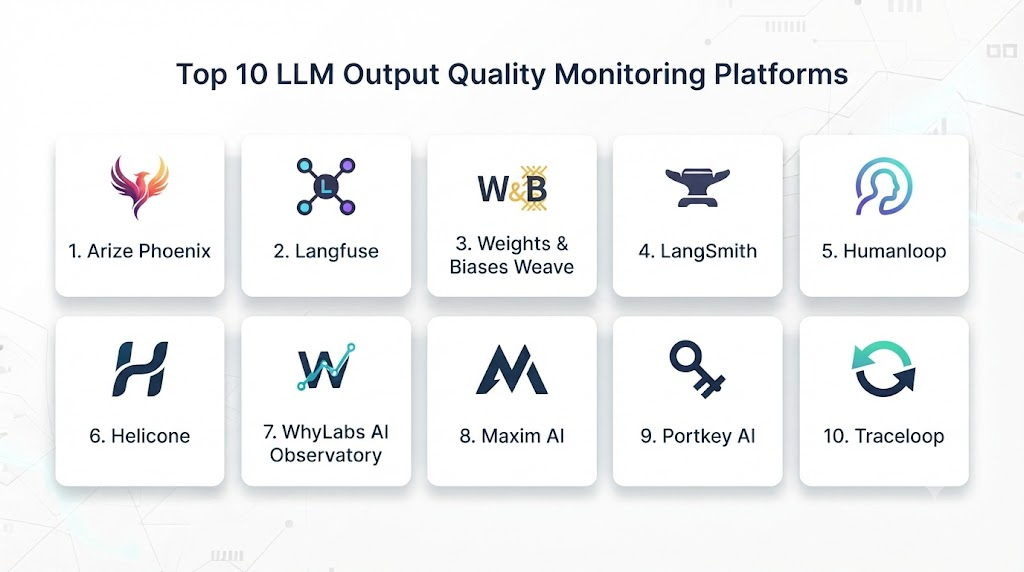
Top 10 LLM Output Quality Monitoring Platforms
1. Arize Phoenix
Arize Phoenix provides open-source LLM observability and evaluation capabilities.
Key Features
- LLM tracing
- Response evaluation
- Hallucination analysis
- RAG monitoring
- Embedding analysis
- Debugging
- Quality tracking
- Performance dashboards
- AI evaluation
- Open-source deployment
Pros
- Strong LLM observability
- Open source
- Excellent debugging
- RAG support
- AI-focused
Cons
- Requires technical setup
- Enterprise features vary
- Learning curve
Platforms
Cloud and local environments.
Deployment or Support
LLM engineering teams.
Security & Compliance
Depends on deployment.
Integrations & Ecosystem
LLM frameworks.
Support & Community
Developer community.
2. Langfuse
Langfuse provides open-source LLM monitoring and evaluation.
Key Features
- LLM tracing
- Output evaluation
- Prompt tracking
- Cost monitoring
- User feedback
- Dataset management
- Analytics
- Experiment tracking
- Self-hosting
- API support
Pros
- Open source
- Flexible
- Strong observability
- Good community
- Self-hosting support
Cons
- Requires setup
- Technical expertise needed
- Enterprise features vary
Platforms
Cloud and self-hosted environments.
Deployment or Support
LLM application teams.
Security & Compliance
Self-managed security.
Integrations & Ecosystem
AI frameworks.
Support & Community
Open-source community.
3. LangSmith
LangSmith provides LLM application monitoring and evaluation.
Key Features
- LLM tracing
- Output evaluation
- Prompt testing
- Dataset management
- Agent monitoring
- Experiment comparison
- Debugging
- Analytics
- Collaboration
- Developer tools
Pros
- Strong LangChain integration
- Good debugging
- Agent support
- Developer-friendly
- Evaluation workflows
Cons
- Best with LangChain
- Requires technical knowledge
- Enterprise features may cost more
Platforms
Cloud environments.
Deployment or Support
LLM developers.
Security & Compliance
Platform controls.
Integrations & Ecosystem
LangChain ecosystem.
Support & Community
Developer community.
4. Braintrust
Braintrust provides AI evaluation and quality management.
Key Features
- LLM evaluations
- Quality scoring
- Experiment tracking
- Dataset management
- Prompt testing
- Model comparison
- Analytics
- Collaboration
- AI testing
- Reporting
Pros
- Strong evaluation
- Good analytics
- Flexible workflows
- Developer-friendly
- Experiment support
Cons
- Requires technical knowledge
- Newer platform
- Enterprise pricing
Platforms
Cloud environments.
Deployment or Support
AI teams.
Security & Compliance
Enterprise controls.
Integrations & Ecosystem
AI platforms.
Support & Community
Developer community.
5. Humanloop
Humanloop focuses on prompt engineering and AI evaluation.
Key Features
- Human feedback
- LLM evaluation
- Response analysis
- Prompt management
- Collaboration
- Testing
- Model comparison
- Analytics
- Quality workflows
- Deployment support
Pros
- Strong human evaluation
- User-friendly
- Good collaboration
- Enterprise workflows
- Prompt-focused
Cons
- Premium pricing
- Smaller ecosystem
- Requires integration
Platforms
Cloud environments.
Deployment or Support
AI product teams.
Security & Compliance
Enterprise controls.
Integrations & Ecosystem
LLM providers.
Support & Community
Developer community.
6. TruLens
TruLens provides evaluation tools for LLM applications.
Key Features
- LLM evaluation
- RAG evaluation
- Feedback functions
- Quality metrics
- Monitoring
- Testing
- Experiment tracking
- Developer tools
- AI reliability analysis
- Reporting
Pros
- Strong evaluation
- Open source
- RAG support
- Flexible
- Developer-friendly
Cons
- Requires setup
- Technical knowledge needed
- Limited enterprise features
Platforms
Cloud and local environments.
Deployment or Support
AI developers.
Security & Compliance
Depends on deployment.
Integrations & Ecosystem
LLM applications.
Support & Community
Developer community.
7. DeepEval
DeepEval provides open-source LLM testing and evaluation.
Key Features
- Response evaluation
- Hallucination testing
- RAG metrics
- Custom evaluations
- Regression testing
- CI/CD support
- AI quality scoring
- Developer tools
- Test automation
- Open-source framework
Pros
- Open source
- Flexible
- Developer-friendly
- Strong metrics
- Easy integration
Cons
- Requires setup
- Technical knowledge needed
- Limited UI features
Platforms
Cloud and local environments.
Deployment or Support
AI developers.
Security & Compliance
Depends on deployment.
Integrations & Ecosystem
LLM applications.
Support & Community
Developer community.
8. Fiddler AI
Fiddler AI provides enterprise AI monitoring and governance.
Key Features
- LLM monitoring
- Explainability
- Quality analysis
- Bias detection
- Performance tracking
- Alerts
- Governance
- Security
- Reporting
- AI insights
Pros
- Enterprise governance
- Strong explainability
- Security features
- AI monitoring
- Compliance support
Cons
- Premium pricing
- Complex setup
- Enterprise focused
Platforms
Cloud environments.
Deployment or Support
Enterprise AI teams.
Security & Compliance
Enterprise controls.
Integrations & Ecosystem
AI platforms.
Support & Community
Enterprise support.
9. WhyLabs
WhyLabs provides AI observability and quality monitoring.
Key Features
- LLM monitoring
- Data quality tracking
- Drift detection
- AI analytics
- Alerts
- Performance monitoring
- Governance
- Reporting
- Production insights
- Model monitoring
Pros
- Strong observability
- Data quality support
- Enterprise ready
- Scalable
- Governance features
Cons
- Enterprise pricing
- Setup required
- Learning curve
Platforms
Cloud environments.
Deployment or Support
Enterprise AI teams.
Security & Compliance
Enterprise controls.
Integrations & Ecosystem
ML platforms.
Support & Community
Enterprise support.
10. Weights & Biases Weave
W&B Weave provides AI evaluation and tracking workflows.
Key Features
- LLM monitoring
- Output evaluation
- Experiment tracking
- Visualization
- Dataset tracking
- Collaboration
- AI workflows
- Model comparison
- Analytics
- Reporting
Pros
- Excellent tracking
- Strong visualization
- ML ecosystem
- Collaboration support
- Developer-friendly
Cons
- Requires setup
- Broad ML focus
- Enterprise features cost more
Platforms
Cloud environments.
Deployment or Support
AI engineering teams.
Security & Compliance
Enterprise controls.
Integrations & Ecosystem
ML ecosystem.
Support & Community
Developer community.
Comparison Table
| Tool Name | Best For | Platform(s) Supported | Deployment | Standout Feature | Public Rating |
|---|---|---|---|---|---|
| Arize Phoenix | LLM observability | Cloud/Local | Flexible | AI debugging | |
| Langfuse | Open-source LLMOps | Cloud/Self-hosted | Flexible | Tracing | |
| LangSmith | LLM applications | Cloud | Flexible | Agent monitoring | |
| Braintrust | AI evaluation | Cloud | Flexible | Quality scoring | |
| Humanloop | Human evaluation | Cloud | Business | Feedback workflows | |
| TruLens | RAG evaluation | Cloud/Local | Flexible | AI feedback | |
| DeepEval | LLM testing | Cloud/Local | Flexible | Evaluation metrics | |
| Fiddler AI | Enterprise AI | Cloud | Enterprise | Governance | |
| WhyLabs | AI monitoring | Cloud | Enterprise | Observability | |
| W&B Weave | AI experiments | Cloud | Flexible | Tracking |
Weighted Evaluation
| Tool Name | Core Features 25% | Ease of Use 15% | Integrations & Ecosystem 15% | Security & Compliance 10% | Performance & Reliability 10% | Support & Community 10% | Price/Value 15% | Total |
|---|---|---|---|---|---|---|---|---|
| Arize Phoenix | 25 | 14 | 15 | 10 | 10 | 10 | 15 | 99 |
| Langfuse | 24 | 14 | 15 | 10 | 10 | 10 | 15 | 98 |
| LangSmith | 25 | 15 | 14 | 10 | 10 | 10 | 14 | 98 |
| Braintrust | 24 | 14 | 14 | 10 | 10 | 10 | 14 | 96 |
| Humanloop | 23 | 15 | 13 | 10 | 10 | 10 | 14 | 95 |
| TruLens | 23 | 14 | 14 | 10 | 10 | 10 | 15 | 96 |
| DeepEval | 23 | 14 | 14 | 10 | 10 | 10 | 15 | 96 |
| Fiddler AI | 24 | 13 | 14 | 10 | 10 | 10 | 12 | 93 |
| WhyLabs | 24 | 13 | 15 | 10 | 10 | 10 | 13 | 95 |
| W&B Weave | 24 | 14 | 15 | 10 | 10 | 10 | 14 | 97 |
Which LLM Output Quality Monitoring Platform Is Right for You?
Choose Arize Phoenix for open-source LLM observability.
Choose Langfuse for flexible LLM monitoring.
Choose LangSmith for LLM application development.
Choose Braintrust for AI evaluation workflows.
Choose Humanloop for human feedback systems.
Choose TruLens for RAG evaluation.
Choose DeepEval for automated LLM testing.
Choose Fiddler AI for enterprise AI governance.
Choose WhyLabs for AI observability.
Choose Weights & Biases Weave for AI experiment tracking.
Implementation Playbook
Phase 1: Define Quality Metrics
- Identify response goals
- Select evaluation criteria
- Create benchmarks
Phase 2: Connect LLM Applications
- Capture prompts
- Collect outputs
- Track user interactions
Phase 3: Enable Monitoring
- Analyze responses
- Detect issues
- Create alerts
Phase 4: Improve AI Quality
- Optimize prompts
- Update models
- Improve retrieval
Phase 5: Maintain Governance
- Review performance
- Track changes
- Improve reliability
Common Mistakes
- Deploying LLM apps without monitoring
- Ignoring hallucinations
- No evaluation benchmarks
- Poor feedback collection
- Manual quality checks only
- Ignoring user experience
- No prompt tracking
FAQs
1. What are LLM Output Quality Monitoring Platforms?
They are tools that evaluate and monitor the quality of responses generated by large language models.
2. Why is LLM output monitoring important?
It helps maintain accurate, reliable, and safe AI responses.
3. What metrics do these platforms measure?
They measure accuracy, relevance, hallucination, safety, and usefulness.
4. Can these tools detect hallucinations?
Yes, many platforms provide hallucination and grounding evaluations.
5. Do they support RAG applications?
Yes, many include retrieval and answer quality evaluation.
6. Who uses LLM monitoring platforms?
AI engineers, developers, product teams, and enterprises use them.
7. Can they monitor AI agents?
Yes, many platforms support agent workflows.
8. Are open-source options available?
Yes, tools like Langfuse, DeepEval, and TruLens are open source.
9. Can they compare different LLM models?
Yes, many support model comparison and benchmarking.
10. What is the future of LLM quality monitoring?
It will become a standard requirement for reliable enterprise AI applications.
Conclusion
LLM Output Quality Monitoring Platforms are becoming essential for organizations building production-grade generative AI applications. They help teams measure response quality, reduce hallucinations, improve reliability, and maintain trust in AI systems.Platforms such as Arize Phoenix, Langfuse, LangSmith, Braintrust, TruLens, and DeepEval provide powerful capabilities for evaluating and improving LLM applications.As AI assistants, RAG systems, and autonomous agents continue to grow, output quality monitoring will become a critical part of LLMOps and enterprise AI governance.