Introduction
Agentic Research Assist Platforms are AI-powered systems that use intelligent agents to help users discover information, analyze data, summarize knowledge, generate insights, and automate complex research workflows.
Unlike traditional search tools that only retrieve information, agentic research platforms can understand research goals, plan investigation steps, collect relevant information, evaluate sources, organize findings, and create research outputs.
These platforms act as intelligent research assistants that help professionals, researchers, businesses, and students perform faster and more effective knowledge discovery.
Agentic Research Assist Platforms help users:
- Conduct deep research
- Analyze large amounts of information
- Summarize documents
- Compare sources
- Generate reports
- Discover insights
- Automate research workflows
Modern organizations use these platforms to reduce manual research effort and improve decision-making.
Agentic Research Assist Platforms are used by:
- Researchers
- Business analysts
- Consultants
- Students
- Scientists
- Product teams
- Market intelligence teams
- Enterprise knowledge teams
Modern platforms provide capabilities such as:
- AI research agents
- Web and document analysis
- Knowledge retrieval
- Source evaluation
- Report generation
- Data analysis
- Citation support
- Workflow automation
- Knowledge management
- Collaboration features
The goal of Agentic Research Assist Platforms is to create intelligent research systems that can independently gather, analyze, and organize information.
What Are Agentic Research Assist Platforms?
Agentic Research Assist Platforms are AI systems designed to automate research activities using autonomous agents.
These agents can:
- Understand research objectives
- Create research plans
- Search information sources
- Analyze documents
- Extract important insights
- Generate summaries
Example:
Research task:
“Analyze the latest trends in cloud security.”
AI research agent:
- Understands research objective
- Finds relevant reports
- Reviews technical information
- Extracts important trends
- Creates structured summary
- Provides insights
Why Businesses Need Agentic Research Assist Platforms
Research teams spend significant time on:
- Finding information
- Reading documents
- Comparing sources
- Preparing reports
- Extracting insights
Traditional research methods create challenges:
- Large information volume
- Time-consuming analysis
- Difficulty finding relevant data
- Manual report preparation
Agentic research platforms help organizations:
- Save research time
- Improve information quality
- Accelerate decision-making
- Discover hidden insights
- Automate knowledge workflows
How Agentic Research Assist Platforms Work
Research Goal Understanding
The AI agent analyzes:
- User objectives
- Research questions
- Required outcomes
Research Planning
The agent creates:
- Search strategies
- Investigation steps
- Information requirements
Information Collection
The system gathers:
- Documents
- Articles
- Reports
- Databases
- Internal knowledge
Analysis and Reasoning
The AI evaluates:
- Patterns
- Relationships
- Key findings
Report Generation
The platform creates:
- Summaries
- Reports
- Recommendations
Continuous Improvement
The system improves through:
- User feedback
- Previous research tasks
- Knowledge updates
Key Components of Agentic Research Assist Platforms
AI Research Agents
Perform:
- Investigation
- Analysis
- Summarization
Knowledge Retrieval System
Accesses:
- Documents
- Databases
- Enterprise knowledge
Source Evaluation Engine
Analyzes:
- Reliability
- Relevance
- Quality
Reasoning Engine
Supports:
- Comparison
- Decision-making
- Insight generation
Report Generation
Creates:
- Research summaries
- Business reports
- Analysis documents
Collaboration Features
Supports:
- Team research
- Sharing
- Knowledge management
Types of Agentic Research Assist Agents
Market Research Agents
Analyze:
- Industry trends
- Competitors
- Customer behavior
Academic Research Agents
Support:
- Literature reviews
- Paper analysis
- Research discovery
Business Intelligence Agents
Help with:
- Strategy analysis
- Market insights
- Decision support
Technical Research Agents
Analyze:
- Technologies
- Documentation
- Engineering trends
Legal Research Agents
Assist with:
- Regulations
- Case information
- Compliance research
Key Features of Agentic Research Assist Platforms
Autonomous Information Gathering
AI agents collect information automatically.
Benefits:
- Faster research
- Less manual searching
Multi-Source Analysis
Combines information from:
- Documents
- Websites
- Databases
- Knowledge systems
Benefits:
- Better insights
- Wider perspective
Document Understanding
Analyzes:
- PDFs
- Reports
- Research papers
- Business documents
AI Summarization
Creates:
- Short summaries
- Detailed reports
- Key findings
Citation and Source Tracking
Helps maintain:
- Research accuracy
- Source transparency
Knowledge Organization
Manages:
- Notes
- Findings
- Research history
Common Use Cases
Market Intelligence
Organizations use AI agents for:
- Competitor research
- Industry analysis
- Market trends
Product Research
Teams analyze:
- Customer needs
- Product opportunities
- Technology trends
Academic Research
Researchers use platforms for:
- Literature discovery
- Paper analysis
- Knowledge organization
Investment Research
Analysts use AI for:
- Company analysis
- Market evaluation
- Risk assessment
Software Engineering Research
Developers analyze:
- Technologies
- Frameworks
- Architecture patterns
Business Strategy
Executives use AI agents for:
- Decision support
- Strategic planning
- Trend analysis
Why Agentic Research Assist Platforms Matter
Faster Knowledge Discovery
AI agents reduce research time.
Better Decision Making
Organizations receive structured insights.
Improved Productivity
Researchers focus on high-value analysis.
Large-Scale Information Processing
AI handles complex information volumes.
Continuous Knowledge Support
Agents provide ongoing research assistance.
Evaluation Criteria for Buyers
Research Accuracy
Evaluate:
- Information quality
- Reasoning ability
- Source reliability
Data Sources
Consider support for:
- Web sources
- Documents
- Enterprise data
AI Capabilities
Evaluate:
- Planning
- Analysis
- Summarization
Collaboration
Look for:
- Sharing
- Team workflows
- Knowledge management
Security
Consider:
- Data privacy
- Access controls
- Enterprise compliance
Scalability
Evaluate:
- Research volume
- User numbers
- Enterprise requirements
Key Trends
Autonomous Research Agents
AI systems are becoming capable of performing complete research workflows.
Enterprise Knowledge Agents
Companies are building internal AI research assistants.
AI-Powered Market Intelligence
Businesses are using AI for faster competitive analysis.
Scientific AI Assistants
Researchers are adopting AI for discovery and experimentation.
Multi-Agent Research Systems
Multiple agents collaborate on complex investigations.
Personalized Research Assistants
AI agents are adapting to individual user needs.
Methodology
The following Agentic Research Assist Platforms were evaluated based on:
- Research capabilities
- AI reasoning
- Data sources
- Report generation
- Collaboration
- Security
- Scalability
- Enterprise readiness
- User experience
- Value
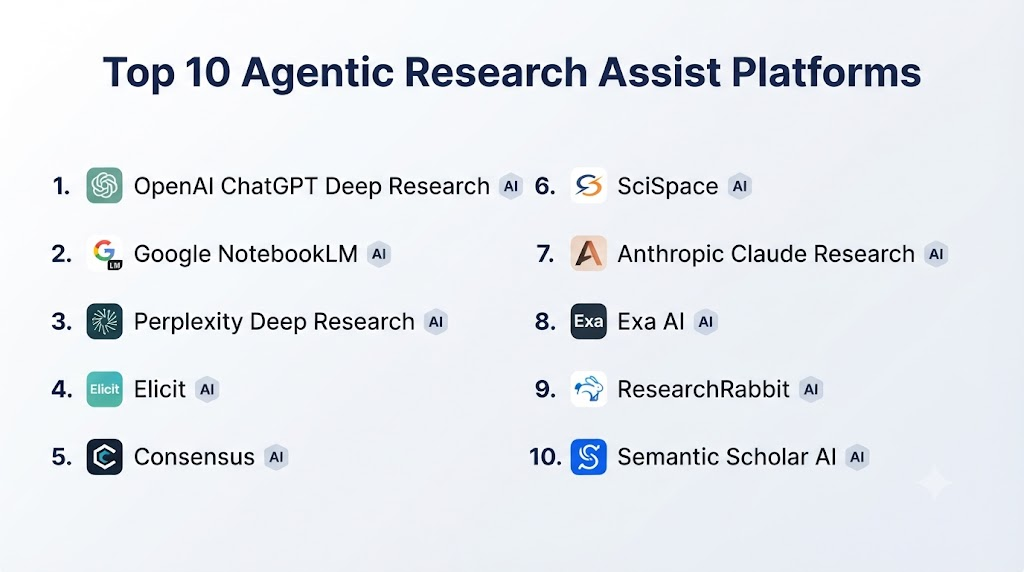
Top 10 Agentic Research Assist Platforms
1. Perplexity Enterprise
Perplexity provides AI-powered research capabilities with source-based answers and information discovery.
Key Features
- AI research assistant
- Source citations
- Web research
- Document analysis
- Enterprise knowledge search
- Report generation
- Collaboration
- Research history
- Data privacy controls
- Team management
Pros
- Strong research experience
- Source references
- Fast information discovery
- Easy usability
- Enterprise options
Cons
- Web dependency
- Source quality varies
- Advanced workflows require customization
Platforms
Cloud environments.
Deployment or Support
Research and enterprise knowledge workflows.
Security & Compliance
Enterprise security options.
Integrations & Ecosystem
Web and enterprise data sources.
Support & Community
User community.
2. ChatGPT Deep Research
ChatGPT Deep Research provides AI-powered investigation and analysis capabilities.
Key Features
- Autonomous research
- Multi-step analysis
- Document understanding
- Report generation
- Data analysis
- Knowledge synthesis
- Reasoning workflows
- Research assistance
- File analysis
- User collaboration
Pros
- Strong reasoning ability
- Flexible research workflows
- Broad capabilities
- Easy adoption
- Strong AI ecosystem
Cons
- Requires careful verification
- Usage limits may apply
- Output quality depends on prompts
Platforms
Cloud environments.
Deployment or Support
Professional and enterprise research.
Security & Compliance
Platform security controls.
Integrations & Ecosystem
AI tools and data sources.
Support & Community
Large user community.
3. Google Gemini Deep Research
Google Gemini provides AI research assistance with access to information and analysis capabilities.
Key Features
- Research automation
- Document analysis
- Information synthesis
- Google ecosystem integration
- Report creation
- Knowledge discovery
- Data analysis
- Enterprise support
- AI assistance
- Collaboration
Pros
- Strong information ecosystem
- Google integration
- Good analysis capabilities
- Enterprise support
- Flexible
Cons
- Google ecosystem dependency
- Requires verification
- Feature availability varies
Platforms
Cloud environments.
Deployment or Support
Business and research workflows.
Security & Compliance
Google security framework.
Integrations & Ecosystem
Google services.
Support & Community
Large community.
4. Microsoft Copilot Researcher
Microsoft Copilot provides AI-assisted research capabilities for enterprise users.
Key Features
- Research assistance
- Microsoft 365 integration
- Document analysis
- Enterprise search
- Report generation
- Knowledge access
- Data analysis
- Collaboration
- Security controls
- Workflow integration
Pros
- Enterprise integration
- Strong productivity features
- Secure environment
- Business-focused
- Easy adoption
Cons
- Microsoft ecosystem dependency
- Licensing complexity
- Enterprise setup required
Platforms
Cloud environments.
Deployment or Support
Enterprise research.
Security & Compliance
Microsoft security framework.
Integrations & Ecosystem
Microsoft applications.
Support & Community
Enterprise support.
5. Claude Research
Claude provides AI research and analysis capabilities focused on long-form reasoning.
Key Features
- Document analysis
- Research assistance
- Long-context understanding
- Summarization
- Knowledge synthesis
- Report creation
- Data interpretation
- Enterprise features
- Collaboration
- AI reasoning
Pros
- Strong long-document analysis
- Good reasoning
- Clear writing
- Useful for research
- Enterprise options
Cons
- Limited external data access
- Requires verification
- Feature availability varies
Platforms
Cloud environments.
Deployment or Support
Research and business analysis.
Security & Compliance
Enterprise controls.
Integrations & Ecosystem
AI applications.
Support & Community
Developer community.
6. Elicit
Elicit supports academic research and literature analysis.
Key Features
- Research paper discovery
- Literature review
- Paper summaries
- Academic analysis
- Evidence extraction
- Research organization
- Data tables
- AI assistance
- Search workflows
- Collaboration
Pros
- Strong academic focus
- Useful literature workflows
- Research-friendly
- Structured analysis
- Easy usage
Cons
- Academic focus
- Limited business workflows
- Research scope limitations
Platforms
Cloud environments.
Deployment or Support
Academic research.
Security & Compliance
Platform controls.
Integrations & Ecosystem
Research databases.
Support & Community
Research community.
7. Consensus
Consensus provides AI-assisted academic research based on scientific literature.
Key Features
- Scientific search
- Research summaries
- Evidence analysis
- Paper discovery
- Literature insights
- Academic workflows
- Knowledge extraction
- Research support
- Search tools
- Collaboration
Pros
- Science-focused
- Evidence-based research
- Easy discovery
- Academic usefulness
- Structured outputs
Cons
- Limited general research
- Academic focus
- Requires source review
Platforms
Cloud environments.
Deployment or Support
Scientific research.
Security & Compliance
Platform controls.
Integrations & Ecosystem
Research sources.
Support & Community
Academic users.
8. You.com Research Agent
You.com provides AI research and search capabilities.
Key Features
- AI search
- Research assistance
- Information synthesis
- Source discovery
- Summaries
- AI agents
- Productivity tools
- Custom workflows
- Knowledge exploration
- Collaboration
Pros
- Flexible search
- AI-powered research
- Easy access
- Multiple AI tools
- User-friendly
Cons
- Source verification required
- Feature changes
- Less enterprise depth
Platforms
Cloud environments.
Deployment or Support
Research workflows.
Security & Compliance
Platform controls.
Integrations & Ecosystem
Web sources.
Support & Community
User community.
9. NotebookLM
NotebookLM provides AI-powered document research and knowledge assistance.
Key Features
- Document analysis
- Knowledge organization
- Source-based answers
- Summaries
- Research notes
- File understanding
- Study assistance
- Collaboration
- AI insights
- Content generation
Pros
- Excellent document analysis
- Source-focused
- Easy organization
- Useful for knowledge work
- Simple workflow
Cons
- Document-focused
- Limited autonomous workflows
- Requires source materials
Platforms
Cloud environments.
Deployment or Support
Research and knowledge management.
Security & Compliance
Platform security.
Integrations & Ecosystem
Document sources.
Support & Community
User community.
10. Glean AI Research Assistant
Glean provides enterprise AI search and knowledge assistance.
Key Features
- Enterprise search
- Knowledge discovery
- Document analysis
- Workplace data access
- AI answers
- Collaboration
- Security controls
- Data integration
- Employee assistance
- Knowledge management
Pros
- Strong enterprise search
- Good security
- Workplace integration
- Knowledge management
- Scalable
Cons
- Enterprise pricing
- Requires setup
- Focused on internal data
Platforms
Cloud environments.
Deployment or Support
Enterprise knowledge management.
Security & Compliance
Enterprise security.
Integrations & Ecosystem
Enterprise applications.
Support & Community
Enterprise support.
Comparison Table
| Tool Name | Best For | Platform(s) Supported | Deployment | Standout Feature | Public Rating |
|---|---|---|---|---|---|
| Perplexity Enterprise | Web research | Cloud | Enterprise | Source-based answers | |
| ChatGPT Deep Research | General research | Cloud | Flexible | Multi-step reasoning | |
| Gemini Deep Research | Google users | Cloud | Enterprise | Google ecosystem | |
| Copilot Researcher | Enterprise research | Cloud | Enterprise | Microsoft integration | |
| Claude Research | Long analysis | Cloud | Business | Long context | |
| Elicit | Academic research | Cloud | Research | Literature review | |
| Consensus | Scientific research | Cloud | Research | Evidence discovery | |
| You.com | AI search | Cloud | Flexible | Research search | |
| NotebookLM | Document research | Cloud | Personal/Business | Source analysis | |
| Glean AI | Enterprise knowledge | Cloud | Enterprise | Internal search |
Weighted Evaluation
| Tool Name | Core Features 25% | Ease of Use 15% | Integrations & Ecosystem 15% | Security & Compliance 10% | Performance & Reliability 10% | Support & Community 10% | Price/Value 15% | Total |
|---|---|---|---|---|---|---|---|---|
| Perplexity Enterprise | 24 | 15 | 14 | 10 | 10 | 10 | 14 | 97 |
| ChatGPT Deep Research | 25 | 15 | 15 | 10 | 10 | 10 | 14 | 99 |
| Gemini Deep Research | 24 | 14 | 15 | 10 | 10 | 10 | 13 | 96 |
| Copilot Researcher | 24 | 14 | 15 | 10 | 10 | 10 | 13 | 96 |
| Claude Research | 24 | 15 | 14 | 10 | 10 | 10 | 14 | 97 |
| Elicit | 22 | 15 | 13 | 10 | 10 | 10 | 15 | 95 |
| Consensus | 22 | 15 | 13 | 10 | 10 | 10 | 15 | 95 |
| You.com Research | 22 | 15 | 13 | 10 | 10 | 10 | 14 | 94 |
| NotebookLM | 23 | 15 | 14 | 10 | 10 | 10 | 15 | 97 |
| Glean AI | 24 | 13 | 15 | 10 | 10 | 10 | 12 | 94 |
Which Agentic Research Assist Platform Is Right for You?
Choose ChatGPT Deep Research for general AI-powered research.
Choose Perplexity Enterprise for source-driven research.
Choose Google Gemini Deep Research for Google ecosystem users.
Choose Microsoft Copilot Researcher for enterprise teams.
Choose Claude Research for long documents and analysis.
Choose Elicit for academic literature research.
Choose Consensus for scientific evidence research.
Choose You.com Research Agent for AI-powered search.
Choose NotebookLM for document-based research.
Choose Glean AI for enterprise knowledge discovery.
Implementation Playbook
Phase 1: Define Research Goals
- Identify research requirements
- Define expected outcomes
- Select information sources
Phase 2: Prepare Knowledge Sources
- Add documents
- Connect databases
- Organize information
Phase 3: Configure AI Research Agents
- Define tasks
- Set instructions
- Configure workflows
Phase 4: Validate Results
- Review sources
- Check accuracy
- Improve prompts
Phase 5: Scale Research Operations
- Create repeatable workflows
- Share knowledge
- Improve processes
Common Mistakes
- Trusting AI output without verification
- Using poor-quality sources
- Ignoring citations
- Not defining research goals
- Poor data organization
- Lack of human review
- Sharing sensitive information
FAQs
1. What are Agentic Research Assist Platforms?
They are AI platforms that automate research, analysis, and knowledge discovery.
2. How are they different from search engines?
They can analyze information, reason, summarize, and create research outputs.
3. Who uses research assistant platforms?
Researchers, analysts, businesses, students, and professionals use them.
4. Can AI agents perform complete research tasks?
Yes, many can automate multi-step research workflows.
5. Can these platforms analyze documents?
Yes, many support PDFs, reports, and internal documents.
6. Are AI research results always accurate?
Users should verify important information and sources.
7. Can businesses use these platforms?
Yes, many provide enterprise security and collaboration features.
8. Do research agents support citations?
Many platforms provide source references and citations.
9. Can AI research agents replace researchers?
They support researchers by reducing manual work.
10. What is the future of AI research assistants?
AI agents will increasingly automate complex research and knowledge workflows.
Conclusion
Agentic Research Assist Platforms are transforming how individuals and organizations discover, analyze, and use information. By combining AI reasoning, automation, knowledge retrieval, and report generation, these platforms help users complete research faster and make better decisions.Solutions such as ChatGPT Deep Research, Perplexity Enterprise, Google Gemini Deep Research, Microsoft Copilot Researcher, Claude Research, and Glean AI are enabling a new generation of intelligent research workflows.As AI agents continue advancing, agentic research platforms will become essential tools for businesses, researchers, and professionals who need faster access to reliable knowledge.