Introduction
Agentic IT Operations Platforms are AI-powered systems that enable autonomous AI agents to monitor, analyze, troubleshoot, and optimize IT infrastructure with minimal human intervention.
Unlike traditional IT automation tools that execute predefined scripts, agentic IT operations platforms use artificial intelligence, machine learning, and autonomous agents to understand incidents, investigate problems, recommend solutions, and execute operational tasks.
These platforms act as intelligent digital IT assistants that can:
- Monitor infrastructure
- Detect incidents
- Analyze root causes
- Automate troubleshooting
- Resolve service issues
- Optimize resources
- Support IT teams
Modern enterprises use agentic IT operations platforms to improve reliability, reduce downtime, and manage increasingly complex technology environments.
These platforms help organizations:
- Automate IT operations
- Reduce manual troubleshooting
- Improve incident response
- Increase system availability
- Optimize cloud resources
- Enhance operational efficiency
Agentic IT Operations Platforms are used by:
- IT operations teams
- DevOps teams
- SRE teams
- Cloud engineering teams
- Platform engineering teams
- Enterprise technology teams
Modern platforms provide capabilities such as:
- AI incident management
- Autonomous remediation
- Infrastructure monitoring
- Root cause analysis
- Log analysis
- Workflow automation
- Cloud optimization
- Knowledge management
- IT service integration
- Operational analytics
The goal of Agentic IT Operations Platforms is to create intelligent IT environments where AI agents can proactively manage systems and support engineering teams.
What Are Agentic IT Operations Platforms?
Agentic IT Operations Platforms are AI-driven systems that allow autonomous agents to manage IT infrastructure, applications, and operational workflows.
These AI agents can:
- Observe system behavior
- Analyze problems
- Decide actions
- Execute fixes
- Learn from previous incidents
Example:
Problem:
“Application response time increased.”
AI agent actions:
- Analyze application metrics
- Check infrastructure health
- Identify bottleneck
- Restart affected service
- Notify engineers
- Document resolution
Why Enterprises Need Agentic IT Operations
Modern IT environments are becoming more complex due to:
- Cloud infrastructure
- Microservices
- Kubernetes
- Distributed applications
- Hybrid environments
Traditional monitoring creates challenges:
- Too many alerts
- Slow incident response
- Complex troubleshooting
- Limited engineering capacity
Agentic IT operations helps teams handle complexity through intelligent automation.
How Agentic IT Operations Platforms Work
Data Collection
AI agents collect information from:
- Logs
- Metrics
- Traces
- Events
- Cloud resources
- Applications
Problem Detection
Agents identify:
- Failures
- Performance issues
- Security risks
- Resource problems
Investigation
AI agents analyze:
- System dependencies
- Historical incidents
- Configuration changes
Decision Making
The agent determines:
- Possible causes
- Required actions
- Escalation needs
Automated Remediation
Agents execute actions:
- Restart services
- Adjust resources
- Apply fixes
- Create tickets
Continuous Learning
Systems improve through:
- Incident history
- Feedback
- Operational data
Key Components of Agentic IT Operations Platforms
AI Operations Agents
Perform:
- Monitoring
- Analysis
- Decision-making
- Remediation
Observability Integration
Connects with:
- Metrics
- Logs
- Traces
- Monitoring systems
Incident Management
Automates:
- Detection
- Prioritization
- Resolution workflows
Knowledge Management
Uses:
- Documentation
- Runbooks
- Previous incidents
Automation Engine
Executes:
- Scripts
- Workflows
- Infrastructure actions
Security Controls
Provides:
- Permissions
- Approval workflows
- Audit trails
Types of Agentic IT Operations Agents
Incident Response Agents
Handle:
- Alerts
- Troubleshooting
- Resolution
Cloud Optimization Agents
Manage:
- Cost optimization
- Resource allocation
- Scaling
Security Operations Agents
Support:
- Threat detection
- Investigation
- Response
DevOps Automation Agents
Assist with:
- Deployment
- CI/CD workflows
- Infrastructure tasks
SRE Agents
Help with:
- Reliability management
- Error analysis
- Performance improvement
Key Features of Agentic IT Operations Platforms
Autonomous Incident Management
AI agents can:
- Detect issues
- Analyze incidents
- Suggest fixes
Benefits:
- Faster response
- Reduced downtime
Root Cause Analysis
Identifies:
- System failures
- Dependency issues
- Configuration problems
Self-Healing Infrastructure
Automatically performs:
- Recovery actions
- Service restoration
- Resource adjustments
Predictive Operations
Uses AI to predict:
- Failures
- Capacity issues
- Performance problems
Workflow Automation
Automates:
- IT processes
- Approvals
- Escalations
Natural Language Operations
Allows engineers to interact using:
- Chat commands
- Questions
- Instructions
Common Use Cases
Cloud Infrastructure Management
AI agents optimize:
- Servers
- Containers
- Cloud resources
Incident Response
Automates:
- Alert investigation
- Troubleshooting
- Resolution
Application Monitoring
Tracks:
- Performance
- Availability
- Errors
Kubernetes Operations
Supports:
- Cluster monitoring
- Deployment issues
- Resource management
DevOps Automation
Helps with:
- CI/CD workflows
- Deployment operations
- Environment management
Enterprise IT Support
Automates:
- Employee requests
- Service workflows
- Issue resolution
Why Agentic IT Operations Platforms Matter
Faster Incident Resolution
AI agents reduce troubleshooting time.
Improved Reliability
Systems become more proactive.
Reduced Operational Costs
Automation reduces manual effort.
Better Engineering Productivity
Teams focus on strategic work.
24/7 IT Operations
AI agents continuously monitor systems.
Evaluation Criteria for Buyers
AI Capabilities
Evaluate:
- Reasoning
- Automation
- Decision-making
Observability Support
Look for:
- Metrics
- Logs
- Traces
- Monitoring integrations
Automation Features
Consider:
- Remediation workflows
- Runbook automation
- Tool execution
Integration Support
Important integrations:
- Cloud platforms
- Monitoring tools
- ITSM systems
Security Controls
Evaluate:
- Permissions
- Compliance
- Audit logging
Scalability
Consider:
- Infrastructure size
- Enterprise workloads
- Multi-cloud environments
Key Trends
Rise of AIOps Agents
AI agents are becoming central to IT operations.
Self-Healing Infrastructure
Organizations are moving toward autonomous recovery.
AI-Powered SRE
SRE teams are adopting intelligent assistants.
Cloud Complexity Management
AI helps manage hybrid and multi-cloud systems.
Autonomous DevOps
AI agents are supporting development and deployment.
Enterprise Automation
Organizations are building AI-driven IT operations centers.
Methodology
The following Agentic IT Operations Platforms were evaluated based on:
- AI automation capabilities
- Observability
- Incident management
- Integration ecosystem
- Security
- Scalability
- Enterprise readiness
- Workflow automation
- Reliability
- Value
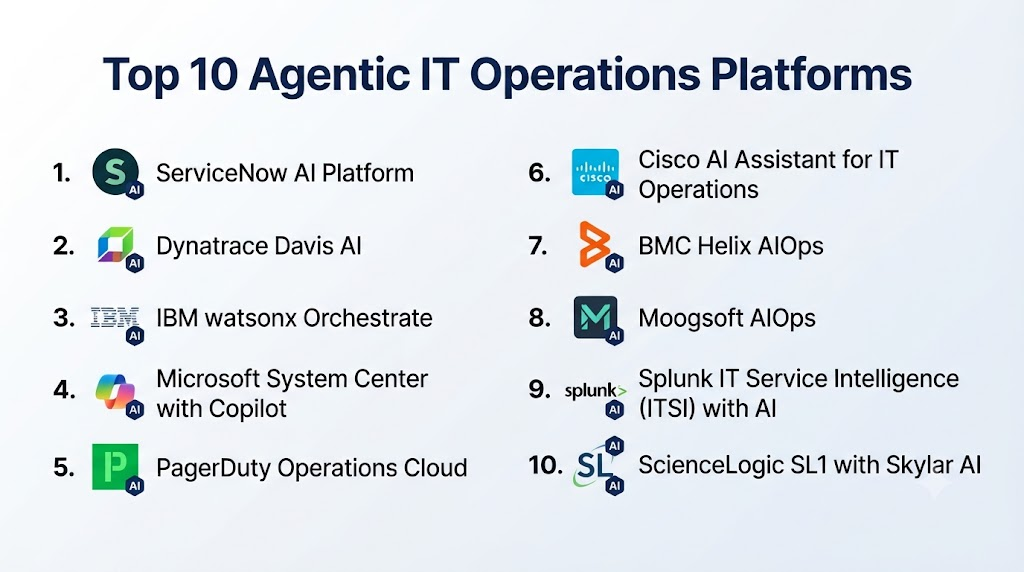
Top 10 Agentic IT Operations Platforms
1. ServiceNow AI Operations
ServiceNow AI Operations provides intelligent IT operations automation using AI and machine learning.
Key Features
- AI incident management
- Event correlation
- Root cause analysis
- Workflow automation
- ITSM integration
- Knowledge management
- Automated remediation
- Predictive analytics
- Operational dashboards
- Enterprise governance
Pros
- Strong ITSM integration
- Enterprise-ready
- Powerful workflows
- Good automation
- Scalable
Cons
- Complex deployment
- Enterprise pricing
- Requires platform expertise
Platforms
Cloud environments.
Deployment or Support
Enterprise IT operations.
Security & Compliance
Enterprise security controls.
Integrations & Ecosystem
ServiceNow ecosystem.
Support & Community
Enterprise support.
2. Dynatrace Davis AI
Dynatrace Davis AI provides AI-powered observability and automation.
Key Features
- AI root cause analysis
- Application monitoring
- Infrastructure monitoring
- Automated insights
- Performance analysis
- Dependency mapping
- Cloud monitoring
- Event intelligence
- Automation workflows
- Digital experience monitoring
Pros
- Strong observability
- Excellent AI analysis
- Enterprise scalability
- Deep monitoring
- Automation support
Cons
- Premium pricing
- Complex setup
- Requires expertise
Platforms
Cloud and enterprise environments.
Deployment or Support
Enterprise operations.
Security & Compliance
Enterprise controls.
Integrations & Ecosystem
Cloud platforms and applications.
Support & Community
Enterprise support.
3. Datadog AI Operations
Datadog provides AI-powered monitoring and operational intelligence.
Key Features
- Infrastructure monitoring
- Log analytics
- APM
- AI insights
- Incident analysis
- Security monitoring
- Dashboards
- Alerts
- Cloud monitoring
- Automation
Pros
- Complete observability platform
- Strong integrations
- Scalable
- Developer-friendly
- Enterprise-ready
Cons
- Cost can increase
- Complex configuration
- Large platform
Platforms
Cloud environments.
Deployment or Support
Enterprise monitoring.
Security & Compliance
Enterprise security.
Integrations & Ecosystem
Cloud and DevOps tools.
Support & Community
Large community.
4. Splunk AI Assistant
Splunk provides AI capabilities for IT monitoring and security operations.
Key Features
- Log analysis
- Incident investigation
- AI assistance
- Security monitoring
- Event correlation
- Operational analytics
- Search intelligence
- Automation
- Dashboards
- Enterprise monitoring
Pros
- Strong analytics
- Security integration
- Enterprise adoption
- Powerful search
- Large ecosystem
Cons
- Complex platform
- Expensive
- Requires expertise
Platforms
Cloud and enterprise environments.
Deployment or Support
Enterprise operations.
Security & Compliance
Enterprise security.
Integrations & Ecosystem
IT and security systems.
Support & Community
Enterprise support.
5. New Relic AI Monitoring
New Relic provides AI-powered observability and application monitoring.
Key Features
- Application monitoring
- Infrastructure monitoring
- AI insights
- Error analysis
- Performance tracking
- Distributed tracing
- Alerts
- Dashboards
- Cloud monitoring
- Developer tools
Pros
- Developer-friendly
- Strong observability
- Good analytics
- Easy adoption
- Scalable
Cons
- Cost considerations
- Requires configuration
- Limited autonomous remediation
Platforms
Cloud environments.
Deployment or Support
Application operations.
Security & Compliance
Enterprise controls.
Integrations & Ecosystem
DevOps tools.
Support & Community
Developer community.
6. BMC Helix AIOps
BMC Helix AIOps provides AI-driven IT operations management.
Key Features
- Event management
- Incident prediction
- Root cause analysis
- Automation
- ITSM integration
- Service monitoring
- Workflow management
- AI recommendations
- Analytics
- Enterprise support
Pros
- Strong IT operations focus
- Enterprise workflows
- Good automation
- Scalable
- ITSM capabilities
Cons
- Complex deployment
- Enterprise pricing
- Requires training
Platforms
Cloud environments.
Deployment or Support
Enterprise IT.
Security & Compliance
Enterprise security.
Integrations & Ecosystem
IT management systems.
Support & Community
Enterprise support.
7. IBM Watson AIOps
IBM Watson AIOps provides AI-based IT operations intelligence.
Key Features
- Event analysis
- Incident management
- Root cause analysis
- Automation
- Data correlation
- AI recommendations
- Workflow integration
- Operational analytics
- Enterprise governance
- Cloud support
Pros
- Strong enterprise AI
- Good analytics
- Governance features
- Enterprise support
- Automation
Cons
- Complex implementation
- Higher cost
- Requires expertise
Platforms
Cloud environments.
Deployment or Support
Enterprise operations.
Security & Compliance
Enterprise security.
Integrations & Ecosystem
IBM ecosystem.
Support & Community
Enterprise support.
8. PagerDuty Operations Cloud
PagerDuty provides AI-powered incident management and response automation.
Key Features
- Incident response
- Alert management
- AI recommendations
- Workflow automation
- On-call management
- Event intelligence
- Analytics
- Escalation workflows
- Collaboration tools
- Reliability management
Pros
- Strong incident management
- Easy adoption
- Good automation
- Developer-friendly
- Reliable
Cons
- Focused on incidents
- Limited infrastructure management
- Requires integrations
Platforms
Cloud environments.
Deployment or Support
IT operations.
Security & Compliance
Enterprise controls.
Integrations & Ecosystem
Monitoring and DevOps tools.
Support & Community
Developer community.
9. BigPanda AIOps
BigPanda provides AI-based event correlation and incident automation.
Key Features
- Event intelligence
- Alert correlation
- Incident automation
- Root cause analysis
- Workflow automation
- IT operations analytics
- Monitoring integration
- AI recommendations
- Collaboration
- Enterprise workflows
Pros
- Strong event management
- Good automation
- Enterprise-focused
- Reduces alert noise
- Scalable
Cons
- Requires setup
- Enterprise pricing
- Limited outside IT operations
Platforms
Cloud environments.
Deployment or Support
Enterprise IT operations.
Security & Compliance
Enterprise controls.
Integrations & Ecosystem
Monitoring tools.
Support & Community
Enterprise support.
10. Moogsoft AIOps
Moogsoft provides AI-powered incident management and operational intelligence.
Key Features
- Event correlation
- Noise reduction
- Incident detection
- AI analysis
- Collaboration
- Automation workflows
- Monitoring integration
- Operational insights
- Alert management
- IT operations support
Pros
- Strong AIOps capabilities
- Good event management
- Reduces alerts
- Automation support
- Enterprise focus
Cons
- Requires configuration
- Limited general automation
- Enterprise pricing
Platforms
Cloud environments.
Deployment or Support
Enterprise operations.
Security & Compliance
Enterprise controls.
Integrations & Ecosystem
Monitoring platforms.
Support & Community
Enterprise support.
Comparison Table
| Tool Name | Best For | Platform(s) Supported | Deployment | Standout Feature | Public Rating |
|---|---|---|---|---|---|
| ServiceNow AI Ops | IT workflows | Cloud | Enterprise | Automation | |
| Dynatrace Davis AI | Observability | Cloud | Enterprise | Root cause analysis | |
| Datadog AI Ops | Monitoring | Cloud | Enterprise | Full observability | |
| Splunk AI | Analytics | Cloud/Enterprise | Enterprise | Log intelligence | |
| New Relic AI | Application monitoring | Cloud | Enterprise | Developer experience | |
| BMC Helix AIOps | IT operations | Cloud | Enterprise | ITSM automation | |
| IBM Watson AIOps | Enterprise AI Ops | Cloud | Enterprise | AI analysis | |
| PagerDuty | Incident response | Cloud | Business | Incident automation | |
| BigPanda | Event intelligence | Cloud | Enterprise | Alert correlation | |
| Moogsoft | AIOps | Cloud | Enterprise | Noise reduction |
Weighted Evaluation
| Tool Name | Core Features 25% | Ease of Use 15% | Integrations & Ecosystem 15% | Security & Compliance 10% | Performance & Reliability 10% | Support & Community 10% | Price/Value 15% | Total |
|---|---|---|---|---|---|---|---|---|
| ServiceNow AI Ops | 25 | 12 | 15 | 10 | 10 | 10 | 12 | 94 |
| Dynatrace Davis AI | 25 | 13 | 15 | 10 | 10 | 10 | 12 | 95 |
| Datadog AI Ops | 25 | 14 | 15 | 10 | 10 | 10 | 13 | 97 |
| Splunk AI | 24 | 12 | 15 | 10 | 10 | 10 | 12 | 93 |
| New Relic AI | 24 | 14 | 14 | 10 | 10 | 10 | 13 | 95 |
| BMC Helix | 24 | 12 | 14 | 10 | 10 | 10 | 12 | 92 |
| IBM Watson AIOps | 24 | 11 | 14 | 10 | 10 | 10 | 12 | 91 |
| PagerDuty | 23 | 15 | 14 | 10 | 10 | 10 | 14 | 96 |
| BigPanda | 23 | 13 | 14 | 10 | 10 | 10 | 12 | 92 |
| Moogsoft | 23 | 13 | 14 | 10 | 10 | 10 | 12 | 92 |
Which Agentic IT Operations Platform Is Right for You?
Choose ServiceNow AI Operations for enterprise IT workflows.
Choose Dynatrace Davis AI for intelligent observability.
Choose Datadog AI Operations for full-stack monitoring.
Choose Splunk AI Assistant for analytics and security operations.
Choose New Relic AI for application monitoring.
Choose BMC Helix AIOps for IT service management.
Choose IBM Watson AIOps for enterprise AI operations.
Choose PagerDuty Operations Cloud for incident response.
Choose BigPanda AIOps for event intelligence.
Choose Moogsoft AIOps for alert management.
Implementation Playbook
Phase 1: Assess IT Operations
- Identify operational challenges
- Analyze incident patterns
- Define automation goals
Phase 2: Connect Data Sources
- Integrate monitoring tools
- Connect logs and metrics
- Configure workflows
Phase 3: Deploy AI Agents
- Enable monitoring
- Configure automation
- Set permissions
Phase 4: Test Automation
- Validate recommendations
- Review remediation actions
- Improve workflows
Phase 5: Optimize Operations
- Analyze performance
- Reduce incidents
- Expand automation
Common Mistakes
- Automating without proper permissions
- Ignoring monitoring quality
- Poor integration planning
- Lack of testing
- No human approval process
- Ignoring security requirements
- Not measuring improvements
FAQs
1. What are Agentic IT Operations Platforms?
They are AI-powered platforms that automate IT monitoring, troubleshooting, and operations.
2. How are they different from traditional AIOps?
Agentic IT operations platforms use autonomous AI agents that can make decisions and execute actions.
3. Who uses these platforms?
IT teams, DevOps engineers, SRE teams, and enterprises use them.
4. Can AI agents fix IT problems automatically?
Yes, many platforms support automated remediation.
5. What systems do these platforms monitor?
They monitor applications, infrastructure, cloud services, and networks.
6. Are human engineers still needed?
Yes, humans manage complex decisions and governance.
7. Can these platforms work with cloud environments?
Yes, many support multi-cloud and hybrid environments.
8. How do companies measure success?
Through reduced downtime, faster resolution, and improved reliability.
9. Are agentic IT operations secure?
Security depends on permissions, monitoring, and governance controls.
10. What is the future of agentic IT operations?
AI-driven self-healing and autonomous infrastructure management will become increasingly common.
Conclusion
Agentic IT Operations Platforms are transforming how organizations manage modern technology environments. By combining AI agents, observability, automation, and intelligent decision-making, these platforms help businesses create more reliable and efficient IT operations.Solutions such as Datadog AI Operations, Dynatrace Davis AI, ServiceNow AI Operations, PagerDuty, Splunk AI, and New Relic AI are enabling organizations to move from reactive troubleshooting toward proactive and autonomous IT management.As infrastructure complexity continues to grow, agentic IT operations will become a critical foundation for modern enterprise technology.