Introduction
Agentic Customer Support Platforms are AI-powered customer service systems that use autonomous AI agents to understand customer requests, analyze information, perform actions, and resolve issues with minimal human involvement.
Unlike traditional chatbots that follow predefined scripts, agentic customer support platforms can reason through customer problems, access business systems, use tools, retrieve knowledge, and complete multi-step tasks.
These platforms enable AI customer support agents to:
- Understand customer intent
- Answer complex questions
- Search knowledge bases
- Process requests
- Update customer records
- Create support tickets
- Recommend solutions
- Escalate issues when required
Modern businesses are adopting agentic customer support platforms to improve customer experiences, reduce response times, and provide 24/7 intelligent assistance.
These platforms help organizations:
- Automate customer conversations
- Reduce support workload
- Improve resolution speed
- Increase customer satisfaction
- Provide personalized assistance
- Scale support operations
Agentic Customer Support Platforms are used by:
- SaaS companies
- E-commerce businesses
- Financial organizations
- Healthcare providers
- Telecom companies
- Enterprise support teams
Modern platforms provide capabilities such as:
- AI customer agents
- Natural language understanding
- Knowledge retrieval
- CRM integration
- Ticket automation
- Workflow execution
- Human handoff
- Analytics
- Conversation monitoring
- Customer sentiment analysis
The goal of Agentic Customer Support Platforms is to create intelligent support systems that can solve customer problems efficiently while maintaining accuracy, security, and human oversight.
What Are Agentic Customer Support Platforms?
Agentic Customer Support Platforms are AI systems that act as autonomous customer service representatives.
They can:
- Understand customer requests
- Decide the next action
- Access company information
- Execute workflows
- Provide solutions
Example:
Customer:
“I want to change my subscription plan.”
AI agent:
- Identifies customer account
- Checks available plans
- Explains options
- Updates subscription
- Confirms completion
Why Businesses Need Agentic Customer Support
Customer expectations are changing. Users want:
- Faster responses
- Personalized solutions
- 24/7 availability
- Accurate information
Traditional support systems struggle with:
- High ticket volume
- Repetitive questions
- Slow response times
- Increasing operational costs
Agentic platforms solve these challenges through intelligent automation.
How Agentic Customer Support Platforms Work
Customer Request Understanding
The AI agent analyzes:
- Customer message
- Intent
- Context
- Previous interactions
Knowledge Retrieval
The agent accesses:
- Documentation
- FAQs
- Product information
- Customer records
Decision Making
The agent determines:
- Best response
- Required action
- Need for escalation
Tool Execution
The agent connects with:
- CRM systems
- Billing platforms
- Order systems
- Ticketing tools
Response Delivery
The customer receives:
- Answer
- Solution
- Status update
Continuous Improvement
The system learns from:
- Feedback
- Conversations
- Performance data
Key Components of Agentic Customer Support Platforms
AI Customer Agents
Handle customer conversations autonomously.
Capabilities:
- Reasoning
- Planning
- Problem solving
Knowledge Management
Provides access to:
- Product information
- Policies
- Documentation
CRM Integration
Connects with:
- Customer profiles
- Purchase history
- Support records
Workflow Automation
Automates:
- Ticket creation
- Refund requests
- Account updates
Human Escalation
Transfers complex cases to human agents.
Analytics and Monitoring
Tracks:
- Resolution rate
- Customer satisfaction
- Agent performance
Types of Agentic Customer Support Agents
General Support Agents
Handle:
- Common questions
- Product information
- Basic troubleshooting
Sales Support Agents
Assist with:
- Product recommendations
- Lead qualification
- Customer engagement
Technical Support Agents
Handle:
- Troubleshooting
- Technical issues
- Documentation support
Billing Agents
Manage:
- Payments
- Invoices
- Subscription changes
Customer Success Agents
Support:
- Customer onboarding
- Product adoption
- Retention
Key Features of Agentic Customer Support Platforms
Autonomous Conversation Handling
AI agents manage conversations independently.
Benefits:
- Faster responses
- Reduced workload
Omnichannel Support
Supports:
- Chat
- Messaging platforms
- Voice channels
Knowledge Grounding
Uses trusted business information.
Benefits:
- More accurate answers
- Reduced hallucination risk
Workflow Execution
Allows agents to perform actions.
Examples:
- Update accounts
- Process requests
- Create tickets
Sentiment Analysis
Detects:
- Customer emotions
- Satisfaction levels
- Urgency
Human-Agent Collaboration
Combines:
- AI automation
- Human expertise
Common Use Cases
E-commerce Customer Support
AI agents handle:
- Order tracking
- Returns
- Product questions
Banking Support
Agents assist with:
- Account information
- Transactions
- Customer queries
SaaS Support
Handles:
- Product issues
- Account management
- Technical questions
Healthcare Support
Supports:
- Appointment information
- Patient queries
- Service guidance
Telecom Support
Automates:
- Plan changes
- Troubleshooting
- Billing questions
Travel Support
Manages:
- Booking questions
- Changes
- Customer assistance
Why Agentic Customer Support Platforms Matter
24/7 Customer Availability
AI agents provide continuous support.
Faster Resolution
Customers receive immediate assistance.
Lower Support Costs
Businesses automate repetitive tasks.
Better Customer Experience
Personalized interactions improve satisfaction.
Scalable Operations
Support capacity grows without proportional hiring.
Evaluation Criteria for Buyers
AI Capabilities
Evaluate:
- Reasoning quality
- Language understanding
- Accuracy
Integration Support
Look for:
- CRM integrations
- Helpdesk tools
- Business applications
Automation Features
Consider:
- Workflow execution
- Task completion
- Ticket automation
Security
Evaluate:
- Data protection
- Access control
- Compliance
Analytics
Look for:
- Conversation insights
- Performance metrics
- Customer feedback
Scalability
Consider:
- Conversation volume
- Multiple channels
- Enterprise requirements
Key Trends
Rise of AI Customer Service Agents
Businesses are replacing basic chatbots with intelligent agents.
Autonomous Resolution
AI agents are solving more customer problems independently.
Voice AI Support
Customer support is expanding into AI-powered voice interactions.
Personalized Customer Experiences
Agents use customer history for better responses.
Human-AI Collaboration
Support teams are becoming AI-assisted.
Enterprise AI Governance
Companies are focusing on secure AI deployment.
Methodology
The following Agentic Customer Support Platforms were evaluated based on:
- AI agent capabilities
- Customer support features
- Automation
- Integrations
- Security
- Scalability
- Analytics
- Enterprise readiness
- User experience
- Value
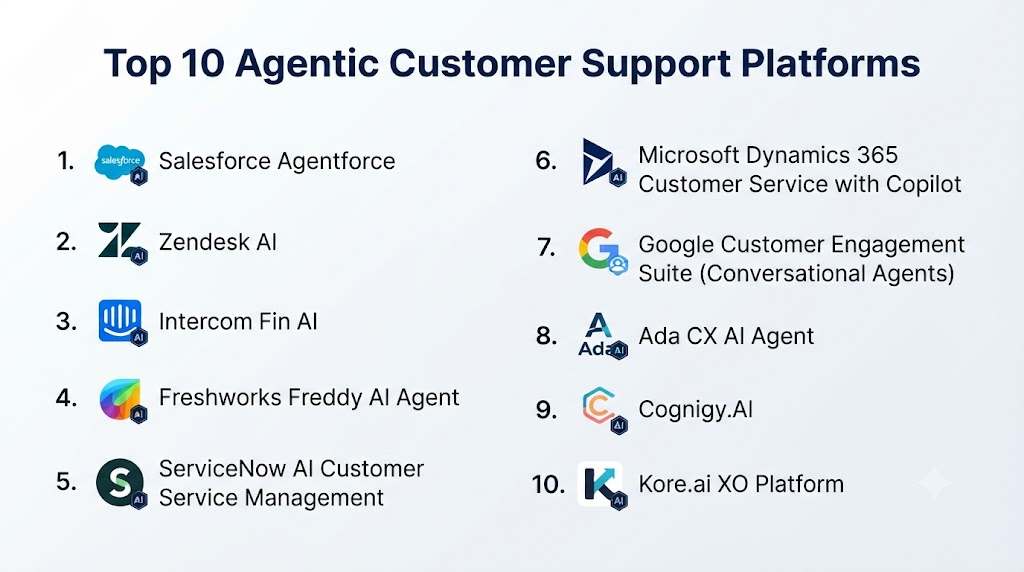
Top 10 Agentic Customer Support Platforms
- Salesforce Agentforce Service
- Zendesk AI Agents
- Intercom Fin AI Agent
- Microsoft Copilot Studio
- ServiceNow Customer Service Management AI
- Freshworks Freddy AI
- HubSpot AI Customer Agent
- Ada AI Customer Service
- Gorgias AI Agent
- Cognigy AI
1. Salesforce Agentforce Service
Salesforce Agentforce Service provides autonomous AI agents connected with customer relationship management workflows.
Key Features
- AI customer agents
- CRM integration
- Customer data access
- Automated workflows
- Case management
- Knowledge retrieval
- Personalization
- Analytics
- Human escalation
- Enterprise security
Pros
- Strong CRM capabilities
- Enterprise-ready
- Deep customer data integration
- Scalable
- Powerful automation
Cons
- Salesforce dependency
- Higher cost
- Requires CRM expertise
Platforms
Cloud environments.
Deployment or Support
Enterprise customer service.
Security & Compliance
Enterprise security controls.
Integrations & Ecosystem
Salesforce ecosystem.
Support & Community
Enterprise support.
2. Zendesk AI Agents
Zendesk provides AI-powered customer service automation.
Key Features
- AI support agents
- Ticket automation
- Knowledge management
- Customer conversations
- Workflow automation
- Analytics
- Omnichannel support
- Help center integration
- Agent assistance
- Reporting
Pros
- Strong helpdesk platform
- Easy adoption
- Good customer support features
- Large ecosystem
- Reliable
Cons
- Pricing complexity
- Advanced automation requires setup
- Limited customization
Platforms
Cloud environments.
Deployment or Support
Customer support teams.
Security & Compliance
Enterprise controls.
Integrations & Ecosystem
Business applications.
Support & Community
Large user community.
3. Intercom Fin AI Agent
Intercom Fin provides AI-powered customer support agents.
Key Features
- AI conversations
- Knowledge-based answers
- Customer messaging
- Automated resolution
- Support workflows
- Conversation analytics
- Human handoff
- Customer insights
- Multichannel support
- Team collaboration
Pros
- Excellent conversational experience
- Easy deployment
- Strong messaging features
- Good user experience
- Customer-focused
Cons
- SaaS dependency
- Pricing considerations
- Requires content preparation
Platforms
Cloud environments.
Deployment or Support
Customer service automation.
Security & Compliance
Platform security.
Integrations & Ecosystem
Business applications.
Support & Community
Customer community.
4. Microsoft Copilot Studio
Microsoft Copilot Studio enables businesses to create AI-powered customer service agents.
Key Features
- Custom AI agents
- Knowledge sources
- Workflow automation
- Microsoft integrations
- CRM connections
- Analytics
- Security controls
- Agent management
- Low-code development
- Enterprise governance
Pros
- Strong enterprise integration
- Secure platform
- Flexible development
- Microsoft ecosystem
- Scalable
Cons
- Microsoft dependency
- Licensing complexity
- Requires configuration
Platforms
Cloud environments.
Deployment or Support
Enterprise support.
Security & Compliance
Microsoft security framework.
Integrations & Ecosystem
Microsoft services.
Support & Community
Enterprise support.
5. ServiceNow Customer Service Management AI
ServiceNow provides AI-driven customer service automation.
Key Features
- Customer workflows
- AI agents
- Case management
- Knowledge management
- Automation
- Enterprise integrations
- Analytics
- Service workflows
- Governance
- Security
Pros
- Enterprise workflow strength
- Good automation
- Strong governance
- Scalable
- IT service integration
Cons
- Enterprise complexity
- Higher pricing
- Requires expertise
Platforms
Cloud environments.
Deployment or Support
Enterprise operations.
Security & Compliance
Enterprise security.
Integrations & Ecosystem
ServiceNow platform.
Support & Community
Enterprise support.
6. Freshworks Freddy AI
Freshworks Freddy AI provides AI-powered customer engagement solutions.
Key Features
- AI support agents
- Ticket automation
- Customer insights
- Knowledge search
- Workflow automation
- Chat support
- Analytics
- Customer engagement
- Helpdesk integration
- Automation tools
Pros
- Easy implementation
- Good helpdesk features
- Affordable
- User-friendly
- Business focused
Cons
- Less enterprise customization
- Limited advanced workflows
- SaaS dependency
Platforms
Cloud environments.
Deployment or Support
Business customer support.
Security & Compliance
Platform security.
Integrations & Ecosystem
Freshworks products.
Support & Community
User community.
7. HubSpot AI Customer Agent
HubSpot provides AI tools for customer engagement and support.
Key Features
- Customer conversations
- CRM integration
- Knowledge access
- Ticket management
- Sales support
- Marketing integration
- Analytics
- Automation workflows
- Customer insights
- AI assistance
Pros
- Strong CRM integration
- Easy adoption
- Marketing support
- Good usability
- Unified platform
Cons
- HubSpot ecosystem dependency
- Advanced features require plans
- Limited complex automation
Platforms
Cloud environments.
Deployment or Support
Business teams.
Security & Compliance
Platform security.
Integrations & Ecosystem
HubSpot ecosystem.
Support & Community
Large community.
8. Ada AI Customer Service
Ada provides AI customer service automation.
Key Features
- AI conversations
- Automated support
- Knowledge integration
- Multilingual support
- Workflow automation
- Analytics
- Customer personalization
- Agent escalation
- Business integrations
- Self-service
Pros
- Strong automation
- Good customer experience
- Multilingual support
- Easy deployment
- AI-focused
Cons
- Enterprise pricing
- Requires setup
- Limited developer flexibility
Platforms
Cloud environments.
Deployment or Support
Customer service automation.
Security & Compliance
Enterprise controls.
Integrations & Ecosystem
Business applications.
Support & Community
Enterprise support.
9. Gorgias AI Agent
Gorgias provides AI customer support solutions for e-commerce businesses.
Key Features
- E-commerce support
- AI responses
- Order management
- Customer conversations
- Ticket automation
- Store integrations
- Knowledge base
- Analytics
- Workflow automation
- Agent assistance
Pros
- Strong e-commerce focus
- Easy setup
- Good integrations
- Customer-friendly
- Automation features
Cons
- Limited enterprise use
- Industry-focused
- Smaller ecosystem
Platforms
Cloud environments.
Deployment or Support
E-commerce businesses.
Security & Compliance
Platform controls.
Integrations & Ecosystem
E-commerce platforms.
Support & Community
User community.
10. Cognigy AI
Cognigy provides enterprise conversational AI and automation solutions.
Key Features
- AI agents
- Voice automation
- Chat automation
- Workflow orchestration
- Enterprise integrations
- Knowledge management
- Analytics
- Multichannel support
- Agent assistance
- Security controls
Pros
- Enterprise-grade
- Strong conversational AI
- Omnichannel support
- Flexible workflows
- Scalable
Cons
- Complex setup
- Enterprise pricing
- Requires expertise
Platforms
Cloud and enterprise environments.
Deployment or Support
Enterprise customer operations.
Security & Compliance
Enterprise security.
Integrations & Ecosystem
Business systems and APIs.
Support & Community
Enterprise support.
Comparison Table
| Tool Name | Best For | Platform(s) Supported | Deployment | Standout Feature | Public Rating |
|---|---|---|---|---|---|
| Salesforce Agentforce | CRM support | Cloud | Enterprise | Customer data automation | |
| Zendesk AI | Helpdesk support | Cloud | Business | Ticket automation | |
| Intercom Fin | Messaging support | Cloud | Business | AI conversations | |
| Copilot Studio | Enterprise agents | Cloud | Enterprise | Custom agents | |
| ServiceNow CSM AI | Enterprise workflows | Cloud | Enterprise | Service automation | |
| Freshworks Freddy | SMB support | Cloud | Business | Easy deployment | |
| HubSpot AI Agent | CRM support | Cloud | Business | Customer insights | |
| Ada AI | Automated support | Cloud | Enterprise | AI self-service | |
| Gorgias AI | E-commerce support | Cloud | Business | Store automation | |
| Cognigy AI | Enterprise CX | Cloud | Enterprise | Omnichannel agents |
Weighted Evaluation
| Tool Name | Core Features 25% | Ease of Use 15% | Integrations & Ecosystem 15% | Security & Compliance 10% | Performance & Reliability 10% | Support & Community 10% | Price/Value 15% | Total |
|---|---|---|---|---|---|---|---|---|
| Salesforce Agentforce | 25 | 13 | 15 | 10 | 10 | 10 | 12 | 95 |
| Zendesk AI | 24 | 14 | 15 | 10 | 10 | 10 | 13 | 96 |
| Intercom Fin | 24 | 15 | 14 | 10 | 10 | 10 | 13 | 96 |
| Copilot Studio | 25 | 14 | 15 | 10 | 10 | 10 | 13 | 97 |
| ServiceNow CSM AI | 24 | 12 | 15 | 10 | 10 | 10 | 12 | 93 |
| Freshworks Freddy | 23 | 15 | 14 | 10 | 10 | 10 | 14 | 96 |
| HubSpot AI Agent | 23 | 15 | 15 | 10 | 10 | 10 | 13 | 96 |
| Ada AI | 23 | 14 | 14 | 10 | 10 | 10 | 13 | 94 |
| Gorgias AI | 22 | 15 | 14 | 10 | 10 | 10 | 14 | 95 |
| Cognigy AI | 24 | 12 | 14 | 10 | 10 | 10 | 12 | 92 |
Which Agentic Customer Support Platform Is Right for You?
Choose Salesforce Agentforce for CRM-powered support.
Choose Zendesk AI Agents for helpdesk automation.
Choose Intercom Fin for customer messaging.
Choose Microsoft Copilot Studio for enterprise AI agents.
Choose ServiceNow CSM AI for enterprise workflows.
Choose Freshworks Freddy AI for affordable automation.
Choose HubSpot AI Agent for CRM-based customer support.
Choose Ada AI for automated customer service.
Choose Gorgias AI Agent for e-commerce support.
Choose Cognigy AI for enterprise conversational AI.
Implementation Playbook
Phase 1: Identify Support Goals
- Analyze customer problems
- Define automation areas
- Select use cases
Phase 2: Prepare Knowledge Sources
- Organize documentation
- Connect business data
- Configure knowledge access
Phase 3: Build AI Agents
- Define behavior
- Connect tools
- Create workflows
Phase 4: Test and Deploy
- Evaluate responses
- Monitor performance
- Add human controls
Phase 5: Improve Continuously
- Analyze conversations
- Update knowledge
- Optimize workflows
Common Mistakes
- Deploying agents without testing
- Poor knowledge management
- Giving excessive permissions
- Ignoring customer feedback
- No human escalation strategy
- Limited monitoring
- Poor integration planning
FAQs
1. What are Agentic Customer Support Platforms?
They are AI systems that autonomously handle customer service tasks.
2. How are agentic support platforms different from chatbots?
They can reason, use tools, and complete actions instead of only answering questions.
3. Can AI agents resolve customer issues automatically?
Yes, many can handle complete workflows.
4. Are human agents still required?
Yes, for complex or sensitive situations.
5. What industries use AI customer support agents?
E-commerce, finance, healthcare, SaaS, telecom, and travel.
6. Can AI support agents access CRM data?
Yes, many platforms integrate with CRM systems.
7. Are AI support agents available 24/7?
Yes, they can provide continuous support.
8. How do businesses measure AI support performance?
Through resolution rate, accuracy, customer satisfaction, and response time.
9. Can AI agents support multiple languages?
Many platforms provide multilingual capabilities.
10. What is the future of agentic customer support?
AI agents will increasingly manage complete customer service workflows with human collaboration.
Conclusion
Agentic Customer Support Platforms are transforming customer service by combining artificial intelligence, automation, knowledge management, and enterprise integrations.Platforms such as Salesforce Agentforce, Zendesk AI, Intercom Fin, Microsoft Copilot Studio, ServiceNow AI, and Cognigy are helping organizations deliver faster and more personalized customer experiences.As AI agents become more advanced, agentic customer support will become a key component of modern business operations, enabling companies to provide intelligent, scalable, and efficient customer service.