Introduction
AI Model Marketplace Platforms are online ecosystems that allow developers, researchers, businesses, and organizations to discover, share, purchase, deploy, and manage artificial intelligence models.
As artificial intelligence adoption grows, organizations need faster ways to access high-quality AI models without building every model from scratch. Model marketplaces provide centralized platforms where users can find pre-trained models, foundation models, machine learning solutions, and specialized AI models for different use cases.
AI Model Marketplace Platforms help organizations:
- Discover ready-to-use AI models
- Reduce AI development time
- Deploy models faster
- Access specialized AI capabilities
- Compare different models
- Manage model versions
- Collaborate with AI communities
- Build AI-powered applications
These platforms are used by:
- Machine learning engineers
- AI researchers
- Data scientists
- Enterprise AI teams
- Software developers
- Startups
- Academic institutions
- AI solution providers
Modern AI model marketplaces provide access to:
- Large language models (LLMs)
- Computer vision models
- Speech models
- Generative AI models
- Recommendation models
- Healthcare AI models
- Industry-specific AI solutions
The goal of AI Model Marketplace Platforms is to simplify AI development by providing a trusted environment for finding and deploying machine learning models.
How AI Model Marketplace Platforms Work
Model Discovery
Users search for AI models based on:
- Model type
- Task requirements
- Performance metrics
- Framework compatibility
- License requirements
Examples:
- Text generation models
- Image recognition models
- Speech-to-text models
- Code generation models
Model Evaluation
Platforms provide information such as:
- Model performance
- Benchmark results
- Documentation
- Usage examples
- Community feedback
Model Deployment
Users can deploy models through:
- APIs
- Cloud services
- Local infrastructure
- Edge devices
- AI development platforms
Model Management
Marketplace platforms help manage:
- Model versions
- Updates
- Dependencies
- Documentation
- Usage tracking
Collaboration
Developers and researchers can:
- Share models
- Improve existing models
- Provide feedback
- Build AI communities
Types of AI Models Available in Marketplaces
Large Language Models
Used for:
- Chatbots
- Content generation
- Search systems
- AI assistants
Computer Vision Models
Used for:
- Image classification
- Object detection
- Medical imaging
- Video analysis
Speech AI Models
Used for:
- Speech recognition
- Voice assistants
- Audio processing
Generative AI Models
Used for:
- Image generation
- Text generation
- Video creation
Domain-Specific Models
Designed for:
- Healthcare
- Finance
- Legal
- Manufacturing
- Education
Common Use Cases
Enterprise AI Development
Companies use marketplaces to quickly integrate AI capabilities.
AI Application Building
Developers find models for:
- SaaS applications
- Mobile apps
- Automation tools
Research and Experimentation
Researchers compare models and test new AI approaches.
AI Prototyping
Startups use marketplaces to build solutions faster.
Custom AI Solutions
Organizations combine existing models with internal data.
Edge AI Deployment
Companies access optimized models for:
- Devices
- Sensors
- Embedded systems
Why AI Model Marketplace Platforms Matter
Faster AI Development
Organizations can use existing models instead of starting from zero.
Lower Development Costs
Pre-trained models reduce:
- Training expenses
- Infrastructure requirements
- Development time
Better Model Access
Teams can access advanced AI capabilities easily.
AI Innovation
Marketplaces encourage collaboration between:
- Researchers
- Developers
- Businesses
Simplified Deployment
Platforms make model integration easier.
Evaluation Criteria for Buyers
Model Variety
A strong marketplace should provide:
- Multiple AI categories
- Different model sizes
- Industry-specific solutions
Model Quality
Important factors include:
- Benchmark performance
- Accuracy
- Reliability
- Documentation
Deployment Options
Platforms should support:
- APIs
- Cloud deployment
- Local deployment
- Edge deployment
Security and Compliance
Organizations should evaluate:
- Model licensing
- Data privacy
- Security practices
- Access control
Developer Experience
Important features include:
- Documentation
- SDKs
- Examples
- APIs
Community Support
A strong ecosystem should provide:
- Reviews
- Discussions
- Model contributions
- Technical support
Key Trends
Growth of Foundation Model Marketplaces
Organizations are increasingly adopting ready-made AI models.
Open-Source AI Expansion
Open communities are contributing thousands of AI models.
Enterprise AI Adoption
Businesses are using marketplaces for faster AI implementation.
Specialized AI Models
Industry-focused models are becoming more popular.
AI Model Security
Organizations are focusing on:
- Model verification
- Licensing
- Responsible AI usage
Model Deployment Automation
Marketplaces are adding:
- One-click deployment
- API access
- Cloud integration
Methodology
The following AI Model Marketplace Platforms were evaluated based on:
- Model availability
- Deployment capabilities
- Developer experience
- Enterprise readiness
- Security features
- Community support
- Integration options
- Performance
- Scalability
- Value
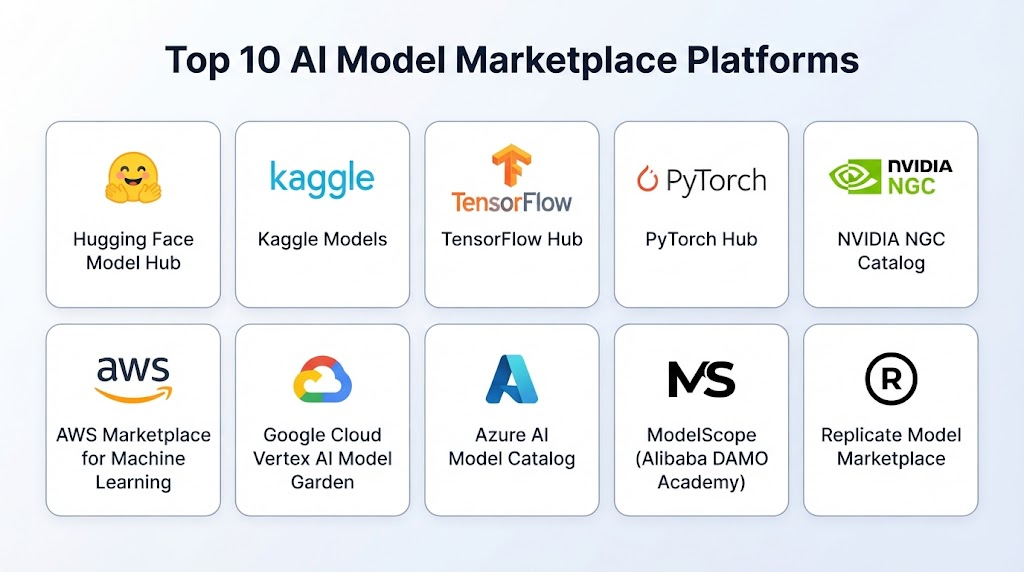
Top 10 AI Model Marketplace Platforms
1. Hugging Face Model Hub
Hugging Face Model Hub is one of the largest platforms for discovering and sharing machine learning models.
Key Features
- Large AI model repository
- LLM support
- Computer vision models
- NLP models
- Dataset integration
- Model versioning
- Community sharing
- Documentation support
- Model evaluation
- Deployment options
Pros
- Huge open-source ecosystem
- Supports thousands of models
- Strong developer community
- Easy model access
- Extensive documentation
Cons
- Quality varies between models
- Requires technical knowledge
- Security review responsibility
Platforms
Cloud and local environments.
Deployment or Support
Flexible deployment options.
Security & Compliance
Depends on individual model providers and usage.
Integrations & Ecosystem
Transformers, machine learning frameworks, cloud platforms, and AI applications.
Support & Community
Large AI developer community.
2. AWS Marketplace for Machine Learning
AWS Marketplace provides AI and machine learning solutions that integrate with AWS infrastructure.
Key Features
- Enterprise AI models
- Cloud deployment
- Vendor solutions
- Model management
- Security controls
- AWS integration
- API access
- Enterprise workflows
- Billing management
- Deployment automation
Pros
- Enterprise-ready
- Strong cloud integration
- Security capabilities
- Scalable infrastructure
- Vendor ecosystem
Cons
- AWS dependency
- Cloud complexity
- Higher learning curve
Platforms
AWS cloud environment.
Deployment or Support
Enterprise cloud deployment.
Security & Compliance
Strong AWS security framework.
Integrations & Ecosystem
AWS services and enterprise applications.
Support & Community
Enterprise support.
3. Google Vertex AI Model Garden
Google Vertex AI Model Garden provides access to Google’s and partner AI models.
Key Features
- Foundation models
- Generative AI models
- Model deployment
- Model evaluation
- Cloud integration
- AI pipelines
- Enterprise controls
- API access
- Model customization
- Monitoring tools
Pros
- Strong cloud ecosystem
- Enterprise capabilities
- Advanced AI models
- Good deployment support
- Integrated workflows
Cons
- Google Cloud dependency
- Requires cloud expertise
- Enterprise pricing
Platforms
Google Cloud.
Deployment or Support
Enterprise cloud deployment.
Security & Compliance
Enterprise security controls.
Integrations & Ecosystem
Google Cloud AI services and enterprise systems.
Support & Community
Enterprise support.
4. NVIDIA NGC Catalog
NVIDIA NGC provides optimized AI models, software containers, and resources.
Key Features
- AI model repository
- GPU-optimized models
- Deep learning resources
- Containers
- Performance optimization
- Enterprise AI workflows
- Model deployment
- Framework support
- Documentation
- Hardware optimization
Pros
- Excellent GPU optimization
- Enterprise-ready
- High-performance models
- Strong AI ecosystem
- Production support
Cons
- NVIDIA-focused
- Requires GPU knowledge
- Infrastructure requirements
Platforms
Cloud and GPU environments.
Deployment or Support
Enterprise deployment.
Security & Compliance
Enterprise security support.
Integrations & Ecosystem
NVIDIA hardware, AI frameworks, and cloud platforms.
Support & Community
Enterprise support.
5. Azure AI Model Catalog
Azure AI Model Catalog provides access to AI models through Microsoft’s cloud ecosystem.
Key Features
- Foundation models
- Open-source models
- Enterprise deployment
- Model evaluation
- AI governance
- Security controls
- API integration
- Monitoring
- Customization options
- Cloud workflows
Pros
- Enterprise-ready
- Strong security
- Microsoft ecosystem
- Scalable deployment
- Governance support
Cons
- Azure dependency
- Complex setup
- Cloud-focused
Platforms
Microsoft Azure.
Deployment or Support
Enterprise cloud deployment.
Security & Compliance
Strong enterprise security.
Integrations & Ecosystem
Microsoft services and enterprise applications.
Support & Community
Enterprise support.
6. Kaggle Models
Kaggle provides a community platform for sharing machine learning models and resources.
Key Features
- Model sharing
- Community projects
- Dataset integration
- Notebook support
- Experiment workflows
- Research collaboration
- AI competitions
- Model discovery
- Learning resources
- Open-source contributions
Pros
- Strong community
- Learning-friendly
- Free resources
- Research collaboration
- Easy experimentation
Cons
- Limited enterprise features
- Model quality varies
- Deployment options limited
Platforms
Cloud environments.
Deployment or Support
Research and experimentation.
Security & Compliance
Depends on user contributions.
Integrations & Ecosystem
Datasets, notebooks, and ML frameworks.
Support & Community
Large data science community.
7. TensorFlow Hub
TensorFlow Hub provides reusable machine learning models for TensorFlow applications.
Key Features
- Pre-trained models
- Computer vision models
- NLP models
- Transfer learning support
- Model sharing
- TensorFlow integration
- Documentation
- Deployment support
- Research resources
- Developer tools
Pros
- Strong TensorFlow support
- Reliable models
- Easy integration
- Good documentation
- Research adoption
Cons
- TensorFlow-focused
- Smaller ecosystem than some competitors
- Limited model diversity
Platforms
Cloud and local environments.
Deployment or Support
Flexible deployment.
Security & Compliance
Depends on model usage.
Integrations & Ecosystem
TensorFlow ecosystem and AI applications.
Support & Community
Developer community.
8. PyTorch Hub
PyTorch Hub provides access to pre-trained PyTorch models.
Key Features
- Pre-trained models
- Deep learning support
- Computer vision models
- Research models
- Easy loading
- Model sharing
- Developer workflows
- Experimentation tools
- Documentation
- Community resources
Pros
- Strong research adoption
- Easy model loading
- Flexible framework
- Large community
- Good experimentation
Cons
- Requires PyTorch knowledge
- Model quality varies
- Limited enterprise management
Platforms
Cloud and local environments.
Deployment or Support
Flexible deployment.
Security & Compliance
Depends on model sources.
Integrations & Ecosystem
PyTorch ecosystem and AI frameworks.
Support & Community
Research community.
9. ModelScope
ModelScope is an AI model community and marketplace providing access to machine learning models.
Key Features
- AI model repository
- NLP models
- Vision models
- Multimodal models
- Model sharing
- Deployment tools
- Dataset support
- Research collaboration
- Model testing
- Community resources
Pros
- Large model collection
- Supports multiple AI tasks
- Open ecosystem
- Research-friendly
- Growing community
Cons
- Smaller global adoption
- Documentation varies
- Enterprise features developing
Platforms
Cloud and local environments.
Deployment or Support
Flexible deployment.
Security & Compliance
Depends on model providers.
Integrations & Ecosystem
AI frameworks and cloud environments.
Support & Community
Developer community.
10. Replicate
Replicate provides access to AI models through simple APIs.
Key Features
- Hosted AI models
- API deployment
- Generative AI models
- Image models
- Language models
- Easy integration
- Model execution
- Developer tools
- Scaling support
- Community models
Pros
- Simple API access
- Easy deployment
- Good developer experience
- Fast experimentation
- No infrastructure management
Cons
- Limited customization
- Depends on hosted infrastructure
- Usage costs vary
Platforms
Cloud environment.
Deployment or Support
Cloud deployment.
Security & Compliance
Depends on platform configuration.
Integrations & Ecosystem
AI applications and developer tools.
Support & Community
Developer community.
Comparison Table
| Tool Name | Best For | Platform(s) Supported | Deployment | Standout Feature | Public Rating |
|---|---|---|---|---|---|
| Hugging Face Model Hub | Open-source AI models | Cloud/Local | Flexible | Largest model ecosystem | |
| AWS Marketplace | Enterprise AI | AWS | Enterprise | Cloud deployment | |
| Vertex AI Model Garden | Cloud AI models | Google Cloud | Enterprise | Foundation models | |
| NVIDIA NGC | GPU AI workloads | NVIDIA Cloud | Enterprise | Optimized models | |
| Azure Model Catalog | Enterprise AI | Azure | Enterprise | Governance | |
| Kaggle Models | Community ML | Cloud | Research | Collaboration | |
| TensorFlow Hub | TensorFlow models | Cloud/Local | Flexible | TensorFlow integration | |
| PyTorch Hub | Research models | Cloud/Local | Flexible | PyTorch ecosystem | |
| ModelScope | AI community | Cloud/Local | Flexible | Model variety | |
| Replicate | API-based AI | Cloud | Cloud | Easy deployment |
Weighted Evaluation
| Tool Name | Core Features 25% | Ease of Use 15% | Integrations & Ecosystem 15% | Security & Compliance 10% | Performance & Reliability 10% | Support & Community 10% | Price/Value 15% | Total |
|---|---|---|---|---|---|---|---|---|
| Hugging Face Model Hub | 25 | 15 | 15 | 10 | 10 | 10 | 15 | 100 |
| AWS Marketplace | 24 | 12 | 15 | 10 | 10 | 10 | 12 | 93 |
| Vertex AI Model Garden | 24 | 12 | 15 | 10 | 10 | 10 | 12 | 93 |
| NVIDIA NGC | 24 | 12 | 14 | 10 | 10 | 10 | 11 | 91 |
| Azure Model Catalog | 24 | 12 | 15 | 10 | 10 | 10 | 12 | 93 |
| Kaggle Models | 22 | 15 | 13 | 9 | 10 | 10 | 15 | 94 |
| TensorFlow Hub | 23 | 14 | 14 | 10 | 10 | 10 | 14 | 95 |
| PyTorch Hub | 23 | 14 | 14 | 10 | 10 | 10 | 14 | 95 |
| ModelScope | 23 | 13 | 13 | 10 | 10 | 10 | 14 | 93 |
| Replicate | 22 | 15 | 14 | 10 | 10 | 10 | 14 | 95 |
Which AI Model Marketplace Platform Is Right for You?
Choose Hugging Face Model Hub for open-source AI models and research.
Choose AWS Marketplace for enterprise cloud AI deployment.
Choose Google Vertex AI Model Garden for Google Cloud AI solutions.
Choose NVIDIA NGC for GPU-optimized AI models.
Choose Azure AI Model Catalog for Microsoft enterprise environments.
Choose Kaggle Models for learning and community collaboration.
Choose TensorFlow Hub for TensorFlow applications.
Choose PyTorch Hub for research and PyTorch workflows.
Choose ModelScope for broad AI model discovery.
Choose Replicate for simple API-based model deployment.
Implementation Playbook
Phase 1: Define AI Requirements
- Identify business objectives
- Select AI tasks
- Determine model requirements
- Define deployment needs
Phase 2: Discover Models
- Search available models
- Compare performance
- Review documentation
- Check licensing
Phase 3: Test Models
- Run experiments
- Evaluate accuracy
- Measure performance
- Validate compatibility
Phase 4: Deploy Models
- Configure infrastructure
- Integrate APIs
- Monitor performance
- Manage versions
Phase 5: Maintain Models
- Update models
- Track improvements
- Monitor security
- Optimize usage
Common Mistakes
- Choosing models without testing
- Ignoring licensing requirements
- Not checking security risks
- Selecting models without documentation
- Ignoring deployment requirements
- Not monitoring model updates
- Using unsuitable models
- Skipping performance evaluation
FAQs
1. What are AI Model Marketplace Platforms?
AI Model Marketplace Platforms provide access to ready-made machine learning models for development and deployment.
2. Why use AI model marketplaces?
They reduce development time and provide access to advanced AI capabilities.
3. Who uses AI model marketplaces?
Developers, enterprises, researchers, and startups use them.
4. Can businesses deploy marketplace models commercially?
Yes, depending on licensing and platform policies.
5. What types of models are available?
Marketplaces provide LLMs, vision models, speech models, and specialized AI models.
6. Are marketplace models secure?
Security depends on the platform, provider, and model evaluation process.
7. Can users customize marketplace models?
Many models can be fine-tuned or adapted.
8. How do organizations select AI models?
They evaluate performance, cost, compatibility, and licensing.
9. Are AI marketplaces useful for startups?
Yes, they help startups build AI solutions faster.
10. What is the future of AI model marketplaces?
AI marketplaces will become central platforms for discovering, deploying, and managing AI models.
Conclusion
AI Model Marketplace Platforms are becoming essential ecosystems for accelerating artificial intelligence development. They provide organizations with access to thousands of models, reducing development time and making advanced AI capabilities easier to adopt.Platforms such as Hugging Face Model Hub, AWS Marketplace, Vertex AI Model Garden, NVIDIA NGC, Azure AI Model Catalog, TensorFlow Hub, PyTorch Hub, and Replicate help developers and enterprises build AI solutionsAs AI adoption continues growing, model marketplaces will play a major role in creating a more accessible, collaborative, and scalable AI ecosystem.