Introduction
LLM Routing & Model Gateway Platforms are AI infrastructure solutions that help organizations manage, optimize, and control access to multiple large language models (LLMs) through a unified interface.
As businesses adopt more AI models from different providers, managing multiple APIs, model versions, costs, performance requirements, and security policies becomes increasingly complex. LLM routing platforms solve this challenge by acting as an intelligent gateway between applications and AI models.
These platforms automatically route requests to the most suitable model based on factors such as:
- Cost
- Latency
- Accuracy
- Availability
- User requirements
- Security policies
- Task complexity
LLM Model Gateway Platforms help organizations:
- Connect multiple AI providers
- Optimize AI infrastructure costs
- Improve application reliability
- Manage API access
- Monitor model performance
- Apply security controls
- Scale AI applications efficiently
These platforms are used by:
- Enterprise AI teams
- Software developers
- Machine learning engineers
- Cloud architects
- AI application developers
- SaaS companies
- Data science teams
- Platform engineering teams
Modern LLM routing platforms provide capabilities such as:
- Intelligent model selection
- API management
- Request routing
- Load balancing
- Cost optimization
- Prompt management
- Usage monitoring
- Security controls
- Observability
- Model fallback strategies
The goal of LLM Routing & Model Gateway Platforms is to simplify AI operations by creating a centralized control layer for managing multiple AI models.
How LLM Routing & Model Gateway Platforms Work
Application Request
An AI application sends a request to the LLM gateway instead of directly connecting to individual model providers.
Examples:
- Chat applications
- AI assistants
- Enterprise automation tools
- Customer support systems
Request Analysis
The gateway analyzes the request based on:
- Prompt type
- User requirements
- Model availability
- Performance goals
- Cost limits
Intelligent Routing
The platform selects the best model based on routing rules.
Examples:
- Simple questions → smaller models
- Complex reasoning → advanced models
- Cost-sensitive requests → economical models
Model Execution
The selected LLM processes the request and returns the response.
Monitoring and Optimization
The gateway tracks:
- Latency
- Token usage
- Cost
- Quality
- Errors
- Model performance
Types of LLM Routing Strategies
Cost-Based Routing
Selects models based on pricing efficiency.
Benefits:
- Lower AI expenses
- Better budget control
Performance-Based Routing
Chooses models based on speed and quality.
Benefits:
- Improved user experience
- Faster responses
Task-Based Routing
Routes requests based on task complexity.
Examples:
- Summarization
- Coding
- Reasoning
- Translation
Load-Based Routing
Distributes traffic across available models.
Benefits:
- Better reliability
- Higher availability
Fallback Routing
Automatically switches models during failures.
Benefits:
- Improved uptime
- Reduced service interruption
Common Use Cases
Enterprise AI Applications
Organizations use gateways to manage multiple AI services.
Customer Support Systems
Routing platforms select suitable models for:
- Customer conversations
- Ticket automation
- Knowledge search
AI SaaS Products
Companies manage multiple model providers through one infrastructure layer.
Developer Platforms
Teams provide centralized AI access for internal applications.
Cost Optimization
Businesses reduce AI spending through smart routing.
High Availability Systems
Applications maintain reliability through model fallback.
Why LLM Routing & Model Gateway Platforms Matter
Multi-Model Management
Organizations can manage multiple AI providers from one place.
Cost Reduction
Smart routing reduces unnecessary usage of expensive models.
Better Performance
Applications receive faster and more reliable responses.
Improved Security
Gateways provide:
- Access control
- Monitoring
- Data protection
Easier AI Scaling
Teams can expand AI applications without managing multiple integrations.
Evaluation Criteria for Buyers
Model Provider Support
Platforms should support:
- OpenAI-compatible APIs
- Open-source models
- Cloud AI providers
- Custom models
Routing Capabilities
Important features include:
- Intelligent routing
- Fallback strategies
- Load balancing
- Cost optimization
Observability
Platforms should provide:
- Usage tracking
- Latency monitoring
- Cost reports
- Error analysis
Security
Important capabilities include:
- Authentication
- Authorization
- Data protection
- Governance controls
Developer Experience
Important features include:
- APIs
- SDKs
- Documentation
- Easy integration
Scalability
Organizations should evaluate:
- High request volume support
- Enterprise workloads
- Distributed deployment
Key Trends
Multi-Model AI Adoption
Companies are increasingly using multiple AI models instead of relying on a single provider.
AI Cost Optimization
Organizations are focusing on reducing LLM operating costs.
Enterprise AI Governance
Businesses need better control over AI usage.
Open-Source Model Growth
Routing platforms are supporting more open-source models.
AI Observability Expansion
Monitoring AI applications is becoming essential.
Hybrid AI Infrastructure
Companies are combining:
- Cloud models
- Private models
- Local models
Methodology
The following LLM Routing & Model Gateway Platforms were evaluated based on:
- Routing capabilities
- Model compatibility
- Performance optimization
- Security features
- Observability
- Scalability
- Developer experience
- Integration ecosystem
- Enterprise readiness
- Value
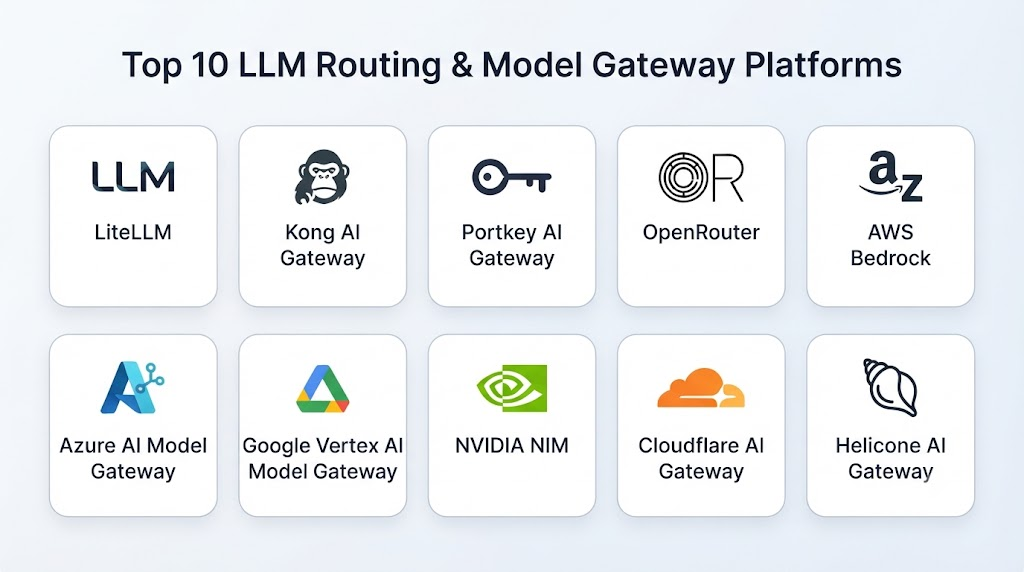
Top 10 LLM Routing & Model Gateway Platforms
1. LiteLLM
LiteLLM is an open-source LLM gateway that provides a unified interface for connecting applications with multiple AI providers.
Key Features
- Multi-provider support
- OpenAI-compatible API
- Model routing
- Cost tracking
- Load balancing
- Fallback handling
- Usage monitoring
- Proxy gateway
- Enterprise controls
- Developer APIs
Pros
- Open-source
- Supports many models
- Easy integration
- Flexible routing
- Strong developer adoption
Cons
- Requires technical setup
- Enterprise management needs configuration
- Infrastructure responsibility
Platforms
Cloud and self-hosted environments.
Deployment or Support
Flexible deployment.
Security & Compliance
Supports authentication and access controls.
Integrations & Ecosystem
AI providers, cloud platforms, and developer applications.
Support & Community
Large developer community.
2. Kong AI Gateway
Kong AI Gateway provides API management and security capabilities for AI applications.
Key Features
- API gateway management
- AI traffic routing
- Authentication
- Rate limiting
- Monitoring
- Security policies
- Model integration
- Traffic control
- Enterprise governance
- Developer tools
Pros
- Strong API management
- Enterprise security
- Reliable infrastructure
- Scalable architecture
- Good governance
Cons
- Requires API gateway expertise
- Enterprise-focused
- More complex setup
Platforms
Cloud and enterprise environments.
Deployment or Support
Enterprise deployment.
Security & Compliance
Strong security capabilities.
Integrations & Ecosystem
APIs, cloud systems, and enterprise applications.
Support & Community
Enterprise and developer support.
3. Portkey AI Gateway
Portkey provides infrastructure tools for managing LLM applications.
Key Features
- LLM routing
- API gateway
- Cost monitoring
- Prompt management
- Model fallback
- Observability
- Request tracking
- Performance monitoring
- Multiple provider support
- AI application controls
Pros
- AI-focused gateway
- Easy integration
- Good observability
- Multi-model support
- Developer-friendly
Cons
- Requires AI infrastructure knowledge
- Advanced features may need configuration
- Enterprise needs planning
Platforms
Cloud and enterprise environments.
Deployment or Support
Cloud deployment.
Security & Compliance
Provides AI governance features.
Integrations & Ecosystem
LLM providers, APIs, and AI applications.
Support & Community
Developer community.
4. OpenRouter
OpenRouter provides access to multiple AI models through a unified API.
Key Features
- Multiple model access
- Model comparison
- API routing
- Provider selection
- Cost visibility
- Model switching
- Developer integration
- Usage tracking
- AI application support
- Unified interface
Pros
- Easy multi-model access
- Simple API
- Large model selection
- Developer-friendly
- Flexible usage
Cons
- Less enterprise customization
- Depends on providers
- Governance features vary
Platforms
Cloud environment.
Deployment or Support
Cloud-based deployment.
Security & Compliance
Depends on provider configuration.
Integrations & Ecosystem
AI models and developer applications.
Support & Community
Developer community.
5. AWS Bedrock
AWS Bedrock provides managed access to multiple foundation models through a unified cloud platform.
Key Features
- Multiple foundation models
- Model management
- Enterprise security
- AI application integration
- Monitoring
- Governance
- Scalability
- API access
- Cloud integration
- Enterprise deployment
Pros
- Enterprise-ready
- Strong security
- Cloud scalability
- Multiple models
- AWS ecosystem
Cons
- AWS dependency
- Cloud complexity
- Higher learning curve
Platforms
AWS cloud environment.
Deployment or Support
Enterprise cloud deployment.
Security & Compliance
Strong enterprise security.
Integrations & Ecosystem
AWS services and enterprise applications.
Support & Community
Enterprise support.
6. Azure AI Model Gateway
Azure provides enterprise AI model management and routing capabilities.
Key Features
- Model access management
- AI routing
- Security controls
- Monitoring
- Enterprise integration
- API management
- Governance
- Scaling
- Application integration
- Cloud deployment
Pros
- Enterprise capabilities
- Strong security
- Microsoft ecosystem
- Scalable
- Good governance
Cons
- Azure dependency
- Complex configuration
- Enterprise-focused
Platforms
Azure cloud.
Deployment or Support
Enterprise deployment.
Security & Compliance
Strong security controls.
Integrations & Ecosystem
Microsoft cloud services and enterprise systems.
Support & Community
Enterprise support.
7. Google Vertex AI Model Gateway
Google Vertex AI provides AI model management and deployment capabilities.
Key Features
- Model access
- AI routing
- Model management
- Monitoring
- Enterprise deployment
- Security controls
- Cloud integration
- Evaluation tools
- AI workflows
- Developer APIs
Pros
- Strong cloud integration
- Enterprise scalability
- Google AI ecosystem
- Good monitoring
- Secure infrastructure
Cons
- Google Cloud dependency
- Requires expertise
- Complex enterprise setup
Platforms
Google Cloud.
Deployment or Support
Enterprise cloud deployment.
Security & Compliance
Enterprise security support.
Integrations & Ecosystem
Google Cloud AI services.
Support & Community
Enterprise support.
8. NVIDIA NIM
NVIDIA NIM provides optimized AI model deployment and inference infrastructure.
Key Features
- Model serving
- AI inference optimization
- Enterprise deployment
- GPU acceleration
- Model management
- API access
- Performance optimization
- Cloud deployment
- Security controls
- AI application support
Pros
- High performance
- GPU optimization
- Enterprise-ready
- Fast inference
- Strong AI infrastructure
Cons
- NVIDIA dependency
- Requires expertise
- Infrastructure costs
Platforms
Cloud and enterprise environments.
Deployment or Support
Enterprise deployment.
Security & Compliance
Enterprise security features.
Integrations & Ecosystem
NVIDIA ecosystem, GPUs, and AI applications.
Support & Community
Enterprise support.
9. Cloudflare AI Gateway
Cloudflare AI Gateway helps organizations manage and monitor AI API traffic.
Key Features
- AI request management
- Caching
- Analytics
- Monitoring
- Rate limiting
- Security controls
- Cost tracking
- API management
- Traffic optimization
- Developer tools
Pros
- Edge infrastructure
- Easy integration
- Performance optimization
- Security features
- Cost visibility
Cons
- Limited advanced routing
- Cloudflare dependency
- Requires platform knowledge
Platforms
Cloud environments.
Deployment or Support
Cloud deployment.
Security & Compliance
Strong network security.
Integrations & Ecosystem
AI providers, APIs, and Cloudflare services.
Support & Community
Developer community.
10. Helicone AI Gateway
Helicone provides observability and management tools for LLM applications.
Key Features
- LLM monitoring
- Request tracking
- Cost analytics
- Performance analysis
- Model comparison
- Logging
- AI application insights
- API management
- Developer tools
- Usage analytics
Pros
- Strong observability
- Easy integration
- Cost tracking
- Developer-friendly
- Good monitoring
Cons
- Less focused on routing
- Requires integration
- Advanced governance limited
Platforms
Cloud environments.
Deployment or Support
Cloud deployment.
Security & Compliance
Provides monitoring controls.
Integrations & Ecosystem
LLM APIs and AI applications.
Support & Community
Developer community.
Comparison Table
| Tool Name | Best For | Platform(s) Supported | Deployment | Standout Feature | Public Rating |
|---|---|---|---|---|---|
| LiteLLM | Multi-model routing | Cloud/Self-hosted | Flexible | Open-source gateway | |
| Kong AI Gateway | Enterprise API control | Cloud | Enterprise | API governance | |
| Portkey AI Gateway | LLM infrastructure | Cloud | Flexible | AI gateway features | |
| OpenRouter | Model access | Cloud | Cloud | Multiple models | |
| AWS Bedrock | Enterprise AI | AWS | Enterprise | Managed foundation models | |
| Azure AI Gateway | Enterprise AI | Azure | Enterprise | Microsoft ecosystem | |
| Vertex AI Gateway | Cloud AI | Google Cloud | Enterprise | Google AI services | |
| NVIDIA NIM | AI inference | Cloud | Enterprise | GPU optimization | |
| Cloudflare AI Gateway | AI traffic control | Cloud | Cloud | Edge optimization | |
| Helicone Gateway | LLM observability | Cloud | Cloud | Monitoring |
Weighted Evaluation
| Tool Name | Core Features 25% | Ease of Use 15% | Integrations & Ecosystem 15% | Security & Compliance 10% | Performance & Reliability 10% | Support & Community 10% | Price/Value 15% | Total |
|---|---|---|---|---|---|---|---|---|
| LiteLLM | 25 | 15 | 15 | 10 | 10 | 10 | 15 | 100 |
| Kong AI Gateway | 24 | 12 | 15 | 10 | 10 | 10 | 12 | 93 |
| Portkey AI Gateway | 24 | 14 | 14 | 10 | 10 | 10 | 14 | 96 |
| OpenRouter | 23 | 15 | 14 | 9 | 10 | 10 | 14 | 95 |
| AWS Bedrock | 25 | 12 | 15 | 10 | 10 | 10 | 12 | 94 |
| Azure Gateway | 24 | 12 | 15 | 10 | 10 | 10 | 12 | 93 |
| Vertex AI Gateway | 24 | 12 | 15 | 10 | 10 | 10 | 12 | 93 |
| NVIDIA NIM | 24 | 11 | 14 | 10 | 10 | 10 | 11 | 90 |
| Cloudflare AI Gateway | 23 | 14 | 14 | 10 | 10 | 10 | 14 | 95 |
| Helicone Gateway | 22 | 15 | 14 | 10 | 10 | 10 | 14 | 95 |
Which LLM Routing & Model Gateway Platform Is Right for You?
Choose LiteLLM for flexible open-source LLM routing.
Choose Kong AI Gateway for enterprise API governance.
Choose Portkey AI Gateway for AI infrastructure management.
Choose OpenRouter for easy access to multiple models.
Choose AWS Bedrock for enterprise cloud AI.
Choose Azure AI Gateway for Microsoft-based organizations.
Choose Vertex AI Gateway for Google Cloud environments.
Choose NVIDIA NIM for optimized AI inference.
Choose Cloudflare AI Gateway for edge AI traffic management.
Choose Helicone Gateway for LLM observability.
Implementation Playbook
Phase 1: Define AI Infrastructure Needs
- Identify supported models
- Analyze application requirements
- Define routing goals
- Establish security policies
Phase 2: Connect Model Providers
- Integrate AI APIs
- Configure authentication
- Add routing rules
- Setup monitoring
Phase 3: Optimize Routing
- Create cost rules
- Configure fallback models
- Monitor performance
- Improve response quality
Phase 4: Deploy Applications
- Connect applications
- Test reliability
- Monitor traffic
- Optimize usage
Phase 5: Continuous Improvement
- Analyze costs
- Review model performance
- Update routing policies
- Improve AI operations
Common Mistakes
- Using only one AI provider
- Ignoring cost optimization
- Poor routing rules
- Lack of monitoring
- Weak security controls
- No fallback strategy
- Ignoring latency requirements
- Not tracking model performance
FAQs
1. What are LLM Routing Platforms?
LLM Routing Platforms automatically select and manage AI models based on application requirements.
2. Why use an LLM gateway?
It simplifies managing multiple AI providers and improves reliability.
3. Can routing platforms reduce AI costs?
Yes. They can select lower-cost models when appropriate.
4. Can organizations use multiple LLM providers?
Yes. Gateways are designed for multi-model environments.
5. What is intelligent routing?
Intelligent routing selects the best model based on factors like cost, speed, and quality.
6. Are LLM gateways secure?
Many provide authentication, access control, and monitoring features.
7. Who uses LLM routing platforms?
Enterprises, SaaS companies, developers, and AI teams use them.
8. Can gateways improve AI reliability?
Yes. Fallback routing helps maintain availability.
9. How do companies choose an LLM gateway?
They evaluate routing features, security, integrations, and scalability.
10. What is the future of LLM gateways?
LLM gateways will become essential infrastructure as organizations adopt multiple AI models.
Conclusion
LLM Routing & Model Gateway Platforms are becoming critical components of modern AI infrastructure. They help organizations manage multiple AI models, reduce costs, improve reliability, and create scalable AI applications.Platforms such as LiteLLM, Portkey, Kong AI Gateway, OpenRouter, AWS Bedrock, Azure AI services, NVIDIA NIM, and Cloudflare AI Gateway provide powerful solutions for managing AI model operations.As enterprises continue adopting generative AI, intelligent routing and centralized model management will play an important role in building efficient, secure, and scalable AI ecosystems.