Introduction
Model Benchmarking Suites are artificial intelligence evaluation frameworks and platforms that help researchers, developers, and organizations measure the performance, accuracy, efficiency, safety, and reliability of AI models.
As AI models become increasingly complex, comparing different models has become challenging. Large language models, computer vision systems, speech models, and multimodal AI systems require standardized evaluation methods to understand their real-world capabilities.
Model Benchmarking Suites provide structured testing environments where AI systems can be evaluated using predefined datasets, metrics, and performance standards.
These platforms help organizations:
- Compare AI model performance
- Evaluate accuracy and reliability
- Measure reasoning capabilities
- Test safety and robustness
- Select suitable AI models
- Improve model development workflows
- Validate production readiness
Model Benchmarking Suites are used by:
- AI researchers
- Machine learning engineers
- Enterprise AI teams
- Data scientists
- Academic institutions
- AI product teams
- Model developers
- Technology organizations
Modern benchmarking platforms support evaluation of:
- Large language models (LLMs)
- Computer vision models
- Speech recognition models
- Multimodal models
- Generative AI systems
- Machine learning algorithms
The goal of model benchmarking suites is to provide transparent, repeatable, and reliable methods for measuring AI performance.
How Model Benchmarking Suites Work
Model Selection
The process begins by selecting AI models for evaluation.
Models may include:
- Foundation models
- Custom enterprise models
- Open-source models
- Research models
Benchmark Dataset Selection
Benchmark suites use standardized datasets designed to test specific capabilities.
Examples include:
- Reasoning
- Language understanding
- Coding
- Mathematics
- Vision tasks
- Safety evaluation
Evaluation Execution
The platform runs models against benchmark tasks.
The system measures:
- Accuracy
- Response quality
- Latency
- Resource usage
- Reliability
Performance Scoring
Results are calculated using predefined metrics.
Common metrics include:
- Accuracy scores
- F1 scores
- BLEU scores
- Human preference scores
- Task completion rates
Result Analysis
Organizations analyze benchmark results to:
- Compare models
- Identify weaknesses
- Select deployment options
- Improve AI systems
Types of AI Benchmarking
Language Model Benchmarking
Evaluates:
- Knowledge
- Reasoning
- Understanding
- Generation quality
Computer Vision Benchmarking
Measures:
- Image classification
- Object detection
- Segmentation accuracy
Speech Model Benchmarking
Tests:
- Speech recognition
- Audio understanding
- Voice generation
Multimodal Benchmarking
Evaluates models that process:
- Text
- Images
- Audio
- Video
Safety Benchmarking
Measures:
- Bias
- Toxicity
- Reliability
- Alignment
Common Use Cases
AI Model Selection
Organizations compare models before production deployment.
Research Evaluation
Researchers measure improvements between different AI approaches.
Enterprise AI Validation
Companies test models before integrating them into business workflows.
Generative AI Testing
Organizations evaluate:
- Chatbots
- AI assistants
- Content generation systems
AI Safety Testing
Teams identify:
- Model weaknesses
- Unsafe behavior
- Reliability issues
Continuous Model Monitoring
Organizations track performance after deployment.
Why Model Benchmarking Suites Matter
Better Decision Making
Benchmark results help organizations select suitable AI models.
Improved AI Quality
Testing identifies performance gaps.
Standardized Evaluation
Common benchmarks enable fair comparison.
Reduced Deployment Risks
Organizations can validate models before production use.
AI Transparency
Benchmarking improves understanding of model capabilities.
Evaluation Criteria for Buyers
Benchmark Coverage
Platforms should support:
- Multiple AI tasks
- Different model types
- Industry-specific evaluations
Metric Support
Important metrics include:
- Accuracy
- Performance
- Efficiency
- Safety
Model Compatibility
Platforms should support:
- Open-source models
- Commercial models
- Custom models
Automation
Important features include:
- Automated testing
- Reporting
- Evaluation pipelines
Scalability
Organizations should evaluate:
- Large model testing
- Distributed evaluation
- Enterprise workloads
Developer Experience
Platforms should provide:
- APIs
- Documentation
- Integration tools
Key Trends
LLM Evaluation Growth
Large language model benchmarking is becoming increasingly important.
AI Safety Evaluation
Organizations are focusing on responsible AI testing.
Automated Benchmarking
Platforms are reducing manual evaluation efforts.
Custom Enterprise Benchmarks
Companies are creating domain-specific evaluation systems.
Multimodal Testing
Benchmarking is expanding beyond text-based AI.
Continuous Evaluation
Organizations are monitoring AI performance throughout the model lifecycle.
Methodology
The following platforms were evaluated based on:
- Benchmark coverage
- Evaluation capabilities
- Model support
- Performance metrics
- Developer experience
- Community adoption
- Integration options
- Scalability
- Reliability
- Value
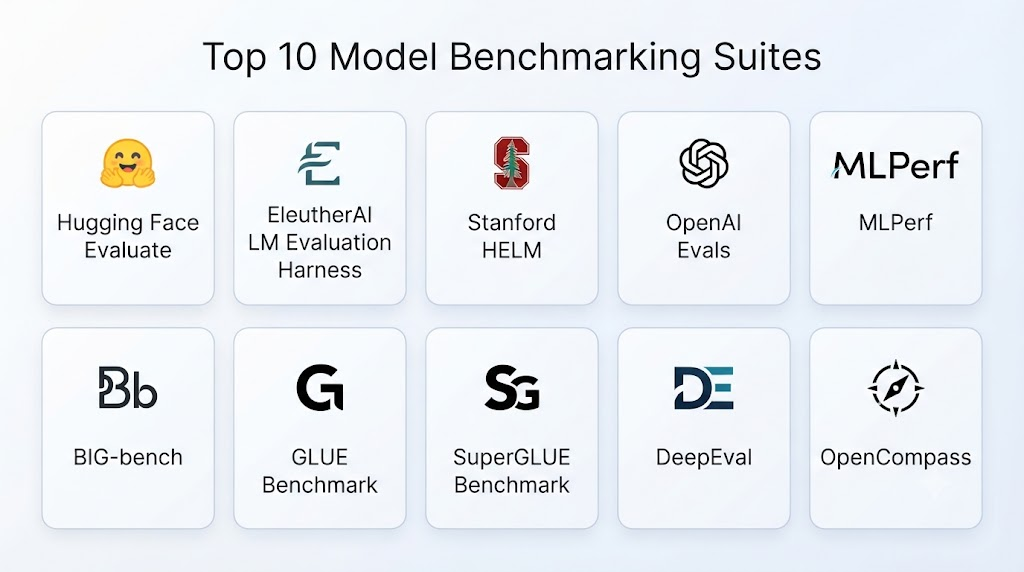
Top 10 Model Benchmarking Suites
1. Hugging Face Evaluate
Hugging Face Evaluate provides tools for measuring and comparing machine learning model performance.
Key Features
- Model evaluation
- NLP benchmarking
- Metric libraries
- Dataset integration
- Model comparison
- Custom metrics
- Evaluation workflows
- Open-source tools
- Community benchmarks
- AI research support
Pros
- Large AI ecosystem
- Easy integration
- Supports many models
- Strong community
- Open-source
Cons
- Requires technical knowledge
- Benchmark setup can vary
- Limited enterprise governance
Platforms
Cloud and local environments.
Deployment or Support
Flexible deployment.
Security & Compliance
Depends on implementation.
Integrations & Ecosystem
Hugging Face models, datasets, transformers, and AI frameworks.
Support & Community
Large AI developer community.
2. EleutherAI LM Evaluation Harness
EleutherAI LM Evaluation Harness is a popular open-source framework for evaluating language models.
Key Features
- LLM benchmarking
- Multiple evaluation tasks
- Standard datasets
- Model comparison
- Custom benchmarks
- Research workflows
- Automated testing
- Metric reporting
- Open-source framework
- Community contributions
Pros
- Widely adopted
- Strong LLM support
- Research-friendly
- Flexible benchmarking
- Large community
Cons
- Requires technical expertise
- Mostly focused on language models
- Manual configuration needed
Platforms
Cloud and local environments.
Deployment or Support
Research and development deployment.
Security & Compliance
Depends on implementation.
Integrations & Ecosystem
Open-source AI models and research frameworks.
Support & Community
Research community.
3. Stanford HELM
Stanford HELM provides comprehensive evaluation methods for language models.
Key Features
- Holistic model evaluation
- Accuracy testing
- Safety evaluation
- Fairness analysis
- Efficiency measurement
- Benchmark datasets
- Research reports
- Model comparison
- Language model testing
- Performance analysis
Pros
- Comprehensive evaluation
- Research-backed
- Strong transparency
- Multiple evaluation dimensions
- High-quality benchmarks
Cons
- Research-focused
- Requires expertise
- Limited production tooling
Platforms
Research environments.
Deployment or Support
Research deployment.
Security & Compliance
Includes safety evaluation methods.
Integrations & Ecosystem
AI research tools and language models.
Support & Community
Academic community.
4. OpenAI Evals
OpenAI Evals provides evaluation frameworks for testing AI model performance.
Key Features
- Model evaluation
- Custom benchmarks
- AI testing workflows
- Accuracy measurement
- Performance tracking
- Dataset-based evaluation
- Automated testing
- Model comparison
- Evaluation templates
- Developer tools
Pros
- Flexible evaluation framework
- Supports custom tests
- Developer-friendly
- Good for AI applications
- Easy workflow integration
Cons
- Requires evaluation design knowledge
- Limited open benchmark coverage
- Platform-specific focus
Platforms
Cloud and development environments.
Deployment or Support
Cloud-based workflows.
Security & Compliance
Depends on implementation.
Integrations & Ecosystem
AI applications, APIs, and developer tools.
Support & Community
Developer community.
5. MLPerf
MLPerf provides industry-standard benchmarks for measuring AI performance.
Key Features
- AI performance testing
- Hardware benchmarking
- Training benchmarks
- Inference benchmarks
- Industry comparisons
- Performance measurement
- Hardware evaluation
- Efficiency testing
- Standard metrics
- Enterprise analysis
Pros
- Industry standard
- Hardware-focused evaluation
- Reliable metrics
- Enterprise adoption
- Transparent results
Cons
- Less focused on application quality
- Requires benchmarking expertise
- Hardware-oriented
Platforms
Cloud, hardware, and enterprise environments.
Deployment or Support
Enterprise benchmarking.
Security & Compliance
Standardized evaluation practices.
Integrations & Ecosystem
AI hardware vendors, cloud providers, and ML systems.
Support & Community
Large industry community.
6. BIG-bench
BIG-bench provides challenging benchmarks for evaluating advanced AI capabilities.
Key Features
- Language model evaluation
- Reasoning tasks
- Knowledge testing
- Complex benchmarks
- Research datasets
- Model comparison
- Human-designed tasks
- AI capability analysis
- Open-source benchmarks
- Community contributions
Pros
- Advanced reasoning evaluation
- Research-focused
- Wide task coverage
- Open-source
- Community-driven
Cons
- Research complexity
- Not production-focused
- Requires expertise
Platforms
Research environments.
Deployment or Support
Research deployment.
Security & Compliance
Evaluation-focused.
Integrations & Ecosystem
AI research platforms and language models.
Support & Community
Research community.
7. GLUE Benchmark
GLUE provides standardized benchmarks for evaluating natural language understanding models.
Key Features
- NLP evaluation
- Language understanding tasks
- Standard datasets
- Model comparison
- Performance scoring
- Research benchmarks
- NLP analysis
- Evaluation metrics
- Academic adoption
- Community resources
Pros
- Established benchmark
- Easy comparison
- Research adoption
- Standardized evaluation
- Good NLP coverage
Cons
- Older benchmark design
- Limited modern LLM evaluation
- NLP-focused
Platforms
Research environments.
Deployment or Support
Research deployment.
Security & Compliance
Benchmark-focused.
Integrations & Ecosystem
NLP frameworks and research tools.
Support & Community
Academic community.
8. SuperGLUE Benchmark
SuperGLUE extends language understanding evaluation for advanced AI systems.
Key Features
- Advanced NLP tasks
- Reasoning evaluation
- Language understanding
- Benchmark datasets
- Model comparison
- Research analysis
- Performance scoring
- AI capability testing
- Community benchmarks
- Evaluation metrics
Pros
- Challenging evaluation
- Better reasoning tests
- Research adoption
- Standardized metrics
- Good NLP coverage
Cons
- Limited enterprise use
- NLP-focused
- Requires technical knowledge
Platforms
Research environments.
Deployment or Support
Research deployment.
Security & Compliance
Evaluation-focused.
Integrations & Ecosystem
NLP research frameworks.
Support & Community
Academic community.
9. DeepEval
DeepEval provides evaluation tools for testing modern AI applications.
Key Features
- LLM evaluation
- AI application testing
- Custom metrics
- Quality measurement
- Regression testing
- Model comparison
- Automated evaluation
- Developer workflows
- AI monitoring
- Testing frameworks
Pros
- Developer-friendly
- Application-focused
- Supports LLM testing
- Automation support
- Practical workflows
Cons
- Requires evaluation knowledge
- Newer ecosystem
- Limited traditional benchmarks
Platforms
Cloud and local environments.
Deployment or Support
Application deployment workflows.
Security & Compliance
Depends on implementation.
Integrations & Ecosystem
AI applications, APIs, and development tools.
Support & Community
Developer community.
10. OpenCompass
OpenCompass provides comprehensive evaluation tools for large language models.
Key Features
- LLM benchmarking
- Multiple datasets
- Model comparison
- Evaluation automation
- Performance analysis
- Open-source framework
- Reasoning evaluation
- Language testing
- Reporting tools
- Research workflows
Pros
- Strong LLM evaluation
- Broad benchmark coverage
- Open-source
- Flexible workflows
- Research adoption
Cons
- Requires expertise
- Primarily research-focused
- Configuration complexity
Platforms
Cloud and local environments.
Deployment or Support
Research and enterprise evaluation.
Security & Compliance
Depends on implementation.
Integrations & Ecosystem
AI models, datasets, and research frameworks.
Support & Community
AI research community.
Comparison Table
| Tool Name | Best For | Platform(s) Supported | Deployment | Standout Feature | Public Rating |
|---|---|---|---|---|---|
| Hugging Face Evaluate | ML evaluation | Cloud/Local | Flexible | Metric ecosystem | |
| LM Evaluation Harness | LLM testing | Cloud/Local | Research | LLM benchmarks | |
| Stanford HELM | Comprehensive evaluation | Research | Academic | Holistic testing | |
| OpenAI Evals | AI application testing | Cloud | Flexible | Custom evaluations | |
| MLPerf | Hardware benchmarking | Enterprise | Industry | Standard metrics | |
| BIG-bench | AI capability testing | Research | Academic | Complex tasks | |
| GLUE | NLP evaluation | Research | Academic | Standard NLP tests | |
| SuperGLUE | Advanced NLP | Research | Academic | Reasoning benchmarks | |
| DeepEval | LLM application testing | Cloud/Local | Production | AI testing workflows | |
| OpenCompass | LLM evaluation | Cloud/Local | Research | Broad benchmarks |
Weighted Evaluation
| Tool Name | Core Features 25% | Ease of Use 15% | Integrations & Ecosystem 15% | Security & Compliance 10% | Performance & Reliability 10% | Support & Community 10% | Price/Value 15% | Total |
|---|---|---|---|---|---|---|---|---|
| Hugging Face Evaluate | 24 | 15 | 15 | 10 | 10 | 10 | 14 | 98 |
| LM Evaluation Harness | 24 | 13 | 14 | 10 | 10 | 10 | 15 | 96 |
| Stanford HELM | 25 | 11 | 14 | 10 | 10 | 10 | 12 | 92 |
| OpenAI Evals | 23 | 15 | 14 | 10 | 10 | 10 | 13 | 95 |
| MLPerf | 24 | 12 | 15 | 10 | 10 | 10 | 12 | 93 |
| BIG-bench | 23 | 11 | 14 | 10 | 10 | 10 | 13 | 91 |
| GLUE | 22 | 13 | 13 | 10 | 10 | 10 | 14 | 92 |
| SuperGLUE | 22 | 12 | 13 | 10 | 10 | 10 | 14 | 91 |
| DeepEval | 23 | 15 | 14 | 10 | 10 | 10 | 14 | 96 |
| OpenCompass | 24 | 12 | 14 | 10 | 10 | 10 | 14 | 94 |
Which Model Benchmarking Suite Is Right for You?
Choose Hugging Face Evaluate for general AI model evaluation.
Choose LM Evaluation Harness for large language model benchmarking.
Choose Stanford HELM for comprehensive research evaluation.
Choose OpenAI Evals for AI application testing.
Choose MLPerf for hardware performance benchmarking.
Choose BIG-bench for advanced AI capability testing.
Choose GLUE for traditional NLP evaluation.
Choose SuperGLUE for advanced language reasoning tests.
Choose DeepEval for production AI application testing.
Choose OpenCompass for large-scale LLM evaluation.
Implementation Playbook
Phase 1: Define Evaluation Goals
- Identify testing objectives
- Select required metrics
- Choose benchmark categories
- Define success criteria
Phase 2: Select Benchmarks
- Choose relevant datasets
- Select evaluation methods
- Prepare test environments
Phase 3: Run Evaluations
- Execute benchmarks
- Collect results
- Compare models
- Analyze performance
Phase 4: Improve Models
- Identify weaknesses
- Optimize models
- Retrain when needed
- Repeat evaluation
Phase 5: Monitor Production Models
- Track performance
- Run continuous tests
- Validate updates
Common Mistakes
- Using unsuitable benchmarks
- Measuring only accuracy
- Ignoring real-world performance
- Not testing safety
- Poor evaluation design
- Comparing incompatible models
- Ignoring latency and cost
- Not performing continuous evaluation
FAQs
1. What are Model Benchmarking Suites?
Model Benchmarking Suites are tools used to evaluate and compare AI model performance.
2. Why are AI benchmarks important?
They provide standardized methods for measuring model capabilities.
3. What metrics are used in AI benchmarking?
Common metrics include accuracy, efficiency, reliability, safety, and response quality.
4. Can benchmarking be used for LLMs?
Yes. Many platforms specialize in evaluating large language models.
5. Who uses model benchmarking suites?
Researchers, enterprises, developers, and AI teams use them.
6. Are benchmarks enough to judge AI models?
Benchmarks are useful but should be combined with real-world testing.
7. What is continuous AI evaluation?
It is the process of regularly testing models after deployment.
8. How do organizations select benchmarks?
They choose benchmarks based on model type, business goals, and required capabilities.
9. Can companies create custom benchmarks?
Yes. Many platforms support custom evaluation workflows.
10. What is the future of AI benchmarking?
AI benchmarking will expand toward safety, reasoning, multimodal evaluation, and real-world performance testing.
Conclusion
Model Benchmarking Suites are becoming essential for understanding, comparing, and improving modern AI systems. As artificial intelligence models become more powerful and complex, reliable evaluation methods are necessary for selecting and deploying trustworthy AI solutions.Platforms such as Hugging Face Evaluate, LM Evaluation Harness, Stanford HELM, OpenAI Evals, MLPerf, DeepEval, and OpenCompass provide valuable tools for measuring AI performance across different use cases.The future of AI development will depend on continuous benchmarking, transparent evaluation, and standardized methods that help organizations build safer, more reliable, and more effective AI systems.