Introduction
Parameter-Efficient Fine-Tuning (PEFT) Tooling provides frameworks, libraries, and platforms that allow developers and organizations to customize large artificial intelligence models by updating only a small portion of model parameters instead of retraining the entire model.
Large language models (LLMs) contain billions of parameters, making traditional fine-tuning expensive and resource-intensive. Full model training requires powerful hardware, large datasets, and significant computing resources. PEFT techniques solve this challenge by introducing efficient methods that adapt existing models with fewer trainable parameters.
PEFT approaches allow organizations to customize AI models while reducing:
- Training costs
- GPU requirements
- Memory usage
- Development time
- Infrastructure complexity
Parameter-efficient fine-tuning methods include:
- Low-Rank Adaptation (LoRA)
- Quantized LoRA (QLoRA)
- Adapters
- Prefix tuning
- Prompt tuning
- P-Tuning
- IA3
- BitFit
PEFT tooling helps organizations:
- Customize large language models
- Adapt AI models for specific domains
- Train models using limited resources
- Build specialized AI assistants
- Improve model performance
- Deploy customized AI solutions
These tools are used by:
- Machine learning engineers
- AI researchers
- Enterprise AI teams
- Data scientists
- Developers
- Startups
- Academic institutions
Modern PEFT platforms provide capabilities such as:
- Model adaptation
- Training optimization
- Dataset management
- Experiment tracking
- Model evaluation
- Deployment workflows
- Hardware acceleration
The goal of PEFT tooling is to make advanced AI customization accessible without the cost and complexity of full-scale model training.
How Parameter-Efficient Fine-Tuning Works
Traditional Fine-Tuning Challenge
Large AI models contain billions of parameters. Updating all parameters requires:
- Large GPU clusters
- High memory capacity
- Expensive infrastructure
- Longer training cycles
PEFT Approach
PEFT keeps most model parameters unchanged and trains only additional lightweight components.
The original model remains frozen while small adapter layers or parameter updates are added.
LoRA (Low-Rank Adaptation)
LoRA introduces smaller trainable matrices into existing model layers.
Benefits include:
- Lower memory usage
- Faster training
- Smaller model files
- Easier deployment
QLoRA
QLoRA combines:
- Model quantization
- LoRA adapters
This enables fine-tuning large models using fewer computing resources.
Adapter-Based Training
Adapters add small neural network modules that specialize models for specific tasks.
Prompt-Based Methods
Prompt tuning trains optimized prompts instead of changing the model itself.
Common Use Cases
Enterprise AI Assistants
Organizations customize models for internal knowledge and workflows.
Customer Support AI
Companies fine-tune models for:
- Brand communication
- Customer responses
- Support automation
Healthcare AI
PEFT helps adapt models for:
- Medical documentation
- Research assistance
- Healthcare workflows
Financial AI
Organizations customize models for:
- Risk analysis
- Compliance tasks
- Financial research
Legal AI
Fine-tuned models support:
- Contract analysis
- Legal document processing
- Research workflows
Coding Assistants
Developers customize models for:
- Programming languages
- Code standards
- Internal frameworks
Why PEFT Tooling Matters
Lower Training Costs
Organizations can customize models without expensive full retraining.
Reduced Hardware Requirements
PEFT enables training on smaller GPU environments.
Faster Development
Teams can adapt models quickly for specific tasks.
Multiple Model Customizations
Organizations can create multiple lightweight adapters from one base model.
Easier Deployment
Small adapter files simplify model management.
Evaluation Criteria for Buyers
Supported PEFT Methods
Platforms should support:
- LoRA
- QLoRA
- Adapters
- Prompt tuning
- Other efficient methods
Model Compatibility
Important support includes:
- Open-source LLMs
- Vision models
- Multimodal models
- Custom architectures
Training Efficiency
Organizations should evaluate:
- Memory usage
- Training speed
- Resource requirements
Developer Experience
Platforms should provide:
- APIs
- Documentation
- Examples
- Training tools
Deployment Support
Important capabilities include:
- Model merging
- Adapter management
- Production deployment
Security
Organizations should consider:
- Data privacy
- Access control
- Model protection
Key Trends
Growth of Small AI Customization
Organizations are choosing efficient customization instead of expensive retraining.
Open-Source PEFT Adoption
Open-source communities are accelerating PEFT development.
Enterprise AI Personalization
Companies are building customized AI assistants.
Efficient LLM Training
PEFT is becoming a standard approach for adapting foundation models.
Edge AI Customization
Lightweight adapters are helping deploy customized AI on smaller devices.
Automated Fine-Tuning
Platforms are simplifying PEFT workflows.
Methodology
The following PEFT tools were evaluated based on:
- PEFT capabilities
- Model compatibility
- Training efficiency
- Developer experience
- Community support
- Deployment options
- Security
- Integration ecosystem
- Performance
- Value
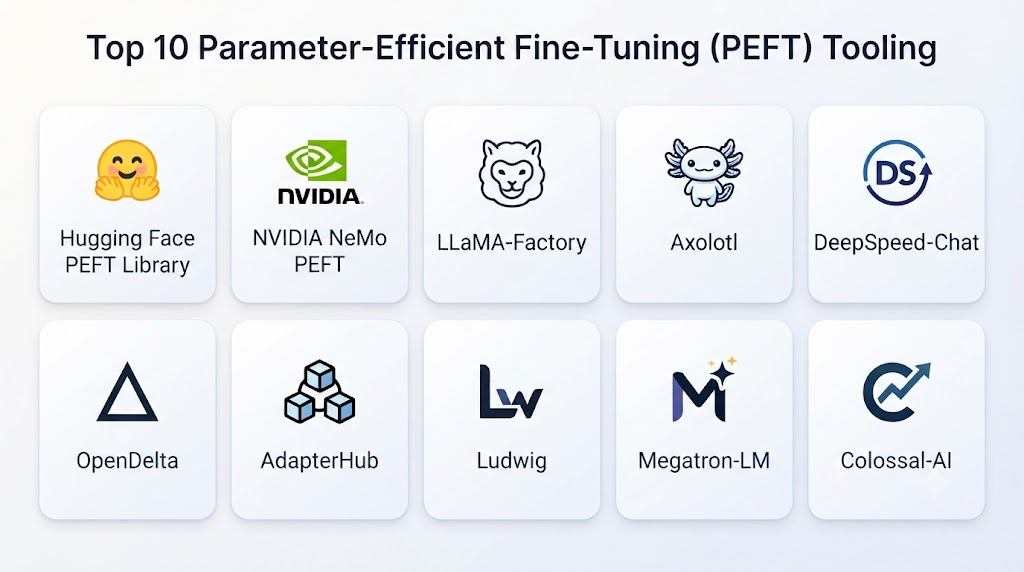
Top 10 Parameter-Efficient Fine-Tuning (PEFT) Tooling
1. Hugging Face PEFT Library
Hugging Face PEFT Library is one of the most widely used open-source frameworks for implementing parameter-efficient fine-tuning methods.
Key Features
- LoRA support
- QLoRA support
- Adapter methods
- Prompt tuning
- Large model compatibility
- Training integration
- Model sharing
- Evaluation workflows
- Multiple framework support
- Open-source ecosystem
Pros
- Large developer community
- Easy integration
- Strong documentation
- Supports many models
- Industry adoption
Cons
- Requires ML knowledge
- Training configuration can be complex
- Hardware planning needed
Platforms
Cloud, local, and enterprise environments.
Deployment or Support
Flexible deployment.
Security & Compliance
Depends on deployment environment.
Integrations & Ecosystem
Transformers ecosystem, AI frameworks, datasets, and model hubs.
Support & Community
Large AI developer community.
2. NVIDIA NeMo PEFT
NVIDIA NeMo provides enterprise tools for training and customizing large AI models efficiently.
Key Features
- LoRA training
- Adapter tuning
- Large language model customization
- Distributed training
- GPU optimization
- Model evaluation
- Enterprise workflows
- Performance optimization
- AI model management
- Deployment support
Pros
- Excellent GPU performance
- Enterprise-ready
- Supports large models
- Strong optimization
- Production capabilities
Cons
- Requires NVIDIA hardware
- Technical expertise needed
- Complex setup
Platforms
Cloud and enterprise environments.
Deployment or Support
Enterprise deployment.
Security & Compliance
Enterprise security controls.
Integrations & Ecosystem
NVIDIA hardware, AI frameworks, cloud platforms, and enterprise systems.
Support & Community
Enterprise support.
3. LLaMA-Factory
LLaMA-Factory provides tools for efficiently fine-tuning large language models.
Key Features
- LoRA training
- QLoRA support
- Multiple LLM support
- Training automation
- Dataset management
- Model evaluation
- Instruction tuning
- Chat model customization
- Deployment workflows
- Open-source tools
Pros
- Easy LLM customization
- Supports many models
- Active community
- Good training workflows
- Beginner-friendly compared with manual methods
Cons
- Requires technical knowledge
- Hardware requirements vary
- Enterprise features limited
Platforms
Local and cloud environments.
Deployment or Support
Flexible deployment.
Security & Compliance
Depends on implementation.
Integrations & Ecosystem
Open-source models, AI frameworks, and developer tools.
Support & Community
Open-source community.
4. Axolotl
Axolotl is an open-source framework designed for efficient LLM fine-tuning.
Key Features
- LoRA training
- QLoRA training
- Instruction tuning
- Dataset configuration
- Model optimization
- Training automation
- Multiple model support
- Evaluation tools
- Experiment management
- Community extensions
Pros
- Flexible configuration
- Strong open-source support
- Supports popular LLMs
- Good customization options
- Active development
Cons
- Requires technical skills
- Configuration complexity
- Limited enterprise management
Platforms
Cloud and local environments.
Deployment or Support
Local and cloud deployment.
Security & Compliance
Depends on deployment.
Integrations & Ecosystem
Open-source models, training frameworks, and AI tools.
Support & Community
Developer community.
5. DeepSpeed-Chat
DeepSpeed-Chat provides efficient training tools for conversational AI models.
Key Features
- Efficient LLM training
- Fine-tuning workflows
- Reinforcement learning support
- Distributed training
- Memory optimization
- Large model support
- Training pipelines
- Performance optimization
- Model management
- AI research tools
Pros
- Excellent scalability
- Strong performance
- Microsoft research support
- Large model capability
- Optimized training
Cons
- Complex for beginners
- Requires advanced ML knowledge
- Infrastructure requirements
Platforms
Cloud and high-performance environments.
Deployment or Support
Enterprise and research deployment.
Security & Compliance
Depends on implementation.
Integrations & Ecosystem
DeepSpeed ecosystem, AI frameworks, and cloud infrastructure.
Support & Community
Research and developer community.
6. OpenDelta
OpenDelta provides parameter-efficient adaptation methods for transformer models.
Key Features
- Adapter tuning
- LoRA support
- Delta parameter training
- Transformer compatibility
- Model adaptation
- Research workflows
- Lightweight training
- Experiment tools
- Model customization
- Open-source framework
Pros
- Research-friendly
- Lightweight customization
- Flexible approaches
- Efficient training
- Open-source
Cons
- Smaller ecosystem
- Requires expertise
- Limited enterprise tooling
Platforms
Cloud and local environments.
Deployment or Support
Flexible deployment.
Security & Compliance
Depends on implementation.
Integrations & Ecosystem
Transformer models and AI research tools.
Support & Community
Research community.
7. AdapterHub
AdapterHub provides adapter-based training tools for transformer models.
Key Features
- Adapter modules
- Task-specific training
- Multi-task learning
- Model sharing
- NLP customization
- Lightweight updates
- Research workflows
- Model management
- Integration support
- Developer tools
Pros
- Efficient customization
- Strong NLP support
- Good research foundation
- Multiple adapters
- Resource efficient
Cons
- Mostly NLP-focused
- Requires technical understanding
- Smaller ecosystem
Platforms
Cloud and local environments.
Deployment or Support
Flexible deployment.
Security & Compliance
Depends on implementation.
Integrations & Ecosystem
Transformer frameworks and NLP tools.
Support & Community
Research community.
8. Ludwig
Ludwig provides a low-code approach for building and customizing machine learning models.
Key Features
- Model fine-tuning
- Configuration-based training
- LLM customization
- Experiment tracking
- Evaluation tools
- Data processing
- Model deployment
- Workflow automation
- Developer tools
- Enterprise support
Pros
- Easier model customization
- Less coding required
- Good experimentation tools
- Supports multiple AI tasks
- Developer-friendly
Cons
- Less control for advanced researchers
- Performance tuning may require expertise
- Smaller PEFT ecosystem
Platforms
Cloud and local environments.
Deployment or Support
Cloud and enterprise deployment.
Security & Compliance
Enterprise security options.
Integrations & Ecosystem
Machine learning frameworks and data platforms.
Support & Community
Developer community.
9. Megatron-LM
Megatron-LM provides large-scale model training and customization capabilities.
Key Features
- Large model training
- Distributed training
- Transformer optimization
- Parallel processing
- Model scaling
- Training efficiency
- Research workflows
- Performance tools
- AI infrastructure support
- Enterprise deployment
Pros
- Supports massive models
- High performance
- Research-focused
- Advanced optimization
- Scalable training
Cons
- Complex setup
- Requires significant infrastructure
- Advanced expertise needed
Platforms
High-performance computing environments.
Deployment or Support
Enterprise and research deployment.
Security & Compliance
Depends on infrastructure.
Integrations & Ecosystem
NVIDIA hardware, AI frameworks, and research platforms.
Support & Community
Research community.
10. Colossal-AI
Colossal-AI provides efficient distributed training and model optimization tools.
Key Features
- Efficient training
- Memory optimization
- Model parallelism
- Fine-tuning support
- Large model training
- GPU optimization
- AI workflows
- Distributed computing
- Performance tuning
- Deployment tools
Pros
- Strong efficiency
- Supports large models
- Advanced optimization
- Open-source
- Flexible training
Cons
- Requires technical expertise
- Complex configuration
- Infrastructure requirements
Platforms
Cloud and high-performance environments.
Deployment or Support
Enterprise and research deployment.
Security & Compliance
Depends on implementation.
Integrations & Ecosystem
AI frameworks, GPUs, and distributed systems.
Support & Community
Open-source community.
Comparison Table
| Tool Name | Best For | Platform(s) Supported | Deployment | Standout Feature | Public Rating |
|---|---|---|---|---|---|
| Hugging Face PEFT | General PEFT workflows | Cloud/Local | Flexible | Wide model support | N/A |
| NVIDIA NeMo PEFT | Enterprise AI training | Cloud/Enterprise | Hybrid | GPU optimization | N/A |
| LLaMA-Factory | LLM customization | Cloud/Local | Flexible | Easy fine-tuning | N/A |
| Axolotl | Open LLM tuning | Cloud/Local | Flexible | Configuration-based training | N/A |
| DeepSpeed-Chat | Large conversational models | Cloud | Enterprise | Distributed training | N/A |
| OpenDelta | Research adaptation | Cloud/Local | Flexible | Adapter methods | N/A |
| AdapterHub | NLP customization | Cloud/Local | Flexible | Adapter ecosystem | N/A |
| Ludwig | Low-code AI tuning | Cloud/Local | Flexible | Easy workflows | N/A |
| Megatron-LM | Large-scale models | HPC/Cloud | Enterprise | Model scaling | N/A |
| Colossal-AI | Efficient training | Cloud/HPC | Enterprise | Optimization | N/A |
Weighted Evaluation
| Tool Name | Core Features 25% | Ease of Use 15% | Integrations & Ecosystem 15% | Security & Compliance 10% | Performance & Reliability 10% | Support & Community 10% | Price/Value 15% | Total |
|---|---|---|---|---|---|---|---|---|
| Hugging Face PEFT | 25 | 15 | 15 | 10 | 10 | 10 | 14 | 99 |
| NVIDIA NeMo PEFT | 25 | 12 | 14 | 10 | 10 | 10 | 11 | 92 |
| LLaMA-Factory | 24 | 14 | 14 | 10 | 10 | 10 | 14 | 96 |
| Axolotl | 24 | 13 | 14 | 10 | 10 | 10 | 14 | 95 |
| DeepSpeed-Chat | 25 | 11 | 14 | 10 | 10 | 10 | 12 | 92 |
| OpenDelta | 22 | 12 | 13 | 10 | 10 | 10 | 14 | 91 |
| AdapterHub | 22 | 13 | 13 | 10 | 10 | 10 | 14 | 92 |
| Ludwig | 22 | 15 | 13 | 10 | 10 | 10 | 13 | 93 |
| Megatron-LM | 25 | 10 | 14 | 10 | 10 | 10 | 11 | 90 |
| Colossal-AI | 24 | 11 | 13 | 10 | 10 | 10 | 12 | 90 |
Which PEFT Tooling Is Right for You?
Choose Hugging Face PEFT when you need a complete and widely adopted PEFT framework.
Choose NVIDIA NeMo PEFT when enterprise-scale GPU training is required.
Choose LLaMA-Factory when quick LLM customization is important.
Choose Axolotl when flexible open-source fine-tuning workflows are needed.
Choose DeepSpeed-Chat when training large conversational models.
Choose OpenDelta when research-focused adaptation methods are required.
Choose AdapterHub when adapter-based NLP customization is needed.
Choose Ludwig when low-code AI customization is preferred.
Choose Megatron-LM when large-scale model training is required.
Choose Colossal-AI when efficient distributed training is important.
Implementation Playbook
Phase 1: Define Fine-Tuning Goals
- Identify business objectives
- Select base model
- Define required improvements
- Choose PEFT approach
Phase 2: Prepare Training Data
- Collect examples
- Clean datasets
- Validate quality
- Format training data
Phase 3: Configure PEFT Training
- Select LoRA or adapter methods
- Configure parameters
- Train lightweight adapters
- Evaluate results
Phase 4: Deploy Customized Models
- Merge adapters if needed
- Create APIs
- Integrate applications
- Monitor performance
Phase 5: Improve Models
- Collect feedback
- Update datasets
- Retrain adapters
- Optimize performance
Common Mistakes
- Fine-tuning without quality data
- Choosing incorrect PEFT methods
- Ignoring evaluation metrics
- Overfitting models
- Poor dataset preparation
- Not monitoring results
- Ignoring deployment needs
- Using unnecessary computing resources
FAQs
1. What is Parameter-Efficient Fine-Tuning (PEFT)?
PEFT is a method for customizing AI models by updating only a small number of parameters instead of retraining the entire model.
2. Why use PEFT instead of full fine-tuning?
PEFT reduces training cost, memory usage, and computing requirements.
3. What are popular PEFT methods?
Popular methods include LoRA, QLoRA, adapters, prompt tuning, and prefix tuning.
4. Can PEFT work with large language models?
Yes. PEFT is commonly used for adapting large language models.
5. Who uses PEFT tools?
AI researchers, developers, startups, and enterprises use PEFT tooling.
6. Is PEFT cheaper than traditional fine-tuning?
Yes. PEFT usually requires fewer resources.
7. Can multiple PEFT adapters be created from one model?
Yes. Organizations can create different lightweight adapters for different tasks.
8. Are PEFT methods suitable for enterprise AI?
Yes. Many enterprises use PEFT for customized AI applications.
9. How do organizations choose PEFT tooling?
They should evaluate model support, performance, cost, deployment, and community support.
10. What is the future of PEFT?
PEFT will continue growing as organizations seek efficient ways to customize advanced AI models.
Conclusion
Parameter-Efficient Fine-Tuning (PEFT) Tooling is becoming a critical approach for building customized AI solutions efficiently. By reducing training requirements while maintaining strong performance, PEFT allows organizations to adapt powerful foundation models without massive infrastructure investments.Tools such as Hugging Face PEFT, NVIDIA NeMo, LLaMA-Factory, Axolotl, DeepSpeed, and other frameworks provide flexible options for researchers and enterprises building specialized AI applicationsThe future of AI customization will rely heavily on efficient fine-tuning methods that combine powerful foundation models with domain-specific knowledge, reduced costs, and scalable deployment strategies.