Introduction
Model Fine-Tuning Platforms are artificial intelligence platforms that help developers, researchers, and organizations customize pre-trained AI models for specific tasks, industries, and business requirements.
Large foundation models are trained on massive datasets and can perform a wide range of tasks. However, organizations often need AI systems that understand their specific terminology, workflows, brand requirements, domain knowledge, and operational processes. Fine-tuning allows teams to adapt existing models using specialized datasets instead of building new models from scratch.
Model fine-tuning platforms simplify the process of training, optimizing, evaluating, and deploying customized AI models. These platforms provide tools for dataset preparation, training workflows, model evaluation, resource management, and production deployment.
Model Fine-Tuning Platforms help organizations:
- Customize AI models for specific use cases
- Improve task-specific accuracy
- Adapt models to industry knowledge
- Reduce AI development time
- Build specialized AI assistants
- Improve business workflow automation
- Create private AI solutions
These platforms are used by:
- AI engineers
- Machine learning teams
- Enterprises
- Startups
- Research organizations
- Software developers
- Data scientists
- Product teams
Modern fine-tuning platforms support:
- Large language models
- Vision models
- Speech models
- Multimodal models
- Domain-specific AI systems
- Instruction tuning
- Parameter-efficient fine-tuning
- Model evaluation
- Deployment automation
The goal of these platforms is to make AI customization easier, faster, and more accessible for organizations building intelligent applications.
How Model Fine-Tuning Platforms Work
Dataset Preparation
Fine-tuning begins with preparing specialized datasets.
Organizations collect:
- Business documents
- Industry data
- User interactions
- Expert knowledge
- Training examples
Data is cleaned and formatted for model training.
Model Selection
Organizations select a suitable base model based on:
- Task requirements
- Performance needs
- Computing resources
- Domain requirements
Training Process
The platform adjusts the model using:
- Fine-tuning techniques
- Instruction tuning
- Parameter-efficient methods
- Reinforcement learning approaches
Model Evaluation
Customized models are tested for:
- Accuracy
- Reliability
- Response quality
- Domain understanding
Deployment
Fine-tuned models are deployed through:
- APIs
- Cloud platforms
- Enterprise applications
- Edge environments
Common Fine-Tuning Techniques
Full Fine-Tuning
The entire model is updated using new training data.
Advantages:
- Maximum customization
- High task adaptation
Challenges:
- Requires significant computing resources
Parameter-Efficient Fine-Tuning
Only selected model parameters are updated.
Examples:
- LoRA
- Adapters
- Prompt tuning
Advantages:
- Lower cost
- Faster training
- Less hardware requirement
Instruction Tuning
Models learn how to follow specific instructions and workflows.
Domain Adaptation
Models are customized for specific industries such as:
- Healthcare
- Finance
- Legal
- Education
- Cybersecurity
Common Use Cases
Enterprise AI Assistants
Organizations create assistants trained on internal knowledge.
Customer Support Automation
Fine-tuned models improve:
- Customer responses
- Issue resolution
- Support workflows
Healthcare AI
Organizations customize models for:
- Medical documentation
- Research analysis
- Clinical workflows
Financial AI
Fine-tuned models support:
- Risk analysis
- Compliance workflows
- Financial research
Legal AI
Organizations customize models for:
- Contract analysis
- Legal research
- Document review
Software Development
Fine-tuned coding models help with:
- Code generation
- Debugging
- Documentation
Why Model Fine-Tuning Platforms Matter
Better Accuracy
Customized models perform better on specialized tasks.
Industry Adaptation
Models can understand domain-specific terminology.
Improved User Experience
AI responses become more relevant and consistent.
Faster Development
Organizations avoid building models from the beginning.
Better Control
Businesses gain control over AI behavior and outputs.
Evaluation Criteria for Buyers
Training Capabilities
Platforms should support:
- Multiple model types
- Fine-tuning methods
- Training workflows
Dataset Management
Important features include:
- Data preparation
- Validation tools
- Dataset versioning
Performance
Organizations should evaluate:
- Training speed
- Model accuracy
- Resource efficiency
Deployment Options
Platforms should support:
- Cloud deployment
- Private environments
- API access
Security
Important features include:
- Data privacy
- Access control
- Enterprise security
Developer Experience
Platforms should provide:
- APIs
- SDKs
- Documentation
- Monitoring tools
Key Trends
Parameter-Efficient Fine-Tuning
Organizations are adopting efficient methods that reduce training costs.
Enterprise Custom AI Models
Businesses are creating models trained on internal knowledge.
Automated Fine-Tuning
Platforms are simplifying model customization workflows.
Open-Source Model Customization
Companies are adapting open models for specific needs.
AI Governance
Organizations are focusing on secure and responsible fine-tuning.
Continuous Model Improvement
Businesses are continuously updating models with new data.
Methodology
The following platforms were evaluated based on:
- Fine-tuning capabilities
- Model support
- Training features
- Deployment options
- Security
- Developer experience
- Integration ecosystem
- Scalability
- Performance
- Value
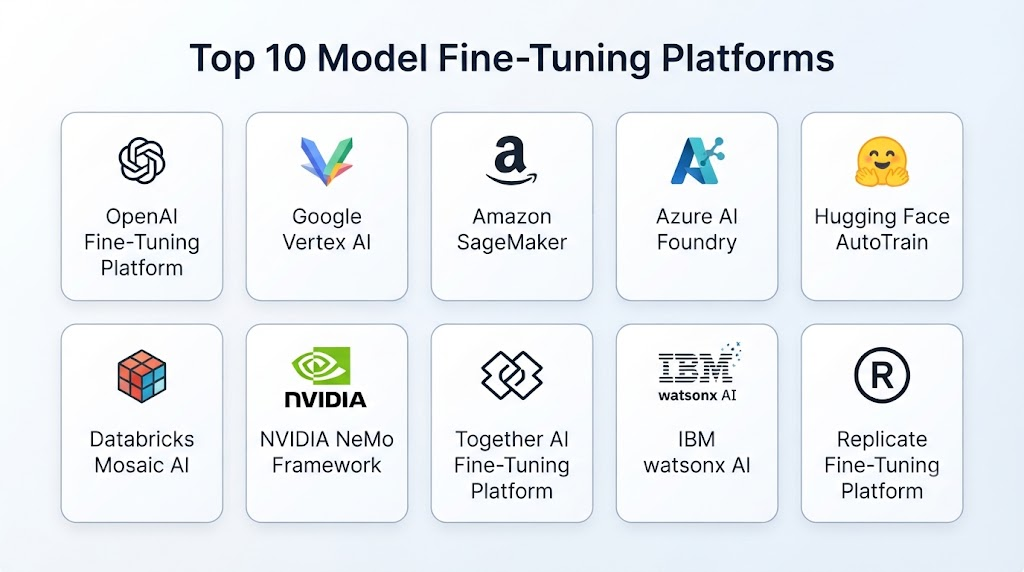
Top 10 Model Fine-Tuning Platforms
1. OpenAI Fine-Tuning Platform
OpenAI Fine-Tuning Platform enables developers to customize language models for specific applications.
Key Features
- Language model fine-tuning
- Custom training datasets
- Model customization
- API deployment
- Evaluation workflows
- AI application integration
- Training management
- Model testing
- Production deployment
- Developer tools
Pros
- Easy fine-tuning workflow
- Strong language models
- Developer-friendly APIs
- Good documentation
- Fast integration
Cons
- Limited control compared with open models
- Usage costs increase with scale
- Requires quality datasets
Platforms
Cloud API platform.
Deployment or Support
Cloud deployment.
Security & Compliance
Enterprise data protection features.
Integrations & Ecosystem
AI applications, developer tools, APIs, and software platforms.
Support & Community
Large developer community.
2. Google Vertex AI
Google Vertex AI provides machine learning tools for training and customizing AI models.
Key Features
- Model tuning
- Training pipelines
- Dataset management
- Model evaluation
- Deployment tools
- AI workflows
- Monitoring
- Enterprise integration
- Custom models
- Machine learning tools
Pros
- Complete AI development platform
- Strong cloud infrastructure
- Enterprise scalability
- Advanced ML tools
- Good integration options
Cons
- Requires cloud expertise
- Complex configuration
- Higher learning curve
Platforms
Cloud platform.
Deployment or Support
Cloud deployment.
Security & Compliance
Enterprise cloud security controls.
Integrations & Ecosystem
Google Cloud services, data platforms, AI tools, and enterprise applications.
Support & Community
Google Cloud support ecosystem.
3. Amazon SageMaker
Amazon SageMaker provides tools for building, training, customizing, and deploying machine learning models.
Key Features
- Model training
- Fine-tuning workflows
- Dataset management
- Automated ML tools
- Model deployment
- Monitoring
- GPU infrastructure
- AI pipelines
- Model management
- Enterprise integration
Pros
- Powerful ML infrastructure
- Enterprise scalability
- Flexible deployment
- Strong AWS ecosystem
- Advanced tools
Cons
- Requires AWS expertise
- Complex setup
- Cost management needed
Platforms
Cloud platform.
Deployment or Support
Cloud deployment.
Security & Compliance
Enterprise cloud security.
Integrations & Ecosystem
AWS services, databases, AI tools, and enterprise applications.
Support & Community
AWS support ecosystem.
4. Azure AI Foundry
Azure AI Foundry provides enterprise tools for customizing and deploying AI models.
Key Features
- Model customization
- Fine-tuning workflows
- AI evaluation
- Data integration
- Model monitoring
- Enterprise deployment
- Security controls
- AI governance
- API integration
- Development tools
Pros
- Enterprise-focused
- Strong Microsoft ecosystem
- Security capabilities
- Scalable infrastructure
- Governance support
Cons
- Requires Azure knowledge
- Enterprise complexity
- Configuration effort
Platforms
Cloud platform.
Deployment or Support
Cloud deployment.
Security & Compliance
Enterprise security controls.
Integrations & Ecosystem
Microsoft services, business applications, databases, and AI tools.
Support & Community
Microsoft support ecosystem.
5. Hugging Face AutoTrain
Hugging Face AutoTrain simplifies fine-tuning open-source AI models.
Key Features
- Automated fine-tuning
- Open-source models
- Dataset management
- Training automation
- Model evaluation
- NLP models
- Vision models
- Deployment support
- Community models
- Developer tools
Pros
- Easy open-model customization
- Large AI ecosystem
- Flexible model selection
- Strong community
- Supports multiple tasks
Cons
- Requires technical knowledge
- Model quality varies
- Hardware requirements
Platforms
Cloud and local environments.
Deployment or Support
Cloud and self-managed deployment.
Security & Compliance
Depends on deployment environment.
Integrations & Ecosystem
Open-source models, AI frameworks, datasets, and developer tools.
Support & Community
Large AI community.
6. Databricks Mosaic AI
Databricks Mosaic AI provides enterprise AI customization using organizational data.
Key Features
- Model customization
- Data integration
- Fine-tuning workflows
- AI agents
- Model evaluation
- Enterprise governance
- Monitoring
- Deployment
- Knowledge integration
- Analytics support
Pros
- Strong data ecosystem
- Enterprise workflows
- Good governance
- AI and data integration
- Scalable platform
Cons
- Requires Databricks expertise
- Enterprise complexity
- Learning curve
Platforms
Cloud platform.
Deployment or Support
Cloud deployment.
Security & Compliance
Enterprise security controls.
Integrations & Ecosystem
Data platforms, analytics systems, AI applications, and enterprise tools.
Support & Community
Enterprise support.
7. NVIDIA NeMo Framework
NVIDIA NeMo provides tools for training and customizing large AI models.
Key Features
- LLM fine-tuning
- Model training
- Speech AI support
- Multimodal models
- GPU optimization
- Distributed training
- Model evaluation
- Enterprise AI workflows
- Deployment tools
- Performance optimization
Pros
- Excellent GPU optimization
- Enterprise-ready
- Supports large models
- High performance
- Advanced customization
Cons
- Requires NVIDIA hardware
- Technical expertise needed
- Complex workflows
Platforms
Cloud and enterprise environments.
Deployment or Support
Enterprise deployment.
Security & Compliance
Enterprise security support.
Integrations & Ecosystem
NVIDIA hardware, AI frameworks, cloud platforms, and enterprise systems.
Support & Community
Enterprise support.
8. Together AI Fine-Tuning Platform
Together AI provides infrastructure for customizing and deploying open AI models.
Key Features
- Open model fine-tuning
- Training APIs
- Model deployment
- GPU infrastructure
- Model optimization
- Developer tools
- AI workflows
- Custom models
- Inference support
- API integration
Pros
- Open model flexibility
- Developer-friendly
- Fast experimentation
- Flexible deployment
- Good performance
Cons
- Smaller ecosystem
- Requires AI knowledge
- Enterprise features vary
Platforms
Cloud platform.
Deployment or Support
Cloud deployment.
Security & Compliance
Security options vary.
Integrations & Ecosystem
Open models, AI applications, developer tools, and cloud platforms.
Support & Community
Developer support.
9. IBM watsonx AI
IBM watsonx AI provides enterprise AI customization and governance capabilities.
Key Features
- Model tuning
- AI governance
- Enterprise deployment
- Data management
- Model evaluation
- Monitoring
- Security controls
- Hybrid deployment
- AI workflows
- Business integration
Pros
- Strong governance
- Enterprise security
- Hybrid capabilities
- Business integration
- AI management
Cons
- Complex implementation
- Enterprise-focused
- Requires expertise
Platforms
Cloud and hybrid platforms.
Deployment or Support
Hybrid deployment.
Security & Compliance
Enterprise security controls.
Integrations & Ecosystem
Enterprise systems, data platforms, and AI applications.
Support & Community
Enterprise support.
10. Replicate Fine-Tuning Platform
Replicate provides developer-friendly tools for running and customizing AI models.
Key Features
- Model customization
- API deployment
- AI experimentation
- Model hosting
- Developer workflows
- Open-source models
- Easy integration
- Model execution
- Application support
- Deployment tools
Pros
- Simple API experience
- Fast development
- Developer-friendly
- Easy experimentation
- Flexible model access
Cons
- Limited enterprise governance
- Scaling requires planning
- Usage costs vary
Platforms
Cloud platform.
Deployment or Support
Cloud deployment.
Security & Compliance
Security depends on application implementation.
Integrations & Ecosystem
AI applications, APIs, and developer tools.
Support & Community
Developer community.
Comparison Table
| Tool Name | Best For | Platform(s) Supported | Deployment | Standout Feature | Public Rating |
|---|---|---|---|---|---|
| OpenAI Fine-Tuning | Language model customization | Cloud API | Cloud | Easy model adaptation | N/A |
| Google Vertex AI | Enterprise ML | Cloud | Cloud | Complete AI platform | N/A |
| Amazon SageMaker | ML workflows | Cloud | Cloud | Training infrastructure | N/A |
| Azure AI Foundry | Enterprise AI | Cloud | Cloud | Governance tools | N/A |
| Hugging Face AutoTrain | Open models | Cloud/Local | Flexible | Automated tuning | N/A |
| Databricks Mosaic AI | Data-driven AI | Cloud | Cloud | Enterprise data integration | N/A |
| NVIDIA NeMo | Large model training | Cloud/Enterprise | Hybrid | GPU optimization | N/A |
| Together AI | Open model tuning | Cloud | Cloud | Flexible customization | N/A |
| IBM watsonx AI | Enterprise governance | Hybrid | Hybrid | AI management | N/A |
| Replicate | Developer workflows | Cloud | Cloud | Simple APIs | N/A |
Weighted Evaluation
| Tool Name | Core Features 25% | Ease of Use 15% | Integrations & Ecosystem 15% | Security & Compliance 10% | Performance & Reliability 10% | Support & Community 10% | Price/Value 15% | Total |
|---|---|---|---|---|---|---|---|---|
| OpenAI Fine-Tuning | 24 | 15 | 15 | 10 | 10 | 10 | 12 | 96 |
| Google Vertex AI | 25 | 13 | 15 | 10 | 10 | 10 | 11 | 94 |
| Amazon SageMaker | 25 | 12 | 15 | 10 | 10 | 10 | 12 | 94 |
| Azure AI Foundry | 25 | 13 | 15 | 10 | 10 | 10 | 12 | 95 |
| Hugging Face AutoTrain | 23 | 14 | 14 | 10 | 10 | 10 | 13 | 94 |
| Databricks Mosaic AI | 24 | 12 | 15 | 10 | 10 | 10 | 11 | 92 |
| NVIDIA NeMo | 25 | 11 | 14 | 10 | 10 | 10 | 11 | 91 |
| Together AI | 23 | 14 | 13 | 10 | 10 | 10 | 12 | 92 |
| IBM watsonx AI | 23 | 12 | 14 | 10 | 10 | 10 | 10 | 89 |
| Replicate | 22 | 15 | 13 | 10 | 10 | 10 | 12 | 92 |
Which Model Fine-Tuning Platform Is Right for You?
Choose OpenAI Fine-Tuning Platform when easy language model customization is needed.
Choose Google Vertex AI when enterprise machine learning workflows are required.
Choose Amazon SageMaker when advanced ML infrastructure is needed.
Choose Azure AI Foundry when Microsoft enterprise integration matters.
Choose Hugging Face AutoTrain when customizing open-source models.
Choose Databricks Mosaic AI when enterprise data integration is important.
Choose NVIDIA NeMo when training large AI models with GPU acceleration.
Choose Together AI when flexible open-model customization is preferred.
Choose IBM watsonx AI when governance and enterprise control matter.
Choose Replicate when quick AI experimentation is required.
Implementation Playbook
Phase 1: Define Customization Goals
- Identify AI use cases
- Define expected outcomes
- Select base models
- Determine data requirements
Phase 2: Prepare Training Data
- Collect domain data
- Clean datasets
- Validate information
- Create training examples
Phase 3: Fine-Tune Models
- Configure training settings
- Apply tuning methods
- Evaluate performance
- Optimize results
Phase 4: Deploy Models
- Create APIs
- Integrate applications
- Monitor usage
- Secure access
Phase 5: Improve Continuously
- Collect feedback
- Update datasets
- Retrain models
- Monitor quality
Common Mistakes
- Using poor-quality training data
- Fine-tuning without clear goals
- Ignoring evaluation
- Overfitting models
- Poor security practices
- Not monitoring performance
- Ignoring deployment requirements
- Choosing unsuitable base models
FAQs
1. What are Model Fine-Tuning Platforms?
Model Fine-Tuning Platforms help organizations customize existing AI models for specific tasks and business needs.
2. Why fine-tune AI models?
Fine-tuning improves accuracy and allows models to understand specialized information.
3. What data is required for fine-tuning?
Organizations typically use examples, documents, domain knowledge, and task-specific datasets.
4. Can open-source models be fine-tuned?
Yes. Many open-source models support customization.
5. Is fine-tuning expensive?
Costs depend on model size, dataset size, and computing requirements.
6. Who uses fine-tuning platforms?
Enterprises, developers, researchers, and AI teams use them.
7. What is parameter-efficient fine-tuning?
It is a technique that customizes models while updating fewer parameters to reduce resource requirements.
8. Are fine-tuned models more accurate?
They can provide better results for specialized tasks when trained with quality data.
9. How do companies choose a fine-tuning platform?
Companies evaluate model support, cost, security, deployment, and customization features.
10. What is the future of model fine-tuning?
Fine-tuning will continue growing as organizations build specialized AI systems for different industries.
Conclusion
Model Fine-Tuning Platforms are becoming essential for organizations that want to move beyond general AI models and create customized intelligent solutions.Platforms such as OpenAI Fine-Tuning, Google Vertex AI, Amazon SageMaker, Azure AI Foundry, Hugging Face AutoTrain, NVIDIA NeMo, and other solutions provide powerful tools for adapting AI models to specific business requirementThe future of AI development will depend on customized models that combine powerful foundation models with specialized data, domain knowledge, security, and responsible AI practices.