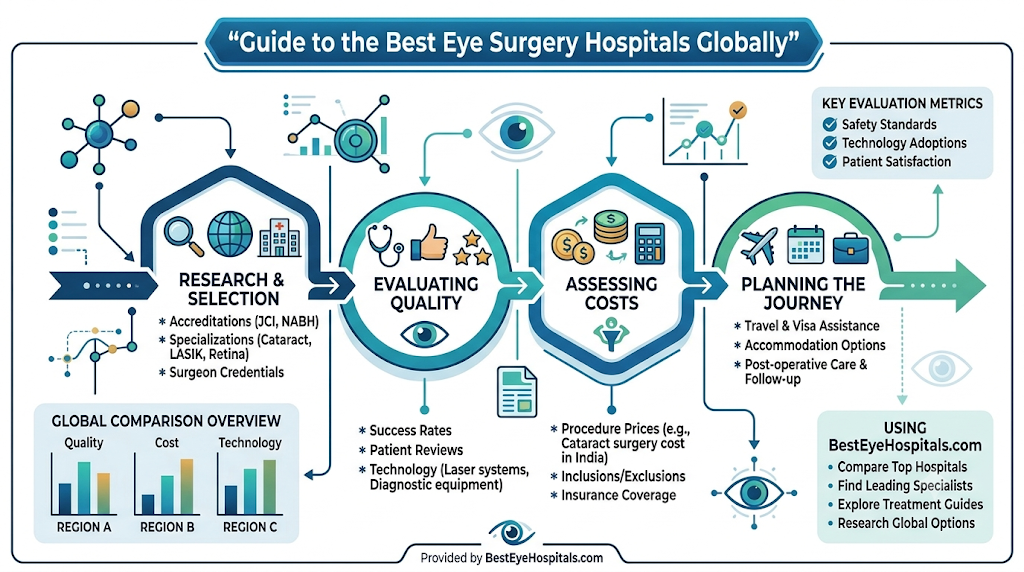
Navigating the world of advanced eye care can be overwhelming for patients seeking vision correction or complex eye treatment. Finding the best eye surgery hospitals requires evaluating clinical technology, healthcare quality, and surgical expertise. Whether you are addressing age-related vision changes or seeking advanced laser procedures, understanding your options is the first step toward lasting visual health. Platforms like best eye hospitals serve as comprehensive directories, helping individuals compare clinics, explore leading specialists, and analyze global treatment offerings. By focusing on objective data, international accreditations, and patient safety standards, this guide empowers individuals and caregivers to make informed, life-changing vision care decisions confidently.
Understanding Advanced Eye Care and Ophthalmology
Modern ophthalmology has transitioned from basic corrective practices to highly sophisticated micro-surgeries and digital diagnostics. Specialized infrastructure forms the backbone of the best ophthalmology hospitals, allowing surgeons to map the eye with microscopic precision. Patients seeking vision care face an array of options, from managing progressive eye diseases like glaucoma to undergoing elective refractive surgery.
Elite eye care centers integrate multi-disciplinary teams consisting of a dedicated retina specialist, cornea specialist, and specialized eye surgeon. These professionals rely on advanced diagnostic imaging, such as Optical Coherence Tomography (OCT) and corneal topography, to detect subtle changes before symptoms worsen. Accessing a dedicated eye clinic equipped with these modern tools ensures that conditions like macular degeneration or diabetic retinopathy are managed effectively, safeguarding long-term vision.
Why Choosing the Right Eye Hospital Matters
Selecting a premier healthcare provider directly influences patient safety, treatment efficacy, and post-operative satisfaction. The best eye hospitals in the world distinguish themselves through stringent clinical protocols and robust hospital accreditation from bodies like the Joint Commission International (JCI). These honors guarantee that the facility maintains the highest benchmarks for sterile environments, surgical safety, and patient care management.
Furthermore, top-tier institutions provide seamless international patient services tailored for medical tourism. Traveling for specialized treatments demands comprehensive support, including localized coordination, language interpretation, and streamlined communication for a second medical opinion. By prioritizing an accredited institution, patients reduce the risk of surgical complications and gain access to comprehensive follow-up care pathways, ensuring a smooth recovery journey.
Key Factors to Compare Eye Hospitals
When evaluating global options for vision care, patients should utilize specific metrics to benchmark institutions effectively. A systematic approach helps separate high-performing specialized centers from general medical facilities.
- Clinical Accreditations: Look for national and international certifications (e.g., JCI, NABH) that validate healthcare quality and safety.
- Surgeon Experience: Research the credentials of the medical staff, ensuring access to a fellowship-trained ophthalmologist or specialized retina specialist.
- Diagnostic Technology: Verify if the hospital utilizes cutting-edge diagnostic imaging, digital workflow integration, and advanced laser suites.
- Patient Support Services: Evaluate the availability of specialized international patient desks, transparent billing practices, and structured post-operative care.
Common Eye Surgeries and Technological Variations
The field of vision correction and eye treatment features diverse surgical interventions tailored to specific anatomical needs. Understanding these technical differences helps patients participate actively in their treatment planning.
Cataract Surgery vs LASIK Surgery
Cataract removal and laser vision correction serve distinct patient demographics and clinical purposes. Cataract surgery replaces a clouded natural lens with an artificial intraocular lens (IOL), primarily restoring clarity to aging eyes. Conversely, LASIK alters the shape of the cornea to correct refractive errors like myopia, hyperopia, and astigmatism in younger adults.
| Features | Cataract Surgery | LASIK Surgery |
| Primary Purpose | Replacing a cloudy natural lens to restore visual clarity | Reshaping the cornea to eliminate dependence on glasses |
| Advantages | Permanent resolution of cataracts; options for multi-focal lenses | Rapid visual recovery; high freedom from corrective eyewear |
| Limitations | Requires surgical entry; minor risk of posterior capsular opacification | Dependent on adequate corneal thickness; temporary dry eye risk |
| Suitable Patients | Individuals with age-related cataracts or severe lens opacity | Adults with stable refractive errors and healthy corneas |
| Cost Considerations | Often covered by insurance; premium IOLs incur out-of-pocket fees | Typically considered elective; varied pricing based on laser tech |
Traditional vs Laser-Assisted Cataract Surgery
Innovations in cataract extraction have introduced automated precision to a historically manual procedure. Traditional surgery utilizes manual incisions and ultrasound waves to break up the cataract, whereas laser-assisted options employ femtosecond lasers for unmatched precision.
| Features | Traditional Cataract Surgery | Laser-Assisted Cataract Surgery |
| Primary Purpose | Manual extraction and replacement of the clouded lens | Automated, laser-guided fragmentation and capsulotomy |
| Advantages | Highly cost-effective; decades of proven clinical success | Exceptional incision precision; reduced ultrasound energy inside eye |
| Limitations | Higher reliance on manual surgeon dexterity for incisions | Higher out-of-pocket costs; not universally available |
| Suitable Patients | Standard cataract patients looking for economical options | Patients seeking premium IOLs or astigmatism correction |
| Cost Considerations | Economical; widely supported by baseline medical insurance | Premium pricing due to specialized advanced laser equipment |
LASIK vs PRK (Photo-Refractive Keratectomy)
Refractive surgeries offer multiple pathways to reshape corneal tissue. While LASIK involves creating a thin corneal flap, PRK completely removes the outer surface layer, making it an excellent alternative for specific eye structures.
| Features | LASIK Surgery | PRK Surgery |
| Primary Purpose | Correcting refractive errors via a sub-surface corneal flap | Correcting vision by reshaping the surface of the cornea |
| Advantages | Minimal discomfort; functional vision restored within 24 hours | No risk of flap complications; ideal for thin corneas |
| Limitations | Requires sufficient corneal thickness; flap displacement risk | Longer recovery window; mild discomfort during initial days |
| Suitable Patients | Patients with normal corneal metrics seeking fast recovery | Athletes or individuals with thin corneas or high dry eye risk |
| Cost Considerations | Standard global pricing structures for refractive suites | Comparable to LASIK, though medication costs may vary |
Treatment Cost Considerations and Medical Tourism
Navigating the financial aspects of advanced vision care is a critical step for many families. The global disparity in healthcare pricing has driven significant interest in international medical destinations, with many seeking the best eye hospitals in India due to affordability and high clinical standards.
Cataract Surgery Cost in India
The cataract surgery cost in India varies based on the choice of hospital, geographic location, and the type of intraocular lens selected. Standard monofocal lens procedures remain highly economical, while advanced multifocal or toric lenses that correct presbyopia and astigmatism represent a higher investment. Even when opting for the best hospitals for cataract surgery, the overall expenses in India generally remain a fraction of the cost found in Western nations, making premier care highly accessible.
LASIK Surgery Cost in India
Similarly, the LASIK surgery cost in India depends greatly on the underlying technology utilized, such as standard LASIK, Custom Wavefront-guided treatments, or advanced micro-keratome blade-free options (SMILE). The best hospitals for LASIK surgery offer state-of-the-art refractive suites operated by an expert eye surgeon. International patients often find that combining travel with advanced laser eye surgery allows them to access top-tier infrastructure while managing their overall medical budget effectively.
Expert Tips for Selecting Eye Care Providers
- Verify Sub-Specialization: Ensure your chosen physician is a dedicated specialist (e.g., a cornea specialist for surface issues) rather than a general practitioner.
- Inquire About Audit Rates: Ask the diagnostic eye clinic or hospital about their documented surgical success rates and infection track records.
- Check Technology Versions: Confirm that the facility utilizes modern diagnostic imaging and current generation laser systems for vision correction.
- Evaluate Continuity of Care: Choose institutions that outline clear protocols for long-distance follow-ups, ensuring your local doctor can coordinate seamlessly.
Best Practices for Patient Planning
Planning an eye treatment requires methodical preparation to achieve optimal results. Patients should secure copies of all raw diagnostic imaging files and comprehensive pre-operative eye examination reports before traveling. It is highly recommended to arrange for an independent second medical opinion to validate the proposed surgical pathway.
Additionally, clarify the specific details of post-operative care, including mandatory recovery timelines and restrictions on travel or physical activity. Managing these variables systematically ensures patient safety and eliminates administrative stress during the recovery period.
Common Mistakes to Avoid
- Prioritizing Cost Over Quality: Choosing an eye clinic solely based on low pricing can compromise safety and technological access.
- Overlooking Accreditation: Failing to verify national or international hospital accreditation standards before scheduling complex surgeries.
- Ignoring Recovery Timelines: Rushing into return travel or regular work environments before the eye surgeon has cleared you for normal activity.
- Vague Financial Agreements: Agreeing to procedures without a fully itemized breakdown of surgical, diagnostic, and lens-related costs.
FAQs
What is the difference between an ophthalmologist and an optometrist?
An ophthalmologist is a medical doctor specialized in diagnosing, treating, and performing surgery on the eyes. An optometrist focuses primarily on vision testing, prescribing corrective lenses, and managing basic eye health issues.
How do I identify the best eye hospitals in the world?
Look for global hospital accreditation from bodies like JCI, advanced infrastructure like digital diagnostic imaging, high surgical success volumes, and a staff comprising international fellowship-trained specialists.
Why is India considered a top destination for eye surgery?
The best eye hospitals in India offer high-quality clinical outcomes, internationally certified eye surgeons, and cutting-edge technologies at a fraction of Western costs, facilitating robust medical tourism.
What factors influence cataract surgery cost in India?
Costs depend on the surgical technique used, such as traditional or laser-assisted, the specific intraocular lens chosen, and the accreditation tier of the selected hospital.
Is LASIK surgery permanent?
Yes, LASIK permanently reshapes the corneal tissue to correct refractive errors. However, it cannot prevent natural age-related vision changes, such as presbyopia, which occur later in life.
What does the average LASIK surgery cost in India cover?
The total cost typically includes pre-operative corneal mapping, the laser procedure fee, surgeon charges, basic post-operative medications, and initial follow-up examinations within the eye clinic.
How long is the recovery period after cataract surgery?
Most patients notice improved vision within a few days, though complete healing and stabilizing of the eye structure generally take around four to six weeks.
Can international patients get a second medical opinion easily?
Yes, premier global eye care institutions feature dedicated international patient services designed to securely review diagnostic files remotely and provide comprehensive secondary clinical opinions.
What are the risks of traveling immediately after laser eye surgery?
Traveling too soon can expose healing eyes to dry airplane air and environmental contaminants, increasing infection risks. Always follow the specific timeline outlined by your eye surgeon.
What technologies are found in the best ophthalmology hospitals?
Top centers utilize advanced diagnostic imaging, femtosecond lasers for cataracts, specialized refractive suites, and high-resolution operating microscopes to maximize patient safety and precision.
How do I choose the best hospitals for cataract surgery?
Evaluate the hospital’s sterile tracking metrics, the availability of advanced premium intraocular lenses, and the clinical experience of their dedicated cataract and cornea specialists.
Are premium intraocular lenses worth the additional investment?
Premium lenses can significantly reduce reliance on glasses by correcting both distance and reading vision, though suitability depends on individual eye health and lifestyle goals.
What should I expect during a comprehensive eye examination?
Expect visual acuity tracking, pupil dilation, fluid pressure checks, and advanced structural scans of the retina to detect underlying conditions like glaucoma or macular changes.
How do specialized retina centers protect vision?
A specialized retina specialist uses targeted diagnostic lasers and localized therapies to manage complex internal structures, preventing permanent vision loss from systemic diseases.
How can a medical tourist verify healthcare quality abroad?
Verify institutional listings on recognized global healthcare tracking portals, look for international board certifications, and review detailed patient experience case studies.
Conclusion
Making informed decisions regarding vision care requires a careful balance of researching hospital infrastructure, surgeon expertise, and technological offerings. Whether you are addressing progressive eye conditions or evaluating vision correction options like cataract or LASIK procedures, prioritizing accredited institutions safeguards your long-term health. By thoroughly comparing clinical data, international patient services, and realistic cost expectations, you protect your visual well-being. Using structured informational platforms allows patients and caregivers to approach treatment planning with clarity, objectivity, and confidence.