Introduction
Domain-Specific Language Model Platforms are AI platforms that allow organizations to build, train, and deploy language models optimized for specialized domains, such as legal, medical, financial, or technical content. Unlike general-purpose LLMs, these platforms focus on domain knowledge, terminology, compliance requirements, and context-specific reasoning.
These platforms are increasingly important as industries demand AI models that understand domain-specific nuances, handle sensitive information securely, and integrate seamlessly into enterprise workflows. Using domain-focused models reduces errors, improves accuracy in complex tasks, and accelerates automation.
Real-world use cases include:
- Legal firms building models that can draft contracts and summarize case law.
- Healthcare organizations creating models for patient data analysis and medical record summarization.
- Financial institutions deploying models for regulatory compliance, risk analysis, or reporting.
- Engineering or manufacturing firms using models for technical documentation and knowledge retrieval.
- Customer support and technical helpdesk automation tailored to specific products or services.
What buyers should evaluate:
- Domain adaptability and fine-tuning options
- Pretrained model quality and benchmarking
- Security and compliance for sensitive data
- Integration with internal systems, APIs, or workflow tools
- Ease of deployment and platform usability
- Scalability for enterprise workloads
- Monitoring, analytics, and performance reporting
- Model versioning and update management
- Cost structure (subscription, pay-as-you-go, usage-based)
- Support, documentation, and community resources
Best for: AI engineers, data scientists, enterprise IT teams, R&D departments, and industries requiring domain-specific expertise.
Not ideal for: Organizations needing only general-purpose language models or low-volume experimentation; simpler NLP APIs may suffice.
Key Trends in Domain-Specific Language Model Platforms
- AI fine-tuning with few-shot and instruction-tuning for domain adaptation
- Integration with proprietary and regulatory datasets
- Privacy-preserving training with differential privacy or on-prem deployment
- Enhanced interpretability and explainability features
- Monitoring and performance tracking for model drift
- API-first platforms enabling easy integration with internal tools
- Prebuilt templates for legal, medical, financial, or technical workflows
- Cloud-native and hybrid deployment options for enterprise flexibility
- Automated compliance and audit reporting for regulated industries
- Pay-as-you-go and usage-based pricing aligned with AI compute consumption
How We Selected These Tools (Methodology)
- Market adoption and enterprise presence in domain-specific AI
- Model accuracy and domain adaptability metrics
- Reliability and performance in production workloads
- Security posture including data handling, encryption, and access controls
- Integration capabilities with APIs, enterprise software, and pipelines
- Scalability for enterprise, SMB, and developer use cases
- Customization and fine-tuning options for domain expertise
- Support, onboarding, and documentation quality
- Pricing transparency and flexibility
- Community engagement and ecosystem strength
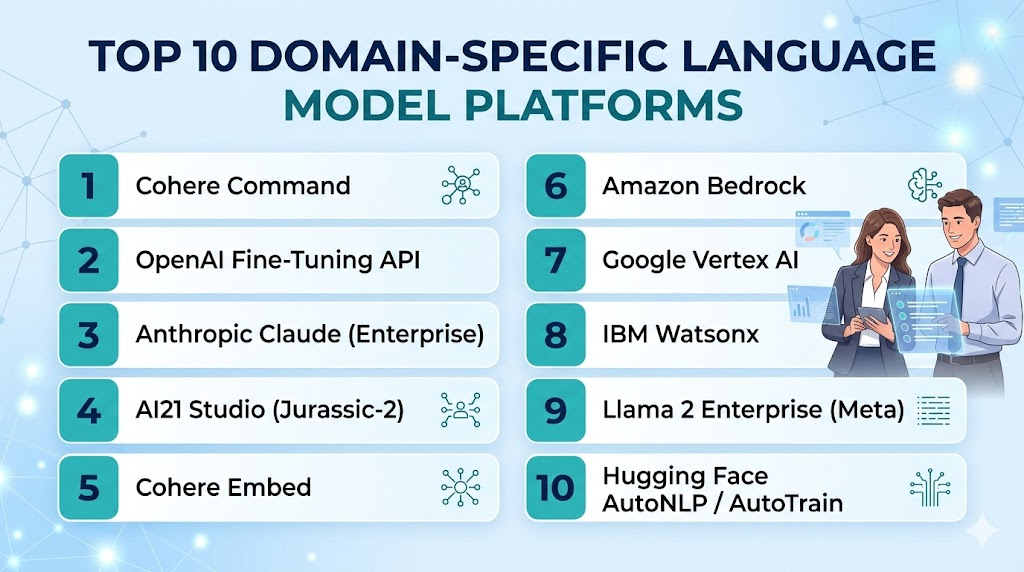
Top 10 Domain-Specific Language Model Platforms
1- Cohere Command
Short description: A platform offering fine-tuning and deployment of language models for enterprise domains, ideal for finance and customer support applications.
Key Features
- Pretrained and fine-tunable language models
- API access for integration into workflows
- Embedding generation for semantic search
- Multi-domain templates
- Usage monitoring dashboards
- Role-based access control
- Deployment flexibility with cloud options
Pros
- Easy API integration
- High performance on domain-specific tasks
- Supports embedding-based retrieval
Cons
- Advanced fine-tuning requires technical expertise
- Limited native GUI for non-technical users
Platforms / Deployment
- Web / API
- Cloud
Security & Compliance
Not publicly stated
Integrations & Ecosystem
- REST APIs
- SDKs for Python, JavaScript
- Custom workflow integration
- Embedding storage connectors
Support & Community
- Documentation and examples
- Email support
- Developer forums
2- OpenAI Fine-Tuning API
Short description: Provides fine-tuning of base LLMs for domain-specific tasks, suitable for legal, healthcare, or specialized industrial knowledge.
Key Features
- Fine-tuning on proprietary datasets
- Pretrained GPT models for instruction-following
- Embeddings for search and semantic tasks
- Model versioning and management
- API-based deployment
- Monitoring of usage and performance
Pros
- Highly flexible for custom domains
- Large model ecosystem
- Reliable uptime and infrastructure
Cons
- Cost scales with usage and model size
- Requires technical expertise for fine-tuning
Platforms / Deployment
- Web / API
- Cloud
Security & Compliance
Not publicly stated
Integrations & Ecosystem
- API-first integration
- Data pipelines via Python or other SDKs
- Workflow automation with internal tools
Support & Community
- Developer documentation
- Community Slack/Forums
- Technical support tiers
3- Anthropic Claude (Enterprise)
Short description: Enterprise-focused LLM platform with safety and alignment features, designed for domain-specific applications in sensitive industries.
Key Features
- Pretrained instruction-following models
- Safety layers and content filters
- Fine-tuning for domain data
- Embeddings and search
- API and SDK access
- Model monitoring and auditing
Pros
- Focused on AI safety
- Good for regulated domains
- Robust enterprise support
Cons
- Limited prebuilt templates for niche domains
- Requires technical expertise to integrate fully
Platforms / Deployment
- Web / API
- Cloud
Security & Compliance
Not publicly stated
Integrations & Ecosystem
- API-based integration
- Python SDK
- Embedding pipelines for search and retrieval
Support & Community
- Documentation
- Enterprise support
- Community forums
4- AI21 Studio (Jurassic-2)
Short description: Provides API and tools for building domain-specific NLP applications with fine-tuning and semantic search capabilities.
Key Features
- Instruction-following models
- Fine-tuning options
- Embeddings for retrieval tasks
- Custom tokenization for domain terms
- Monitoring dashboards
Pros
- Flexible for multiple domains
- Good NLP capabilities
- API-first approach
Cons
- GUI is minimal
- May require custom workflow integration
Platforms / Deployment
- Web / API
- Cloud
Security & Compliance
Not publicly stated
Integrations & Ecosystem
- API endpoints
- SDK support
- Workflow connectors for pipelines
Support & Community
- Documentation
- Email support
- Developer forums
5- Cohere Embed
Short description: Focused on embeddings and semantic search for domain-specific knowledge retrieval and Q&A applications.
Key Features
- Embedding generation for large corpora
- Semantic search and clustering
- API-first integration
- Model fine-tuning for domain data
- Monitoring and logging
Pros
- Strong search and retrieval
- Scales with large document sets
Cons
- Less suited for generative tasks
- Fine-tuning requires technical knowledge
Platforms / Deployment
- Web / API
- Cloud
Security & Compliance
Not publicly stated
Integrations & Ecosystem
- API-based
- Embedding stores
- Pipeline integration
Support & Community
- Documentation
- Email support
6- Amazon Bedrock
Short description: Managed service for building domain-specific LLM applications without managing infrastructure.
Key Features
- Multiple foundational models
- Fine-tuning and embedding generation
- API access for apps
- Secure and scalable infrastructure
- Monitoring and logging
Pros
- No infrastructure overhead
- Enterprise-grade security options
- Integration with AWS ecosystem
Cons
- Learning curve for AWS ecosystem
- Vendor lock-in considerations
Platforms / Deployment
- Web / API
- Cloud
Security & Compliance
Not publicly stated
Integrations & Ecosystem
- AWS services (S3, Lambda, etc.)
- API integration into workflows
- Embedding pipelines
Support & Community
- Documentation
- AWS support tiers
- Developer forums
7- Google Vertex AI
Short description: Offers tools to train, deploy, and serve domain-specific models integrated with Google Cloud AI ecosystem.
Key Features
- Custom training pipelines
- Pretrained foundation models
- Embeddings and search
- Deployment and monitoring
- API access
Pros
- Scalable and cloud-native
- Strong integration with GCP services
- Supports structured data with text
Cons
- Complexity for small teams
- Requires cloud expertise
Platforms / Deployment
- Web / API
- Cloud
Security & Compliance
Not publicly stated
Integrations & Ecosystem
- GCP ecosystem
- API-based deployment
- ML pipelines integration
Support & Community
- Documentation
- Cloud support tiers
- Community forums
8- IBM Watsonx
Short description: AI platform for enterprise domains with model fine-tuning and secure data handling.
Key Features
- Fine-tuning on private corpora
- Foundation and domain-specific models
- Monitoring and analytics
- Enterprise governance features
- API and SDK support
Pros
- Enterprise-grade security
- Strong model governance
- Integrates with IBM Cloud services
Cons
- Complexity for SMB
- May require IBM ecosystem familiarity
Platforms / Deployment
- Web / API
- Cloud / Hybrid
Security & Compliance
Not publicly stated
Integrations & Ecosystem
- IBM Cloud
- APIs for pipelines
- Enterprise apps
Support & Community
- Documentation
- Enterprise support
- Training modules
9- Llama 2 Enterprise (Meta)
Short description: Open-weight models for fine-tuning in domain-specific applications, ideal for R&D and technical domains.
Key Features
- Pretrained open-weight models
- Fine-tuning with private data
- Embeddings and search
- Versioning and monitoring
Pros
- Open-weight flexibility
- Supports multiple domains
Cons
- Requires technical expertise
- Infrastructure needed for large models
Platforms / Deployment
- Web / API / Self-hosted
- Cloud / On-prem
Security & Compliance
Not publicly stated
Integrations & Ecosystem
- API-based pipelines
- Open-source tools for deployment
Support & Community
- Documentation
- GitHub community
10- Hugging Face AutoNLP / AutoTrain
Short description: Provides domain-specific model training pipelines with minimal coding, suitable for multiple industries.
Key Features
- Auto-training pipelines for text classification, NER, QA
- Domain fine-tuning
- Deployment and monitoring
- Model versioning and export
- API and SDK support
Pros
- Low-code platform
- Supports multiple domains
- Community support
Cons
- Less control over advanced fine-tuning
- Requires cloud hosting
Platforms / Deployment
- Web / API
- Cloud / Self-hosted
Security & Compliance
Not publicly stated
Integrations & Ecosystem
- Hugging Face Hub
- API pipelines
- SDK support
Support & Community
- Documentation
- Forums
- Tutorials
Comparison Table (Top 10)
| Tool Name | Best For | Platform(s) Supported | Deployment | Standout Feature | Public Rating |
|---|---|---|---|---|---|
| Cohere Command | Finance, enterprise apps | Web, API | Cloud | Fine-tuning & embeddings | N/A |
| OpenAI Fine-Tuning API | Multiple domains | Web, API | Cloud | Custom GPT fine-tuning | N/A |
| Anthropic Claude | Regulated industries | Web, API | Cloud | Safety and alignment | N/A |
| AI21 Studio | NLP applications | Web, API | Cloud | Semantic search & fine-tuning | N/A |
| Cohere Embed | Search & retrieval | Web, API | Cloud | Domain embedding generation | N/A |
| Amazon Bedrock | Enterprise AI apps | Web, API | Cloud | Managed foundation models | N/A |
| Google Vertex AI | Cloud & domain models | Web, API | Cloud | Scalable AI pipelines | N/A |
| IBM Watsonx | Enterprise | Web, API | Cloud / Hybrid | Governance & security | N/A |
| Llama 2 Enterprise | R&D / technical domains | Web, API, Self-hosted | Cloud / On-prem | Open-weight fine-tuning | N/A |
| Hugging Face AutoNLP | Low-code domain models | Web, API | Cloud / Self-hosted | Automated training pipelines | N/A |
Evaluation & Scoring
| Tool Name | Core (25%) | Ease (15%) | Integrations (15%) | Security (10%) | Performance (10%) | Support (10%) | Value (15%) | Weighted Total |
|---|---|---|---|---|---|---|---|---|
| Cohere Command | 8 | 8 | 7 | 7 | 8 | 7 | 8 | 7.8 |
| OpenAI Fine-Tuning | 9 | 7 | 8 | 7 | 8 | 7 | 7 | 7.9 |
| Anthropic Claude | 8 | 7 | 7 | 8 | 8 | 7 | 7 | 7.8 |
| AI21 Studio | 7 | 8 | 7 | 7 | 7 | 7 | 7 | 7.4 |
| Cohere Embed | 7 | 8 | 6 | 7 | 7 | 7 | 8 | 7.3 |
| Amazon Bedrock | 8 | 7 | 7 | 8 | 8 | 7 | 7 | 7.8 |
| Google Vertex AI | 8 | 7 | 8 | 8 | 8 | 7 | 7 | 7.8 |
| IBM Watsonx | 8 | 7 | 7 | 8 | 8 | 7 | 7 | 7.7 |
| Llama 2 Enterprise | 8 | 6 | 7 | 7 | 8 | 7 | 8 | 7.6 |
| Hugging Face AutoNLP | 7 | 8 | 7 | 7 | 7 | 7 | 8 | 7.4 |
Interpretation: Higher weighted totals indicate stronger suitability for domain-specific applications considering integration, security, and deployment flexibility.
Which Domain-Specific Language Model Platform Is Right for You?
Solo / Freelancer
- Hugging Face AutoNLP or Cohere Embed for low-code, small-scale domain fine-tuning.
SMB
- Cohere Command, AI21 Studio, or OpenAI Fine-Tuning for domain-specific NLP tasks with moderate scale.
Mid-Market
- Amazon Bedrock or Google Vertex AI for scalable deployment and internal workflow integration.
Enterprise
- Anthropic Claude, IBM Watsonx, or OpenAI Fine-Tuning with full governance, monitoring, and regulatory compliance.
Budget vs Premium
- Budget: Hugging Face AutoNLP, Cohere Embed
- Premium: IBM Watsonx, Amazon Bedrock, Anthropic Claude
Feature Depth vs Ease of Use
- Low-code platforms excel in ease; enterprise platforms provide feature depth and integration.
Integrations & Scalability
- Enterprise platforms allow APIs and pipelines for large-scale deployment; low-code solutions are best for experimentation.
Security & Compliance Needs
- Enterprises handling regulated data should prioritize platforms with audit logs, RBAC, and private data options.
Frequently Asked Questions (FAQs)
1- Pricing models?
Mix of subscription, usage-based, or enterprise licensing depending on platform and model size.
2- How is domain adaptation achieved?
Through fine-tuning on domain-specific corpora or instruction-tuning workflows.
3- Can models integrate with internal systems?
Yes — via APIs, SDKs, or workflow pipelines.
4- Are mobile or offline options supported?
Mostly API-based; offline use depends on self-hosted deployment.
5- How long to deploy?
Low-code platforms can be operational in hours; enterprise fine-tuning requires days to weeks.
6- Is AI safety included?
Platforms like Anthropic Claude provide safety layers and alignment mechanisms.
7- Do these platforms provide embeddings?
Most offer embeddings for search, semantic retrieval, and knowledge integration.
8- How to monitor performance?
Monitoring dashboards and usage analytics are provided for drift detection and accuracy tracking.
9- Can multiple domains be supported?
Yes — with separate fine-tuning, templates, or multi-domain model management.
10- Which platform for regulated industries?
IBM Watsonx, Anthropic Claude, or OpenAI Fine-Tuning with proper governance.
Conclusion
Domain-Specific Language Model Platforms enable organizations to leverage AI for specialized workflows while maintaining accuracy, compliance, and integration capabilities. Low-code platforms suit small teams or experimentation, while enterprise platforms provide governance, scalability, and regulatory support. Next steps include piloting 2–3 platforms on internal domain data, validating integration pipelines, and ensuring security measures before full deployment.
The focus on industry-specific AI, compliance, and domain expertise makes this comparison highly relevant for enterprise teams.
One challenge that deserves more attention is knowledge obsolescence. Domain-specific models trained on industry expertise can become outdated as regulations, standards, and best practices evolve. The long-term value of these platforms often depends on how efficiently domain knowledge can be refreshed without requiring complete model redevelopment.