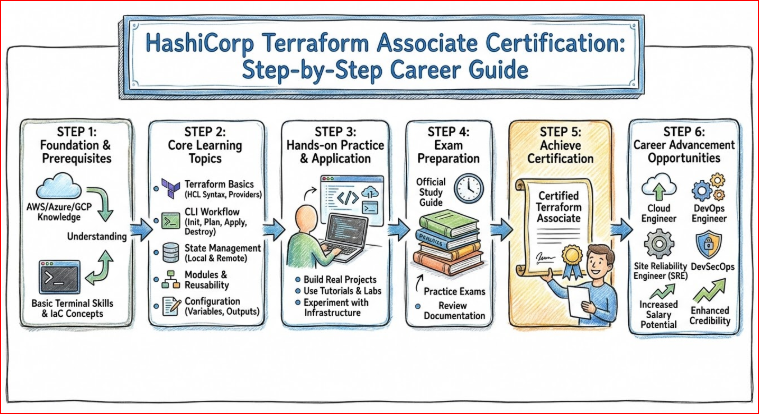
Introduction
Over my career building and scaling massive cloud infrastructures, I have seen many tools come and go, but HashiCorp Terraform has completely changed how the industry operates. Today, provisioning infrastructure manually through a web console is a thing of the past. Whether you are a working software engineer, a system administrator, or an engineering manager in India or anywhere globally, understanding Terraform is no longer optional—it is a mandatory skill. This guide will walk you through everything you need to know about the Hashicorp Certified Terraform Associate program, how to prepare for it, and how it fits into your broader career path.
Certification Overview
Here is a quick look at how the Terraform certification fits into your professional journey.
| Track | Level | Who it’s for | Prerequisites | Skills covered | Recommended order |
|---|---|---|---|---|---|
| Infrastructure as Code | Associate | Cloud Engineers, DevOps, SREs | Basic Terminal & Cloud knowledge | IaC basics, HCL syntax, State management | 1st (Foundational) |
| Container Orchestration | Professional | Platform Engineers, DevOps | Terraform Associate, Linux | Kubernetes cluster setup, Pods, Services | 2nd |
| Cloud Security (DevSecOps) | Professional | Security Engineers, SREs | Terraform Associate, Networking | Compliance as Code, RBAC, Secret injection | 3rd |
What it is
The Hashicorp Certified Terraform Associate is an industry-recognized credential that validates your foundational knowledge of Terraform’s open-source concepts and enterprise features. It proves you can safely and predictably automate, provision, and manage cloud infrastructure using code.
Who should take it
This certification is perfect for Cloud Engineers, DevOps professionals, Software Engineers, and IT Managers who want to standardize deployments. If your daily work involves interacting with AWS, Azure, or Google Cloud, this certification will make your job significantly easier.
Skills you’ll gain
- Deep understanding of Infrastructure as Code (IaC) principles.
- Mastery of the Terraform CLI workflow (
init,plan,apply,destroy). - Proficiency in writing HashiCorp Configuration Language (HCL).
- Safe and secure state file management.
- Ability to read, write, and share reusable Terraform modules.
- Understanding of Terraform Cloud and Enterprise capabilities.
Real-world projects you should be able to do after it
- Provision a highly available, multi-tier Virtual Private Cloud (VPC) on AWS or Azure from scratch.
- Deploy automated CI/CD pipeline infrastructure without touching a user interface.
- Create reusable, standardized Terraform modules for your entire engineering team to use.
- Safely migrate legacy, manually-created cloud infrastructure into version-controlled code.
Preparation plan
- 7–14 days: For experienced cloud engineers. You already know infrastructure well. Focus purely on HCL syntax, state commands, and taking practice tests.
- 30 days: For working software engineers. Dedicate one hour daily to cover core concepts, write basic provisioning scripts, and complete hands-on lab practice.
- 60 days: For complete beginners. Spend time deeply understanding cloud provider basics first, followed by extensive hands-on labs and building your own modules from scratch.
Common mistakes
- Ignoring state file security: Storing state files locally or in public repositories instead of using secure, encrypted remote backends.
- Not using version control: Writing code without committing it to Git, which defeats the purpose of IaC.
- Overcomplicating modules: Trying to build massive, highly dynamic modules on day one instead of keeping code simple and readable.
- Skipping the plan phase: Forgetting to review the
terraform planoutput carefully before runningapply, leading to accidental resource deletion.
Best next certification after this
After mastering Terraform, the best next step is usually the Certified Kubernetes Administrator (CKA) or a cloud-specific architecture certification (like AWS Solutions Architect). This pairs infrastructure provisioning with modern container orchestration.
Next Certifications to Take
Once you have achieved your Terraform Associate certification, your learning journey should not stop. Here are three distinct options for your next move:
- Same track: Move on to advanced Infrastructure Automation or HashiCorp’s Vault certification. This deepens your expertise in the HashiCorp ecosystem, focusing on secret management and complex, multi-cloud deployments.
- Cross-track: Pursue a DevSecOps or Kubernetes certification. Since you now know how to build infrastructure, learning how to secure it or run microservices on it makes you a highly versatile engineer.
- Leadership: Consider an Agile Management or Cloud Architecture leadership credential. This transitions you from writing the code to designing the overall strategy and managing teams of automation engineers.
Choose Your Path
Terraform is a foundational tool that branches into many different specializations. Here is how it fits into six major learning paths:
1. DevOps
In the DevOps path, Terraform is your starting point. You use it to spin up the servers, networks, and databases. From there, you learn CI/CD tools (like Jenkins or GitHub Actions) to deploy applications onto that infrastructure, eventually mastering Kubernetes for scaling.
2. DevSecOps
For DevSecOps, you start with Terraform to ensure infrastructure is created securely by default. You then move into implementing Cloud Security Posture Management, integrating security scanning directly into your Terraform code, and managing Compliance as Code.
3. SRE (Site Reliability Engineering)
SREs use Terraform to build highly available, fault-tolerant systems. After mastering IaC, this path leads you into deep Observability, monitoring, alerting, and automated incident response to ensure the infrastructure you built stays online.
4. AIOps / MLOps
Artificial Intelligence and Machine Learning require massive compute resources. In this path, you use Terraform to automate the rapid provisioning of GPU clusters and data environments, allowing data scientists to work without waiting for IT approvals.
5. DataOps
DataOps professionals focus on data pipelines. You will use Terraform to automatically spin up secure data warehouses, data lakes, and analytics infrastructure in a repeatable, version-controlled manner.
6. FinOps
FinOps bridges cloud engineering and finance. Here, you use Terraform to enforce cost-saving policies. You will write code that estimates costs before deployment and automatically tears down expensive development environments when they are not in use.
Role → Recommended Certifications Mapping
Every role in modern IT requires a different blend of certifications. Here is a mapping of roles to their ideal certification stacks:
| Your Role | Recommended Certifications |
|---|---|
| DevOps Engineer | Terraform Associate, Docker/Kubernetes Certifications, CI/CD Master |
| SRE | Terraform Associate, Observability Engineering, Cloud Architect |
| Platform Engineer | Terraform Associate, Certified Kubernetes Administrator (CKA), Advanced IaC |
| Cloud Engineer | Terraform Associate, AWS/Azure/GCP Solutions Architect |
| Security Engineer | Terraform Associate, Azure Security (AZ-500), CKS |
| Data Engineer | Terraform Associate, DataOps Certified, AWS Data Analytics |
| FinOps Practitioner | Terraform Associate, FinOps Certified Professional |
| Engineering Manager | Terraform Associate (for core understanding), Agile/Scrum, Cloud Leadership |
Top Institutions for Training and Certification
If you are looking for guided help, structured training, and community support, these are the top platforms that provide excellent training for the Hashicorp Certified Terraform Associate.
DevOpsSchool
A premium global training provider offering hands-on, project-based learning for the Terraform Associate certification. They focus heavily on real-world enterprise scenarios, ensuring working professionals get practical, production-ready skills they can apply instantly on the job.
Cotocus
A well-known consulting and training firm that helps engineering teams master automation and IaC. Their Terraform programs are highly interactive and designed specifically to bridge the communication gap between development and operations teams.
Scmgalaxy
A fantastic community-driven learning platform that provides comprehensive, easy-to-understand resources for DevOps tools. Their Terraform training features excellent lab exercises, making it perfect for engineers who are building infrastructure from scratch for the first time.
BestDevOps
As the name suggests, this platform provides top-tier DevOps education with a strong focus on modern cloud practices. Their Terraform modules are carefully structured to take complete beginners to a professional level with the help of dedicated mentorship.
devsecopsschool.com
This institution focuses on embedding security into every phase of the DevOps lifecycle. Their Terraform training is unique because it heavily emphasizes secure coding practices, state file protection, and enforcing compliance as code from day one.
sreschool.com
Tailored specifically for Site Reliability Engineers, this platform teaches Terraform with an eye on high availability and system resilience. You will learn how to provision robust, self-healing infrastructure that can survive unexpected cloud outages.
aiopsschool.com
This platform perfectly blends infrastructure automation with artificial intelligence operations. Their Terraform courses show you exactly how to provision the heavy compute, GPU, and data environments required to run modern AI and ML models efficiently.
dataopsschool.com
Geared toward data professionals, this institution teaches you how to automate complex data pipelines. You will master using Terraform to spin up secure data warehouses, analytics clusters, and massive databases without manual intervention.
finopsschool.com
This school focuses on the critical financial side of cloud computing. Their Terraform training highlights cost-estimation tools, budget-aware provisioning, and automated resource teardowns to save your company money on wasted cloud spend.
General Career and Certification FAQs
When mapping out your career, it is natural to have questions about the value of certifications. Here are 12 common questions I frequently answer for working professionals.
1. What is the difficulty level of modern IT certifications?
Modern certifications have shifted away from simple memorization to scenario-based problem solving. They are moderately difficult and require actual hands-on understanding of the tools to pass.
2. How much time is required to prepare for a cloud certification?
For working engineers, dedicating 1 to 2 hours a day for about 4 to 6 weeks is usually the sweet spot. This allows enough time to read the theory and practice in lab environments.
3. What are the common prerequisites?
Most foundational certifications only require a basic understanding of terminal commands, basic networking, and general cloud computing concepts (like what a virtual machine or a database is).
4. Does the sequence of certifications matter?
Yes. Always start with foundational infrastructure (like Terraform or Cloud Practitioner), move into your specific domain (like Security or Data), and finish with advanced orchestration (like Kubernetes).
5. What is the true value of getting certified?
Certifications force you to learn a tool systematically, ensuring you do not have knowledge gaps. They also act as a global standard to prove your skills to recruiters and clients.
6. How do certifications impact career outcomes and salary?
Certified engineers generally negotiate better salaries and get shortlisted for interviews much faster. It shows dedication to the craft and a validated baseline of technical competence.
7. Should engineering managers take technical certifications?
Absolutely. Managers do not need to write production code daily, but taking foundational certifications helps them estimate project timelines, review architecture, and lead technical teams effectively.
8. Are hands-on labs necessary for certification preparation?
Reading documentation is not enough. Hands-on labs are strictly necessary because exams test how you troubleshoot real errors, which you only experience by doing the work.
9. How often do certifications need to be renewed?
Most tech certifications are valid for two to three years. Technology changes rapidly, so you are often required to take a shorter recertification exam to stay current.
10. Can I get a job purely based on a certification?
A certification gets you the interview, but your ability to explain concepts and demonstrate project work gets you the job. Certifications must be paired with practical experience.
11. Do employers in India value global certifications?
Yes, highly. Global IT service companies and product-based startups in India heavily rely on vendor certifications to prove their team’s capability to international clients.
12. What is the difference between an Associate and Professional level?
Associate levels test your ability to use the tool in standard environments. Professional levels test your ability to design complex architectures, troubleshoot edge cases, and lead enterprise migrations.
FAQs on Hashicorp Certified Terraform Associate
Here are 8 specific questions and answers to help you prepare for the Terraform Associate exam.
1. Is coding experience required for the Terraform Associate exam?
No heavy programming experience is required. Terraform uses HCL (HashiCorp Configuration Language), which is a declarative configuration language. If you can read JSON or simple configuration files, you can easily learn HCL.
2. How long is the Terraform Associate certification valid?
The HashiCorp Certified Terraform Associate certification is valid for exactly two years from the date you pass the exam.
3. What is the passing score for the Terraform exam?
HashiCorp does not publicly disclose the exact passing score, as it scales based on the difficulty of the specific question bank you receive. However, aiming for 70% to 75% in practice tests is a safe benchmark.
4. Does the exam focus heavily on Terraform Cloud?
Yes, the exam includes specific objectives related to Terraform Cloud and Terraform Enterprise. You must understand remote state management, workspaces, and team collaboration features provided by HashiCorp’s managed services.
5. Are the questions multiple-choice or lab-based?
The current Terraform Associate exam consists of multiple-choice, multiple-answer, and true/false questions. There are no practical, terminal-based lab simulations in this specific exam.
6. How much does the Terraform Associate exam cost?
The exam generally costs around $70.50 USD, plus applicable local taxes. This makes it one of the most affordable and high-value cloud certifications available today.
7. Can I use Terraform documentation during the exam?
No. The exam is closed-book and proctored. You cannot refer to the official HashiCorp documentation, notes, or any secondary devices while taking the test.
8. What happens if I fail the Terraform exam on my first try?
If you do not pass, you can retake the exam, but you will need to pay the exam fee again. There is usually a short waiting period before you can schedule your next attempt.
Testimonials
“I had been creating AWS environments manually for years. Taking the Terraform training at DevOpsSchool completely changed my workflow. I passed the Associate exam on my first try and immediately automated our entire staging environment.”
— Rahul S., Lead Cloud Engineer
“As an Engineering Manager, I needed to understand how my team was deploying infrastructure. The certification gave me the exact vocabulary and conceptual framework I needed to guide our DevOps transformation safely.”
— Priya M., Director of Engineering
“The best career investment I made. Moving from a traditional sysadmin role to a modern SRE felt overwhelming until I learned Terraform. The clear structure of the certification path gave me the confidence to apply for senior roles.”
— James T., Site Reliability Engineer
Conclusion
Mastering Terraform is one of the highest-impact decisions you can make for your engineering career. The Hashicorp Certified Terraform Associate is not just a badge to put on your resume; it is proof that you understand the modern language of cloud infrastructure. Whether you are aiming to become a top-tier DevOps Engineer, a Cloud Architect, or a technical Engineering Manager, this certification lays the strongest possible foundation. By following the right preparation plan, practicing consistently, and choosing the right training partner, you will not only pass the exam but fundamentally improve how you and your organization build software. Start your journey today, build secure and scalable code, and take the next big step in your professional life.
Clear and practical guide for the Terraform Associate certification—nicely explains the learning path, exam structure, and how Infrastructure as Code fits into real-world DevOps and cloud careers.