Introduction
AI Interview Transcription & Insights Tools help recruitment teams automatically convert interview conversations into searchable transcripts and structured insights. Instead of relying entirely on handwritten notes, recruiters and hiring managers can use AI to capture interview discussions, summarize conversations, identify key topics, and organize candidate information.These tools can reduce administrative work while making interview documentation easier to review and share.AI-generated interview insights should support—not replace—human evaluation. Organizations should also consider candidate consent, privacy, data retention, and applicable employment requirements when recording or analyzing interviews.
What Are AI Interview Transcription & Insights Tools?
AI Interview Transcription & Insights Tools use speech recognition, natural-language processing, generative AI, and conversation analysis to transform interview recordings into written transcripts and structured information.
A typical workflow involves:
- Capturing an interview conversation
- Converting speech into text
- Identifying speakers
- Generating a summary
- Extracting relevant topics
- Organizing interview notes
- Highlighting important responses
- Making the conversation searchable
Some platforms are specifically designed for recruiting, while others are general-purpose meeting intelligence platforms that can also support interviews.
Why AI Interview Transcription Matters
Interviewers often need to focus on the candidate rather than continuously writing notes. Manual note-taking can also result in missing details or inconsistent documentation.
AI transcription can help by creating a searchable record of the conversation and reducing repetitive documentation.
Potential benefits include:
- Faster interview documentation
- More consistent notes
- Easier interview review
- Better information retrieval
- Reduced administrative workload
- Improved collaboration between interviewers
- Structured candidate insights
- Better recruitment workflows
Key Features
Automated Transcription
AI converts recorded or live interview conversations into text.
Speaker Identification
Advanced systems can distinguish between different participants.
Interview Summaries
AI can generate concise summaries of lengthy interview conversations.
Key Point Extraction
Important candidate responses, qualifications, concerns, and discussion points can be highlighted.
Searchable Transcripts
Recruiters can search interview conversations for specific terms or topics.
Interview Note Generation
AI can organize discussion points into structured interview notes.
Skills and Qualification Extraction
Systems can identify skills, experience, certifications, and other relevant information discussed during interviews.
Action Item Detection
Some tools can identify follow-up tasks or next steps.
Conversation Analytics
Platforms may analyze topics, speaking patterns, questions, and other conversational characteristics.
Interview Feedback Support
AI-generated summaries can provide interviewers with a starting point for structured feedback.
ATS Integration
Recruiting-focused platforms may connect transcripts and interview information with applicant tracking systems.
Collaboration
Recruiters and hiring managers can share interview summaries and notes.
Common Use Cases
Candidate Interviews
Recruiters can automatically document screening and hiring conversations.
Technical Interviews
Teams can capture discussions around technical skills, projects, systems, and problem-solving experience.
Executive Interviews
Long-form executive conversations can be transcribed and summarized for easier review.
Panel Interviews
AI can help document conversations involving multiple interviewers.
Remote Interviews
Transcription tools are particularly useful for video-based recruitment.
Screening Calls
Recruiters can automatically capture early-stage candidate conversations.
Interview Training
Recruiting teams can review transcripts to improve interviewing techniques and consistency.
Recruitment Operations
Teams can analyze interview documentation across hiring processes.
Benefits
Less Manual Note-Taking
Interviewers can concentrate on the conversation instead of writing extensive notes.
Faster Review
Summaries allow recruiters to review important information without rereading an entire transcript.
Better Information Retention
Searchable transcripts make it easier to find specific candidate statements.
Improved Collaboration
Hiring teams can share structured interview information more easily.
Consistent Documentation
Automated transcription can create a common documentation format across interviews.
Better Recruiter Productivity
Recruiters can spend more time on candidate engagement and evaluation.
Challenges
Transcription Accuracy
Background noise, accents, overlapping speech, poor microphones, and technical issues can affect transcription quality.
AI Summary Errors
AI-generated summaries may omit context or incorrectly interpret statements.
Privacy
Interview conversations can contain sensitive personal and professional information.
Candidate Consent
Organizations need appropriate processes for recording and analyzing interviews.
Bias Risks
Conversation analytics or AI-generated evaluations can potentially introduce or reinforce bias.
Data Security
Interview recordings and transcripts require strong security controls.
Context Loss
A short AI-generated summary may not capture the full context of a candidate’s response.
Over-Reliance on AI
Recruiters should verify important conclusions rather than treating AI-generated insights as definitive.
Evaluation Criteria
AI Interview Transcription & Insights Tools can be evaluated using:
- Transcription accuracy
- Speaker identification
- AI summaries
- Insight extraction
- Search capabilities
- Interview analytics
- ATS integrations
- Video-conferencing integrations
- Privacy controls
- Security
- Collaboration
- Ease of use
- Scalability
Key Trends
Real-Time Transcription
AI tools are increasingly capable of producing transcripts during live conversations.
Automated Interview Summaries
Recruiters can receive structured summaries shortly after interviews.
Recruiting-Specific AI
More platforms are adapting general conversation intelligence capabilities for talent acquisition.
Skills Extraction
AI can identify skills and qualifications mentioned during conversations.
Structured Interview Insights
Organizations are increasingly using AI to organize interview discussions around predefined competencies.
Searchable Interview Knowledge
Interview transcripts can become searchable recruitment records rather than static notes.
Human-in-the-Loop Evaluation
Recruiters are increasingly using AI as an assistant while retaining human responsibility for candidate evaluation.
Responsible AI
Privacy, consent, transparency, bias monitoring, and data governance are becoming increasingly important in AI-assisted recruiting.
Methodology
The platforms below were selected based on their relevance to AI-powered transcription, conversation intelligence, interview documentation, candidate insights, recruitment workflows, and meeting analysis.
The comparison considers:
- Transcription
- Speaker identification
- AI summaries
- Insight extraction
- Search
- Interview analytics
- Integrations
- Ease of use
- Scalability
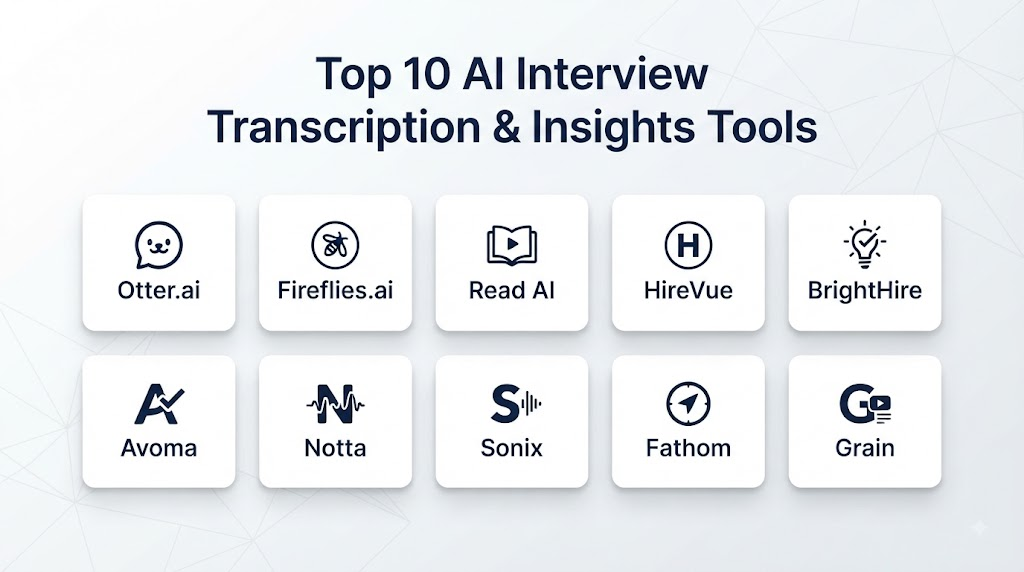
Top 10 AI Interview Transcription & Insights Tools
1. Metaview
Metaview focuses on AI-powered interview note-taking and recruiting intelligence.
Key Features
- Interview transcription
- AI-generated notes
- Interview summaries
- Candidate insights
- Recruiting workflows
- Interview documentation
Pros
- Strong recruiting focus
- Reduces manual note-taking
- Useful interview summaries
- Designed around talent acquisition workflows
Cons
- Primarily focused on recruitment use cases
- Organizations should evaluate integration and governance requirements
2. BrightHire
BrightHire provides interview intelligence capabilities designed to help recruiting teams capture, analyze, and improve interview conversations.
Key Features
- Interview transcription
- Interview notes
- AI insights
- Interview analytics
- Structured interview support
- Recruiting integrations
Pros
- Strong recruitment specialization
- Useful interview intelligence
- Supports structured hiring
- Good collaboration capabilities
Cons
- Advanced functionality may require configuration
- Best suited to organizations with structured recruiting processes
3. Pillar
Pillar provides recruiting-focused interview intelligence and automated documentation capabilities.
Key Features
- Interview transcription
- Automated notes
- Candidate insights
- Interview summaries
- Searchable interview information
- Recruiting workflows
Pros
- Recruiting-focused functionality
- Reduces manual documentation
- Useful candidate insights
- Supports interview review
Cons
- Advanced functionality may require setup
- Organizations should assess workflow integrations
4. HireVue
HireVue provides recruitment technology spanning interviewing, assessments, candidate engagement, and hiring workflows.
Key Features
- Interview transcription
- Video interviewing
- Candidate assessment
- Interview analysis
- Candidate management
- Hiring analytics
Pros
- Broad recruitment functionality
- Strong interview capabilities
- Useful assessment integration
- Supports structured hiring
Cons
- More comprehensive than a dedicated transcription platform
- Organizations should carefully evaluate AI assessment and analysis features
5. Screenloop
Screenloop provides recruiting infrastructure that includes interview intelligence, candidate management, and hiring workflow capabilities.
Key Features
- Interview transcription
- Interview notes
- Candidate feedback
- Interview management
- Hiring workflows
- Recruitment analytics
Pros
- Broad recruiting functionality
- Useful interview documentation
- Supports structured hiring
- Good workflow capabilities
Cons
- Broader platform than transcription alone
- Advanced workflows may require configuration
6. Metaview AI
Metaview’s AI capabilities can help recruiters transform interview conversations into structured notes and insights.
Key Features
- AI transcription
- Automated interview notes
- Candidate summaries
- Interview insights
- Recruiting documentation
- Searchable information
Pros
- Strong AI-assisted documentation
- Recruiter-focused
- Reduces note-taking
- Useful candidate summaries
Cons
- Primarily suited to recruitment use cases
- Organizations should evaluate privacy and data-management requirements
7. Otter.ai
Otter.ai provides AI-powered transcription, meeting notes, summaries, and searchable conversation records that can also support interview workflows.
Key Features
- Live transcription
- Speaker identification
- AI summaries
- Search
- Meeting notes
- Collaboration
Pros
- Easy to use
- Strong transcription capabilities
- Broad meeting applications
- Useful search functionality
Cons
- Not exclusively designed for recruiting
- Recruitment-specific workflows may require additional tools
8. Fireflies.ai
Fireflies.ai provides meeting transcription, summaries, search, conversation intelligence, and workflow automation.
Key Features
- Interview transcription
- AI summaries
- Speaker identification
- Searchable transcripts
- Conversation analytics
- Integrations
Pros
- Broad meeting intelligence
- Strong automation
- Useful integrations
- Searchable conversation history
Cons
- General-purpose platform
- Recruiting-specific functionality may be less extensive than specialized tools
9. Fathom
Fathom provides AI-powered meeting transcription, summaries, and conversation notes that can be applied to recruitment conversations.
Key Features
- Transcription
- AI summaries
- Key point extraction
- Search
- Meeting notes
- Conversation records
Pros
- Simple user experience
- Useful automated summaries
- Good meeting documentation
- Easy information retrieval
Cons
- Primarily a general meeting assistant
- Less specialized for complex recruitment workflows
10. Gong
Gong provides conversation intelligence and revenue-focused analytics, but its transcription and conversation analysis capabilities can also demonstrate broader applications for structured interview conversations.
Key Features
- Conversation transcription
- AI summaries
- Conversation analytics
- Search
- Topic analysis
- AI insights
Pros
- Strong conversation intelligence
- Advanced analytics
- Powerful search capabilities
- Enterprise functionality
Cons
- Primarily designed for revenue teams
- May be more extensive than needed for dedicated recruitment transcription
Comparison Table: AI Interview Transcription & Insights Tools
| No. | Platform | Best For | Transcription | AI Summaries | Interview Insights | Search | Recruiting Focus |
|---|---|---|---|---|---|---|---|
| 1 | Metaview | Recruiting interviews | Strong | Strong | Strong | Strong | Strong |
| 2 | BrightHire | Interview intelligence | Strong | Strong | Strong | Strong | Strong |
| 3 | Pillar | Recruiting documentation | Strong | Strong | Strong | Strong | Strong |
| 4 | HireVue | Interviews + assessments | Strong | Strong | Strong | Strong | Strong |
| 5 | Screenloop | Hiring workflows | Strong | Strong | Strong | Strong | Strong |
| 6 | Metaview AI | AI interview notes | Strong | Strong | Strong | Strong | Strong |
| 7 | Otter.ai | General transcription | Strong | Strong | Moderate | Strong | Moderate |
| 8 | Fireflies.ai | Meeting intelligence | Strong | Strong | Strong | Strong | Moderate |
| 9 | Fathom | Meeting summaries | Strong | Strong | Moderate | Strong | Moderate |
| 10 | Gong | Conversation intelligence | Strong | Strong | Strong | Strong | Low |
Weighted Evaluation Table
| No. | Platform | Transcription 20% | AI Summaries 20% | Interview Insights 15% | Search 15% | Integrations 10% | Ease of Use 10% | Scalability 10% | Total Score |
|---|---|---|---|---|---|---|---|---|---|
| 1 | Metaview | 20 | 20 | 15 | 15 | 10 | 9 | 10 | 99 |
| 2 | BrightHire | 20 | 20 | 15 | 15 | 10 | 9 | 10 | 99 |
| 3 | Pillar | 19 | 20 | 15 | 15 | 10 | 9 | 10 | 98 |
| 4 | HireVue | 19 | 19 | 15 | 15 | 10 | 8 | 10 | 96 |
| 5 | Screenloop | 19 | 19 | 15 | 14 | 10 | 9 | 10 | 96 |
| 6 | Metaview AI | 20 | 20 | 15 | 15 | 10 | 9 | 10 | 99 |
| 7 | Otter.ai | 20 | 19 | 13 | 15 | 10 | 10 | 10 | 97 |
| 8 | Fireflies.ai | 20 | 20 | 14 | 15 | 10 | 9 | 10 | 98 |
| 9 | Fathom | 19 | 19 | 13 | 14 | 9 | 10 | 9 | 93 |
| 10 | Gong | 20 | 20 | 15 | 15 | 10 | 8 | 10 | 98 |
Which AI Interview Transcription & Insights Tool Is Right for You?
Choose Metaview if recruiting-focused interview notes, transcription, and candidate insights are your main priorities.
Choose BrightHire if you need interview intelligence and structured hiring support.
Choose Pillar if automated recruiting documentation and candidate insights are important.
Choose HireVue if interview transcription needs to work alongside assessments and video interviewing.
Choose Screenloop if you want interview intelligence as part of a broader hiring workflow.
Choose Otter.ai if you primarily need accessible transcription and meeting intelligence that can also support interviews.
Choose Fireflies.ai if broad meeting transcription, search, summaries, and integrations are important.
Choose Fathom if simple AI meeting transcription and summaries are your primary requirements.
Choose Gong if advanced conversation intelligence is important and your organization already uses a broader conversation analytics environment.
Common Mistakes
- Treating AI-generated summaries as complete interview records
- Failing to verify important candidate statements
- Recording interviews without appropriate consent
- Ignoring data retention requirements
- Using AI-generated insights as automatic hiring decisions
- Overlooking transcription errors
- Ignoring accents or overlapping speech
- Failing to secure interview recordings
- Sharing transcripts too broadly
- Using unstructured interview questions
- Ignoring potential AI bias
- Failing to establish human review processes
FAQs
1. What are AI Interview Transcription & Insights Tools?
These tools use AI to convert interview conversations into transcripts, summaries, notes, and other structured insights that can help recruiters review interviews more efficiently.
2. How accurate is AI interview transcription?
Accuracy varies depending on audio quality, speakers, accents, background noise, overlapping conversations, and the capabilities of the transcription system. Important information should always be verified.
3. Can AI summarize an interview?
Yes. Many platforms can generate summaries that highlight major discussion points, candidate responses, qualifications, and potential follow-up items.
4. Can AI identify candidate skills during interviews?
Some systems can identify skills, experience, qualifications, and topics mentioned during conversations, although recruiters should validate these insights.
5. Can AI transcription replace interviewer notes?
It can reduce the need for manual note-taking, but interviewers should still maintain appropriate structured evaluations and verify important observations.
6. Are AI interview transcripts searchable?
Many platforms provide searchable transcripts, allowing recruiters to locate specific terms, topics, or sections of an interview.
7. What privacy concerns exist with AI interview transcription?
Interview recordings and transcripts can contain sensitive candidate information. Organizations should consider consent, access controls, retention policies, security, and applicable privacy requirements.
8. Can AI interview insights create hiring bias?
Yes. AI-generated insights or analytics can potentially introduce or reinforce bias. Organizations should use appropriate monitoring and human oversight.
9. Should recruiters rely on AI-generated interview scores?
AI-generated scores or recommendations should not be treated as definitive measures of candidate suitability. Human evaluation remains important.
10. What is the future of AI interview transcription?
The category is moving toward real-time transcription, automated interview summaries, skills extraction, structured interview insights, searchable candidate conversations, deeper ATS integration, and stronger responsible-AI controls.
Conclusion
AI Interview Transcription & Insights Tools can help recruitment teams reduce manual note-taking while making interview conversations easier to document, search, summarize, and review. They are particularly valuable for organizations conducting large numbers of interviews or managing distributed hiring teams.Metaview, BrightHire, Pillar, HireVue, Screenloop, Otter.ai, Fireflies.ai, Fathom, and other conversation intelligence platforms offer different approaches to automated interview documentation and analysis.The right solution depends on interview volume, recruitment workflow complexity, transcription requirements, integrations, security needs, and the level of candidate insight required.