Introduction
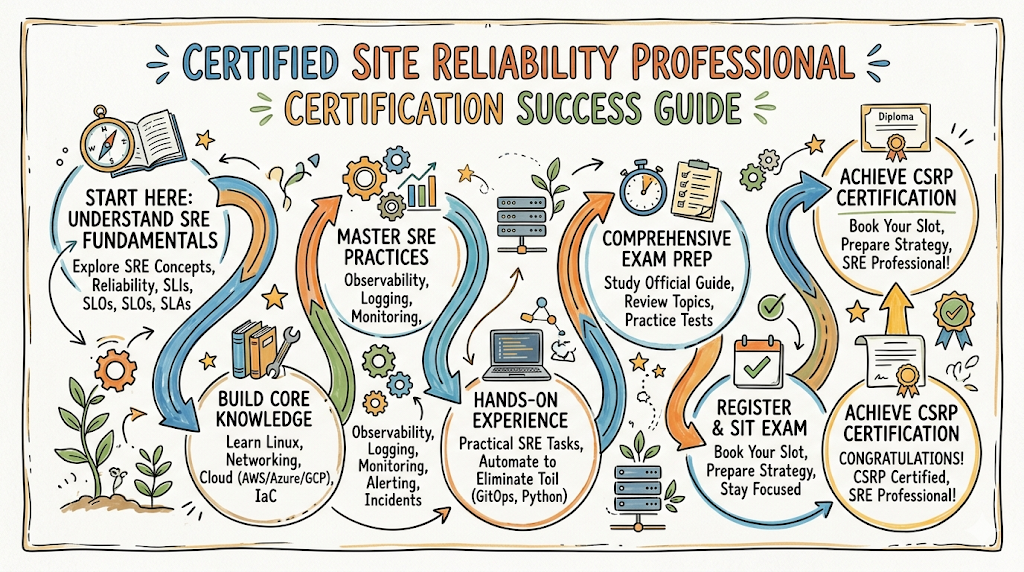
The Certified Site Reliability Professional stands as a definitive benchmark for engineers looking to master the art of balancing system reliability with the pace of software delivery. This guide is specifically designed for technical professionals and engineering leaders who recognize that modern infrastructure is no longer just about keeping the lights on but about engineering resilience into the core of the product. Whether you are navigating a transition from traditional systems administration or looking to refine your expertise in a cloud-native environment, this resource provides the clarity needed to advance. By exploring this certification, professionals can better align their skill sets with the rigorous demands of global enterprises that prioritize uptime and scalability. Leveraging the curriculum provided by Sreschool, this guide helps you navigate the complexities of error budgets, automation, and incident response to make informed decisions for your long-term career trajectory.
What is the Certified Site Reliability Professional?
The Certified Site Reliability Professional represents a shift from reactive troubleshooting to proactive reliability engineering within the modern enterprise. It exists to bridge the gap between software development and traditional operations, treating infrastructure as a software problem rather than a hardware one. This certification is not merely a theoretical exercise; it is designed to reflect the real-world complexities of managing high-traffic, distributed systems in production environments. By focusing on practical application, it ensures that practitioners understand how to implement observability, manage capacity, and handle incident retrospectives effectively. It aligns perfectly with modern workflows by emphasizing the reduction of toil through high-level automation and the use of data-driven metrics to guide operational decisions.
Who Should Pursue Certified Site Reliability Professional?
This certification is ideal for a wide range of professionals, starting with DevOps engineers and systems administrators who wish to formalize their reliability practices. Cloud architects and platform engineers will find immense value in learning how to build self-healing systems that minimize manual intervention. Even security and data professionals can benefit, as reliability is a foundational pillar of both data integrity and system availability. For beginners, it provides a structured roadmap into the world of production engineering, while experienced engineers and managers can use it to standardize reliability practices across their organizations. In the Indian market and globally, the demand for specialists who can handle massive scale is at an all-time high, making this a critical credential for career growth.
Why Certified Site Reliability Professional is Valuable Today and Beyond
In an era where digital services are expected to be available all the time, the demand for reliability expertise has never been more critical. As enterprises move away from simple setups toward complex microservices and serverless environments, the difficulty of managing these systems grows significantly. This certification provides the longevity required to stay relevant because it focuses on core principles—such as service level objectives and error budgets—that do not change when tools do. By mastering these concepts, professionals ensure they are not just tool users but engineers capable of designing resilient systems regardless of the technology stack. The return on investment for this certification is reflected in higher compensation, increased job security, and the ability to lead high-impact engineering initiatives.
Certified Site Reliability Professional Certification Overview
The Certified Site Reliability Professional program is delivered via the official portal at sreschool.com and is hosted on the Sreschool platform. The program is structured into distinct levels that cater to different career stages, moving from foundational knowledge to advanced architectural mastery. The assessment approach is focused on practical competency, requiring candidates to demonstrate their ability to solve real-world operational challenges rather than just memorizing definitions. Ownership of the certification lies with industry-recognized experts who ensure the curriculum is constantly updated to reflect the latest shifts in cloud-native and site reliability engineering practices. This structured approach allows professionals to build a deep, specialized portfolio of skills that are immediately applicable in an enterprise setting.
Certified Site Reliability Professional Certification Tracks & Levels
The certification is organized into three primary levels: Foundation, Professional, and Advanced, ensuring a clear path for career progression. The Foundation level is designed to introduce the core vocabulary and concepts of SRE, such as toil reduction and the philosophy that hope is not a strategy. The Professional level dives deeper into implementation, focusing on building observability pipelines, managing complex incidents, and automating deployments. Finally, the Advanced level is geared toward senior leads and architects who must design organization-wide reliability strategies and governance models. Beyond these levels, there are specialization tracks that allow engineers to focus on specific domains like cost reliability or secure operations, ensuring the certification evolves alongside the professional’s career interests.
Complete Certified Site Reliability Professional Certification Table
| Track | Level | Who it’s for | Prerequisites | Skills Covered | Recommended Order |
| SRE Core | Foundation | Aspiring SREs, Juniors | Basic Linux/Cloud knowledge | SLIs, SLOs, Toil, Error Budgets | 1st |
| SRE Implementation | Professional | DevOps/SREs (2+ years) | Foundation Level | Automation, Incident Mgmt, CI/CD | 2nd |
| SRE Architecture | Advanced | Senior SREs, Architects | Professional Level | Resilience Patterns, Capacity Planning | 3rd |
| Reliability Ops | Specialist | Platform Engineers | Professional Level | Observability, Chaos Engineering | Optional |
| Reliability Lead | Leadership | Engineering Managers | Professional Level | Team Building, Budgeting, Culture | Optional |
Detailed Guide for Each Certified Site Reliability Professional Certification
Certified Site Reliability Professional – Foundation Level
What it is
This level validates a candidate’s understanding of the fundamental principles that distinguish SRE from traditional IT operations. It ensures a baseline competency in the philosophy of reliability and the standard metrics used to measure system health.
Who should take it
It is suitable for junior engineers, computer science graduates, or experienced developers and sysadmins who are new to the SRE paradigm. It is also recommended for project managers who need to communicate effectively with technical reliability teams.
Skills you’ll gain
- Defining Service Level Indicators (SLIs) and Service Level Objectives (SLOs).
- Identifying and quantifying operational toil within a workflow.
- Understanding the concept of Error Budgets and how they balance risk.
- Grasping the fundamentals of incident response and post-mortem culture.
Real-world projects you should be able to do
- Create a basic dashboard monitoring the four golden signals for a simple application.
- Draft a sample Service Level Agreement (SLA) based on business requirements.
- Perform a simple toil analysis on a repetitive manual task and propose an automation plan.
Preparation plan
- 7-14 Days: Focus on the core definitions and the SRE handbook principles; review the differences between DevOps and SRE.
- 30 Days: Work through sample case studies on SLO violations and practice calculating error budgets based on uptime percentages.
- 60 Days: Implement a small-scale monitoring setup using open-source tools to see the concepts in action before taking the exam.
Common mistakes
- Treating SLOs as rigid targets rather than living documents that can change.
- Failing to distinguish between a symptom and a root cause during practice scenarios.
- Overlooking the cultural aspects of SRE, such as a blameless work environment.
Best next certification after this
- Same-track option: Certified Site Reliability Professional – Professional Level.
- Cross-track option: Certified Cloud Practitioner or DevOps Foundation.
- Leadership option: Certified SRE Lead or Management Essentials.
Certified Site Reliability Professional – Professional Level
What it is
This level focuses on the practical execution of SRE duties, validating the ability to build and maintain resilient infrastructure. It bridges the gap between understanding what SRE is and knowing how to implement it at scale in a real environment.
Who should take it
This is aimed at mid-level engineers with at least two years of experience in cloud or operations roles. It is the standard for those actively working as SREs or DevOps engineers who want to validate their implementation skills.
Skills you’ll gain
- Implementing advanced observability stacks with tracing and logging.
- Managing complex incident life cycles and conducting effective blameless post-mortems.
- Automating infrastructure using Infrastructure as Code (IaC) and configuration management.
- Designing automated canary releases and blue-green deployment strategies.
Real-world projects you should be able to do
- Set up a comprehensive monitoring and dashboard stack for a multi-service environment.
- Write a detailed post-mortem report for a simulated production outage.
- Build an automated delivery pipeline that includes automated rollbacks based on system health.
Preparation plan
- 7-14 Days: Review advanced networking, container orchestration, and complex automation scripts.
- 30 Days: Deep dive into incident management frameworks and practice writing automation logic for incident fixes.
- 60 Days: Focus on hands-on labs involving distributed tracing and performance tuning for production workloads.
Common mistakes
- Focusing too much on specific tools rather than the underlying architectural patterns.
- Underestimating the difficulty of managing stateful applications in a distributed system.
- Neglecting the communication aspect of incident response during simulated exams.
Best next certification after this
- Same-track option: Certified Site Reliability Professional – Advanced Level.
- Cross-track option: Certified DevSecOps Professional or FinOps Practitioner.
- Leadership option: Engineering Manager Certification or Technical Lead Path.
Certified Site Reliability Professional – Advanced Level
What it is
The Advanced level validates the ability to design high-level reliability strategies for entire organizations. It focuses on large-scale architectural patterns, capacity planning, and the governance of reliability across multiple teams.
Who should take it
This is intended for senior SREs, principal engineers, and infrastructure architects. Candidates should have a deep background in managing production systems at scale and a clear understanding of business and technical goals.
Skills you’ll gain
- Designing multi-region, highly available architectures with automated failover.
- Performing advanced capacity planning and forecasting using historical data.
- Implementing chaos engineering experiments to discover system weaknesses.
- Leading organizational change to adopt SRE practices at the enterprise level.
Real-world projects you should be able to do
- Design a disaster recovery plan for a global application with a very short recovery time.
- Execute a controlled chaos engineering experiment on a production-like environment.
- Develop a cross-team reliability roadmap that aligns with annual business goals.
Preparation plan
- 7-14 Days: Review high-level system design patterns and global traffic management strategies.
- 30 Days: Analyze enterprise-level case studies of system failures and the architectural changes that followed.
- 60 Days: Conduct mock architectural reviews and focus on the financial and business impact of reliability decisions.
Common mistakes
- Proposing overly complex solutions where simpler, more reliable ones exist.
- Ignoring the cost implications of high-availability designs.
- Failing to account for the human and process-related bottlenecks in global organizations.
Best next certification after this
- Same-track option: Specialist tracks in AI-driven Operations.
- Cross-track option: Certified Cloud Solutions Architect (Expert Level).
- Leadership option: CTO or VP of Engineering development programs.
Choose Your Learning Path
DevOps Path
The DevOps path focuses on the integration of development and operations through a continuous delivery lens. It emphasizes the speed of delivery and the stability of the pipeline. Professionals on this path should start with the Foundation level to understand reliability metrics and then move to the Professional level to master deployment automation. This ensures that as they increase the speed of releases, they have the necessary safeguards to maintain system health and performance.
DevSecOps Path
The DevSecOps path integrates security into the heart of the reliability engineering lifecycle. Engineers here focus on ensuring that automated systems are not only reliable but also resilient to attacks and compliant with regulations. This path requires a blend of the Professional SRE level with specific security tooling and philosophies. It is ideal for those who want to ensure that secure and reliable are treated as the same objective in a production environment.
SRE Path
The pure SRE path is the most direct route for those wishing to specialize in high-scale production engineering. It follows the progression from Foundation to Advanced levels, focusing deeply on the golden signals and the mathematical aspects of error budgeting. This path is perfect for engineers at large tech companies or high-growth startups where uptime is directly tied to revenue. It builds a specialist who can handle the most complex distributed systems with complete confidence.
AIOps Path
The AIOps path is designed for engineers looking to leverage machine learning and artificial intelligence to automate operational tasks. It involves using data science to predict outages, automate root cause analysis, and manage capacity dynamically. Professionals on this path should focus on the data-driven aspects of the Professional and Advanced SRE levels. This ensures that the AI models are grounded in real operational metrics and reliability goals for the business.
MLOps Path
The MLOps path focuses on the reliability of machine learning models in production, treating model drift and training pipelines as operational concerns. Engineers here apply SRE principles to the lifecycle of an ML model, ensuring that the infrastructure supporting the AI remains robust and reliable. It is a niche but rapidly growing field that requires a strong Foundation in SRE principles combined with specialized knowledge of data pipelines and model management.
DataOps Path
The DataOps path applies reliability engineering to data engineering and data science workflows. It focuses on the consistency, quality, and availability of data pipelines, ensuring that data-driven decisions are made on reliable information. SRE principles like SLOs are applied to data freshness and accuracy metrics. This is an essential path for organizations that rely on real-time analytics and big data for their core business operations and decision-making processes.
FinOps Path
The FinOps path intersects reliability engineering with cloud financial management. It focuses on building cost-efficient systems that do not sacrifice performance or uptime for the sake of savings. Engineers learn to treat cost as a reliability metric, ensuring that the infrastructure is sustainable from a business perspective. This path is increasingly popular among senior leaders who need to manage massive cloud budgets while maintaining world-class service levels and performance.
Role → Recommended Certified Site Reliability Professional Certifications
| Role | Recommended Certifications |
| DevOps Engineer | Foundation, Professional |
| SRE | Foundation, Professional, Advanced |
| Platform Engineer | Professional, Advanced |
| Cloud Engineer | Foundation, Professional |
| Security Engineer | Foundation, Professional |
| Data Engineer | Foundation, Professional |
| FinOps Practitioner | Foundation, Professional |
| Engineering Manager | Foundation, Professional |
Next Certifications to Take After Certified Site Reliability Professional
Same Track Progression
Deepening your specialization within the SRE domain involves moving toward architectural and strategic roles. Once you have completed the Advanced level, the logical next step is to focus on Chaos Engineering or Performance Engineering certifications. These niche areas allow you to become a subject matter expert in specific high-value domains. Staying within the track ensures you remain at the cutting edge of how systems are built for massive scale and high resilience.
Cross-Track Expansion
Skill broadening is essential for engineers who want to become well-rounded professionals. After mastering SRE, moving into Cloud Solutions Architecture or Security provides a broader context for your reliability work. For example, understanding the intricacies of cloud-native security helps an SRE build more resilient systems that are protected against external threats. This broadening of skills makes you a versatile asset to any engineering organization and opens doors to varied career opportunities.
Leadership & Management Track
For those looking to transition from technical roles to leadership, the focus shifts from technical implementation to people and process management. Certifications in Technical Leadership or Engineering Management are the ideal follow-up to an Advanced SRE credential. These programs teach you how to build SRE cultures, manage budgets, and align engineering efforts with business outcomes. This transition allows you to influence reliability at an organizational level rather than just a single system.
Training & Certification Support Providers for Certified Site Reliability Professional
DevOpsSchool
DevOpsSchool is a leading global provider of technical training, specializing in DevOps, SRE, and cloud-native technologies. With many years of experience, they offer comprehensive programs designed to take students from foundational concepts to expert-level mastery. Their curriculum for the Certified Site Reliability Professional is highly regarded for its hands-on approach and real-world relevance. They provide a mix of instructor-led sessions and self-paced learning to suit different styles. By focusing on the latest tools and industry best practices, DevOpsSchool ensures that its graduates are ready to meet the demands of modern engineering teams.
Cotocus
Cotocus focuses on delivering high-impact consulting and training services to enterprises and individual professionals. They are known for their deep expertise in site reliability engineering and platform engineering, providing tailored programs that align with specific corporate needs. Their training for the Certified Site Reliability Professional emphasizes architectural patterns and the cultural shifts necessary for successful SRE adoption. Cotocus leverages a network of industry veterans to provide mentorship and practical insights that go beyond standard learning. This makes them an excellent choice for organizations looking to upskill their workforce in modern reliability practices.
Scmgalaxy
Scmgalaxy is a prominent community-driven platform and training provider that has been at the forefront of the DevOps movement for many years. They offer a wealth of resources, including blogs, tutorials, and specialized certification training for site reliability professionals. Their approach to the Certified Site Reliability Professional program is rooted in community feedback and technical excellence. Scmgalaxy provides a supportive environment where learners can interact with peers and experts to solve complex challenges. Their commitment to continuous learning and resource sharing has made them a trusted name for engineers looking to stay updated on infrastructure management.
BestDevOps
BestDevOps is dedicated to providing high-quality, curated training paths for aspiring and experienced DevOps and SRE professionals. Their certification support for the Certified Site Reliability Professional is designed to be accessible yet rigorous, ensuring that candidates truly master the subject matter. They offer specialized modules that cover everything from basic monitoring to advanced observability and chaos engineering. BestDevOps focuses on providing a clear roadmap for career advancement, helping individuals identify the right skills to focus on at each stage. Their practical labs and assessments ensure that learners can apply their knowledge immediately.
devsecopsschool.com
DevSecOpsSchool.com is the premier destination for professionals looking to integrate security into their reliability and development workflows. They offer specialized training that complements the Certified Site Reliability Professional program by focusing on secure infrastructure and automated compliance. Their curriculum emphasizes the philosophy of building security into the heart of systems. With a strong focus on practical tooling and real-world scenarios, DevSecOpsSchool.com prepares engineers to handle the dual challenges of system uptime and data protection. This makes them an invaluable resource for professionals operating in highly regulated or security-conscious industries.
sreschool.com
Sreschool.com is the primary platform for the Certified Site Reliability Professional credential. They are dedicated exclusively to the field of site reliability engineering, offering a deep and focused curriculum that is unmatched in the industry. Their programs are designed by active practitioners who understand the daily challenges of managing production systems. Sreschool.com provides a complete learning environment, including official study guides and interactive labs. Their focus on the specific needs of SREs ensures that every module is relevant, practical, and geared toward solving the most pressing reliability issues faced by modern enterprises.
aiopsschool.com
Aiopsschool.com specializes in the intersection of artificial intelligence and IT operations. They provide advanced training that helps Certified Site Reliability Professionals leverage machine learning to enhance system reliability and automation. Their curriculum covers predictive analytics, automated root cause analysis, and AI-driven capacity management. By focusing on the future of operations, Aiopsschool.com prepares engineers to manage increasingly complex systems that are beyond the reach of manual intervention. Their programs are essential for those looking to lead the next wave of operational innovation and bring intelligent automation to their organizations.
dataopsschool.com
Dataopsschool.com is focused on bringing the rigor of SRE and DevOps to the world of data engineering and analytics. They offer specialized training that teaches professionals how to apply reliability principles to data pipelines and large-scale data platforms. Their support for the Certified Site Reliability Professional program includes specific modules on data observability and pipeline resilience. Dataopsschool.com bridges the gap between traditional operations and the unique demands of data-centric workflows. This makes them a critical training provider for engineers working in data-heavy environments where the reliability of information is vital.
finopsschool.com
Finopsschool.com is the leading provider of training for cloud financial management and cost optimization. They help Certified Site Reliability Professionals understand the financial impact of their technical decisions, promoting a culture of cost-aware engineering. Their curriculum integrates SRE principles with financial accountability, teaching engineers how to balance performance, reliability, and cost. Finopsschool.com provides the tools and frameworks necessary to manage cloud spend in a way that supports business growth. Their training is vital for senior SREs and leads who are responsible for large-scale infrastructure budgets and need to show value.
Frequently Asked Questions (General)
- How difficult is the certification for someone with no prior site reliability experience?
The entry-level program is designed to be accessible for those new to the field, provided they have a basic understanding of cloud systems. However, the higher levels are quite challenging and require hands-on experience in managing production environments.
- What is the average time required to prepare for the Foundation level?
Most candidates find that 30 days of consistent study, involving about five to ten hours per week, is enough to master the core concepts and feel prepared for the exam.
- Are there any specific technical prerequisites I should know about?
While the entry level has no strict prerequisites, having a basic understanding of Linux, networking, and at least one major cloud provider is very helpful for your success.
- How long does the certification remain valid after I pass?
Typically, the certification is valid for two to three years. After this time, professionals are encouraged to renew or move up to a higher level to ensure their skills remain current.
- Does this certification help in getting a salary increase?
Yes, site reliability engineering is one of the highest-paying roles in the technology industry today. Holding a recognized certification validates your expertise and often leads to better compensation.
- Can I take the certification exam online from home?
Yes, the exams are delivered through a secure online proctoring system. This allows you to take the test from anywhere in the world as long as you have a stable internet connection.
- Is there a practical component to the exam?
The Professional and Advanced levels often include scenario-based questions or hands-on labs that test your ability to solve real-world operational problems rather than just memory.
- How does this differ from a standard DevOps certification?
While DevOps focuses on the entire software delivery process, SRE is a specific way of doing DevOps that focuses primarily on system reliability and how production systems are run.
- Are the study materials provided by the hosting site sufficient?
Yes, the official curriculum and study guides are very thorough. However, reading industry-standard handbooks and blogs can provide extra context and deeper understanding.
- Is this certification recognized by global technology companies?
Absolutely. The principles taught are industry standards used by major tech companies worldwide, making the credential highly valuable in any market or country.
- What happens if I do not pass the exam on my first try?
Most providers have a clear retake policy. You should review your score report to see which areas need improvement and spend more time on those topics before trying again.
- Can I skip the Foundation level if I already have experience?
If you have significant experience in a reliability role, some paths might allow you to go straight to the Professional level, but the Foundation level is recommended for a full understanding.
FAQs on Certified Site Reliability Professional
- What is the core focus of the Certified Site Reliability Professional curriculum?
The program focuses on using software to automate operations, managing error budgets, and using observability to ensure systems stay healthy and reliable for users.
- How does this certification address modern cloud technologies?
The curriculum is built around modern practices like container management, microservices, and automated infrastructure, ensuring your skills work in today’s cloud environments.
- Is chaos engineering part of the Advanced level of this program?
Yes, chaos engineering is a key part of the Advanced track because it is essential for finding hidden weaknesses in complex systems before they cause real outages.
- Does the program cover incident management and learning from failures?
Yes, the Professional level provides a deep dive into how to handle incidents and how to conduct blameless reviews so that the team can learn and improve.
- How are SLOs and SLIs handled in the certification process?
These are core topics. The program teaches you how to define and measure these metrics to balance the need for reliability with the need to release new features quickly.
- Is reducing manual work a major theme of the training?
Absolutely. A large part of the certification focuses on identifying manual, repetitive tasks and using automation to replace them with efficient and scalable software solutions.
- What role does observability play in the certification?
Observability is a main pillar. The program covers how to use metrics, logs, and traces to see deep into how your systems are performing and where problems might be.
- How does the certification help with my long-term career growth?
It provides a clear path from junior roles to senior leadership positions, validating the specialized skills you need at every stage of your career as a reliability professional.
Conclusion
As someone who has seen the evolution of operations from manual work to software-defined systems, I can say that the Certified Site Reliability Professional is a high-value investment. It moves beyond the hype and provides a real framework for managing systems at scale. The industry no longer rewards those who just fix things when they break; it rewards those who can build systems that do not break in the first place. This certification provides the mental models and technical skills required to be that kind of engineer. If you are serious about a career in production engineering, this credential provides the rigor and recognition needed to stand out. It is a practical, experience-driven path that respects the complexity of the modern enterprise and gives you the tools to master it.
Very informative post. I liked how it highlights key SRE concepts like automation, observability, and incident management for real-world success.
Great guide on Certified SRE Professional—clear and practical for understanding modern reliability practices and career growth in SRE.