Introduction
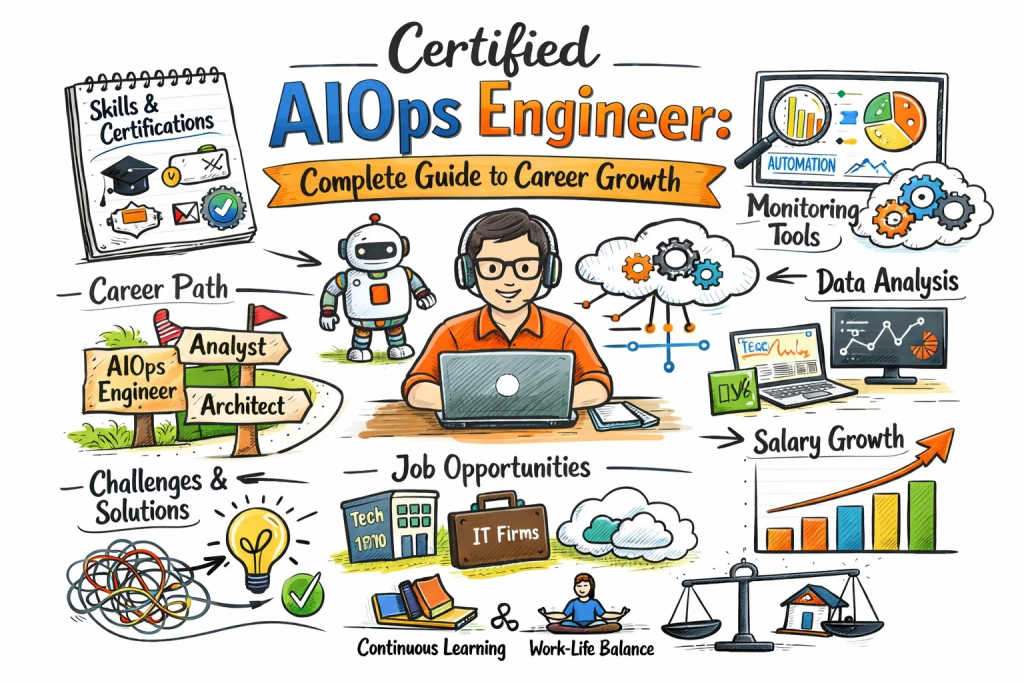
The integration of artificial intelligence into IT operations is no longer a futuristic concept but a present-day requirement for scalable infrastructure. For professionals looking to lead this transition, the Certified AIOps Engineer program offers a robust framework for mastering intelligent automation. This guide is hosted on aiopsschool and serves as a roadmap for engineers who want to move beyond manual troubleshooting. By focusing on data-driven decision-making and algorithmic system management, this certification prepares you for the high-pressure demands of modern production environments. It is a critical step for anyone aiming to stay relevant in the evolving fields of DevOps and site reliability engineering.
Understanding the Certified AIOps Engineer
The Certified AIOps Engineer designation represents a shift from reactive monitoring to proactive, self-healing system architecture. It exists to address the massive amounts of data generated by cloud-native applications that are now too complex for human teams to manage alone. This certification focuses on teaching engineers how to implement machine learning models that can identify patterns and predict failures before they impact users.
Unlike general AI courses, this program is rooted in production-grade engineering workflows and enterprise-level infrastructure requirements. It aligns with the needs of modern organizations that require high availability and rapid incident response through automation. By mastering these principles, professionals can transition from performing repetitive tasks to designing sophisticated, autonomous operational platforms.
Who Should Pursue Certified AIOps Engineer
This learning path is specifically designed for DevOps engineers, Site Reliability Engineers, and Platform engineers who want to enhance their automation capabilities. It is also highly suitable for cloud architects and data professionals who are increasingly involved in the operational stability of distributed systems. Even security and compliance professionals will find value in learning how AI can be used for anomaly detection and threat response.
Beginners who have a foundation in Linux and cloud services can use this as a career accelerator to enter high-demand roles. Experienced engineers and technical managers can utilize the program to modernize their skill sets and lead digital transformation initiatives within their companies. This certification is globally recognized and holds significant value for professionals working in major tech hubs, including India and North America.
Why Certified AIOps Engineer is Valuable Today and Beyond
The value of this certification lies in its focus on the future of infrastructure management where human intervention is minimized. As enterprises continue to adopt multi-cloud and microservices, the demand for engineers who can manage these environments using AI will only increase. This program ensures that your skills remain relevant even as specific monitoring tools and cloud providers change over time.
Investing in this certification provides a strong return on time because it addresses the most critical bottleneck in modern engineering: operational complexity. Companies are actively looking for specialists who can reduce “toil” and improve system reliability through intelligent software. By earning this credential, you position yourself as a high-value asset capable of driving efficiency and reducing operational costs for any organization.
Certified AIOps Engineer Certification Overview
The Certified AIOps Engineer program is a comprehensive curriculum that covers the full spectrum of intelligent IT operations. It is delivered through a series of structured modules that include both theoretical concepts and practical, hands-on lab exercises. The certification levels are designed to provide a clear progression for learners, ensuring they build a solid foundation before moving to advanced topics.
The assessment process is rigorous and focused on real-world scenarios, which ensures that certificate holders possess practical, job-ready skills. It covers essential domains such as data ingestion, anomaly detection, automated root cause analysis, and self-healing systems. Ownership and oversight of the program are maintained by industry experts who understand the evolving challenges of large-scale system administration and cloud engineering.
Certified AIOps Engineer Certification Tracks and Levels
The program is structured into three primary tiers: Foundation, Professional, and Advanced, to support engineers at various career stages. The Foundation level introduces the core concepts of AIOps and the basic data science principles used in operations. The Professional level focuses on the practical implementation of tools and the creation of automated incident response workflows.
The Advanced level is intended for architects and leads who are responsible for designing company-wide AIOps strategies and complex automated ecosystems. There are also specialized tracks available for those who want to focus specifically on SRE integration, security automation, or financial operations. This tiered approach allows professionals to tailor their learning journey to their specific career goals and technical interests.
Complete Certified AIOps Engineer Certification Table
| Track | Level | Who it’s for | Prerequisites | Skills Covered | Recommended Order |
| 1. Core Ops | Foundation | Junior Engineers | Linux Basics | Data Collection, AIOps Basics | First |
| 2. Automation | Professional | DevOps / SRE | 2 Years Experience | Anomaly Detection, Remediation | Second |
| 3. Architecture | Advanced | Senior Leads | 5 Years Experience | Strategic Planning, AI Design | Third |
| 4. Security | Specialist | Security Engineers | Security Basics | AI-Driven Threat Detection | Optional |
| 5. Cost Mgmt | Specialist | FinOps Leads | Cloud Concepts | Predictive Cost Modeling | Optional |
Detailed Guide for Each Certified AIOps Engineer Certification
Certified AIOps Engineer – Foundation Level
What it is
- This certification validates a fundamental understanding of how AI techniques are applied to traditional IT monitoring and management.
- It serves as an entry point for engineers who need to understand the terminology and basic architecture of an AIOps platform.
Who should take it
- Ideal for sysadmins, junior DevOps engineers, and college graduates looking to specialize in modern infrastructure automation.
- It is also beneficial for managers who need a high-level understanding of how AI impacts their engineering teams.
Skills you’ll gain
- Understanding the difference between traditional and intelligent monitoring.
- Basics of data types including logs, metrics, and traces.
- Knowledge of standard AIOps workflows and data pipelines.
- Familiarity with the common tools used in the AIOps ecosystem.
Real-world projects you should be able to do
- Configure a basic data collection agent for a small server cluster.
- Use an AIOps tool to identify simple patterns in application logs.
Preparation plan
- 7-14 Days: Familiarize yourself with AIOps terminology and core concepts through official guides.
- 30 Days: Complete all foundational modules and participate in introductory labs.
- 60 Days: Review case studies and pass practice exams to ensure concept mastery.
Common mistakes
- Trying to learn complex machine learning algorithms before understanding operational data.
- Ignoring the importance of clean data sources in the AIOps process.
Best next certification after this
- Same-track option: Professional AIOps Engineer.
- Cross-track option: SRE Foundation.
- Leadership option: Digital Transformation Specialist.
Certified AIOps Engineer – Professional Level
What it is
- This certification confirms your ability to implement, manage, and optimize AIOps platforms in a production environment.
- It focuses on practical application, ensuring that you can build systems that actively reduce operational noise and solve problems.
Who should take it
- Intermediate engineers with experience in DevOps or SRE roles who are tasked with implementing automation.
- Platform engineers responsible for maintaining the health of large-scale cloud applications.
Skills you’ll gain
- Implementing automated root cause analysis across distributed systems.
- Building and tuning noise reduction filters for alerting systems.
- Creating automated self-healing scripts for common infrastructure failures.
- Integrating AIOps tools with existing CI/CD and incident management platforms.
Real-world projects you should be able to do
- Set up an end-to-end automated remediation workflow for a database failure.
- Design a predictive alerting system that identifies potential resource exhaustion.
Preparation plan
- 7-14 Days: Deep dive into tool-specific integration guides and advanced automation scripts.
- 30 Days: Focus on building complex labs that simulate production outages and remediation.
- 60 Days: Complete advanced scenarios and troubleshoot failing automation pipelines.
Common mistakes
- Relying on automation without proper testing, leading to “cascading failures.”
- Failing to communicate the value of AIOps to non-technical stakeholders.
Best next certification after this
- Same-track option: Advanced AIOps Architect.
- Cross-track option: Certified DevSecOps Professional.
- Leadership option: Engineering Manager Track.
Choose Your Learning Path
1. DevOps Path
The DevOps path focuses on using AI to improve the speed and reliability of the software delivery lifecycle. Engineers learn how to use predictive analytics to identify potential bugs or deployment risks before they reach production users. This path is essential for teams looking to achieve high deployment frequency while maintaining strict system stability. It bridges the gap between fast-paced development and reliable operations.
2. DevSecOps Path
In this path, the emphasis is on integrating AI-driven security checks into every stage of the development process. Professionals learn to use AIOps to detect sophisticated security threats and vulnerabilities that traditional scanners might miss. This proactive approach to security is critical for protecting sensitive data in modern cloud environments. It helps security teams keep pace with the rapid speed of DevOps deployments.
3. SRE Path
The SRE path is dedicated to using AI to maintain Service Level Objectives and manage error budgets more effectively. It focuses on reducing “toil” by automating the resolution of frequent, low-level incidents. SREs learn to use machine learning to gain deeper insights into system performance and reliability trends over time. This path is ideal for those managing massive, globally distributed infrastructure.
4. AIOps Path
This is a dedicated specialist path for those who want to be at the core of the intelligent operations movement. It covers the entire lifecycle of data from ingestion and cleaning to model training and automated response. Professionals on this path often become the architects of the platforms that other engineering teams use. It requires a deep commitment to mastering both infrastructure and operational data science.
5. MLOps Path
The MLOps path focuses specifically on the challenges of deploying and managing machine learning models in production. It applies traditional DevOps principles to the machine learning lifecycle to ensure models are reliable and reproducible. This path is vital for companies whose core products are driven by AI and machine learning. It ensures that ML models are as stable as the infrastructure they run on.
6. DataOps Path
DataOps ensures that the data pipelines feeding into AIOps and other systems are high-quality and reliable. This path teaches engineers how to manage data as code and automate the testing and deployment of data workflows. Without strong DataOps, AIOps systems will suffer from “garbage in, garbage out” issues. It is a critical specialty for any organization that relies heavily on data-driven decision-making.
7. FinOps Path
The FinOps path uses AI to manage cloud costs and optimize resource usage across complex, multi-cloud environments. Professionals learn to use predictive modeling to forecast future spending and identify opportunities for immediate savings. This path is becoming increasingly important as companies look to maximize their cloud investment. It combines technical cloud knowledge with financial accountability and strategy.
Role → Recommended Certified AIOps Engineer Certifications
| Role | Recommended Certifications |
| DevOps Engineer | AIOps Professional, DevSecOps Professional |
| SRE | AIOps Professional, SRE Advanced |
| Platform Engineer | AIOps Architect, Cloud Infrastructure Master |
| Cloud Engineer | AIOps Foundation, Multi-Cloud Specialist |
| Security Engineer | AI-Driven Security, DevSecOps Professional |
| Data Engineer | DataOps Professional, MLOps Specialist |
| FinOps Practitioner | AIOps for Finance, Cloud Cost Architect |
| Engineering Manager | AIOps Strategy and Leadership |
Next Certifications to Take After Certified AIOps Engineer
1. Same Track Progression
Once you have completed the core AIOps certifications, you should look for deep-dive specializations in advanced machine learning for operations. This could include focusing on neural networks or advanced statistical modeling for complex system behaviors. Mastering these advanced topics will help you move into principal architect roles where you design custom automation solutions. Continuous learning in this track ensures you stay at the absolute forefront of the industry.
2. Cross-Track Expansion
Expanding your expertise into related fields like DevSecOps or DataOps will make you a more versatile and valuable professional. Understanding how AI impacts multiple domains allows you to provide more comprehensive solutions to your organization. This cross-training is highly valued in modern engineering cultures that prioritize broad technical knowledge. It allows you to lead cross-functional teams and solve complex, multi-dimensional business problems effectively.
3. Leadership & Management Track
For those aiming for senior management or executive roles, certifications in technical leadership and digital strategy are the next logical steps. These programs help you translate technical automation successes into tangible business outcomes and ROI. This track is designed for those who want to drive company-wide technical vision and manage large engineering departments. It focuses on the strategic implementation of technology rather than just the day-to-day management.
Training & Certification Support Providers
1. DevOpsSchool
DevOpsSchool is a premier destination for professionals seeking in-depth training in DevOps, SRE, and automation technologies. They offer a vast library of courses that are carefully designed to meet the current demands of the global tech industry. Their training methodology emphasizes hands-on experience, ensuring that students can apply what they learn in real-world scenarios immediately. With a team of expert trainers who have extensive industry experience, DevOpsSchool provides a learning environment that is both challenging and supportive. They have helped thousands of engineers advance their careers through structured certification programs and ongoing community support. Their focus on practical skills and job readiness makes them a top choice for aspiring automation experts.
2. Cotocus
Cotocus is a specialized technical training and consulting firm that focuses on high-end infrastructure and automation frameworks for modern enterprises. They are known for their intensive bootcamps and customized corporate training programs that deliver immediate technical results. Their trainers are active consultants who bring current production-level challenges into the classroom for students to solve. Cotocus prides itself on its ability to teach complex technologies in a way that is accessible yet technically rigorous. They provide a unique learning experience that combines deep theory with practical, outcome-oriented labs and projects. For professionals looking to master niche or advanced technical domains, Cotocus offers unparalleled expertise and guidance.
3. Scmgalaxy
Scmgalaxy has established itself as a leading community and training resource for software configuration management and DevOps professionals. They provide a wealth of free tutorials, guides, and structured training programs that cover a wide range of automation tools. Their approach is heavily centered on community engagement, allowing learners to benefit from the collective knowledge of thousands of peers. Scmgalaxy offers practical, common-sense training that focuses on the tools and techniques actually used in the industry today. Their long history in the field has made them a trusted name for engineers looking to upskill or transition into new technical roles. They continue to be a vital resource for the global DevOps community.
4. BestDevOps
BestDevOps focuses on providing streamlined, efficient, and highly effective certification paths for busy engineering professionals who need to see results quickly. Their curriculum is designed to strip away the fluff and focus on the core skills needed to pass exams and perform on the job. They use modern instructional design to ensure high retention rates and clear understanding of complex topics like AI and cloud architecture. BestDevOps offers a variety of flexible learning options, including self-paced courses and instructor-led sessions, to fit any schedule. Many professionals have successfully accelerated their careers by following the clear and concise roadmaps provided by BestDevOps. They are a great choice for targeted skill development.
5. devsecopsschool.com
devsecopsschool.com is the industry leader for specialized training at the intersection of security, development, and operations. They provide deep-dive courses that teach engineers how to automate security checks and maintain compliance in fast-moving DevOps environments. Their instructors are security experts who understand the practical challenges of integrating protection without slowing down the development process. The school offers certifications that are highly respected by employers in finance, healthcare, and other highly regulated sectors. Students learn how to build “security-by-design” into their infrastructure and applications using the latest AI and automation tools. This specialized focus makes devsecopsschool.com the go-to resource for modern security professionals.
6. sreschool.com
sreschool.com is dedicated to the art and science of Site Reliability Engineering, providing training based on the industry’s most successful frameworks. They teach engineers how to manage massive scale and high availability using data-driven principles like error budgets and SLIs. The courses are deeply technical and focus on the practical tools needed to reduce downtime and improve system resilience. Learners gain experience in automated incident response, capacity planning, and post-mortem analysis in production-like environments. sreschool.com is a key partner for organizations looking to modernize their operations and adopt an SRE culture. Their certifications validate that an engineer has the mindset and skills to maintain the world’s most critical systems.
7. aiopsschool.com
aiopsschool.com is the primary training hub for the Certified AIOps Engineer program and other AI-focused operational disciplines. They offer a comprehensive curriculum that takes students from the foundations of data science to advanced autonomous system design. Their training is unique in its focus on the intersection of artificial intelligence and infrastructure management. With state-of-the-art labs and a curriculum developed by AIOps pioneers, they provide the most direct path to mastering this emerging field. aiopsschool.com is committed to defining the standards of excellence for intelligent operations training worldwide. It is the essential destination for any engineer who wants to lead in the era of AI-driven infrastructure.
8. dataopsschool.com
dataopsschool.com addresses the critical need for reliability and speed in managing the data pipelines that drive modern business intelligence and AI. They teach engineers how to apply DevOps principles to data management, ensuring that data is high-quality, secure, and always available. Their courses cover data versioning, automated testing of pipelines, and data governance as code. The instructors at dataopsschool.com are experienced data architects who have managed some of the world’s most complex data ecosystems. Their certifications are becoming increasingly important as companies realize that successful AI starts with robust DataOps. They are the leading authority on this vital and rapidly growing engineering specialty.
9. finopsschool.com
finopsschool.com provides the specialized training needed to manage and optimize cloud spending in a multi-cloud world. They teach professionals how to use AI and data analytics to identify waste, forecast costs, and drive financial accountability. Their courses are designed for both technical engineers who manage resources and financial professionals who need to understand cloud economics. Students learn how to build a FinOps culture that balances cost, speed, and quality effectively. As cloud budgets continue to grow, the skills taught at finopsschool.com are essential for business sustainability and technical efficiency. They are the premier provider for anyone looking to master the financial side of cloud operations.
Frequently Asked Questions (General)
- How difficult is the certification exam for this program?
Answer: The difficulty is moderate to high, as it requires a solid understanding of both infrastructure operations and the basic principles of machine learning. The Foundation level is designed to be accessible, while the Advanced level requires significant real-world experience.
- What are the primary prerequisites for enrolling in the course?
Answer: Most tracks require a basic understanding of Linux, cloud computing concepts, and at least one scripting language like Python. Specific prerequisites vary by level, with professional tiers requiring 2-3 years of relevant industry experience.
- How much time should I dedicate to complete a certification?
Answer: On average, most professionals spend between 30 to 60 days to complete a level. This includes time for watching lectures, completing hands-on labs, and studying for the final assessment.
- Is the exam conducted in an online or offline format?
Answer: The exams are typically conducted in an online proctored format, allowing candidates from around the world to take them at their convenience. This ensures global accessibility for all interested professionals.
- Will this certification help me get a higher salary?
Answer: Yes, skills in AIOps and intelligent automation are in high demand and short supply. Professionals with these validated skills often command significantly higher salaries and are eligible for more senior roles.
- Does the certification have an expiration date?
Answer: To ensure that your skills remain current with rapidly changing technology, these certifications usually require renewal every two to three years. This can be done through a recertification exam or continuing education credits.
- Do I need to be an expert in mathematics to pass?
Answer: No, the program focuses on the application of AI to operations rather than the deep mathematical theory of creating new algorithms. You should be comfortable with data concepts but do not need a background in advanced calculus.
- Are hands-on labs included as part of the training?
Answer: Yes, practical labs are a cornerstone of the curriculum. You will have access to sandbox environments where you can practice implementing AIOps tools and workflows on real infrastructure.
- Can these certifications be taken by engineering managers?
Answer: Absolutely, managers can benefit greatly from the Foundation and Leadership tracks. It helps them understand the technical challenges their teams face and how to strategically implement AI in their departments.
- Is the curriculum based on specific vendor tools?
Answer: While specific tools are used in the labs for demonstration, the curriculum focuses on vendor-neutral principles. This ensures that the knowledge you gain can be applied to any AIOps platform or cloud provider.
- What kind of support is available during the training?
Answer: Most providers offer a combination of community forums, mentor support, and technical help desks to assist you through difficult concepts. This ensures you never get stuck while progressing through the modules.
- Are there any discounts available for corporate teams?
Answer: Most training providers offer group pricing and customized training packages for corporate teams looking to upskill their employees together. You should contact the provider directly for specific team rates.
FAQs on Certified AIOps Engineer
- How does this certification help with Site Reliability Engineering?
Answer: It directly supports SRE goals by providing the tools to reduce manual “toil” and improve system reliability through predictive analytics. It allows SREs to manage much larger environments with higher confidence and less manual intervention.
- Can I apply these skills to a multi-cloud environment?
Answer: Yes, the principles of AIOps are designed to work across distributed and diverse infrastructure. The certification teaches you how to aggregate and analyze data from multiple clouds like AWS, Azure, and Google Cloud simultaneously.
- Is there a focus on automated incident response?
Answer: Yes, a large portion of the Professional and Advanced levels is dedicated to building self-healing systems. You will learn how to create workflows that automatically detect, diagnose, and remediate common production issues.
- Will I learn how to use machine learning for log analysis?
Answer: Absolutely, one of the core domains of the program is using AI to filter through massive amounts of log data. You will learn how to identify anomalies and hidden patterns that traditional log management tools might miss.
- How does the program address data privacy and security?
Answer: The curriculum includes modules on secure data handling and ensuring that AI models do not introduce new security risks. It emphasizes the importance of maintaining data integrity and compliance throughout the AIOps lifecycle.
- Is there a specific track for financial optimization?
Answer: Yes, the FinOps track within the program focuses specifically on using AI to manage and predict cloud costs. It is ideal for professionals who need to balance high-performance infrastructure with strict budget constraints.
- What is the format of the final certification exam?
Answer: The exam usually consists of a mix of multiple-choice questions and practical, lab-based tasks. This ensures that you have both the theoretical knowledge and the hands-on ability to perform AIOps tasks.
- Can I start with the Professional level if I have experience?
Answer: While it is possible, we strongly recommend starting with the Foundation level to ensure you have a firm grasp of the specific AIOps terminology used throughout the program. This leads to a much smoother learning experience overall.
Conclusion
Reflecting on the current state of infrastructure, it is clear that we have passed the point where manual management is sustainable. The scale and speed of modern business require a new approach, and AIOps is the answer to that challenge. This certification provides the structure and validation needed to master this complex but rewarding field.
From a career perspective, becoming a Certified AIOps Engineer places you in a small group of professionals who are prepared for the next decade of technology. It is a commitment to excellence and a signal to employers that you are ready to lead in an automated world. If you are looking to increase your impact, your salary, and your job security, this path is undoubtedly worth the investment. Focus on building your practical skills, and you will see the results in your professional life.
Great guide! It clearly explains how the Certified AIOps Engineer path helps professionals move from traditional operations to AI-driven, automated environments. I liked the focus on skills like machine learning, observability, and predictive operations, which are essential for modern IT career growth.