Introduction
AI Smart City Control Center Copilots are intelligent software assistants designed to help city operators monitor, understand, and coordinate complex urban systems from a centralized control environment. They can bring together information from transportation, public safety, utilities, environmental sensors, infrastructure systems, emergency services, and citizen-service platforms, then use AI to summarize situations and help operators decide what to do next.
Instead of requiring operators to manually examine dozens of dashboards, alerts, camera feeds, reports, and sensor streams, a copilot can provide a unified conversational interface for asking questions, investigating incidents, generating summaries, and coordinating workflows.
The most important evaluation criteria include integration depth, real-time data processing, AI reliability, multimodal capabilities, workflow automation, security, privacy, explainability, human oversight, interoperability, scalability, latency, and total cost of owneLarge municipalities, smart-city programs, transportation authorities, emergency-operation centers, public-sector technology teams, utilities, airports, campuses, and organizations operating multiple connected urban systems Small municipalities with limited digital infrastructure or organizations that only need a simple dashboard, reporting system, or individual departmental application.
What’s Changed in AI Smart City Control Center Copilots
- Generative AI is making control-center interfaces more conversational, allowing operators to query complex operational data using natural language.
- AI agents can increasingly perform multi-step tasks rather than simply answering questions.
- Multimodal AI can combine text, sensor information, maps, images, video, documents, and operational events.
- Copilots can help operators correlate events across departments instead of treating transportation, utilities, public safety, and environmental systems separately.
- Retrieval-augmented generation can connect AI assistants to municipal procedures, emergency plans, infrastructure documentation, and historical records.
- Real-time event processing is becoming increasingly important for control rooms where information can become outdated within minutes.
- Human-in-the-loop controls remain critical when AI recommendations could affect public safety or essential infrastructure.
- AI systems increasingly need clear explanations showing which data or events contributed to an operational recommendation.
- Privacy-preserving architectures are becoming more important as cities process video, mobility, location, and citizen-service information.
- Edge AI can reduce latency for cameras, sensors, and other devices while limiting transmission of raw data.
- AI model routing can help organizations balance latency, accuracy, privacy, and operational cost.
- Prompt-injection and malicious-data risks become more significant when AI agents can access municipal systems.
- Digital twins can allow operators to explore potential consequences before changing real-world infrastructure.
- AI evaluation is becoming a continuous process rather than a one-time testing exercise.
- Governance teams increasingly need model inventories, audit trails, access controls, incident procedures, and documented human-approval requirements.
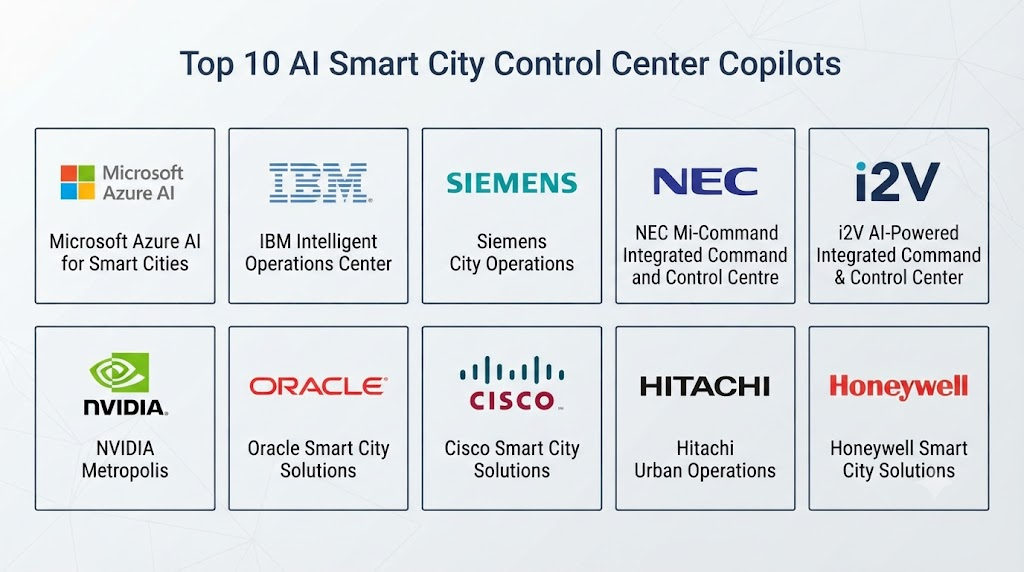
Top 10 AI Smart City Control Center Copilots
#1 — Microsoft Azure AI + Azure IoT
One-line verdict: Best for cities building enterprise-grade AI copilots across IoT, analytics, applications, and municipal data.
Short description:
Microsoft’s cloud and AI ecosystem can provide the building blocks for smart-city control-center copilots. Organizations can combine AI services with IoT, data platforms, analytics, mapping, applications, and existing enterprise systems.
Standout Capabilities
- Generative AI assistants
- IoT data processing
- Enterprise data integration
- AI agents
- Real-time analytics
- Multimodal AI capabilities
- Workflow automation
- Enterprise application integration
AI-Specific Depth
- Model support: Multiple hosted models and model-selection options are available across the ecosystem; exact availability varies.
- RAG / knowledge integration: Supported through Azure AI and related data services.
- Evaluation: AI evaluation and monitoring capabilities are available, with exact functionality depending on architecture.
- Guardrails: AI safety, content filtering, identity, access controls, and application-level controls can be incorporated.
- Observability: Cloud monitoring, application telemetry, AI-related monitoring, and operational analytics are available.
Pros
- Broad enterprise and government technology ecosystem
- Strong AI and data-platform capabilities
- Highly extensible architecture
Cons
- Can require substantial architecture and engineering
- Costs can become complex across multiple services
- A successful deployment usually requires system integration rather than simple installation
Security & Compliance
Security capabilities include identity management, access controls, encryption capabilities, logging, and enterprise governance options. Specific certifications and requirements depend on the selected services and environment.
Deployment & Platforms
- Cloud: Yes
- Hybrid: Supported
- Edge: Supported through applicable Azure technologies
- Web: Yes
- Desktop: Through connected applications
- Mobile: Through supported applications
Integrations & Ecosystem
Microsoft’s ecosystem can connect AI with municipal data and operational systems.
- IoT platforms
- Databases
- APIs
- Analytics
- GIS and mapping systems
- Enterprise applications
- Workflow systems
Pricing Model
Usage-based and service-specific pricing models. Exact cost depends on architecture, data volume, AI model usage, storage, and connected services.
Best-Fit Scenarios
- Enterprise smart-city control centers
- Multi-department municipal AI
- Large-scale IoT operations
#2 — IBM watsonx
One-line verdict: Best for municipalities prioritizing AI governance, enterprise data, responsible AI, and controlled deployment architectures.
Short description:
IBM watsonx provides AI development, governance, data, and automation capabilities that can be assembled into intelligent control-center workflows. It is particularly relevant where governance and enterprise data management are major requirements.
Standout Capabilities
- Enterprise AI assistants
- AI governance
- Data management
- AI model management
- Generative AI
- Automation
- Enterprise integration
- Analytics
AI-Specific Depth
- Model support: Supports IBM and selected third-party/open models depending on environment.
- RAG / knowledge integration: Supported through IBM AI and data capabilities.
- Evaluation: AI evaluation and governance capabilities are available.
- Guardrails: Governance and AI safety capabilities are available.
- Observability: Monitoring and governance capabilities vary by component.
Pros
- Strong governance orientation
- Enterprise AI capabilities
- Suitable for complex data environments
Cons
- Implementation can be complex
- Requires architecture and integration expertise
- Pricing varies by services and deployment
Security & Compliance
Enterprise identity, access management, governance, auditing, and security capabilities are available. Specific certifications depend on the product and deployment.
Deployment & Platforms
- Cloud: Yes
- Hybrid: Supported
- On-premises: Available for applicable products
- Web: Yes
- Edge: Varies
Integrations & Ecosystem
- Enterprise databases
- APIs
- Data platforms
- AI models
- Automation systems
- Analytics
- Existing municipal applications
Pricing Model
Subscription, consumption, and enterprise models vary by product.
Best-Fit Scenarios
- Government AI governance
- Enterprise control centers
- Highly regulated municipal environments
#3 — NVIDIA AI Enterprise
One-line verdict: Best for cities developing high-performance, customized AI control-center systems with computer vision and edge processing.
Short description:
NVIDIA provides AI infrastructure and software for building sophisticated smart-city applications. Its technologies are particularly relevant for computer vision, video analytics, digital twins, edge AI, and accelerated AI workloads.
Standout Capabilities
- Computer vision
- Edge AI
- Video analytics
- Generative AI
- Digital twins
- AI infrastructure
- Accelerated computing
- Custom AI applications
AI-Specific Depth
- Model support: Broad ecosystem supporting proprietary, open, and custom models.
- RAG / knowledge integration: Can be implemented through supported AI frameworks and application architectures.
- Evaluation: Depends on the deployed AI stack.
- Guardrails: Application-specific and platform-level controls vary.
- Observability: Infrastructure and AI monitoring capabilities are available through the broader ecosystem.
Pros
- Excellent AI performance capabilities
- Strong computer-vision ecosystem
- Suitable for edge and large-scale AI deployments
Cons
- Requires significant technical expertise
- Hardware and infrastructure costs can be substantial
- More of a platform foundation than a ready-made municipal copilot
Security & Compliance
Security depends on the selected infrastructure and application architecture. Specific certifications vary across products and deployment environments.
Deployment & Platforms
- Cloud: Yes
- On-premises: Yes
- Edge: Strong
- Hybrid: Yes
- Linux: Strong ecosystem support
Integrations & Ecosystem
- AI frameworks
- GPUs
- Edge devices
- Cameras
- IoT platforms
- Digital-twin systems
- Data platforms
Pricing Model
Enterprise licensing and infrastructure-dependent pricing. Exact pricing varies.
Best-Fit Scenarios
- Computer-vision control centers
- AI-heavy smart-city infrastructure
- Edge AI deployments
#4 — Siemens Insights Hub
One-line verdict: Best for industrial cities and infrastructure operators connecting operational assets, IoT data, analytics, and AI.
Short description:
Siemens Insights Hub provides an industrial IoT environment for connecting assets and using operational data for analytics and optimization. It can form part of a broader intelligent control-center architecture.
Standout Capabilities
- Industrial IoT
- Asset monitoring
- Operational analytics
- Predictive insights
- Data integration
- Industrial AI
- Asset performance monitoring
- Connected infrastructure
AI-Specific Depth
- Model support: AI capabilities vary by solution and architecture.
- RAG / knowledge integration: Not a primary capability.
- Evaluation: Analytics and AI evaluation depend on the implemented application.
- Guardrails: Enterprise and operational controls vary.
- Observability: Strong orientation toward asset and operational monitoring.
Pros
- Strong industrial and infrastructure capabilities
- Useful for connected city assets
- Good fit for operational technology environments
Cons
- More infrastructure-focused than general-purpose conversational copilots
- Integration can be complex
- Pricing is not publicly stated
Security & Compliance
Enterprise security and access controls are available, with exact capabilities depending on deployment.
Deployment & Platforms
- Cloud: Yes
- Edge: Supported
- Hybrid: Supported
- Web: Yes
Integrations & Ecosystem
- Industrial IoT
- Sensors
- Operational systems
- Analytics
- APIs
- Asset-management systems
- Enterprise platforms
Pricing Model
Not publicly stated.
Best-Fit Scenarios
- Infrastructure control centers
- Utility operations
- Industrial smart-city environments
#5 — Google Cloud Vertex AI
One-line verdict: Best for technically advanced cities building custom AI copilots around data, geospatial intelligence, and machine learning.
Short description:
Google Cloud Vertex AI provides AI development, model management, generative AI, data integration, and machine-learning capabilities. It can serve as the AI foundation for a custom smart-city control-center copilot.
Standout Capabilities
- Generative AI
- AI agents
- Model development
- Multimodal AI
- Data analytics
- Machine learning
- AI evaluation
- Enterprise integrations
AI-Specific Depth
- Model support: Multiple model families and model-development options are available.
- RAG / knowledge integration: Supported through Google Cloud AI and data services.
- Evaluation: AI evaluation capabilities are available.
- Guardrails: Safety and governance controls are available.
- Observability: Cloud monitoring and AI application monitoring can be incorporated.
Pros
- Strong AI development environment
- Flexible for custom applications
- Useful for multimodal and data-intensive workloads
Cons
- Requires technical implementation
- Not a ready-made city control-center application
- Cloud architecture can become complex
Security & Compliance
Enterprise identity, access control, encryption, logging, governance, and security services are available. Exact compliance depends on the selected services.
Deployment & Platforms
- Cloud: Yes
- Hybrid: Supported through applicable technologies
- Edge: Supported through relevant products
- Web: Yes
Integrations & Ecosystem
- Data warehouses
- APIs
- IoT systems
- GIS data
- AI models
- Analytics
- Enterprise applications
Pricing Model
Consumption-based cloud pricing varies according to model usage, storage, compute, data processing, and other services.
Best-Fit Scenarios
- Custom smart-city copilots
- AI engineering teams
- Large municipal data platforms
#6 — AWS IoT + Amazon Bedrock
One-line verdict: Best for cities building cloud-native AI assistants that combine IoT data, foundation models, agents, and automation.
Short description:
AWS provides IoT, data, AI, analytics, and foundation-model services that can be assembled into a smart-city operations copilot. The architecture is particularly suitable for organizations wanting significant control over AI model selection and application design.
Standout Capabilities
- Foundation models
- AI agents
- IoT integration
- Real-time data processing
- Event-driven architectures
- Generative AI
- Analytics
- Workflow automation
AI-Specific Depth
- Model support: Multiple foundation models are available through the ecosystem.
- RAG / knowledge integration: Supported.
- Evaluation: AI evaluation capabilities are available across relevant services.
- Guardrails: Guardrail and safety controls are available for applicable generative-AI workloads.
- Observability: Cloud monitoring and application telemetry are available.
Pros
- Flexible cloud architecture
- Strong IoT ecosystem
- Broad AI service portfolio
Cons
- Requires technical expertise
- Multiple services may need to be assembled
- Costs can be difficult to predict at scale
Security & Compliance
AWS provides extensive identity, access, encryption, logging, and governance capabilities. Specific compliance depends on the services and deployment.
Deployment & Platforms
- Cloud: Yes
- Edge: Supported
- Hybrid: Supported
- Web: Yes
Integrations & Ecosystem
- IoT devices
- Databases
- APIs
- AI models
- Analytics
- Event systems
- Workflow automation
Pricing Model
Consumption-based pricing across individual services.
Best-Fit Scenarios
- Cloud-native smart cities
- IoT-heavy control centers
- Custom AI agent architectures
#7 — Palantir AIP
One-line verdict: Best for organizations needing AI-assisted operational decision-making across complex, interconnected city data.
Short description:
Palantir AIP is designed to connect generative AI with enterprise data, operational workflows, and controlled actions. Its architecture is particularly relevant to organizations seeking AI assistance for complex operational environments.
Standout Capabilities
- AI-assisted operations
- Enterprise data integration
- AI agents
- Workflow automation
- Operational decision support
- Data ontology
- Controlled AI actions
- Human oversight
AI-Specific Depth
- Model support: Supports multiple model providers depending on configuration.
- RAG / knowledge integration: Strong enterprise-data integration capabilities.
- Evaluation: AI testing and operational evaluation capabilities vary by implementation.
- Guardrails: Designed around controlled AI actions, permissions, and operational governance.
- Observability: Operational monitoring and application-level visibility are available.
Pros
- Strong operational-data orientation
- Useful for complex decision workflows
- Designed for controlled AI deployment
Cons
- Enterprise-oriented
- Implementation can be substantial
- Pricing is not publicly stated
Security & Compliance
Security, access control, auditability, and governance are central to the platform. Specific certifications should be verified for the selected environment.
Deployment & Platforms
- Cloud: Supported
- On-premises: Supported in applicable environments
- Hybrid: Supported
- Web: Yes
Integrations & Ecosystem
- Enterprise databases
- APIs
- Operational systems
- Data platforms
- AI models
- Workflow systems
- IoT and external data
Pricing Model
Not publicly stated.
Best-Fit Scenarios
- Complex municipal operations
- Cross-department control centers
- AI-assisted decision support
#8 — Cisco IoT / AI Operations Ecosystem
One-line verdict: Best for cities prioritizing connected infrastructure, network visibility, cybersecurity, and operational intelligence.
Short description:
Cisco provides networking, security, IoT, observability, and AI technologies that can form the infrastructure layer of an intelligent city operations environment.
Standout Capabilities
- Network monitoring
- IoT connectivity
- Security
- Observability
- Edge computing
- Infrastructure analytics
- AI-assisted operations
- Connected-device management
AI-Specific Depth
- Model support: Varies by Cisco product and architecture.
- RAG / knowledge integration: Available through selected AI architectures rather than being a universal IoT capability.
- Evaluation: Varies.
- Guardrails: Security controls and access policies can protect AI-enabled environments.
- Observability: Strong infrastructure and network observability orientation.
Pros
- Strong networking foundation
- Cybersecurity capabilities
- Useful for connected city infrastructure
Cons
- Not a standalone city copilot
- Requires integration with AI and operational applications
- Pricing varies substantially
Security & Compliance
Security is a major part of Cisco’s ecosystem, including identity, network controls, monitoring, and security-management capabilities.
Deployment & Platforms
- Cloud: Yes
- Edge: Yes
- On-premises: Yes
- Hybrid: Yes
Integrations & Ecosystem
- IoT devices
- Networks
- Security systems
- APIs
- Cloud platforms
- Edge infrastructure
- Monitoring systems
Pricing Model
Product-specific licensing and subscription models.
Best-Fit Scenarios
- Connected city infrastructure
- Secure control-center networks
- IoT operations
#9 — Hitachi Lumada
One-line verdict: Best for infrastructure-heavy smart-city programs combining IoT, analytics, AI, and operational systems.
Short description:
Hitachi Lumada is an ecosystem for digital solutions, IoT, data analytics, and AI. It can support intelligent infrastructure and operational applications relevant to smart-city environments.
Standout Capabilities
- IoT
- Data analytics
- AI
- Infrastructure monitoring
- Digital transformation
- Asset intelligence
- Operational optimization
- Enterprise integration
AI-Specific Depth
- Model support: Varies by solution and implementation.
- RAG / knowledge integration: Varies / N/A depending on the application.
- Evaluation: Application-specific.
- Guardrails: Enterprise governance and operational controls vary.
- Observability: Infrastructure and application monitoring capabilities vary.
Pros
- Strong infrastructure orientation
- Broad enterprise integration
- Suitable for complex operational environments
Cons
- Large enterprise implementation
- Capabilities vary significantly by solution
- Pricing is not publicly stated
Security & Compliance
Security and governance depend on the selected Lumada solution and deployment architecture.
Deployment & Platforms
- Cloud: Supported
- Edge: Supported
- Hybrid: Supported
- Web: Supported
Integrations & Ecosystem
- IoT
- Enterprise applications
- Sensors
- Data platforms
- Analytics
- APIs
- Infrastructure systems
Pricing Model
Not publicly stated.
Best-Fit Scenarios
- Infrastructure-heavy cities
- Utility operations
- Large digital-transformation programs
#10 — OpenAI Platform
One-line verdict: Best for development teams building conversational municipal copilots around APIs, agents, documents, and operational applications.
Short description:
The OpenAI platform can provide models and agent-building capabilities that developers can integrate into municipal applications. It is more suitable as an AI layer for a custom control-center copilot than as a complete smart-city operations platform.
Standout Capabilities
- Conversational AI
- Agentic workflows
- Multimodal capabilities
- Tool calling
- Structured outputs
- Document-based applications
- Custom application development
- AI-assisted workflow automation
AI-Specific Depth
- Model support: OpenAI model ecosystem; BYO third-party model support is not the primary positioning.
- RAG / knowledge integration: Can be implemented through application architecture and supported retrieval capabilities.
- Evaluation: Evaluation tooling is available for testing AI applications.
- Guardrails: Safety mechanisms and application-level controls can be incorporated.
- Observability: Application developers can implement tracing and operational monitoring depending on architecture.
Pros
- Strong conversational AI capabilities
- Flexible for custom applications
- Useful for natural-language control-center interfaces
Cons
- Not a complete smart-city management platform
- Requires integration with municipal systems
- Operational safety controls must be designed carefully
Security & Compliance
Enterprise security, access controls, encryption, and administrative features vary by product and deployment. Specific requirements should be verified before using sensitive municipal data.
Deployment & Platforms
- Cloud: Yes
- API: Yes
- Web applications: Supported through development
- On-premises: Varies / N/A
- Edge: Application-dependent
Integrations & Ecosystem
- APIs
- Databases
- Municipal applications
- IoT platforms
- Document repositories
- Workflow systems
- Custom tools
Pricing Model
Usage-based pricing varies by model and API usage.
Best-Fit Scenarios
- Custom control-center copilots
- Municipal knowledge assistants
- AI-powered operational interfaces
Comparison Table
| Tool Name | Best For | Deployment | Model Flexibility | Strength | Watch-Out | Public Rating |
|---|---|---|---|---|---|---|
| Microsoft Azure AI + Azure IoT | Enterprise smart cities | Cloud / Hybrid / Edge | Hosted / Multi-model | Broad ecosystem | Architecture complexity | N/A |
| IBM watsonx | Governed enterprise AI | Cloud / Hybrid / On-premises | Hosted / Open / Multi-model | AI governance | Implementation complexity | N/A |
| NVIDIA AI Enterprise | AI infrastructure | Cloud / Edge / On-premises | Multi-model / Open / Custom | AI performance | Requires expertise | N/A |
| Siemens Insights Hub | Infrastructure operations | Cloud / Edge / Hybrid | Varies | Industrial IoT | Infrastructure focus | N/A |
| Google Cloud Vertex AI | Custom AI copilots | Cloud | Multi-model / Custom | AI development | Engineering required | N/A |
| AWS IoT + Bedrock | Cloud-native AI | Cloud / Edge / Hybrid | Multi-model | IoT + AI | Service complexity | N/A |
| Palantir AIP | Operational intelligence | Cloud / Hybrid | Multi-model | Controlled AI workflows | Enterprise complexity | N/A |
| Cisco IoT / AI Ecosystem | Connected infrastructure | Cloud / Edge / On-premises | Varies | Network + security | Not a standalone copilot | N/A |
| Hitachi Lumada | Infrastructure intelligence | Cloud / Edge / Hybrid | Varies | Operational integration | Large implementation | N/A |
| OpenAI Platform | Custom AI copilots | Cloud / API | Hosted | Conversational AI | Requires integration | N/A |
Scoring & Evaluation
The scores below are comparative rather than absolute product ratings. They reflect how well each ecosystem can support a smart-city control-center copilot rather than the quality of every individual product.
A city should validate the scores with a pilot using its own data, operational systems, security requirements, and workflows.
| Tool | Core | Reliability/Eval | Guardrails | Integrations | Ease | Perf/Cost | Security/Admin | Support | Weighted Total |
|---|---|---|---|---|---|---|---|---|---|
| Microsoft Azure AI + Azure IoT | 9.5 | 9.2 | 9.2 | 9.7 | 8.2 | 8.5 | 9.5 | 9.4 | 9.2 |
| IBM watsonx | 9.2 | 9.2 | 9.5 | 9.2 | 7.9 | 8.1 | 9.5 | 9.2 | 9.0 |
| NVIDIA AI Enterprise | 9.1 | 9.0 | 8.7 | 9.2 | 7.3 | 8.4 | 9.0 | 9.0 | 8.7 |
| Siemens Insights Hub | 8.9 | 8.6 | 8.8 | 9.3 | 8.0 | 8.4 | 9.1 | 9.1 | 8.7 |
| Google Cloud Vertex AI | 9.3 | 9.3 | 9.0 | 9.4 | 8.1 | 8.6 | 9.2 | 9.2 | 9.0 |
| AWS IoT + Bedrock | 9.4 | 9.1 | 9.1 | 9.6 | 7.9 | 8.6 | 9.4 | 9.4 | 9.1 |
| Palantir AIP | 9.4 | 9.1 | 9.5 | 9.5 | 7.8 | 8.4 | 9.5 | 9.3 | 9.1 |
| Cisco IoT / AI Ecosystem | 8.8 | 8.5 | 9.2 | 9.4 | 8.0 | 8.3 | 9.5 | 9.3 | 8.9 |
| Hitachi Lumada | 8.8 | 8.5 | 8.8 | 9.2 | 7.8 | 8.2 | 9.0 | 9.1 | 8.7 |
| OpenAI Platform | 8.7 | 9.2 | 9.0 | 9.0 | 9.0 | 8.8 | 8.8 | 8.9 | 8.9 |
Top 3 for Enterprise
- Microsoft Azure AI + Azure IoT
- Palantir AIP
- AWS IoT + Bedrock
Top 3 for SMB
- OpenAI Platform
- Google Cloud Vertex AI
- AWS IoT + Bedrock
Top 3 for Developers
- OpenAI Platform
- Google Cloud Vertex AI
- AWS IoT + Bedrock
Which AI Smart City Control Center Copilot Is Right for You?
Solo / Freelancer
A solo developer usually does not need an entire smart-city platform.
A better approach is to build a focused prototype using:
- A conversational AI model
- Municipal datasets
- APIs
- GIS information
- A small knowledge base
- Simulated sensor data
- Basic dashboards
Good prototype ideas include an emergency-information assistant, traffic operations assistant, city-document assistant, or infrastructure reporting copilot.
SMB
Smaller organizations should avoid attempting to automate an entire control center immediately.
Start with one operational workflow, such as:
- Incident summarization
- Service-request analysis
- Traffic reporting
- Infrastructure monitoring
- Environmental reporting
- Operator knowledge search
The objective should be measurable productivity improvement rather than maximum AI complexity.
Mid-Market
Mid-sized cities should prioritize interoperability.
The copilot should connect existing systems rather than replace every municipal application.
Important capabilities include:
- API integration
- Event streaming
- GIS integration
- Document retrieval
- Identity management
- Audit trails
- Operator approval
- AI evaluation
- Incident management
Enterprise
Large municipalities should treat the copilot as an operational platform rather than simply a chatbot.
Enterprise architecture should include:
- Centralized data integration
- Event processing
- AI agents
- Multimodal intelligence
- Knowledge retrieval
- GIS
- Digital twins where appropriate
- Security controls
- Model governance
- Human oversight
- Disaster recovery
- High availability
- Cross-department workflows
Regulated Industries
Public-sector control centers handle information that can have significant safety, privacy, and accountability implications.
Prioritize:
- Data minimization
- Access controls
- Auditability
- Encryption
- Retention policies
- Data residency requirements
- Human approval
- AI testing
- Incident response
- Model monitoring
Budget vs Premium
A budget deployment should focus on one clearly defined workflow.
For example, an AI assistant could summarize incoming incidents and retrieve relevant operating procedures without being allowed to change infrastructure.
Premium deployments can add:
- Real-time event correlation
- AI agents
- Multimodal processing
- Automated workflows
- Digital twins
- Predictive analytics
- Cross-department orchestration
Build vs Buy
Build when:
- The city has a capable engineering team.
- Existing systems have APIs.
- Custom workflows are essential.
- Data must remain under strong organizational control.
- The city wants to avoid dependence on a single application vendor.
Buy when:
- Fast deployment is important.
- Integration expertise is limited.
- Operational support is required.
- The organization wants a mature enterprise platform.
A hybrid model is often the most practical: purchase the operational data and infrastructure layer while building a custom AI copilot on top.
Implementation Playbook: 30 / 60 / 90 Days
First 30 Days: Pilot + Success Metrics
Choose one control-center workflow.
Good candidates include:
- Incident summarization
- Operator knowledge retrieval
- Traffic-event analysis
- Infrastructure alerts
- Emergency-response documentation
Define success metrics such as:
- Operator time saved
- Response time
- Alert investigation time
- Answer accuracy
- Escalation accuracy
- False-positive rate
- Human override frequency
Create a controlled data environment before connecting sensitive operational systems.
Days 31–60: Security + Evaluation + Rollout
During this phase:
- Establish identity and access controls.
- Define data-retention rules.
- Create an AI evaluation dataset.
- Test hallucination rates.
- Test prompt injection.
- Test malicious documents.
- Evaluate tool-calling behavior.
- Establish human approval rules.
- Add audit logging.
- Implement prompt and configuration version control.
- Test system failure scenarios.
- Establish incident-response procedures.
The AI should initially operate in recommendation or read-only mode for safety-sensitive workflows.
Days 61–90: Optimize Cost/Latency + Governance + Scale
After proving value:
- Add additional data sources.
- Optimize model routing.
- Reduce unnecessary context.
- Introduce caching where appropriate.
- Improve retrieval quality.
- Monitor latency.
- Track AI usage costs.
- Monitor model drift.
- Establish governance reviews.
- Expand to additional departments.
- Create formal change-management procedures.
Agentic capabilities should be introduced gradually rather than granting broad operational permissions immediately.
Common Mistakes & How to Avoid Them
- Treating a smart-city copilot as an ordinary chatbot.
- Connecting AI directly to critical infrastructure without human approval.
- Allowing unrestricted tool calling.
- Ignoring prompt-injection attacks.
- Feeding untrusted sensor or document data directly into AI agents.
- Failing to evaluate hallucinations.
- Using outdated municipal procedures as authoritative knowledge.
- Retaining sensitive data unnecessarily.
- Giving every operator the same permissions.
- Ignoring auditability.
- Building a single AI interface without fixing underlying data-quality problems.
- Connecting too many systems before validating the first workflow.
- Ignoring AI latency during emergency operations.
- Failing to create fallback procedures when AI becomes unavailable.
- Assuming the most powerful model is always the best model.
- Ignoring model and vendor lock-in.
- Failing to monitor AI-agent actions.
- Automating decisions that require human judgment.
- Treating cybersecurity as an afterthought.
- Measuring chatbot usage instead of actual operational improvement.
FAQs
What is an AI Smart City Control Center Copilot?
It is an AI assistant designed to help city operators understand information from multiple urban systems, investigate events, retrieve knowledge, summarize situations, and support operational decisions.
How is a copilot different from a smart-city dashboard?
A dashboard primarily presents information. A copilot can interpret information, answer questions, summarize events, retrieve relevant knowledge, and potentially initiate controlled workflows.
Can a copilot connect to traffic systems?
Yes, provided the traffic-management platform exposes suitable APIs, data feeds, or integration mechanisms.
Can it connect to IoT sensors?
Yes. IoT platforms can provide sensor data that the AI layer uses for analysis, alerts, or operational summaries.
Can AI copilots process camera feeds?
Some architectures can use computer vision and multimodal AI to analyze visual information. Privacy and retention requirements should be carefully considered.
Can a copilot control city infrastructure?
Technically, AI agents can be connected to operational tools, but safety-sensitive actions should use strict permissions, validation, audit logs, and human approval.
Can cities use their own AI models?
Some enterprise AI architectures support open or custom models. The exact capability depends on the selected platform and deployment.
Is self-hosting possible?
Self-hosting varies considerably. Infrastructure-oriented platforms may support on-premises or edge deployment, while some managed AI services are primarily cloud-based.
Does a smart-city copilot need RAG?
Not always, but RAG is highly useful when the copilot needs to answer questions using municipal procedures, policies, manuals, emergency plans, or infrastructure documentation.
How should AI reliability be tested?
Create representative test cases using real operational scenarios and evaluate factual accuracy, retrieval accuracy, tool selection, hallucinations, refusal behavior, and response consistency.
What are AI guardrails?
Guardrails are controls that restrict unsafe, unauthorized, or inappropriate AI behavior. They can include access policies, content controls, tool permissions, validation rules, and human approvals.
How important is observability?
Very important. Operators and administrators need to understand what the AI did, which tools it used, what data influenced the response, how long the operation took, and where failures occurred.
How much does a smart-city AI copilot cost?
There is no universal price. Costs depend on AI usage, data volume, infrastructure, integrations, sensors, storage, licensing, support, and the number of operators.
Can smaller cities use these technologies?
Yes. Smaller cities should start with narrowly defined applications rather than attempting a complete citywide control-center transformation.
Should the copilot replace control-center operators?
No. The strongest use case is decision support and workflow assistance. Operators should retain authority over safety-critical and high-impact decisions.
Can generative AI predict emergencies?
Generative AI itself should not be treated as a reliable emergency prediction engine. Specialized forecasting and detection models should generally handle predictive functions, while generative AI can help interpret and communicate results.
How can municipalities protect sensitive data?
Use data minimization, access controls, encryption, retention policies, approved environments, monitoring, and clear rules governing which information AI applications can access.
What happens if the AI service goes offline?
The control center should continue operating through established non-AI procedures. Critical infrastructure should never depend entirely on the availability of a generative AI service.
Is a digital twin necessary?
No. Digital twins can be valuable for simulation and scenario analysis, but a city can deploy a useful copilot without implementing a complete digital twin.
What is the biggest benefit of an AI control-center copilot?
The biggest benefit is reducing the cognitive burden on operators by turning large volumes of fragmented operational information into understandable, actionable context.
What is the biggest risk?
The biggest risk is excessive trust in incorrect AI recommendations, particularly when the system has access to operational tools or safety-sensitive infrastructure.
Conclusion
AI Smart City Control Center Copilots represent a shift from passive city dashboards toward intelligent operational assistance. Instead of forcing operators to manually search through separate systems, an AI copilot can help connect information from transportation, infrastructure, utilities, environmental monitoring, emergency response, and other municipal systems.Microsoft Azure AI and Azure IoT provide a broad foundation for enterprise smart-city architectures. IBM watsonx is particularly attractive where governance and enterprise AI management are priorities. AWS IoT and Bedrock offer flexible cloud-native architectures, while Google Cloud Vertex AI provides strong capabilities for custom AI development. NVIDIA is particularly relevant for computer vision and edge AI, while Palantir AIP is well suited to complex operational decision-making. Siemens, Cisco, and Hitachi provide strong infrastructure-oriented ecosystems, while the OpenAI platform can serve as a flexible AI layer for custom municipal applications.