Introduction
AI Traffic Flow Optimization Systems use artificial intelligence, machine learning, computer vision, connected sensors, traffic signals, GPS information, and real-time transportation data to improve how vehicles, pedestrians, cyclists, and public transport move through roads and intersections. Instead of relying only on fixed traffic-light schedules and historical traffic patterns, these systems can analyze changing conditions and recommend or automatically adjust traffic operations.
The technology is becoming increasingly useful as cities deal with congestion, unpredictable travel demand, road incidents, construction, emissions, and growing pressure to improve transportation efficiency without continuously building new roads.
Common use cases include:
- Adaptive traffic signal timing
- Intersection congestion reduction
- Real-time incident detection
- Public transportation priority
- Emergency vehicle signal priority
- Pedestrian and cyclist movement analysis
- Traffic-demand prediction
- Highway and arterial traffic management
- Smart corridor optimization
- Congestion and emissions reduction
When evaluating a platform, buyers should consider traffic prediction accuracy, computer-vision capabilities, sensor compatibility, signal-controller integration, edge processing, AI explainability, latency, cybersecurity, scalability, interoperability, privacy controls, and integration with existing traffic-management systems.
Best for: Municipalities, transportation departments, smart-city programs, highway authorities, airport operators, universities, large campuses, and organizations managing complex road networks.
Not ideal for: Small communities with simple road networks and low traffic volumes where traditional signal timing, traffic studies, and basic monitoring systems may provide sufficient value.
What’s Changed in AI Traffic Flow Optimization Systems
AI traffic management is moving beyond fixed signal timing toward continuously adaptive and predictive transportation operations.
- AI systems can use real-time traffic conditions instead of relying exclusively on predetermined signal schedules.
- Computer vision can help detect vehicles, pedestrians, bicycles, queues, and unusual roadway activity.
- Traffic prediction models can anticipate congestion before it becomes severe.
- Edge AI can process video and sensor information locally, reducing latency and potentially reducing the amount of raw data transmitted.
- Multimodal systems can combine cameras, radar, connected-vehicle information, GPS, weather, road sensors, and historical traffic data.
- AI can help coordinate multiple intersections rather than optimizing each intersection independently.
- Public transportation priority can be incorporated into broader traffic optimization strategies.
- Emergency-response systems can use transportation intelligence to support faster movement through intersections.
- AI-generated recommendations can help traffic operators understand why congestion is increasing.
- Digital-twin approaches can help transportation teams test traffic strategies before implementing them.
- Predictive incident detection is becoming increasingly important for highways and major corridors.
- Privacy-preserving approaches are gaining importance as transportation systems collect large amounts of video and mobility information.
- Cybersecurity is becoming a central requirement because traffic infrastructure is connected to operational networks.
- Model monitoring is important because traffic patterns change with weather, construction, events, seasons, and population behavior.
- Transportation agencies increasingly need auditable AI decision-making rather than unexplained automated changes.
Quick Buyer Checklist
- Does the system support real-time traffic analysis?
- Can it integrate with existing traffic signal controllers?
- Does it support adaptive signal control?
- Can it process camera feeds?
- Does it support radar or other roadway sensors?
- Can it analyze pedestrian and cyclist movements?
- Does it support public transportation priority?
- Can it detect incidents?
- Does it provide traffic forecasting?
- Can it optimize multiple intersections?
- Does it support edge processing?
- What is the expected decision latency?
- Can it operate when cloud connectivity is interrupted?
- Does it integrate with existing traffic-management systems?
- Are APIs available?
- Can the agency export its data?
- Does it support historical traffic analysis?
- Can operators override AI recommendations?
- Are audit logs available?
- Are role-based permissions available?
- How is video data retained?
- Can personally identifiable information be minimized?
- Does the system support privacy-preserving computer vision?
- Can models be evaluated before deployment?
- Is there monitoring for model drift?
- Can the platform scale from one intersection to an entire network?
- What happens when sensors fail?
- Is vendor lock-in manageable?
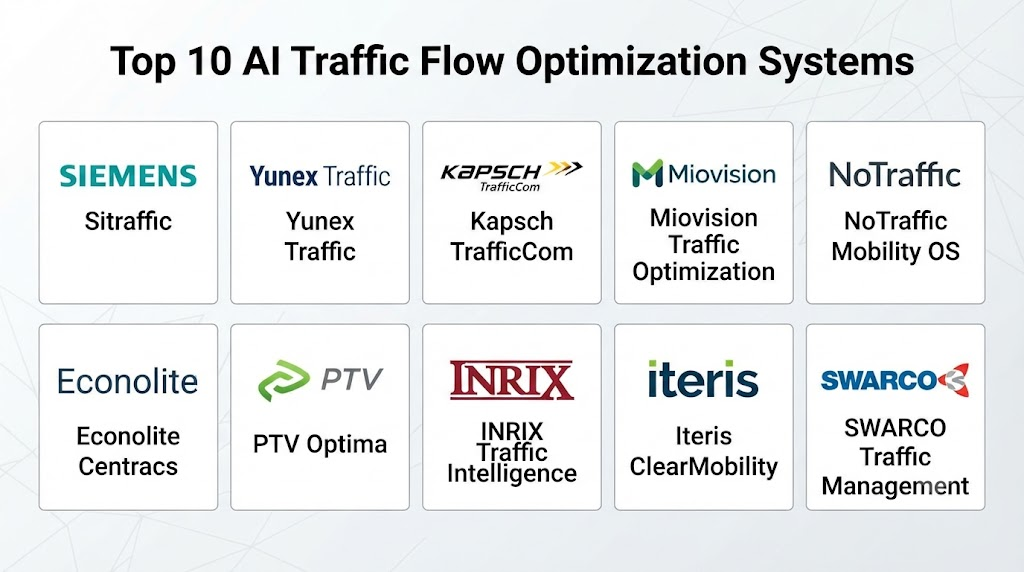
Top 10 AI Traffic Flow Optimization Systems
#1 — Miovision
One-line verdict: Best for cities seeking AI-powered traffic monitoring, signal optimization, and transportation data across intersections.
Short description:
Miovision provides traffic-management technologies that combine traffic data, video analytics, signal management, and transportation intelligence. Its platform is designed for transportation agencies managing intersections and broader roadway networks.
Standout Capabilities
- Traffic signal management
- AI-based video analytics
- Intersection monitoring
- Traffic data collection
- Signal optimization
- Transportation analytics
- Connected traffic infrastructure
- Network-level traffic management
AI-Specific Depth
- Model support: Proprietary AI and computer-vision capabilities; BYO model support varies.
- RAG / knowledge integration: Not a primary traffic-optimization function.
- Evaluation: Traffic performance can be evaluated using operational transportation metrics; exact AI evaluation tooling varies.
- Guardrails: Operational controls and permissions vary by implementation; detailed AI-specific guardrails are not publicly stated.
- Observability: Traffic monitoring and operational analytics; token-level AI observability is N/A.
Pros
- Strong transportation-industry specialization
- Combines traffic data with signal-management capabilities
- Suitable for municipal transportation agencies
Cons
- Primarily focused on transportation organizations
- Deployment may require roadway infrastructure integration
- Pricing is not publicly stated
Security & Compliance
Security, access control, and data-management capabilities depend on the product configuration and deployment. Specific certifications should be verified during procurement.
Deployment & Platforms
- Cloud: Available
- Web: Available
- Edge: Supported for applicable traffic-processing workloads
- Hybrid: Varies by deployment
- Mobile: Varies / N/A
Integrations & Ecosystem
The platform can connect traffic monitoring, signal systems, transportation data, and roadway infrastructure.
- Traffic signal controllers
- Cameras
- Transportation-management systems
- APIs
- Traffic sensors
- Analytics
- Municipal infrastructure
Pricing Model
Not publicly stated.
Best-Fit Scenarios
- City traffic management
- Intersection optimization
- Municipal transportation operations
#2 — NoTraffic
One-line verdict: Best for adaptive intersection management using real-time AI perception and traffic signal optimization.
Short description:
NoTraffic focuses on intelligent intersection management. Its technology uses real-time sensing and AI to understand roadway activity and support dynamic traffic signal decisions.
Standout Capabilities
- Adaptive signal control
- AI traffic detection
- Intersection optimization
- Real-time traffic analysis
- Multimodal traffic detection
- Pedestrian awareness
- Emergency-vehicle support
- Traffic-flow optimization
AI-Specific Depth
- Model support: Proprietary AI and computer-vision models.
- RAG / knowledge integration: N/A as a core capability.
- Evaluation: Traffic performance can be measured using intersection and corridor metrics.
- Guardrails: Operational controls and configurable signal-management policies; detailed AI guardrail specifications are not publicly stated.
- Observability: Real-time intersection monitoring and transportation metrics.
Pros
- Designed specifically for intelligent intersections
- Real-time traffic optimization
- Can consider multiple transportation modes
Cons
- Focused primarily on intersection use cases
- Requires roadway and signal infrastructure
- Pricing is not publicly stated
Security & Compliance
Security and privacy capabilities should be evaluated according to the deployment architecture and local transportation requirements.
Deployment & Platforms
- Edge: Supported
- Cloud: Supported for applicable platform functions
- Web: Available for management functions
- Hybrid: Available depending on architecture
Integrations & Ecosystem
- Traffic signals
- Roadway sensors
- Cameras
- Transportation-management systems
- APIs
- Traffic operations
- Connected infrastructure
Pricing Model
Not publicly stated.
Best-Fit Scenarios
- Smart intersections
- High-congestion corridors
- Multimodal urban transportation
#3 — Yunex Traffic
One-line verdict: Best for large transportation agencies needing integrated traffic management, adaptive control, and intelligent infrastructure.
Short description:
Yunex Traffic provides transportation-management technologies covering traffic signals, intelligent transportation systems, roadway management, and connected infrastructure.
Standout Capabilities
- Traffic signal control
- Adaptive traffic management
- Intelligent transportation systems
- Traffic monitoring
- Corridor management
- Public transportation priority
- Incident-management support
- Connected infrastructure
AI-Specific Depth
- Model support: Proprietary analytics and AI capabilities; exact model flexibility varies.
- RAG / knowledge integration: N/A as a primary traffic-management function.
- Evaluation: Traffic-performance evaluation varies by solution.
- Guardrails: Operational controls and traffic-management policies; detailed AI-specific guardrails are not publicly stated.
- Observability: Traffic operations monitoring and system analytics.
Pros
- Broad transportation portfolio
- Suitable for large-scale deployments
- Strong integration with traffic infrastructure
Cons
- Enterprise-oriented
- Implementation may require significant infrastructure work
- Pricing is not publicly stated
Security & Compliance
Specific security controls and certifications should be verified for the particular deployment.
Deployment & Platforms
- Cloud: Available for applicable services
- Edge: Supported
- Web: Available
- Hybrid: Supported depending on architecture
Integrations & Ecosystem
- Traffic signal controllers
- Transportation-management systems
- Roadway sensors
- Public transportation systems
- APIs
- Connected infrastructure
- Analytics
Pricing Model
Not publicly stated.
Best-Fit Scenarios
- Large cities
- Highway authorities
- Regional transportation networks
#4 — Kapsch TrafficCom
One-line verdict: Best for transportation authorities managing complex traffic networks, highways, tolling, and intelligent transportation systems.
Short description:
Kapsch TrafficCom develops intelligent transportation technologies covering traffic management, tolling, mobility, and roadway operations. Its broader transportation platform can support traffic optimization and intelligent network management.
Standout Capabilities
- Traffic management
- Intelligent transportation systems
- Traffic monitoring
- Highway management
- Mobility analytics
- Connected transportation
- Incident management
- Traffic control
AI-Specific Depth
- Model support: Proprietary analytics and AI capabilities; exact model flexibility varies.
- RAG / knowledge integration: N/A as a primary capability.
- Evaluation: Traffic performance and operational metrics can be used for evaluation.
- Guardrails: Transportation operational controls; detailed AI-specific guardrails are not publicly stated.
- Observability: Traffic and transportation-system monitoring.
Pros
- Broad transportation expertise
- Suitable for complex transportation networks
- Strong highway and intelligent-transportation orientation
Cons
- Enterprise-focused
- Deployment can involve substantial infrastructure
- Pricing is not publicly stated
Security & Compliance
Security and compliance depend on the selected solution and deployment.
Deployment & Platforms
- Cloud: Available depending on solution
- Edge: Supported
- Hybrid: Supported
- Web: Available
Integrations & Ecosystem
- Traffic-management systems
- Road sensors
- Tolling systems
- Cameras
- APIs
- Highway infrastructure
- Mobility platforms
Pricing Model
Not publicly stated.
Best-Fit Scenarios
- Highway traffic management
- Regional transportation systems
- Large intelligent-transportation deployments
#5 — Iteris
One-line verdict: Best for transportation agencies combining traffic analytics, signal optimization, mobility intelligence, and roadway monitoring.
Short description:
Iteris provides intelligent transportation systems focused on traffic management, roadway performance, mobility analytics, and transportation infrastructure. Its solutions can support agencies seeking better visibility and optimization of traffic flow.
Standout Capabilities
- Traffic analytics
- Signal optimization
- Mobility intelligence
- Traffic monitoring
- Transportation planning
- Roadway analytics
- Adaptive traffic management
- Decision support
AI-Specific Depth
- Model support: Proprietary analytics and AI capabilities; detailed BYO model support varies.
- RAG / knowledge integration: N/A as a core traffic optimization feature.
- Evaluation: Transportation performance metrics and historical comparisons.
- Guardrails: Operational controls; detailed AI-specific guardrails are not publicly stated.
- Observability: Traffic analytics and system monitoring.
Pros
- Strong traffic analytics capabilities
- Useful for transportation planning and operations
- Broad roadway intelligence
Cons
- Feature availability varies by solution
- Integration requirements can be significant
- Pricing is not publicly stated
Security & Compliance
Specific security capabilities should be confirmed for the chosen product and deployment.
Deployment & Platforms
- Cloud: Available
- Web: Available
- Edge: Supported for applicable applications
- Hybrid: Varies
Integrations & Ecosystem
- Traffic signals
- Cameras
- Transportation sensors
- Mobility data
- APIs
- Traffic-management systems
- Analytics platforms
Pricing Model
Not publicly stated.
Best-Fit Scenarios
- Municipal transportation agencies
- Traffic analytics
- Smart corridor management
#6 — Econolite
One-line verdict: Best for agencies modernizing traffic signal operations with adaptive control and intelligent transportation technologies.
Short description:
Econolite provides traffic-management and intelligent transportation technologies, including signal control, traffic detection, and transportation-management solutions.
Standout Capabilities
- Traffic signal control
- Adaptive signal systems
- Traffic detection
- Intersection management
- Traffic operations
- Transportation analytics
- Signal coordination
- Intelligent transportation systems
AI-Specific Depth
- Model support: Proprietary traffic analytics and control technologies; exact AI model flexibility varies.
- RAG / knowledge integration: N/A.
- Evaluation: Traffic performance can be assessed through operational transportation metrics.
- Guardrails: Signal-control rules and operational controls; detailed AI-specific guardrails are not publicly stated.
- Observability: Traffic and signal monitoring capabilities.
Pros
- Strong traffic-signal expertise
- Useful for intersection modernization
- Established transportation focus
Cons
- More transportation-specific than general AI platforms
- Deployment requires infrastructure compatibility
- Pricing is not publicly stated
Security & Compliance
Security capabilities vary according to implementation. Specific requirements should be verified before deployment.
Deployment & Platforms
- Edge: Supported
- Cloud: Available for applicable systems
- Web: Available
- Hybrid: Supported depending on architecture
Integrations & Ecosystem
- Signal controllers
- Traffic detectors
- Cameras
- Transportation-management platforms
- APIs
- Roadway systems
- Analytics
Pricing Model
Not publicly stated.
Best-Fit Scenarios
- Signal modernization
- Urban intersections
- Adaptive traffic control
#7 — SWARCO
One-line verdict: Best for cities and transportation operators implementing intelligent traffic control and multimodal mobility systems.
Short description:
SWARCO provides intelligent transportation technologies covering traffic management, signal control, road infrastructure, parking, and mobility systems.
Standout Capabilities
- Traffic signal management
- Adaptive traffic control
- Traffic detection
- Mobility management
- Roadway infrastructure
- Parking integration
- Public transportation support
- Traffic analytics
AI-Specific Depth
- Model support: Proprietary and solution-specific analytics; detailed model flexibility varies.
- RAG / knowledge integration: N/A.
- Evaluation: Transportation performance metrics can be used to measure results.
- Guardrails: Operational controls vary by deployment.
- Observability: Traffic and infrastructure monitoring capabilities.
Pros
- Broad mobility portfolio
- Strong transportation infrastructure focus
- Multimodal capabilities
Cons
- Large solution portfolio can make selection complex
- Integration may require specialized expertise
- Pricing is not publicly stated
Security & Compliance
Security and compliance depend on the selected system and deployment architecture.
Deployment & Platforms
- Cloud: Available
- Edge: Supported
- Hybrid: Available
- Web: Available
Integrations & Ecosystem
- Traffic signals
- Roadside equipment
- Cameras
- Public transportation
- Parking systems
- APIs
- Traffic-management platforms
Pricing Model
Not publicly stated.
Best-Fit Scenarios
- Smart-city transportation
- Multimodal mobility
- Traffic-control modernization
#8 — Siemens Mobility
One-line verdict: Best for large cities and transportation authorities integrating traffic management with broader intelligent mobility infrastructure.
Short description:
Siemens Mobility offers transportation technologies spanning traffic management, rail, road infrastructure, intelligent transportation systems, and connected mobility. Its broad portfolio can support large-scale transportation optimization programs.
Standout Capabilities
- Traffic management
- Intelligent transportation systems
- Signal control
- Mobility analytics
- Roadway management
- Public transportation integration
- Connected infrastructure
- Transportation operations
AI-Specific Depth
- Model support: Siemens AI and analytics capabilities vary by solution.
- RAG / knowledge integration: Not a primary traffic-management function.
- Evaluation: Transportation performance and operational analytics.
- Guardrails: Enterprise and operational controls; detailed AI-specific guardrails vary.
- Observability: Transportation infrastructure and operational monitoring.
Pros
- Broad transportation ecosystem
- Suitable for large infrastructure programs
- Strong integration possibilities
Cons
- Enterprise implementation
- Potentially high infrastructure complexity
- Pricing is not publicly stated
Security & Compliance
Specific security, privacy, and compliance requirements should be confirmed for the selected deployment.
Deployment & Platforms
- Cloud: Available
- Edge: Supported
- Hybrid: Supported
- Web: Available
Integrations & Ecosystem
- Traffic signals
- Rail systems
- Roadway infrastructure
- Transportation-management systems
- APIs
- Mobility platforms
- Analytics
Pricing Model
Not publicly stated.
Best-Fit Scenarios
- Major metropolitan areas
- Integrated mobility programs
- Large transportation infrastructure projects
#9 — Cubic Transportation Systems
One-line verdict: Best for cities and transportation agencies integrating traffic management, public transit, and mobility data.
Short description:
Cubic Transportation Systems develops intelligent transportation and mobility solutions. Its technology portfolio focuses on transportation management, public transit, mobility data, and connected transportation operations.
Standout Capabilities
- Traffic management
- Mobility management
- Public transportation integration
- Transportation analytics
- Real-time information
- Connected transportation
- Traffic operations
- Multimodal mobility
AI-Specific Depth
- Model support: AI and analytics capabilities vary by product.
- RAG / knowledge integration: N/A as a core traffic-flow function.
- Evaluation: Transportation performance and operational metrics.
- Guardrails: Operational policies and controls; detailed AI-specific guardrails are not publicly stated.
- Observability: Transportation-system monitoring and analytics.
Pros
- Strong multimodal orientation
- Useful for transportation agencies
- Can connect mobility and traffic operations
Cons
- Enterprise-focused
- Product capabilities vary by deployment
- Pricing is not publicly stated
Security & Compliance
Specific security and compliance capabilities should be confirmed for the selected system.
Deployment & Platforms
- Cloud: Available
- Web: Available
- Hybrid: Varies
- Edge: Supported for applicable systems
Integrations & Ecosystem
- Public transit
- Traffic-management systems
- Mobility data
- APIs
- Roadway systems
- Analytics
- Connected vehicles
Pricing Model
Not publicly stated.
Best-Fit Scenarios
- Multimodal transportation
- Transit-oriented cities
- Regional mobility management
#10 — PTV Group
One-line verdict: Best for transportation planning teams using AI-supported traffic simulation, forecasting, and network optimization.
Short description:
PTV Group provides transportation planning, traffic simulation, mobility analytics, and traffic-management technologies. Its software can help agencies model traffic behavior and evaluate potential transportation strategies.
Standout Capabilities
- Traffic simulation
- Transportation modeling
- Network analysis
- Traffic forecasting
- Mobility planning
- Scenario analysis
- Traffic optimization
- Transportation analytics
AI-Specific Depth
- Model support: Analytics and AI capabilities vary by product.
- RAG / knowledge integration: N/A.
- Evaluation: Strong simulation-based evaluation of transportation scenarios.
- Guardrails: Scenario and planning controls; detailed AI-specific guardrails are not publicly stated.
- Observability: Traffic and simulation analytics.
Pros
- Strong transportation modeling
- Useful for scenario planning
- Helps evaluate network-level changes
Cons
- More planning-oriented than some real-time signal systems
- Requires transportation expertise
- Pricing is not publicly stated
Security & Compliance
Specific security controls and certifications should be verified for the chosen deployment.
Deployment & Platforms
- Cloud: Available for applicable products
- Web: Available for applicable products
- Desktop: Supported for relevant applications
- Hybrid: Varies
Integrations & Ecosystem
- Traffic data
- Transportation models
- GIS systems
- APIs
- Simulation tools
- Mobility platforms
- Traffic-management systems
Pricing Model
Not publicly stated.
Best-Fit Scenarios
- Transportation planning
- Traffic simulation
- Network optimization
Comparison Table
| Tool Name | Best For | Deployment | Model Flexibility | Strength | Watch-Out | Public Rating |
|---|---|---|---|---|---|---|
| Miovision | Traffic operations | Cloud / Edge / Hybrid | Proprietary / Configurable | Signal and traffic intelligence | Infrastructure integration | N/A |
| NoTraffic | Adaptive intersections | Edge / Cloud | Proprietary AI | Real-time intersection optimization | Intersection-focused | N/A |
| Yunex Traffic | Large traffic networks | Cloud / Edge / Hybrid | Proprietary / Configurable | Network-scale traffic management | Enterprise complexity | N/A |
| Kapsch TrafficCom | Highway and ITS | Cloud / Edge / Hybrid | Proprietary / Configurable | Large transportation networks | Complex deployments | N/A |
| Iteris | Traffic analytics | Cloud / Edge / Hybrid | Proprietary / Configurable | Mobility intelligence | Integration requirements | N/A |
| Econolite | Signal modernization | Edge / Cloud / Hybrid | Proprietary / Configurable | Signal-control expertise | Infrastructure dependency | N/A |
| SWARCO | Smart mobility | Cloud / Edge / Hybrid | Proprietary / Configurable | Multimodal transportation | Portfolio complexity | N/A |
| Siemens Mobility | Large mobility programs | Cloud / Edge / Hybrid | Proprietary / Configurable | Integrated transportation | Enterprise implementation | N/A |
| Cubic Transportation Systems | Multimodal mobility | Cloud / Edge / Hybrid | Proprietary / Configurable | Transit and mobility integration | Product-specific capabilities | N/A |
| PTV Group | Traffic planning | Cloud / Desktop / Hybrid | Configurable | Traffic simulation | Less focused on direct signal control | N/A |
Scoring & Evaluation
The following scores are comparative estimates based on platform breadth, traffic-management capabilities, AI potential, integration flexibility, usability, performance considerations, security orientation, and ecosystem maturity. They are not absolute product ratings.
Actual procurement decisions should use a proof of concept with local traffic data, signal controllers, sensors, and transportation workflows.
| Tool | Core | Reliability/Eval | Guardrails | Integrations | Ease | Perf/Cost | Security/Admin | Support | Weighted Total |
|---|---|---|---|---|---|---|---|---|---|
| Miovision | 9.5 | 9.0 | 8.8 | 9.5 | 8.4 | 8.8 | 9.0 | 9.2 | 9.0 |
| NoTraffic | 9.2 | 9.1 | 8.7 | 9.0 | 8.5 | 9.0 | 8.8 | 8.8 | 8.9 |
| Yunex Traffic | 9.5 | 8.9 | 9.0 | 9.5 | 7.8 | 8.5 | 9.3 | 9.2 | 8.9 |
| Kapsch TrafficCom | 9.3 | 8.8 | 8.9 | 9.5 | 7.7 | 8.4 | 9.2 | 9.1 | 8.8 |
| Iteris | 9.1 | 8.9 | 8.7 | 9.2 | 8.3 | 8.7 | 8.9 | 8.9 | 8.8 |
| Econolite | 9.0 | 8.6 | 8.7 | 9.2 | 8.2 | 8.6 | 8.9 | 8.9 | 8.7 |
| SWARCO | 9.2 | 8.7 | 8.8 | 9.3 | 8.0 | 8.5 | 9.0 | 9.0 | 8.8 |
| Siemens Mobility | 9.4 | 8.8 | 9.1 | 9.6 | 7.7 | 8.3 | 9.4 | 9.3 | 8.8 |
| Cubic Transportation Systems | 8.9 | 8.6 | 8.7 | 9.3 | 8.0 | 8.5 | 9.0 | 9.0 | 8.7 |
| PTV Group | 9.0 | 9.2 | 8.5 | 9.0 | 8.0 | 8.6 | 8.8 | 9.0 | 8.8 |
Top 3 for Enterprise
- Miovision
- Yunex Traffic
- Siemens Mobility
Top 3 for SMB
- NoTraffic
- Iteris
- Econolite
Top 3 for Developers
- PTV Group
- Miovision
- Iteris
Which AI Traffic Flow Optimization System Is Right for You?
Solo / Freelancer
Most individuals and small consulting teams do not need a complete traffic-control platform.
A better starting point may be:
- Traffic simulation
- Historical traffic analysis
- GIS-based modeling
- Open transportation datasets
- Cloud analytics
- Custom machine-learning experiments
The objective should be understanding traffic patterns rather than directly controlling road infrastructure.
SMB
Small transportation operators and private campuses can focus on targeted optimization.
Good initial applications include:
- Campus intersections
- Parking facilities
- Private roads
- Industrial parks
- Event venues
- Airport access roads
A narrowly scoped deployment is usually easier to measure and manage than a citywide implementation.
Mid-Market
Regional transportation organizations should consider systems that can coordinate multiple intersections and transportation modes.
Important requirements include:
- Real-time traffic data
- Signal integration
- Traffic prediction
- Incident detection
- Centralized monitoring
- APIs
- Historical analytics
- Operator controls
Enterprise
Large cities and transportation authorities need network-level capabilities.
Prioritize:
- Central traffic-management systems
- Adaptive signal control
- Edge AI
- Computer vision
- Connected-vehicle data
- Public transportation priority
- Emergency response
- Network optimization
- Cybersecurity
- Privacy
- Disaster recovery
- Human oversight
Regulated Industries
Transportation infrastructure can be safety-critical and publicly accountable.
Organizations should emphasize:
- Auditability
- Cybersecurity
- Privacy
- Human override
- Operational resilience
- Access control
- Data governance
- Model monitoring
- Incident response
- Change management
AI should not be allowed to make uncontrolled changes to safety-critical traffic infrastructure.
Budget vs Premium
A budget-conscious organization should start with one or two intersections or a single corridor.
Measure:
- Average delay
- Queue length
- Travel time
- Stops per vehicle
- Throughput
- Pedestrian delay
- Transit delay
- Incident response
Premium platforms become more attractive when an agency needs citywide coordination, complex integrations, 24/7 operations, and multimodal optimization.
Build vs Buy
Building a custom traffic optimization solution may make sense when:
- The agency has strong engineering capabilities.
- Existing signal infrastructure has accessible APIs.
- Unique traffic-control algorithms are required.
- Local traffic patterns differ significantly from standard use cases.
- The organization has sufficient data-science expertise.
Buying is usually preferable when:
- Deployment speed matters.
- Operational support is important.
- The transportation network is large.
- Integration with existing traffic infrastructure is complicated.
- Safety and reliability requirements are high.
A hybrid approach can be effective: purchase traffic-control infrastructure while developing custom analytics and prediction models.
Implementation Playbook: 30 / 60 / 90 Days
First 30 Days: Pilot + Success Metrics
Start with a limited corridor or small group of intersections.
Collect:
- Traffic volume
- Turning movements
- Queue lengths
- Signal timing
- Travel times
- Pedestrian activity
- Transit movements
- Incident history
- Weather conditions
- Time-of-day patterns
Define baseline metrics before changing traffic operations.
Useful KPIs include:
- Average vehicle delay
- Intersection throughput
- Queue length
- Travel time
- Number of stops
- Transit delay
- Pedestrian delay
- Emissions indicators
Days 31–60: Security + Evaluation + Rollout
During the second phase:
- Validate sensor accuracy.
- Test camera-based detection.
- Compare AI predictions against observed traffic.
- Evaluate signal recommendations in simulation.
- Test unusual traffic conditions.
- Validate emergency overrides.
- Review cybersecurity.
- Establish access controls.
- Configure audit logging.
- Define operator approval procedures.
- Test failure recovery.
AI models should be evaluated against historical traffic conditions that were not used for development.
Days 61–90: Optimize Cost/Latency + Governance + Scale
Once the pilot is successful:
- Optimize edge processing.
- Reduce unnecessary cloud transmission.
- Improve model latency.
- Tune signal strategies.
- Monitor model drift.
- Establish model-version control.
- Create incident-response procedures.
- Expand to additional intersections.
- Integrate public transportation data.
- Establish governance reviews.
- Document AI decision policies.
Common Mistakes & How to Avoid Them
- Deploying AI without accurate traffic sensors.
- Optimizing one intersection while making neighboring intersections worse.
- Ignoring pedestrians and cyclists.
- Treating traffic as purely vehicle movement.
- Using historical data without accounting for changing traffic patterns.
- Creating excessive alerts for traffic operators.
- Ignoring construction and special events.
- Failing to test severe weather conditions.
- Relying entirely on cloud connectivity for safety-critical decisions.
- Not providing manual override capabilities.
- Ignoring cybersecurity for traffic infrastructure.
- Collecting more video data than necessary.
- Retaining raw video without a clear operational purpose.
- Failing to evaluate model drift.
- Automating signal changes without adequate testing.
- Ignoring emergency vehicle priority.
- Not integrating AI recommendations with existing traffic-management workflows.
- Creating vendor lock-in without data-export capabilities.
FAQs
What is an AI traffic flow optimization system?
It is a transportation technology that uses AI, sensors, traffic data, computer vision, and predictive analytics to improve vehicle and multimodal movement through roads and intersections.
How does AI optimize traffic signals?
AI can analyze current traffic conditions and recommend or apply signal timing changes designed to reduce delay, queues, stops, or other transportation-performance problems.
Can AI control traffic lights automatically?
Some traffic-management systems support automated adaptive control. The exact level of automation depends on the platform, traffic infrastructure, safety requirements, and agency configuration.
What data is required?
Common inputs include traffic counts, camera feeds, radar, signal states, vehicle speeds, GPS information, historical traffic patterns, weather, incidents, and road conditions.
Can AI detect traffic congestion?
Yes. Computer vision and traffic analytics can identify vehicle density, queues, speeds, and other congestion indicators.
Can AI predict traffic congestion?
Yes. Machine-learning models can forecast traffic conditions using historical patterns and real-time information. Prediction quality depends heavily on data quality and changing roadway conditions.
Can these systems manage pedestrians?
Some systems can incorporate pedestrian detection and pedestrian signal requirements. Capabilities vary by platform.
Can AI prioritize public transportation?
Yes. Traffic-management systems can support transit priority strategies where compatible signal infrastructure and transportation policies are in place.
Can AI help emergency vehicles?
AI-supported traffic systems can incorporate emergency-response priorities, although emergency control should remain governed by established transportation and public-safety policies.
Is computer vision required?
No. AI traffic optimization can use many data sources. Computer vision is useful for extracting traffic information from cameras but is not the only possible input.
Is edge AI useful for traffic management?
Yes. Edge processing can reduce latency and limit the amount of raw video or sensor data transmitted to centralized systems.
How important is privacy?
Privacy is extremely important because traffic cameras and mobility systems can potentially capture sensitive information. Agencies should minimize unnecessary data collection and establish appropriate retention and access policies.
Can traffic AI work with existing signal controllers?
Many transportation platforms are designed to integrate with traffic signal infrastructure, but compatibility depends on controller models, communication standards, configuration, and local infrastructure.
How should traffic AI be evaluated?
Organizations should compare baseline and post-deployment metrics such as delay, travel time, queue length, throughput, stops, transit performance, and pedestrian delay.
What happens when sensors fail?
A robust system should detect missing or unreliable sensor data and transition to an appropriate fallback strategy rather than blindly applying potentially incorrect AI recommendations.
Can generative AI improve traffic management?
Generative AI can help operators query transportation data, summarize incidents, explain traffic conditions, and assist with operational documentation. It should complement rather than replace specialized traffic-control algorithms.
Does traffic optimization AI eliminate congestion?
No. AI can improve traffic operations, but it cannot eliminate congestion caused by fundamental capacity constraints, demand growth, road closures, major incidents, or insufficient infrastructure.
Should cities build their own AI traffic system?
Only when they have the engineering, transportation, cybersecurity, data, and operational expertise required to maintain a safety-critical system. Buying or using a hybrid architecture is often more practical.
How expensive are AI traffic optimization systems?
Pricing varies significantly based on intersections, sensors, signal infrastructure, software, installation, integration, support, and data-processing requirements. Exact pricing is generally not publicly stated.
Can these systems work for small cities?
Yes, but smaller cities should start with targeted deployments where congestion or delay creates measurable operational problems.
Conclusion
AI Traffic Flow Optimization Systems can help transportation agencies move from static traffic management toward adaptive, predictive, and increasingly multimodal transportation operations. By combining real-time traffic information, computer vision, sensors, predictive analytics, signal control, and transportation-management systems, cities can make better-informed decisions about how road networks operate.Miovision is a strong option for organizations focused on traffic operations and signal intelligence. NoTraffic is particularly relevant to adaptive intersection management. Yunex Traffic, Kapsch TrafficCom, SWARCO, Siemens Mobility, and Cubic Transportation Systems can support broader transportation and mobility environments. Econolite and Iteris are relevant for traffic-control and roadway-management applications, while PTV Group is particularly useful when simulation and transportation planning are central requirements.