Introduction
AI Data Retention Classification tools help organizations determine what data should be retained, archived, anonymized, or deleted based on its content, sensitivity, business purpose, regulatory requirements, and lifecycle.
Traditional retention programs often depend on manually created rules. AI can make the process more dynamic by analyzing large volumes of documents, emails, customer records, chat conversations, AI prompts, model outputs, logs, and other unstructured inforEnterprises, privacy teams, records-management teams, compliance departments, security teams, legal teams, data-governance professionals, and organizations handling large volumes of unstructured or AI-generated informat Small teams with simple file-storage environments, organizations with very limited data, or businesses that can manage retention requirements effectively with basic storage-provider policies.
What Is AI Data Retention Classification?
AI Data Retention Classification is the process of using artificial intelligence, machine learning, natural-language processing, metadata analysis, and automated rules to determine how long different types of information should be kept.
A modern retention program may classify information according to factors such as:
- Data type
- Sensitivity
- Business value
- Regulatory requirement
- Legal hold status
- Department
- Geographic location
- Customer relationship
- Contractual obligation
- Creation date
- Last-accessed date
- Processing purpose
- Data owner
- AI-generated versus human-generated content
For example, an organization could classify a document as:
Public → Internal → Confidential → Sensitive → Regulated
The classification can then be connected to retention policies.
An old marketing brochure might have a relatively short lifecycle, while a financial record, employment record, contract, or legally relevant document may require a very different retention period.
AI becomes particularly useful when organizations have millions of files and cannot realistically inspect each item manually.
Why AI Data Retention Classification Matters
AI adoption has created new categories of information that organizations need to govern.
Employees may generate:
- AI prompts
- AI responses
- Meeting transcripts
- Automatically generated reports
- Code generated by AI assistants
- Customer-service conversations
- AI-generated summaries
- Embedded vector representations
- Model interaction logs
- Agent activity records
The question is no longer simply:
“Where is our data?”
Organizations increasingly need to ask:
“What information are we retaining, why are we retaining it, and when should it stop being retained?”
Poor retention practices can increase storage costs, privacy exposure, security risk, discovery costs, and regulatory complexity.
AI-assisted classification can help organizations move toward data minimization by design.
What to Evaluate Before Choosing a Platform
Organizations should evaluate:
- Content classification accuracy
- Retention-rule flexibility
- Metadata analysis
- Sensitive-data detection
- Natural-language understanding
- Automated policy recommendations
- Human review workflows
- Data discovery
- Records management
- Legal holds
- Data deletion workflows
- Audit trails
- Role-based access control
- Encryption
- Data residency
- AI governance
- Model transparency
- False-positive management
- Integration capabilities
- Reporting and analytics
What Has Changed in AI Data Retention Classification
- AI-generated information is expanding rapidly: Organizations now need retention policies for prompts, outputs, transcripts, generated documents, and AI-agent activity.
- Unstructured data is becoming harder to manage: Email, documents, chats, recordings, and collaboration content often require contextual classification.
- Context-aware classification is more valuable: Simple keyword matching can miss the meaning and sensitivity of information.
- AI agents create new retention questions: Organizations need to determine which agent logs, tool calls, intermediate outputs, and decisions should be retained.
- Data minimization is becoming more important: Keeping everything indefinitely creates unnecessary privacy and security exposure.
- Retention and privacy are increasingly connected: Data that no longer serves a legitimate purpose may need to be deleted rather than simply archived.
- Human review remains important: High-impact retention decisions should not always be completely automated.
- Classification needs continuous improvement: Models and policies should be evaluated against real organizational data.
- Explainability matters: Compliance teams may need to understand why information was assigned to a particular retention category.
- Cloud environments complicate retention: Information may exist across SaaS platforms, cloud storage, databases, backups, and collaboration systems.
- AI privacy and security are converging: Retention systems increasingly need to identify sensitive data before it reaches inappropriate systems.
- Cost optimization is becoming a practical driver: Better classification can help organizations reduce unnecessary storage and processing.
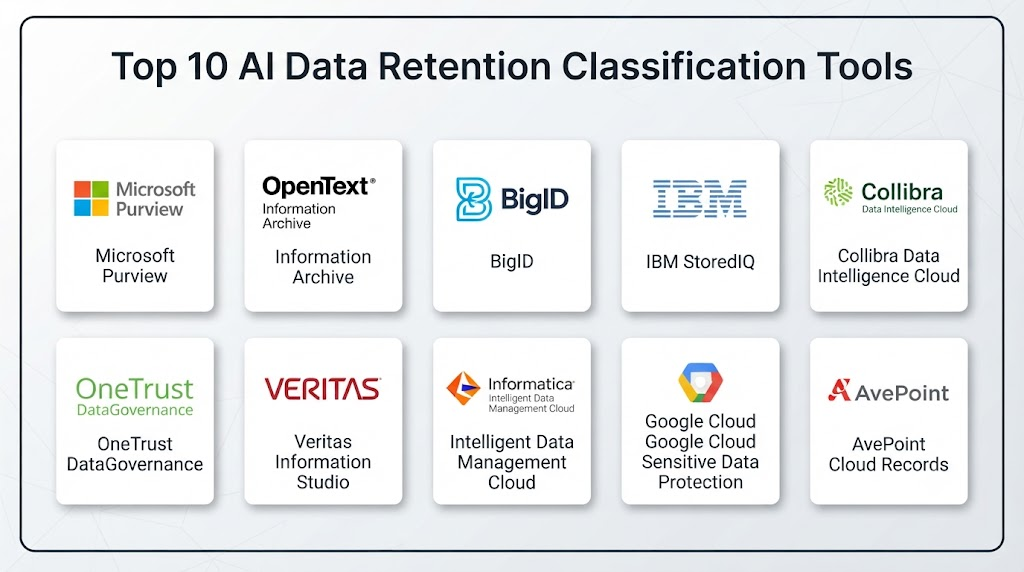
Top 10 AI Data Retention Classification Tools
1 — Microsoft Purview
One-line verdict: Best for Microsoft-centric enterprises managing data classification, retention, compliance, and information governance.
Short description:
Microsoft Purview provides a broad set of data governance, compliance, information protection, and records-management capabilities. It is particularly relevant to organizations already using Microsoft 365 and Azure.
Standout Capabilities
- Data classification
- Retention policies
- Records management
- Sensitive-information detection
- Data governance
- Information protection
- Compliance workflows
- Data discovery
AI-Specific Depth
- Model support: AI capabilities vary across Microsoft services.
- RAG / knowledge integration: Integrates with Microsoft data environments; RAG compatibility depends on architecture.
- Evaluation: AI-specific classification evaluation varies.
- Guardrails: Data and information-protection policies provide governance controls.
- Observability: Compliance and data-governance reporting capabilities vary.
Pros
- Strong Microsoft ecosystem integration
- Broad information-governance functionality
- Useful for enterprise-scale data environments
Cons
- Configuration can be complex
- Best fit may depend on Microsoft ecosystem adoption
- Exact capabilities vary across Purview services
Security & Compliance
Microsoft provides extensive enterprise security and compliance capabilities. Organizations should verify current service-specific encryption, RBAC, SSO, retention, residency, and certification requirements before deployment.
Deployment & Platforms
- Deployment: Cloud
- Platforms: Web
- Self-hosted: Varies by capability
Integrations & Ecosystem
Microsoft Purview works across a broad Microsoft and enterprise data ecosystem.
- Microsoft 365
- Azure
- Data platforms
- Cloud storage
- Enterprise applications
- Security systems
- APIs
Pricing Model
Licensing and consumption models vary by capability. Exact pricing is not included here.
Best-Fit Scenarios
- Microsoft-heavy enterprises
- Enterprise retention programs
- Sensitive-data classification
2 — IBM FileNet
One-line verdict: Best for enterprises requiring mature content management, records management, classification, and information lifecycle controls.
Short description:
IBM FileNet provides enterprise content management and document lifecycle capabilities. Organizations can use it to classify, manage, retain, and govern large collections of enterprise information.
Standout Capabilities
- Enterprise content management
- Document classification
- Records management
- Retention policies
- Workflow automation
- Document lifecycle management
- Metadata management
- Enterprise governance
AI-Specific Depth
- Model support: AI capabilities vary by IBM product integration.
- RAG / knowledge integration: Enterprise content repositories can support knowledge workflows; exact RAG architecture varies.
- Evaluation: Not primarily an AI model evaluation platform.
- Guardrails: Content and workflow governance controls.
- Observability: Document and workflow tracking.
Pros
- Mature enterprise content-management foundation
- Strong records-management capabilities
- Suitable for complex document environments
Cons
- Enterprise implementation can be complex
- May require specialist administration
- Not primarily designed as an AI-only retention product
Security & Compliance
Security controls depend on deployment and configuration. Verify current encryption, SSO, RBAC, audit logging, retention, residency, and certification requirements.
Deployment & Platforms
- Deployment: Cloud / hybrid options vary
- Platforms: Web and enterprise environments
- Self-hosted: Varies
Integrations & Ecosystem
- Enterprise applications
- Document repositories
- Workflow systems
- Databases
- APIs
- Business applications
Pricing Model
Enterprise licensing/subscription; exact pricing varies.
Best-Fit Scenarios
- Large document repositories
- Records-management programs
- Complex enterprise content environments
3 — OpenText
One-line verdict: Best for large organizations managing enterprise information lifecycle, records, documents, and retention across complex environments.
Short description:
OpenText provides enterprise information-management technologies covering content management, records, governance, information lifecycle, and compliance-related workflows.
Standout Capabilities
- Enterprise content management
- Records management
- Information governance
- Document classification
- Retention management
- Information lifecycle management
- Workflow automation
- Enterprise search
AI-Specific Depth
- Model support: AI capabilities vary across OpenText products.
- RAG / knowledge integration: Enterprise content and search integrations vary.
- Evaluation: AI-specific evaluation capabilities vary.
- Guardrails: Information governance and access controls.
- Observability: Content-management reporting and monitoring.
Pros
- Broad enterprise information-management portfolio
- Strong records and lifecycle capabilities
- Suitable for complex organizations
Cons
- Large product ecosystem can be difficult to navigate
- Implementation may require professional services
- Exact AI capabilities depend on selected products
Security & Compliance
Security and compliance capabilities vary by product and deployment. Verify current certifications and controls before procurement.
Deployment & Platforms
- Deployment: Cloud / hybrid / on-premises options vary
- Platforms: Web and enterprise systems
- Self-hosted: Varies
Integrations & Ecosystem
- Enterprise content repositories
- Cloud storage
- Business applications
- Databases
- APIs
- Search systems
- Workflow platforms
Pricing Model
Enterprise licensing and subscription models vary.
Best-Fit Scenarios
- Enterprise records management
- Large document environments
- Complex information governance
4 — BigID
One-line verdict: Best for discovering, classifying, and governing sensitive data across complex enterprise environments.
Short description:
BigID specializes in data discovery, classification, privacy, and data security. Its ability to identify sensitive information across heterogeneous data environments makes it relevant to retention classification.
Standout Capabilities
- Data discovery
- Sensitive-data classification
- Data mapping
- Data cataloging
- Privacy management
- Data governance
- Risk analysis
- Data security
AI-Specific Depth
- Model support: AI governance capabilities vary.
- RAG / knowledge integration: Strong data discovery and integration capabilities.
- Evaluation: AI classification evaluation varies.
- Guardrails: Data security and policy controls.
- Observability: Data discovery and governance monitoring.
Pros
- Strong sensitive-data discovery
- Broad data-environment coverage
- Useful for data minimization initiatives
Cons
- Not solely a retention-management platform
- Requires integration with retention systems
- Enterprise deployment can require substantial configuration
Security & Compliance
Verify current product-specific security, encryption, access control, audit, retention, residency, and certification details.
Deployment & Platforms
- Deployment: Cloud / hybrid options vary
- Platforms: Web
- Self-hosted: Varies
Integrations & Ecosystem
- Databases
- Data warehouses
- Cloud storage
- SaaS applications
- Security tools
- Governance platforms
- APIs
Pricing Model
Enterprise pricing; exact pricing is not publicly stated.
Best-Fit Scenarios
- Sensitive-data discovery
- Enterprise data governance
- Retention-risk analysis
5 — Securiti
One-line verdict: Best for organizations combining data discovery, privacy governance, AI data controls, and lifecycle management.
Short description:
Securiti provides data-security and privacy technologies designed to help organizations discover data, understand its context, manage privacy obligations, and implement governance controls.
Standout Capabilities
- Data discovery
- Data classification
- Sensitive-data identification
- Privacy management
- Data governance
- AI data governance
- Policy automation
- Data security
AI-Specific Depth
- Model support: AI governance capabilities vary.
- RAG / knowledge integration: Enterprise data discovery and integration capabilities.
- Evaluation: AI governance and classification workflows vary.
- Guardrails: Data-policy controls vary by product.
- Observability: Data and governance monitoring capabilities vary.
Pros
- Strong data-intelligence foundation
- Useful for AI data environments
- Combines privacy and security considerations
Cons
- Broad platform scope
- Requires careful implementation
- Exact retention features should be validated for the intended workflow
Security & Compliance
Verify current security documentation, certifications, encryption, RBAC, SSO, retention, and residency.
Deployment & Platforms
- Deployment: Cloud
- Platforms: Web
- Self-hosted: Varies / N/A
Integrations & Ecosystem
- Cloud platforms
- Databases
- SaaS systems
- Data warehouses
- AI environments
- APIs
- Security tools
Pricing Model
Enterprise subscription; exact pricing varies.
Best-Fit Scenarios
- AI data governance
- Sensitive-data management
- Enterprise privacy programs
6 — Collibra
One-line verdict: Best for organizations connecting retention classification with enterprise data cataloging, governance, lineage, and ownership.
Short description:
Collibra provides data intelligence and governance capabilities that help organizations understand data assets, ownership, lineage, classification, and policy requirements.
Standout Capabilities
- Data catalog
- Data classification
- Data governance
- Data lineage
- Policy management
- Data ownership
- Data quality
- AI governance
AI-Specific Depth
- Model support: AI governance capabilities vary.
- RAG / knowledge integration: Enterprise data catalog and knowledge integration.
- Evaluation: AI evaluation is not the platform’s primary purpose.
- Guardrails: Policy and governance controls.
- Observability: Data lineage and governance monitoring.
Pros
- Excellent data-governance foundation
- Strong metadata capabilities
- Useful for complex enterprise data landscapes
Cons
- Not a dedicated retention engine
- Requires policy integration
- May be excessive for smaller organizations
Security & Compliance
Verify current security controls, encryption, SSO, RBAC, audit logging, residency, and certifications.
Deployment & Platforms
- Deployment: Cloud / hybrid options
- Platforms: Web
- Self-hosted: Varies
Integrations & Ecosystem
- Data warehouses
- Databases
- BI tools
- Cloud platforms
- Governance systems
- APIs
- Enterprise applications
Pricing Model
Enterprise subscription; exact pricing varies.
Best-Fit Scenarios
- Data governance
- Retention classification
- Enterprise metadata management
7 — OneTrust
One-line verdict: Best for organizations connecting retention classification with privacy, governance, risk, and data lifecycle programs.
Short description:
OneTrust provides a broad privacy and governance platform. Its privacy, data governance, and risk-management capabilities can support retention classification programs.
Standout Capabilities
- Data discovery
- Data mapping
- Privacy management
- Data governance
- Risk management
- Data classification
- Policy workflows
- Compliance reporting
AI-Specific Depth
- Model support: AI governance capabilities vary.
- RAG / knowledge integration: Data discovery and integration capabilities vary.
- Evaluation: AI-specific evaluation capabilities vary.
- Guardrails: Policy and governance controls.
- Observability: Governance reporting.
Pros
- Broad privacy ecosystem
- Strong enterprise governance orientation
- Useful for privacy-led retention programs
Cons
- Platform complexity
- Multiple modules may be required
- Exact retention functionality depends on configuration
Security & Compliance
Verify current product-specific security, certification, access-control, encryption, retention, and residency information.
Deployment & Platforms
- Deployment: Cloud
- Platforms: Web
- Self-hosted: Varies / N/A
Integrations & Ecosystem
- Privacy systems
- Data platforms
- GRC tools
- Enterprise applications
- Vendor-management systems
- APIs
Pricing Model
Enterprise subscription/module-based pricing; exact pricing varies.
Best-Fit Scenarios
- Enterprise privacy programs
- Retention governance
- Data lifecycle management
8 — ServiceNow
One-line verdict: Best for enterprises integrating data-retention classification into broader risk, compliance, workflow, and governance operations.
Short description:
ServiceNow provides enterprise workflow, risk, compliance, and governance capabilities. Organizations can integrate retention-related processes into broader business workflows.
Standout Capabilities
- Workflow automation
- Risk management
- Compliance
- Governance
- Case management
- Approval workflows
- Enterprise integrations
- Reporting
AI-Specific Depth
- Model support: AI capabilities vary across ServiceNow products.
- RAG / knowledge integration: Enterprise knowledge capabilities.
- Evaluation: AI governance and evaluation capabilities vary.
- Guardrails: Workflow and policy controls.
- Observability: Enterprise workflow reporting.
Pros
- Strong workflow automation
- Broad enterprise ecosystem
- Useful for integrating retention processes
Cons
- Requires configuration
- Not specifically a retention-classification platform
- Enterprise deployments can be complex
Security & Compliance
Verify current service-specific security controls, certifications, encryption, retention, access control, and residency.
Deployment & Platforms
- Deployment: Cloud
- Platforms: Web
- Self-hosted: Not generally the primary model
Integrations & Ecosystem
- GRC
- Security systems
- IT platforms
- Enterprise applications
- Identity systems
- APIs
- Workflow tools
Pricing Model
Enterprise/module-based pricing; exact pricing varies.
Best-Fit Scenarios
- Enterprise workflow governance
- Retention approvals
- Integrated compliance programs
9 — Google Cloud Sensitive Data Protection
One-line verdict: Best for organizations needing automated sensitive-data discovery and classification across Google Cloud data environments.
Short description:
Google Cloud Sensitive Data Protection provides data discovery, inspection, classification, and de-identification capabilities. It can help organizations identify sensitive information that should influence retention decisions.
Standout Capabilities
- Sensitive-data inspection
- Data classification
- Data discovery
- De-identification
- Content inspection
- Automated detection
- Cloud data integration
- Privacy controls
AI-Specific Depth
- Model support: AI model support is not the primary function.
- RAG / knowledge integration: Can inspect data used in cloud-based workflows; exact RAG integration varies.
- Evaluation: Classification accuracy can be evaluated against organizational datasets.
- Guardrails: Sensitive-data detection and policy controls.
- Observability: Cloud monitoring and reporting capabilities vary.
Pros
- Strong sensitive-data detection
- Useful cloud integration
- Can support privacy and data-minimization workflows
Cons
- Not a complete records-management system
- Best suited to data-discovery use cases
- Retention enforcement may require additional services
Security & Compliance
Google Cloud provides enterprise security and compliance capabilities. Verify service-specific controls and regional requirements before deployment.
Deployment & Platforms
- Deployment: Cloud
- Platforms: Web / API
- Self-hosted: N/A
Integrations & Ecosystem
- Google Cloud Storage
- BigQuery
- Cloud databases
- APIs
- Data pipelines
- Security systems
- Analytics platforms
Pricing Model
Usage-based pricing; exact costs depend on workload and configuration.
Best-Fit Scenarios
- Google Cloud environments
- Sensitive-data discovery
- Automated data classification
10 — Amazon Macie
One-line verdict: Best for AWS environments that need automated discovery and classification of sensitive information in Amazon S3.
Short description:
Amazon Macie is designed to discover and classify sensitive data in Amazon S3. It can provide valuable information for organizations building automated retention and data-lifecycle workflows.
Standout Capabilities
- Sensitive-data discovery
- S3 data classification
- Automated inspection
- Sensitive-information identification
- Findings
- Security integration
- AWS-native workflows
- Data visibility
AI-Specific Depth
- Model support: AI models are not the primary product function.
- RAG / knowledge integration: Useful for inspecting data repositories that may support AI workflows; specific RAG integration varies.
- Evaluation: Detection results can be reviewed and validated.
- Guardrails: Sensitive-data findings can inform governance policies.
- Observability: AWS-native monitoring and findings.
Pros
- Strong AWS integration
- Automated sensitive-data discovery
- Useful for S3 environments
Cons
- Focused primarily on Amazon S3
- Not a complete records-management platform
- Retention enforcement requires complementary services
Security & Compliance
AWS provides extensive security controls, but organizations should verify current service-specific requirements, encryption, access controls, logging, retention, and regional considerations.
Deployment & Platforms
- Deployment: Cloud
- Platforms: AWS console / APIs
- Self-hosted: N/A
Integrations & Ecosystem
- Amazon S3
- AWS security services
- AWS IAM
- AWS APIs
- Cloud workflows
- Data pipelines
- Governance systems
Pricing Model
Usage-based pricing; exact cost depends on data volume and configuration.
Best-Fit Scenarios
- AWS data lakes
- S3-sensitive-data discovery
- Cloud data governance
Comparison Table
| Tool | Best For | Deployment | Model Flexibility | Strength | Watch-Out | Public Rating |
|---|---|---|---|---|---|---|
| Microsoft Purview | Microsoft enterprises | Cloud | Hosted / varies | Information governance | Complexity | N/A |
| IBM FileNet | Enterprise content | Cloud / Hybrid | Varies | Records management | Implementation effort | N/A |
| OpenText | Information lifecycle | Cloud / Hybrid / On-premises | Varies | Enterprise content governance | Broad portfolio | N/A |
| BigID | Sensitive-data discovery | Cloud / Hybrid | Varies | Data intelligence | Retention requires integration | N/A |
| Securiti | AI data governance | Cloud | Varies | Privacy and data intelligence | Broad platform | N/A |
| Collibra | Data governance | Cloud / Hybrid | Varies | Metadata and lineage | Not retention-only | N/A |
| OneTrust | Privacy governance | Cloud | Varies | Privacy ecosystem | Configuration complexity | N/A |
| ServiceNow | Enterprise workflows | Cloud | Varies | Workflow automation | Not specialized | N/A |
| Google Cloud Sensitive Data Protection | GCP data discovery | Cloud | Hosted | Sensitive-data detection | Requires complementary retention tools | N/A |
| Amazon Macie | AWS/S3 discovery | Cloud | Hosted | S3 classification | AWS-centric | N/A |
Scoring & Evaluation
The following scores are comparative editorial assessments rather than independent laboratory benchmarks. Organizations should validate them against their own data sources, retention policies, classification accuracy requirements, and operating environment.
| Tool | Core | Reliability/Eval | Guardrails | Integrations | Ease | Perf/Cost | Security/Admin | Support | Weighted Total |
|---|---|---|---|---|---|---|---|---|---|
| Microsoft Purview | 10 | 9 | 9 | 10 | 7 | 8 | 10 | 10 | 9.15 |
| IBM FileNet | 9 | 8 | 9 | 9 | 6 | 7 | 10 | 9 | 8.40 |
| OpenText | 9 | 8 | 9 | 10 | 6 | 7 | 10 | 9 | 8.55 |
| BigID | 10 | 9 | 9 | 10 | 7 | 8 | 10 | 9 | 9.05 |
| Securiti | 10 | 9 | 9 | 10 | 7 | 8 | 10 | 9 | 9.05 |
| Collibra | 9 | 8 | 9 | 10 | 7 | 7 | 10 | 9 | 8.65 |
| OneTrust | 9 | 8 | 9 | 10 | 7 | 7 | 10 | 9 | 8.65 |
| ServiceNow | 8 | 8 | 9 | 10 | 7 | 7 | 10 | 10 | 8.55 |
| Google Cloud Sensitive Data Protection | 8 | 9 | 9 | 10 | 8 | 9 | 10 | 10 | 9.00 |
| Amazon Macie | 8 | 9 | 9 | 9 | 9 | 9 | 10 | 10 | 8.95 |
Which AI Data Retention Classification Tool Is Right for You?
Solo / Freelancer
A freelancer rarely needs an enterprise retention-classification platform.
A simple combination of:
- Organized folders
- Manual retention schedules
- Cloud storage policies
- Spreadsheet-based inventories
- Periodic deletion reviews
may be sufficient.
Use specialized software when the amount or sensitivity of data makes manual classification impractical.
SMB
SMBs should focus on simplicity and automation.
Prioritize:
- Easy classification
- Cloud integration
- Sensitive-data discovery
- Retention rules
- Automated deletion
- Clear reporting
Avoid buying a large enterprise information-governance suite unless the business genuinely needs it.
Mid-Market
Mid-market organizations should connect classification with privacy and compliance programs.
Look for:
- Central data inventory
- Automated classification
- Retention schedules
- Sensitive-data detection
- Legal holds
- Approval workflows
- Audit logs
- API integrations
Enterprise
Enterprises usually need a layered approach.
A mature architecture may include:
Discovery → Classification → Risk analysis → Retention policy → Approval → Archive/Delete → Audit
Microsoft Purview is especially relevant to Microsoft-heavy environments, while BigID and Securiti can be strong choices when cross-platform data discovery is important.
Regulated Industries
Organizations in finance, healthcare, insurance, and government should prioritize:
- Sensitive-data detection
- Retention policy enforcement
- Legal holds
- Audit trails
- Data residency
- Access controls
- Human approval
- Data deletion verification
- Policy versioning
Budget vs Premium
Cloud-native services such as Amazon Macie or Google Cloud Sensitive Data Protection can be attractive when the primary requirement is sensitive-data discovery.
Enterprise platforms become more appropriate when organizations need:
- Records management
- Data governance
- Privacy workflows
- Retention policies
- Cross-platform discovery
- Compliance reporting
- Enterprise administration
Build vs Buy
Build when:
- Your data environment is highly specialized.
- You already operate a strong data-governance platform.
- Retention logic is unique.
- You have engineering and compliance resources.
Buy when:
- You have millions of documents.
- Classification is difficult to perform manually.
- You operate across many cloud platforms.
- Regulatory requirements are significant.
- You need audit-ready workflows.
A hybrid approach is often practical: use commercial discovery and classification services while maintaining organization-specific retention rules internally.
Implementation Playbook: 30 / 60 / 90 Days
First 30 Days: Discover and Define
Start by identifying:
- Data repositories
- Business owners
- Data categories
- Sensitive information
- AI-generated content
- Existing retention policies
- Legal requirements
- Current deletion processes
Create a baseline inventory.
Select one or two high-volume repositories for the initial pilot.
Days 31–60: Classify and Test
Create classification categories such as:
- Public
- Internal
- Confidential
- Sensitive
- Regulated
- Legal hold
- Temporary
- Deletion eligible
Test AI classification against known datasets.
Measure:
- Precision
- Recall
- False positives
- False negatives
- Confidence
- Processing time
Human reviewers should validate high-risk classifications.
Days 61–90: Automate and Govern
Connect classifications to retention rules.
For example:
Data discovered → Classified → Retention category assigned → Policy evaluated → Human approval if required → Archive/delete → Audit record
Introduce reassessment triggers when:
- Regulations change
- Data categories change
- New AI systems are deployed
- Retention policies change
- New repositories are connected
- Business purposes change
Common Mistakes and How to Avoid Them
- Keeping everything forever: More data does not automatically mean more business value.
- Using keywords alone: Context-based classification can be more effective for complex information.
- Ignoring AI-generated content: Prompts, outputs, transcripts, and agent logs can contain sensitive information.
- Deleting data without legal review: Legal holds and regulatory requirements must be respected.
- Automating every deletion decision: High-risk records may require human approval.
- Not testing classification accuracy: AI classifications should be measured against representative data.
- Ignoring false negatives: Missing sensitive information can create serious risk.
- Ignoring false positives: Excessive classification can create unnecessary operational work.
- Failing to document policies: Retention decisions should be traceable.
- Ignoring backups: Deletion workflows should consider backup and recovery architectures.
- Overlooking cloud copies: The same information may exist in multiple systems.
- No ownership model: Every major retention category should have an accountable owner.
- No reassessment process: Policies should evolve as systems and regulations change.
- Ignoring vendor data: Third-party processors may retain information outside your primary environment.
FAQs
What is AI Data Retention Classification?
It is the use of AI and automated rules to classify information according to its sensitivity, business purpose, regulatory requirements, and appropriate retention lifecycle.
Why is AI useful for data retention?
AI can analyze large volumes of unstructured information faster than manual teams and can identify contextual patterns that simple metadata or keyword rules may miss.
Can AI classify documents automatically?
Yes. Many data-governance and classification platforms provide automated classification capabilities, although accuracy depends on the technology, configuration, data type, and classification rules.
Can AI classify sensitive personal information?
Many data-discovery platforms can identify categories of sensitive information. Organizations should test detection accuracy using representative data before relying on automated results.
Should AI-generated content have retention policies?
Usually, organizations should determine whether AI-generated content contains business, legal, personal, or operational information that requires retention. Not every AI output needs to be retained indefinitely.
How should AI prompts be classified?
Prompts can be classified based on their content, user, system, sensitivity, business purpose, and whether they contain personal or confidential information.
Can AI agents create retention problems?
Yes. Agents may create logs, tool calls, intermediate outputs, reports, and other artifacts. Organizations should define which of these records have business or regulatory value.
Can these tools automatically delete data?
Some platforms can support or trigger automated deletion workflows, but deletion should be carefully governed to avoid violating legal holds, regulatory obligations, or business requirements.
Do these platforms support legal holds?
Some enterprise records-management and governance platforms support legal-hold workflows. Exact functionality varies by product.
How accurate is AI classification?
There is no universal accuracy level. Organizations should conduct their own evaluation using representative data and measure false positives and false negatives.
Can these tools work across multiple clouds?
Many enterprise data-governance platforms support multiple data sources, although coverage differs considerably between vendors.
Is self-hosting important?
Self-hosting can matter for organizations with strict data-residency, security, or infrastructure requirements. However, cloud services may provide simpler deployment and maintenance.
How do AI retention tools reduce storage costs?
By identifying redundant, obsolete, unnecessary, or low-value data, organizations can potentially reduce the amount of information stored in expensive systems.
Can retention classification improve privacy?
Yes. Better classification can help organizations identify information that no longer has a legitimate purpose and should be deleted or anonymized.
What is the biggest risk of automated retention?
The biggest risks include incorrect classification, accidental deletion, excessive retention, incomplete data discovery, and failure to account for legal or regulatory requirements.
Conclusion
AI Data Retention Classification is becoming increasingly important as organizations accumulate massive volumes of documents, messages, customer information, AI-generated content, logs, and machine-generated records.The strongest approach is not simply to use AI to decide what gets deleted. Instead, organizations should create a complete lifecycle:Microsoft Purview is a strong option for organizations deeply invested in the Microsoft ecosystem. BigID and Securiti are compelling when cross-platform data discovery and sensitive-data intelligence are priorities. OpenText and IBM FileNet are relevant to mature enterprise content and records-management environments, while Collibra is particularly useful when data governance and lineage are central.For cloud-focused organizations, Amazon Macie and Google Cloud Sensitive Data Protection can provide valuable sensitive-data discovery capabilities, although they should generally be viewed as components of a broader retention architecture rather than complete records-management solutions.