Introduction
AI Insider Trading Risk Detection tools use artificial intelligence, machine learning, behavioral analytics, transaction analysis, and surveillance technology to identify patterns that may indicate potential insider trading or other market-abuse risks. Instead of relying only on predefined rules, these systems can analyze large volumes of trading activity alongside employee information, communications, market events, restricted lists, watchlists, and other contextual signals.
The goal is not to automatically declare that someone has committed insider trading. Rather, AI helps compliance and surveillance teams identify unusual activity that deserves investigation.
Common use cases include:
- Employee trading surveillance
- Suspicious trading-pattern detection
- Pre-event and post-event trade analysis
- Trading around material events
- Restricted-list monitoring
- Watchlist surveillance
- Communication and trade correlation
- Market-abuse investigation
- Insider-risk scoring
- Alert prioritization
- Investigation workflow automation
- Regulatory surveillance support
Best for: Investment banks, broker-dealers, asset managers, hedge funds, exchanges, wealth-management firms, financial institutions, compliance teams, and organizations with substantial employee or client trading activity.
Not ideal for: Small organizations with very limited trading activity, firms that only need basic employee-trading declarations, or teams without the data infrastructure required for advanced surveillance analytics.
What Is AI Insider Trading Risk Detection?
AI Insider Trading Risk Detection refers to software that applies machine learning, statistical analysis, behavioral analytics, natural-language processing, and other analytical techniques to trading-surveillance data.
Traditional surveillance systems often depend heavily on predefined scenarios. For example, a compliance team might configure a rule that generates an alert when an employee trades a security shortly before a significant corporate announcement.
AI-assisted systems can go further by examining combinations of signals.
For example, a platform might identify:
- An employee trading an unusual security
- A significant change from their historical behavior
- Trading shortly before an important event
- Connections between the employee and another account
- Relevant communications
- Changes in trading frequency or position size
- Relationships between securities and corporate events
The resulting risk signal can then be reviewed by a compliance professional.
This distinction is important: AI detection identifies risk; it does not establish guilt.
Why AI Matters for Insider Trading Surveillance
Financial institutions process enormous quantities of trading and communication data. Manual surveillance becomes increasingly difficult when firms operate across multiple markets, asset classes, jurisdictions, and business units.
AI can help compliance teams:
- Detect behavioral anomalies
- Correlate trading with events
- Identify unusual trading patterns
- Prioritize investigation queues
- Connect related accounts
- Reduce repetitive analysis
- Surface hidden relationships
- Analyze communications alongside transactions
- Improve investigator productivity
- Create more consistent surveillance workflows
AI is particularly useful when suspicious activity does not match a single predefined rule.
What to Evaluate Before Buying
Organizations evaluating AI insider-trading surveillance platforms should consider:
- Trading surveillance capabilities
- Behavioral analytics
- Employee-trading monitoring
- Market-abuse scenarios
- Event correlation
- Communication surveillance
- Entity resolution
- Risk scoring
- Alert prioritization
- Explainability
- Investigation workflows
- Case management
- Data lineage
- Audit trails
- Model governance
- False-positive management
- Integration capabilities
- Real-time processing
- Data retention
- Security and access controls
What Has Changed in AI Insider Trading Risk Detection
- Behavioral analytics: Platforms increasingly compare current trading activity with historical behavioral patterns.
- Context-aware detection: Trading activity can be evaluated alongside market events, corporate announcements, and other relevant information.
- Cross-channel surveillance: Firms increasingly correlate trading data with communications and other employee activity.
- Entity resolution: AI can help connect employees, accounts, issuers, securities, and related entities.
- Risk-based prioritization: Instead of treating every alert equally, systems can rank cases based on multiple signals.
- Natural-language investigation: Investigators can increasingly use natural-language interfaces to explore surveillance data.
- AI-assisted investigations: Systems can summarize alerts and assemble relevant evidence for investigators.
- Network analytics: Relationship analysis can reveal connections between accounts, traders, issuers, and other entities.
- Explainability: Compliance teams increasingly require understandable reasons for AI-generated alerts.
- Human oversight: Automated surveillance needs investigator review, especially for high-impact decisions.
- Model governance: Firms need controls for model validation, performance monitoring, changes, and drift.
- Privacy-by-design: Employee and communication data require strong access, retention, and governance controls.
Quick Buyer Checklist
- Does the platform support employee-trading surveillance?
- Can it analyze trading behavior over time?
- Does it support behavioral anomaly detection?
- Can it correlate trades with corporate events?
- Does it support communication surveillance?
- Can it connect related accounts and entities?
- Does it provide risk scoring?
- Can analysts customize surveillance scenarios?
- Are AI-generated alerts explainable?
- Can investigators review supporting evidence?
- Are audit logs available?
- Can analysts override or annotate AI decisions?
- Does it support model monitoring?
- Does it integrate with order and trade-management systems?
- Can it ingest communications data?
- Does it provide APIs?
- Are data-retention policies configurable?
- Are role-based access controls available?
- Can it scale to large trading volumes?
- Does it support your required asset classes and jurisdictions?
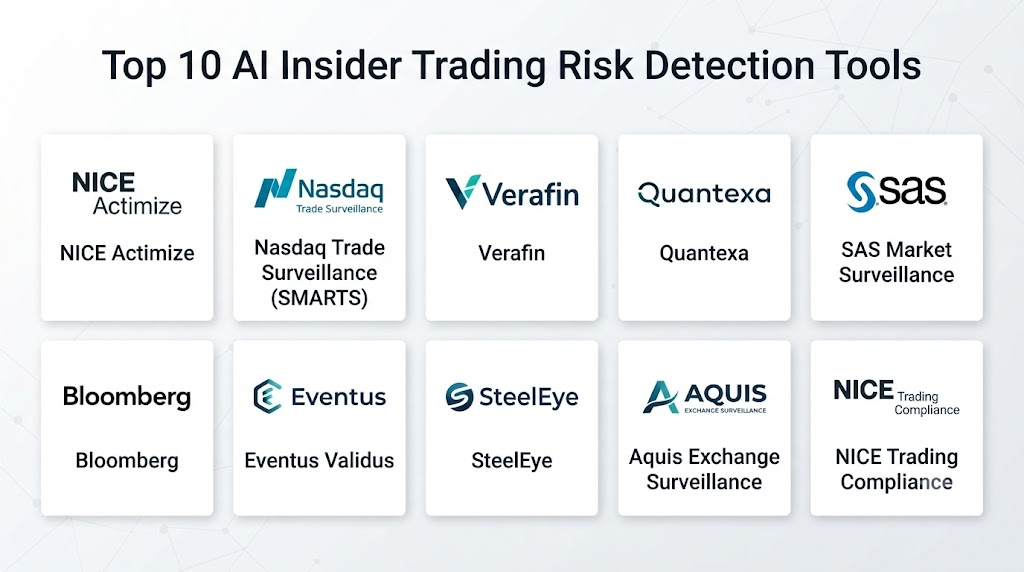
Top 10 AI Insider Trading Risk Detection Tools
1 — NICE Actimize
One-line verdict: Best for large financial institutions requiring comprehensive surveillance, market-abuse detection, and investigation capabilities.
Short description:
NICE Actimize provides financial-crime and compliance technology covering surveillance, fraud, AML, and market-abuse use cases. Its enterprise-oriented capabilities can support sophisticated trading-surveillance operations.
Standout Capabilities
- Trade surveillance
- Market-abuse detection
- Employee surveillance
- Behavioral analytics
- Alert management
- Case management
- Risk analytics
- Investigation workflows
AI-Specific Depth
- Model support: Proprietary analytics and machine-learning capabilities; exact model architectures are not publicly stated.
- RAG / knowledge integration: Not primarily a RAG platform; knowledge integration varies by implementation.
- Evaluation: Detailed model-evaluation methodology is not publicly stated.
- Guardrails: Compliance workflows, permissions, and configurable surveillance controls.
- Observability: Surveillance analytics and operational reporting; detailed AI telemetry varies.
Pros
- Broad enterprise surveillance capabilities
- Strong financial-services specialization
- Supports complex investigation workflows
Cons
- Can require substantial implementation
- Enterprise-oriented
- May be excessive for smaller firms
Security & Compliance
Enterprise security and administrative capabilities are available. Specific certifications, retention controls, and regional deployment options should be verified for the selected configuration.
Deployment & Platforms
- Deployment: Cloud / deployment options vary
- Platforms: Enterprise web applications
- Self-hosted: Varies / N/A
Integrations & Ecosystem
The platform is designed to connect surveillance data with broader financial-institution systems.
- Order-management systems
- Trading platforms
- Communication systems
- Case-management systems
- Market-data sources
- APIs
Pricing Model
Enterprise pricing; exact pricing varies by implementation.
Best-Fit Scenarios
- Investment banks
- Large broker-dealers
- Global surveillance operations
2 — Nasdaq Trade Surveillance
One-line verdict: Best for financial institutions seeking established market-surveillance technology across trading and market-abuse scenarios.
Short description:
Nasdaq provides surveillance technology designed to identify potential market abuse and suspicious trading behavior. Its solutions are relevant to exchanges, broker-dealers, and other market participants.
Standout Capabilities
- Trade surveillance
- Market-abuse detection
- Cross-market monitoring
- Alert generation
- Investigation support
- Market-data analysis
- Surveillance workflows
- Risk analytics
AI-Specific Depth
- Model support: Analytical and machine-learning capabilities vary by solution; exact models are not publicly stated.
- RAG / knowledge integration: N/A for core surveillance.
- Evaluation: Detailed AI evaluation methodology is not publicly stated.
- Guardrails: Surveillance rules and investigation controls.
- Observability: Surveillance reporting and analytics.
Pros
- Strong capital-markets expertise
- Broad surveillance experience
- Suitable for complex trading environments
Cons
- Enterprise implementation
- May require specialist surveillance expertise
- Exact AI functionality varies by product
Security & Compliance
Security, access controls, auditability, retention, and certifications should be verified for the selected deployment.
Deployment & Platforms
- Deployment: Cloud / managed / varies
- Platforms: Enterprise web environment
- Self-hosted: Varies / N/A
Integrations & Ecosystem
- Order data
- Trade data
- Market data
- Exchange systems
- Communication systems
- APIs
Pricing Model
Enterprise pricing; exact pricing is not publicly standardized.
Best-Fit Scenarios
- Broker-dealers
- Exchanges
- Capital-markets firms
3 — S&P Global Cappitech
One-line verdict: Best for financial firms combining trade reporting, transaction data management, and surveillance-related regulatory workflows.
Short description:
S&P Global Cappitech provides regulatory reporting and financial-market technology. Its broader ecosystem can support organizations managing large volumes of trading and regulatory data.
Standout Capabilities
- Transaction reporting
- Regulatory reporting
- Trading data management
- Data validation
- Regulatory workflows
- Compliance operations
- Data analytics
- Reporting automation
AI-Specific Depth
- Model support: Varies / N/A.
- RAG / knowledge integration: N/A.
- Evaluation: Not publicly stated.
- Guardrails: Workflow and compliance controls.
- Observability: Reporting and data-quality analytics.
Pros
- Strong regulatory-data expertise
- Useful for high-volume market data
- Enterprise financial-services focus
Cons
- Not solely an insider-trading detection platform
- AI capabilities vary by solution
- May require complementary surveillance technology
Security & Compliance
Security and compliance controls vary by product and deployment and should be validated directly.
Deployment & Platforms
- Deployment: Cloud / managed
- Platforms: Web / enterprise
- Self-hosted: Varies / N/A
Integrations & Ecosystem
- Trading systems
- Regulatory reporting systems
- Market data
- Data warehouses
- APIs
- Compliance platforms
Pricing Model
Enterprise pricing; exact pricing varies.
Best-Fit Scenarios
- Regulatory reporting environments
- Capital markets
- Trading-data operations
4 — SymphonyAI
One-line verdict: Best for enterprises seeking AI-driven surveillance, anomaly detection, investigation support, and financial-market intelligence.
Short description:
SymphonyAI develops enterprise AI technology across multiple industries, including financial services. Its financial-services capabilities can support surveillance, risk analytics, and investigation workflows.
Standout Capabilities
- AI-driven analytics
- Surveillance
- Anomaly detection
- Financial intelligence
- Risk analytics
- Investigation support
- Entity analysis
- Workflow automation
AI-Specific Depth
- Model support: Proprietary AI and machine-learning capabilities.
- RAG / knowledge integration: Varies by implementation.
- Evaluation: Detailed model-evaluation methodology is not publicly stated.
- Guardrails: Enterprise governance and workflow controls.
- Observability: Analytics and operational reporting.
Pros
- Strong AI orientation
- Broad enterprise capabilities
- Suitable for complex analytical environments
Cons
- Enterprise implementation complexity
- Requires data integration
- Exact capabilities vary by product
Security & Compliance
Security and compliance details should be validated for the specific solution and deployment.
Deployment & Platforms
- Deployment: Cloud / hybrid / varies
- Platforms: Enterprise
- Self-hosted: Varies / N/A
Integrations & Ecosystem
- Trading systems
- Market data
- Communications
- Enterprise data
- Risk platforms
- APIs
Pricing Model
Enterprise pricing; exact pricing varies.
Best-Fit Scenarios
- Large financial institutions
- Complex surveillance environments
- AI-driven compliance programs
5 — Eventus
One-line verdict: Best for firms requiring configurable trade surveillance across multiple asset classes and market environments.
Short description:
Eventus provides trade-surveillance technology for financial markets. Its platform is designed to help firms identify potential market abuse and investigate suspicious trading behavior.
Standout Capabilities
- Trade surveillance
- Market-abuse monitoring
- Multi-asset surveillance
- Alert management
- Case investigation
- Configurable scenarios
- Regulatory surveillance
- Risk monitoring
AI-Specific Depth
- Model support: Analytics and automation capabilities vary; exact AI model architecture is not publicly stated.
- RAG / knowledge integration: N/A.
- Evaluation: Not publicly stated.
- Guardrails: Surveillance scenarios and workflow controls.
- Observability: Surveillance reporting and analytics.
Pros
- Dedicated trade-surveillance focus
- Configurable workflows
- Broad market coverage
Cons
- Specialized implementation
- Requires surveillance expertise
- AI-specific details can vary
Security & Compliance
Specific security controls, certifications, and retention capabilities should be verified for the relevant deployment.
Deployment & Platforms
- Deployment: Cloud / managed / varies
- Platforms: Web / enterprise
- Self-hosted: Varies / N/A
Integrations & Ecosystem
- Order-management systems
- Trading platforms
- Market data
- Compliance systems
- Case-management tools
- APIs
Pricing Model
Enterprise pricing; exact pricing varies.
Best-Fit Scenarios
- Broker-dealers
- Futures and derivatives firms
- Multi-asset trading environments
6 — SteelEye
One-line verdict: Best for organizations combining financial data management, regulatory reporting, analytics, and surveillance-related workflows.
Short description:
SteelEye provides financial-data and regulatory technology designed to help firms manage trading and regulatory data. Its broader data infrastructure can support compliance and surveillance workflows.
Standout Capabilities
- Financial-data management
- Regulatory reporting
- Data analytics
- Data quality
- Transaction reporting
- Compliance workflows
- Data normalization
- Financial-market integrations
AI-Specific Depth
- Model support: Varies / N/A.
- RAG / knowledge integration: N/A.
- Evaluation: Not publicly stated.
- Guardrails: Data and compliance controls.
- Observability: Data-quality and reporting analytics.
Pros
- Strong financial-data infrastructure
- Useful for regulatory workflows
- Data normalization capabilities
Cons
- Not exclusively focused on insider-trading detection
- May require complementary surveillance tools
- Advanced surveillance capabilities vary
Security & Compliance
Security and compliance features vary by product and deployment and should be validated during procurement.
Deployment & Platforms
- Deployment: Cloud
- Platforms: Web / APIs
- Self-hosted: Varies / N/A
Integrations & Ecosystem
- Trading platforms
- Market data
- Regulatory systems
- Data warehouses
- APIs
- Reporting systems
Pricing Model
Enterprise and usage-based models may apply; exact pricing varies.
Best-Fit Scenarios
- Financial-data management
- Regulatory operations
- Capital-markets compliance
7 — ACA APEX
One-line verdict: Best for investment firms looking to connect employee-trading compliance with broader compliance-management workflows.
Short description:
ACA APEX is a compliance platform designed for investment advisers and other financial organizations. It can support employee-trading compliance and related compliance-management processes.
Standout Capabilities
- Employee trading compliance
- Personal account dealing workflows
- Compliance monitoring
- Attestation workflows
- Restricted-list processes
- Compliance reporting
- Employee compliance
- Risk management
AI-Specific Depth
- Model support: AI-specific model details are not publicly stated.
- RAG / knowledge integration: N/A.
- Evaluation: Not publicly stated.
- Guardrails: Compliance workflows and access controls.
- Observability: Compliance reporting and audit information.
Pros
- Strong compliance focus
- Relevant to employee-trading monitoring
- Useful for investment-management firms
Cons
- More compliance-management oriented than broad market surveillance
- AI capabilities may be limited compared with AI-native platforms
- Product scope varies by organization
Security & Compliance
Security controls, certifications, retention, and access management should be confirmed for the specific service.
Deployment & Platforms
- Deployment: Cloud
- Platforms: Web
- Self-hosted: Not publicly stated
Integrations & Ecosystem
- Portfolio systems
- Trading data
- Employee records
- Compliance systems
- APIs
- Reporting tools
Pricing Model
Enterprise or subscription-based pricing; exact pricing varies.
Best-Fit Scenarios
- Investment advisers
- Employee-trading compliance
- Compliance-management programs
8 — SteelEye Trade Surveillance
One-line verdict: Best for financial firms looking for surveillance workflows built around consolidated trading and financial-market data.
Short description:
SteelEye’s financial-data environment can support trade-surveillance and compliance use cases by consolidating and normalizing market and transaction data.
Standout Capabilities
- Trading-data consolidation
- Data normalization
- Surveillance workflows
- Transaction analysis
- Regulatory reporting
- Data quality
- Compliance analytics
- Financial-market integrations
AI-Specific Depth
- Model support: Varies / N/A.
- RAG / knowledge integration: N/A.
- Evaluation: Not publicly stated.
- Guardrails: Data governance and workflow controls.
- Observability: Data-quality and reporting analytics.
Pros
- Strong data foundation
- Useful for fragmented trading environments
- Financial-market specialization
Cons
- Surveillance depth depends on configuration
- May require additional analytics
- Enterprise implementation can be complex
Security & Compliance
Security and compliance capabilities vary according to deployment and should be verified.
Deployment & Platforms
- Deployment: Cloud
- Platforms: Web / API
- Self-hosted: Varies / N/A
Integrations & Ecosystem
- Trading data
- Market data
- Regulatory systems
- Data warehouses
- APIs
- Compliance applications
Pricing Model
Enterprise pricing; exact pricing varies.
Best-Fit Scenarios
- Capital-markets firms
- Trading-data consolidation
- Surveillance infrastructure
9 — Scila
One-line verdict: Best for exchanges and market participants requiring surveillance technology for detecting suspicious trading and market-abuse patterns.
Short description:
Scila provides market-surveillance technology focused on detecting suspicious behavior in financial markets. Its solutions are designed for market operators and financial institutions.
Standout Capabilities
- Market surveillance
- Trade surveillance
- Market-abuse detection
- Pattern analysis
- Alert generation
- Investigation workflows
- Cross-market analysis
- Surveillance analytics
AI-Specific Depth
- Model support: Analytical and machine-learning capabilities vary; exact models are not publicly stated.
- RAG / knowledge integration: N/A.
- Evaluation: Not publicly stated.
- Guardrails: Surveillance scenarios and investigator controls.
- Observability: Surveillance analytics and reporting.
Pros
- Dedicated market-surveillance focus
- Suitable for complex markets
- Strong analytical orientation
Cons
- Specialized product
- Requires domain expertise
- Exact AI capabilities should be verified
Security & Compliance
Security and regulatory controls should be validated against the intended implementation.
Deployment & Platforms
- Deployment: Cloud / on-premises / varies
- Platforms: Enterprise
- Self-hosted: Varies / N/A
Integrations & Ecosystem
- Exchanges
- Trading platforms
- Market-data systems
- Order data
- Compliance systems
- APIs
Pricing Model
Enterprise pricing; exact pricing varies.
Best-Fit Scenarios
- Exchanges
- Market operators
- Institutional trading environments
10 — ACA ComplianceAlpha
One-line verdict: Best for investment firms wanting employee-trading surveillance integrated with broader compliance-management capabilities.
Short description:
ACA ComplianceAlpha is a compliance-management platform for investment firms. It can support employee-trading oversight alongside other compliance processes.
Standout Capabilities
- Employee trading
- Personal account dealing
- Compliance monitoring
- Restricted-list management
- Compliance workflows
- Reporting
- Attestations
- Risk management
AI-Specific Depth
- Model support: AI-specific details are not publicly stated.
- RAG / knowledge integration: N/A.
- Evaluation: Not publicly stated.
- Guardrails: Workflow and compliance controls.
- Observability: Compliance reporting and audit trails.
Pros
- Investment-management focus
- Useful employee-trading workflows
- Broader compliance functionality
Cons
- Not a dedicated AI market-surveillance engine
- Advanced trading analytics may require additional technology
- Exact AI capabilities vary
Security & Compliance
Organizations should verify current security controls, certifications, data retention, access management, and residency requirements.
Deployment & Platforms
- Deployment: Cloud
- Platforms: Web
- Self-hosted: Not publicly stated
Integrations & Ecosystem
- Employee systems
- Trading systems
- Compliance databases
- Portfolio platforms
- Reporting tools
- APIs
Pricing Model
Subscription / enterprise pricing; exact pricing varies.
Best-Fit Scenarios
- Investment advisers
- Employee-trading compliance
- Broader compliance programs
Comparison Table
| Tool | Best For | Deployment | Model Flexibility | Strength | Watch-Out | Public Rating |
|---|---|---|---|---|---|---|
| NICE Actimize | Enterprise surveillance | Cloud / varies | Proprietary | Broad surveillance | Implementation complexity | N/A |
| Nasdaq Trade Surveillance | Capital markets | Cloud / managed | Proprietary | Market surveillance | Enterprise complexity | N/A |
| S&P Global Cappitech | Regulatory data | Cloud / managed | Varies | Financial-data workflows | Not solely surveillance | N/A |
| SymphonyAI | AI-driven surveillance | Cloud / Hybrid | Proprietary | AI analytics | Integration effort | N/A |
| Eventus | Multi-asset surveillance | Cloud / managed | Proprietary / varies | Configurable surveillance | Specialist setup | N/A |
| SteelEye | Financial data | Cloud | Varies | Data infrastructure | Surveillance depth varies | N/A |
| ACA APEX | Employee trading | Cloud | Varies | Compliance workflows | Narrower surveillance scope | N/A |
| SteelEye Trade Surveillance | Trading data surveillance | Cloud | Varies | Data consolidation | Additional analytics may be needed | N/A |
| Scila | Market surveillance | Cloud / on-premises / varies | Proprietary / varies | Market-abuse detection | Specialized | N/A |
| ACA ComplianceAlpha | Investment compliance | Cloud | Varies | Employee-trading compliance | Limited AI-specific depth | N/A |
Scoring & Evaluation
The following scoring is a comparative buying framework rather than an independent performance benchmark. Scores reflect the apparent breadth of capabilities, enterprise suitability, flexibility, and surveillance focus rather than guaranteed detection accuracy.
| Tool | Core | Reliability/Eval | Guardrails | Integrations | Ease | Perf/Cost | Security/Admin | Support | Weighted Total |
|---|---|---|---|---|---|---|---|---|---|
| NICE Actimize | 10 | 9 | 10 | 10 | 7 | 8 | 10 | 10 | 9.15 |
| Nasdaq Trade Surveillance | 10 | 9 | 10 | 10 | 7 | 8 | 10 | 10 | 9.15 |
| S&P Global Cappitech | 8 | 8 | 9 | 10 | 8 | 9 | 9 | 10 | 8.75 |
| SymphonyAI | 9 | 9 | 9 | 9 | 7 | 8 | 10 | 10 | 8.90 |
| Eventus | 9 | 9 | 9 | 9 | 8 | 8 | 9 | 9 | 8.80 |
| SteelEye | 8 | 8 | 9 | 10 | 8 | 9 | 9 | 9 | 8.75 |
| ACA APEX | 8 | 7 | 9 | 9 | 9 | 8 | 9 | 9 | 8.45 |
| SteelEye Trade Surveillance | 8 | 8 | 9 | 10 | 8 | 9 | 9 | 9 | 8.75 |
| Scila | 9 | 9 | 9 | 9 | 7 | 8 | 9 | 9 | 8.75 |
| ACA ComplianceAlpha | 8 | 7 | 9 | 9 | 9 | 8 | 9 | 9 | 8.45 |
Top 3 for Enterprise
- NICE Actimize
- Nasdaq Trade Surveillance
- SymphonyAI
Top 3 for SMB
- ACA APEX
- ACA ComplianceAlpha
- Eventus
Top 3 for Developers
- S&P Global Cappitech
- SteelEye
- Eventus
Which AI Insider Trading Risk Detection Tool Is Right for You?
Solo / Freelancer
Individual professionals rarely need a full enterprise market-surveillance platform.
For consulting or research purposes, lightweight analytics and compliance tools may be sufficient.
If you are actually responsible for regulated employee-trading surveillance, however, a specialized platform is preferable to a general-purpose AI tool.
SMB
Smaller financial firms should prioritize:
- Employee-trading monitoring
- Restricted lists
- Watchlists
- Configurable alerts
- Compliance reporting
- Simple integrations
- Auditability
- Reasonable implementation effort
The best platform is usually the one that solves the firm’s highest-risk surveillance requirement without creating unnecessary operational complexity.
Mid-Market
Mid-market firms should consider platforms capable of connecting:
- Trading data
- Employee information
- Market data
- Corporate events
- Communications
- Compliance records
Behavioral analytics and entity resolution become increasingly valuable as trading volumes and organizational complexity increase.
Enterprise
Large institutions should prioritize:
- High-volume surveillance
- Cross-market monitoring
- Multi-asset coverage
- Behavioral analytics
- Network analysis
- Communication surveillance
- Explainable AI
- Case management
- Model governance
- Data lineage
- Auditability
- Enterprise access controls
NICE Actimize, Nasdaq, SymphonyAI, Eventus, and other enterprise surveillance platforms are relevant options to evaluate.
Regulated Industries
Financial-market participants should place regulatory governance ahead of AI novelty.
Important controls include:
- Human review
- Model validation
- Audit trails
- Evidence preservation
- Access control
- Data retention
- Explainability
- Model monitoring
- Change management
AI should make surveillance more effective without creating an opaque decision-making process.
Budget vs Premium
Budget-conscious organizations should start with their highest-risk scenarios.
For example:
- Employee trading
- Trading before material events
- Restricted-security violations
- Unusual position changes
- Suspicious account relationships
Enterprise organizations with multiple asset classes and jurisdictions may justify more comprehensive surveillance infrastructure.
Build vs Buy
Build when:
- You have specialized surveillance engineers.
- Your trading data architecture is mature.
- Your organization requires proprietary detection logic.
- You have internal model-validation capabilities.
Buy when:
- You need mature surveillance workflows.
- You need market-abuse scenarios out of the box.
- You lack specialized surveillance engineering expertise.
- You need vendor-supported integrations.
A hybrid strategy can be effective: use a commercial surveillance platform while building specialized models for institution-specific risks.
Implementation Playbook: 30 / 60 / 90 Days
First 30 Days: Pilot
Select a limited surveillance scenario.
Possible pilots include:
- Employee trading before corporate events
- Unusual trading behavior
- Restricted-list violations
- Suspicious account relationships
Establish baseline measurements:
- Number of alerts
- False-positive rate
- Investigation time
- Escalation rate
- Analyst workload
- Detection coverage
Create a representative test set using historical surveillance cases.
Days 31–60: Harden Security and Evaluation
Integrate the platform with approved data sources.
Implement:
- SSO
- RBAC
- Audit logging
- Data-retention policies
- Access controls
- Model-version tracking
- Prompt/version controls where generative AI is used
- Investigator approval
Test for:
- False positives
- False negatives
- Missing data
- Incorrect entity matches
- Adversarial inputs
- Prompt injection
- Model drift
- Unusual trading patterns
Every high-risk AI recommendation should remain reviewable.
Days 61–90: Optimize and Scale
Expand to additional surveillance scenarios after validating the pilot.
Monitor:
- Alert quality
- Investigation efficiency
- Analyst acceptance
- Model performance
- Processing latency
- Infrastructure costs
- AI usage costs
- False-positive trends
Establish governance for:
- Model changes
- Scenario changes
- Data changes
- AI incidents
- Investigator overrides
- Regulatory updates
- Model validation
Common Mistakes and How to Avoid Them
- Treating an AI alert as proof of insider trading: An alert is a risk signal, not a conclusion.
- Ignoring contextual information: Trading activity needs to be evaluated alongside relevant events and relationships.
- Using only static rules: Static scenarios can miss complex behavioral patterns.
- Over-relying on machine learning: AI should complement established surveillance controls.
- Ignoring false negatives: Missing suspicious behavior can be more serious than generating extra alerts.
- No explainability: Investigators need to understand why activity was flagged.
- Poor data quality: Incorrect employee, trading, or market data can undermine detection.
- No entity resolution: Related accounts and individuals can remain hidden without relationship analysis.
- No human oversight: High-impact compliance decisions should receive appropriate review.
- Weak audit trails: Investigation decisions and AI recommendations should be traceable.
- Ignoring communication context: Trading patterns may be more meaningful when correlated with permitted surveillance data.
- No model monitoring: Detection models can degrade as trading behavior changes.
- Uncontrolled AI prompts: Generative AI workflows require versioning and governance.
- Prompt-injection exposure: Untrusted text or documents should not be allowed to manipulate surveillance workflows.
- Unmanaged retention: Sensitive employee and trading information needs controlled retention.
- No fallback workflow: Compliance teams need manual procedures if AI services become unavailable.
FAQs
What is AI insider trading risk detection?
AI insider trading risk detection uses machine learning, behavioral analytics, transaction analysis, and other AI techniques to identify trading activity that may warrant compliance investigation.
Can AI prove insider trading?
No. AI can identify suspicious patterns and generate risk signals, but determining whether insider trading occurred requires appropriate investigation and evidence.
Can AI monitor employee trading?
Yes. Specialized compliance platforms can monitor employee or personal-account trading and compare activity against policies, restricted lists, and other compliance information.
Can AI detect trading before corporate announcements?
AI-based surveillance can analyze the timing of trades relative to relevant events and identify unusual patterns for investigator review.
Does AI reduce false positives?
It can potentially reduce false positives by considering multiple contextual and behavioral signals, but results depend heavily on model quality, data, configuration, and implementation.
Can AI analyze communications?
Some surveillance platforms support communication surveillance or integration with communication-monitoring systems. Exact capabilities vary by product.
Does insider-trading detection require machine learning?
No. Rules-based surveillance remains important. Machine learning can complement rules by identifying patterns that may be difficult to encode manually.
Can these tools analyze multiple asset classes?
Many enterprise surveillance platforms support multiple asset classes, but coverage varies by vendor and implementation.
Are AI surveillance recommendations explainable?
The level of explainability varies. Buyers should specifically test whether investigators can see the signals, evidence, and factors contributing to an alert.
Can an AI system automatically close surveillance alerts?
Some workflows may support automated disposition under defined conditions, but organizations should carefully control automation and maintain appropriate human oversight for material compliance decisions.
Can these platforms be self-hosted?
Deployment options vary. Some enterprise solutions support different hosting models, while others are primarily cloud or managed services.
How much do AI insider-trading surveillance tools cost?
Pricing depends on trading volume, users, markets, modules, data sources, deployment, and implementation requirements. Exact pricing is generally vendor-specific.
What data is required?
Typical inputs can include orders, executions, account information, employee information, security data, market data, corporate events, and other approved compliance information.
How should an AI surveillance model be tested?
Use historical cases and representative scenarios while measuring false positives, false negatives, detection consistency, explainability, latency, and investigator usefulness.
Conclusion
AI Insider Trading Risk Detection can help financial institutions move from simple rule-based monitoring toward more contextual, behavioral, and data-driven surveillance. The most valuable systems can analyze trading activity alongside historical behavior, market events, employee information, relationships, and other approved data sources.
However, AI should not be treated as an autonomous compliance decision-maker. Insider-trading surveillance is a high-stakes activity where explainability, evidence, governance, auditability, privacy, and human judgment matter as much as detection capability.
For large institutions, comprehensive platforms such as NICE Actimize, Nasdaq Trade Surveillance, SymphonyAI, Eventus, and other specialized surveillance systems can provide a strong foundation. Investment firms primarily focused on employee-trading compliance may benefit from platforms such as ACA’s compliance solutions, while financial-data platforms can play an important supporting role.
The right choice depends on your firm’s trading volume, asset classes, jurisdictions, surveillance scenarios, data architecture, existing compliance systems, and budget.
The practical approach is straightforward:
- Shortlist platforms based on your highest-risk surveillance scenarios and required data sources.
- Run a controlled pilot using representative historical trading cases and measure both detection quality and false-positive rates.
- Verify explainability, security, auditability, model governance, human oversight, and integration requirements before scaling into production.