Introduction
AI eDiscovery Document Review platforms use artificial intelligence to help legal teams find, organize, classify, prioritize, and analyze large collections of electronically stored information during litigation, investigations, regulatory matters, and internal reviews. Instead of requiring attorneys and review teams to manually examine every document, AI can identify potentially relevant material, surface important evidence, group similar documents, and help prioritize what deserves human attention.
These platforms can process emails, PDFs, office documents, chat messages, spreadsheets, images, and other forms of electronically stored information. Their usefulness becomes especially clear when a matter involves hundreds of thousands or millions of do Law firms, corporate legal departments, litigation teams, compliance groups, investigation teams, and organizations handling large volumes of electronically stored informat Individuals or small organizations handling only a handful of documents, or matters where a simple file-search workflow is sufficient.
What Is AI eDiscovery Document Review?
AI eDiscovery Document Review is the use of machine learning, natural-language processing, generative AI, and related technologies to analyze electronically stored information during legal discovery.
Traditional review often involves attorneys or contract-review professionals examining documents one by one. AI-assisted review adds automated classification and prioritization to the process.
Depending on the platform, AI may help with:
- Document classification
- Relevance prediction
- Technology-assisted review
- Similarity analysis
- Email threading
- Concept clustering
- Entity recognition
- Privilege identification
- Sensitive-data detection
- Duplicate identification
- Near-duplicate detection
- Document summarization
- Timeline creation
- Investigative search
- Evidence prioritization
The objective is not simply to process documents faster. A strong eDiscovery system should help legal teams find important evidence while maintaining defensibility, auditability, security, and appropriate human oversight.
How AI eDiscovery Document Review Works
1. Data Collection
Electronically stored information is collected from relevant sources.
This can include:
- Cloud storage
- Collaboration platforms
- Enterprise applications
- Mobile devices
- File servers
- Databases
- Business systems
2. Processing
The collected data is processed, indexed, deduplicated, and prepared for analysis.
3. Enrichment
The system may extract metadata, text, entities, dates, senders, recipients, and other information.
4. AI Classification
Machine-learning or generative-AI systems can classify documents according to relevance, privilege, issue, or other criteria.
5. Prioritization
Potentially important documents can be moved higher in the review queue.
6. Human Validation
Reviewers examine AI findings and confirm classifications.
7. Investigation and Production
Teams can search, analyze, tag, report, and prepare appropriate materials for later stages of the legal process.
Why AI eDiscovery Document Review Matters
Large investigations can produce enormous amounts of information. Manual review can become expensive, slow, and difficult to manage.
AI-assisted review can help legal teams:
- Reduce repetitive document review
- Prioritize potentially relevant evidence
- Find relationships between documents
- Identify similar documents
- Accelerate investigations
- Improve review consistency
- Support large-scale matters
- Reduce reviewer workload
- Organize complex datasets
- Build more efficient workflows
However, speed should not be the only measurement.
A useful eDiscovery platform must also provide defensible workflows, transparent review processes, reliable search, strong auditability, and appropriate controls over sensitive information.
Key Features to Evaluate
When evaluating AI eDiscovery Document Review platforms, look for:
- Technology-assisted review
- Machine-learning classification
- Generative AI assistance
- Natural-language search
- Semantic search
- Concept clustering
- Email threading
- Near-duplicate detection
- Privilege workflows
- Document summarization
- Entity extraction
- Timeline analysis
- Review workflows
- Custom coding fields
- Audit trails
- Legal hold support
- Data processing capabilities
- Production tools
- API access
- Security and access controls
What Has Changed in AI eDiscovery Document Review
- Generative AI is becoming part of review workflows: Teams can use natural-language interfaces to summarize, investigate, and ask questions about document collections.
- Semantic search is increasingly important: Reviewers can search by meaning rather than relying only on exact keywords.
- AI-assisted prioritization is becoming more sophisticated: Systems can help identify documents likely to be relevant earlier in the review process.
- Multimodal analysis is becoming more useful: Modern workflows increasingly involve text, images, spreadsheets, and other content types.
- Human-in-the-loop review remains critical: AI outputs still require appropriate validation.
- AI evaluation is increasingly important: Organizations should measure recall, precision, consistency, and reviewer agreement.
- Prompt and model governance matter: Changes to AI configurations can affect review outcomes.
- Data privacy is a major concern: eDiscovery collections can contain privileged, personal, confidential, and commercially sensitive information.
- Auditability is essential: Legal teams need to understand what actions occurred and how documents were classified.
- Cost and processing efficiency matter: Large document collections can generate substantial infrastructure and review costs.
- AI explainability is increasingly valuable: Reviewers need evidence for why a document was surfaced or classified.
- Security-by-design is becoming standard practice: Access control, encryption, retention, and tenant isolation should be evaluated carefully.
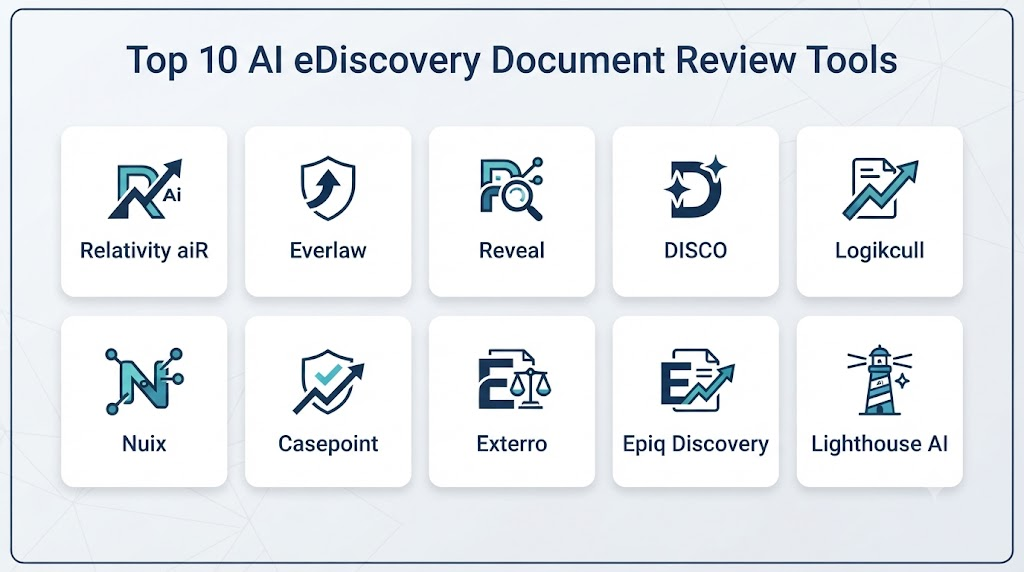
Top 10 AI eDiscovery Document Review Tools
1 — Relativity
One-line verdict: Best for sophisticated legal teams managing complex, large-scale eDiscovery, investigations, and AI-assisted document review.
Short description:
Relativity is a widely used eDiscovery and legal data platform supporting document processing, review, investigation, analytics, and production workflows. Its ecosystem supports sophisticated review operations and AI-assisted analysis.
Standout Capabilities
- Large-scale eDiscovery
- Technology-assisted review
- Document classification
- Advanced search
- Analytics
- Review workflows
- Investigation support
- Production workflows
AI-Specific Depth
- Model support: Platform and ecosystem support for multiple AI capabilities; exact model availability varies.
- RAG / knowledge integration: Document repositories and case-specific data; exact implementations vary.
- Evaluation: AI and review workflows can be evaluated using matter-specific datasets and review processes.
- Guardrails: User permissions, workflow controls, and review governance.
- Observability: Case and review activity tracking; detailed AI telemetry varies by feature.
Pros
- Strong eDiscovery ecosystem
- Suitable for complex matters
- Extensive review and analytics capabilities
Cons
- Can be complex for inexperienced users
- Enterprise implementation may require specialized expertise
- Pricing varies by deployment and matter
Security & Compliance
Enterprise security, access controls, audit capabilities, and compliance options are available, but organizations should verify the exact controls applicable to their deployment.
Deployment & Platforms
- Deployment: Cloud and other deployment options depending on offering
- Platforms: Web
- Self-hosted: Availability varies
Integrations & Ecosystem
Relativity supports a broad legal technology ecosystem.
- Data sources
- Legal hold systems
- Review workflows
- Analytics
- Processing tools
- Production systems
- APIs and extensibility
Pricing Model
Enterprise and matter-based pricing; exact pricing varies.
Best-Fit Scenarios
- Large litigation matters
- Complex investigations
- Enterprise eDiscovery
2 — Everlaw
One-line verdict: Best for modern cloud-based eDiscovery teams wanting intuitive review, analytics, collaboration, and AI-assisted investigation.
Short description:
Everlaw provides cloud-based eDiscovery capabilities for litigation, investigations, and regulatory matters. Its platform combines data processing, review, analytics, collaboration, and AI-assisted workflows.
Standout Capabilities
- Cloud eDiscovery
- Document review
- AI-assisted analysis
- Predictive coding
- Visual analytics
- Collaboration
- Data processing
- Production
AI-Specific Depth
- Model support: Vendor-managed AI; exact model configuration varies.
- RAG / knowledge integration: Matter-specific document collections.
- Evaluation: Review and analytics workflows support iterative validation.
- Guardrails: Permissions and workflow controls.
- Observability: Matter-level review and workflow analytics.
Pros
- Modern user experience
- Strong collaboration
- Useful analytics capabilities
Cons
- Enterprise features may require configuration
- AI behavior varies by workflow
- Pricing is not generally standardized publicly
Security & Compliance
Security and compliance capabilities are available; specific certifications and controls should be verified for the current offering.
Deployment & Platforms
- Deployment: Cloud
- Platforms: Web
- Self-hosted: Not publicly stated
Integrations & Ecosystem
- Data collection
- Legal review
- Litigation workflows
- Production
- Analytics
- APIs
- Legal technology integrations
Pricing Model
Enterprise or matter-based pricing; exact pricing varies.
Best-Fit Scenarios
- Litigation teams
- Regulatory investigations
- Cloud-first legal departments
3 — DISCO
One-line verdict: Best for legal teams seeking cloud eDiscovery with AI-assisted review, analytics, and streamlined investigation workflows.
Short description:
DISCO provides cloud-based eDiscovery and legal technology designed to help organizations process, review, analyze, and produce large collections of documents.
Standout Capabilities
- Document review
- AI-assisted analysis
- Legal search
- Predictive coding
- Investigation workflows
- Analytics
- Document processing
- Production
AI-Specific Depth
- Model support: Managed AI capabilities; exact models vary.
- RAG / knowledge integration: Matter-specific document collections.
- Evaluation: Review validation and analytics capabilities vary by workflow.
- Guardrails: Access controls and review workflows.
- Observability: Workflow and case-level analytics.
Pros
- Cloud-focused architecture
- Useful AI-assisted workflows
- Strong legal-review orientation
Cons
- Best suited to professional legal workflows
- Pricing varies
- Advanced use cases may require training
Security & Compliance
Security controls are available, but specific certifications and deployment requirements should be confirmed.
Deployment & Platforms
- Deployment: Cloud
- Platforms: Web
- Self-hosted: Not publicly stated
Integrations & Ecosystem
- Data sources
- Document processing
- Legal workflows
- Analytics
- Production
- APIs
- Review systems
Pricing Model
Matter-based or enterprise pricing; exact pricing varies.
Best-Fit Scenarios
- Litigation review
- Corporate investigations
- Large document collections
4 — Reveal
One-line verdict: Best for legal teams wanting AI-assisted review, visual analytics, and flexible investigation workflows across complex datasets.
Short description:
Reveal is an eDiscovery platform focused on document review, analytics, investigation, and AI-assisted workflows. It supports legal teams working with large and complex information collections.
Standout Capabilities
- AI document review
- Predictive analytics
- Concept clustering
- Visual analytics
- Document classification
- Search
- Investigation
- Review workflows
AI-Specific Depth
- Model support: AI capabilities vary by feature and configuration.
- RAG / knowledge integration: Case document collections.
- Evaluation: Technology-assisted review and validation workflows.
- Guardrails: User access and workflow controls.
- Observability: Review and analytics reporting.
Pros
- Strong visual analytics
- Useful investigative workflows
- Flexible review capabilities
Cons
- Requires reviewer training
- Advanced workflows can be complex
- Pricing varies
Security & Compliance
Security capabilities are available; current certifications and data controls should be verified for the intended deployment.
Deployment & Platforms
- Deployment: Cloud and other options depending on product configuration
- Platforms: Web
- Self-hosted: Varies / N/A
Integrations & Ecosystem
- Data processing
- Legal review
- Investigations
- Analytics
- Production
- APIs
- Legal technology ecosystem
Pricing Model
Enterprise or matter-based pricing; exact pricing varies.
Best-Fit Scenarios
- Complex investigations
- Litigation
- Analytics-heavy document review
5 — Casepoint
One-line verdict: Best for enterprises and government organizations requiring broad eDiscovery, review, analytics, and investigation capabilities.
Short description:
Casepoint provides a cloud-based platform for eDiscovery, legal review, investigations, and information governance. It supports large-scale document processing and analysis.
Standout Capabilities
- eDiscovery
- Document review
- Data processing
- Analytics
- Investigation
- Predictive coding
- Legal hold workflows
- Production
AI-Specific Depth
- Model support: Managed AI and analytics capabilities; exact models vary.
- RAG / knowledge integration: Matter and repository data.
- Evaluation: Review workflows and validation capabilities.
- Guardrails: Enterprise permissions and workflow controls.
- Observability: Case-level reporting and audit capabilities vary.
Pros
- Broad eDiscovery functionality
- Enterprise-oriented
- Useful for complex data environments
Cons
- May require implementation expertise
- Broad platform can be complex
- Pricing varies
Security & Compliance
Security and compliance options should be evaluated according to organizational requirements and deployment configuration.
Deployment & Platforms
- Deployment: Cloud
- Platforms: Web
- Self-hosted: Not publicly stated
Integrations & Ecosystem
- Legal hold
- Data sources
- Review systems
- Analytics
- Production
- APIs
- Enterprise applications
Pricing Model
Enterprise and matter-based pricing; exact pricing varies.
Best-Fit Scenarios
- Enterprise legal departments
- Government investigations
- Large-scale eDiscovery
6 — Logikcull
One-line verdict: Best for teams seeking simplified cloud eDiscovery workflows with automated processing and accessible document review.
Short description:
Logikcull is an eDiscovery platform focused on simplifying data collection, processing, search, review, and production. Its automation-oriented approach can reduce the complexity of routine discovery workflows.
Standout Capabilities
- Automated data processing
- eDiscovery
- Document review
- Search
- Deduplication
- Data filtering
- Legal production
- Workflow automation
AI-Specific Depth
- Model support: Managed AI capabilities vary.
- RAG / knowledge integration: Matter-specific documents and data.
- Evaluation: Review workflows support human validation.
- Guardrails: Access and workflow controls.
- Observability: Processing and workflow reporting.
Pros
- Easier to use than some complex platforms
- Strong automation
- Useful for smaller legal teams
Cons
- Advanced matters may require additional capabilities
- AI details vary by feature
- Pricing depends on usage and deployment
Security & Compliance
Security controls are available; organizations should verify current compliance and retention options.
Deployment & Platforms
- Deployment: Cloud
- Platforms: Web
- Self-hosted: Not publicly stated
Integrations & Ecosystem
- Cloud storage
- Legal workflows
- Data processing
- Review
- Production
- APIs
Pricing Model
Usage or subscription-oriented pricing; exact pricing varies.
Best-Fit Scenarios
- SMB legal teams
- Routine discovery
- Smaller investigations
7 — Nextpoint
One-line verdict: Best for legal teams wanting cloud eDiscovery with review, processing, analytics, and case-management capabilities.
Short description:
Nextpoint provides eDiscovery tools for processing, reviewing, organizing, and producing electronically stored information in legal matters.
Standout Capabilities
- Document processing
- eDiscovery review
- Search
- Document tagging
- Analytics
- Case management
- Production
- Litigation support
AI-Specific Depth
- Model support: AI capabilities vary by product and feature.
- RAG / knowledge integration: Matter-specific datasets.
- Evaluation: Review validation varies.
- Guardrails: Access and workflow controls.
- Observability: Case and processing reports.
Pros
- Practical eDiscovery workflows
- Useful for litigation teams
- Broad document-processing functionality
Cons
- Advanced AI capabilities vary
- Complex matters may require expertise
- Pricing varies
Security & Compliance
Security controls and compliance requirements should be verified for the applicable deployment.
Deployment & Platforms
- Deployment: Cloud
- Platforms: Web
- Self-hosted: Varies / N/A
Integrations & Ecosystem
- Data collection
- Document processing
- Review
- Litigation workflows
- Production
- APIs
- Legal applications
Pricing Model
Subscription or matter-based pricing; exact pricing varies.
Best-Fit Scenarios
- Litigation teams
- Law firms
- Corporate investigations
8 — Exterro
One-line verdict: Best for organizations connecting eDiscovery with legal governance, privacy, information governance, and investigations.
Short description:
Exterro provides legal and risk technology spanning eDiscovery, privacy, information governance, and related workflows. This broader approach can be valuable for organizations managing discovery alongside data governance.
Standout Capabilities
- eDiscovery
- Document review
- Information governance
- Investigations
- Data privacy
- Legal hold
- Data management
- Analytics
AI-Specific Depth
- Model support: AI capabilities vary across products.
- RAG / knowledge integration: Enterprise data and legal repositories.
- Evaluation: Review and analytics validation varies.
- Guardrails: Enterprise permissions and governance controls.
- Observability: Workflow and administrative reporting.
Pros
- Broad legal technology ecosystem
- Strong governance orientation
- Useful for enterprise environments
Cons
- Broader platform requires planning
- Multiple product areas can increase complexity
- Pricing varies
Security & Compliance
Security and compliance capabilities depend on the applicable product and deployment. Verify current certifications and controls.
Deployment & Platforms
- Deployment: Cloud and other deployment options may vary
- Platforms: Web
- Self-hosted: Varies / N/A
Integrations & Ecosystem
- Information governance
- Privacy systems
- Legal hold
- eDiscovery
- Investigations
- Enterprise applications
- APIs
Pricing Model
Enterprise licensing; exact pricing varies.
Best-Fit Scenarios
- Enterprise investigations
- Information governance
- Integrated legal operations
9 — ZyLAB ONE
One-line verdict: Best for organizations requiring broad information management, investigation, and AI-assisted eDiscovery capabilities.
Short description:
ZyLAB ONE provides information management and eDiscovery capabilities designed to help organizations collect, process, search, analyze, and review large datasets.
Standout Capabilities
- eDiscovery
- Information management
- AI-assisted search
- Document review
- Data processing
- Investigations
- Analytics
- Legal workflows
AI-Specific Depth
- Model support: Managed AI capabilities vary.
- RAG / knowledge integration: Enterprise document collections.
- Evaluation: Analytics and review validation vary.
- Guardrails: Access and governance controls.
- Observability: Workflow reporting varies.
Pros
- Broad information-management capabilities
- Useful for investigations
- AI-assisted discovery workflows
Cons
- Implementation may require expertise
- Feature availability varies
- Pricing is not publicly standardized
Security & Compliance
Security, governance, and compliance capabilities should be verified according to the required deployment.
Deployment & Platforms
- Deployment: Cloud and other options depending on offering
- Platforms: Web
- Self-hosted: Varies / N/A
Integrations & Ecosystem
- Enterprise repositories
- Data sources
- Legal workflows
- Investigations
- Analytics
- APIs
- Document systems
Pricing Model
Enterprise pricing; exact pricing varies.
Best-Fit Scenarios
- Large investigations
- Enterprise eDiscovery
- Information management
10 — DISCO Cecilia AI
One-line verdict: Best for legal teams exploring generative AI assistance for document-heavy discovery and investigative workflows.
Short description:
Cecilia is DISCO’s AI-oriented capability for helping legal professionals work with discovery data. It is designed to support investigation and review activities using natural-language interaction and AI-assisted analysis.
Standout Capabilities
- AI-assisted investigation
- Natural-language interaction
- Document analysis
- Evidence discovery
- Summarization
- Review assistance
- Investigation workflows
- eDiscovery integration
AI-Specific Depth
- Model support: Vendor-managed AI; exact model configuration varies.
- RAG / knowledge integration: Matter-specific discovery data.
- Evaluation: AI performance should be validated against matter-specific review datasets.
- Guardrails: Workflow and access controls; detailed model-level defenses are not publicly stated.
- Observability: Platform-level workflow tracking varies.
Pros
- Natural-language AI workflow
- Designed for discovery data
- Can help accelerate investigation
Cons
- AI outputs require legal validation
- Best value depends on underlying discovery data
- Exact AI configuration is not publicly stated
Security & Compliance
Security and compliance capabilities depend on the platform configuration. Verify current controls before processing sensitive discovery material.
Deployment & Platforms
- Deployment: Cloud
- Platforms: Web
- Self-hosted: Not publicly stated
Integrations & Ecosystem
- eDiscovery data
- Document review
- Investigation workflows
- Search
- Analytics
- Legal operations
Pricing Model
Enterprise or matter-based pricing; exact pricing varies.
Best-Fit Scenarios
- AI-assisted investigations
- Large document collections
- Discovery review workflows
Comparison Table
| Tool | Best For | Deployment | Model Flexibility | Strength | Watch-Out | Public Rating |
|---|---|---|---|---|---|---|
| Relativity | Complex enterprise eDiscovery | Cloud / varies | Managed / varies | Mature review ecosystem | Complexity | N/A |
| Everlaw | Cloud-first discovery | Cloud | Managed AI | Usability and collaboration | Enterprise configuration | N/A |
| DISCO | AI-assisted eDiscovery | Cloud | Managed AI | Modern discovery workflows | Matter complexity | N/A |
| Reveal | Analytics-heavy review | Cloud / varies | Managed AI | Visual analytics | Training requirements | N/A |
| Casepoint | Enterprise and government | Cloud | Managed AI | Broad eDiscovery | Implementation complexity | N/A |
| Logikcull | Simplified discovery | Cloud | Managed AI | Automation | Advanced-case requirements | N/A |
| Nextpoint | Litigation support | Cloud | Managed AI | Practical workflows | AI depth varies | N/A |
| Exterro | Governance + discovery | Cloud / varies | Managed AI | Integrated legal operations | Broad platform | N/A |
| ZyLAB ONE | Information management | Cloud / varies | Managed AI | Enterprise data analysis | Configuration | N/A |
| DISCO Cecilia AI | Generative discovery assistance | Cloud | Managed AI | Natural-language investigation | Human validation required | N/A |
Scoring & Evaluation
The following scores are comparative editorial assessments rather than official vendor ratings. They are intended to provide a consistent framework for comparing capabilities, not to represent independently audited performance.
| Tool | Core | Reliability/Eval | Guardrails | Integrations | Ease | Perf/Cost | Security/Admin | Support | Weighted Total |
|---|---|---|---|---|---|---|---|---|---|
| Relativity | 10 | 9 | 9 | 10 | 7 | 8 | 10 | 9 | 9.00 |
| Everlaw | 9 | 9 | 9 | 9 | 9 | 8 | 9 | 9 | 8.90 |
| DISCO | 9 | 9 | 9 | 9 | 9 | 8 | 9 | 9 | 8.85 |
| Reveal | 9 | 9 | 9 | 9 | 8 | 8 | 9 | 8 | 8.70 |
| Casepoint | 9 | 9 | 9 | 9 | 7 | 8 | 10 | 9 | 8.75 |
| Logikcull | 8 | 8 | 8 | 8 | 9 | 9 | 8 | 8 | 8.25 |
| Nextpoint | 8 | 8 | 8 | 8 | 8 | 8 | 8 | 8 | 8.00 |
| Exterro | 9 | 8 | 9 | 10 | 7 | 7 | 10 | 9 | 8.60 |
| ZyLAB ONE | 9 | 8 | 9 | 9 | 7 | 8 | 9 | 8 | 8.45 |
| DISCO Cecilia AI | 8 | 9 | 9 | 9 | 9 | 8 | 9 | 9 | 8.75 |
Top 3 for Enterprise
- Relativity
- Everlaw
- Casepoint
Top 3 for SMB
- Logikcull
- Nextpoint
- Everlaw
Top 3 for Developers
- Relativity
- Everlaw
- DISCO
Which AI eDiscovery Document Review Tool Is Right for You?
Solo / Freelancer
Independent practitioners and very small legal teams should prioritize simplicity.
Look for:
- Straightforward document ingestion
- Search
- Deduplication
- Basic AI classification
- Easy review
- Transparent workflow
- Reasonable usage economics
A sophisticated enterprise platform may not be necessary for a small document set.
SMB
Small and mid-sized legal organizations should focus on tools that reduce operational complexity.
Prioritize:
- Easy setup
- Automated processing
- Search
- Review
- AI-assisted classification
- Basic analytics
- Secure collaboration
- Export capabilities
Logikcull and similar simplified platforms can be worth considering when usability is a major priority.
Mid-Market
Mid-market organizations often need a balance between advanced review functionality and manageable implementation.
Prioritize:
- Technology-assisted review
- Predictive coding
- Analytics
- Custom workflows
- Privilege review
- AI summaries
- Auditability
- Integrations
Everlaw, DISCO, Reveal, and similar platforms can fit this type of environment depending on the matter.
Enterprise
Enterprise organizations should evaluate eDiscovery as part of a larger legal-data architecture.
Important capabilities include:
- Large-scale processing
- Advanced analytics
- Complex review workflows
- Multiple data sources
- RBAC
- Audit logs
- Legal hold
- Data governance
- API access
- AI evaluation
- Security controls
- Production workflows
Relativity and Casepoint are particularly relevant for organizations managing complex discovery environments.
Regulated Industries
Regulated organizations should carefully examine:
- Data residency
- Encryption
- Access controls
- Retention
- Legal holds
- Auditability
- Vendor security
- Data processing
- AI governance
- Human review
A platform that performs well technically may still be unsuitable if it cannot satisfy the organization’s legal or data-handling requirements.
Budget vs Premium
Budget-oriented solutions may work well when:
- Matters are relatively small
- Data sources are limited
- Review workflows are straightforward
- Advanced analytics are not required
Premium platforms become more attractive when:
- Data volumes are extremely large
- Investigations are complex
- Multiple review teams are involved
- Regulatory scrutiny is high
- Advanced analytics are necessary
- Complex productions are expected
Build vs Buy
Build when:
- You have highly specialized workflows.
- Your organization has strong engineering resources.
- Your data architecture is highly customized.
- You require proprietary analytical methods.
Buy when:
- You need established eDiscovery workflows.
- You need rapid deployment.
- You need legal review and production capabilities.
- You need mature security and audit functionality.
Building a complete eDiscovery platform internally is significantly more complicated than simply building a document-search application.
Implementation Playbook: 30 / 60 / 90 Days
First 30 Days: Pilot and Measure
Select one representative matter.
Build a controlled dataset containing:
- Relevant documents
- Irrelevant documents
- Privileged documents
- Near duplicates
- Long documents
- Email threads
- Different file formats
- Potentially sensitive information
Define success metrics:
- Recall
- Precision
- Reviewer agreement
- False-positive rate
- False-negative rate
- Review time
- Cost per document
- AI override rate
Create an initial AI evaluation set.
Days 31–60: Security and Evaluation
Harden the workflow.
Test:
- Search accuracy
- AI classification
- Summarization
- Privilege identification
- Sensitive information detection
- Duplicate handling
- Long-context performance
Conduct red-team testing against AI features.
Test whether misleading instructions inside documents can influence the AI.
Establish:
- Access controls
- Retention policies
- Audit requirements
- Prompt/version control
- Human escalation
- Incident response
- AI change-management procedures
Days 61–90: Optimize and Scale
After validating the pilot:
- Expand data sources
- Automate routine workflows
- Improve search strategies
- Tune AI classification
- Monitor false positives
- Monitor false negatives
- Track processing costs
- Improve reviewer workflows
- Integrate with legal systems
- Establish governance
Create a repeatable evaluation process so future AI changes can be tested before being used in important matters.
Common Mistakes and How to Avoid Them
- Assuming AI eliminates legal review: AI should assist reviewers rather than replace legal judgment.
- Skipping validation: Always test AI performance using representative matter data.
- Ignoring false negatives: Missed relevant evidence can be more serious than excessive review.
- Overloading reviewers with AI results: Poor prioritization can simply move the bottleneck.
- Using keyword search alone: Semantic and conceptual analysis can uncover relevant information missed by exact terms.
- Ignoring email relationships: Email threading and communication context can be important.
- Failing to handle duplicates: Duplicate documents can inflate review volume.
- Ignoring privilege: Privileged documents require careful workflows and human validation.
- Trusting AI summaries without verification: Summaries should be checked against source documents.
- Ignoring prompt injection: Documents may contain instructions that attempt to manipulate AI systems.
- Poor data retention controls: Discovery datasets can contain extremely sensitive information.
- Insufficient access controls: Review permissions should reflect matter roles.
- No audit trail: Legal teams need defensible records of review activity.
- Ignoring model changes: AI behavior can change when models or configurations change.
- Not monitoring costs: Large document collections can produce significant processing expenses.
- Failing to plan data portability: Organizations should understand how data and review work product can be exported.
FAQs
What is AI eDiscovery Document Review?
AI eDiscovery Document Review uses artificial intelligence to process, classify, prioritize, search, and analyze electronically stored information during litigation, investigations, and regulatory matters.
Can AI replace attorneys in eDiscovery?
No. AI can automate and prioritize many repetitive tasks, but legal professionals should remain responsible for important judgments, validation, privilege decisions, and defensibility.
What types of documents can AI eDiscovery systems analyze?
Depending on the platform, systems can process emails, PDFs, office files, spreadsheets, images, chat data, and other electronically stored information.
What is Technology-Assisted Review?
Technology-Assisted Review uses machine learning or related analytical techniques to help identify and prioritize documents that are potentially relevant to a legal matter.
Can AI find relevant documents without exact keywords?
Yes. Semantic and conceptual search can identify documents based on meaning and relationships rather than relying solely on exact keyword matches.
Can AI identify privileged documents?
Some platforms provide AI-assisted privilege workflows or classification capabilities, but privilege determinations should receive appropriate legal review.
How should companies evaluate AI accuracy?
Use a representative, human-reviewed dataset and measure metrics such as recall, precision, false positives, false negatives, and reviewer agreement.
Is generative AI safe for eDiscovery?
It can be useful, but organizations should evaluate security, data handling, retention, access controls, model behavior, and the possibility of prompt injection before using it with sensitive discovery data.
What is prompt injection in eDiscovery?
Prompt injection occurs when content inside a document or data source attempts to influence an AI system’s instructions or behavior. eDiscovery workflows should treat document content as untrusted input.
Can AI summarize millions of documents?
AI can help summarize and prioritize large collections, but summaries should be validated and should not be treated as a substitute for appropriate document review.
How much does AI eDiscovery cost?
Pricing varies significantly based on data volume, processing requirements, users, matter complexity, storage, review features, and vendor pricing structure. Exact costs should be confirmed directly with each provider.
Can AI eDiscovery platforms be self-hosted?
Some platforms or deployment configurations may support different hosting models, but availability varies. Organizations with strict hosting requirements should verify this before purchasing.
What is the biggest benefit of AI in eDiscovery?
The biggest benefit is the ability to prioritize and analyze large document collections more efficiently, allowing reviewers to focus attention where it is most valuable.
What is the biggest risk?
The biggest risk is over-trusting automated results. Incorrect classification, missed evidence, hallucinated summaries, or inappropriate automation can create serious legal and operational consequences.
Can AI eDiscovery integrate with legal hold systems?
Many enterprise eDiscovery platforms integrate with legal hold, collection, review, analytics, and production workflows, although the exact integrations vary.
Should every document be reviewed by AI?
Not necessarily. Organizations should determine which workflows benefit from AI and establish appropriate validation based on matter complexity and risk.
Conclusion
AI eDiscovery Document Review is becoming an important part of modern legal technology because discovery teams increasingly face enormous volumes of electronically stored information. AI can help transform that information into a more manageable review workflow by prioritizing documents, identifying relationships, classifying content, supporting semantic search, and accelerating investigations.Relativity remains particularly relevant for complex enterprise eDiscovery environments, while Everlaw, DISCO, Reveal, and Casepoint provide strong options for sophisticated review and analytics workflows. Logikcull and Nextpoint can be attractive where usability and practical discovery workflows are priorities, while Exterro and ZyLAB ONE are relevant for organizations looking beyond discovery toward broader information governance and investigation requirements.