Introduction
AI Skills Assessment Platforms are software solutions that use artificial intelligence, automation, adaptive testing, and data analysis to evaluate what employees, candidates, students, or professionals know and can do. Instead of relying only on traditional questionnaires or fixed exams, these platforms can assess technical knowledge, job-related skills, communication abilities, problem-solving, and other competencies.
Organizations use AI-powered assessments for hiring, workforce planning, employee development, upskilling, reskilling, certification preparation, and internal mobility. Depending on the platform, assessments may include coding challenges, simulations, quizzes, interviews, scenario-based questions, adaptive tests, or AI-generated assess HR teams, recruiters, L&D departments, enterprises, technology companies, staffing organizations, universities, and businesses building skills-based talent str Very small teams that conduct only occasional interviews, organizations needing simple manual quizzes, or situations where a standardized assessment is already sufficient and AI adds little value.
What Are AI Skills Assessment Platforms?
An AI Skills Assessment Platform evaluates a person’s capabilities using automated tests, adaptive assessments, simulations, interviews, coding exercises, or other evaluation methods.
Traditional assessments often provide every participant with the same questions.
AI-powered platforms can potentially make assessments more dynamic.
For example, a software engineer may be evaluated through coding tasks and technical questions, while a sales professional may receive scenario-based questions involving negotiation, communication, and customer management.
Depending on the platform, AI may be used to:
- Generate assessment questions
- Adapt question difficulty
- Analyze responses
- Evaluate coding
- Analyze interview responses
- Identify skill gaps
- Compare demonstrated skills with job requirements
- Generate assessment reports
- Recommend follow-up learning
The important distinction is that AI should support assessment quality rather than become a black box for high-impact employment decisions.
How AI Skills Assessment Platforms Work
1. Define the Skill Framework
Organizations first identify the competencies they want to measure.
Examples include:
- Python
- Java
- Cloud computing
- Data analysis
- Project management
- Communication
- Leadership
- Cybersecurity
- Sales
- Problem-solving
2. Create or Select Assessments
The platform may provide ready-made assessments or allow organizations to build custom tests.
3. Assess the Candidate or Employee
Participants may complete:
- Multiple-choice questions
- Coding exercises
- Simulations
- Written responses
- Video interviews
- Technical challenges
- Situational judgment tests
- Adaptive assessments
4. AI Analysis
AI can analyze responses and generate structured results.
5. Skill Scoring
The system produces scores or proficiency levels for the assessed competencies.
6. Reporting
Managers, recruiters, or L&D teams can review results and identify strengths and development areas.
7. Learning Recommendations
Some platforms can connect assessment results with training resources or development plans.
Why AI Skills Assessment Matters
Hiring and workforce development are increasingly becoming skills-oriented.
A résumé can show what someone claims to have done, but an assessment can provide additional evidence of demonstrated capability.
For employers, this can help with:
- Faster candidate screening
- Consistent evaluation
- Technical skill verification
- Workforce skill mapping
- Employee development
- Internal mobility
- Training prioritization
However, organizations should avoid treating an automated score as an absolute measure of a person’s potential. Assessment design, job relevance, accessibility, bias, and human review remain important.
What to Evaluate Before Choosing a Platform
Organizations should compare:
- Assessment accuracy
- Skill coverage
- Question quality
- Adaptive testing
- AI evaluation
- Coding assessment support
- Interview assessment
- Custom assessment creation
- Reporting
- Anti-cheating controls
- Bias and fairness controls
- Integrations
- Candidate experience
- Employee experience
- Security and privacy
- API availability
- Scalability
- Cost
What Has Changed in AI Skills Assessment Platforms
- Generative AI is changing assessment creation: Organizations can increasingly generate draft questions and assessment content faster.
- Adaptive assessments are becoming more useful: Systems can adjust question difficulty according to performance.
- AI coding evaluation is expanding: Technical hiring platforms can automatically evaluate programming tasks and coding behavior.
- Simulation-based assessment is gaining importance: Realistic workplace scenarios can measure applied skills rather than simple memorization.
- AI interviews are becoming more sophisticated: Automated systems can structure and analyze interview responses, although human oversight remains important.
- Skills graphs are becoming more important: Assessment results can be connected to broader competency frameworks.
- Assessment-to-learning workflows are emerging: Results can trigger personalized training recommendations.
- Continuous assessment is replacing one-time testing in some environments: Organizations can track skill development over time.
- Generative AI is creating new cheating risks: Companies need stronger assessment integrity strategies because candidates may have access to AI assistants.
- AI-assisted assessment requires governance: Organizations need clear rules around automated decision-making and candidate data.
- Explainability is increasingly important: Recruiters and employees should understand what an assessment measures and how results are interpreted.
- Privacy is a major consideration: Assessment systems may process resumes, test responses, interview recordings, coding activity, and other personal information.
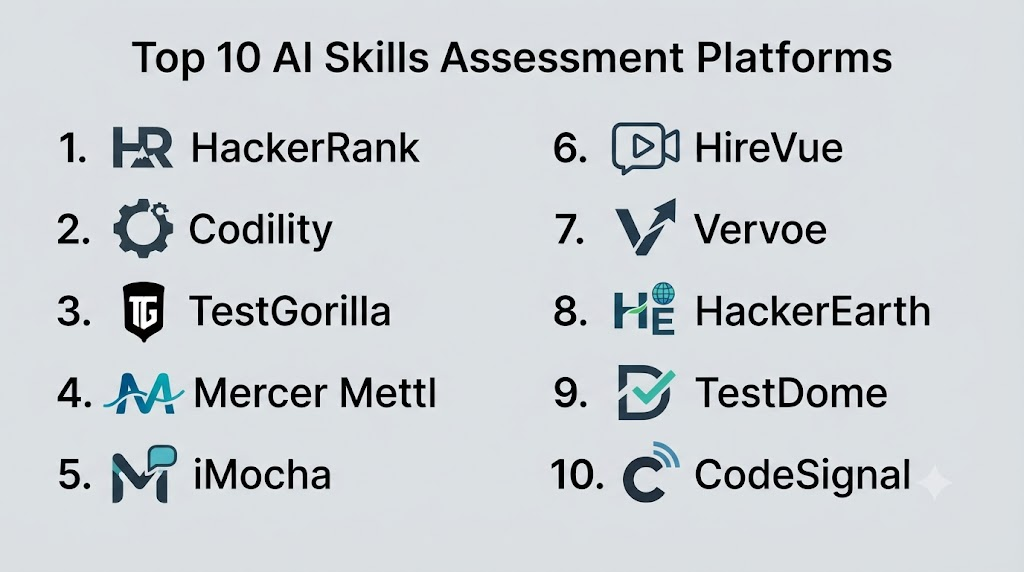
Top 10 AI Skills Assessment Platforms
1. HackerRank
One-line verdict: Best for organizations assessing software engineering, coding, technical skills, and developer capabilities at scale.
Short description:
HackerRank is a widely used technical assessment platform focused on evaluating developers and technical candidates. It provides coding challenges, assessments, interview capabilities, and technical skill evaluation.
Standout Capabilities
- Coding assessments
- Technical screening
- Programming challenges
- Developer interviews
- Skill-based evaluation
- Interview workflows
- Coding environments
- Technical reporting
AI-Specific Depth
- Model support: AI-related capabilities vary by product and implementation.
- RAG / knowledge integration: N/A or varies by feature.
- Evaluation: Automated coding evaluation is a core capability.
- Guardrails: Assessment-integrity controls vary.
- Observability: Assessment activity and candidate analytics are available; AI-specific observability varies.
Pros
- Strong technical assessment capabilities
- Designed specifically for developer evaluation
- Useful for large-scale technical hiring
Cons
- Primarily focused on technical skills
- Less suitable for broad nontechnical competency assessment
- Advanced functionality may require enterprise configuration
Security & Compliance
Security, privacy, identity, access, retention, and compliance capabilities vary by plan and deployment. Organizations should verify current requirements before procurement.
Deployment & Platforms
- Deployment: Cloud
- Platforms: Web
- Self-hosted: Not publicly stated
Integrations & Ecosystem
- Applicant tracking systems
- HR platforms
- Recruiting workflows
- APIs
- Developer hiring tools
- Interview workflows
Pricing Model
Pricing varies based on plan, usage, and organizational requirements.
Best-Fit Scenarios
- Developer recruitment
- Technical screening
- Engineering workforce assessment
2. Codility
One-line verdict: Best for companies evaluating software developers through coding challenges, technical assessments, and structured engineering tests.
Short description:
Codility focuses on technical hiring and developer assessment. Organizations can use coding challenges and technical evaluations to measure programming capabilities.
Standout Capabilities
- Coding assessments
- Programming challenges
- Technical screening
- Developer interviews
- Coding environments
- Automated evaluation
- Candidate reports
- Technical skill assessment
AI-Specific Depth
- Model support: AI capabilities vary.
- RAG / knowledge integration: N/A.
- Evaluation: Automated coding evaluation is a core function.
- Guardrails: Assessment integrity capabilities vary.
- Observability: Candidate and assessment analytics available.
Pros
- Strong coding assessment capabilities
- Focused developer experience
- Useful for technical recruiting
Cons
- Narrower than general workforce assessment platforms
- Primarily focused on technical skills
- Assessment design still requires careful validation
Security & Compliance
Security and compliance features vary according to plan and deployment.
Deployment & Platforms
- Deployment: Cloud
- Platforms: Web
- Self-hosted: Not publicly stated
Integrations & Ecosystem
- ATS systems
- HR platforms
- Recruiting workflows
- APIs
- Developer tools
- Interview processes
Pricing Model
Pricing varies by organization and usage.
Best-Fit Scenarios
- Software engineering hiring
- Coding screening
- Technical workforce evaluation
3. TestGorilla
One-line verdict: Best for organizations seeking broad pre-employment assessments covering technical, cognitive, and workplace skills.
Short description:
TestGorilla provides pre-employment testing across multiple categories, allowing employers to assess candidates beyond résumé information.
Standout Capabilities
- Skills testing
- Cognitive assessments
- Technical assessments
- Situational judgment
- Personality-related assessments
- Candidate screening
- Custom tests
- Hiring workflows
AI-Specific Depth
- Model support: AI functionality varies.
- RAG / knowledge integration: N/A.
- Evaluation: Automated assessment scoring is supported; AI-specific evaluation varies.
- Guardrails: Assessment integrity and administrative controls vary.
- Observability: Candidate performance reporting available.
Pros
- Broad assessment categories
- Useful for nontechnical hiring
- Can support standardized screening
Cons
- Assessment quality varies by test type
- Employers still need job-relevant validation
- Advanced AI capabilities should be evaluated separately
Security & Compliance
Security, privacy, and organizational controls vary by subscription and configuration.
Deployment & Platforms
- Deployment: Cloud
- Platforms: Web
- Self-hosted: Not publicly stated
Integrations & Ecosystem
- ATS integrations
- HR systems
- Recruitment workflows
- APIs
- Candidate management
- Assessment libraries
Pricing Model
Tiered and enterprise pricing varies.
Best-Fit Scenarios
- Pre-employment screening
- General skills assessment
- SMB and mid-market recruiting
4. iMocha
One-line verdict: Best for enterprises combining skills assessment, technical testing, workforce skills intelligence, and talent development.
Short description:
iMocha provides skills assessment and talent intelligence capabilities for organizations evaluating technical and professional skills.
Standout Capabilities
- Skills assessment
- Technical assessment
- Skill-gap analysis
- Workforce skills intelligence
- Coding tests
- Custom assessments
- Talent development
- Reporting
AI-Specific Depth
- Model support: AI capabilities vary by feature.
- RAG / knowledge integration: Varies / N/A.
- Evaluation: Automated assessment and skills analytics are available.
- Guardrails: Governance capabilities vary.
- Observability: Assessment and skills analytics available.
Pros
- Broad skills coverage
- Useful for workforce development
- Supports technical assessments
Cons
- Enterprise configuration may require planning
- Results depend on assessment quality
- Buyers should validate AI claims for specific modules
Security & Compliance
Security and compliance capabilities vary by deployment and contract.
Deployment & Platforms
- Deployment: Cloud
- Platforms: Web
- Self-hosted: Varies / N/A
Integrations & Ecosystem
- HR systems
- ATS platforms
- LMS systems
- Talent-management tools
- APIs
- Skills frameworks
Pricing Model
Enterprise pricing varies.
Best-Fit Scenarios
- Enterprise skills assessment
- Workforce transformation
- Upskilling and reskilling
5. Mercer | Mettl
One-line verdict: Best for large organizations requiring broad assessments across technical, cognitive, behavioral, and professional competencies.
Short description:
Mercer | Mettl provides assessment solutions covering recruitment, talent development, technical skills, cognitive capabilities, and behavioral competencies.
Standout Capabilities
- Technical assessments
- Cognitive testing
- Behavioral assessments
- Coding tests
- Recruitment assessment
- Talent development
- Custom assessments
- Enterprise reporting
AI-Specific Depth
- Model support: AI functionality varies.
- RAG / knowledge integration: N/A or varies.
- Evaluation: Automated assessment capabilities vary by assessment type.
- Guardrails: Assessment governance and integrity features vary.
- Observability: Candidate and assessment analytics available.
Pros
- Broad assessment portfolio
- Enterprise focus
- Suitable for multiple job categories
Cons
- Can be more complex than lightweight assessment tools
- Enterprise buyers may need implementation support
- Specific AI features require validation
Security & Compliance
Security, privacy, access controls, and compliance offerings vary by solution and contract.
Deployment & Platforms
- Deployment: Cloud
- Platforms: Web
- Self-hosted: Varies / N/A
Integrations & Ecosystem
- HR platforms
- ATS systems
- Learning systems
- APIs
- Enterprise talent tools
- Recruitment workflows
Pricing Model
Enterprise pricing varies.
Best-Fit Scenarios
- Large-scale recruitment
- Enterprise workforce assessment
- Multi-skill evaluation
6. SHL
One-line verdict: Best for enterprises seeking established talent assessment across cognitive, behavioral, technical, and job-related capabilities.
Short description:
SHL provides talent assessment solutions for recruitment and workforce development. Its assessment portfolio covers multiple competency categories.
Standout Capabilities
- Cognitive assessments
- Behavioral assessments
- Technical assessments
- Job simulations
- Candidate screening
- Workforce analytics
- Talent development
- Assessment design
AI-Specific Depth
- Model support: AI capabilities vary.
- RAG / knowledge integration: N/A or varies.
- Evaluation: Automated assessment scoring varies by assessment.
- Guardrails: Assessment governance varies.
- Observability: Assessment reporting and analytics available.
Pros
- Broad assessment expertise
- Enterprise-oriented
- Suitable for large-scale hiring
Cons
- Enterprise-focused
- Can require professional assessment expertise
- AI capabilities vary by solution
Security & Compliance
Organizations should verify current security, privacy, data-retention, and compliance controls for the specific service.
Deployment & Platforms
- Deployment: Cloud
- Platforms: Web
- Self-hosted: Not publicly stated
Integrations & Ecosystem
- ATS
- HR systems
- Talent platforms
- APIs
- Assessment workflows
- Enterprise analytics
Pricing Model
Enterprise pricing varies.
Best-Fit Scenarios
- Enterprise recruitment
- High-volume hiring
- Workforce assessment
7. CodeSignal
One-line verdict: Best for modern technical hiring teams assessing coding, software engineering, and practical development skills.
Short description:
CodeSignal provides technical assessment and interview capabilities focused on software engineering and technology roles.
Standout Capabilities
- Coding assessments
- Technical interviews
- Programming environments
- Skills evaluation
- Developer screening
- Practical technical tasks
- Interview workflows
- Assessment analytics
AI-Specific Depth
- Model support: AI functionality varies.
- RAG / knowledge integration: N/A.
- Evaluation: Automated technical assessment is a core capability.
- Guardrails: Assessment-integrity controls vary.
- Observability: Candidate performance and assessment data available.
Pros
- Developer-focused
- Practical technical assessments
- Useful for engineering recruitment
Cons
- Primarily technical
- Not designed as a general-purpose workforce assessment platform
- Organizations must define appropriate assessment criteria
Security & Compliance
Security and privacy capabilities vary by plan and organizational configuration.
Deployment & Platforms
- Deployment: Cloud
- Platforms: Web
- Self-hosted: Not publicly stated
Integrations & Ecosystem
- ATS
- HR tools
- APIs
- Recruiting workflows
- Technical interviews
- Developer assessment systems
Pricing Model
Pricing varies by organization and requirements.
Best-Fit Scenarios
- Software engineering hiring
- Technical screening
- Developer interviews
8. Vervoe
One-line verdict: Best for organizations using practical work-sample assessments to evaluate candidates based on demonstrated job skills.
Short description:
Vervoe focuses on skills-based hiring through practical assessments designed to simulate real workplace tasks.
Standout Capabilities
- Work-sample assessments
- Skills-based hiring
- Practical tasks
- Automated evaluation
- Candidate screening
- Custom assessments
- Role-specific evaluation
- Hiring analytics
AI-Specific Depth
- Model support: AI capabilities vary.
- RAG / knowledge integration: Varies / N/A.
- Evaluation: AI-assisted evaluation varies by assessment.
- Guardrails: Governance capabilities vary.
- Observability: Candidate and assessment analytics available.
Pros
- Focuses on practical skills
- Useful for skills-based hiring
- Can reduce reliance on résumé screening
Cons
- Assessment design is still important
- AI evaluation should be validated for high-impact decisions
- Some roles may require specialized assessment formats
Security & Compliance
Security and privacy controls vary and should be verified for the intended deployment.
Deployment & Platforms
- Deployment: Cloud
- Platforms: Web
- Self-hosted: Not publicly stated
Integrations & Ecosystem
- ATS
- HR systems
- Recruiting workflows
- APIs
- Candidate management
- Assessment tools
Pricing Model
Pricing varies.
Best-Fit Scenarios
- Skills-based recruitment
- Work-sample testing
- Practical candidate screening
9. Testlify
One-line verdict: Best for companies wanting customizable pre-employment assessments across technical and general workplace skills.
Short description:
Testlify provides skills assessment and hiring evaluation capabilities covering technical, cognitive, and workplace competencies.
Standout Capabilities
- Technical assessments
- Cognitive tests
- Soft-skill assessment
- Custom assessments
- Candidate screening
- Automated scoring
- Assessment libraries
- Hiring workflows
AI-Specific Depth
- Model support: AI functionality varies.
- RAG / knowledge integration: N/A.
- Evaluation: Automated assessment scoring available.
- Guardrails: Assessment-integrity capabilities vary.
- Observability: Candidate analytics and reporting available.
Pros
- Broad assessment library
- Customization options
- Suitable for different hiring scenarios
Cons
- Buyers should validate individual assessment methodologies
- AI functionality varies
- Enterprise governance requirements may need additional review
Security & Compliance
Security, privacy, access controls, and data retention vary by plan.
Deployment & Platforms
- Deployment: Cloud
- Platforms: Web
- Self-hosted: Not publicly stated
Integrations & Ecosystem
- ATS
- HR tools
- Recruiting workflows
- APIs
- Candidate management
- Assessment libraries
Pricing Model
Tiered and enterprise pricing varies.
Best-Fit Scenarios
- SMB recruitment
- General skills testing
- Technical screening
10. Adaface
One-line verdict: Best for recruiters seeking ready-made technical, aptitude, communication, and job-specific assessments.
Short description:
Adaface provides online assessment solutions covering programming, aptitude, communication, role-specific knowledge, and other hiring competencies.
Standout Capabilities
- Technical assessments
- Coding tests
- Aptitude testing
- Communication assessment
- Role-based tests
- Custom assessments
- Candidate screening
- Automated evaluation
AI-Specific Depth
- Model support: AI functionality varies.
- RAG / knowledge integration: N/A.
- Evaluation: Automated scoring and assessment capabilities vary by test.
- Guardrails: Anti-cheating and assessment controls vary.
- Observability: Candidate assessment reporting available.
Pros
- Broad assessment library
- Useful for technical recruitment
- Supports role-specific testing
Cons
- Primarily recruitment-focused
- Assessment effectiveness depends on test selection
- Advanced enterprise requirements should be validated
Security & Compliance
Security and privacy capabilities vary by plan and organizational requirements.
Deployment & Platforms
- Deployment: Cloud
- Platforms: Web
- Self-hosted: Not publicly stated
Integrations & Ecosystem
- ATS
- HR platforms
- APIs
- Recruiting workflows
- Candidate assessment
- Technical screening
Pricing Model
Pricing varies according to plan and usage.
Best-Fit Scenarios
- Technical recruitment
- Pre-employment testing
- SMB and mid-market hiring
Comparison Table
| Tool | Best For | Deployment | Model Flexibility | Strength | Watch-Out | Public Rating |
|---|---|---|---|---|---|---|
| HackerRank | Developer assessment | Cloud | Managed AI / Varies | Coding evaluation | Technical focus | N/A |
| Codility | Technical hiring | Cloud | Managed AI / Varies | Developer testing | Narrow skill scope | N/A |
| TestGorilla | General hiring | Cloud | Managed AI / Varies | Broad assessments | Requires validation | N/A |
| iMocha | Enterprise skills intelligence | Cloud | Managed AI / Varies | Skills assessment | Implementation complexity | N/A |
| Mercer | Mettl | Enterprise assessment | Cloud | Managed AI / Varies | Broad assessment portfolio | Enterprise complexity | N/A |
| SHL | Large-scale talent assessment | Cloud | Managed AI / Varies | Established assessment ecosystem | Enterprise focus | N/A |
| CodeSignal | Engineering hiring | Cloud | Managed AI / Varies | Practical coding | Technical focus | N/A |
| Vervoe | Work-sample hiring | Cloud | Managed AI / Varies | Practical assessments | AI evaluation needs review | N/A |
| Testlify | Custom hiring assessments | Cloud | Managed AI / Varies | Assessment variety | Feature depth varies | N/A |
| Adaface | Ready-made assessments | Cloud | Managed AI / Varies | Technical and aptitude tests | Recruitment focus | N/A |
Scoring & Evaluation
The following scores are comparative editorial assessments for general AI skills-assessment use cases. They are not official vendor scores and should be validated against your own requirements.
| Tool | Core | Reliability/Eval | Guardrails | Integrations | Ease | Perf/Cost | Security/Admin | Support | Weighted Total |
|---|---|---|---|---|---|---|---|---|---|
| HackerRank | 10 | 9 | 9 | 9 | 8 | 8 | 9 | 9 | 8.95 |
| Codility | 10 | 9 | 9 | 9 | 8 | 8 | 9 | 9 | 8.95 |
| TestGorilla | 9 | 8 | 8 | 9 | 9 | 9 | 8 | 9 | 8.65 |
| iMocha | 10 | 9 | 9 | 9 | 8 | 8 | 9 | 9 | 8.95 |
| Mercer | Mettl | 10 | 9 | 9 | 9 | 7 | 8 | 9 | 9 | 8.85 |
| SHL | 10 | 9 | 9 | 9 | 7 | 8 | 10 | 9 | 8.95 |
| CodeSignal | 10 | 9 | 9 | 9 | 8 | 8 | 9 | 9 | 8.95 |
| Vervoe | 9 | 8 | 8 | 8 | 9 | 8 | 8 | 8 | 8.30 |
| Testlify | 9 | 8 | 8 | 8 | 9 | 9 | 8 | 8 | 8.40 |
| Adaface | 9 | 8 | 8 | 8 | 9 | 9 | 8 | 9 | 8.45 |
Top 3 for Enterprise
- SHL
- Mercer | Mettl
- iMocha
Top 3 for SMB
- TestGorilla
- Testlify
- Adaface
Top 3 for Developers
- HackerRank
- CodeSignal
- Codility
Which AI Skills Assessment Platform Is Right for You?
Solo / Freelancer
Individual professionals usually don’t need a full enterprise assessment platform.
A specialized technical assessment, certification exam, coding platform, or self-assessment tool may be more practical.
Focus on:
- Relevant skills
- Quality of questions
- Practical exercises
- Immediate feedback
- Progress tracking
SMB
Small businesses should prioritize simplicity.
Look for:
- Ready-made assessments
- Simple candidate invitations
- Automated scoring
- Basic reporting
- ATS integration
- Reasonable administration requirements
Platforms such as TestGorilla, Testlify, and Adaface may be suitable starting points depending on the skills being assessed.
Mid-Market
Mid-sized organizations should consider moving beyond simple pre-employment testing.
Useful capabilities include:
- Skill frameworks
- Custom assessments
- Workforce analytics
- Employee assessments
- Internal mobility
- LMS integration
- Technical and nontechnical testing
Enterprise
Enterprises should prioritize assessment governance and consistency.
Important requirements include:
- Large-scale assessment delivery
- Skills taxonomies
- Assessment validation
- HR integration
- ATS integration
- APIs
- Role-based access
- Reporting
- Auditability
- Privacy controls
- Human review
Large enterprises may benefit from platforms such as SHL, Mercer | Mettl, or iMocha, depending on their assessment strategy.
Regulated Industries
Financial services, healthcare, government, and other regulated organizations should pay particular attention to:
- Candidate privacy
- Employee privacy
- Data retention
- Data residency
- Encryption
- Access controls
- Audit logs
- Automated decision-making
- Bias monitoring
- Human oversight
An AI-generated assessment should be reviewed for job relevance and unintended bias before being used in high-impact hiring decisions.
Budget vs Premium
Budget-oriented teams can often start with ready-made assessment libraries.
Premium platforms become more valuable when an organization needs:
- Custom assessment design
- Large-scale testing
- Workforce analytics
- Advanced integrations
- Skills intelligence
- Enterprise administration
- Professional assessment support
Build vs Buy
Buy when:
- You need assessments quickly.
- Standard skill libraries are sufficient.
- You want ready-made candidate workflows.
- You don’t have assessment scientists or specialized engineering resources.
Build when:
- Your skills are highly specialized.
- Your assessment methodology is proprietary.
- You need complete control over scoring.
- Your organization has strong engineering and data-science resources.
A custom system could combine an assessment engine, question bank, adaptive testing, scoring models, skill ontology, analytics, and learning recommendations.
Implementation Playbook: 30 / 60 / 90 Days
First 30 Days: Pilot
Choose one assessment use case.
For example:
- Software engineering
- Sales
- Customer support
- Cybersecurity
- Data analysis
Define:
- Skills to measure
- Assessment duration
- Required proficiency
- Success criteria
- Candidate experience
Establish baseline metrics before launching.
Days 31–60: Validate and Harden
Run assessments with a representative group.
Evaluate:
- Assessment completion
- Score distribution
- Candidate feedback
- Predictive relevance
- Question quality
- False positives
- False negatives
- Accessibility
- Potential bias
Create a formal assessment evaluation process.
Days 61–90: Scale and Govern
At this stage:
- Integrate with ATS or HR systems.
- Establish assessment version control.
- Monitor assessment performance.
- Review AI-generated questions.
- Create AI-use policies.
- Establish human-review procedures.
- Monitor cheating and assessment manipulation.
- Create incident-handling procedures.
- Review data retention.
- Track candidate experience.
Common Mistakes and How to Avoid Them
- Using generic tests for specialized jobs: Build assessments around actual job requirements.
- Overusing AI-generated questions: Human experts should review generated assessment content.
- Treating a score as objective truth: A test measures selected skills, not a person’s entire capability.
- Ignoring assessment validity: Organizations should establish that assessments actually measure job-relevant competencies.
- Failing to test for bias: AI-assisted evaluation can introduce or amplify unwanted patterns.
- Ignoring accessibility: Candidates may have different accessibility needs.
- Using assessments that are too long: Excessive testing can damage candidate experience.
- Failing to account for generative AI: Modern assessments need strategies for AI-assisted cheating.
- Relying only on multiple-choice questions: Practical tasks can provide stronger evidence for some skills.
- Ignoring candidate privacy: Assessment responses and recordings can contain personal information.
- No human review: High-impact hiring decisions should not depend blindly on automated scores.
- Ignoring data retention: Organizations should know how long candidate and employee data is retained.
- Failing to monitor assessment drift: Skills and technologies change, so assessment content needs regular review.
- Overlooking vendor lock-in: Export capabilities and assessment portability should be considered.
- Optimizing for completion instead of usefulness: A completed assessment is not necessarily an effective assessment.
FAQs
What is an AI Skills Assessment Platform?
It is software that uses automation and AI-related technologies to evaluate technical, professional, cognitive, behavioral, or job-specific skills.
How is AI used in skills assessments?
AI can assist with question generation, adaptive testing, response analysis, coding evaluation, interview analysis, scoring, and skill-gap identification, depending on the platform.
Can AI skills assessment platforms be used for hiring?
Yes. Many platforms are designed specifically for recruitment and pre-employment screening. Organizations should validate assessments for job relevance and fairness.
Can these platforms assess technical skills?
Yes. Technical assessments can include coding, programming, data analysis, cybersecurity, cloud technologies, software engineering, and other technical competencies.
Can AI assess soft skills?
Some platforms support behavioral, communication, situational judgment, and other workplace-skill assessments. These assessments should be carefully designed and validated.
Can employees use these platforms for upskilling?
Yes. Employee assessments can identify skill gaps and provide information that L&D teams can use to design development programs.
Can AI-generated questions be trusted?
AI-generated questions should not automatically be considered reliable. Subject-matter experts should review questions for accuracy, relevance, difficulty, ambiguity, and bias.
Do these platforms support adaptive testing?
Some platforms support adaptive or dynamic assessment approaches, but capabilities differ. Buyers should test how difficulty actually changes during an assessment.
Can candidates use ChatGPT or other AI tools during assessments?
This depends on assessment design and platform controls. Organizations should explicitly define whether AI assistance is allowed and use appropriate assessment-integrity mechanisms where necessary.
Is employee and candidate data private?
Privacy depends on the vendor, configuration, contract, and applicable policies. Buyers should review retention, access, processing, residency, and data-use practices.
Can companies integrate these platforms with an ATS?
Many assessment platforms provide integrations with applicant tracking systems. Exact integrations vary by vendor.
Can organizations build custom assessments?
Yes. Many platforms provide custom assessment functionality, although the level of customization differs.
How much do AI skills assessment platforms cost?
Pricing varies based on users, assessments, features, integrations, and enterprise requirements. Exact pricing should be confirmed with each vendor.
Can companies build their own AI assessment system?
Yes. A custom system can combine question generation, assessment delivery, scoring, skill taxonomies, analytics, and AI evaluation. However, building a reliable assessment system requires significant expertise.
Should AI assessment results make the final hiring decision?
AI assessment results should generally be treated as one input rather than the sole basis for a high-impact employment decision. Human review and job-relevant validation remain important.
Conclusion
AI Skills Assessment Platforms are becoming an important component of skills-based hiring and workforce development. They can help organizations move beyond résumé-based evaluation by providing structured evidence about what candidates or employees can actually do.For software engineering, platforms such as HackerRank, Codility, and CodeSignal provide specialized technical assessment capabilities. For broader enterprise talent assessment, SHL, Mercer | Mettl, and iMocha offer wider assessment approaches. Organizations seeking simpler hiring assessments may consider TestGorilla, Testlify, Vervoe, or AdafaceAI can make skills assessment faster and more scalable, but good assessment design remains more important than the AI label.