Introduction
AI Corporate Training Recommendation Engines are AI-powered systems that analyze employee skills, learning activity, job roles, career goals, and organizational requirements to recommend relevant training and development opportunities.
Instead of giving every employee the same course catalog, these systems can help create more personalized learning paths. An employee might receive recommendations based on a skill gap, current role, completed courses, assessment results, or a target career path. Learning teams can also use recommendations to support workforce development and identify broader organizational skill needs.
Best for: Enterprises, mid-sized companies, HR and L&D teams, talent-development organizations, technology companies, and businesses with large or continuously changing learning requirements.
Not ideal for: Very small companies with limited training content, organizations that only need mandatory compliance courses, or teams without sufficient employee and learning data to support meaningful personalization.
What Are AI Corporate Training Recommendation Engines?
An AI Corporate Training Recommendation Engine uses employee and learning data to determine which learning resources may be most relevant to a particular employee.
Traditional corporate learning often works like a digital library: employees search through hundreds or thousands of courses and choose what they think they need.
AI recommendation systems attempt to make that process more intelligent.
For example, an employee working as a software engineer might receive recommendations for:
- Cloud architecture
- Kubernetes
- Secure coding
- Leadership skills
- System design
- Relevant certifications
Another employee in sales could receive recommendations related to:
- Negotiation
- CRM usage
- Sales forecasting
- Product knowledge
- Communication
- Account management
The recommendation engine can potentially consider multiple signals rather than relying solely on job title.
How AI Corporate Training Recommendation Engines Work
1. Employee Profile Analysis
The platform may consider information such as:
- Job role
- Department
- Skills
- Seniority
- Career goals
- Completed training
- Assessments
- Certifications
2. Learning Activity Analysis
The system can analyze:
- Courses completed
- Courses started
- Completion rates
- Assessment results
- Learning preferences
- Search behavior
- Content engagement
3. Skill-Gap Identification
AI can compare current capabilities with:
- Job requirements
- Target roles
- Organizational competency frameworks
- Required skills
- Future workforce requirements
4. Content Matching
The engine matches employees with potentially relevant:
- Courses
- Videos
- Articles
- Books
- Projects
- Assessments
- Certifications
- Learning paths
5. Recommendation Generation
Employees receive personalized learning suggestions based on available signals.
6. Continuous Updating
As employees complete training and develop new skills, recommendations can change.
Why AI Training Recommendations Matter
Corporate learning environments can contain enormous amounts of content.
An organization may have:
- Internal courses
- External courses
- Videos
- Documentation
- Workshops
- Certifications
- Instructor-led programs
- Knowledge bases
- Microlearning
The problem is no longer simply finding training content.
The challenge is finding the right training at the right time for the right employee.
AI can help reduce that discovery problem while making learning programs more closely aligned with business and career goals.
What to Evaluate Before Choosing a Platform
Organizations should consider:
- Recommendation quality
- Skill taxonomy capabilities
- AI personalization
- Content integration
- LMS integration
- Employee profiles
- Career-path functionality
- Assessment capabilities
- Analytics
- Administrative controls
- Privacy and data governance
- API and integration capabilities
- Human review and recommendation controls
- Cost and scalability
What Has Changed in AI Corporate Training Recommendation Engines
- Skill-based recommendations are becoming more important: Platforms increasingly focus on skills rather than only job titles.
- Generative AI is improving discovery: Employees can interact with learning systems conversationally and describe what they want to learn.
- Career development is becoming connected to learning: Training recommendations can be tied to potential future roles.
- AI agents can support learning workflows: Future systems can potentially coordinate assessments, recommendations, reminders, and learning activities.
- Multimodal learning is expanding: Recommendation systems can potentially work across video, documents, courses, simulations, and other content formats.
- Internal knowledge is becoming more valuable: Organizations increasingly want recommendations based on proprietary knowledge as well as external courses.
- Skills intelligence is becoming a core capability: Organizations want visibility into what skills employees have and where gaps exist.
- Personalization is moving beyond course history: Modern recommendation approaches can consider role, goals, skills, and organizational needs.
- Privacy is increasingly important: Employee learning data can reveal sensitive information about performance and career development.
- Explainability matters: Employees and managers should understand why particular learning recommendations are being presented.
- Human oversight remains important: AI-generated recommendations should support employees rather than dictate career decisions.
- Cost and model efficiency matter: Enterprises need to evaluate AI usage, data-processing requirements, and ongoing infrastructure costs.
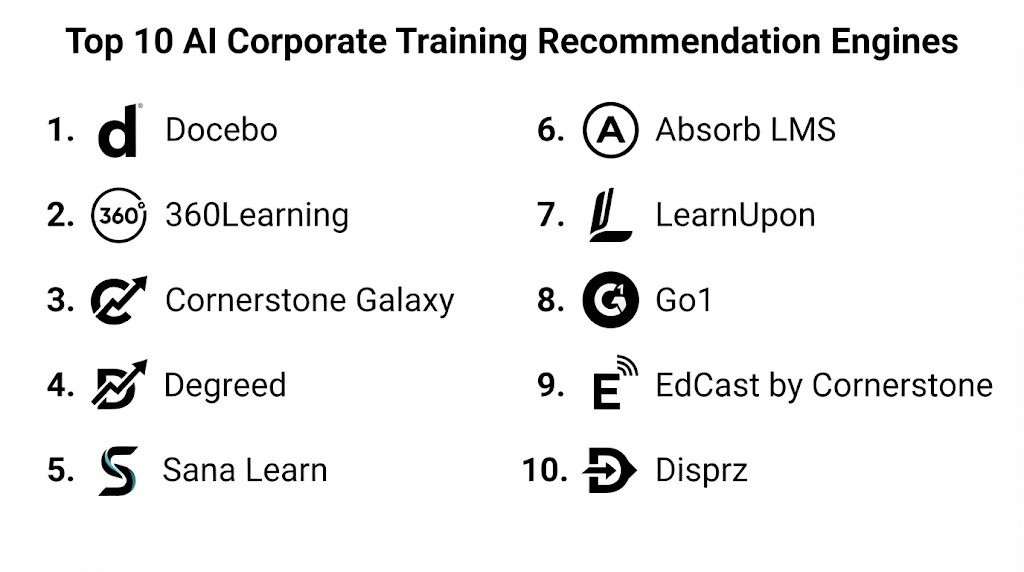
Top 10 AI Corporate Training Recommendation Engines
1. Cornerstone
One-line verdict: Best for large organizations seeking enterprise learning, talent development, skills intelligence, and personalized training recommendations.
Short description:
Cornerstone provides an enterprise learning and talent-development ecosystem that can support personalized learning, skills development, content discovery, and workforce development.
Standout Capabilities
- Personalized learning experiences
- Skills management
- Learning content discovery
- Employee development
- Career development
- Learning administration
- Talent management
- Enterprise analytics
AI-Specific Depth
- Model support: AI capabilities are platform-dependent; proprietary implementation details vary.
- RAG / knowledge integration: Capabilities vary by product and configuration.
- Evaluation: Recommendation quality depends on configured data, models, and content.
- Guardrails: Enterprise administrative and governance controls vary.
- Observability: Learning and analytics reporting available; AI-specific observability varies.
Pros
- Strong enterprise focus
- Broad talent-management ecosystem
- Useful for large-scale workforce development
Cons
- Can be complex for smaller organizations
- Enterprise implementations may require significant configuration
- Full value depends on quality of organizational data
Security & Compliance
Enterprise identity, access, governance, privacy, retention, and security controls vary by product and deployment. Organizations should verify current requirements directly with the vendor.
Deployment & Platforms
- Deployment: Primarily cloud-based
- Platforms: Web and mobile experiences
- Self-hosted: Varies / N/A
Integrations & Ecosystem
The platform can integrate with enterprise HR and learning environments.
- HR systems
- LMS environments
- Learning content
- Talent systems
- Skills data
- APIs
- Enterprise applications
Pricing Model
Enterprise pricing varies based on organization size, modules, users, and implementation requirements.
Best-Fit Scenarios
- Large enterprises
- Global L&D teams
- Skills-based workforce programs
2. Degreed
One-line verdict: Best for organizations focused on skills-based learning, personalized content discovery, and employee development.
Short description:
Degreed is a learning and skills platform designed to help employees discover learning resources and organizations understand workforce skills.
Standout Capabilities
- Personalized learning
- Skills intelligence
- Learning experience management
- Content aggregation
- Career development
- Skill profiles
- Learning pathways
- Workforce analytics
AI-Specific Depth
- Model support: AI functionality varies by product and implementation.
- RAG / knowledge integration: Content and knowledge integration capabilities vary.
- Evaluation: Recommendation effectiveness depends on available learning and skills data.
- Guardrails: Administrative controls and governance capabilities vary.
- Observability: Learning and skills analytics are available; AI-specific telemetry varies.
Pros
- Strong skills focus
- Broad learning-content approach
- Useful for employee development
Cons
- Requires meaningful skills data
- Recommendation quality depends on content metadata
- Enterprise configuration can be complex
Security & Compliance
Security, privacy, identity, access control, retention, and governance capabilities should be verified for the selected deployment.
Deployment & Platforms
- Deployment: Cloud
- Platforms: Web and mobile
- Self-hosted: Not publicly stated
Integrations & Ecosystem
- LMS platforms
- HR systems
- Learning providers
- Content libraries
- Skills frameworks
- APIs
- Enterprise systems
Pricing Model
Enterprise pricing varies.
Best-Fit Scenarios
- Skills-based organizations
- Large learning ecosystems
- Internal mobility initiatives
3. Docebo
One-line verdict: Best for organizations wanting an enterprise learning platform with AI-assisted personalization and learning-content management.
Short description:
Docebo provides an enterprise learning platform designed for employee, customer, and partner training. Its ecosystem includes AI-enabled capabilities for content discovery, personalization, and learning management.
Standout Capabilities
- AI-assisted learning
- Personalized learning
- Learning management
- Content management
- Learning analytics
- Skills development
- Automated learning workflows
- Enterprise training
AI-Specific Depth
- Model support: AI capabilities vary across features.
- RAG / knowledge integration: Knowledge and content capabilities vary by configuration.
- Evaluation: Learning and recommendation analytics vary.
- Guardrails: Administrative and content controls vary.
- Observability: Learning analytics and reporting available; AI-specific observability varies.
Pros
- Broad enterprise learning capabilities
- Strong content-management functionality
- Suitable for multiple training audiences
Cons
- Enterprise-oriented
- Advanced functionality may require configuration
- Costs can increase with scale and requirements
Security & Compliance
Security and governance capabilities vary by deployment and contract. Organizations should verify current certifications and controls before procurement.
Deployment & Platforms
- Deployment: Cloud
- Platforms: Web and mobile
- Self-hosted: Not publicly stated
Integrations & Ecosystem
- HR systems
- CRM systems
- Enterprise applications
- Content providers
- APIs
- Authentication systems
- Learning technologies
Pricing Model
Enterprise subscription pricing varies.
Best-Fit Scenarios
- Enterprise employee training
- Customer education
- Multi-audience learning
4. SAP SuccessFactors Learning
One-line verdict: Best for enterprises that want learning recommendations integrated with HR, talent, and workforce-management processes.
Short description:
SAP SuccessFactors Learning is part of SAP’s broader human capital management ecosystem. Organizations can connect employee development and learning processes with broader HR workflows.
Standout Capabilities
- Learning management
- Employee development
- Personalized learning
- Talent integration
- Compliance training
- Skills management
- HR integration
- Enterprise reporting
AI-Specific Depth
- Model support: AI functionality varies across SAP products and configurations.
- RAG / knowledge integration: Varies / N/A.
- Evaluation: Recommendation and learning analytics vary.
- Guardrails: Enterprise governance and access controls vary.
- Observability: Reporting and analytics capabilities vary.
Pros
- Strong HR integration
- Enterprise scalability
- Useful for workforce-development programs
Cons
- Best suited to larger organizations
- Implementation can be complex
- SAP ecosystem expertise may be valuable
Security & Compliance
Enterprise security and governance features vary according to configuration, region, and contractual arrangements.
Deployment & Platforms
- Deployment: Cloud
- Platforms: Web and mobile
- Self-hosted: Varies / N/A
Integrations & Ecosystem
- SAP HR
- Talent management
- Employee data
- Learning content
- Enterprise APIs
- Identity systems
Pricing Model
Enterprise pricing varies.
Best-Fit Scenarios
- Large SAP customers
- Global workforce training
- HR-integrated learning
5. Workday Learning
One-line verdict: Best for organizations that want learning recommendations closely connected to employee profiles and HR processes.
Short description:
Workday Learning is part of the Workday human-capital-management ecosystem. It provides learning management and employee-development functionality within a broader HR environment.
Standout Capabilities
- Personalized learning
- Employee development
- Learning management
- Skills
- Talent workflows
- Learning content
- Reporting
- HR integration
AI-Specific Depth
- Model support: AI functionality varies across Workday products.
- RAG / knowledge integration: Varies / N/A.
- Evaluation: Recommendation effectiveness depends on data and configuration.
- Guardrails: Enterprise governance and access controls vary.
- Observability: Learning and workforce analytics available; AI telemetry varies.
Pros
- Strong HR integration
- Useful employee-development workflows
- Enterprise-oriented
Cons
- Most attractive to Workday customers
- Enterprise implementation can be complex
- Recommendation quality depends on employee and skills data
Security & Compliance
Organizations should verify current Workday security, privacy, retention, identity, and governance capabilities for their deployment.
Deployment & Platforms
- Deployment: Cloud
- Platforms: Web and mobile
- Self-hosted: Not publicly stated
Integrations & Ecosystem
- HR
- Talent management
- Employee profiles
- Skills
- Learning content
- Enterprise systems
- APIs
Pricing Model
Enterprise pricing varies.
Best-Fit Scenarios
- Workday customers
- Enterprise L&D
- Skills-based workforce development
6. LinkedIn Learning
One-line verdict: Best for companies seeking a large professional-learning library with personalized content discovery and employee development.
Short description:
LinkedIn Learning provides professional courses covering business, technology, creative skills, and other workplace topics. Organizations can use its enterprise capabilities to provide employees with structured learning content and recommendations.
Standout Capabilities
- Personalized recommendations
- Large professional-learning catalog
- Skills-focused content
- Learning paths
- Professional development
- Business and technical courses
- Enterprise administration
- Learning analytics
AI-Specific Depth
- Model support: AI capabilities vary.
- RAG / knowledge integration: Content discovery and integration capabilities vary.
- Evaluation: Course and learning analytics vary.
- Guardrails: Administrative controls vary.
- Observability: Learning activity analytics available.
Pros
- Broad professional content
- Familiar learning experience
- Strong business and technology coverage
Cons
- Recommendations depend heavily on available content
- Less customizable than building a proprietary recommendation system
- Enterprise functionality may require appropriate licensing
Security & Compliance
Security, privacy, identity, and administrative controls vary by organizational configuration.
Deployment & Platforms
- Deployment: Cloud
- Platforms: Web and mobile
- Self-hosted: No
Integrations & Ecosystem
- HR systems
- LMS platforms
- Enterprise identity
- Learning-content workflows
- APIs
- Skills frameworks
Pricing Model
Enterprise pricing varies.
Best-Fit Scenarios
- Professional skills development
- Technology training
- Broad employee learning
7. Udemy Business
One-line verdict: Best for organizations needing broad technical, business, and professional learning content with personalized discovery.
Short description:
Udemy Business provides organizations with access to a large library of professional courses. Its learning environment can support personalized course discovery and skills development.
Standout Capabilities
- Large course catalog
- Personalized learning
- Technical training
- Business training
- Learning paths
- Skills development
- Reporting
- Enterprise administration
AI-Specific Depth
- Model support: AI features vary.
- RAG / knowledge integration: Content integration capabilities vary.
- Evaluation: Learning analytics and recommendation effectiveness vary.
- Guardrails: Administrative controls vary.
- Observability: Learning activity reporting available.
Pros
- Broad content selection
- Strong technical coverage
- Useful for workforce upskilling
Cons
- Content quality can vary between courses
- Organizations may need internal curation
- Recommendation quality depends on employee data
Security & Compliance
Enterprise security and administrative capabilities vary by organizational setup.
Deployment & Platforms
- Deployment: Cloud
- Platforms: Web and mobile
- Self-hosted: No
Integrations & Ecosystem
- LMS
- HR systems
- Identity systems
- APIs
- Learning content
- Enterprise reporting
Pricing Model
Enterprise subscription pricing varies.
Best-Fit Scenarios
- Technology upskilling
- Large employee populations
- Broad learning programs
8. Coursera for Business
One-line verdict: Best for organizations combining structured professional education with skills-based employee development.
Short description:
Coursera for Business provides professional learning content and programs from universities, companies, and educational organizations. Businesses can use the platform for structured workforce learning and skill development.
Standout Capabilities
- Personalized learning
- Professional courses
- Skill development
- Learning paths
- Assessments
- Certificates
- Enterprise analytics
- Career-oriented learning
AI-Specific Depth
- Model support: AI functionality varies.
- RAG / knowledge integration: N/A or varies by feature.
- Evaluation: Assessments and learning analytics support evaluation; recommendation evaluation varies.
- Guardrails: Administrative controls vary.
- Observability: Learning analytics available.
Pros
- Strong academic and professional content
- Useful for structured learning
- Good technical and business coverage
Cons
- Recommendation quality depends on employee profiles
- Some advanced learning requires greater time commitment
- Enterprise functionality varies by plan
Security & Compliance
Security, privacy, identity, retention, and governance controls should be verified for the organization’s specific deployment.
Deployment & Platforms
- Deployment: Cloud
- Platforms: Web and mobile
- Self-hosted: No
Integrations & Ecosystem
- LMS
- HR systems
- Enterprise identity
- Learning content
- APIs
- Skills frameworks
Pricing Model
Enterprise subscription pricing varies.
Best-Fit Scenarios
- Professional upskilling
- Technology training
- Structured workforce development
9. Sana Learn
One-line verdict: Best for organizations exploring AI-native learning experiences, knowledge discovery, and personalized employee development.
Short description:
Sana Learn combines learning, knowledge, and AI capabilities to help organizations create more personalized employee learning experiences.
Standout Capabilities
- AI-assisted learning
- Personalized learning
- Knowledge discovery
- Learning content
- Employee development
- Search
- Learning workflows
- AI-powered interactions
AI-Specific Depth
- Model support: AI architecture and supported models vary.
- RAG / knowledge integration: Knowledge integration is an important part of the platform.
- Evaluation: AI evaluation capabilities vary and should be validated during procurement.
- Guardrails: AI governance and administrative controls vary.
- Observability: Learning analytics available; detailed AI observability varies.
Pros
- AI-first learning approach
- Strong knowledge-learning connection
- Modern user experience
Cons
- AI-specific capabilities require careful evaluation
- Enterprise buyers should verify governance requirements
- Newer AI approaches may require organizational change
Security & Compliance
Security, privacy, access control, retention, and compliance capabilities should be verified directly for the required deployment.
Deployment & Platforms
- Deployment: Cloud
- Platforms: Web and supported mobile experiences
- Self-hosted: Not publicly stated
Integrations & Ecosystem
- HR systems
- Enterprise knowledge
- Learning content
- APIs
- Identity systems
- Workplace applications
Pricing Model
Enterprise pricing varies.
Best-Fit Scenarios
- AI-first L&D programs
- Knowledge-heavy organizations
- Personalized employee learning
10. 360Learning
One-line verdict: Best for organizations combining collaborative learning, employee-generated content, and personalized training recommendations.
Short description:
360Learning provides a collaborative learning platform that emphasizes knowledge sharing, course creation, learning management, and employee development.
Standout Capabilities
- Collaborative learning
- Learning management
- Course creation
- Personalized learning
- Knowledge sharing
- Learning analytics
- Employee-generated content
- Enterprise training
AI-Specific Depth
- Model support: AI capabilities vary.
- RAG / knowledge integration: Internal knowledge and content capabilities vary.
- Evaluation: Assessment and learning analytics vary.
- Guardrails: Administrative controls vary.
- Observability: Learning analytics available; detailed AI observability varies.
Pros
- Strong collaborative-learning approach
- Useful for internal knowledge sharing
- Supports employee-created training
Cons
- Requires content participation from employees
- Recommendation quality depends on content and learner data
- Enterprise configuration may require planning
Security & Compliance
Security, privacy, identity, access, retention, and governance capabilities vary by deployment and contract.
Deployment & Platforms
- Deployment: Cloud
- Platforms: Web and mobile
- Self-hosted: Not publicly stated
Integrations & Ecosystem
- HR systems
- LMS environments
- Collaboration tools
- Enterprise identity
- APIs
- Learning content
Pricing Model
Enterprise subscription pricing varies.
Best-Fit Scenarios
- Collaborative organizations
- Internal knowledge transfer
- Employee-led training
Comparison Table
| Tool | Best For | Deployment | Model Flexibility | Strength | Watch-Out | Public Rating |
|---|---|---|---|---|---|---|
| Cornerstone | Enterprise L&D | Cloud | Managed AI | Skills and talent ecosystem | Complex implementation | N/A |
| Degreed | Skills-based learning | Cloud | Managed AI | Skills intelligence | Requires quality skills data | N/A |
| Docebo | Enterprise learning | Cloud | Managed AI | AI-assisted learning | Configuration complexity | N/A |
| SAP SuccessFactors Learning | HR-integrated learning | Cloud | Managed AI | HR integration | Best for SAP environments | N/A |
| Workday Learning | Workforce development | Cloud | Managed AI | HR integration | Workday ecosystem focus | N/A |
| LinkedIn Learning | Professional learning | Cloud | Managed AI | Content discovery | Catalog-dependent | N/A |
| Udemy Business | Technical upskilling | Cloud | Managed AI | Broad course library | Course-quality variation | N/A |
| Coursera for Business | Structured professional learning | Cloud | Managed AI | University and industry content | Some programs are time-intensive | N/A |
| Sana Learn | AI-native learning | Cloud | AI-focused | Knowledge and personalization | AI governance needs review | N/A |
| 360Learning | Collaborative learning | Cloud | Managed AI | Employee-generated content | Requires participation | N/A |
Scoring & Evaluation
The following scores are comparative assessments for corporate training recommendation use cases, not official vendor ratings. They should be treated as a starting point for vendor evaluation.
| Tool | Core | Reliability/Eval | Guardrails | Integrations | Ease | Perf/Cost | Security/Admin | Support | Weighted Total |
|---|---|---|---|---|---|---|---|---|---|
| Cornerstone | 10 | 9 | 9 | 10 | 7 | 8 | 10 | 9 | 9.00 |
| Degreed | 9 | 9 | 9 | 9 | 8 | 8 | 9 | 9 | 8.75 |
| Docebo | 10 | 9 | 9 | 10 | 8 | 8 | 9 | 9 | 9.10 |
| SAP SuccessFactors Learning | 10 | 9 | 9 | 10 | 7 | 8 | 10 | 9 | 9.05 |
| Workday Learning | 9 | 9 | 9 | 10 | 8 | 8 | 10 | 9 | 9.00 |
| LinkedIn Learning | 9 | 8 | 8 | 9 | 9 | 8 | 9 | 9 | 8.65 |
| Udemy Business | 9 | 8 | 8 | 9 | 9 | 9 | 8 | 9 | 8.60 |
| Coursera for Business | 9 | 9 | 8 | 9 | 9 | 8 | 9 | 9 | 8.80 |
| Sana Learn | 9 | 9 | 9 | 9 | 9 | 8 | 8 | 8 | 8.80 |
| 360Learning | 9 | 8 | 8 | 9 | 9 | 8 | 9 | 9 | 8.55 |
Top 3 for Enterprise
- Cornerstone
- Docebo
- SAP SuccessFactors Learning
Top 3 for SMB
- LinkedIn Learning
- Udemy Business
- 360Learning
Top 3 for Developers
- Udemy Business
- Coursera for Business
- Degreed
Which AI Corporate Training Recommendation Engine Is Right for You?
Solo / Freelancer
Freelancers usually do not need a full corporate recommendation platform.
A simpler combination of professional-learning platforms, personal skill assessments, and manually selected learning paths can be more practical.
Prioritize:
- Content quality
- Search
- Skill relevance
- Career goals
- Learning flexibility
SMB
Small and medium businesses should prioritize ease of administration.
Look for:
- Simple employee onboarding
- Ready-made learning content
- Basic personalization
- Skills tracking
- Manager dashboards
- Straightforward integrations
Avoid expensive enterprise ecosystems unless the organization expects rapid workforce growth.
Mid-Market
Mid-sized organizations can benefit from combining:
- Employee profiles
- Skills frameworks
- Learning history
- Career goals
- Performance data
- Training requirements
A platform that can integrate HR and learning data becomes increasingly valuable at this stage.
Enterprise
Large organizations should prioritize:
- HR integration
- Skills intelligence
- Data governance
- Role-based access
- Auditability
- APIs
- Global scalability
- Multilingual support
- Learning-content aggregation
- AI governance
- Recommendation explainability
Enterprise buyers should also test the recommendation engine using realistic employee profiles before making a decision.
Regulated Industries
Organizations in finance, healthcare, government, and other regulated sectors should pay special attention to:
- Employee-data privacy
- Access controls
- Data retention
- Data residency
- Auditability
- Encryption
- Vendor data usage
- AI governance
- Human review
- Explainability
Training recommendations should not unintentionally expose sensitive employee information.
Budget vs Premium
A lower-cost approach can work when an organization primarily needs:
- Course discovery
- Basic learning paths
- Standard content
- Simple reporting
Premium platforms become more valuable when organizations need:
- Skills intelligence
- HR integration
- Advanced personalization
- Workforce analytics
- Internal content
- Career-path recommendations
- Enterprise governance
Build vs Buy
Buy when:
- You need fast deployment.
- Standard learning workflows are sufficient.
- You want a large content ecosystem.
- You don’t have a dedicated AI/data engineering team.
Build when:
- You have highly specialized learning requirements.
- You have a proprietary skills ontology.
- Your internal content is a major competitive advantage.
- You need complete control over recommendation logic.
A custom recommendation system can combine employee profiles, skills graphs, learning content, embeddings, ranking models, business rules, and an enterprise learning interface.
Implementation Playbook: 30 / 60 / 90 Days
First 30 Days: Pilot
Start with one department or employee group.
Define:
- Target roles
- Required skills
- Available content
- Career paths
- Learning objectives
- Recommendation success metrics
Measure whether employees actually engage with recommended content.
Days 31–60: Improve Personalization
Integrate additional data sources such as:
- HR systems
- LMS
- Skills frameworks
- Assessments
- Career profiles
Create an evaluation process for recommendations.
Test:
- Relevance
- Diversity of recommendations
- Accuracy
- Repetition
- Bias
- Employee feedback
Days 61–90: Scale and Govern
At this stage:
- Establish AI governance.
- Define employee-data policies.
- Create recommendation review procedures.
- Monitor recommendation performance.
- Track cost and latency.
- Establish incident-handling processes.
- Create model and prompt version control where applicable.
- Introduce human review for sensitive recommendations.
Common Mistakes and How to Avoid Them
- Recommending courses solely from job titles: Job titles rarely describe the full skill profile.
- Ignoring employee goals: Career aspirations can be important recommendation signals.
- Using poor-quality skill data: Incorrect skills produce irrelevant recommendations.
- Over-personalizing: Employees may benefit from discovering content outside their predicted interests.
- Ignoring internal knowledge: Proprietary documentation and expert knowledge can be highly valuable.
- Treating recommendations as mandatory: Recommendations should generally support employee choice.
- Ignoring bias: Recommendation systems can reproduce biases in historical learning data.
- Failing to evaluate recommendations: Organizations should measure whether recommendations are actually useful.
- Ignoring data privacy: Learning activity can reveal information about employee behavior and development.
- Creating excessive notifications: Too many recommendations reduce engagement.
- Ignoring content freshness: Outdated training can become a liability.
- Using AI without human review: Career-related recommendations can have meaningful consequences.
- Overlooking vendor lock-in: Proprietary skill taxonomies and recommendation data can make switching difficult.
- Failing to measure business outcomes: Course completion alone does not prove improved workforce capability.
FAQs
What is an AI Corporate Training Recommendation Engine?
It is an AI-powered system that recommends learning content, courses, skills, and development activities based on employee profiles, learning history, skills, roles, and organizational requirements.
How does AI personalize corporate training?
AI can analyze employee data and learning behavior to identify potentially relevant content and learning paths. The exact personalization approach varies between platforms.
Can AI recommend training based on employee skills?
Yes. Skills-based recommendations are an important use case. Systems can compare an employee’s current skills with desired capabilities and recommend relevant learning resources.
Can these platforms integrate with an LMS?
Yes. Many corporate learning platforms integrate with LMS and HR systems. The exact integrations depend on the platform and configuration.
Can companies use their own training content?
Many enterprise learning platforms support internal content alongside external learning resources. The available formats and integration methods vary.
Can AI recommend career-development training?
Yes. Some platforms connect learning recommendations with skills and career-development workflows. Organizations should ensure that employees understand how such recommendations are generated.
Is employee data safe in AI training platforms?
Security and privacy depend on the vendor, deployment, configuration, and organizational policies. Companies should evaluate data access, retention, encryption, residency, and vendor data usage before deployment.
Can companies use their own AI models?
This varies significantly between platforms. Many commercial learning platforms provide managed AI capabilities rather than allowing customers to directly select or deploy arbitrary models.
Can AI recommendation systems be self-hosted?
Self-hosting availability varies. Traditional LMS and custom recommendation architectures may offer more deployment flexibility than fully managed commercial learning platforms.
How much do AI corporate training recommendation engines cost?
Pricing varies based on employees, modules, content, integrations, implementation requirements, and enterprise agreements. Exact pricing should be obtained directly from vendors.
Can companies build their own recommendation engine?
Yes. Organizations with strong data and engineering teams can build custom systems using employee profiles, skills data, content metadata, machine-learning models, ranking systems, and business rules.
What is the biggest benefit of AI training recommendations?
The primary benefit is reducing the effort employees and managers spend searching for relevant learning while making training more closely aligned with skills and development goals.
Can AI replace L&D teams?
No. AI can automate parts of content discovery and personalization, but L&D professionals remain important for strategy, content governance, instructional design, workforce planning, and human support.
How should organizations evaluate recommendation quality?
Measure relevance, engagement, completion, employee feedback, skill development, recommendation diversity, accuracy, and business outcomes rather than relying only on clicks or course completion.
What is the difference between an LMS and an AI recommendation engine?
An LMS primarily manages learning delivery, users, courses, assessments, and records. An AI recommendation engine focuses more heavily on determining what learning content may be relevant to a particular employee.
Conclusion
AI Corporate Training Recommendation Engines are becoming increasingly useful as organizations move from generic employee training toward personalized, skills-based workforce development.The strongest systems do more than recommend popular courses. They connect employee roles, skills, learning history, career objectives, organizational requirements, and available content to create more relevant learning experiences.Enterprise organizations may benefit from comprehensive platforms such as Cornerstone, Degreed, Docebo, SAP SuccessFactors Learning, and Workday Learning. Organizations primarily looking for broad professional-learning libraries can consider platforms such as LinkedIn Learning, Udemy Business, and Coursera for Business. AI-first and collaborative approaches can also make platforms such as Sana Learn and 360Learning worth evaluating.The most effective implementation treats AI recommendations as decision support rather than automated career judgment.