Introduction
AI Content Moderation for Media is becoming increasingly important as publishers, streaming platforms, social networks, news organizations, gaming companies, marketplaces, and digital communities process enormous amounts of user-generated and professionally produced content.
Modern media platforms handle text, images, videos, audio, livestreams, comments, advertisements, captions, metadata, and user profiles. Reviewing every piece of content manually is expensive, slow, and difficult to scale.
AI-powered moderation systems can analyze content automatically and identify potentially harmful or policy-violating material. Depending on the system, AI can detect:
- Hate speech
- Harassment
- Violence
- Graphic content
- Sexual content
- Child-safety risks
- Dangerous activities
- Self-harm content
- Spam
- Fraud
- Misinformation signals
- Copyright-related issues
- Toxic comments
- Impersonation
- Manipulated media
- Suspicious behavior
The strongest moderation systems do not simply remove everything that appears suspicious. Instead, they combine AI classification, policy rules, confidence thresholds, contextual analysis, human review, appeals, and continuous evaluation.
This is especially important because moderation is inherently contextual. A news report about violence, for example, may contain imagery that would normally be considered disturbing but may be legitimate journalistic content.
AI Content Moderation for Media therefore works best as a decision-support and risk-management system, rather than as an entirely autonomous replacement for human judgment.
What Is AI Content Moderation for Media?
AI Content Moderation for Media refers to the use of artificial intelligence and machine learning to automatically analyze digital media and determine whether content complies with defined safety, community, legal, editorial, or brand policies.
It can operate across multiple media formats.
Text
AI can analyze:
- Comments
- Posts
- Reviews
- Messages
- Captions
- Titles
- Descriptions
- Metadata
Images
Computer vision models can detect:
- Nudity
- Violence
- Weapons
- Graphic imagery
- Hate symbols
- Dangerous activities
- Sensitive objects
Video
AI can analyze video frames and sequences for:
- Violence
- Sexual content
- Dangerous behavior
- Hate-related imagery
- Graphic scenes
- Policy violations
Audio
Speech and audio models can identify:
- Toxic language
- Threats
- Harassment
- Hate speech
- Suspicious phrases
Livestreams
AI moderation can continuously monitor live content and flag potentially problematic material for immediate review.
Why AI Content Moderation Matters
The scale of digital media has made purely manual moderation impractical for many organizations.
A large platform may receive:
- Millions of comments
- Thousands of video uploads
- Large volumes of images
- Continuous livestreams
- Automated messages
- User reports
Human moderators cannot inspect everything immediately.
AI can act as the first layer of defense.
A typical architecture may look like:
Content upload → AI analysis → policy classification → risk score → automated action or human review → appeal → final decision → feedback loop
This enables organizations to focus human resources on the most difficult and sensitive cases.
How AI Content Moderation Works
1. Content Ingestion
The system receives content from:
- Upload systems
- Social feeds
- Comment systems
- Messaging platforms
- Streaming platforms
- APIs
- Moderation queues
2. Preprocessing
Content is prepared for analysis.
For example:
- Video is separated into frames.
- Audio is converted to speech transcripts.
- Images are resized or normalized.
- Text is cleaned and segmented.
- Metadata is extracted.
3. AI Classification
Different models analyze different types of content.
A text model may identify toxic language, while a computer-vision model analyzes images.
4. Policy Mapping
The AI classification is mapped to the organization’s moderation policies.
For example:
Detected content: Threatening language
Policy: Violent threats
Confidence: High
Action: Human review or automated restriction
5. Risk Scoring
The system may assign a risk score.
For example:
- Low risk
- Medium risk
- High risk
- Critical risk
6. Automated Action
Depending on confidence and policy, the system may:
- Allow
- Restrict
- Hide
- Blur
- Label
- Demote
- Quarantine
- Escalate
7. Human Review
Borderline or sensitive cases can be sent to trained moderators.
8. Appeals
Users should have mechanisms to challenge moderation decisions when appropriate.
9. Continuous Improvement
Moderation systems can be improved using:
- Human decisions
- Appeals
- False-positive analysis
- False-negative analysis
- Policy updates
- New examples
- Emerging threats
Key Features of AI Content Moderation Platforms
Multimodal Moderation
The strongest systems can analyze text, images, audio, and video together.
Real-Time Moderation
Important for:
- Livestreams
- Chats
- Online communities
- Gaming
- Social networks
Automated Classification
AI can categorize content based on predefined policies.
Risk Scoring
Content can be prioritized according to confidence and severity.
Human-in-the-Loop Review
AI handles routine cases while humans handle complex decisions.
Policy Customization
Organizations can create moderation rules based on their specific needs.
Contextual Analysis
AI can consider surrounding text, conversation history, metadata, and other signals.
Language Detection
Global platforms need support for multiple languages and dialects.
Image Detection
Computer vision can identify sensitive visual content.
Video Analysis
AI can analyze multiple frames and temporal sequences.
Speech-to-Text Moderation
Audio can be transcribed and analyzed.
Livestream Monitoring
Continuous AI monitoring can identify potential violations during live broadcasts.
Duplicate Content Detection
Systems can identify previously reviewed or known content.
User Behavior Analysis
Moderation can consider behavioral patterns in addition to individual pieces of content.
Moderation Queues
High-risk cases can be prioritized for human review.
Appeals Management
Users can challenge moderation decisions.
Audit Logs
Organizations can maintain records of:
- Decisions
- Rules triggered
- Model outputs
- Reviewer actions
- Appeals
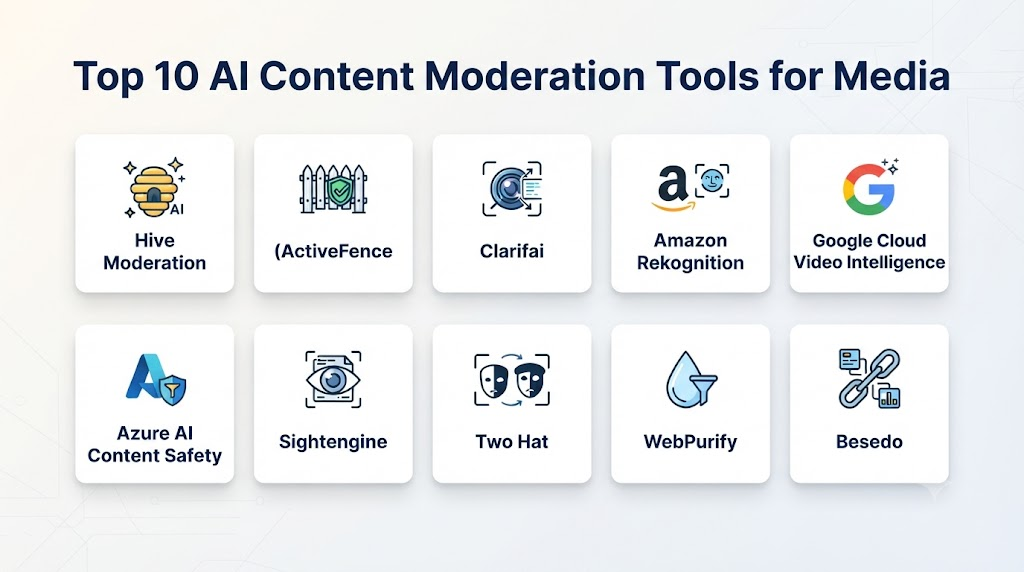
Top 10 AI Content Moderation Tools for Media
1. Hive
One-line verdict: Best for organizations seeking broad AI-powered moderation across visual and textual content.
Short description:
Hive provides AI-powered content understanding and moderation capabilities that can be used to analyze images, videos, text, and other media. Its capabilities are relevant to platforms dealing with large volumes of user-generated content.
Standout Capabilities
- Image moderation
- Video moderation
- Text analysis
- AI content classification
- NSFW detection
- Violence detection
- Hate-related content detection
- OCR-related analysis
- Content intelligence
AI-Specific Depth
- Model support: Specialized AI models for content analysis.
- RAG / knowledge integration: Not primarily a RAG-based moderation system.
- Evaluation: Classification performance and human-review feedback.
- Guardrails: Configurable moderation policies.
- Observability: API and platform-level monitoring capabilities.
Pros
- Multimodal capabilities
- API-oriented workflows
- Suitable for large content volumes
- Broad moderation categories
- Useful for automated pipelines
Cons
- Advanced implementation may require engineering resources
- Organizations need to configure policies carefully
- AI decisions still require validation
Security & Compliance
Organizations should assess data processing, retention, access controls, and deployment architecture before processing sensitive media.
Deployment & Platforms
- API
- Cloud workflows
- Enterprise integrations
Best-Fit Scenarios
- Media platforms
- Marketplaces
- Social platforms
- User-generated content systems
- Digital communities
2. Sightengine
One-line verdict: Best for developers seeking specialized image, video, and text moderation APIs.
Short description:
Sightengine provides automated moderation and content-analysis capabilities for digital platforms that need to screen uploaded or user-generated content.
Standout Capabilities
- Image moderation
- Video moderation
- Text moderation
- Face detection
- Nudity detection
- Violence detection
- Weapon detection
- OCR
- Spam detection
AI-Specific Depth
- Model support: Specialized machine-learning models.
- RAG / knowledge integration: Not central to moderation.
- Evaluation: Classification and detection performance.
- Guardrails: Configurable moderation thresholds.
- Observability: API-level integration and monitoring.
Pros
- Developer-friendly
- Broad media support
- API-based
- Useful for automated pipelines
- Strong moderation categories
Cons
- Requires technical integration
- Classification errors can occur
- Policy customization may require careful configuration
Security & Compliance
Companies should evaluate storage, processing, regional requirements, and data-handling policies.
Deployment & Platforms
- API
- Cloud
- Application integrations
Best-Fit Scenarios
- Social applications
- Marketplaces
- Dating platforms
- Media platforms
- User-generated content applications
3. AWS AI Content Moderation
One-line verdict: Best for organizations already operating large media pipelines on AWS.
Short description:
AWS provides AI services that can support content moderation through image and video analysis, making them suitable for organizations building customized moderation pipelines.
Standout Capabilities
- Image analysis
- Video analysis
- Object detection
- Facial analysis
- Content classification
- Media processing
- Event-driven workflows
AI-Specific Depth
- Model support: AWS machine-learning services.
- RAG / knowledge integration: Can be integrated with broader AI architectures.
- Evaluation: Model metrics, human review, and application-level evaluation.
- Guardrails: Service-level and application-level controls.
- Observability: Cloud monitoring and logging ecosystem.
Pros
- Strong cloud infrastructure
- Scalable
- Flexible architecture
- Broad developer ecosystem
- Suitable for enterprise deployments
Cons
- Requires engineering expertise
- Costs can become complex at scale
- Organizations must build policy workflows around the underlying services
Security & Compliance
AWS provides extensive enterprise security capabilities, but organizations remain responsible for correctly configuring their environment.
Deployment & Platforms
- Cloud
- APIs
- Serverless workflows
- Containerized applications
Best-Fit Scenarios
- Enterprise media companies
- Streaming platforms
- Large content repositories
- Cloud-native applications
4. Google Cloud AI Content Moderation
One-line verdict: Best for organizations building multimodal moderation systems within Google Cloud.
Short description:
Google Cloud provides machine-learning and media-analysis capabilities that can be combined to build content moderation workflows for images, video, text, and other data types.
Standout Capabilities
- Image analysis
- Video analysis
- Text analysis
- Speech recognition
- AI classification
- Content labeling
- Custom machine-learning workflows
AI-Specific Depth
- Model support: Google AI and machine-learning services.
- RAG / knowledge integration: Can be integrated into broader AI applications.
- Evaluation: Model evaluation and human review.
- Guardrails: Cloud AI safety and policy controls.
- Observability: Cloud monitoring and logging.
Pros
- Enterprise infrastructure
- Scalable
- Strong AI ecosystem
- Flexible architecture
- Good multimodal potential
Cons
- Requires technical expertise
- Custom moderation architecture may be necessary
- Cost management requires planning
Best-Fit Scenarios
- Streaming
- Media companies
- Social platforms
- Enterprise applications
5. Microsoft Azure AI Content Safety
One-line verdict: Best for enterprises seeking centralized AI safety capabilities across Microsoft cloud environments.
Short description:
Azure AI Content Safety provides capabilities designed to detect potentially harmful content across text and images and can be incorporated into broader application moderation workflows.
Standout Capabilities
- Text moderation
- Image moderation
- Harm classification
- Severity scoring
- Custom safety workflows
- Enterprise integration
AI-Specific Depth
- Model support: Microsoft AI safety models.
- RAG / knowledge integration: Can support broader generative AI applications.
- Evaluation: Safety evaluation and application monitoring.
- Guardrails: Strong focus on AI safety controls.
- Observability: Azure monitoring and enterprise management capabilities.
Pros
- Enterprise-focused
- Strong safety orientation
- Cloud integration
- Scalable
- Useful for generative AI applications
Cons
- Requires technical implementation
- Organizations may need additional tools for full video moderation
- Policy configuration can be complex
Security & Compliance
Microsoft’s enterprise cloud environment provides extensive security and compliance capabilities, although implementation responsibilities remain with the customer.
Best-Fit Scenarios
- Enterprise applications
- Media platforms
- AI applications
- Social communities
- Business software
6. OpenAI Moderation Models
One-line verdict: Best for developers who need AI-assisted safety classification for text and supported multimodal content.
Short description:
OpenAI moderation capabilities can help developers identify potentially harmful or policy-sensitive content and incorporate safety classification into AI applications and content workflows.
Standout Capabilities
- Text moderation
- Multimodal safety analysis
- Harm-category classification
- Safety filtering
- Automated screening
- Application-level moderation
AI-Specific Depth
- Model support: OpenAI safety and moderation models.
- RAG / knowledge integration: Can be combined with retrieval and application-specific policy systems.
- Evaluation: Safety evaluations, benchmarks, human review, and production feedback.
- Guardrails: Safety-focused moderation mechanisms.
- Observability: Application developers can build monitoring around moderation decisions.
Pros
- Strong AI ecosystem
- Developer-oriented
- Flexible integration
- Useful for AI applications
- Multimodal potential
Cons
- Requires application engineering
- Organizations must design their own broader moderation workflow
- Policy requirements may require additional business logic
Best-Fit Scenarios
- AI applications
- Media platforms
- Chat applications
- Community platforms
- Developer-built moderation systems
7. Two Hat
One-line verdict: Best for organizations focused on trust-and-safety operations and customizable content moderation.
Short description:
Two Hat provides AI-powered moderation technologies designed for online communities, social platforms, gaming environments, and other user-generated content ecosystems.
Standout Capabilities
- Text moderation
- Toxicity detection
- Harassment detection
- Child-safety protection
- Real-time moderation
- Community safety
- Risk classification
Pros
- Trust-and-safety focused
- Real-time capabilities
- Strong community orientation
- Useful for gaming and social platforms
Cons
- More specialized than general-purpose AI platforms
- Requires policy configuration
- Organizations should validate language and cultural coverage
Best-Fit Scenarios
- Gaming
- Social communities
- Youth-oriented platforms
- Chat systems
8. Spectrum Labs
One-line verdict: Best for conversational and community safety workflows.
Short description:
Spectrum Labs focuses on AI-powered trust and safety, particularly for conversational environments and user-generated interactions.
Standout Capabilities
- Toxicity detection
- Harassment detection
- Hate speech detection
- Threat detection
- Conversational safety
- Community moderation
- Risk analysis
Pros
- Strong conversational focus
- Useful for social platforms
- Real-time moderation potential
- Trust-and-safety orientation
Cons
- Primarily focused on certain moderation scenarios
- Requires careful policy configuration
- Human review remains important
Best-Fit Scenarios
- Social communities
- Gaming
- Chat platforms
- Online communities
9. WebPurify
One-line verdict: Best for organizations combining automated moderation with human moderation services.
Short description:
WebPurify provides content moderation services and technology that can support organizations managing user-generated content across different media formats.
Standout Capabilities
- Automated moderation
- Human moderation
- Image moderation
- Video moderation
- Text moderation
- Community safety
- Review workflows
Pros
- Human-in-the-loop approach
- Broad moderation services
- Useful for high-risk content
- Suitable for organizations requiring escalation
Cons
- Human moderation can increase costs
- Service configuration requires careful planning
- Automated detection still needs evaluation
Best-Fit Scenarios
- Social networks
- Marketplaces
- Dating platforms
- Media companies
- User-generated content platforms
10. ActiveFence
One-line verdict: Best for large-scale trust-and-safety programs requiring broad threat detection.
Short description:
ActiveFence focuses on trust and safety for digital platforms, helping organizations identify harmful content and platform abuse across multiple categories.
Standout Capabilities
- Content moderation
- Threat intelligence
- Harm detection
- Child-safety protection
- Terrorism-related content detection
- Fraud and abuse detection
- Multilingual moderation
- Platform safety
Pros
- Enterprise-oriented
- Broad trust-and-safety capabilities
- Useful for large platforms
- Multilingual focus
- Supports complex safety programs
Cons
- Enterprise implementation can be complex
- Requires policy and operational expertise
- Human review remains important for nuanced cases
Best-Fit Scenarios
- Large media companies
- Social platforms
- Marketplaces
- Streaming services
- Global digital platforms
Comparison Table
| Tool | Best For | Text | Image | Video | Audio | Real-Time | Human Review |
|---|---|---|---|---|---|---|---|
| Hive | Multimodal moderation | Excellent | Excellent | Excellent | Good | Good | Good |
| Sightengine | Developer APIs | Excellent | Excellent | Excellent | Moderate | Excellent | Limited |
| AWS | Cloud-scale systems | Excellent | Excellent | Excellent | Good | Excellent | Custom |
| Google Cloud | Enterprise AI | Excellent | Excellent | Excellent | Excellent | Excellent | Custom |
| Azure AI Content Safety | Enterprise safety | Excellent | Excellent | Good | Good | Excellent | Custom |
| OpenAI Moderation | AI applications | Excellent | Excellent | Good | Good | Excellent | Custom |
| Two Hat | Communities/gaming | Excellent | Good | Good | Moderate | Excellent | Excellent |
| Spectrum Labs | Conversational safety | Excellent | Limited | Limited | Good | Excellent | Good |
| WebPurify | Human + AI moderation | Excellent | Excellent | Excellent | Good | Good | Excellent |
| ActiveFence | Enterprise trust & safety | Excellent | Excellent | Excellent | Excellent | Excellent | Excellent |
Scoring & Evaluation
These scores are editorial assessments intended to compare general capabilities rather than official vendor benchmarks.
| Tool | Core Moderation | Reliability | Multimodal AI | Customization | Integrations | Scalability | Security/Admin | Human Review | Support | Weighted Total |
|---|---|---|---|---|---|---|---|---|---|---|
| Hive | 10 | 9 | 10 | 9 | 9 | 9 | 9 | 8 | 9 | 9.15 |
| Sightengine | 9 | 9 | 9 | 9 | 10 | 9 | 8 | 7 | 9 | 8.85 |
| AWS | 10 | 10 | 10 | 10 | 10 | 10 | 10 | 8 | 10 | 9.75 |
| Google Cloud | 10 | 10 | 10 | 10 | 10 | 10 | 10 | 8 | 10 | 9.75 |
| Azure AI Content Safety | 10 | 10 | 9 | 10 | 10 | 10 | 10 | 8 | 10 | 9.65 |
| OpenAI Moderation | 10 | 10 | 9 | 9 | 10 | 10 | 9 | 8 | 10 | 9.50 |
| Two Hat | 9 | 9 | 8 | 10 | 9 | 9 | 9 | 10 | 9 | 9.10 |
| Spectrum Labs | 9 | 9 | 7 | 10 | 9 | 9 | 9 | 9 | 9 | 8.90 |
| WebPurify | 9 | 9 | 9 | 9 | 8 | 9 | 8 | 10 | 9 | 8.90 |
| ActiveFence | 10 | 10 | 10 | 10 | 9 | 10 | 10 | 10 | 10 | 9.90 |
Top 3 AI Content Moderation Solutions for Enterprise
1. ActiveFence
Best suited to large platforms requiring broad trust-and-safety capabilities, threat detection, and complex moderation operations.
2. AWS
Strong for enterprises that want to build customized moderation pipelines inside a large cloud ecosystem.
3. Google Cloud
Well suited to organizations building scalable multimodal AI systems with extensive cloud infrastructure.
Top 3 for SMB
1. Sightengine
A practical option for businesses that need ready-to-integrate moderation APIs.
2. Hive
Useful for businesses requiring broad image, video, and text moderation.
3. WebPurify
Particularly useful when a business needs both automated moderation and human review.
Top 3 for Developers
1. OpenAI Moderation
Strong for developers building AI applications that require integrated safety classification.
2. Sightengine
Useful for developers who need specialized moderation APIs across media types.
3. AWS
Strong for developers building highly customized and scalable moderation pipelines.
Benefits of AI Content Moderation for Media
1. Scalability
AI can evaluate enormous amounts of content much faster than human teams.
2. Faster Detection
Potentially harmful content can be identified soon after upload.
3. Reduced Moderator Workload
AI can handle routine cases while human moderators focus on complex decisions.
4. Consistent Policy Enforcement
Automated systems can apply standardized rules across large content libraries.
5. Real-Time Protection
AI can monitor live conversations, streams, and interactions.
6. Multilingual Moderation
Modern AI systems can analyze multiple languages and linguistic patterns.
7. Better Prioritization
Moderation queues can prioritize the highest-risk cases.
8. Improved User Safety
Faster detection can reduce users’ exposure to harmful content.
9. Operational Efficiency
Organizations can reduce the amount of manual review required for straightforward cases.
10. Continuous Improvement
AI systems can be evaluated and improved using moderation outcomes and appeals.
AI Content Moderation Use Cases
Social Media
AI moderation can analyze:
- Posts
- Images
- Videos
- Comments
- Direct interactions
- User reports
Streaming Platforms
AI can monitor:
- Movies
- Shows
- Trailers
- User uploads
- Livestreams
- Comments
News Organizations
Moderation can help analyze:
- Reader comments
- User submissions
- Images
- Videos
- Social interactions
However, editorial context must be considered carefully.
Gaming
Gaming platforms can use AI to identify:
- Harassment
- Toxicity
- Threats
- Hate speech
- Inappropriate usernames
- Chat abuse
Marketplaces
AI can detect:
- Fraudulent listings
- Scam messages
- Prohibited products
- Manipulated images
- Suspicious descriptions
Dating Platforms
AI can assist with:
- Harassment
- Scam behavior
- Sexual content
- Threats
- Fake profiles
- Inappropriate images
Education
Platforms can moderate:
- Student discussions
- Uploaded content
- Messages
- Community posts
Livestreaming
Real-time moderation can detect potentially harmful content while a broadcast is happening.
AI Moderation for Images
Image moderation is one of the most established AI moderation applications.
Computer vision can detect:
- Nudity
- Sexual content
- Graphic violence
- Weapons
- Drugs
- Hate symbols
- Dangerous activities
However, image classification can be difficult when context matters.
For example, the same image may appear in:
- A news report
- A documentary
- An educational lesson
- A medical article
- A harmful user-generated post
The moderation system should therefore consider context before taking irreversible action.
AI Moderation for Video
Video moderation is more complex because videos contain time-based sequences.
A moderation system may analyze:
- Video frames
- Audio
- Speech transcripts
- On-screen text
- Metadata
- Scene transitions
- User reports
A single-frame analysis may miss important context.
For example, a short sequence can reveal whether an object is being:
- Displayed
- Used
- Discussed
- Threatened with
- Demonstrated for educational purposes
Temporal analysis is therefore important for sophisticated video moderation.
AI Moderation for Audio
AI can convert speech into text and analyze the resulting transcript.
It can identify potential:
- Threats
- Harassment
- Hate speech
- Abuse
- Spam
- Toxic language
However, speech moderation must handle:
- Accents
- Dialects
- Background noise
- Slang
- Code-switching
- Sarcasm
- Context
AI Moderation for Livestreams
Livestream moderation requires extremely low latency.
A possible architecture is:
Live stream → frame sampling → audio transcription → AI analysis → risk scoring → moderation action → human escalation
The system must balance:
- Accuracy
- Speed
- Cost
- False positives
- False negatives
Overly aggressive moderation can interrupt legitimate broadcasts, while slow moderation can allow harmful content to spread.
Human-in-the-Loop Moderation
Human moderation remains essential for difficult cases.
AI should ideally handle:
Low-Risk Content
Automatically approve.
High-Confidence Violations
Automatically restrict or escalate depending on policy.
Ambiguous Content
Send to a human moderator.
Sensitive Cases
Require specialized human review.
A strong workflow can therefore be:
AI detection → confidence scoring → automated decision where appropriate → human review → appeal → policy feedback
False Positives and False Negatives
Two major risks in AI moderation are:
False Positive
Legitimate content is incorrectly classified as harmful.
Example:
A documentary about a conflict may contain graphic imagery that is journalistically relevant.
False Negative
Harmful content is incorrectly allowed.
Example:
A subtle threat may evade automated detection.
Organizations should measure both.
Important metrics include:
- Precision
- Recall
- F1 score
- False-positive rate
- False-negative rate
- Escalation rate
- Appeal reversal rate
Moderation Policy Design
Technology alone cannot define what is acceptable.
Organizations should first create clear policies.
For example:
Category
Harassment
Definition
Targeted abusive behavior intended to intimidate, threaten, or degrade another individual.
Examples
- Direct threats
- Persistent targeted abuse
- Severe personal attacks
Exceptions
- Clearly labeled satire
- Documented news reporting
- Academic discussion
Action
- Low confidence: allow
- Medium confidence: review
- High confidence: restrict
This policy structure can then be translated into AI moderation workflows.
Security & Compliance Considerations
Media companies should consider:
Data Privacy
Understand how content is processed and stored.
Data Retention
Define how long moderation data and user content remain available.
Access Control
Limit moderation data to authorized personnel.
Auditability
Maintain records of important moderation decisions.
Regional Requirements
Different markets may have different content and privacy requirements.
User Appeals
Users should have appropriate mechanisms to challenge incorrect decisions.
Human Oversight
High-impact decisions should have human review where appropriate.
Model Governance
Organizations should monitor model performance and update policies as threats evolve.
Build vs. Buy
Build
Build a custom moderation system when:
- You have unique policies.
- You process very large volumes.
- You possess substantial historical moderation data.
- You need proprietary classification.
- You require specialized integrations.
- You have an experienced AI engineering team.
Buy
Use an existing platform when:
- You need faster deployment.
- Your moderation categories are relatively standard.
- You lack internal ML resources.
- You need established APIs.
- You require vendor support.
Hybrid
Many large organizations will benefit from a hybrid approach.
For example:
Third-party AI model → internal policy engine → risk scoring → human moderation → appeals → analytics
This provides flexibility while reducing the need to build every AI capability internally.
30/60/90-Day Implementation Plan
First 30 Days: Policy and Baseline
Start by defining:
- Moderation categories
- Severity levels
- Escalation rules
- Human-review requirements
- Appeal procedures
Then collect historical examples.
Measure:
- Existing moderation volume
- Review time
- False positives
- False negatives
- Appeal outcomes
Days 31–60: AI Pilot
Deploy AI on a controlled content sample.
Evaluate:
- Classification accuracy
- Latency
- Cost
- False-positive rate
- False-negative rate
- Human-review workload
Keep automated actions limited during the pilot.
Days 61–90: Production Scaling
Once performance is validated:
- Automate high-confidence decisions.
- Route ambiguous cases to humans.
- Build moderation dashboards.
- Add audit logs.
- Implement appeals.
- Monitor model drift.
- Establish continuous evaluation.
Common Mistakes & How to Avoid Them
1. Automating Every Moderation Decision
AI is not equally reliable for every type of content.
Solution: Use confidence thresholds and human escalation.
2. Ignoring Context
Identical content can have different meanings in different situations.
Solution: Include surrounding text, metadata, conversation history, and content context where appropriate.
3. Using One Model for Everything
Different content types require different capabilities.
Solution: Use specialized models or multimodal systems.
4. Ignoring False Positives
Incorrect removals can frustrate legitimate users.
Solution: Track false-positive rates and appeal reversals.
5. Ignoring False Negatives
Missing harmful content can create serious safety risks.
Solution: Continuously test models using adversarial and real-world examples.
6. Failing to Support Appeals
Users may be incorrectly moderated.
Solution: Build transparent appeal processes.
7. Ignoring Language Diversity
Moderation quality can vary dramatically between languages.
Solution: Test across relevant languages, dialects, and cultural contexts.
8. Relying Only on Text Transcripts
Video and audio context can contain information that transcripts miss.
Solution: Use multimodal analysis.
9. Ignoring Model Drift
Online behavior and harmful-content patterns evolve.
Solution: Continuously monitor performance and update evaluation datasets.
10. Neglecting Moderator Wellbeing
Human moderators may encounter disturbing content.
Solution: Provide appropriate training, support, workload management, and escalation procedures.
11. Treating AI Scores as Absolute Truth
A confidence score is not the same as a final policy decision.
Solution: Combine model output with policy rules and human judgment.
12. Failing to Audit Decisions
Without decision records, organizations may struggle to understand moderation failures.
Solution: Maintain appropriate audit logs and review mechanisms.
Future of AI Content Moderation for Media
AI moderation is likely to become increasingly multimodal and contextual.
Multimodal Understanding
Future systems will analyze text, images, audio, video, and metadata together.
Context-Aware Moderation
AI will increasingly evaluate conversations and content sequences rather than isolated pieces of information.
Real-Time Video Moderation
Streaming platforms will move toward increasingly low-latency moderation.
Personalized Safety
Platforms may adapt safety controls to different user groups and risk profiles.
Better Multilingual Coverage
AI will improve moderation across languages and regional dialects.
Automated Policy Mapping
Organizations may use AI to translate written policies into operational moderation rules.
Improved Human-AI Collaboration
Moderators will increasingly receive:
- AI summaries
- Evidence
- Confidence scores
- Similar cases
- Policy references
- Recommended actions
This can improve decision speed while retaining human oversight.
FAQAS
1. What Is AI Content Moderation for Media?
AI Content Moderation for Media uses artificial intelligence to automatically analyze text, images, audio, video, livestreams, and other digital content to identify potentially harmful or policy-violating material.
2. What Types of Content Can AI Moderation Detect?
Depending on the system, AI can detect hate speech, harassment, violence, graphic imagery, sexual content, threats, spam, dangerous activities, scams, and other policy-defined categories.
3. Can AI Moderate Video Content?
Yes. AI can analyze video frames, audio, speech transcripts, on-screen text, and metadata. More advanced systems can analyze sequences over time rather than relying on individual frames.
4. Can AI Moderate Livestreams?
Yes. AI can continuously analyze livestreams and identify potentially harmful content for automated action or human review. Real-time moderation requires careful balancing of speed and accuracy.
5. Is AI Content Moderation 100% Accurate?
No. AI moderation systems can produce both false positives and false negatives. Human review, appeals, continuous evaluation, and policy-specific thresholds remain important.
6. Can AI Moderation Understand Context?
Modern multimodal AI can consider more context than traditional keyword filters, but contextual interpretation remains challenging. Sensitive or ambiguous cases should receive additional review.
7. Does AI Replace Human Content Moderators?
Usually, AI is best used to reduce repetitive workload and prioritize difficult cases. Human moderators remain important for nuanced, sensitive, and disputed decisions.
8. How Can Companies Reduce False Positives?
Organizations can use better policy definitions, contextual signals, confidence thresholds, human review, representative evaluation datasets, and systematic analysis of appeal outcomes.
9. Is AI Content Moderation Useful for Small Media Companies?
Yes. Smaller organizations can use moderation APIs and managed services instead of building an entire AI system internally. This can make automated moderation more accessible without requiring a large machine-learning team.
10. What Is the Future of AI Content Moderation?
The future is likely to involve multimodal, contextual, real-time, multilingual, and human-assisted moderation systems that combine AI detection with policy engines, human review, appeals, and continuous evaluation.
Conclusion
AI Content Moderation for Media is becoming an essential technology for organizations managing large volumes of digital content. From text and images to audio, video, livestreams, and user-generated content, AI can help identify potential policy violations faster, prioritize high-risk cases, reduce manual workloads, and improve overall platform safeHowever, effective moderation requires more than automated detection. The best approach combines AI classification, clear moderation policies, contextual analysis, human oversight, appeals, continuous monitoring, and real-world performance evaluation. Organizations should also pay close attention to false positives, false negatives, privacy, security, cultural differences, and changing content patterns.