Introduction
AI Chat Commerce Assistants are AI-powered conversational systems designed to help shoppers discover products, compare options, answer questions, provide recommendations, and sometimes complete parts of the purchasing journey through chat. Instead of requiring customers to navigate categories, filters, and product pages manually, these assistants let shoppers describe what they want in natural language.
For example, a customer might ask, “I need a lightweight laptop for programming under my budget,” or “Which running shoes are best for long-distance training?” The assistant can interpret the request, retrieve relevant product information, compare choices, and guide the shopper toward a purchase.
Best for: E-commerce brands, retailers, marketplaces, DTC businesses, consumer brands, and enterprises with large product catalogs or high volumes of shopping-related customer questions.
Not ideal for: Very small stores with limited product catalogs, businesses that receive little customer traffic, or organizations without reliable product, inventory, pricing, and order data.
What’s Changed in AI Chat Commerce Assistants
- Conversational shopping is moving beyond basic chatbots: Modern systems can understand shopping intent rather than simply matching keywords to FAQ articles.
- AI agents can perform actions: Depending on the implementation, assistants can search catalogs, add products to carts, retrieve order information, and trigger workflows.
- Product discovery is becoming multimodal: Customers can increasingly combine text, images, product attributes, and conversational requests.
- Real-time product information is critical: Assistants need current availability, pricing, promotions, shipping information, and product specifications to avoid misleading shoppers.
- Personalization is becoming more contextual: Systems can potentially combine session context, customer preferences, browsing behavior, and purchase history where appropriate.
- RAG is important for product accuracy: Retrieval from catalogs, documentation, policies, and inventory systems helps reduce unsupported AI answers.
- Hallucination control is a major buying criterion: A commerce assistant should not invent product specifications, discounts, compatibility information, or delivery promises.
- Tool calling is becoming central: Good commerce assistants need controlled access to search, inventory, cart, order, recommendation, and customer-service systems.
- Guardrails are increasingly important: Shopping assistants need protection against prompt injection, unauthorized actions, data leakage, and manipulated product information.
- Human handoff remains important: Complex complaints, high-value purchases, and unusual customer requests may require human agents.
- Voice and messaging channels are expanding: Commerce assistants can increasingly appear across websites, mobile applications, messaging channels, and voice experiences.
- Cost and latency matter: Long AI conversations can become expensive, particularly when every response requires multiple retrieval and tool calls.
- Model flexibility is becoming valuable: Businesses may want to combine proprietary models, commercial APIs, and open models rather than depending on one provider.
- AI-generated product content is becoming connected to commerce assistants: Assistants increasingly depend on structured product data and high-quality product descriptions.
- Evaluation needs to reflect commerce outcomes: Accuracy alone is not enough; businesses should measure conversion, product relevance, customer satisfaction, escalation rates, and incorrect recommendations.
Quick Buyer Checklist
When evaluating AI Chat Commerce Assistants, look for:
- Natural-language product discovery.
- Catalog search.
- Product recommendation.
- Product comparison.
- Conversational filtering.
- Product availability lookup.
- Price and promotion awareness.
- Inventory integration.
- Cart integration.
- Checkout integration.
- Order-status integration.
- Customer-service integration.
- Personalization.
- Conversation memory.
- Multilingual support.
- Multimodal capabilities.
- RAG support.
- Product-data grounding.
- Structured product catalogs.
- API integrations.
- Tool calling.
- Agent workflows.
- Human handoff.
- Evaluation and testing.
- Hallucination controls.
- Prompt-injection protection.
- Access controls.
- Audit logs.
- Data retention controls.
- Privacy controls.
- Model choice.
- BYO-model options.
- Latency controls.
- Cost monitoring.
- Analytics.
- A/B testing.
- Vendor lock-in risk.
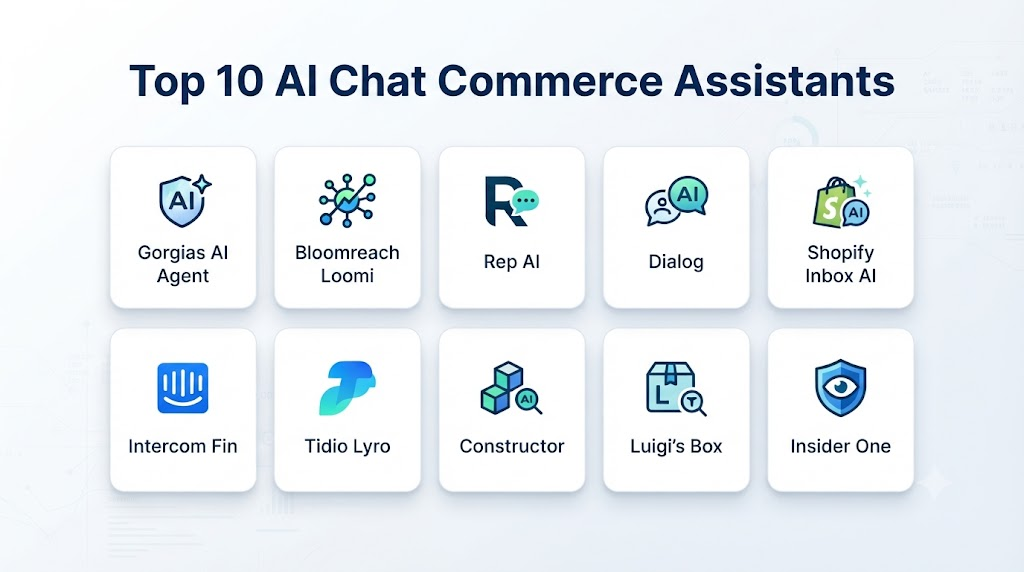
Top 10 AI Chat Commerce Assistants
1. Salesforce Agentforce
One-line verdict: Best for enterprises wanting AI shopping and service agents integrated with customer, commerce, and CRM workflows.
Short description:
Salesforce Agentforce provides agentic AI capabilities that can support customer-service and commerce workflows. Organizations can connect conversational experiences with customer data, business processes, and enterprise systems.
Standout Capabilities
- AI agents.
- Customer-service automation.
- Commerce workflows.
- Customer data integration.
- Conversational interactions.
- Workflow automation.
- Enterprise administration.
- Human-agent handoff.
AI-Specific Depth
- Model support: Salesforce-managed AI capabilities with broader model options depending on configuration.
- RAG / knowledge integration: Strong integration with enterprise data and knowledge sources.
- Evaluation: Enterprise AI testing and monitoring capabilities vary by configuration.
- Guardrails: Enterprise controls, permissions, and AI governance capabilities.
- Observability: Monitoring and analytics capabilities vary by product configuration.
Pros
- Strong enterprise ecosystem.
- Connects conversational AI with customer workflows.
- Suitable for complex service and commerce environments.
Cons
- Can be complex to implement.
- Best suited to organizations already using Salesforce extensively.
- Total costs can increase as capabilities and usage expand.
Security & Compliance
Enterprise identity, access control, auditing, and security capabilities are available across Salesforce products, but specific controls and certifications should be verified for the selected configuration.
Deployment & Platforms
- Cloud.
- Web applications.
- Mobile experiences.
- APIs.
- Enterprise systems.
Integrations & Ecosystem
Salesforce can connect commerce conversations with customer and business data.
- CRM.
- Commerce systems.
- Customer service.
- APIs.
- Knowledge bases.
- Workflow automation.
- Enterprise applications.
Pricing Model
Typically subscription, product-tier, and usage-related pricing depending on the Salesforce products and AI capabilities selected.
Best-Fit Scenarios
- Enterprise retailers.
- Large customer-service operations.
- Businesses already using Salesforce.
2. Shopify Sidekick
One-line verdict: Best for Shopify merchants wanting an AI assistant integrated directly into their commerce management environment.
Short description:
Shopify Sidekick is an AI assistant designed to help Shopify merchants work with their stores. Its primary focus includes assisting merchants with store management, insights, and commerce-related tasks rather than functioning solely as a consumer shopping chatbot.
Standout Capabilities
- Natural-language interaction.
- Store-management assistance.
- Commerce insights.
- Merchant workflows.
- Shopify ecosystem integration.
- AI-assisted decision making.
- Task assistance.
- Business recommendations.
AI-Specific Depth
- Model support: Shopify-managed AI capabilities.
- RAG / knowledge integration: Uses Shopify-related store context and data depending on the task.
- Evaluation: Specific internal evaluation mechanisms are not fully public.
- Guardrails: Platform-level controls and permissions.
- Observability: Merchant analytics and platform capabilities vary.
Pros
- Deep Shopify integration.
- Convenient for Shopify merchants.
- Low infrastructure overhead.
Cons
- Primarily tied to the Shopify ecosystem.
- Consumer-facing assistant capabilities may differ from dedicated conversational commerce platforms.
- Advanced customization may require additional applications or development.
Security & Compliance
Shopify provides platform-level security and merchant administration controls. Specific AI data handling should be reviewed for the applicable Shopify services.
Deployment & Platforms
- Shopify platform.
- Web.
- Merchant administration environment.
Integrations & Ecosystem
- Shopify stores.
- Product catalog.
- Orders.
- Store data.
- Apps.
- Commerce workflows.
Pricing Model
Availability and pricing depend on the Shopify plan and applicable AI capabilities.
Best-Fit Scenarios
- Shopify merchants.
- Small and medium retailers.
- Merchants seeking AI-assisted store management.
3. Gorgias AI Agent
One-line verdict: Best for e-commerce brands that want AI-powered customer support integrated with shopping and order workflows.
Short description:
Gorgias provides customer-service software designed for e-commerce businesses, with AI capabilities that can automate customer interactions and support workflows.
Standout Capabilities
- AI customer support.
- Automated responses.
- Order-related assistance.
- Product questions.
- Customer-service workflows.
- Human-agent escalation.
- E-commerce integrations.
- Support analytics.
AI-Specific Depth
- Model support: Managed AI capabilities.
- RAG / knowledge integration: Uses connected help-center and commerce information.
- Evaluation: Support performance and automation analytics are available, with exact AI evaluation features varying.
- Guardrails: Workflow and automation controls.
- Observability: Customer-service analytics and performance reporting.
Pros
- E-commerce-focused.
- Strong customer-service workflows.
- Useful for reducing repetitive support tickets.
Cons
- More customer-service focused than general-purpose shopping agents.
- Advanced shopping experiences may require additional integrations.
- Pricing varies with plan and usage.
Security & Compliance
Security and administrative capabilities vary by plan and configuration. Enterprise requirements should be verified directly.
Deployment & Platforms
- Cloud.
- Web.
- E-commerce integrations.
- APIs.
Integrations & Ecosystem
- E-commerce platforms.
- Help centers.
- Customer support.
- Orders.
- Shipping information.
- Product catalogs.
Pricing Model
Subscription and usage-related pricing depending on plan and AI usage.
Best-Fit Scenarios
- DTC brands.
- E-commerce customer support.
- Retailers handling large support volumes.
4. Intercom Fin
One-line verdict: Best for businesses wanting an AI customer-service agent capable of answering shopping and product-related questions.
Short description:
Intercom Fin is an AI agent designed to resolve customer questions using business knowledge and connected support content. It can be useful for commerce businesses that need conversational assistance before and after purchase.
Standout Capabilities
- AI customer support.
- Conversational answers.
- Knowledge retrieval.
- Automated resolution.
- Human escalation.
- Support workflows.
- Multichannel customer conversations.
- Analytics.
AI-Specific Depth
- Model support: Managed AI models and underlying model infrastructure.
- RAG / knowledge integration: Strong knowledge-based retrieval.
- Evaluation: Support resolution and AI performance metrics.
- Guardrails: Business knowledge and workflow controls.
- Observability: Conversation and resolution analytics.
Pros
- Strong conversational support.
- Good knowledge integration.
- Useful for automated customer-service workflows.
Cons
- Primarily support-oriented.
- Full product-recommendation experiences may require customization.
- Commerce functionality depends on integrations.
Security & Compliance
Intercom provides enterprise security and administration capabilities; specific certifications and controls should be verified for the selected plan.
Deployment & Platforms
- Cloud.
- Web.
- Messaging.
- APIs.
Integrations & Ecosystem
- Help centers.
- CRM systems.
- E-commerce platforms.
- APIs.
- Customer-service workflows.
- Messaging channels.
Pricing Model
Subscription and usage-based components may apply.
Best-Fit Scenarios
- Online retailers.
- Subscription businesses.
- E-commerce customer service.
5. Ada
One-line verdict: Best for enterprises building sophisticated automated customer conversations across service and commerce journeys.
Short description:
Ada provides AI-powered customer-service automation designed to handle customer conversations across digital channels. Commerce organizations can use it for product questions, order support, and other customer interactions.
Standout Capabilities
- AI customer-service agents.
- Automated conversations.
- Knowledge integration.
- Multichannel support.
- Workflow automation.
- Personalization.
- Human escalation.
- Analytics.
AI-Specific Depth
- Model support: Managed AI and configurable AI infrastructure.
- RAG / knowledge integration: Knowledge integration is a central capability.
- Evaluation: AI performance and conversation analytics.
- Guardrails: Workflow controls and policy configuration.
- Observability: Conversation analytics and operational reporting.
Pros
- Enterprise-oriented.
- Strong automation capabilities.
- Useful across complex customer journeys.
Cons
- Enterprise implementation can require significant planning.
- Pricing is generally customized.
- Product-discovery capabilities depend on connected commerce data.
Security & Compliance
Enterprise security and compliance controls should be verified against the current offering.
Deployment & Platforms
- Cloud.
- Web.
- Messaging channels.
- APIs.
Integrations & Ecosystem
- CRM.
- E-commerce.
- Help centers.
- Customer-service platforms.
- APIs.
- Business systems.
Pricing Model
Enterprise/custom pricing.
Best-Fit Scenarios
- Large retailers.
- Global customer-service operations.
- Complex commerce journeys.
6. Coveo
One-line verdict: Best for enterprises combining AI-powered search, personalization, recommendations, and conversational product discovery.
Short description:
Coveo provides AI-powered search and relevance technology for digital experiences. Its capabilities can support product discovery, personalized search, recommendations, and commerce experiences.
Standout Capabilities
- AI search.
- Product discovery.
- Personalization.
- Recommendations.
- Relevance optimization.
- Commerce search.
- Analytics.
- Conversational experiences.
AI-Specific Depth
- Model support: Managed AI and search models.
- RAG / knowledge integration: Strong search and retrieval capabilities.
- Evaluation: Search relevance and experimentation capabilities.
- Guardrails: Enterprise controls and configurable relevance policies.
- Observability: Search analytics and relevance metrics.
Pros
- Strong product discovery.
- Enterprise search capabilities.
- Useful for large catalogs.
Cons
- More search/relevance focused than pure customer-service agents.
- Implementation can be sophisticated.
- Enterprise-oriented pricing and deployment.
Security & Compliance
Enterprise administration and security capabilities are available, but exact requirements should be verified.
Deployment & Platforms
- Cloud.
- APIs.
- Web applications.
Integrations & Ecosystem
- Product catalogs.
- Commerce platforms.
- CMS.
- CRM.
- APIs.
- Analytics.
- Search interfaces.
Pricing Model
Enterprise/custom pricing.
Best-Fit Scenarios
- Large product catalogs.
- Enterprise retailers.
- Personalized commerce search.
7. Algolia
One-line verdict: Best for developers building fast conversational product discovery on top of powerful commerce search infrastructure.
Short description:
Algolia provides search and discovery technology that can be integrated into commerce applications. Its AI-related capabilities can support relevance, personalization, recommendations, and conversational discovery experiences.
Standout Capabilities
- Product search.
- Recommendations.
- Personalization.
- Search relevance.
- APIs.
- Developer tooling.
- Analytics.
- Commerce discovery.
AI-Specific Depth
- Model support: Algolia-managed AI/search capabilities with integrations varying by product.
- RAG / knowledge integration: Search indexes provide structured retrieval.
- Evaluation: Search relevance and analytics capabilities.
- Guardrails: Application-level policies and filtering.
- Observability: Search analytics and performance metrics.
Pros
- Developer-friendly.
- Strong search performance.
- Useful for large catalogs.
Cons
- Requires development for a full conversational assistant.
- More search-focused than complete customer-service automation.
- Costs scale with usage.
Security & Compliance
Enterprise controls are available depending on the plan and deployment configuration.
Deployment & Platforms
- Cloud.
- APIs.
- Web.
- Mobile applications through integrations.
Integrations & Ecosystem
- Product catalogs.
- E-commerce platforms.
- APIs.
- Front-end frameworks.
- Analytics.
- Recommendation systems.
Pricing Model
Usage and tier-based pricing.
Best-Fit Scenarios
- Developer-led retailers.
- Large product catalogs.
- Conversational search experiences.
8. Amazon Q Business
One-line verdict: Best for organizations building AI assistants that connect enterprise knowledge and workflows to commerce operations.
Short description:
Amazon Q Business provides enterprise conversational AI capabilities designed to work with organizational information and systems. Commerce companies can use it for internal support, product knowledge, operations, and employee-facing workflows.
Standout Capabilities
- Enterprise AI assistant.
- Knowledge retrieval.
- Natural-language questions.
- Enterprise connectors.
- Business workflow assistance.
- Access controls.
- AWS integration.
- Generative AI.
AI-Specific Depth
- Model support: Amazon-managed and configurable model capabilities depending on service.
- RAG / knowledge integration: Strong enterprise retrieval capabilities.
- Evaluation: Enterprise AI evaluation capabilities vary by implementation.
- Guardrails: Access permissions and AI controls.
- Observability: AWS monitoring and application analytics.
Pros
- Strong enterprise integration.
- Useful for internal commerce operations.
- AWS ecosystem support.
Cons
- Primarily an enterprise assistant rather than a dedicated consumer shopping platform.
- Requires integration for customer-facing commerce.
- Architecture can become complex.
Security & Compliance
AWS provides extensive identity, security, logging, and governance capabilities. Specific controls depend on configuration.
Deployment & Platforms
- Cloud.
- Enterprise applications.
- APIs.
- AWS infrastructure.
Integrations & Ecosystem
- Enterprise data.
- AWS services.
- Business applications.
- APIs.
- Knowledge sources.
- Identity systems.
Pricing Model
Subscription and usage-related pricing varies by service configuration.
Best-Fit Scenarios
- Enterprise retailers.
- Internal commerce teams.
- AWS-native organizations.
9. Salesforce Commerce Cloud AI Capabilities
One-line verdict: Best for large retailers wanting AI-assisted commerce experiences connected to catalogs, customers, and digital storefronts.
Short description:
Salesforce Commerce Cloud provides commerce infrastructure that can be combined with Salesforce AI capabilities to support personalized customer experiences and commerce workflows.
Standout Capabilities
- Product discovery.
- Personalization.
- Commerce workflows.
- Customer data integration.
- AI-assisted experiences.
- Product recommendations.
- Digital storefronts.
- Customer engagement.
AI-Specific Depth
- Model support: Salesforce-managed AI capabilities with broader model options depending on configuration.
- RAG / knowledge integration: Enterprise data and commerce information can support AI experiences.
- Evaluation: Capabilities vary by Salesforce product and implementation.
- Guardrails: Salesforce permissions, governance, and AI controls.
- Observability: Commerce and customer analytics.
Pros
- Strong enterprise commerce ecosystem.
- Connects commerce and customer data.
- Suitable for complex retail environments.
Cons
- Enterprise implementation can be expensive and complex.
- Best suited to organizations already invested in Salesforce.
- Requires careful architecture for conversational experiences.
Security & Compliance
Enterprise security, identity, and administrative controls are available across Salesforce products. Exact compliance depends on the selected services and configuration.
Deployment & Platforms
- Cloud.
- Web.
- Mobile.
- APIs.
Integrations & Ecosystem
- CRM.
- Commerce.
- Marketing.
- Customer service.
- Product catalogs.
- APIs.
- Analytics.
Pricing Model
Enterprise subscription and product-based pricing.
Best-Fit Scenarios
- Enterprise retailers.
- Global commerce organizations.
- Salesforce-centric businesses.
10. Adobe Commerce AI Ecosystem
One-line verdict: Best for commerce organizations combining product catalogs, personalization, search, content, and AI-powered customer experiences.
Short description:
Adobe Commerce provides a commerce platform that can be extended with Adobe’s broader AI and experience capabilities. Retailers can build conversational shopping experiences around product data, customer journeys, content, and commerce operations.
Standout Capabilities
- Product catalog management.
- Personalization.
- Commerce experiences.
- Search.
- Content integration.
- Customer journeys.
- AI-assisted workflows.
- Enterprise extensibility.
AI-Specific Depth
- Model support: Adobe-managed AI capabilities and integrations vary.
- RAG / knowledge integration: Can leverage commerce and content data depending on implementation.
- Evaluation: Analytics and experimentation capabilities vary.
- Guardrails: Enterprise permissions and platform controls.
- Observability: Commerce analytics and customer-experience measurement.
Pros
- Strong commerce foundation.
- Good for complex product catalogs.
- Enterprise extensibility.
Cons
- Conversational AI may require additional implementation.
- Enterprise architecture can be complex.
- Exact AI capabilities vary across Adobe products.
Security & Compliance
Adobe provides enterprise security and administration capabilities; exact certifications, controls, and data-handling policies should be verified for the selected deployment.
Deployment & Platforms
- Cloud.
- Web.
- APIs.
- Enterprise commerce environments.
Integrations & Ecosystem
- Product catalogs.
- CMS.
- Analytics.
- Marketing.
- Customer data.
- APIs.
- Commerce applications.
Pricing Model
Enterprise/custom pricing.
Best-Fit Scenarios
- Enterprise retailers.
- Large catalogs.
- Adobe-centric commerce organizations.
Comparison Table
| Tool Name | Best For | Deployment | Model Flexibility | Strength | Watch-Out | Public Rating |
|---|---|---|---|---|---|---|
| Salesforce Agentforce | Enterprise commerce agents | Cloud | Hosted / Multi-model depending on configuration | Enterprise agent workflows | Implementation complexity | |
| Shopify Sidekick | Shopify merchants | Cloud | Hosted | Native merchant integration | Shopify ecosystem dependency | |
| Gorgias AI Agent | E-commerce support | Cloud | Hosted | Customer-service automation | More support-focused | |
| Intercom Fin | Conversational support | Cloud | Hosted | Knowledge-based AI support | Requires commerce integrations | |
| Ada | Enterprise customer conversations | Cloud | Managed | Automated customer journeys | Enterprise complexity | |
| Coveo | AI commerce search | Cloud | Hosted | Search and personalization | More discovery-focused | |
| Algolia | Developer-led commerce search | Cloud | Hosted / Integrations | Fast product discovery | Requires custom assistant layer | |
| Amazon Q Business | Enterprise knowledge assistants | Cloud | Managed | Enterprise knowledge | Not primarily consumer shopping | |
| Salesforce Commerce Cloud AI | Enterprise retail | Cloud | Hosted / Configurable | Commerce integration | Complex ecosystem | |
| Adobe Commerce AI Ecosystem | Enterprise digital commerce | Cloud | Hosted / Integrations | Commerce platform depth | Custom AI work may be required |
Scoring & Evaluation
These scores are comparative rather than absolute. They are intended to help buyers understand relative strengths across commerce-assistant requirements, not to represent official vendor ratings.
| Tool | Core | Reliability/Eval | Guardrails | Integrations | Ease | Perf/Cost | Security/Admin | Support | Weighted Total |
|---|---|---|---|---|---|---|---|---|---|
| Salesforce Agentforce | 10 | 9 | 10 | 10 | 7 | 7 | 10 | 9 | 9.15 |
| Shopify Sidekick | 8 | 8 | 8 | 10 | 9 | 9 | 8 | 9 | 8.55 |
| Gorgias AI Agent | 9 | 8 | 8 | 9 | 9 | 8 | 8 | 9 | 8.55 |
| Intercom Fin | 9 | 9 | 9 | 9 | 9 | 8 | 9 | 9 | 8.95 |
| Ada | 9 | 9 | 9 | 9 | 8 | 7 | 9 | 9 | 8.75 |
| Coveo | 10 | 9 | 9 | 10 | 7 | 8 | 9 | 9 | 9.00 |
| Algolia | 9 | 9 | 8 | 10 | 8 | 9 | 9 | 9 | 8.95 |
| Amazon Q Business | 8 | 8 | 9 | 10 | 7 | 8 | 10 | 9 | 8.65 |
| Salesforce Commerce Cloud AI | 10 | 8 | 10 | 10 | 7 | 7 | 10 | 9 | 9.05 |
| Adobe Commerce AI Ecosystem | 9 | 8 | 9 | 10 | 7 | 7 | 9 | 9 | 8.65 |
Top 3 for Enterprise
- Salesforce Agentforce — Strong combination of agents, customer data, workflows, and enterprise controls.
- Salesforce Commerce Cloud AI — Strong fit for organizations already operating complex Salesforce commerce environments.
- Coveo — Excellent for enterprise product discovery, search, personalization, and relevance.
Top 3 for SMB
- Shopify Sidekick — Convenient for Shopify merchants.
- Gorgias AI Agent — Strong e-commerce customer-support automation.
- Intercom Fin — Good option for conversational customer support.
Top 3 for Developers
- Algolia — Strong search and discovery foundation.
- Coveo — Powerful relevance and search infrastructure.
- Amazon Q Business — Useful for organizations building enterprise AI workflows within AWS.
Which AI Chat Commerce Assistant Tool Is Right for You?
Solo / Freelancer
Small stores should focus on simplicity rather than building a complex autonomous agent.
Prioritize:
- Easy installation.
- Product catalog access.
- FAQ answering.
- Basic recommendations.
- Order-status assistance.
- Human handoff.
- Low maintenance.
A platform-native assistant or e-commerce support AI is generally more practical than building a custom agent.
SMB
Growing businesses should look for assistants that can connect:
- Product catalog.
- Inventory.
- Orders.
- Shipping.
- Customer support.
- FAQs.
- Promotions.
The assistant should be able to distinguish between factual product information and recommendations.
For example, it should be able to state a product’s actual specifications rather than inventing them.
Mid-Market
Mid-market retailers should build a more structured conversational architecture.
A useful workflow is:
Customer request → intent detection → product retrieval → recommendation → product comparison → availability check → cart action → checkout or human handoff
Introduce analytics around:
- Search-to-product conversion.
- Conversation-to-cart conversion.
- Average order value.
- Recommendation acceptance.
- Human escalation.
- Incorrect-answer rate.
Enterprise
Enterprise retailers should treat conversational commerce as an AI application rather than simply a chatbot.
The architecture should include:
- Product information management.
- Search.
- Recommendation engine.
- Inventory.
- Pricing.
- Promotions.
- Customer identity.
- Order management.
- CRM.
- Customer service.
- AI orchestration.
- Observability.
- Governance.
Enterprise buyers should also establish strict permissions for AI agents.
An assistant that can recommend a product is lower risk than an agent that can change an order, issue a refund, modify an address, or complete a purchase.
Regulated Industries
Commerce assistants used in regulated environments should be designed with stronger controls.
Prioritize:
- Data minimization.
- Customer authentication.
- Permission-based access.
- Audit logs.
- Human review.
- Controlled recommendations.
- Retention policies.
- Regional processing.
- Clear disclosures.
AI should not make unsupported claims about regulated products.
Budget vs Premium
Budget
Start with:
- Product catalog search.
- FAQ retrieval.
- Basic recommendations.
- Customer-service automation.
- Human handoff.
Premium
Consider:
- Agentic workflows.
- Multimodal product discovery.
- Personalized recommendations.
- Real-time inventory.
- Dynamic merchandising.
- Customer-specific experiences.
- Cart and checkout actions.
- Advanced analytics.
- Multiple AI models.
Build vs Buy
Build when:
- Your organization has strong engineering resources.
- You have highly specialized product-discovery requirements.
- You need complete control over the AI orchestration layer.
- You have unique product and customer data.
- You require specialized workflows.
Buy when:
- You need faster deployment.
- Your team has limited AI engineering resources.
- Your commerce platform already has AI integrations.
- You want managed infrastructure.
- Your primary goal is customer-service automation.
Hybrid Approach
For many retailers, hybrid architecture is the strongest option:
- Managed LLM.
- Internal product search.
- Internal recommendation engine.
- Structured product catalog.
- Commerce APIs.
- AI orchestration layer.
- Human support.
- Centralized analytics.
Implementation Playbook: 30 / 60 / 90 Days
First 30 Days: Pilot + Success Metrics
Start with a narrow shopping journey.
For example:
Product discovery → product recommendation → product comparison
Connect:
- Product catalog.
- Product specifications.
- Availability.
- Pricing.
- FAQ content.
Create an evaluation dataset containing:
- Common customer questions.
- Ambiguous requests.
- Product comparisons.
- Out-of-stock products.
- Invalid product requests.
- Complex compatibility questions.
- Adversarial prompts.
Measure:
- Answer accuracy.
- Product relevance.
- Recommendation quality.
- Hallucination rate.
- Response latency.
- Conversation abandonment.
- Human escalation rate.
Days 31–60: Security + Evaluation + Rollout
Introduce controlled tool access.
For example:
- Search catalog → allowed.
- Retrieve product price → allowed.
- Retrieve inventory → allowed.
- Add to cart → controlled.
- Cancel order → authentication required.
- Issue refund → human approval.
Build an evaluation harness covering:
- Product accuracy.
- Policy compliance.
- Recommendation relevance.
- Tool-call accuracy.
- Prompt injection.
- Data leakage.
- Incorrect claims.
Implement:
- Prompt/version control.
- Model/version tracking.
- Audit logs.
- Access control.
- Data retention policies.
- Human escalation.
Days 61–90: Optimize + Scale
Expand into:
- Personalized recommendations.
- Cart assistance.
- Order support.
- Cross-selling.
- Upselling.
- Multilingual shopping.
- Image-based shopping.
Optimize:
- Model routing.
- Retrieval latency.
- API costs.
- Token consumption.
- Tool-call frequency.
- Response quality.
Monitor:
- Conversion.
- Average order value.
- Customer satisfaction.
- Escalation rate.
- Hallucinations.
- Incorrect product recommendations.
- AI operating cost.
Common Mistakes & How to Avoid Them
- Allowing the AI to invent product information: Ground responses in structured product data.
- Ignoring inventory: An assistant should not recommend unavailable products without clearly explaining availability.
- Using outdated pricing: Connect pricing information to a current source.
- Overusing large models: Route simple requests to cheaper, faster models where appropriate.
- No evaluation dataset: Test the assistant using real shopping questions.
- No product relevance measurement: Track whether recommended products actually match customer intent.
- Giving agents excessive permissions: Apply least-privilege access.
- Ignoring prompt injection: Treat customer messages and product descriptions as untrusted inputs.
- No human escalation: Complex shopping or service issues should have a fallback.
- Ignoring conversation context: Customers should not need to repeat basic information throughout a session.
- Poor product data quality: AI cannot reliably recommend products when catalog information is incomplete.
- Ignoring multilingual customers: Test important languages separately.
- No cost controls: Monitor tokens, tool calls, retrieval calls, and model usage.
- No latency monitoring: Slow assistants can reduce engagement.
- No audit logs: Track important AI actions.
- Automating irreversible actions: Require authentication or human approval for refunds, cancellations, and sensitive account changes.
- Over-personalization: Use customer data responsibly and transparently.
- Ignoring vendor lock-in: Maintain an abstraction layer where practical.
- Measuring only chatbot engagement: Measure actual commerce outcomes.
- Treating the assistant as a replacement for search: Conversational AI and conventional search can complement each other.
FAQs
1. What Are AI Chat Commerce Assistants?
AI Chat Commerce Assistants are conversational AI systems that help customers discover products, compare options, answer shopping questions, and navigate purchasing journeys.
2. How Are AI Commerce Assistants Different From Traditional Chatbots?
Traditional chatbots often depend on predefined flows and scripted responses. AI commerce assistants can interpret natural-language requests and dynamically retrieve product information.
3. Can AI Chat Commerce Assistants Recommend Products?
Yes. They can recommend products using customer requirements, product attributes, catalog data, and potentially personalization signals.
4. Can an AI Commerce Assistant Search a Product Catalog?
Yes. Catalog search is one of the most important capabilities for conversational shopping.
5. Can AI Assistants Compare Products?
Yes. An assistant can compare products based on attributes such as size, specifications, features, compatibility, price, and customer requirements.
6. Can an AI Commerce Assistant Add Products to a Cart?
Some implementations can perform cart actions through controlled commerce APIs. The assistant should have only the permissions required for the task.
7. Can AI Assistants Complete Purchases?
Technically, an agent can participate in checkout workflows when connected to the necessary commerce systems. Sensitive purchase actions should include appropriate authentication and safeguards.
8. Can AI Commerce Assistants Use Customer Data?
They can use customer information when the platform and applicable privacy controls permit it. Businesses should minimize unnecessary data access and clearly define what information the assistant can retrieve.
9. Can AI Commerce Assistants Use RAG?
Yes. RAG is highly useful for grounding answers in product catalogs, policies, documentation, shipping information, and other frequently updated knowledge.
10. Can AI Commerce Assistants Hallucinate?
Yes. They can generate incorrect product specifications, compatibility claims, prices, availability information, or recommendations if the system is poorly designed.
11. How Can Hallucinations Be Reduced?
Use structured product data, retrieval, tool calling, strict prompts, validation rules, confidence thresholds, evaluation datasets, and human escalation.
12. What Is the Role of Human Agents?
Human agents handle ambiguous, sensitive, high-value, or exceptional cases that AI cannot confidently resolve.
13. Can AI Commerce Assistants Support Multiple Languages?
Many systems can support multiple languages, but performance should be evaluated separately for each important market and language.
14. Can AI Commerce Assistants Understand Images?
Some modern systems can process images. This can enable use cases such as “find something similar to this product” or visual product discovery.
15. Can AI Commerce Assistants Handle Voice?
Depending on the implementation, conversational commerce can be extended to voice interfaces. Voice introduces additional latency, recognition, privacy, and evaluation considerations.
16. What Is Agentic Commerce?
Agentic commerce refers to AI systems that can perform multiple actions on behalf of customers rather than simply answering questions.
17. What Actions Should a Commerce Agent Be Allowed to Perform?
Permissions should be based on risk. Product search and comparison are relatively low-risk, while refunds, account changes, cancellations, and purchases require stronger authentication and controls.
18. Can AI Commerce Assistants Increase Conversion?
They can potentially improve product discovery and reduce friction, but businesses should validate conversion impact through controlled experiments rather than assuming improvement.
19. Are AI Commerce Assistants Expensive?
Costs depend on conversation volume, model selection, retrieval, tool calls, integrations, and infrastructure. High-volume retailers should monitor cost per conversation and cost per successful shopping session.
20. Can Small Businesses Use AI Commerce Assistants?
Yes. Small businesses can begin with simpler customer-service or product-discovery assistants rather than building complex agentic systems.
21. Can AI Commerce Assistants Work With Shopify?
Yes. Shopify merchants can use platform-native AI capabilities and third-party applications, depending on their requirements and configuration.
22. Can AI Commerce Assistants Work With Salesforce?
Yes. Salesforce provides commerce, CRM, service, and AI capabilities that can be combined for conversational commerce workflows.
23. Can AI Commerce Assistants Work With Existing Search Engines?
Yes. In many architectures, the AI assistant acts as a conversational layer over existing search and recommendation infrastructure.
24. Should Businesses Replace Traditional E-commerce Search With AI Chat?
Not necessarily. Traditional search remains useful for precise queries and fast navigation. Conversational AI is particularly useful for complex, exploratory, or recommendation-oriented shopping requests.
25. Can AI Commerce Assistants Reduce Customer-Service Costs?
They can automate repetitive questions and potentially reduce support workload. Actual savings depend on automation quality, escalation rates, integration depth, and customer adoption.
26. How Should Commerce AI Be Evaluated?
Evaluate both AI and business outcomes:
- Answer accuracy.
- Product relevance.
- Hallucination rate.
- Latency.
- Escalation rate.
- Customer satisfaction.
- Conversion.
- Revenue per session.
- Cost per conversation.
27. What Is Prompt Injection in Commerce AI?
Prompt injection occurs when untrusted input attempts to manipulate the AI into ignoring its instructions or performing unauthorized actions. Commerce agents should isolate customer input from privileged instructions and tools.
28. Can AI Agents Access Inventory and Pricing?
Yes, when connected to appropriate APIs. However, the assistant should retrieve current information instead of relying on potentially outdated model knowledge.
29. Should Companies Build or Buy an AI Commerce Assistant?
Buying is generally faster for standard customer-service and commerce requirements. Building may make sense when the business has unique data, workflows, or product-discovery requirements.
30. What Is the Best AI Chat Commerce Assistant?
There is no universal winner. Salesforce is particularly strong for enterprise agent workflows, Shopify is attractive for Shopify merchants, Gorgias and Intercom are strong for e-commerce support, while Coveo and Algolia are strong foundations for AI-powered product discovery.
Conclusion
AI Chat Commerce Assistants are evolving from simple customer-service chatbots into intelligent shopping interfaces capable of understanding intent, retrieving product information, comparing products, making recommendations, and interacting with commerce systems. strongest implementations combine AI with reliable commerce infrastructure rather than expecting a language model to know everything.The right platform depends on the organization’s existing technology stack and goals. Salesforce Agentforce can be attractive for enterprise agent workflows, Shopify Sidekick is useful for Shopify merchants, Gorgias and Intercom Fin are strong for customer-service automation, while Coveo and Algolia are particularly relevant for product discovery and searchThe key is to avoid treating conversational AI as a standalone chatbot. A successful commerce assistant should be a controlled er connected to accurate product, customer, inventory, and tran