Introduction
AI UGC Moderation for Marketplaces tools use artificial intelligence to automatically review user-generated content (UGC) before, during, or after it appears on a marketplace. UGC can include product reviews, seller descriptions, customer comments, images, videos, chat messages, questions and answers, profile information, and other community contributions.
For marketplaces, moderation is particularly challenging because content is created by many independent users and sellers. A single platform may process thousands or millions of submissions across multiple languages and formats. AI moderation can help identify spam, scams, abusive language, prohibited content, unsafe imagery, misleading claims, and other policy violations while routing uncertain cases to human moderators.
Best for: Online marketplaces, social commerce platforms, classified marketplaces, peer-to-peer platforms, app marketplaces, community-driven commerce businesses, and organizations processing large volumes of user-generated content.
Not ideal for: Very small platforms with limited UGC volume, businesses that can comfortably rely on manual moderation, or highly specialized moderation requirements where a custom rules engine and expert review are more appropriate.
What’s Changed in AI UGC Moderation for Marketplaces
- Multimodal moderation is becoming more important: Marketplaces increasingly need to evaluate text, images, audio, and video together.
- Real-time moderation is becoming standard: Platforms increasingly need decisions before harmful content becomes visible.
- AI moderation is moving beyond keyword filtering: Modern systems can evaluate semantic context rather than relying only on blocked-word lists.
- Human-in-the-loop workflows remain essential: Ambiguous cases should be escalated instead of forcing the AI to make every decision.
- Multilingual moderation is increasingly important: Global marketplaces need policies that work across languages and cultural contexts.
- AI-generated content creates new moderation challenges: Platforms increasingly need to identify synthetic spam, manipulated content, and automated abuse.
- Prompt injection matters for moderation systems using LLMs: Untrusted UGC should never be allowed to override moderation instructions.
- Policy customization is becoming critical: Marketplaces need moderation aligned with their own community guidelines and prohibited-product policies.
- Explainability is becoming more useful: Moderators benefit from seeing why content was flagged and which policy category was triggered.
- False positives matter as much as false negatives: Incorrectly removing legitimate seller or customer content can damage marketplace trust.
- Moderation observability is becoming essential: Teams need visibility into detection rates, review queues, latency, and model performance.
- Privacy requirements are becoming more important: Moderation systems may process private messages, user images, and other sensitive content.
- AI agents require stronger controls: Automated agents should have tightly restricted permissions when they can hide, remove, or escalate marketplace content.
- Continuous evaluation is becoming necessary: Moderation models should be tested against new abuse patterns, adversarial content, and changing marketplace policies.
Quick Buyer Checklist
When shortlisting AI UGC moderation platforms, evaluate:
- Text moderation.
- Image moderation.
- Video moderation.
- Audio moderation.
- Multilingual support.
- Spam detection.
- Hate and harassment detection.
- Sexual-content detection.
- Violence detection.
- Fraud and scam detection.
- Self-harm content detection.
- Prohibited-product detection.
- Custom policy rules.
- Custom taxonomies.
- Confidence scores.
- Human review workflows.
- Appeals management.
- Automated enforcement.
- Manual moderation.
- Real-time APIs.
- Batch processing.
- Webhooks.
- SDKs.
- API latency.
- Model flexibility.
- Hosted versus private deployment.
- Data retention.
- Data privacy.
- Regional processing requirements.
- Encryption.
- SSO and RBAC.
- Audit logging.
- Prompt-injection resistance.
- Adversarial testing.
- Evaluation tools.
- Model monitoring.
- False-positive controls.
- False-negative analysis.
- Cost per moderation request.
- Rate limits.
- Vendor lock-in.
- Marketplace integrations.
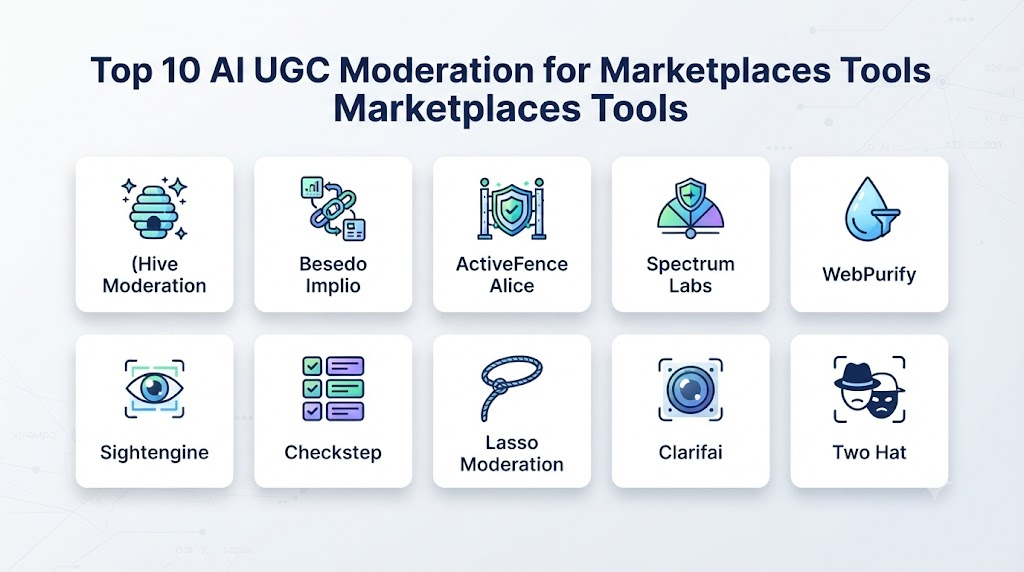
Top 10 AI UGC Moderation for Marketplaces Tools
1. Hive
One-line verdict: Best for marketplaces needing broad multimodal content moderation across text, images, video, and other media.
Short description:
Hive provides AI-powered content moderation and classification capabilities designed for large-scale digital platforms. Its technology can analyze different types of user-generated content and identify potentially problematic material.
Standout Capabilities
- Image moderation.
- Text moderation.
- Video analysis.
- Content classification.
- Automated policy enforcement.
- Custom classification capabilities.
- API-based workflows.
- Large-scale content processing.
AI-Specific Depth
- Model support: Primarily managed AI models and APIs.
- RAG / knowledge integration: Not a primary marketplace moderation requirement; custom workflows may provide contextual information.
- Evaluation: Classification confidence and moderation workflows; detailed evaluation capabilities vary.
- Guardrails: Content policies and configurable moderation categories.
- Observability: API and classification outputs can support moderation monitoring.
Pros
- Strong multimodal focus.
- Suitable for large content volumes.
- Useful for automated moderation pipelines.
Cons
- Configuration may require technical resources.
- Exact capabilities depend on the selected services.
- Custom marketplace policies may require additional implementation.
Security & Compliance
Security controls, retention policies, regional processing, and certifications should be verified against the current enterprise offering.
Deployment & Platforms
- Cloud.
- API.
- Developer integrations.
Integrations & Ecosystem
Hive can be integrated into marketplace moderation pipelines.
- REST APIs.
- Application backends.
- Content-management workflows.
- Moderation queues.
- Custom applications.
- Automated enforcement systems.
Pricing Model
Usage-based or enterprise pricing may apply depending on the service.
Best-Fit Scenarios
- Large marketplaces.
- Image-heavy platforms.
- Multimodal moderation environments.
2. ActiveFence
One-line verdict: Best for large digital platforms requiring comprehensive trust and safety infrastructure with customized moderation policies.
Short description:
ActiveFence provides trust and safety technology for online platforms. Its capabilities cover areas such as harmful-content detection, platform safety, and moderation operations.
Standout Capabilities
- Content moderation.
- Trust and safety.
- Threat detection.
- Policy enforcement.
- Multimodal analysis.
- Human moderation workflows.
- Platform safety.
- Custom policy implementation.
AI-Specific Depth
- Model support: Managed AI systems; exact architecture varies.
- RAG / knowledge integration: Contextual moderation capabilities vary by implementation.
- Evaluation: Trust-and-safety evaluation workflows; exact tooling varies.
- Guardrails: Policy-based moderation and enforcement.
- Observability: Moderation and trust-and-safety reporting capabilities vary.
Pros
- Enterprise-oriented.
- Broad trust-and-safety scope.
- Suitable for complex policy environments.
Cons
- May be excessive for small marketplaces.
- Enterprise implementation can be complex.
- Pricing is generally customized.
Security & Compliance
Enterprise security and compliance controls should be confirmed during procurement.
Deployment & Platforms
- Cloud.
- API.
- Enterprise integrations.
Integrations & Ecosystem
- Marketplace platforms.
- Social platforms.
- Content systems.
- Moderation operations.
- APIs.
- Human-review workflows.
Pricing Model
Enterprise/custom pricing.
Best-Fit Scenarios
- Global marketplaces.
- Large user-generated-content platforms.
- High-risk trust-and-safety environments.
3. Spectrum Labs
One-line verdict: Best for marketplaces and communities needing contextual AI moderation for conversations and harmful user behavior.
Short description:
Spectrum Labs focuses on AI-powered trust and safety, particularly for user-generated conversations and online communities. Its technology can help identify harmful or policy-violating behavior.
Standout Capabilities
- Text moderation.
- Conversation analysis.
- Harmful-content detection.
- Community safety.
- Behavioral signals.
- Custom policy categories.
- Automated moderation.
- Trust-and-safety workflows.
AI-Specific Depth
- Model support: Managed AI models.
- RAG / knowledge integration: Contextual conversation analysis rather than traditional RAG.
- Evaluation: Policy and classification evaluation capabilities vary.
- Guardrails: Custom safety taxonomies and policies.
- Observability: Moderation analytics vary.
Pros
- Strong contextual moderation.
- Useful for community-driven platforms.
- Designed around trust and safety.
Cons
- Particularly focused on conversational environments.
- Marketplace-specific workflows may require integration work.
- Exact feature availability varies.
Security & Compliance
Verify current security, privacy, retention, and compliance requirements.
Deployment & Platforms
- Cloud.
- API.
- Platform integrations.
Integrations & Ecosystem
- Chat.
- Community platforms.
- Marketplace messaging.
- APIs.
- Moderation systems.
- Trust-and-safety workflows.
Pricing Model
Enterprise pricing varies.
Best-Fit Scenarios
- Marketplace messaging.
- Community marketplaces.
- Platforms with seller-buyer conversations.
4. OpenAI Moderation
One-line verdict: Best for developers building custom marketplace moderation workflows using programmable AI safety classification.
Short description:
OpenAI provides moderation capabilities that developers can integrate into applications. For marketplaces, moderation models can be incorporated into workflows that evaluate text and supported content types before content is displayed or acted upon.
Standout Capabilities
- API-based moderation.
- Text safety classification.
- Multimodal moderation capabilities depending on model.
- Developer integration.
- Confidence-oriented classification.
- Automated workflows.
- Custom application logic.
- High-volume programmatic processing.
AI-Specific Depth
- Model support: Managed OpenAI models.
- RAG / knowledge integration: Not required for core moderation; application context can be supplied as part of a custom workflow.
- Evaluation: Developers can create custom evaluation datasets and test suites.
- Guardrails: Safety classification plus application-level policy enforcement.
- Observability: Application teams can monitor latency, usage, and moderation decisions through their own infrastructure and applicable platform tooling.
Pros
- Developer-friendly.
- Easy to integrate into custom applications.
- Flexible for custom marketplace workflows.
Cons
- Requires engineering work for a complete moderation platform.
- Marketplace-specific policy workflows must be implemented.
- Human review infrastructure is not automatically equivalent to a complete managed trust-and-safety operation.
Security & Compliance
Security, privacy, retention, and enterprise controls should be evaluated against the applicable service and configuration.
Deployment & Platforms
- Cloud API.
- Backend applications.
- Web and mobile applications through application backends.
Integrations & Ecosystem
- REST APIs.
- Application backends.
- Databases.
- Moderation queues.
- Custom dashboards.
- E-commerce platforms.
Pricing Model
Usage-based API pricing varies by model and usage.
Best-Fit Scenarios
- Developer-led marketplaces.
- Custom moderation architectures.
- Platforms wanting programmable moderation.
5. Google Cloud Vision AI
One-line verdict: Best for marketplaces needing scalable image analysis as part of a broader cloud-based content moderation architecture.
Short description:
Google Cloud Vision capabilities can analyze images and detect visual characteristics that can contribute to moderation workflows. Marketplace teams can combine image analysis with other services to build broader moderation pipelines.
Standout Capabilities
- Image analysis.
- Visual classification.
- Content detection.
- Image metadata.
- Cloud APIs.
- Scalable processing.
- Developer integration.
- Cloud-native architecture.
AI-Specific Depth
- Model support: Managed Google Cloud models and APIs.
- RAG / knowledge integration: N/A for core visual moderation.
- Evaluation: Application teams can build evaluation datasets and validation workflows.
- Guardrails: Application-level policies and cloud controls.
- Observability: Cloud monitoring capabilities can support operational monitoring.
Pros
- Strong cloud infrastructure.
- Useful for image-heavy marketplaces.
- Integrates with broader cloud systems.
Cons
- Not a complete marketplace moderation platform by itself.
- Requires engineering.
- Full policy enforcement needs additional components.
Security & Compliance
Cloud security, identity, logging, and compliance capabilities vary by service and configuration.
Deployment & Platforms
- Cloud.
- API.
- Developer environments.
Integrations & Ecosystem
- Cloud storage.
- Databases.
- APIs.
- Data pipelines.
- Application backends.
- Monitoring systems.
Pricing Model
Usage-based cloud pricing.
Best-Fit Scenarios
- Image-heavy marketplaces.
- Cloud-native platforms.
- Custom moderation pipelines.
6. AWS AI Services
One-line verdict: Best for marketplaces already operating on AWS and building custom scalable moderation pipelines.
Short description:
AWS provides several AI services that can be combined for content analysis, image understanding, text processing, and application-level moderation. It is particularly useful when moderation is part of a larger AWS architecture.
Standout Capabilities
- Image analysis.
- Text processing.
- Machine learning services.
- Cloud-native processing.
- Event-driven workflows.
- Scalable infrastructure.
- API integration.
- Custom model deployment.
AI-Specific Depth
- Model support: AWS-managed services plus options for custom and third-party models depending on architecture.
- RAG / knowledge integration: Available through broader AWS AI architecture rather than as a core moderation feature.
- Evaluation: Custom evaluation pipelines can be built.
- Guardrails: Application and cloud-level controls.
- Observability: AWS monitoring and logging ecosystem.
Pros
- Highly scalable.
- Strong developer ecosystem.
- Good for custom architectures.
Cons
- Requires significant engineering for end-to-end moderation.
- Multiple services may need to be combined.
- Costs can become complex.
Security & Compliance
AWS provides extensive security and identity capabilities, but exact compliance depends on services, regions, and configuration.
Deployment & Platforms
- Cloud.
- APIs.
- Custom infrastructure.
- Hybrid architectures depending on design.
Integrations & Ecosystem
- S3.
- Lambda.
- API services.
- Databases.
- Event systems.
- Monitoring.
- Machine-learning services.
Pricing Model
Primarily usage-based cloud pricing.
Best-Fit Scenarios
- AWS-native marketplaces.
- High-scale platforms.
- Engineering-heavy organizations.
7. Microsoft Azure AI Content Safety
One-line verdict: Best for organizations wanting managed AI safety capabilities integrated into Microsoft and Azure application environments.
Short description:
Azure AI Content Safety provides AI-powered content analysis capabilities for identifying potentially harmful content. It can be integrated into applications and marketplace moderation workflows.
Standout Capabilities
- Text safety analysis.
- Image safety analysis.
- Safety classification.
- Configurable thresholds.
- API integration.
- Cloud scalability.
- Application integration.
- Enterprise cloud controls.
AI-Specific Depth
- Model support: Microsoft-managed AI safety models.
- RAG / knowledge integration: N/A for core safety classification.
- Evaluation: Developers can construct test datasets and moderation evaluations.
- Guardrails: Safety categories and configurable filtering.
- Observability: Azure monitoring can support operational visibility.
Pros
- Strong enterprise cloud integration.
- Useful for text and image moderation.
- Developer-friendly APIs.
Cons
- Requires application-level workflow design.
- Not a full trust-and-safety operation.
- Marketplace-specific policies require additional logic.
Security & Compliance
Azure provides enterprise security and identity capabilities; applicable certifications and regional controls should be verified for the selected service.
Deployment & Platforms
- Cloud.
- API.
- Azure applications.
Integrations & Ecosystem
- Azure applications.
- APIs.
- Storage.
- Databases.
- Monitoring.
- Identity systems.
Pricing Model
Usage-based cloud pricing.
Best-Fit Scenarios
- Azure-based marketplaces.
- Enterprise applications.
- Custom content-safety pipelines.
8. Clarifai
One-line verdict: Best for organizations wanting flexible AI-powered visual and text analysis with options for custom model development.
Short description:
Clarifai provides an AI platform for computer vision, language, and custom AI workflows. Marketplace teams can use it to develop content classification and moderation pipelines.
Standout Capabilities
- Computer vision.
- Text analysis.
- Custom models.
- Model deployment.
- AI workflows.
- Classification.
- APIs.
- Enterprise AI infrastructure.
AI-Specific Depth
- Model support: Hosted and custom model options vary.
- RAG / knowledge integration: Available through broader platform capabilities.
- Evaluation: Model evaluation capabilities vary.
- Guardrails: Application-specific moderation policies.
- Observability: Model and workflow monitoring capabilities vary.
Pros
- Flexible AI platform.
- Custom-model support.
- Useful for specialized moderation.
Cons
- Requires technical expertise.
- More platform-oriented than plug-and-play moderation.
- Custom implementation may be necessary.
Security & Compliance
Verify current enterprise security and compliance capabilities for the intended deployment.
Deployment & Platforms
- Cloud.
- APIs.
- Custom deployments depending on product configuration.
Integrations & Ecosystem
- APIs.
- Custom applications.
- Machine-learning pipelines.
- Databases.
- Cloud platforms.
- Model workflows.
Pricing Model
Pricing varies by usage and enterprise requirements.
Best-Fit Scenarios
- Custom moderation systems.
- Specialized visual moderation.
- AI engineering teams.
9. Amazon Rekognition
One-line verdict: Best for image and video moderation workflows in marketplaces already using Amazon Web Services infrastructure.
Short description:
Amazon Rekognition provides computer vision capabilities that can help identify potentially unsafe or inappropriate visual content. Marketplace developers can integrate its capabilities into image and video review workflows.
Standout Capabilities
- Image moderation.
- Video analysis.
- Visual content detection.
- API-based processing.
- Cloud scalability.
- Automated classification.
- Event-driven architecture.
- AWS integration.
AI-Specific Depth
- Model support: Managed AWS computer-vision models.
- RAG / knowledge integration: N/A for core image moderation.
- Evaluation: Custom application-level evaluation.
- Guardrails: Application-level policies and thresholds.
- Observability: AWS monitoring and logging capabilities.
Pros
- Strong image/video processing.
- Natural fit for AWS architectures.
- Scalable cloud processing.
Cons
- Focused primarily on visual content.
- Text moderation requires additional services.
- Marketplace policy logic must be implemented.
Security & Compliance
AWS security controls apply depending on service and configuration. Specific certifications and regional requirements should be verified.
Deployment & Platforms
- Cloud.
- API.
- AWS infrastructure.
Integrations & Ecosystem
- Amazon S3.
- AWS Lambda.
- Databases.
- Event systems.
- Application backends.
- AWS monitoring.
Pricing Model
Usage-based cloud pricing.
Best-Fit Scenarios
- Image-heavy marketplaces.
- AWS-native applications.
- Visual moderation pipelines.
10. Besedo
One-line verdict: Best for marketplaces combining automated content moderation with professional human review and operational trust-and-safety services.
Short description:
Besedo provides content moderation technology and moderation services for online platforms and marketplaces. Its approach can combine automated detection with human moderation workflows.
Standout Capabilities
- Automated moderation.
- Human moderation.
- Marketplace safety.
- Spam detection.
- Fraud-related content controls.
- Policy enforcement.
- Moderation operations.
- Content review.
AI-Specific Depth
- Model support: Managed AI capabilities.
- RAG / knowledge integration: N/A or implementation-specific.
- Evaluation: Moderation quality and human-review workflows.
- Guardrails: Policy-based content controls.
- Observability: Moderation operations and reporting vary.
Pros
- Combines technology and human moderation.
- Marketplace-oriented.
- Useful for high-volume content operations.
Cons
- Service-oriented approach may be more than smaller teams need.
- Pricing is typically customized.
- Exact AI architecture is not fully public.
Security & Compliance
Security, privacy, data retention, and compliance requirements should be verified during procurement.
Deployment & Platforms
- Cloud.
- API.
- Managed moderation operations.
Integrations & Ecosystem
- Marketplace platforms.
- Content-management systems.
- Moderation queues.
- APIs.
- Human-review workflows.
- Trust-and-safety operations.
Pricing Model
Enterprise/custom pricing.
Best-Fit Scenarios
- Large marketplaces.
- Classified platforms.
- Organizations requiring human moderation support.
Comparison Table
| Tool Name | Best For | Deployment | Model Flexibility | Strength | Watch-Out | Public Rating |
|---|---|---|---|---|---|---|
| Hive | Multimodal marketplace moderation | Cloud | Managed | Broad content analysis | Custom policy work may be needed | |
| ActiveFence | Enterprise trust & safety | Cloud | Managed | Comprehensive safety | Enterprise complexity | |
| Spectrum Labs | Conversation moderation | Cloud | Managed | Contextual safety | More conversation-focused | |
| OpenAI Moderation | Developer-built moderation | Cloud API | Managed | Programmable AI | Requires custom workflow | |
| Google Cloud Vision AI | Visual moderation | Cloud | Managed | Image analysis | Not a complete moderation platform | |
| AWS AI Services | AWS-native moderation | Cloud | Managed/custom | Scalable architecture | Requires engineering | |
| Microsoft Azure AI Content Safety | Enterprise safety APIs | Cloud | Managed | Text and image safety | Requires application integration | |
| Clarifai | Custom AI moderation | Cloud/custom | Flexible | Custom models | Technical implementation | |
| Amazon Rekognition | Image/video moderation | Cloud | Managed | Visual analysis | Limited as a complete text solution | |
| Besedo | Managed marketplace moderation | Cloud/service | Managed | AI + human moderation | Custom enterprise engagement |
Scoring & Evaluation
The following scores are comparative assessments based on breadth, marketplace applicability, AI capabilities, integration potential, operational usability, and enterprise readiness. They are not vendor-published ratings.
| Tool | Core | Reliability/Eval | Guardrails | Integrations | Ease | Perf/Cost | Security/Admin | Support | Weighted Total |
|---|---|---|---|---|---|---|---|---|---|
| Hive | 9 | 9 | 9 | 9 | 8 | 8 | 8 | 8 | 8.65 |
| ActiveFence | 10 | 9 | 10 | 9 | 7 | 7 | 9 | 9 | 8.85 |
| Spectrum Labs | 9 | 9 | 9 | 8 | 8 | 8 | 8 | 8 | 8.50 |
| OpenAI Moderation | 9 | 9 | 9 | 10 | 9 | 9 | 8 | 8 | 8.95 |
| Google Cloud Vision AI | 8 | 8 | 8 | 10 | 8 | 8 | 9 | 9 | 8.50 |
| AWS AI Services | 9 | 8 | 9 | 10 | 7 | 8 | 10 | 9 | 8.80 |
| Microsoft Azure AI Content Safety | 9 | 8 | 9 | 10 | 8 | 8 | 10 | 9 | 8.90 |
| Clarifai | 8 | 9 | 8 | 9 | 7 | 7 | 8 | 8 | 8.10 |
| Amazon Rekognition | 8 | 8 | 8 | 10 | 8 | 8 | 9 | 9 | 8.55 |
| Besedo | 9 | 8 | 9 | 8 | 8 | 7 | 9 | 9 | 8.35 |
Top 3 for Enterprise
- ActiveFence — Strong trust-and-safety orientation and enterprise policy capabilities.
- Microsoft Azure AI Content Safety — Strong enterprise cloud integration and safety APIs.
- AWS AI Services — Broad infrastructure and customization options.
Top 3 for SMB
- OpenAI Moderation — Straightforward programmable approach for development teams.
- Microsoft Azure AI Content Safety — Useful managed safety APIs.
- Amazon Rekognition — Practical for visual-content moderation.
Top 3 for Developers
- OpenAI Moderation — Strong API-oriented approach.
- AWS AI Services — Extensive cloud building blocks.
- Google Cloud Vision AI — Strong visual-analysis capabilities.
Which AI UGC Moderation Tool Is Right for You?
Solo / Freelancer
Small marketplaces should avoid unnecessarily complicated trust-and-safety stacks.
Prioritize:
- Easy API integration.
- Text moderation.
- Image moderation.
- Clear confidence scores.
- Low operational overhead.
- Simple escalation workflows.
A managed moderation API is often more practical than building an internal moderation model.
SMB
Growing marketplaces should introduce structured moderation policies.
Focus on:
- Automated detection.
- Human review.
- Custom blocked categories.
- Appeals.
- Moderation logs.
- Multilingual coverage.
- Cost controls.
The objective should be reducing manual workload without completely removing human oversight.
Mid-Market
Mid-market marketplaces typically need a hybrid moderation architecture.
A practical workflow is:
User submission → AI screening → policy classification → confidence threshold → automated action or human review → appeal → audit record
Add separate workflows for:
- Reviews.
- Seller listings.
- Images.
- Messages.
- Product questions.
- User profiles.
Enterprise
Enterprise marketplaces need a comprehensive trust-and-safety program rather than simply an AI API.
Prioritize:
- Multimodal moderation.
- Global language support.
- Policy customization.
- Human review.
- Appeals.
- Audit trails.
- Privacy controls.
- Regional processing.
- Model evaluation.
- Red-team testing.
- Abuse analytics.
- Incident management.
- SLA requirements.
ActiveFence, Besedo, AWS, Microsoft, and other enterprise-oriented options can be considered depending on the operating model.
Regulated Industries
Marketplaces dealing with financial products, healthcare products, government-related services, or other sensitive categories should use additional controls.
Recommended practices include:
- Human approval.
- Strict policy taxonomies.
- Source-data validation.
- Audit trails.
- Data minimization.
- Retention policies.
- Regional processing.
- Access controls.
- Incident response.
Budget vs Premium
Budget
Start with:
- Managed moderation APIs.
- Basic text/image classification.
- Manual review.
- Simple rules.
- Confidence thresholds.
Premium
Consider:
- Multimodal moderation.
- Custom policy models.
- AI agents.
- Advanced trust-and-safety operations.
- Human moderation services.
- Automated appeals.
- Behavioral risk analysis.
- Continuous evaluation.
Build vs Buy
Build when:
- You have strong ML engineering capabilities.
- Your marketplace has unique moderation requirements.
- You need specialized policy models.
- You have enough data to evaluate custom models.
- You require complete control over infrastructure.
Buy when:
- You need fast deployment.
- Your team lacks ML expertise.
- You need proven moderation categories.
- You want managed infrastructure.
- Your marketplace is scaling quickly.
Hybrid Approach
A hybrid system often provides the best balance:
- Third-party AI moderation.
- Internal marketplace policy engine.
- Custom fraud detection.
- Human moderation.
- Internal evaluation.
- Marketplace-specific rules.
- Centralized audit logs.
Implementation Playbook: 30 / 60 / 90 Days
First 30 Days: Pilot + Success Metrics
Start with a representative content dataset.
Include:
- Legitimate reviews.
- Spam.
- Abusive content.
- Borderline content.
- Product images.
- Seller descriptions.
- Messages.
- Multiple languages.
- Previously moderated examples.
Define:
- Allowed content.
- Restricted content.
- Prohibited content.
- Escalation categories.
- Appeal categories.
Measure:
- Precision.
- Recall.
- False positives.
- False negatives.
- Average moderation latency.
- Human-review percentage.
- Cost per moderation decision.
Days 31–60: Security + Evaluation + Rollout
Build an evaluation harness.
Test:
- Normal content.
- Adversarial content.
- Misspellings.
- Slang.
- Multilingual content.
- Obfuscated abusive language.
- Manipulated images.
- AI-generated content.
- Prompt injection attempts.
Create separate confidence thresholds:
- High confidence → automatic action.
- Medium confidence → human review.
- Low confidence → allow or collect additional signals.
Implement:
- Audit logs.
- Access controls.
- Data retention rules.
- Model/version tracking.
- Prompt/version control.
- Incident workflows.
Days 61–90: Optimize + Scale
Expand moderation to additional content types.
Optimize:
- Model routing.
- API latency.
- Cost.
- Human-review queues.
- Automated actions.
- Policy accuracy.
Introduce continuous monitoring for:
- False positives.
- False negatives.
- Emerging abuse patterns.
- Model drift.
- New attack techniques.
- Cost increases.
- Queue growth.
Common Mistakes & How to Avoid Them
- Relying only on keyword lists: Users can bypass simple filters with spelling changes and coded language.
- Automatically deleting everything AI flags: Use confidence thresholds and human review.
- Ignoring false positives: Legitimate users can be harmed by aggressive moderation.
- Ignoring false negatives: Harmful content can damage marketplace trust.
- Using one policy for every content type: Reviews, images, seller listings, and private messages require different policies.
- Ignoring multilingual moderation: Abuse can appear in multiple languages and dialects.
- Failing to test adversarial content: Attackers actively try to bypass automated systems.
- Ignoring prompt injection: Untrusted UGC should never be allowed to modify moderation instructions.
- No evaluation dataset: Maintain representative examples of legitimate and violating content.
- No human escalation: Ambiguous cases require human judgment.
- No appeals process: Users need a mechanism to challenge moderation decisions.
- No audit trail: Record why content was flagged or removed.
- Ignoring privacy: Moderation systems may process sensitive user information.
- No retention controls: Do not retain moderation data longer than necessary.
- Ignoring latency: Real-time marketplace interactions require fast moderation decisions.
- No cost monitoring: High-volume marketplaces can generate significant API usage.
- Over-automating enforcement: Detection and enforcement should not always be the same action.
- No policy versioning: Marketplace rules evolve and moderation systems must track those changes.
- Ignoring AI-generated abuse: Automated sellers and bots can create large quantities of spam.
- No vendor fallback: Critical marketplace moderation should have contingency plans for provider outages.
FAQs
1. What Is AI UGC Moderation for Marketplaces?
AI UGC moderation uses machine learning and AI models to detect content that violates marketplace policies. It can analyze text, images, video, audio, reviews, seller listings, and other user submissions.
2. Why Do Marketplaces Need AI Moderation?
Marketplaces can receive enormous volumes of user-generated content. AI can automatically review much of that content and reserve human attention for difficult or ambiguous cases.
3. Can AI Moderate Product Reviews?
Yes. AI can identify spam, abusive language, prohibited content, suspicious patterns, and other policy violations in product reviews.
4. Can AI Moderate Seller Listings?
Yes. AI can review seller-generated titles, descriptions, images, and other listing information against marketplace policies.
5. Can AI Moderate Marketplace Images?
Yes. Computer-vision and multimodal AI systems can analyze uploaded images for prohibited or unsafe visual content.
6. Can AI Moderate Marketplace Messages?
Yes. AI can analyze buyer-seller conversations for spam, abuse, scams, threats, or other policy violations where the marketplace’s privacy and legal framework permits such processing.
7. Can AI Moderation Work in Real Time?
Yes. API-based moderation can be placed before publication or message delivery. Latency depends on the model, provider, network, and workflow architecture.
8. Can AI Moderation Detect Spam?
Yes. AI can identify semantic spam as well as repeated or suspicious content patterns. Stronger systems can combine content analysis with behavioral signals.
9. Can AI Detect Fake Reviews?
AI can identify signals associated with suspicious reviews, but content moderation alone cannot reliably establish that a review is fraudulent. Behavioral and transaction-level signals are often required.
10. Can AI Detect Scams on Marketplaces?
AI can identify suspicious language, links, messages, and behavioral patterns. However, fraud detection is generally stronger when content signals are combined with transaction and account data.
11. Can AI Moderate Multiple Languages?
Many modern AI moderation systems support multiple languages, but accuracy varies significantly by language, dialect, slang, and content type.
12. Should Marketplaces Completely Automate Moderation?
No. High-confidence cases can often be automated, but ambiguous or high-impact decisions should generally have human oversight.
13. What Is Human-in-the-Loop Moderation?
It is a workflow where AI performs initial classification and sends uncertain or sensitive cases to human moderators for final review.
14. How Do You Measure AI Moderation Quality?
Important metrics include precision, recall, false-positive rate, false-negative rate, moderation latency, human escalation rate, appeal overturn rate, and cost per decision.
15. Can AI Moderation Be Customized?
Yes. Depending on the platform, teams can combine AI classifications with marketplace-specific policies, rules, thresholds, custom models, and human-review workflows.
16. Can Marketplace Moderation Models Be Attacked?
Yes. Attackers may intentionally modify text, images, or other content to evade detection. Regular adversarial and red-team testing is important.
17. What Is Prompt Injection in AI Moderation?
Prompt injection occurs when untrusted content attempts to manipulate an AI system into ignoring its instructions. Moderation architectures should treat all user-generated content as untrusted input.
18. Can AI Moderation Identify AI-Generated Content?
Some systems can analyze signals associated with synthetic or manipulated content, but reliable detection is difficult and should not be treated as absolute proof.
19. Can AI Moderation Reduce Human Moderator Work?
Yes. The biggest operational benefit is usually prioritization: AI handles straightforward cases while humans focus on uncertain, sensitive, or high-impact decisions.
20. Does AI Moderation Require Storing User Content?
Not necessarily. Architecture and provider policies determine whether content is retained, for how long, and where it is processed. Buyers should verify these controls before deployment.
21. Can AI Moderation Be Self-Hosted?
Some AI and open-model approaches can be self-hosted, while many managed moderation services operate through cloud APIs. Deployment options vary significantly.
22. Is AI Moderation Expensive?
Costs depend on content volume, content type, model complexity, latency requirements, and the percentage of cases requiring human review. High-volume marketplaces should calculate cost per moderated item.
23. Should a Marketplace Build Its Own Moderation Model?
Building can make sense for highly specialized policies or organizations with strong ML resources. Most smaller teams will find managed moderation services faster to deploy.
24. Can AI Moderation Replace Trust-and-Safety Teams?
No. AI can automate classification and prioritization, but trust-and-safety teams remain important for policy design, appeals, investigations, escalation, and emerging abuse patterns.
25. What Is the Best AI UGC Moderation Tool for Marketplaces?
There is no universal winner. ActiveFence and Besedo are relevant for broader trust-and-safety operations, Hive is useful for multimodal moderation, while OpenAI, Microsoft, AWS, Google Cloud, and Clarifai can be strong foundations for custom moderation architectures.
26. What Should a Marketplace Moderate First?
Start with high-risk and high-volume content such as seller listings, product images, reviews, marketplace messages, prohibited products, spam, and scam-related content.
27. How Can Marketplaces Avoid Over-Moderation?
Use calibrated confidence thresholds, representative evaluation datasets, human review, appeal workflows, and regular false-positive analysis.
28. How Often Should AI Moderation Models Be Evaluated?
Evaluation should be continuous rather than a one-time exercise. Test after model changes, policy changes, new abuse patterns, and major marketplace feature releases.
29. Can AI Moderation Work With Existing Marketplace Software?
Yes. Most modern architectures can connect moderation services through APIs, webhooks, event queues, and backend workflows.
30. What Is the Best Alternative to AI UGC Moderation?
Alternatives include manual moderation, rule-based filtering, keyword systems, community reporting, reputation systems, and custom machine-learning models. In practice, marketplaces often combine several approaches.
Conclusion
AI UGC Moderation for Marketplaces has become an important part of building trustworthy digital commerce environments. Marketplaces must protect buyers, sellers, moderators, and the platform itself from spam, scams, abusive behavior, prohibited content, unsafe media, and coordinated abuse.A practical system combines:Different platforms serve different needs. Hive is attractive for multimodal moderation, ActiveFence and Besedo are relevant for broader trust-and-safety operations, while OpenAI Moderation, Microsoft Azure AI Content Safety, AWS AI services, and Google Cloud can provide building blocks for custom moderation systems.The most important objective is not to automate every moderation decision. It is to create a reliable system that makes high-confidence decisions automatically, routes uncertain cases to humans, protects user data, and continuously improves as abuse patterns evolve.