Introduction
AI Visual Search for Shopping allows customers to search for products using images instead of relying only on keywords. A shopper can upload a photograph, screenshot, social-media image, or camera capture, and an AI system can analyze visual characteristics such as shape, color, pattern, style, texture, and object type to find matching or visually similar products.
This is especially useful when shoppers know what they want visually but cannot describe it accurately with words. A customer might photograph a chair, upload a screenshot of a jacket, or capture a pair of shoes and then use the image to discover products in an online catalog.
Best for: Fashion retailers, furniture and home-decor stores, beauty brands, marketplaces, electronics retailers, automotive-parts businesses, and large e-commerce companies with substantial product catalogs.
Not ideal for: Small stores with limited catalogs, businesses with poor product photography, or merchants whose customers primarily use highly specific text-based searches. Traditional keyword search may be simpler and more cost-effective in those cases.
What’s Changed in AI Visual Search for Shopping
- Image search is becoming multimodal: Modern shopping experiences increasingly combine images, text, natural language, and conversational queries.
- Visual search is moving beyond exact matching: AI can identify products with similar styles, colors, shapes, materials, and patterns even when the photographed item is not identical to a catalog product.
- Camera search is becoming a commerce interface: Mobile shoppers can photograph an item in the physical world and immediately search an online catalog.
- Multi-object recognition is increasingly important: A single image can contain clothing, accessories, furniture, or multiple products that shoppers may want to identify separately.
- Visual search is converging with recommendations: The system can find visually similar products and then personalize the results using shopper behavior.
- Generative AI is improving catalog enrichment: AI can extract attributes from product images and help make catalogs easier to search.
- Natural-language image search is emerging: Customers can combine visual input with descriptions such as “find something similar but in black.”
- Visual search is becoming part of conversational commerce: AI shopping assistants can use product images as part of a multi-turn discovery journey.
- Cold-start problems can be reduced: Visual similarity can help recommend new products before sufficient customer interaction data exists.
- Merchandising remains important: Retailers still need controls for inventory, promotions, margins, availability, and strategic products.
- Evaluation is becoming more sophisticated: Retailers should measure visual relevance, conversion, click-through rate, revenue per search, latency, and customer engagement.
- AI agents create new opportunities: Shopping agents can potentially use visual retrieval to identify products and compare options before recommending a purchase.
- Privacy needs more attention: Uploaded customer images may contain people, homes, locations, or other sensitive information, so retention and processing policies matter.
- Latency remains critical: Visual inference and image retrieval must be fast enough for real-time shopping.
- Catalog quality remains foundational: Poor product photography, inconsistent attributes, missing variants, and weak catalog data can reduce visual-search accuracy.
Quick Buyer Checklist
When shortlisting AI Visual Search for Shopping platforms, evaluate:
- Image upload search.
- Camera search.
- Mobile support.
- Visual similarity search.
- Exact product identification.
- Multi-object detection.
- Product attribute recognition.
- Image embeddings.
- Vector search.
- Multimodal search.
- Text + image queries.
- Natural-language image search.
- Product recommendations.
- “Shop the look” functionality.
- Product catalog ingestion.
- Automatic product tagging.
- Category classification.
- Color recognition.
- Style recognition.
- Material recognition.
- Personalized visual ranking.
- Inventory-aware ranking.
- Merchandising controls.
- Search analytics.
- A/B testing.
- Offline evaluation.
- Online experimentation.
- Relevance monitoring.
- Latency monitoring.
- AI inference cost controls.
- API and SDK availability.
- E-commerce integrations.
- Data privacy.
- Image retention controls.
- Encryption.
- RBAC.
- Audit logging.
- Data residency.
- Model flexibility.
- BYO model support where required.
- Vendor lock-in risk.
- Cloud, hybrid, or self-hosted options.
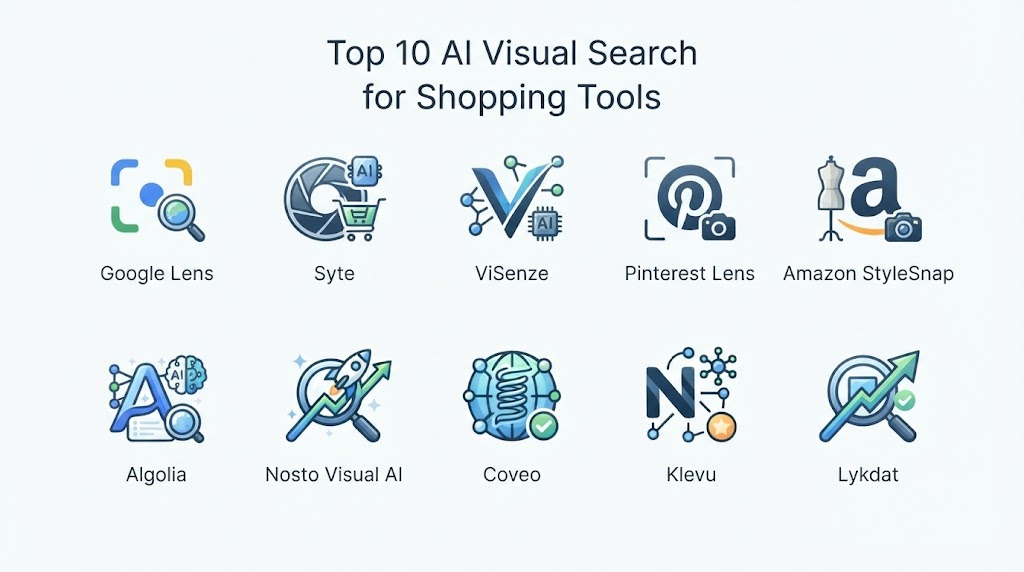
Top 10 AI Visual Search for Shopping Tools
1. Syte
One-line verdict: Best for fashion, home, and lifestyle retailers building sophisticated visual product discovery experiences.
Short description:
Syte specializes in visual AI for e-commerce product discovery. Its platform supports camera search, visual recommendations, multi-object detection, image-based discovery, and product attribute understanding. Syte specifically emphasizes fashion, home decor, and jewelry use cases. (Syte)
Standout Capabilities
- AI-powered visual search.
- Camera-based product discovery.
- Multi-object detection.
- Visual product recommendations.
- “Shop the look” experiences.
- Visual attribute recognition.
- Image cropping for individual objects.
- Commerce-focused visual discovery.
AI-Specific Depth
- Model support: Proprietary/managed visual AI; exact underlying models are not publicly stated.
- RAG / knowledge integration: Product catalog and visual attribute retrieval rather than a conventional RAG platform.
- Evaluation: Search and commerce analytics can be used to evaluate discovery performance; exact evaluation methodology varies.
- Guardrails: Merchandising and business controls are available; specific generative-AI guardrail architecture is not publicly stated.
- Observability: Commerce and search analytics are available; exact AI tracing and token-level metrics are not publicly stated.
Pros
- Strong specialization in visual commerce.
- Particularly relevant for fashion and lifestyle retailers.
- Supports complex visual discovery experiences.
Cons
- Primarily targeted toward commerce organizations.
- May be more platform than a small retailer needs.
- Enterprise pricing is not publicly stated.
Security & Compliance
Security and compliance capabilities vary by deployment and agreement. Specific certifications and data-residency options should be verified during procurement.
Deployment & Platforms
- Cloud.
- Web.
- Mobile.
- APIs.
- E-commerce applications.
Integrations & Ecosystem
Syte is designed to integrate visual discovery into existing commerce experiences.
- E-commerce websites.
- Mobile applications.
- Product catalogs.
- Recommendation systems.
- Merchandising workflows.
- APIs.
- JavaScript-based experiences.
Pricing Model
Enterprise pricing varies. Exact pricing is not publicly stated.
Best-Fit Scenarios
- Fashion visual search.
- Home-decor product discovery.
- Image-driven shopping experiences.
2. ViSenze
One-line verdict: Best for retailers seeking multimodal visual search, recommendations, and shopping discovery in one platform.
Short description:
ViSenze provides AI-powered visual search and broader product discovery capabilities. Its current platform combines visual search with semantic text, natural-language, social, recommendation, and shopping-assistant experiences. (Visenze)
Standout Capabilities
- AI visual search.
- Image-based product discovery.
- Multi-search.
- Similar-product recommendations.
- “Shop the look.”
- Social search.
- AI product tagging.
- Shopping-assistant experiences.
AI-Specific Depth
- Model support: Managed AI capabilities and models; exact model architecture is not publicly stated.
- RAG / knowledge integration: Product catalogs and retrieval are core components; broader RAG implementation varies.
- Evaluation: Conversion-funnel analytics and discovery analytics are available.
- Guardrails: Business rules and configurable search controls are available; specific generative-AI guardrail architecture is not publicly stated.
- Observability: Search and conversion analytics are available; detailed token-level observability is not publicly stated.
Pros
- Strong multimodal approach.
- Supports multiple visual commerce use cases.
- Provides APIs, SDKs, connectors, and commerce integrations. (Visenze)
Cons
- Broad feature set may require implementation planning.
- Primarily designed for commerce organizations.
- Enterprise pricing is not publicly stated.
Security & Compliance
Specific security controls, certifications, retention, and residency options should be verified for the selected deployment.
Deployment & Platforms
- Cloud.
- Web.
- Mobile.
- APIs.
- E-commerce platforms.
Integrations & Ecosystem
ViSenze provides connectors and APIs intended to simplify integration into commerce environments.
- Shopify.
- Magento.
- BigCommerce.
- WooCommerce.
- Fynd.
- Custom websites.
- Mobile applications.
Pricing Model
Enterprise pricing varies. Exact pricing is not publicly stated.
Best-Fit Scenarios
- Multimodal commerce search.
- Fashion and apparel discovery.
- Visual recommendations and social commerce.
3. Algolia
One-line verdict: Best for developers wanting fast API-driven visual search combined with traditional, semantic, personalized, and commerce search.
Short description:
Algolia has expanded beyond traditional text search with visual search capabilities that can allow shoppers to upload photographs or screenshots and discover similar products. Its approach can combine visual intent with search, personalization, merchandising, and recommendations. (Algolia)
Standout Capabilities
- Visual search.
- Image-based product discovery.
- Visual recommendations.
- Hybrid search.
- Personalization.
- Merchandising.
- Search analytics.
- APIs and developer tooling.
AI-Specific Depth
- Model support: Managed AI/search capabilities; external image-analysis services can also be integrated.
- RAG / knowledge integration: Search index provides retrieval infrastructure; broader RAG workflows depend on implementation.
- Evaluation: Analytics and A/B testing support relevance evaluation.
- Guardrails: Merchandising rules and search controls provide operational governance.
- Observability: Search analytics and performance monitoring are available.
Pros
- Strong developer experience.
- Visual search can coexist with existing search infrastructure.
- Useful combination of search, personalization, and merchandising.
Cons
- Visual search may require additional architecture depending on the use case.
- Developers need to configure product-image indexing and retrieval appropriately.
- Pricing varies by usage and requirements.
Security & Compliance
Security and administrative capabilities vary by plan and deployment. Required certifications and residency options should be verified during procurement.
Deployment & Platforms
- Cloud.
- Web.
- Mobile.
- APIs.
- Headless commerce.
Integrations & Ecosystem
- Shopify.
- Salesforce Commerce Cloud.
- Magento.
- Custom commerce platforms.
- Product catalogs.
- Analytics.
- APIs.
Pricing Model
Usage-based and plan-based pricing varies by implementation.
Best-Fit Scenarios
- Developer-led commerce platforms.
- Visual search combined with text search.
- High-performance product discovery.
4. Google Cloud AI Commerce Search
One-line verdict: Best for enterprises building customized AI commerce search experiences using Google Cloud’s broader AI infrastructure.
Short description:
Google Cloud AI Commerce Search provides AI-first commerce search with personalized results, recommendations, catalog enhancement, semantic understanding, and conversational commerce. Google also provides visual-search building blocks through its broader AI and vector-search ecosystem. (Google Cloud)
Standout Capabilities
- AI commerce search.
- Personalized ranking.
- Product recommendations.
- Catalog enrichment.
- Semantic search.
- Conversational shopping.
- Vector-search architecture.
- AI-driven product discovery.
AI-Specific Depth
- Model support: Google-managed AI models and services; architecture varies by implementation.
- RAG / knowledge integration: Strong retrieval and product-catalog integration capabilities.
- Evaluation: Search analytics and experimentation can support relevance evaluation.
- Guardrails: Google provides built-in safety and merchandising controls within AI Commerce Search. (Google Cloud)
- Observability: Google Cloud monitoring and analytics capabilities can support operational visibility; exact implementation varies.
Pros
- Strong cloud AI ecosystem.
- Suitable for large-scale commerce.
- Flexible for organizations already using Google Cloud.
Cons
- Requires cloud engineering expertise.
- Architecture can become complex.
- Costs can vary substantially with traffic and AI usage.
Security & Compliance
Google Cloud provides extensive security and access-control capabilities. Exact compliance and data-residency requirements should be assessed against the selected configuration.
Deployment & Platforms
- Cloud.
- Web.
- Mobile.
- APIs.
- Enterprise applications.
Integrations & Ecosystem
- Google Cloud.
- BigQuery.
- Vector search.
- Product catalogs.
- Data platforms.
- AI services.
- Commerce applications.
Pricing Model
Usage-based cloud pricing varies according to services, traffic, storage, and AI consumption.
Best-Fit Scenarios
- Large retailers.
- Custom visual commerce architectures.
- Google Cloud-based organizations.
5. Vue.ai
One-line verdict: Best for retailers combining computer vision, catalog enrichment, personalized search, and product recommendations.
Short description:
Vue.ai combines computer vision, NLP, catalog enrichment, personalization, search, and recommendations for e-commerce. Its platform can extract product attributes from images and use structured product intelligence to improve discovery. (Vue.ai)
Standout Capabilities
- Computer vision.
- Visual product discovery.
- Catalog enrichment.
- Image attribute extraction.
- Personalized search.
- Product recommendations.
- AI-generated product information.
- Omnichannel personalization.
AI-Specific Depth
- Model support: Managed AI models; exact underlying models are not publicly stated.
- RAG / knowledge integration: Product catalog and enriched product data form the primary knowledge layer.
- Evaluation: A/B testing and analytics capabilities are available.
- Guardrails: Rule-based controls can be combined with AI workflows.
- Observability: Analytics dashboards and experience metrics are available; detailed model tracing is not publicly stated.
Pros
- Strong catalog-intelligence capabilities.
- Combines visual and textual product discovery.
- Useful for retailers with complex product data.
Cons
- Broad platform may be more than visual search alone.
- Requires catalog integration.
- Pricing is not publicly stated.
Security & Compliance
Specific security certifications and data-residency options are not publicly stated and should be verified during procurement.
Deployment & Platforms
- Cloud.
- Web.
- Mobile.
- APIs.
- E-commerce environments.
Integrations & Ecosystem
- Product catalogs.
- CRM systems.
- Websites.
- Mobile applications.
- Offline databases.
- Analytics.
- APIs.
Pricing Model
Enterprise pricing varies. Exact pricing is not publicly stated.
Best-Fit Scenarios
- Catalog-heavy retailers.
- Fashion commerce.
- Personalized product discovery.
6. Clarifai
One-line verdict: Best for technical teams building customizable computer-vision and visual-search workflows for commerce.
Short description:
Clarifai provides AI infrastructure for computer vision, image understanding, and visual search. Its commerce-oriented capabilities can support image-based product discovery and similar-product recommendations. (Clarifai)
Standout Capabilities
- Computer vision.
- Visual similarity search.
- Image classification.
- Data annotation.
- Model customization.
- Product discovery.
- Recommendation workflows.
- AI model management.
AI-Specific Depth
- Model support: Broad AI model ecosystem with customization options.
- RAG / knowledge integration: Vector and visual retrieval can be incorporated into custom architectures.
- Evaluation: Model evaluation and testing capabilities depend on the workflow.
- Guardrails: Governance capabilities vary by deployment and model architecture.
- Observability: Platform monitoring and model-management capabilities vary.
Pros
- Flexible AI infrastructure.
- Strong computer-vision orientation.
- Suitable for custom workflows.
Cons
- More engineering-oriented than turnkey commerce products.
- Requires ML expertise for advanced implementations.
- Commerce-specific functionality may need customization.
Security & Compliance
Security and compliance capabilities vary by product and deployment. Specific certifications should be verified during procurement.
Deployment & Platforms
- Cloud.
- APIs.
- Custom applications.
- Potentially self-managed components depending on product and deployment.
Integrations & Ecosystem
- Computer-vision models.
- Vector databases.
- Data pipelines.
- Product catalogs.
- Custom applications.
- APIs.
- AI workflows.
Pricing Model
Pricing varies according to usage and selected capabilities.
Best-Fit Scenarios
- Custom visual-search platforms.
- Computer-vision development.
- Enterprise AI experimentation.
7. Lykdat
One-line verdict: Best for fashion businesses looking for image-based product discovery and visually similar apparel search.
Short description:
Lykdat focuses specifically on fashion image search and product discovery. Its platform allows shoppers to search using images and provides APIs for businesses seeking image-based fashion search capabilities. (LykDat)
Standout Capabilities
- Fashion image search.
- Visual product discovery.
- Similar-item search.
- Image-based shopping.
- Fashion product comparison.
- API-based integration.
- Image understanding.
- Apparel-focused search.
AI-Specific Depth
- Model support: Proprietary/managed visual AI; exact model architecture is not publicly stated.
- RAG / knowledge integration: Product catalogs are used for visual retrieval.
- Evaluation: Specific evaluation methodology is not publicly stated.
- Guardrails: Not publicly stated.
- Observability: API and search performance monitoring details are not publicly stated.
Pros
- Strong fashion specialization.
- Image-first shopping experience.
- API suitable for custom applications.
Cons
- More specialized than general-purpose visual-search platforms.
- Primarily focused on fashion.
- Enterprise security details should be verified.
Security & Compliance
Specific certifications, retention controls, residency, and enterprise security capabilities are not publicly stated.
Deployment & Platforms
- Cloud.
- APIs.
- Web.
- Custom commerce applications.
Integrations & Ecosystem
- Fashion catalogs.
- E-commerce websites.
- Custom applications.
- Product databases.
- APIs.
Pricing Model
Not publicly stated.
Best-Fit Scenarios
- Fashion marketplaces.
- Apparel image search.
- Visual fashion discovery.
8. Cloudinary Visual Search
One-line verdict: Best for organizations wanting visual search tightly integrated with a large digital-asset and product-media ecosystem.
Short description:
Cloudinary provides visual search for image collections, allowing organizations to retrieve visually similar assets using images or text. Its AI capabilities can also analyze and enrich visual media, making it relevant to commerce teams managing large product-image libraries. (Cloudinary)
Standout Capabilities
- Visual similarity search.
- Image-based retrieval.
- Natural-language visual search.
- AI image understanding.
- Automated metadata enrichment.
- Product-media management.
- Image optimization.
- API-first media infrastructure.
AI-Specific Depth
- Model support: Managed Cloudinary AI capabilities; exact model choices vary.
- RAG / knowledge integration: Visual asset retrieval rather than conventional RAG.
- Evaluation: Search relevance can be evaluated through retrieval results; detailed commerce evaluation capabilities vary.
- Guardrails: Access controls and media governance features are available; specific generative guardrails vary.
- Observability: Cloudinary provides operational and media analytics; detailed model-level tracing varies.
Pros
- Strong visual-media infrastructure.
- Useful for large image libraries.
- API-first architecture.
Cons
- Primarily a visual-media platform rather than a dedicated commerce-search engine.
- Enterprise Visual Search availability depends on plan. (Cloudinary)
- Additional architecture may be required for full shopping search.
Security & Compliance
Security, access control, and governance capabilities vary by plan and configuration. Specific compliance requirements should be verified.
Deployment & Platforms
- Cloud.
- APIs.
- Web.
- Mobile.
- Commerce applications.
Integrations & Ecosystem
- E-commerce platforms.
- DAM workflows.
- Product catalogs.
- APIs.
- AI applications.
- Media pipelines.
- Developer tooling.
Pricing Model
Pricing varies by Cloudinary plan, usage, and selected capabilities.
Best-Fit Scenarios
- Large product-image libraries.
- Visual media search.
- Commerce teams already using Cloudinary.
9. Google Cloud Vision API Product Search
One-line verdict: Best for developers building image-based product matching with Google Cloud computer-vision infrastructure.
Short description:
Google Cloud’s Vision API Product Search provides product-set indexing and image-based product queries. Developers can create product sets with reference images and query them using image input to retrieve relevant products. (Google Cloud Documentation)
Standout Capabilities
- Image-based product search.
- Product-set indexing.
- Reference-image management.
- Visual product matching.
- Cloud API.
- Computer-vision infrastructure.
- Developer-oriented architecture.
- Custom application integration.
AI-Specific Depth
- Model support: Google-managed computer-vision models.
- RAG / knowledge integration: Product sets and reference images act as the retrieval layer.
- Evaluation: Application-specific testing is required; standardized commerce evaluation varies.
- Guardrails: Cloud security controls are available; visual-search-specific guardrails are not publicly stated.
- Observability: Google Cloud monitoring can support operational visibility.
Pros
- Developer-friendly API approach.
- Strong cloud infrastructure.
- Useful for custom visual-product applications.
Cons
- Requires engineering work.
- Less turnkey than specialized visual-commerce platforms.
- Full personalization requires additional architecture.
Security & Compliance
Security depends on Google Cloud configuration. Specific compliance and residency requirements should be verified for the chosen environment.
Deployment & Platforms
- Cloud.
- APIs.
- Web.
- Mobile.
- Custom applications.
Integrations & Ecosystem
- Google Cloud Storage.
- Product catalogs.
- Cloud applications.
- AI services.
- Data pipelines.
- Custom APIs.
Pricing Model
Usage-based cloud pricing varies according to API usage and supporting infrastructure.
Best-Fit Scenarios
- Custom visual-search applications.
- Developer-led commerce.
- Google Cloud environments.
10. Amazon AI-Powered Shopping and Visual Discovery Technologies
One-line verdict: Best for businesses already invested in Amazon’s broader commerce and cloud ecosystem seeking AI-powered discovery capabilities.
Short description:
Amazon provides a broad ecosystem of AI, computer vision, recommendation, search, and commerce technologies. For organizations building custom visual shopping workflows, Amazon Web Services can provide computer-vision, machine-learning, storage, and search components that can be assembled into a visual-search architecture.
Standout Capabilities
- Computer vision.
- Image analysis.
- Machine learning.
- Vector retrieval.
- Product recommendation architecture.
- Cloud-based AI services.
- Commerce data integration.
- Custom AI applications.
AI-Specific Depth
- Model support: Broad managed and customizable AI options depending on services selected.
- RAG / knowledge integration: Vector and retrieval architectures can be built using AWS services.
- Evaluation: Developers can create custom offline and online evaluation pipelines.
- Guardrails: AI governance and security controls vary by service.
- Observability: AWS provides extensive infrastructure monitoring capabilities.
Pros
- Broad cloud ecosystem.
- Highly customizable.
- Strong infrastructure for enterprise AI.
Cons
- Requires significant engineering.
- Visual shopping is not necessarily a single turnkey product.
- Costs can become complex across multiple services.
Security & Compliance
AWS provides extensive identity, access, encryption, logging, and governance capabilities. Specific certifications and requirements depend on the selected services and deployment.
Deployment & Platforms
- Cloud.
- APIs.
- Web.
- Mobile.
- Custom applications.
Integrations & Ecosystem
- Object storage.
- Machine learning.
- Vector databases.
- Search.
- Data warehouses.
- Product catalogs.
- APIs.
Pricing Model
Primarily usage-based cloud pricing across the services used.
Best-Fit Scenarios
- Custom enterprise visual search.
- AWS-based commerce infrastructure.
- Large-scale AI development.
Comparison Table
| Tool Name | Best For | Deployment | Model Flexibility | Strength | Watch-Out | Public Rating |
|---|---|---|---|---|---|---|
| Syte | Fashion and lifestyle retailers | Cloud | Managed | Commerce-focused visual discovery | Enterprise-oriented | N/A |
| ViSenze | Multimodal retail discovery | Cloud | Managed | Visual + text + recommendations | Broad implementation scope | N/A |
| Algolia | Developer-led commerce search | Cloud | Managed + integrations | Fast search and visual discovery | Requires integration | N/A |
| Google Cloud AI Commerce Search | Enterprise AI commerce | Cloud | Managed/Cloud AI | AI commerce ecosystem | Engineering complexity | N/A |
| Vue.ai | Catalog intelligence | Cloud | Managed | Vision + catalog enrichment | Broad platform | N/A |
| Clarifai | Custom AI development | Cloud/Varies | Flexible | Computer vision | Requires expertise | N/A |
| Lykdat | Fashion visual search | Cloud/API | Managed | Fashion specialization | Narrower category focus | N/A |
| Cloudinary | Visual media search | Cloud | Managed | Visual asset infrastructure | Not purely commerce search | N/A |
| Google Cloud Vision API Product Search | Custom image matching | Cloud/API | Managed | Developer flexibility | More engineering required | N/A |
| Amazon AI/Cloud Stack | Custom enterprise solutions | Cloud | Flexible | Broad AI infrastructure | Multiple services required | N/A |
Scoring & Evaluation
The following scores are comparative editorial assessments rather than official vendor ratings. They should be treated as a starting framework, not a substitute for testing the platforms with your own catalog and customer images.
| Tool | Core | Reliability/Eval | Guardrails | Integrations | Ease | Perf/Cost | Security/Admin | Support | Weighted Total |
|---|---|---|---|---|---|---|---|---|---|
| Syte | 10 | 9 | 9 | 9 | 9 | 8 | 9 | 9 | 9.05 |
| ViSenze | 10 | 9 | 9 | 10 | 9 | 8 | 9 | 9 | 9.15 |
| Algolia | 10 | 9 | 9 | 10 | 9 | 10 | 9 | 9 | 9.45 |
| Google Cloud AI Commerce Search | 10 | 10 | 9 | 10 | 7 | 8 | 10 | 10 | 9.35 |
| Vue.ai | 9 | 8 | 8 | 9 | 8 | 8 | 8 | 8 | 8.25 |
| Clarifai | 9 | 9 | 9 | 9 | 7 | 8 | 9 | 9 | 8.60 |
| Lykdat | 8 | 8 | 7 | 8 | 9 | 8 | 7 | 7 | 7.80 |
| Cloudinary | 8 | 8 | 8 | 10 | 9 | 8 | 9 | 9 | 8.55 |
| Google Cloud Vision API Product Search | 9 | 9 | 8 | 10 | 7 | 8 | 10 | 10 | 8.80 |
| Amazon AI/Cloud Stack | 9 | 9 | 9 | 10 | 6 | 8 | 10 | 10 | 8.70 |
Top 3 for Enterprise
- Google Cloud AI Commerce Search — Strong option for organizations wanting managed AI commerce capabilities and broader cloud infrastructure.
- ViSenze — Strong multimodal commerce discovery platform.
- Syte — Particularly compelling for visual-first fashion and lifestyle commerce.
Top 3 for SMB
- Algolia — Strong combination of search infrastructure, APIs, and visual discovery.
- Lykdat — Attractive for fashion-focused image search.
- ViSenze — Useful when visual discovery is a strategic part of the storefront.
Top 3 for Developers
- Algolia — API-first architecture and broad search tooling.
- Google Cloud Vision API Product Search — Useful for building custom image-based product matching.
- Clarifai — Strong flexibility for computer-vision development.
Which AI Visual Search for Shopping Tool Is Right for You?
Solo / Freelancer
Small online stores should start with a simple visual-search use case rather than building an entire multimodal commerce platform.
Prioritize:
- Image upload.
- Visually similar products.
- Easy catalog integration.
- Mobile support.
- Basic analytics.
- Reasonable implementation effort.
If your catalog has only a few hundred products, conventional search may still provide enough value.
SMB
SMBs should look for managed visual-search products that minimize ML engineering.
Prioritize:
- Simple APIs.
- Commerce integrations.
- Product-image indexing.
- Visual similarity.
- Search analytics.
- Merchandising controls.
- Reasonable operating costs.
Algolia, ViSenze, and Lykdat can be considered depending on catalog type and technical requirements.
Mid-Market
Mid-market retailers can start combining visual similarity with customer behavior.
A useful architecture is:
Image Upload → Visual Encoder → Product Retrieval → Business Rules → Personalization → Inventory Filter → Results
Add:
- A/B testing.
- Personalized ranking.
- Product recommendations.
- Catalog enrichment.
- Search analytics.
- Real-time inventory.
Enterprise
Enterprise organizations should treat visual search as part of a broader product-discovery architecture.
Evaluate:
- Millions of product images.
- Multiple regions.
- Multiple languages.
- Mobile camera experiences.
- Product variants.
- Inventory.
- Personalization.
- Merchandising.
- Search latency.
- AI model governance.
- Data privacy.
- Observability.
Enterprises may prefer a specialized visual-commerce platform or build a custom system using cloud AI infrastructure.
Regulated Industries
Visual shopping systems can process more than product images. Uploaded photos may contain:
- Faces.
- Homes.
- Locations.
- Children.
- Personal belongings.
- Screenshots containing customer information.
Therefore, organizations should evaluate:
- Image retention.
- Data minimization.
- Access controls.
- Encryption.
- Data residency.
- Deletion policies.
- Consent.
- Logging.
- Third-party processing.
- AI governance.
Budget vs Premium
Budget Approach
Start with:
- Image upload.
- Similar-product retrieval.
- Basic computer vision.
- Existing search engine.
- Simple product embeddings.
Premium Approach
Consider:
- Multimodal search.
- Personalized visual ranking.
- Multi-object detection.
- Conversational shopping.
- Real-time inventory.
- AI-generated catalog enrichment.
- Multimodal recommendations.
- Agentic shopping workflows.
Build vs Buy
Build when:
- Visual search is strategically important.
- Your engineering team has ML expertise.
- You need proprietary ranking.
- You have large amounts of behavioral data.
- You need complete control over the AI pipeline.
Buy when:
- You need to launch quickly.
- Search is not a core competitive differentiator.
- You want managed infrastructure.
- You need prebuilt commerce functionality.
- Your team lacks computer-vision specialists.
Hybrid Approach
A hybrid model can be especially effective.
For example:
- Buy visual retrieval.
- Own customer data.
- Own merchandising logic.
- Own evaluation datasets.
- Own analytics.
- Customize ranking.
- Maintain an abstraction layer between your commerce application and the vendor.
This provides faster deployment without completely surrendering architectural control.
Implementation Playbook: 30 / 60 / 90 Days
First 30 Days: Pilot + Success Metrics
Start with one product category.
Fashion is often a natural starting point because customers frequently recognize products visually.
Collect:
- Product images.
- Product IDs.
- Product categories.
- Product attributes.
- Product variants.
- Inventory.
- Search events.
- Product clicks.
- Add-to-cart events.
- Purchases.
Create a baseline.
Measure:
- Search conversion.
- Visual-search click-through rate.
- Add-to-cart rate.
- Revenue per visual search.
- Search latency.
- Zero-result rate.
- Product-match accuracy.
Create an evaluation dataset containing:
- Clean product images.
- Smartphone photographs.
- Screenshots.
- Images with multiple objects.
- Poorly lit images.
- Cropped images.
- Different viewing angles.
- Visually similar products.
Days 31–60: Security + Evaluation + Rollout
Build an evaluation harness.
Test:
- Exact matches.
- Near matches.
- Similar styles.
- Different colors.
- Different backgrounds.
- Multiple objects.
- Low-quality photographs.
- New products.
- Out-of-stock products.
For multimodal AI systems, test:
- Image + text.
- Image + natural-language instructions.
- Ambiguous queries.
- Unsupported product claims.
- Incorrect product attributes.
- Prompt injection.
- Malicious product metadata.
- Privacy leakage.
Introduce human review for important generative shopping experiences.
Days 61–90: Optimize + Scale
Expand visual search to:
- Product pages.
- Search pages.
- Category pages.
- Mobile applications.
- Social commerce.
- Email campaigns.
- Shopping assistants.
Optimize:
- Image embeddings.
- Retrieval quality.
- Ranking.
- Personalization.
- Caching.
- Latency.
- Infrastructure costs.
Introduce governance for:
- Model versions.
- Embedding versions.
- Product-index versions.
- Prompt versions.
- Evaluation datasets.
- Search rules.
- Incident handling.
Common Mistakes & How to Avoid Them
- Using poor product images: Low-quality catalog images make visual matching harder.
- Ignoring image diversity: Test real customer photographs rather than only professional product shots.
- Assuming visual similarity means product equivalence: A visually similar product may have different specifications or price.
- Ignoring product attributes: Color, size, material, brand, and compatibility can matter as much as appearance.
- Failing to handle multiple objects: A photograph may contain several products.
- Ignoring inventory: Don’t prioritize visually perfect products that cannot be purchased.
- Over-personalizing visual results: Personalization should not obscure relevant new products.
- No cold-start strategy: New products need visual retrieval even before behavioral data exists.
- No evaluation dataset: Maintain representative images and expected results.
- No A/B testing: Measure visual search against the existing search experience.
- Ignoring latency: Customers expect visual search to feel interactive.
- Uncontrolled generative AI: Validate generated product information against authoritative catalog data.
- Prompt injection exposure: Treat product descriptions and user-provided content as untrusted input.
- Unmanaged image retention: Define how long customer-uploaded images are stored.
- Ignoring privacy: Uploaded images can contain personal information.
- No observability: Monitor search quality, latency, failures, and business performance.
- Unexpected inference costs: High-volume image processing can become expensive.
- Vendor lock-in: Preserve product embeddings, catalog information, events, and evaluation data where practical.
FAQs
1. What Is AI Visual Search for Shopping?
AI Visual Search allows shoppers to search for products using images rather than relying only on written keywords.
2. How Does AI Visual Search Work?
A visual-search system analyzes an image, converts relevant visual information into machine-readable representations, and retrieves matching or similar products from a catalog.
3. Can Customers Search With a Screenshot?
Yes. Many visual-search implementations can accept screenshots as image queries.
4. Can Customers Take a Photo With Their Phone?
Yes. Mobile camera search is one of the most practical visual-shopping use cases.
5. Can Visual Search Find an Exact Product?
It can attempt to identify an exact product when the catalog contains sufficient reference information. Accuracy depends on image quality, catalog coverage, and model performance.
6. What Happens When the Exact Product Is Not Available?
A good visual-search system can return visually similar products, alternative products, or complementary products.
7. Can AI Visual Search Recognize Multiple Products in One Image?
Some platforms support multi-object detection. This can allow shoppers to identify several products from a single photograph.
8. Can Visual Search Work With Fashion Products?
Yes. Fashion is one of the strongest use cases because appearance, style, color, pattern, and silhouette strongly influence purchasing decisions.
9. Can Visual Search Work for Furniture?
Yes. Furniture and home decor can benefit from visual similarity, style matching, room discovery, and “shop the room” experiences.
10. Can Visual Search Work With Electronics?
Yes, although visual appearance alone may not be sufficient. Product specifications, model numbers, compatibility, and technical attributes should also be incorporated.
11. Can Visual Search Be Combined With Text?
Yes. Multimodal search can allow shoppers to upload an image and add instructions such as “find something similar in black.”
12. Is Visual Search the Same as Reverse Image Search?
Not exactly. Reverse image search typically looks for matching or related images, while shopping visual search is optimized to retrieve purchasable products from a commerce catalog.
13. What Is Visual Similarity Search?
Visual similarity search retrieves products that look similar to the customer’s uploaded image based on visual characteristics.
14. Can Visual Search Be Personalized?
Yes. Visual intent can be combined with customer preferences, session activity, purchase history, location, and other signals where appropriate.
15. Does Visual Search Require a Large Product Catalog?
Not necessarily, but larger catalogs can provide more opportunities for useful visual discovery. Small catalogs may have fewer meaningful matches.
16. Does Visual Search Need Customer Data?
Not always. Visual similarity can work using only the image and product catalog. Customer data becomes useful when adding personalization.
17. Can AI Visual Search Work Without Customer History?
Yes. It can retrieve products based on the visual characteristics of the uploaded image even for anonymous shoppers.
18. What Is Multimodal Shopping Search?
Multimodal search combines multiple input types, such as images, text, voice, and conversational instructions, to understand shopping intent.
19. Can Generative AI Improve Visual Search?
Yes. Generative AI can help interpret complex shopping requests, enrich product information, summarize visual attributes, and support conversational discovery.
20. Can Generative AI Replace Visual Retrieval?
Usually, no. Retrieval remains important for grounding results in real products, inventory, prices, and catalog information.
21. How Should Visual Search Accuracy Be Evaluated?
Create a representative test set and measure exact-match accuracy, visual relevance, top-k retrieval quality, conversion, click-through rate, and search latency.
22. What Images Should Be Used for Testing?
Use a mixture of professional catalog photos, smartphone images, screenshots, cropped images, different angles, poor lighting, multiple-object images, and real customer photographs.
23. Is Visual Search Expensive?
Costs vary based on image volume, inference requirements, indexing, storage, retrieval infrastructure, and vendor pricing.
24. Can Visual Search Be Self-Hosted?
Custom visual-search architectures can be self-hosted, but many commercial platforms are primarily cloud-based.
25. Can Businesses Bring Their Own AI Models?
Some AI infrastructure platforms support custom or multiple models. Specialized visual-commerce platforms may offer less model-level control.
26. What Privacy Issues Should Retailers Consider?
Retailers should consider image retention, deletion, consent, access controls, data minimization, residency, encryption, and whether third parties process uploaded images.
27. Can a Customer’s Uploaded Image Contain Sensitive Information?
Yes. A photograph may unintentionally include faces, addresses, documents, locations, or other personal information. Systems should account for this possibility.
28. Can Visual Search Be Manipulated?
Yes. Malicious images, manipulated product photographs, adversarial inputs, and malicious text accompanying images can affect AI systems. Security testing should be part of implementation.
29. Should Merchandisers Control Visual Search Results?
Yes. Retailers may need to promote strategic products, suppress unavailable products, manage campaigns, and enforce commercial rules.
30. What Is the Best AI Visual Search Tool?
There is no universal winner. Syte is particularly strong for visual commerce, ViSenze for multimodal retail discovery, Algolia for developer-led search, and cloud AI platforms can be attractive for organizations building customized solutions.
31. Is Visual Search Better Than Keyword Search?
Neither is universally better. Visual search is valuable when customers cannot describe what they want, while keyword search remains highly effective for precise product names, specifications, and attributes.
32. Can Visual Search Improve Conversion?
It can reduce discovery friction and help shoppers find relevant products faster. Actual business impact depends on catalog quality, retrieval accuracy, UX, traffic, and implementation.
33. Can Visual Search Help With Out-of-Stock Products?
Yes. A system can use visual similarity to suggest alternative products when the exact item is unavailable.
34. How Long Does It Take to Implement Visual Search?
Implementation time varies from relatively quick API integration to substantial enterprise projects involving catalog transformation, mobile UX, personalization, evaluation, and security.
35. Should a Small Retailer Buy or Build Visual Search?
Buying a managed solution is usually simpler when visual search is not a core technical differentiator. Building can make sense when the retailer has strong ML expertise and highly customized requirements.
36. What Should Retailers Do First?
Start with one category, establish baseline metrics, create an image evaluation dataset, test visual retrieval, measure business impact, and then expand to other product categories.
Conclusion
AI Visual Search for Shopping is changing product discovery by allowing customers to search through images, screenshots, camera photographs, visual similarity, and multimodal queries rather than relying entirely on keywords.Syte stands out for retailers focused heavily on visual product discovery, particularly fashion, home, and lifestyle. ViSenze is compelling for retailers wanting visual search combined with multimodal search and recommendations. Algolia is attractive for developer-led commerce teams that want visual discovery connected to broader search infrastructure. Google Cloud and AWS-oriented architectures are better suited to organizations that want extensive control and have the engineering resources to build customized systems.The best choice depends on the retailer’s catalog, product category, technical stack, image quality, customer behavior, personalization requirements, traffic, budget, and governance need