Introduction
AI Product Recommendation Engines use artificial intelligence, machine learning, behavioral analytics, and customer data to determine which products or content should be recommended to each shopper. Instead of showing identical products to every visitor, these systems can personalize recommendations based on browsing behavior, purchase history, product relationships, customer segments, real-time activity, and contextual signals.A recommendation engine can power experiences such as “Recommended for You,” “Customers Also Bought,” “Similar Products,” “Frequently Bought Together,” personalized search results, cross-sells, upsells, and individualized product feeds.Best for: E-commerce companies, retailers, marketplaces, consumer brands, subscription businesses, digital platforms, and organizations with enough customer and product data to support personalization.Not ideal for: Very small stores with limited products, little customer traffic, or insufficient behavioral data. In those cases, merchandising rules, category-based recommendations, or simple “popular products” widgets may be more practical.
What’s Changed in AI Product Recommendation Engines
- Real-time personalization is becoming more important: Recommendation systems increasingly respond to current sessions instead of relying exclusively on historical customer profiles.
- Generative AI is improving product discovery: AI can help customers describe what they want using natural language and translate that intent into product recommendations.
- Multimodal recommendations are emerging: Product images, descriptions, attributes, reviews, and behavioral data can be combined to improve discovery.
- Conversational shopping is expanding: AI assistants can recommend products through multi-turn conversations rather than static recommendation widgets.
- Agentic commerce is emerging: AI shopping agents can potentially discover products, compare options, and assist with purchase decisions.
- Cold-start problems remain important: AI systems increasingly use product attributes, semantic representations, and contextual signals to recommend products even when behavioral data is limited.
- Recommendations are becoming more contextual: Location, device, session activity, inventory availability, price, and customer intent can influence recommendations.
- Inventory-aware recommendations matter: Recommending products that cannot be purchased can create a poor customer experience.
- Business rules remain necessary: Merchandising teams often need the ability to promote, suppress, exclude, or prioritize specific products.
- AI evaluation is becoming more sophisticated: Teams are measuring recommendation relevance alongside revenue, conversion, margin, engagement, and customer satisfaction.
- Privacy is increasingly important: Recommendation engines can process sensitive behavioral and customer information, making data governance critical.
- Cost and latency matter: Real-time personalization requires fast inference and efficient data pipelines, especially for high-traffic commerce websites.
Quick Buyer Checklist
When evaluating AI Product Recommendation Engines, look for:
- Real-time personalization.
- Collaborative filtering.
- Content-based recommendations.
- Hybrid recommendation models.
- Session-based recommendations.
- Product similarity.
- Frequently-bought-together recommendations.
- Cross-selling.
- Upselling.
- Personalized search.
- Personalized product feeds.
- Contextual recommendations.
- Cold-start support.
- Product catalog integration.
- Customer-profile integration.
- Behavioral-event ingestion.
- Real-time APIs.
- SDKs.
- E-commerce integrations.
- CDP integrations.
- CRM integrations.
- CMS integrations.
- Data warehouse integrations.
- A/B testing.
- Recommendation evaluation.
- Offline evaluation.
- Online experimentation.
- Human merchandising controls.
- Business rules.
- Product exclusions.
- Inventory-aware recommendations.
- Explainability.
- Guardrails.
- Privacy controls.
- Data retention controls.
- RBAC.
- Auditability.
- Model monitoring.
- Latency monitoring.
- Cost controls.
- Multi-model support.
- Vendor lock-in considerations.
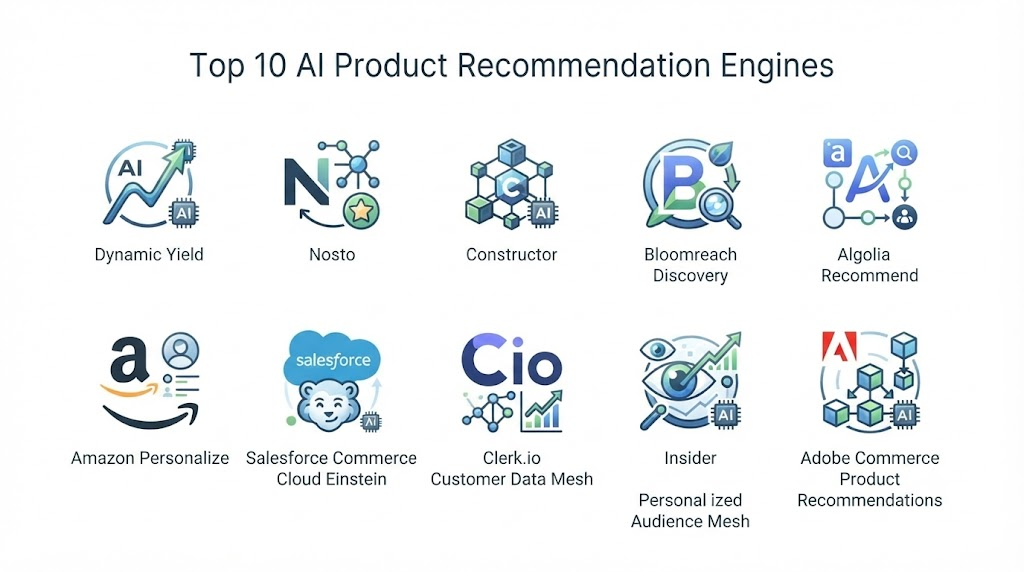
Top 10 AI Product Recommendation Engines
1. Amazon Personalize
One-line verdict: Best for developers wanting a managed machine-learning service for building customized product recommendation experiences.
Short description:
Amazon Personalize is a managed machine-learning service designed for creating personalized recommendations and ranking experiences. Developers can integrate it into applications without building an entire recommendation infrastructure from scratch.
Standout Capabilities
- Personalized recommendations.
- User-item interaction modeling.
- Product ranking.
- Real-time recommendation APIs.
- Machine-learning workflows.
- Custom recommendation applications.
- AWS integration.
- Developer-focused deployment.
AI-Specific Depth
- Model support: Managed machine-learning capabilities with configurable recommendation workflows; exact underlying model choices vary.
- RAG / knowledge integration: Not primarily a RAG platform.
- Evaluation: Recommendation performance can be evaluated using relevant metrics; exact evaluation options vary by implementation.
- Guardrails: Application-level controls depend on the surrounding AWS architecture.
- Observability: Monitoring capabilities vary according to the broader AWS implementation.
Pros
- Managed recommendation infrastructure.
- Strong AWS ecosystem integration.
- Useful for custom applications.
Cons
- Requires development expertise.
- Requires organizations to build surrounding commerce experiences.
- Usage-based costs require monitoring.
Security & Compliance
AWS provides extensive security and identity capabilities, but the final security posture depends on architecture and configuration. Specific compliance requirements should be verified for the selected services.
Deployment & Platforms
- Cloud.
- APIs.
- Web applications.
- Mobile applications.
- AWS environments.
Integrations & Ecosystem
Amazon Personalize can be integrated into custom applications and data pipelines.
- AWS services.
- E-commerce applications.
- Data warehouses.
- Customer-event systems.
- APIs.
- Mobile applications.
Pricing Model
Usage-based pricing varies according to data processing, training, inference, and related services.
Best-Fit Scenarios
- Custom e-commerce recommendation systems.
- AWS-based personalization.
- Developer-built recommendation applications.
2. Salesforce Commerce Cloud Einstein
One-line verdict: Best for retailers already using Salesforce commerce technologies and seeking embedded AI personalization.
Short description:
Salesforce Commerce Cloud Einstein provides AI-powered capabilities within the Salesforce commerce ecosystem. It can support personalized product discovery and recommendation experiences across digital commerce.
Standout Capabilities
- Product recommendations.
- Commerce personalization.
- Customer behavior analysis.
- Product discovery.
- Merchandising support.
- Commerce analytics.
- Customer-data integration.
- Personalized shopping experiences.
AI-Specific Depth
- Model support: Managed AI capabilities; specific underlying models vary.
- RAG / knowledge integration: Enterprise customer and commerce data integration is central; specific RAG architecture varies.
- Evaluation: Commerce performance can be measured through business and experimentation metrics.
- Guardrails: Enterprise permissions and governance capabilities vary by configuration.
- Observability: Commerce analytics provide performance visibility.
Pros
- Strong commerce integration.
- Useful for Salesforce customers.
- Connects personalization with customer data.
Cons
- Most attractive within the Salesforce ecosystem.
- Advanced customization may require specialist expertise.
- Pricing varies.
Security & Compliance
Salesforce provides enterprise security and administrative controls, but exact capabilities and certifications should be verified for the selected product configuration.
Deployment & Platforms
- Cloud.
- Web.
- Mobile commerce.
- APIs.
Integrations & Ecosystem
- Salesforce Commerce Cloud.
- CRM.
- Customer data.
- Marketing systems.
- E-commerce applications.
- APIs.
Pricing Model
Enterprise pricing varies according to product configuration, users, usage, and other requirements.
Best-Fit Scenarios
- Salesforce-based commerce.
- Personalized online retail.
- Integrated customer personalization.
3. Adobe Commerce Recommendations
One-line verdict: Best for Adobe Commerce merchants seeking integrated AI-powered product discovery and personalized recommendations.
Short description:
Adobe Commerce provides commerce capabilities that can be enhanced with AI-powered product recommendations and personalization. It is particularly relevant to organizations already using the Adobe commerce ecosystem.
Standout Capabilities
- Product recommendations.
- Personalized shopping.
- Product discovery.
- Catalog intelligence.
- Commerce analytics.
- Merchandising.
- Customer behavior analysis.
- Commerce integration.
AI-Specific Depth
- Model support: Managed AI capabilities vary by Adobe product and implementation.
- RAG / knowledge integration: Commerce catalog and customer data integration are central.
- Evaluation: Recommendation performance can be assessed using commerce metrics and experimentation.
- Guardrails: Commerce and administrative controls vary.
- Observability: Commerce analytics support monitoring.
Pros
- Strong Adobe Commerce integration.
- Useful for existing Adobe customers.
- Connects recommendations with broader commerce workflows.
Cons
- Less attractive if Adobe Commerce is not already part of the technology stack.
- Configuration can require commerce expertise.
- Pricing varies.
Security & Compliance
Security and compliance capabilities vary by product, deployment, and contract.
Deployment & Platforms
- Cloud.
- Web.
- Commerce applications.
- APIs.
Integrations & Ecosystem
- Adobe Commerce.
- Product catalogs.
- Customer data.
- Analytics.
- Marketing systems.
- APIs.
Pricing Model
Pricing varies based on product and enterprise requirements.
Best-Fit Scenarios
- Adobe Commerce stores.
- Personalized product discovery.
- Enterprise digital commerce.
4. Algolia Recommend
One-line verdict: Best for developers seeking fast, API-driven product recommendations integrated with search and discovery.
Short description:
Algolia provides search and discovery technology, including recommendation capabilities. It is useful for businesses that want recommendations closely integrated with product search and real-time digital discovery.
Standout Capabilities
- Product recommendations.
- Search integration.
- Personalized discovery.
- Similar-product recommendations.
- Frequently-bought-together experiences.
- API-first architecture.
- Real-time experiences.
- Developer tooling.
AI-Specific Depth
- Model support: Managed recommendation capabilities; exact model architecture varies.
- RAG / knowledge integration: Search and catalog data integration is central.
- Evaluation: Search and recommendation performance can be evaluated through analytics and experimentation.
- Guardrails: Application and administrative controls vary.
- Observability: Search and recommendation analytics provide operational visibility.
Pros
- Strong developer experience.
- Excellent search and discovery combination.
- API-driven architecture.
Cons
- Requires integration work.
- Recommendation quality depends on available interaction data.
- Pricing varies.
Security & Compliance
Security and administrative controls vary by plan and configuration. Specific certifications should be verified before procurement.
Deployment & Platforms
- Cloud.
- APIs.
- Web.
- Mobile.
Integrations & Ecosystem
- E-commerce platforms.
- Product catalogs.
- Search applications.
- Analytics systems.
- APIs.
- Mobile applications.
Pricing Model
Typically usage- and service-based, with pricing varying according to requirements.
Best-Fit Scenarios
- Search-driven commerce.
- Product discovery.
- Developer-focused personalization.
5. Bloomreach Discovery
One-line verdict: Best for commerce teams combining AI product recommendations with search, merchandising, and personalization.
Short description:
Bloomreach provides digital commerce search, merchandising, personalization, and customer engagement capabilities. Its recommendation functionality can be used as part of a broader personalized commerce strategy.
Standout Capabilities
- Product recommendations.
- Personalized discovery.
- Search.
- Merchandising.
- Customer segmentation.
- Commerce personalization.
- Behavioral analysis.
- Marketing integration.
AI-Specific Depth
- Model support: Managed AI and machine-learning capabilities vary.
- RAG / knowledge integration: Catalog and behavioral data integration is central.
- Evaluation: Commerce performance can be measured using experiments and business metrics.
- Guardrails: Merchandising and administrative controls vary.
- Observability: Analytics and personalization reporting provide monitoring.
Pros
- Strong commerce personalization.
- Combines search and recommendations.
- Useful for marketing teams and merchandisers.
Cons
- Broader platform than recommendation alone.
- Enterprise implementation can require planning.
- Pricing is not publicly stated.
Security & Compliance
Security and compliance capabilities vary by service and agreement. Verify required controls during procurement.
Deployment & Platforms
- Cloud.
- Web.
- APIs.
- Commerce environments.
Integrations & Ecosystem
- E-commerce platforms.
- Product catalogs.
- Marketing systems.
- Customer data.
- Analytics.
- APIs.
Pricing Model
Enterprise pricing varies. Exact pricing is not publicly stated.
Best-Fit Scenarios
- Personalized commerce.
- AI search and recommendations.
- Retail merchandising.
6. Constructor
One-line verdict: Best for enterprise retailers combining AI-powered product discovery, search, recommendations, and merchandising controls.
Short description:
Constructor focuses on search, discovery, recommendations, and merchandising for e-commerce environments. It is particularly relevant to businesses that want recommendations integrated directly into the product-discovery journey.
Standout Capabilities
- Product recommendations.
- Personalized discovery.
- Search.
- Merchandising.
- Product ranking.
- Catalog intelligence.
- Behavioral personalization.
- Commerce analytics.
AI-Specific Depth
- Model support: Managed AI capabilities; underlying models vary.
- RAG / knowledge integration: Product and catalog data integration is central.
- Evaluation: Search and recommendation performance can be evaluated using experimentation and analytics.
- Guardrails: Merchandising and administrative controls vary.
- Observability: Product-discovery analytics support monitoring.
Pros
- Strong product-discovery focus.
- Good combination of search and recommendations.
- Useful merchandising controls.
Cons
- Primarily oriented toward commerce.
- Requires catalog and behavioral data integration.
- Pricing is not publicly stated.
Security & Compliance
Specific security and compliance capabilities vary by deployment and agreement.
Deployment & Platforms
- Cloud.
- APIs.
- Web.
- Mobile commerce.
Integrations & Ecosystem
- E-commerce platforms.
- Product catalogs.
- Search systems.
- Analytics.
- Customer-data systems.
- APIs.
Pricing Model
Enterprise pricing varies. Exact pricing is not publicly stated.
Best-Fit Scenarios
- Large e-commerce catalogs.
- Product discovery.
- Search-plus-recommendation implementations.
7. Coveo
One-line verdict: Best for enterprises needing AI-powered search, recommendations, and personalized digital experiences across multiple channels.
Short description:
Coveo provides AI-powered search, relevance, recommendations, and personalization capabilities. Its technology can support commerce as well as broader enterprise digital experiences.
Standout Capabilities
- AI search.
- Product recommendations.
- Personalization.
- Relevance ranking.
- Content discovery.
- Behavioral analytics.
- Commerce experiences.
- Enterprise search.
AI-Specific Depth
- Model support: Managed AI and relevance models vary.
- RAG / knowledge integration: Strong relevance and enterprise content retrieval capabilities.
- Evaluation: Search and recommendation performance can be tested using relevance metrics and experimentation.
- Guardrails: Enterprise access controls and security capabilities vary.
- Observability: Search and relevance analytics provide monitoring.
Pros
- Broad enterprise discovery capabilities.
- Strong relevance technology.
- Useful beyond commerce.
Cons
- May be more than a small retailer needs.
- Requires integration work.
- Pricing is not publicly stated.
Security & Compliance
Security and compliance capabilities vary by configuration. Specific certifications should be verified for the selected deployment.
Deployment & Platforms
- Cloud.
- Web.
- APIs.
- Enterprise applications.
Integrations & Ecosystem
- Commerce platforms.
- Enterprise content.
- Product catalogs.
- CRM.
- Customer-data systems.
- APIs.
Pricing Model
Enterprise pricing varies. Exact pricing is not publicly stated.
Best-Fit Scenarios
- Enterprise product discovery.
- Personalized search.
- Omnichannel digital experiences.
8. Recombee
One-line verdict: Best for developers needing an API-first recommendation service with flexible personalization capabilities.
Short description:
Recombee provides recommendation infrastructure designed for developers and digital businesses. It can support personalized recommendations across products, content, users, and other catalog-based experiences.
Standout Capabilities
- Personalized recommendations.
- Real-time recommendation APIs.
- Behavioral data processing.
- Product similarity.
- Personalized ranking.
- Developer APIs.
- Recommendation scenarios.
- Custom recommendation logic.
AI-Specific Depth
- Model support: Managed recommendation models and configurable recommendation logic.
- RAG / knowledge integration: N/A as a primary capability.
- Evaluation: Recommendation scenarios can be tested and measured; detailed AI evaluation methodology varies.
- Guardrails: Application-level controls depend on implementation.
- Observability: Recommendation analytics and application monitoring vary.
Pros
- Developer-friendly.
- API-first.
- Suitable for customized recommendation scenarios.
Cons
- Requires technical integration.
- Less comprehensive than full commerce suites.
- Pricing varies.
Security & Compliance
Security controls and certifications vary by plan and deployment.
Deployment & Platforms
- Cloud.
- APIs.
- Web.
- Mobile.
Integrations & Ecosystem
- E-commerce applications.
- Product catalogs.
- Mobile apps.
- Websites.
- Data pipelines.
- APIs.
Pricing Model
Pricing varies by usage and service requirements.
Best-Fit Scenarios
- Custom recommendation APIs.
- Mobile commerce.
- Developer-led personalization.
9. Dynamic Yield
One-line verdict: Best for enterprises seeking experimentation, personalization, and AI-assisted product recommendations across digital channels.
Short description:
Dynamic Yield provides personalization, experimentation, and recommendation capabilities for digital experiences. It is useful for organizations that want recommendations combined with broader customer-experience optimization.
Standout Capabilities
- Product recommendations.
- Personalization.
- A/B testing.
- Customer segmentation.
- Experience optimization.
- Behavioral targeting.
- Recommendation strategies.
- Digital experimentation.
AI-Specific Depth
- Model support: Managed AI and recommendation capabilities vary.
- RAG / knowledge integration: Not primarily a RAG platform.
- Evaluation: Strong emphasis on experimentation and business-outcome measurement.
- Guardrails: Campaign and administrative controls vary.
- Observability: Experience analytics and experimentation reporting support monitoring.
Pros
- Strong experimentation capabilities.
- Combines recommendations with personalization.
- Useful for optimization-focused teams.
Cons
- Broader personalization platform.
- Requires experimentation maturity.
- Pricing is not publicly stated.
Security & Compliance
Security and compliance capabilities vary by implementation and agreement.
Deployment & Platforms
- Cloud.
- Web.
- Mobile.
- APIs.
Integrations & Ecosystem
- E-commerce platforms.
- Customer-data platforms.
- Analytics.
- Marketing systems.
- Websites.
- Mobile applications.
Pricing Model
Enterprise pricing varies. Exact pricing is not publicly stated.
Best-Fit Scenarios
- Personalization programs.
- Recommendation experimentation.
- Enterprise digital commerce.
10. Google Cloud Vertex AI
One-line verdict: Best for engineering teams building customized recommendation systems using Google Cloud AI and data infrastructure.
Short description:
Google Cloud Vertex AI provides machine-learning and AI development capabilities that can support custom recommendation applications. It is better suited to organizations wanting control over recommendation architecture than businesses seeking a ready-made commerce widget.
Standout Capabilities
- Machine-learning development.
- Model training.
- Model deployment.
- Generative AI.
- Data integration.
- Model evaluation.
- AI application development.
- Cloud-scale infrastructure.
AI-Specific Depth
- Model support: Multiple model types and AI approaches can be used.
- RAG / knowledge integration: Supports broader retrieval and enterprise-data architectures.
- Evaluation: Model evaluation capabilities are available depending on the implementation.
- Guardrails: AI governance and safety controls vary by architecture and services used.
- Observability: Model and application monitoring capabilities vary.
Pros
- High flexibility.
- Strong data and AI ecosystem.
- Suitable for proprietary recommendation models.
Cons
- Requires technical expertise.
- Recommendation logic must largely be designed by the organization.
- Usage-based costs require monitoring.
Security & Compliance
Google Cloud provides extensive security capabilities, but the final security posture depends on architecture and configuration.
Deployment & Platforms
- Cloud.
- APIs.
- Web.
- Mobile.
- Data-science environments.
Integrations & Ecosystem
- Google Cloud data services.
- E-commerce platforms.
- Data warehouses.
- Product catalogs.
- Customer data.
- APIs.
- Machine-learning pipelines.
Pricing Model
Usage-based pricing varies according to compute, storage, model usage, data processing, and associated services.
Best-Fit Scenarios
- Custom recommendation engines.
- Large-scale personalization.
- Google Cloud-based AI applications.
Comparison Table
| Tool Name | Best For | Deployment | Model Flexibility | Strength | Watch-Out | Public Rating |
|---|---|---|---|---|---|---|
| Amazon Personalize | Custom recommendations | Cloud | Managed/Multi-model | Developer flexibility | Requires engineering | N/A |
| Salesforce Commerce Cloud Einstein | Salesforce commerce | Cloud | Managed | Commerce integration | Ecosystem dependency | N/A |
| Adobe Commerce Recommendations | Adobe Commerce | Cloud | Managed | Commerce personalization | Adobe ecosystem focus | N/A |
| Algolia Recommend | Search + recommendations | Cloud | Managed | API-first discovery | Integration required | N/A |
| Bloomreach Discovery | Personalized commerce | Cloud | Managed | Search + personalization | Broad platform | N/A |
| Constructor | Product discovery | Cloud | Managed | Search and recommendations | Commerce-focused | N/A |
| Coveo | Enterprise discovery | Cloud | Managed | Relevance and personalization | Can be complex | N/A |
| Recombee | Developer-led personalization | Cloud | Managed/Configurable | Recommendation APIs | Requires development | N/A |
| Dynamic Yield | Personalization + experimentation | Cloud | Managed | Experimentation | Enterprise-oriented | N/A |
| Google Cloud Vertex AI | Custom recommendation AI | Cloud | Multi-model/BYO | Flexibility | DIY complexity | N/A |
Scoring & Evaluation
The scoring below is a comparative rubric for AI Product Recommendation Engines. It is not an official vendor score and should be adjusted according to a company’s traffic, catalog size, data maturity, and business objectives.
| Tool | Core | Reliability/Eval | Guardrails | Integrations | Ease | Perf/Cost | Security/Admin | Support | Weighted Total |
|---|---|---|---|---|---|---|---|---|---|
| Amazon Personalize | 9 | 9 | 9 | 10 | 8 | 9 | 10 | 10 | 9.20 |
| Salesforce Commerce Cloud Einstein | 9 | 8 | 9 | 10 | 9 | 8 | 10 | 10 | 9.10 |
| Adobe Commerce Recommendations | 9 | 8 | 9 | 10 | 9 | 8 | 10 | 9 | 9.05 |
| Algolia Recommend | 9 | 9 | 9 | 10 | 9 | 9 | 9 | 9 | 9.15 |
| Bloomreach Discovery | 10 | 9 | 9 | 10 | 8 | 8 | 9 | 9 | 9.10 |
| Constructor | 9 | 9 | 9 | 9 | 9 | 8 | 9 | 9 | 8.95 |
| Coveo | 9 | 9 | 9 | 10 | 8 | 8 | 10 | 9 | 9.05 |
| Recombee | 9 | 8 | 8 | 9 | 9 | 9 | 8 | 8 | 8.65 |
| Dynamic Yield | 10 | 9 | 9 | 10 | 8 | 8 | 9 | 9 | 9.10 |
| Google Cloud Vertex AI | 10 | 10 | 9 | 10 | 6 | 8 | 10 | 10 | 9.15 |
Top 3 for Enterprise
- Bloomreach Discovery — Strong combination of personalization, discovery, and commerce capabilities.
- Dynamic Yield — Strong for personalization and experimentation.
- Salesforce Commerce Cloud Einstein — Strong choice for organizations deeply invested in Salesforce commerce.
Top 3 for SMB
- Algolia Recommend — Useful for API-driven product discovery.
- Recombee — Suitable for developer-led personalization.
- Amazon Personalize — Useful when an organization wants managed recommendation infrastructure.
Top 3 for Developers
- Google Cloud Vertex AI — Broad flexibility for custom recommendation applications.
- Amazon Personalize — Managed recommendation infrastructure with strong developer integration.
- Algolia Recommend — Strong API-first approach to search and recommendations.
Which AI Product Recommendation Engine Is Right for You?
Solo / Freelancer
Most small stores do not need a sophisticated AI recommendation stack.
Start with:
- Best-selling product recommendations.
- Category-based recommendations.
- Similar-product rules.
- Frequently-bought-together rules.
- Basic personalization.
Upgrade to machine-learning recommendations once sufficient behavioral data exists.
SMB
SMBs should prioritize ease of implementation and measurable commercial impact.
Look for:
- Plug-in commerce integration.
- Automated recommendations.
- Basic personalization.
- Product similarity.
- A/B testing.
- Easy analytics.
- Reasonable implementation effort.
Avoid building a custom ML system unless recommendation quality is strategically important.
Mid-Market
Mid-market retailers should begin combining behavioral and catalog intelligence.
Prioritize:
- Real-time recommendations.
- Session-based personalization.
- Cross-selling.
- Upselling.
- Personalized search.
- Catalog understanding.
- Experimentation.
- Inventory-aware recommendations.
Enterprise
Enterprise retailers should evaluate recommendation engines as part of a broader personalization architecture.
A mature system may look like:
Customer Events → Data Platform → Recommendation Models → Ranking → Business Rules → Personalization Layer → Commerce Experience → Measurement
Enterprise buyers should evaluate:
- High-volume inference.
- Multi-region performance.
- Real-time personalization.
- Data governance.
- Model evaluation.
- A/B testing.
- Merchandising controls.
- Inventory integration.
- Customer-data integration.
- AI governance.
- Explainability.
- Cost optimization.
Regulated Industries
Recommendation systems can process substantial behavioral and customer data.
Evaluate:
- Data collection.
- Consent management.
- Data minimization.
- Retention policies.
- Encryption.
- Access control.
- Data residency.
- Audit logs.
- Model governance.
- Customer profiling policies.
Budget vs Premium
Budget approach:
- Best sellers.
- Rule-based recommendations.
- Category recommendations.
- Simple collaborative filtering.
- Basic personalization.
Premium approach:
- Real-time personalization.
- Deep behavioral modeling.
- Multimodal product understanding.
- Personalized search.
- AI shopping assistants.
- Experimentation.
- Dynamic ranking.
- Cross-channel personalization.
Build vs Buy
Build when:
- Recommendation quality is strategically important.
- You have strong data-science capabilities.
- Your catalog has unique characteristics.
- You need custom ranking logic.
- You want maximum model control.
Buy when:
- You need fast deployment.
- You lack specialized ML expertise.
- Standard recommendation scenarios meet your needs.
- You need prebuilt integrations.
- You want vendor-managed infrastructure.
A hybrid architecture can work well: use a managed recommendation engine while maintaining proprietary business rules and customer-data infrastructure.
Implementation Playbook: 30 / 60 / 90 Days
First 30 Days: Pilot + Success Metrics
Choose one recommendation placement.
For example:
- Product-detail page.
- Homepage.
- Cart.
- Checkout.
- Email.
Collect:
- Product views.
- Product clicks.
- Purchases.
- Add-to-cart events.
- Search behavior.
- Product attributes.
- Customer segments.
- Inventory availability.
Define baseline metrics:
- Recommendation click-through rate.
- Conversion rate.
- Average order value.
- Revenue per visitor.
- Add-to-cart rate.
- Recommendation coverage.
- Product diversity.
Start with recommendations rather than autonomous purchasing decisions.
Days 31–60: Security + Evaluation + Rollout
Create an offline evaluation dataset.
Test:
- Recommendation relevance.
- Ranking quality.
- Cold-start behavior.
- Popularity bias.
- Product diversity.
- Inventory availability.
- Personalization quality.
Run online experiments comparing:
- Existing recommendations.
- AI recommendations.
- Merchandising rules.
- Hybrid strategies.
For generative-AI shopping assistants, test:
- Hallucinations.
- Incorrect product attributes.
- Unsupported claims.
- Prompt injection.
- Privacy leakage.
- Unauthorized actions.
Implement:
- Data access controls.
- Event governance.
- Prompt/version control.
- Human merchandising controls.
- Monitoring.
Days 61–90: Optimization + Governance
Expand personalization across:
- Homepage.
- Search.
- Product pages.
- Cart.
- Email.
- Mobile applications.
Introduce:
- Real-time recommendations.
- Dynamic ranking.
- Inventory-aware ranking.
- Personalized search.
- AI shopping assistants.
- Advanced experimentation.
Monitor:
- Recommendation quality.
- Revenue impact.
- Latency.
- Infrastructure costs.
- Model drift.
- Catalog changes.
- Customer feedback.
Common Mistakes & How to Avoid Them
- Using AI before collecting enough data: Start with simpler strategies when behavioral data is limited.
- Ignoring cold-start products: New products need content and attribute-based recommendations.
- Over-personalization: Excessive personalization can reduce product discovery.
- Ignoring inventory: Do not heavily recommend unavailable products.
- Optimizing only for clicks: Clicks do not necessarily translate into revenue or customer satisfaction.
- Ignoring margin: The highest-converting product may not always be the most commercially valuable recommendation.
- No experimentation: Always compare recommendation strategies.
- No evaluation: Offline testing can identify problems before production deployment.
- Popularity bias: Recommendation systems can repeatedly promote already-popular products.
- Ignoring product diversity: Showing near-identical products can reduce discovery.
- Weak catalog data: Poor product attributes reduce content-based recommendation quality.
- Prompt injection exposure: AI shopping assistants can be manipulated through untrusted product or external content.
- Hallucinated product information: Generative AI should not invent prices, specifications, availability, or product features.
- Uncontrolled data retention: Behavioral data should be managed according to privacy requirements.
- Ignoring latency: Slow recommendations can damage the shopping experience.
- Unexpected AI costs: High-volume recommendation workloads require cost monitoring.
- Vendor lock-in: Maintain access to customer events, catalog data, and business rules.
- Removing human merchandising controls: Merchandisers should retain appropriate control over commercial priorities.
FAQs
1. What Is an AI Product Recommendation Engine?
An AI Product Recommendation Engine analyzes customer behavior, product information, and contextual signals to predict which products are most relevant to each shopper.
2. How Do AI Product Recommendations Work?
Recommendation systems can analyze browsing, purchases, searches, product attributes, customer behavior, and relationships between products to generate personalized rankings.
3. What Is Collaborative Filtering?
Collaborative filtering recommends products based on patterns across users and items. For example, customers who purchased one product may also have purchased another.
4. What Is Content-Based Recommendation?
Content-based recommendation uses product characteristics such as category, description, attributes, or other metadata to identify similar products.
5. What Is a Hybrid Recommendation Engine?
A hybrid engine combines multiple approaches, such as collaborative filtering, content-based recommendations, contextual signals, and business rules.
6. Can AI Recommendations Work in Real Time?
Yes. Some recommendation systems can generate or update recommendations based on current session behavior and other real-time signals.
7. Can AI Recommend Products to New Customers?
Yes. Cold-start strategies can use product popularity, product attributes, contextual information, and early-session behavior when historical customer data is unavailable.
8. Can AI Recommend New Products?
Yes. Content-based and hybrid approaches can recommend new products before enough interaction data exists.
9. Can AI Product Recommendations Increase Sales?
They can potentially increase engagement, conversion, average order value, and cross-selling. However, results vary by business, catalog, customer behavior, and implementation.
10. How Should Recommendation Engines Be Evaluated?
Use both offline and online evaluation. Metrics can include ranking quality, click-through rate, conversion, revenue, average order value, coverage, diversity, and customer satisfaction.
11. Should Recommendation Engines Optimize for Revenue?
Revenue is important, but optimizing only for revenue can create undesirable behavior. Businesses may also need to consider margin, customer experience, diversity, inventory, and long-term retention.
12. Can AI Recommendations Use Customer Data?
Yes. Recommendation systems commonly use behavioral and transaction data, but organizations should apply appropriate privacy, security, consent, and retention controls.
13. Do Recommendation Engines Train on Customer Data?
This depends on the architecture and vendor. Buyers should verify exactly how customer data is stored, processed, isolated, and used.
14. Can Companies Bring Their Own AI Models?
Some platforms and custom architectures support multiple models or custom model workflows. Managed recommendation products may provide less direct model control.
15. Can AI Recommendation Engines Be Self-Hosted?
Custom recommendation systems can be self-hosted. Commercial platforms vary in their deployment options.
16. What Is RAG in Product Recommendations?
RAG can help AI shopping assistants retrieve authoritative product information before generating recommendations or answers. It is especially useful for product specifications and catalog-based conversations.
17. Can Generative AI Replace Traditional Recommendation Models?
Not necessarily. Generative AI is useful for conversational discovery and reasoning, while specialized recommendation models can remain highly effective for large-scale ranking and personalization.
18. Can AI Recommendations Be Manipulated?
Yes. Poorly designed systems can be affected by low-quality data, fraudulent behavior, manipulation, or malicious content. Monitoring and safeguards are important.
19. How Can Hallucinations Be Prevented in AI Shopping Assistants?
Ground responses in authoritative product catalogs, use retrieval mechanisms, validate important product attributes, and restrict unsupported claims.
20. Can Recommendation Engines Consider Inventory?
Yes. Inventory availability can be incorporated into recommendation ranking or business rules, depending on the implementation.
21. Can Recommendation Engines Consider Price?
Yes. Price can be used as a ranking signal or business rule. The exact approach depends on the recommendation architecture.
22. Can AI Recommend Products Across Multiple Channels?
Yes. A centralized recommendation system can potentially support websites, mobile applications, email, marketplaces, and other digital channels.
23. How Much Do AI Recommendation Engines Cost?
Pricing varies considerably. Some services use usage-based pricing, while enterprise platforms may use negotiated pricing based on traffic, features, data, users, or other factors.
24. What Is the Best AI Product Recommendation Engine?
There is no universal winner. Amazon Personalize and Google Cloud Vertex AI are attractive for developers, while Bloomreach, Dynamic Yield, Salesforce Commerce Cloud Einstein, Adobe Commerce Recommendations, and similar platforms can be better suited to commerce teams.
25. Should SMBs Build Their Own Recommendation Engine?
Usually not unless personalization is strategically important and the business has sufficient data and technical resources. Managed solutions are often easier to implement.
26. What Is the Biggest Challenge With Product Recommendations?
Data quality is one of the biggest challenges. Incomplete product catalogs, insufficient behavioral events, incorrect customer identity resolution, and poor inventory data can reduce recommendation quality.
27. Can AI Recommendation Engines Recommend Similar Products?
Yes. Similar-product recommendations can use product attributes, embeddings, behavioral relationships, or combinations of these approaches.
28. Can AI Support Frequently-Bought-Together Recommendations?
Yes. Transaction and behavioral data can identify product combinations that frequently appear together.
29. Can AI Recommendations Be Controlled by Merchandisers?
Many commerce recommendation systems support some combination of business rules, product exclusions, boosting, suppression, or merchandising controls. Exact capabilities vary.
30. How Should a Company Start With AI Product Recommendations?
Begin with one recommendation placement, establish baseline performance, run a controlled experiment, measure business outcomes, validate privacy and data governance, and then expand to additional customer touchpoints.
Conclusion
AI Product Recommendation Engines are becoming an important part of modern digital commerce because customers increasingly expect shopping experiences to adapt to their interests, intent, and context.The strongest systems combine behavioral data, product intelligence, machine learning, real-time signals, business rules, experimentation, and increasingly generative AIFor managed recommendation infrastructure, Amazon Personalize can be attractive to developers building custom systems. Algolia Recommend and Recombee are useful for API-driven recommendation experiences. Commerce-focused organizations may consider Salesforce Commerce Cloud Einstein, Adobe Commerce Recommendations, Bloomreach Discovery, Constructor, Coveo, or Dynamic Yield depending on their existing technology ecosystem and personalization requirements. Teams seeking maximum technical flexibility can consider Google Cloud Vertex AI for custom recommendation architectures.