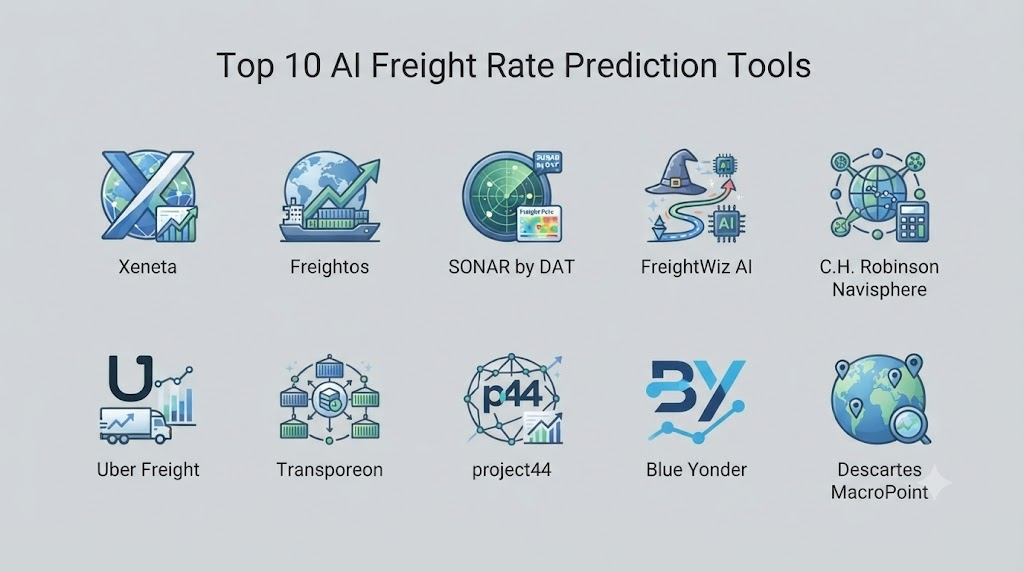
Introduction
AI Freight Rate Prediction Tools use artificial intelligence, machine learning, historical transportation data, market signals, and statistical forecasting to estimate how freight prices may change. Instead of relying entirely on spreadsheets, historical averages, or manual carrier quotes, logistics teams can use predictive systems to understand pricing trends and make more informed transportation decisions.
Freight pricing is influenced by many variables, including supply and demand, fuel costs, seasonality, carrier capacity, equipment availability, shipment volume, lane characteristics, weather, port congestion, and unexpected disruptions. AI can analyze large amounts of these variables much faster than traditional manual processes.
Best for: Shippers, carriers, brokers, 3PLs, freight forwarders, procurement teams, transportation managers, supply-chain planners, manufacturers, retailers, and enterprises with substantial freight spending.
Not ideal for: Very small companies with minimal shipment volumes or highly irregular transportation activity. In those situations, a basic transportation-management system, carrier marketplace, or manual rate-comparison process may provide enough value without the complexity of predictive analytics.
What’s Changed in AI Freight Rate Prediction
- Lane-level forecasting is becoming more important: Buyers increasingly expect forecasts that account for individual origin-destination lanes rather than relying only on broad market averages.
- Large datasets are becoming a competitive advantage: The quality and breadth of historical transportation data can significantly affect prediction performance.
- Spot and contract forecasting are increasingly connected: Procurement teams want to understand both immediate market conditions and longer-term pricing expectations.
- Scenario forecasting is gaining importance: A single predicted rate is often less useful than a range of potential outcomes.
- Real-time signals matter more: Capacity changes, demand fluctuations, weather, congestion, and market disruptions can quickly influence freight pricing.
- AI-assisted procurement is expanding: Predictive analytics can help identify lanes that deserve additional negotiation or sourcing attention.
- Multimodal intelligence is becoming more valuable: Global companies increasingly need visibility across truckload, less-than-truckload, ocean, air, parcel, and other transportation modes.
- AI agents are entering logistics workflows: Intelligent assistants can summarize market changes, identify anomalies, answer pricing questions, and recommend areas for investigation.
- Explainability matters: Procurement professionals need to understand why a forecast changed rather than receiving an unexplained prediction.
- Forecast evaluation is becoming essential: Buyers should compare predictions with actual historical outcomes instead of relying exclusively on vendor accuracy claims.
- API performance matters: Companies embedding predictions into TMS, procurement, quoting, or pricing applications need reliable latency and predictable data usage.
- Governance requirements are increasing: Freight predictions can influence significant purchasing decisions, making access control, auditability, model monitoring, and human review increasingly important.
Quick Buyer Checklist
When shortlisting AI Freight Rate Prediction Tools, evaluate:
- Lane-level forecasting.
- Spot-rate forecasting.
- Contract-rate forecasting.
- Historical freight-rate coverage.
- Current market data.
- Supply and demand indicators.
- Capacity data.
- Seasonality analysis.
- Forecast confidence ranges.
- Forecast-error reporting.
- Historical backtesting.
- Model monitoring.
- Data freshness.
- Data provenance.
- API availability.
- TMS integration.
- ERP integration.
- Procurement-system integration.
- Carrier connectivity.
- RFP support.
- Market benchmarking.
- Network analytics.
- Multimodal coverage.
- Scenario analysis.
- Rate alerts.
- Human-review workflows.
- Explainable predictions.
- Data privacy.
- Data-retention controls.
- Data residency options.
- Role-based access.
- Auditability.
- Model governance.
- AI agent capabilities where relevant.
- Cost monitoring.
- Latency controls.
- Data-export capabilities.
- Vendor lock-in risk.
- Integration flexibility.
Top 10 AI Freight Rate Prediction Tools
1. DAT iQ
One-line verdict: Best for transportation teams needing detailed North American freight-rate intelligence, benchmarking, and predictive market analysis.
Short description:
DAT iQ provides freight-market analytics focused heavily on North American transportation. Its capabilities can help shippers, brokers, carriers, and procurement teams analyze historical rates, market conditions, lane-level pricing, and freight-rate trends.
Standout Capabilities
- Lane-level freight-rate analysis.
- Historical rate benchmarking.
- Spot-rate intelligence.
- Contract-rate analysis.
- Supply and demand indicators.
- Freight-market forecasting.
- Procurement support.
- Transportation market analytics.
AI-Specific Depth
- Model support: Vendor-managed predictive models.
- RAG / knowledge integration: Not primarily a RAG platform; transportation and transaction data are central to the product.
- Evaluation: Forecast performance and error-analysis concepts are incorporated into predictive analytics.
- Guardrails: Not primarily a generative-AI safety platform.
- Observability: Rate trends, market analytics, historical comparisons, and forecasting views provide operational visibility.
Pros
- Strong transportation-data foundation.
- Useful for lane-level freight analysis.
- Well suited to freight procurement and negotiation workflows.
Cons
- Particularly strong in North American truckload markets.
- Not a general-purpose AI development platform.
- Organizations requiring highly customized models may need additional analytics infrastructure.
Security & Compliance
Security, access control, data retention, and enterprise governance capabilities depend on the specific service and agreement. Specific certifications are not stated here.
Deployment & Platforms
- Cloud-based.
- Web-based analytics.
- Data integration options vary.
- API capabilities vary by product.
Integrations & Ecosystem
DAT iQ can support transportation, procurement, pricing, and analytics workflows.
- Transportation-management systems.
- Procurement workflows.
- Analytics platforms.
- Reporting systems.
- Data environments.
- APIs and data services where available.
Pricing Model
Pricing varies by product, usage, and enterprise requirements. Exact pricing is not publicly stated.
Best-Fit Scenarios
- North American truckload forecasting.
- Freight procurement.
- Carrier-rate benchmarking.
2. Xeneta
One-line verdict: Best for ocean and air freight teams seeking market benchmarks, rate intelligence, and forward-looking transportation analysis.
Short description:
Xeneta specializes in freight-market intelligence for ocean and air transportation. Its platform is designed to help businesses understand freight-rate movements, benchmark pricing, compare carriers, and support procurement decisions.
Standout Capabilities
- Ocean freight benchmarking.
- Air freight intelligence.
- Spot-rate analysis.
- Contract-rate analysis.
- Market outlooks.
- Carrier comparisons.
- Freight procurement analytics.
- Market alerts.
AI-Specific Depth
- Model support: Vendor-managed predictive and analytical models.
- RAG / knowledge integration: Not primarily a RAG platform.
- Evaluation: Detailed independent model-evaluation methodology is not publicly stated.
- Guardrails: Product-specific governance controls vary.
- Observability: Rate trends, market intelligence, benchmarks, and predictive views provide analytical visibility.
Pros
- Strong specialization in ocean and air freight.
- Useful for freight procurement.
- Helps connect market pricing with carrier analysis.
Cons
- Less appropriate for organizations focused exclusively on domestic trucking.
- Enterprise implementation may require process changes.
- Exact AI model architecture is not publicly stated.
Security & Compliance
Security and compliance capabilities vary according to product and customer configuration. Specific certifications should be verified for the selected service.
Deployment & Platforms
- Cloud.
- Web.
- Enterprise integrations.
- Data-access options vary.
Integrations & Ecosystem
Xeneta can support procurement, logistics, supply-chain, and transportation-management workflows.
- Procurement systems.
- Freight-management processes.
- Logistics workflows.
- Reporting environments.
- Analytics platforms.
- Data integrations.
Pricing Model
Enterprise subscription pricing varies. Exact pricing is not publicly stated.
Best-Fit Scenarios
- Ocean freight procurement.
- Air freight analysis.
- Global transportation budgeting.
3. Freightos
One-line verdict: Best for freight forwarders and logistics teams combining digital quoting, freight rates, booking, and transportation workflows.
Short description:
Freightos provides digital freight technology supporting rate management, quoting, booking, and freight-forwarding workflows. Its platform is particularly relevant to organizations seeking to digitize pricing processes and reduce dependence on spreadsheets and manual rate comparisons.
Standout Capabilities
- Digital freight quoting.
- Rate management.
- Freight comparison.
- Booking workflows.
- Air freight pricing.
- Multimodal freight workflows.
- Customer-specific quoting.
- Carrier-rate management.
AI-Specific Depth
- Model support: AI capabilities vary by product; exact model architecture is not publicly stated.
- RAG / knowledge integration: Not primarily a RAG platform.
- Evaluation: Detailed AI evaluation methodology is not publicly stated.
- Guardrails: Workflow and platform controls vary.
- Observability: Pricing and quoting workflows provide operational visibility.
Pros
- Strong freight-forwarding orientation.
- Combines rates, quoting, and booking.
- Useful for digitizing manual pricing processes.
Cons
- Not exclusively a freight-rate forecasting platform.
- Predictive depth depends on the specific functionality being used.
- Organizations seeking custom forecasting may require additional tools.
Security & Compliance
Specific security controls, certifications, retention policies, and enterprise configurations should be verified for the applicable service.
Deployment & Platforms
- Cloud.
- Web.
- APIs.
- Enterprise integrations.
Integrations & Ecosystem
Freightos can fit into broader forwarding and logistics technology environments.
- TMS.
- Freight-forwarding software.
- Carrier systems.
- Rate-management workflows.
- Booking systems.
- APIs.
Pricing Model
Pricing varies by service and business requirements. Exact pricing is not publicly stated.
Best-Fit Scenarios
- Freight forwarding.
- Digital freight quoting.
- Rate-management workflows.
4. FreightWaves SONAR
One-line verdict: Best for transportation professionals requiring broad freight-market data, capacity intelligence, and pricing signals.
Short description:
FreightWaves SONAR provides transportation-market intelligence covering freight conditions, rates, capacity, supply-demand signals, and other market indicators. It is useful for organizations that want market intelligence to support internal forecasting and commercial decisions.
Standout Capabilities
- Freight-market intelligence.
- Rate analytics.
- Capacity indicators.
- Market trends.
- Transportation dashboards.
- Supply-demand analysis.
- Market research.
- Data-driven decision support.
AI-Specific Depth
- Model support: Vendor-managed analytics; exact AI model architecture is not publicly stated.
- RAG / knowledge integration: Not primarily a RAG platform.
- Evaluation: Specific AI evaluation methodology is not publicly stated.
- Guardrails: Not primarily a generative-AI platform.
- Observability: Strong market-data and analytics visibility.
Pros
- Broad transportation-market coverage.
- Useful for market research.
- Can complement internal forecasting systems.
Cons
- More focused on market intelligence than automated prediction.
- Advanced use may require analytical expertise.
- Specific predictive capabilities vary.
Security & Compliance
Security, access control, and enterprise compliance details should be verified for the selected service.
Deployment & Platforms
- Cloud.
- Web.
- Data integrations vary.
Integrations & Ecosystem
- Transportation analytics.
- Business intelligence.
- Internal forecasting models.
- Data environments.
- Reporting systems.
- Data services where available.
Pricing Model
Subscription and enterprise pricing vary. Exact pricing is not publicly stated.
Best-Fit Scenarios
- Freight-market analysis.
- Transportation strategy.
- Internal freight forecasting.
5. Transporeon
One-line verdict: Best for large shippers combining transportation procurement, carrier connectivity, freight execution, and analytics.
Short description:
Transporeon provides transportation-management and logistics technology connecting shippers, carriers, and logistics providers. Its broader ecosystem can support transportation procurement and pricing decisions while connecting them with execution processes.
Standout Capabilities
- Transportation procurement.
- Carrier connectivity.
- Freight execution.
- Tender management.
- Rate management.
- Transportation visibility.
- Benchmarking.
- Digital logistics workflows.
AI-Specific Depth
- Model support: AI capabilities vary across products.
- RAG / knowledge integration: Not primarily a RAG platform.
- Evaluation: Detailed AI evaluation methodology is not publicly stated.
- Guardrails: Enterprise workflow and administrative controls vary.
- Observability: Transportation and procurement analytics vary by product.
Pros
- Broad transportation ecosystem.
- Strong procurement orientation.
- Useful for complex shipper networks.
Cons
- Can require significant implementation.
- Not exclusively focused on rate prediction.
- Enterprise configuration can be complex.
Security & Compliance
Security and governance capabilities vary by product and deployment. Specific certifications should be verified for the applicable service.
Deployment & Platforms
- Cloud.
- Web.
- Enterprise integrations.
- APIs.
Integrations & Ecosystem
- TMS.
- ERP.
- Procurement.
- Carrier networks.
- Transportation marketplaces.
- APIs.
Pricing Model
Enterprise pricing varies. Exact pricing is not publicly stated.
Best-Fit Scenarios
- Enterprise transportation procurement.
- Carrier sourcing.
- Transportation-management operations.
6. Blue Yonder
One-line verdict: Best for enterprises connecting transportation forecasting with broader supply-chain planning and optimization.
Short description:
Blue Yonder provides supply-chain planning, transportation, warehouse, and logistics technologies. Its broad architecture can help enterprises connect transportation planning and optimization with wider supply-chain decision-making.
Standout Capabilities
- Transportation planning.
- Transportation optimization.
- Supply-chain planning.
- Network optimization.
- Carrier management.
- Analytics.
- AI-enabled decision support.
- Enterprise integration.
AI-Specific Depth
- Model support: AI capabilities vary across products.
- RAG / knowledge integration: Product-specific; not primarily a RAG platform.
- Evaluation: Detailed AI evaluation methodology is not publicly stated.
- Guardrails: Enterprise governance capabilities vary.
- Observability: Planning and transportation analytics provide operational visibility.
Pros
- Broad supply-chain architecture.
- Strong enterprise planning capabilities.
- Can connect transportation planning with execution.
Cons
- May be excessive for simple freight-rate forecasting.
- Implementation can be complex.
- Specific rate-prediction functionality depends on the selected product.
Security & Compliance
Enterprise security and governance capabilities vary by deployment. Specific certifications should be independently verified.
Deployment & Platforms
- Cloud.
- Enterprise environments.
- Hybrid integration options vary.
- APIs.
Integrations & Ecosystem
- ERP.
- TMS.
- Supply-chain planning.
- Warehouse systems.
- Procurement.
- Analytics.
- APIs.
Pricing Model
Enterprise subscription and licensing models vary. Exact pricing is not publicly stated.
Best-Fit Scenarios
- Enterprise transportation planning.
- Supply-chain optimization.
- Complex logistics networks.
7. Uber Freight
One-line verdict: Best for shippers and carriers seeking digital freight management with data-driven transportation decision support.
Short description:
Uber Freight combines digital transportation technology with freight-management services. Its technology ecosystem supports freight execution, carrier connectivity, logistics workflows, and data-driven transportation decisions.
Standout Capabilities
- Digital freight management.
- Transportation execution.
- Carrier connectivity.
- Freight pricing workflows.
- Network management.
- Transportation analytics.
- Automated logistics workflows.
- Data-driven transportation operations.
AI-Specific Depth
- Model support: Vendor-managed AI and analytics capabilities vary.
- RAG / knowledge integration: Not primarily a RAG platform.
- Evaluation: Detailed predictive-model evaluation is not publicly stated.
- Guardrails: Workflow controls vary.
- Observability: Transportation analytics and operational data provide visibility.
Pros
- Strong digital freight ecosystem.
- Combines technology with transportation operations.
- Useful for large transportation networks.
Cons
- Not solely focused on freight-rate forecasting.
- Predictive functionality depends on the specific product.
- Some capabilities are closely tied to broader transportation workflows.
Security & Compliance
Security and compliance capabilities vary by service and customer configuration.
Deployment & Platforms
- Cloud.
- Web.
- APIs.
- Enterprise integrations.
Integrations & Ecosystem
- TMS.
- ERP.
- Carrier networks.
- Freight workflows.
- Analytics.
- APIs.
Pricing Model
Enterprise and service-specific pricing varies. Exact pricing is not publicly stated.
Best-Fit Scenarios
- Digital freight management.
- Large shipper networks.
- Transportation execution.
8. C.H. Robinson Navisphere
One-line verdict: Best for large shippers combining transportation management, carrier intelligence, execution, and logistics analytics.
Short description:
C.H. Robinson provides transportation and logistics services supported by its technology ecosystem. Navisphere supports transportation-management and logistics workflows, making it relevant to organizations combining freight execution, carrier management, analytics, and pricing decisions.
Standout Capabilities
- Transportation management.
- Carrier management.
- Freight execution.
- Shipment visibility.
- Analytics.
- Procurement workflows.
- Transportation planning.
- Global logistics support.
AI-Specific Depth
- Model support: AI and analytics capabilities vary.
- RAG / knowledge integration: Not primarily a RAG platform.
- Evaluation: Detailed AI evaluation methodology is not publicly stated.
- Guardrails: Enterprise workflow controls vary.
- Observability: Shipment and transportation analytics vary.
Pros
- Broad logistics expertise.
- Strong carrier-network context.
- Suitable for complex transportation operations.
Cons
- Not a pure standalone rate-forecasting platform.
- Some capabilities depend on broader services.
- Exact predictive functionality varies.
Security & Compliance
Security and compliance capabilities should be verified for the specific technology and service arrangement.
Deployment & Platforms
- Cloud.
- Web.
- Enterprise integrations.
- APIs.
Integrations & Ecosystem
- ERP.
- TMS.
- Carrier networks.
- Procurement systems.
- Logistics platforms.
- APIs.
Pricing Model
Enterprise and service-based pricing varies. Exact pricing is not publicly stated.
Best-Fit Scenarios
- Enterprise transportation management.
- Managed transportation.
- Complex carrier networks.
9. Descartes
One-line verdict: Best for logistics organizations connecting transportation analytics with routing, customs, trade, and supply-chain workflows.
Short description:
Descartes provides logistics and supply-chain technology across transportation management, routing, customs, trade compliance, and logistics networks. Its broad ecosystem can support transportation pricing and optimization initiatives.
Standout Capabilities
- Transportation management.
- Routing and optimization.
- Carrier connectivity.
- Logistics analytics.
- Customs workflows.
- Global trade management.
- Fleet and delivery technologies.
- Supply-chain connectivity.
AI-Specific Depth
- Model support: AI and optimization capabilities vary by product.
- RAG / knowledge integration: Not primarily a RAG platform.
- Evaluation: Detailed AI evaluation methodology is not publicly stated.
- Guardrails: Workflow and administrative controls vary.
- Observability: Transportation and logistics analytics vary.
Pros
- Broad logistics ecosystem.
- Useful for multimodal operations.
- Strong integration potential.
Cons
- Freight-rate prediction is not its sole focus.
- Its broad product portfolio can create implementation complexity.
- Exact predictive functionality depends on the selected product.
Security & Compliance
Security and compliance capabilities vary by product and deployment. Specific certifications should be independently verified.
Deployment & Platforms
- Cloud.
- Web.
- Enterprise systems.
- APIs.
- Hybrid options vary.
Integrations & Ecosystem
- TMS.
- ERP.
- Customs platforms.
- Fleet systems.
- Routing systems.
- Carrier networks.
- APIs.
Pricing Model
Enterprise and subscription pricing varies. Exact pricing is not publicly stated.
Best-Fit Scenarios
- Multimodal logistics.
- Transportation optimization.
- Global supply-chain operations.
10. Project44
One-line verdict: Best for organizations combining transportation visibility, predictive intelligence, and logistics-network decision support.
Short description:
Project44 focuses on transportation visibility and supply-chain intelligence. Its predictive capabilities can help organizations anticipate transportation events and improve logistics decisions using transportation-network data.
Standout Capabilities
- Transportation visibility.
- Predictive shipment intelligence.
- Carrier connectivity.
- ETA analytics.
- Supply-chain monitoring.
- Exception management.
- Logistics-data integration.
- Network intelligence.
AI-Specific Depth
- Model support: Vendor-managed predictive models; exact architecture varies.
- RAG / knowledge integration: Not primarily a RAG platform.
- Evaluation: Detailed model-evaluation methodology is not publicly stated.
- Guardrails: Enterprise controls vary by product.
- Observability: Strong focus on shipment and transportation visibility.
Pros
- Strong transportation-data ecosystem.
- Useful predictive logistics capabilities.
- Strong integration potential.
Cons
- More focused on visibility and predictive transportation intelligence than pure rate forecasting.
- Rate-prediction capabilities should be validated against the exact use case.
- Enterprise implementation may require integration work.
Security & Compliance
Security, data retention, access control, and compliance capabilities vary by service and contract.
Deployment & Platforms
- Cloud.
- Web.
- APIs.
- Enterprise integrations.
Integrations & Ecosystem
- TMS.
- ERP.
- Carrier systems.
- Supply-chain platforms.
- Visibility systems.
- APIs.
Pricing Model
Enterprise subscription pricing varies. Exact pricing is not publicly stated.
Best-Fit Scenarios
- Transportation visibility.
- Predictive logistics.
- Enterprise supply-chain analytics.
Comparison Table
| Tool Name | Best For | Deployment | Model Flexibility | Strength | Watch-Out | Public Rating |
|---|---|---|---|---|---|---|
| DAT iQ | North American freight forecasting | Cloud | Hosted | Freight-rate intelligence | Regional specialization | N/A |
| Xeneta | Ocean and air freight | Cloud | Hosted | Freight-market intelligence | Less truckload focused | N/A |
| Freightos | Freight forwarding | Cloud | Hosted/Integrated | Digital rate management | Prediction depth varies | N/A |
| FreightWaves SONAR | Freight-market intelligence | Cloud | Hosted/Data | Market signals | More analytics-oriented | N/A |
| Transporeon | Transportation procurement | Cloud | Hosted/Integrated | Procurement ecosystem | Implementation complexity | N/A |
| Blue Yonder | Enterprise supply chains | Cloud/Hybrid | Multi-model/Integrated | Planning and optimization | Broad platform | N/A |
| Uber Freight | Digital freight management | Cloud | Hosted | Freight execution | Product-specific prediction | N/A |
| C.H. Robinson Navisphere | Enterprise logistics | Cloud | Hosted/Integrated | Transportation management | Broader than forecasting | N/A |
| Descartes | Global logistics | Cloud/Hybrid | Hosted/Integrated | Logistics ecosystem | Large portfolio | N/A |
| Project44 | Predictive transportation | Cloud | Hosted | Visibility and prediction | Rate focus varies | N/A |
Scoring & Evaluation
The following scoring framework is a comparative editorial assessment rather than an official vendor ranking.
Each platform is evaluated on an equal 1–10 scale before applying the requested weighting. The purpose is to help buyers compare strengths and weaknesses consistently. Actual performance can differ significantly depending on data quality, implementation, transportation mode, geography, and business requirements.
| Tool | Core | Reliability/Eval | Guardrails | Integrations | Ease | Perf/Cost | Security/Admin | Support | Weighted Total |
|---|---|---|---|---|---|---|---|---|---|
| DAT iQ | 10 | 9 | 8 | 9 | 9 | 9 | 8 | 9 | 8.90 |
| Xeneta | 10 | 9 | 8 | 9 | 9 | 8 | 8 | 9 | 8.80 |
| Freightos | 9 | 8 | 8 | 9 | 9 | 9 | 8 | 9 | 8.70 |
| FreightWaves SONAR | 9 | 8 | 8 | 8 | 8 | 8 | 8 | 9 | 8.25 |
| Transporeon | 9 | 8 | 9 | 10 | 7 | 8 | 9 | 9 | 8.70 |
| Blue Yonder | 10 | 9 | 9 | 10 | 7 | 7 | 10 | 10 | 9.05 |
| Uber Freight | 9 | 8 | 8 | 9 | 8 | 8 | 8 | 9 | 8.40 |
| C.H. Robinson Navisphere | 9 | 8 | 8 | 10 | 8 | 8 | 9 | 10 | 8.70 |
| Descartes | 9 | 8 | 9 | 10 | 7 | 8 | 9 | 9 | 8.65 |
| Project44 | 9 | 9 | 9 | 10 | 8 | 8 | 9 | 9 | 8.95 |
Top 3 for Enterprise
- Blue Yonder — Strong option for organizations that want transportation analytics connected to broader supply-chain planning.
- Project44 — Strong choice for predictive transportation intelligence and network visibility.
- DAT iQ — Particularly suitable for organizations focused on North American freight-rate analysis.
Top 3 for SMB
- DAT iQ — Useful for organizations needing freight-market intelligence and lane analysis.
- Freightos — Suitable for digital freight quoting and rate-management workflows.
- Xeneta — Particularly relevant for businesses with significant ocean or air freight activity.
Top 3 for Developers
- DAT iQ — Strong data and forecasting orientation.
- Freightos — Useful for digital freight-rate and quoting workflows.
- Project44 — Strong transportation-data and integration ecosystem.
Which AI Freight Rate Prediction Tool Is Right for You?
Solo / Freelancer
Solo freight brokers, consultants, and small logistics professionals generally do not need a complex enterprise forecasting architecture.
Prioritize:
- Easy access to market rates.
- Lane-level analysis.
- Historical trends.
- Current pricing information.
- Simple forecasting.
- Exportable data.
- Low implementation complexity.
A focused freight-intelligence platform can often provide more practical value than a full enterprise transportation-management implementation.
SMB
Small and midsized businesses should focus on measurable financial impact.
Look for:
- Freight-rate forecasting.
- Carrier comparison.
- Lane benchmarking.
- Rate alerts.
- Simple dashboards.
- API access.
- RFP support.
- Budget forecasting.
For North American truckload operations, DAT iQ can be particularly relevant. Businesses concentrated on ocean or air transportation may find a specialized freight-intelligence platform more appropriate.
Mid-Market
Mid-market organizations should connect forecasting with procurement and transportation processes.
Consider:
- TMS integration.
- ERP integration.
- Carrier data.
- Procurement systems.
- RFP workflows.
- Forecasting APIs.
- Rate benchmarking.
- Scenario analysis.
- Historical backtesting.
The objective should not simply be to produce a forecast. The objective should be to turn the forecast into better purchasing decisions.
Enterprise
Large enterprises should treat freight-rate prediction as one component of a broader transportation-intelligence architecture.
A mature architecture may look like:
Market Data → Forecasting → Scenario Planning → Procurement → Carrier Selection → Transportation Execution → Actual Cost → Model Evaluation
Enterprise buyers should prioritize:
- Data quality.
- Data lineage.
- Model governance.
- API reliability.
- Role-based access.
- Auditability.
- Forecast monitoring.
- Multimodal support.
- Regional coverage.
- Cost controls.
- Integration capabilities.
Regulated Industries
Companies operating under strict regulatory, contractual, or internal governance requirements should prioritize:
- Data governance.
- Access controls.
- Audit logging.
- Data retention.
- Model documentation.
- Human approval.
- Explainable predictions.
- Vendor-risk assessment.
- Data residency.
- Incident management.
The greater the financial impact of a prediction, the more important appropriate human oversight becomes.
Budget vs Premium
A budget-oriented implementation may require only:
- Historical rate data.
- Current market rates.
- Basic forecasting.
- Lane comparisons.
- Simple dashboards.
Premium implementations can include:
- Extensive external market data.
- Advanced forecasting.
- Scenario planning.
- Carrier intelligence.
- Network optimization.
- APIs.
- Automated alerts.
- AI assistants.
- Automated procurement workflows.
Build vs Buy
Build when:
- Your company has substantial proprietary freight data.
- Pricing requirements are highly specialized.
- You have experienced data-science resources.
- You require extensive control over model architecture.
- Forecasting must be tightly integrated into proprietary systems.
Buy when:
- You need market data immediately.
- Your internal historical data is limited.
- You need external market benchmarks.
- Deployment speed matters.
- You do not want to maintain forecasting infrastructure.
A hybrid approach can be particularly effective. A business can purchase external market intelligence while building proprietary models using its internal shipment, carrier, and cost data.
Implementation Playbook: 30 / 60 / 90 Days
First 30 Days: Pilot + Success Metrics
Begin with a limited group of high-value freight lanes.
Collect:
- Historical freight rates.
- Contract rates.
- Spot rates.
- Fuel costs.
- Shipment volume.
- Origin.
- Destination.
- Equipment type.
- Carrier.
- Shipment characteristics.
- Actual transportation costs.
Establish baseline metrics:
- Mean absolute error.
- Forecast bias.
- Forecast variance.
- Quote-to-actual difference.
- Procurement savings.
- Rate volatility.
- Forecast lead time.
Do not immediately automate purchasing decisions. First determine whether the prediction is actually useful.
Days 31–60: Security + Evaluation + Rollout
Create an evaluation dataset using historical transportation transactions.
Test the model across:
- High-volume lanes.
- Low-volume lanes.
- Seasonal lanes.
- Highly volatile markets.
- Stable markets.
- Different equipment types.
- Different carriers.
- Different shipment sizes.
Compare predicted rates against actual outcomes.
Also test:
- Missing data.
- Outliers.
- Sudden market movements.
- Capacity shocks.
- Unusual shipments.
- Data-quality problems.
For generative-AI features, evaluate:
- Hallucinations.
- Unsupported explanations.
- Prompt injection.
- Data leakage.
- Incorrect recommendations.
- Inconsistent outputs.
Days 61–90: Cost, Latency + Governance
Once performance is acceptable, connect forecasts with operational processes.
A mature workflow could be:
Market Data → Forecast → Confidence Range → Procurement Decision → Carrier Quote → Actual Rate → Forecast Evaluation
Establish:
- Model-version control.
- Data-quality monitoring.
- Forecast-error monitoring.
- AI incident management.
- Access controls.
- Cost monitoring.
- API monitoring.
- Human-review procedures.
- Model-retraining policies.
- Governance documentation.
Common Mistakes & How to Avoid Them
- Treating forecasts as guaranteed prices: Predictions indicate likely outcomes rather than guaranteed future rates.
- Using insufficient historical data: Small datasets can produce unstable results.
- Ignoring lane-level differences: Broad averages can hide major differences between transportation lanes.
- Ignoring seasonality: Seasonal patterns can significantly influence freight markets.
- Using stale information: Transportation markets can change quickly.
- Ignoring capacity: Freight rates are closely related to the relationship between demand and available capacity.
- Skipping backtesting: Historical forecasts should be compared with actual outcomes.
- Using only point predictions: Forecast ranges can provide better decision support.
- Ignoring forecast bias: Consistent overprediction or underprediction can distort procurement decisions.
- Using one model for every transportation mode: Truckload, ocean, air, parcel, and other markets behave differently.
- Ignoring data quality: Poor shipment data can create poor predictions.
- Operating without observability: Teams should monitor forecast accuracy, data freshness, latency, and system health.
- Over-automating procurement: High-value decisions should retain appropriate human oversight.
- Ignoring model drift: Market behavior changes over time.
- Failing to monitor costs: Data and AI usage can create unexpected operational expenses.
- Creating unnecessary vendor lock-in: Maintain data-export and integration options where practical.
- Ignoring external disruptions: Weather, labor issues, geopolitical events, congestion, and infrastructure problems can invalidate historical assumptions.
- Failing to explain predictions: Procurement teams need enough context to understand why forecasts change.
FAQs
1. What Is an AI Freight Rate Prediction Tool?
An AI Freight Rate Prediction Tool analyzes historical and current transportation information to estimate future freight prices for lanes, markets, equipment types, or transportation modes.
2. How Does AI Predict Freight Rates?
AI models can analyze historical prices, supply and demand, capacity, seasonality, shipment characteristics, fuel costs, and other market variables to generate forecasts.
3. Can AI Predict Truckload Freight Rates?
Yes. Truckload freight is an important use case for predictive analytics because pricing can vary significantly by lane, equipment availability, capacity, and demand.
4. Can AI Predict Ocean Freight Rates?
Yes. Specialized freight-intelligence platforms can analyze ocean-rate data and market conditions to support forecasting and procurement decisions.
5. Can AI Predict Air Freight Rates?
Some freight-intelligence platforms support air-freight market analysis and forecasting. Exact capabilities vary between providers.
6. How Accurate Are AI Freight-Rate Predictions?
There is no universal accuracy level. Accuracy depends on data quality, transportation mode, lane, forecast horizon, market volatility, and the underlying forecasting methodology.
7. Should I Trust a Vendor’s Accuracy Claim?
Vendor claims should be independently tested. Ideally, evaluate the platform using your historical freight data and compare forecasts with actual transportation costs.
8. What Is the Difference Between Freight-Rate Prediction and Benchmarking?
Benchmarking compares your current rate with market rates. Prediction estimates where rates could move in the future. Combining both can provide stronger procurement intelligence.
9. Can AI Predict Contract Freight Rates?
Some platforms provide contract-rate analytics or forecasting capabilities. Forecast horizons and methodologies vary.
10. Can AI Predict Spot Freight Rates?
Yes. Spot-rate forecasting is a common predictive-analytics application, particularly in markets with substantial historical transaction data.
11. Can I Use My Own Freight Data?
The level of support varies. Some platforms provide APIs, data integrations, analytics environments, or customized modeling options.
12. Can a Company Build Its Own Freight-Rate Prediction Model?
Yes. Companies with sufficient historical transportation data and appropriate data-science expertise can develop proprietary forecasting models.
13. When Should a Company Build Instead of Buy?
Build when you have unique internal data, specialized pricing requirements, and strong technical resources. Buy when external market data, implementation speed, and maintained forecasting capabilities are more important.
14. Can AI Automatically Negotiate Freight Rates?
AI can support negotiations by providing market benchmarks, predicted pricing ranges, and negotiation insights. Fully autonomous negotiation requires additional controls and should be approached carefully.
15. Can AI Predict Sudden Freight-Rate Changes?
AI can identify patterns and risk signals, but unexpected disruptions can still create significant forecasting errors. Scenario planning can help manage this uncertainty.
16. What Data Is Most Important for Freight-Rate Prediction?
Important data can include historical rates, lane information, shipment characteristics, capacity, demand, equipment type, seasonality, fuel costs, and market conditions.
17. Does Freight-Rate Prediction Require Generative AI?
No. Many forecasting systems use statistical and machine-learning techniques rather than generative AI. Generative AI can be added as an interface for querying and explaining predictive results.
18. What Role Can AI Agents Play in Freight Forecasting?
AI agents can monitor market changes, summarize rate movements, identify anomalies, compare forecasts with actual costs, and alert procurement teams when specific conditions require attention.
19. Is Self-Hosting Necessary?
Not necessarily. Cloud platforms can reduce infrastructure requirements. Self-hosting may be more relevant when organizations have strict data-control, security, or architectural requirements.
20. How Can Companies Reduce AI Forecasting Risk?
Use historical backtesting, confidence intervals, human review, data-quality validation, model monitoring, scenario analysis, and continuous comparison between predicted and actual rates.
21. Can Freight Prediction Integrate With a TMS?
Yes. Depending on the platform, APIs and enterprise integrations can allow predictions to be used alongside transportation planning, procurement, quoting, and execution systems.
22. What Is the Biggest Benefit of AI Freight-Rate Forecasting?
The biggest benefit is improved decision-making before freight is purchased. Forecasts can help organizations improve budgeting, negotiations, carrier sourcing, and procurement timing.
23. What Is the Biggest Limitation?
Freight markets can experience unexpected events that historical data cannot fully anticipate. AI can reduce uncertainty but cannot eliminate it.
24. Is AI Freight-Rate Prediction Useful for Small Businesses?
It can be useful when freight spending is significant enough to justify analytics. Companies with very low shipment volumes may benefit more from simpler rate-comparison solutions.
25. What Should I Measure During a Freight-Forecasting Pilot?
Measure forecast error, bias, forecast stability, data freshness, procurement savings, quote-to-actual variance, decision time, and the percentage of predictions that lead to useful actions.
26. How Often Should Freight-Rate Models Be Evaluated?
Evaluation frequency should depend on market volatility and business impact. High-volume or highly volatile freight environments generally require more frequent monitoring.
27. Can AI Forecast Freight Rates Across Multiple Modes?
Some platforms support multiple transportation modes, while others specialize in a specific market such as truckload, ocean, or air. Multimodal coverage should be verified before purchase.
28. What Is Model Drift in Freight Forecasting?
Model drift occurs when market behavior changes enough that historical patterns no longer represent current conditions. Regular performance monitoring helps identify when a model needs adjustment or retraining.
29. Should Freight-Rate Predictions Be Fully Automated?
Not necessarily. Automated predictions can improve efficiency, but high-value procurement decisions should include appropriate approval rules and human oversight.
30. What Should I Look for Beyond Prediction Accuracy?
Look at data quality, explainability, integration capabilities, latency, cost, security, governance, usability, scalability, and the ability to connect predictions with actual transportation decisions.
Conclusion
AI Freight Rate Prediction Tools can help logistics and procurement teams make better transportation decisions by turning large volumes of freight data into actionable forecasts.The value of these platforms is not simply producing a predicted number. The real value comes from helping organizations answer practical questions:DAT iQ is particularly relevant for North American freight-rate intelligence. Xeneta is highly relevant for ocean and air markets. Freightos focuses strongly on digital freight quoting and forwarding workflows. FreightWaves SONAR provides broad transportation-market intelligence. Transporeon connects procurement with transportation workflows, while Blue Yonder provides a broader supply-chain planning environment.Uber Freight and C.H. Robinson Navisphere combine transportation technology with broader logistics networks. Descartes offers a wide logistics technology ecosystem, while Project44 is particularly relevant to predictive transportation visibility and network intelligence.