Introduction
AI Fleet Maintenance Analytics platforms use vehicle, maintenance, telematics, and operational data to help fleet teams understand vehicle health, predict maintenance needs, identify emerging failures, and prioritize service activities. Instead of relying only on fixed maintenance intervals or reactive repairs, these systems can help organizations move toward condition-based and predictive maintenance.
For modern fleets, maintenance analytics can connect information from vehicles, diagnostic systems, work orders, parts inventories, fuel systems, inspections, and driver behavior. The result is a more data-driven approach to reducing unplanned downtime, improving maintenance planning, and extending asset utilization.
Best for: Fleet managers, transportation companies, logistics operators, field-service organizations, public-sector fleets, construction companies, rental fleets, and enterprises managing large numbers of vehicles.
Not ideal for: Very small fleets with limited vehicle data or organizations that only need basic service reminders. A conventional fleet-management or CMMS system may be more appropriate when predictive analytics is unnecessary.
What’s Changed in AI Fleet Maintenance Analytics
- Predictive maintenance is moving beyond mileage-based schedules: Systems can increasingly use real vehicle-condition signals instead of relying only on calendar or mileage intervals.
- Telematics data is becoming central: GPS, engine information, diagnostic events, utilization, and operating conditions can provide valuable maintenance signals.
- AI can combine multiple maintenance datasets: Work orders, fault codes, inspection records, parts consumption, and vehicle behavior can be analyzed together.
- Failure prediction is becoming more granular: Instead of simply identifying a vehicle as “at risk,” systems can help maintenance teams prioritize specific assets or components.
- Real-time alerts are becoming more useful: Maintenance teams can receive warnings when new diagnostic or operational patterns appear.
- AI assistants are being added to fleet workflows: Natural-language interfaces can help users query fleet health, maintenance history, and exceptions.
- Multimodal workflows are emerging: Inspection images, technician notes, diagnostic information, and structured fleet data can potentially be analyzed together.
- Human review remains important: High-impact maintenance decisions should not be completely automated without technician or fleet-manager validation.
- Data quality is becoming a competitive advantage: Missing telematics data, incorrect odometer readings, inconsistent work orders, and incomplete repair records can significantly reduce prediction quality.
- Cost and utilization optimization are becoming connected: Maintenance decisions increasingly need to consider vehicle availability, route assignments, downtime costs, and parts availability.
- Privacy and security matter more: Vehicle-location and driver-related information can be sensitive.
- API-first architectures are becoming more important: Fleet organizations increasingly want maintenance analytics connected to TMS, CMMS, ERP, telematics, and other operational systems.
Quick Buyer Checklist
Before selecting an AI Fleet Maintenance Analytics platform, evaluate:
- Predictive maintenance capabilities.
- Vehicle health monitoring.
- Diagnostic-code analysis.
- Telematics integration.
- GPS integration.
- Odometer data.
- Engine data.
- Sensor data.
- Work-order integration.
- Maintenance history.
- Inspection records.
- Parts and inventory integration.
- Failure-risk scoring.
- Maintenance recommendations.
- Automated alerts.
- Human review workflows.
- AI model transparency.
- Historical evaluation.
- Prediction accuracy measurement.
- Data quality monitoring.
- API access.
- Webhooks.
- SDK availability.
- Cloud deployment.
- Self-hosting options.
- Data retention controls.
- Data residency.
- Encryption.
- SSO and RBAC.
- Audit logs.
- Cost controls.
- Reporting.
- Dashboards.
- Vendor lock-in.
- Integration flexibility.
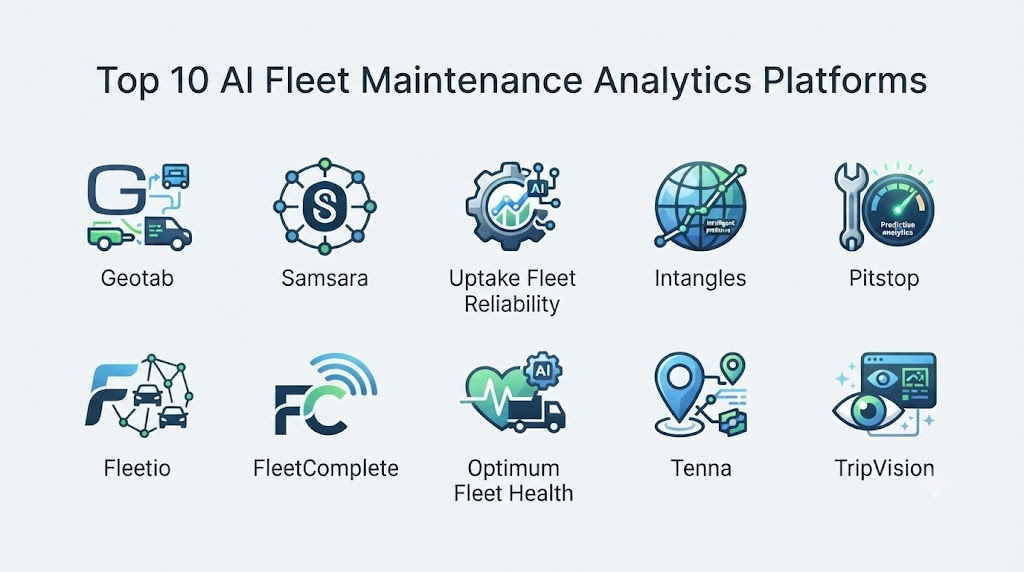
Top 10 AI Fleet Maintenance Analytics Platforms
1. Samsara
One-line verdict: Best for organizations wanting integrated fleet telematics, vehicle diagnostics, maintenance workflows, and operational analytics.
Short description:
Samsara provides connected operations technology for fleets, combining vehicle telematics, diagnostics, maintenance-related workflows, safety information, and operational data. It is particularly useful for organizations seeking a unified fleet-management environment.
Standout Capabilities
- Vehicle telematics.
- Vehicle diagnostics.
- Maintenance workflows.
- Fleet health monitoring.
- Driver and vehicle data.
- Asset tracking.
- Operational dashboards.
- Automated alerts.
AI-Specific Depth
- Model support: Proprietary AI and analytics capabilities; exact model architecture is not publicly stated.
- RAG / knowledge integration: Not primarily a RAG platform; integrations depend on the product and implementation.
- Evaluation: Platform analytics and operational reporting; exact predictive-model evaluation methodology is not publicly stated.
- Guardrails: Role-based controls and workflow permissions vary by product configuration.
- Observability: Fleet dashboards, alerts, operational metrics, and platform reporting.
Pros
- Broad fleet-management ecosystem.
- Strong connection between telematics and maintenance.
- Useful for organizations seeking one operational platform.
Cons
- Can be broader than needed for maintenance-only use cases.
- Implementation can require substantial operational configuration.
- Pricing depends on fleet size and selected products.
Security & Compliance
Security, access control, and compliance capabilities vary by service and configuration. Organizations should verify current contractual and security requirements directly with the vendor.
Deployment & Platforms
- Cloud.
- Web.
- Mobile applications.
- Connected vehicle hardware.
- APIs and integrations.
Integrations & Ecosystem
Samsara can connect fleet data with broader business and operational systems.
- Telematics.
- Fleet-management systems.
- Maintenance workflows.
- ERP systems.
- TMS platforms.
- APIs.
- Connected vehicle devices.
Pricing Model
Typically subscription and hardware/service based; exact pricing varies by deployment.
Best-Fit Scenarios
- Large commercial fleets.
- Integrated fleet operations.
- Predictive maintenance initiatives.
2. Geotab
One-line verdict: Best for data-driven fleets seeking extensive telematics data and a broad ecosystem for maintenance analytics.
Short description:
Geotab provides connected-vehicle and fleet-management technology. Its telematics ecosystem can provide vehicle data that organizations can use for maintenance monitoring, analytics, diagnostics, and predictive maintenance workflows.
Standout Capabilities
- Vehicle telematics.
- Diagnostics.
- Fleet data.
- Maintenance monitoring.
- Vehicle tracking.
- Fleet analytics.
- Developer ecosystem.
- Connected-vehicle platform.
AI-Specific Depth
- Model support: Proprietary analytics and machine-learning capabilities; exact models vary and are not generally disclosed.
- RAG / knowledge integration: N/A as a core maintenance function.
- Evaluation: Fleet and vehicle analytics are available; exact predictive-model evaluation details vary.
- Guardrails: Platform access controls and administrative capabilities.
- Observability: Fleet dashboards, diagnostic information, and operational analytics.
Pros
- Extensive telematics ecosystem.
- Strong data-oriented architecture.
- Broad integration potential.
Cons
- Requires careful data configuration.
- Advanced analytics may require technical expertise.
- Platform breadth can introduce implementation complexity.
Security & Compliance
Security and administrative controls vary by product and deployment. Verify specific requirements during procurement.
Deployment & Platforms
- Cloud.
- Web.
- Mobile.
- Vehicle hardware.
- APIs.
Integrations & Ecosystem
- Telematics devices.
- Fleet-management systems.
- Maintenance systems.
- TMS.
- ERP.
- APIs.
- Partner ecosystem.
Pricing Model
Subscription and hardware/service models vary.
Best-Fit Scenarios
- Data-intensive fleet operations.
- Mixed commercial fleets.
- Custom analytics environments.
3. Motive
One-line verdict: Best for commercial fleets combining telematics, vehicle diagnostics, safety, and maintenance-related fleet operations.
Short description:
Motive provides fleet-management and connected-operations technology covering vehicle tracking, telematics, safety, and maintenance-related workflows. Its platform is suited to commercial fleets seeking integrated operational data.
Standout Capabilities
- Fleet telematics.
- Vehicle tracking.
- Diagnostics.
- Maintenance workflows.
- Fleet monitoring.
- Driver data.
- Operational analytics.
- Alerts.
AI-Specific Depth
- Model support: Proprietary AI and analytics; exact models are not publicly stated.
- RAG / knowledge integration: N/A.
- Evaluation: Operational analytics are available; detailed predictive-model evaluation methodology is not publicly stated.
- Guardrails: Administrative and access controls vary by configuration.
- Observability: Fleet dashboards, alerts, and operational metrics.
Pros
- Integrated commercial fleet platform.
- Useful vehicle and operational data.
- Maintenance can be connected with other fleet functions.
Cons
- Broader than a dedicated maintenance analytics platform.
- Advanced predictive use cases may require configuration.
- Exact capabilities vary by product package.
Security & Compliance
Security and compliance capabilities should be verified for the selected product and contractual configuration.
Deployment & Platforms
- Cloud.
- Web.
- Mobile.
- Connected hardware.
- APIs.
Integrations & Ecosystem
- Fleet-management systems.
- Telematics.
- Maintenance operations.
- TMS.
- ERP.
- APIs.
- Connected vehicle systems.
Pricing Model
Subscription-based and dependent on selected products and fleet requirements.
Best-Fit Scenarios
- Commercial trucking.
- Mixed fleets.
- Integrated fleet operations.
4. Fleetio
One-line verdict: Best for fleet teams wanting maintenance management, vehicle records, work orders, and analytics in one platform.
Short description:
Fleetio focuses on fleet management and maintenance operations. It provides vehicle records, service histories, work orders, inspections, parts information, and reporting that can support data-driven maintenance programs.
Standout Capabilities
- Vehicle maintenance management.
- Work orders.
- Service history.
- Inspections.
- Parts management.
- Fleet records.
- Maintenance reporting.
- Telematics integrations.
AI-Specific Depth
- Model support: AI-specific predictive model details are not publicly stated.
- RAG / knowledge integration: N/A.
- Evaluation: Standard fleet reporting; dedicated AI evaluation capabilities are not publicly stated.
- Guardrails: User permissions and administrative controls.
- Observability: Fleet reports, maintenance records, and operational dashboards.
Pros
- Maintenance-centric.
- Strong work-order functionality.
- Useful fleet records and service history.
Cons
- Less focused on advanced AI prediction than specialized analytics systems.
- Predictive functionality may depend on integrations.
- Large enterprise deployments may require additional systems.
Security & Compliance
Specific controls vary by plan and deployment and should be verified with the vendor.
Deployment & Platforms
- Cloud.
- Web.
- Mobile.
- APIs/integrations.
Integrations & Ecosystem
- Telematics.
- Fuel systems.
- Accounting systems.
- Parts suppliers.
- Fleet hardware.
- APIs.
- Maintenance workflows.
Pricing Model
Subscription-based with plan-dependent functionality.
Best-Fit Scenarios
- Fleet maintenance teams.
- Preventive maintenance.
- Work-order management.
5. AssetWorks FleetFocus
One-line verdict: Best for large public-sector and enterprise fleets requiring structured maintenance and fleet asset management.
Short description:
AssetWorks provides fleet-management software supporting maintenance, asset management, work orders, parts, fuel, and operational processes. It is particularly relevant for larger and more complex fleet organizations.
Standout Capabilities
- Fleet asset management.
- Maintenance management.
- Work orders.
- Parts management.
- Fuel management.
- Fleet records.
- Reporting.
- Enterprise workflows.
AI-Specific Depth
- Model support: AI-specific model architecture varies or is not publicly stated.
- RAG / knowledge integration: N/A.
- Evaluation: Fleet analytics and reporting; dedicated AI evaluation details are not publicly stated.
- Guardrails: Enterprise administrative controls vary by deployment.
- Observability: Reporting, dashboards, and maintenance analytics.
Pros
- Strong fleet-management depth.
- Suitable for complex organizations.
- Maintenance and asset management are closely integrated.
Cons
- May be more complex than smaller fleets require.
- Implementation can require significant planning.
- AI-specific capabilities vary by deployment and product configuration.
Security & Compliance
Enterprise security capabilities should be validated against the organization’s specific requirements.
Deployment & Platforms
- Cloud and enterprise deployment options vary.
- Web.
- APIs/integrations.
- Enterprise systems.
Integrations & Ecosystem
- ERP.
- Fleet systems.
- Fuel systems.
- Parts management.
- Telematics.
- APIs.
- Enterprise databases.
Pricing Model
Enterprise pricing; exact pricing is not publicly stated.
Best-Fit Scenarios
- Government fleets.
- Large enterprise fleets.
- Complex maintenance operations.
6. IBM Maximo Application Suite
One-line verdict: Best for enterprises connecting fleet maintenance analytics with broader enterprise asset-management processes.
Short description:
IBM Maximo Application Suite provides enterprise asset-management capabilities across maintenance, inspections, asset health, work management, and operational processes. It can support fleet-related maintenance programs where vehicle assets are part of a broader asset-management environment.
Standout Capabilities
- Asset management.
- Maintenance management.
- Work management.
- Asset health monitoring.
- Inspections.
- Predictive maintenance capabilities.
- Enterprise integrations.
- Analytics.
AI-Specific Depth
- Model support: IBM AI and analytics capabilities; specific models vary by solution.
- RAG / knowledge integration: AI and data integration capabilities vary by implementation.
- Evaluation: Asset-health and predictive analytics can support evaluation workflows; exact methodology depends on configuration.
- Guardrails: Enterprise governance and administrative capabilities.
- Observability: Asset-health dashboards, analytics, and operational monitoring.
Pros
- Strong enterprise asset-management foundation.
- Suitable for complex maintenance environments.
- Strong integration possibilities.
Cons
- Can be complex for smaller fleet organizations.
- Implementation may require specialized expertise.
- Licensing and architecture can be substantial.
Security & Compliance
Enterprise security, identity, access-control, and governance capabilities are available across IBM enterprise offerings, but specific controls should be validated for the selected implementation.
Deployment & Platforms
- Cloud.
- Hybrid.
- Enterprise environments.
- Web.
- APIs.
Integrations & Ecosystem
- ERP.
- IoT.
- Enterprise data platforms.
- Fleet systems.
- Maintenance systems.
- APIs.
- Analytics platforms.
Pricing Model
Enterprise subscription/licensing model; exact pricing is not publicly stated.
Best-Fit Scenarios
- Large enterprises.
- Complex asset environments.
- Predictive maintenance programs.
7. Uptake
One-line verdict: Best for organizations seeking specialized AI-driven predictive maintenance and asset-health analytics.
Short description:
Uptake focuses on industrial AI and asset performance analytics. Its technology has been associated with predictive maintenance and operational intelligence for asset-intensive industries, including transportation-related environments.
Standout Capabilities
- Predictive maintenance.
- Asset-health analytics.
- Failure-risk prediction.
- Condition monitoring.
- Industrial AI.
- Fleet analytics.
- Operational insights.
- Data integration.
AI-Specific Depth
- Model support: Proprietary machine-learning and analytics technologies.
- RAG / knowledge integration: Not primarily a RAG platform.
- Evaluation: Predictive analytics require model-performance monitoring; exact methodology varies.
- Guardrails: Enterprise data and access controls vary by deployment.
- Observability: Asset-health and operational analytics.
Pros
- Strong predictive-maintenance orientation.
- Designed for asset-intensive organizations.
- Useful for advanced analytics initiatives.
Cons
- May be excessive for smaller fleets.
- Enterprise implementation can require data integration work.
- Pricing is not publicly stated.
Security & Compliance
Specific security and compliance capabilities should be verified for the proposed deployment.
Deployment & Platforms
- Cloud.
- Enterprise integrations.
- APIs.
- Data platforms.
Integrations & Ecosystem
- Telematics.
- IoT.
- Enterprise asset management.
- Data warehouses.
- Fleet systems.
- Analytics platforms.
Pricing Model
Enterprise pricing; exact pricing is not publicly stated.
Best-Fit Scenarios
- Predictive maintenance.
- Large transportation fleets.
- Asset-intensive organizations.
8. Fiix
One-line verdict: Best for maintenance teams wanting CMMS capabilities that can incorporate analytics, asset data, and predictive maintenance workflows.
Short description:
Fiix provides computerized maintenance management capabilities for work orders, assets, preventive maintenance, parts, and maintenance analytics. Its ecosystem can support organizations moving from reactive maintenance toward more data-driven processes.
Standout Capabilities
- CMMS.
- Work orders.
- Preventive maintenance.
- Asset records.
- Parts management.
- Maintenance analytics.
- Automation.
- Integrations.
AI-Specific Depth
- Model support: AI-specific capabilities vary by product and are not fully publicly stated.
- RAG / knowledge integration: N/A.
- Evaluation: Maintenance analytics and reporting; dedicated AI evaluation details are not publicly stated.
- Guardrails: User roles and permissions.
- Observability: Maintenance dashboards and operational reporting.
Pros
- Maintenance-focused.
- Useful CMMS foundation.
- Good transition point toward predictive maintenance.
Cons
- Requires quality asset data.
- Advanced fleet prediction may require telematics integrations.
- Not exclusively focused on fleet vehicles.
Security & Compliance
Specific controls depend on product configuration and should be verified during procurement.
Deployment & Platforms
- Cloud.
- Web.
- Mobile.
- APIs/integrations.
Integrations & Ecosystem
- IoT.
- Telematics.
- ERP.
- Inventory systems.
- APIs.
- Maintenance systems.
Pricing Model
Subscription-based; exact pricing varies.
Best-Fit Scenarios
- Maintenance departments.
- Mixed assets.
- Preventive maintenance programs.
9. Samsara Maintenance
One-line verdict: Best for fleets already using connected vehicle data and wanting maintenance workflows integrated with fleet operations.
Short description:
Samsara’s maintenance capabilities can connect vehicle information and fleet operational data with service and maintenance workflows. This is particularly useful when maintenance decisions need to reflect actual vehicle usage.
Standout Capabilities
- Vehicle diagnostics.
- Maintenance alerts.
- Service scheduling.
- Vehicle health information.
- Telematics.
- Fleet dashboards.
- Operational data.
- Maintenance workflows.
AI-Specific Depth
- Model support: Proprietary analytics; exact predictive models are not publicly stated.
- RAG / knowledge integration: N/A.
- Evaluation: Operational metrics are available; detailed model-evaluation methodology is not publicly stated.
- Guardrails: Administrative and role-based controls vary by implementation.
- Observability: Vehicle and fleet dashboards.
Pros
- Connected vehicle data.
- Integrated maintenance workflows.
- Good fit for operational fleet teams.
Cons
- Best value may come from broader platform adoption.
- Advanced predictive modeling may not be fully customizable.
- Costs increase with additional platform capabilities.
Security & Compliance
Verify current security controls and contractual requirements for your specific deployment.
Deployment & Platforms
- Cloud.
- Web.
- Mobile.
- Vehicle hardware.
- APIs.
Integrations & Ecosystem
- Telematics.
- Fleet management.
- Maintenance systems.
- TMS.
- APIs.
- Enterprise systems.
Pricing Model
Subscription and hardware/service-based.
Best-Fit Scenarios
- Connected fleets.
- Vehicle diagnostics.
- Integrated fleet operations.
10. Nauto
One-line verdict: Best for fleets interested in AI-powered vehicle intelligence combined with safety and operational data.
Short description:
Nauto provides AI-based fleet technology focused on vehicle and driver intelligence. While safety is a major component, its vehicle data and operational insights can contribute to broader fleet maintenance and asset-management strategies.
Standout Capabilities
- AI-based vehicle intelligence.
- Vehicle monitoring.
- Driver behavior analytics.
- Fleet insights.
- Video and sensor data.
- Risk analytics.
- Operational alerts.
- Connected fleet technology.
AI-Specific Depth
- Model support: Proprietary AI systems.
- RAG / knowledge integration: N/A.
- Evaluation: AI analytics are product-specific; exact evaluation methodology is not publicly stated.
- Guardrails: Platform and administrative controls vary.
- Observability: Fleet alerts and operational analytics.
Pros
- Strong AI orientation.
- Rich vehicle and driver data.
- Useful for broader fleet intelligence.
Cons
- Maintenance is not its sole focus.
- May require integration with dedicated maintenance systems.
- Product focus can be broader than maintenance analytics.
Security & Compliance
Specific security and compliance capabilities should be verified for the selected deployment.
Deployment & Platforms
- Cloud.
- Connected vehicle hardware.
- Web.
- Mobile.
- APIs/integrations.
Integrations & Ecosystem
- Telematics.
- Fleet-management systems.
- Safety platforms.
- Maintenance systems.
- APIs.
- Enterprise applications.
Pricing Model
Enterprise/subscription model; exact pricing is not publicly stated.
Best-Fit Scenarios
- AI-enabled fleets.
- Connected vehicles.
- Fleet risk and operational analytics.
Comparison Table
| Tool Name | Best For | Deployment | Model Flexibility | Strength | Watch-Out | Public Rating |
|---|---|---|---|---|---|---|
| Samsara | Connected commercial fleets | Cloud | Hosted | Integrated fleet intelligence | Platform breadth | N/A |
| Geotab | Data-driven fleets | Cloud | Hosted/Platform | Telematics ecosystem | Configuration complexity | N/A |
| Motive | Commercial fleets | Cloud | Hosted | Fleet operations | Product-package dependence | N/A |
| Fleetio | Maintenance teams | Cloud | Hosted/Integrated | Maintenance management | Advanced AI may require integrations | N/A |
| AssetWorks FleetFocus | Large fleets | Cloud/Enterprise | Hosted | Fleet asset management | Implementation complexity | N/A |
| IBM Maximo | Enterprise asset management | Cloud/Hybrid | Multi-model/Enterprise | Asset-health management | Complexity | N/A |
| Uptake | Predictive maintenance | Cloud | Proprietary | Industrial AI | Enterprise focus | N/A |
| Fiix | CMMS-driven maintenance | Cloud | Hosted/Integrated | Maintenance workflows | Fleet-specific AI varies | N/A |
| Samsara Maintenance | Connected fleet maintenance | Cloud | Hosted | Diagnostics integration | Ecosystem dependency | N/A |
| Nauto | AI fleet intelligence | Cloud | Proprietary | AI-based fleet insights | Maintenance is not sole focus | N/A |
Scoring & Evaluation
The following scores are comparative editorial assessments, not official vendor ratings. Fleet maintenance analytics should ultimately be evaluated using your own vehicle population, telematics quality, failure history, work-order data, and maintenance objectives.
The weighting prioritizes core maintenance capabilities, reliability, integration, performance, and security.
| Tool | Core | Reliability/Eval | Guardrails | Integrations | Ease | Perf/Cost | Security/Admin | Support | Weighted Total |
|---|---|---|---|---|---|---|---|---|---|
| Samsara | 10 | 9 | 9 | 10 | 9 | 8 | 9 | 10 | 9.25 |
| Geotab | 10 | 9 | 9 | 10 | 8 | 9 | 9 | 9 | 9.10 |
| Motive | 9 | 9 | 9 | 9 | 9 | 8 | 9 | 9 | 8.95 |
| Fleetio | 9 | 8 | 8 | 9 | 9 | 9 | 8 | 9 | 8.65 |
| AssetWorks FleetFocus | 10 | 8 | 9 | 9 | 7 | 8 | 9 | 9 | 8.65 |
| IBM Maximo | 10 | 9 | 10 | 10 | 7 | 8 | 10 | 10 | 9.30 |
| Uptake | 9 | 10 | 9 | 9 | 7 | 8 | 9 | 9 | 8.95 |
| Fiix | 8 | 8 | 8 | 9 | 9 | 9 | 8 | 9 | 8.55 |
| Samsara Maintenance | 9 | 9 | 9 | 10 | 9 | 8 | 9 | 10 | 9.10 |
| Nauto | 8 | 9 | 9 | 8 | 8 | 8 | 9 | 8 | 8.40 |
Top 3 for Enterprise
- IBM Maximo Application Suite — Strong enterprise asset-management and predictive-maintenance foundation.
- Samsara — Strong connected-fleet ecosystem and operational integration.
- Geotab — Strong telematics data foundation and ecosystem.
Top 3 for SMB
- Fleetio — Maintenance-focused and practical for fleet teams.
- Samsara — Strong option when connected fleet management is also required.
- Motive — Good fit for commercial fleet operations.
Top 3 for Developers
- Geotab — Strong telematics and integration ecosystem.
- Samsara — Useful connected-fleet APIs and operational data.
- Fiix — Good maintenance-management foundation for integrated applications.
Which AI Fleet Maintenance Analytics Platform Is Right for You?
Solo / Freelancer
For a small fleet or independent operation, avoid unnecessarily complex predictive-maintenance infrastructure.
Prioritize:
- Simple maintenance records.
- Vehicle health alerts.
- Easy telematics integration.
- Mobile access.
- Service reminders.
- Basic analytics.
- Straightforward reporting.
A maintenance-management platform may deliver more value than a sophisticated AI system if the fleet has insufficient historical data.
SMB
SMBs should focus on practical operational outcomes:
- Reduced unexpected downtime.
- Better maintenance scheduling.
- Faster identification of vehicle issues.
- Better work-order management.
- Easier access to service history.
- Reasonable subscription costs.
Samsara, Fleetio, Motive, or Geotab can be considered depending on whether the priority is connected telematics, maintenance management, or broader fleet operations.
Mid-Market
Mid-market fleets should begin connecting maintenance analytics with:
- Telematics.
- Work orders.
- Vehicle utilization.
- Fuel consumption.
- Parts.
- Driver behavior.
- Routes.
- Inspection records.
At this stage, predictive analytics can become substantially more useful because organizations typically have more operational data.
Enterprise
Large organizations should consider an architecture that combines:
Vehicle data → Telematics → Data platform → Predictive analytics → Maintenance workflow → Technician → Outcome data
Important enterprise requirements include:
- API integration.
- Fleet-wide data normalization.
- Model monitoring.
- Failure-risk scoring.
- Maintenance prioritization.
- Data governance.
- Role-based access.
- Auditability.
- Cost monitoring.
- Integration with ERP and CMMS.
- Human approval for high-impact decisions.
Regulated Industries
Organizations operating government, public infrastructure, healthcare transportation, or other sensitive fleets should evaluate:
- Location-data privacy.
- Driver information.
- Data retention.
- Access control.
- Encryption.
- Audit logs.
- Data residency.
- Third-party processing.
- Integration security.
Budget vs Premium
A budget fleet may only need:
- Preventive maintenance.
- Diagnostic alerts.
- Service history.
- Basic analytics.
A premium implementation may justify:
- Predictive failure models.
- Real-time vehicle health.
- Advanced anomaly detection.
- Automated maintenance prioritization.
- Fleet-wide optimization.
- AI-assisted technician workflows.
Build vs Buy
Build when:
- You have large historical datasets.
- Your vehicles have specialized operating characteristics.
- You employ data-science expertise.
- Existing fleet systems provide rich telemetry.
- Predictive maintenance is strategically important.
Buy when:
- You need rapid deployment.
- Telematics infrastructure is already available.
- You need broad fleet functionality.
- You do not have sufficient data-science resources.
A hybrid model is often practical: purchase telematics and maintenance infrastructure while building proprietary prediction models around your own fleet data.
Implementation Playbook: 30 / 60 / 90 Days
First 30 Days: Pilot + Success Metrics
Select a representative fleet segment.
Collect:
- Vehicle identifiers.
- Mileage.
- Engine data.
- Diagnostic codes.
- Service history.
- Repair history.
- Parts replacements.
- Inspection results.
- Driver reports.
- Downtime.
- Vehicle utilization.
Define baseline metrics:
- Maintenance cost per vehicle.
- Unplanned downtime.
- Mean time between failures.
- Preventive-maintenance compliance.
- Repair frequency.
- Parts consumption.
- Average work-order duration.
Create a clean historical dataset for evaluation.
Days 31–60: Security + Evaluation + Rollout
Build an evaluation harness for predictive maintenance.
Test:
- Common vehicle failures.
- Rare failures.
- High-mileage vehicles.
- Low-utilization vehicles.
- Different vehicle models.
- Different operating environments.
- Seasonal patterns.
- Diagnostic-code combinations.
Measure:
- Precision.
- Recall.
- False-positive rate.
- False-negative rate.
- Lead time before failure.
- Maintenance cost impact.
If AI-generated maintenance recommendations are used, test them for hallucinations and unsupported recommendations.
Days 61–90: Cost, Latency + Governance
Connect predictions to actual workflows.
For example:
AI risk score → Maintenance manager → Work order → Technician → Repair → Outcome
Then measure whether predictions actually improve operational outcomes.
Implement:
- Model monitoring.
- Prediction drift detection.
- Alert thresholds.
- Data-quality checks.
- API monitoring.
- Access controls.
- Audit trails.
- Cost monitoring.
- Incident procedures.
Do not optimize solely for prediction accuracy. Optimize for business impact.
Common Mistakes & How to Avoid Them
- Using incomplete telematics data: Poor input quality produces unreliable predictions.
- Ignoring maintenance history: Historical repairs are often essential for understanding failure patterns.
- Treating every alert as equally important: Use risk-based prioritization.
- Too many false alarms: Excessive alerts can cause maintenance teams to ignore the system.
- No evaluation dataset: Predictions must be compared against actual failures.
- Ignoring false negatives: Missing a critical failure can be more costly than generating a false alert.
- Automating maintenance without human review: High-impact decisions should have appropriate technician oversight.
- Ignoring vehicle differences: Different makes, models, ages, and operating environments can behave differently.
- Poor work-order data: Inconsistent technician notes can weaken analytics.
- Ignoring data drift: Vehicle populations and operating patterns change.
- No cost monitoring: Sensors, telematics, APIs, storage, and analytics can increase operating costs.
- Unmanaged location data: Fleet and driver information requires appropriate privacy controls.
- No integration with maintenance workflows: Predictions have little value if technicians never act on them.
- Ignoring parts availability: Predicting a repair without considering parts can create operational delays.
- No feedback loop: Completed repairs should feed back into the analytics system.
- Vendor lock-in: Maintain APIs or data-export capabilities that allow future migration.
FAQs
1. What is AI Fleet Maintenance Analytics?
AI Fleet Maintenance Analytics uses vehicle, maintenance, diagnostic, telematics, and operational data to identify maintenance patterns and predict potential problems.
2. How is AI fleet maintenance different from preventive maintenance?
Preventive maintenance usually schedules service based on time, mileage, or predefined intervals. AI-based maintenance can use actual vehicle-condition data and historical patterns to identify changing maintenance risks.
3. Can AI predict vehicle failures?
Yes, predictive models can identify patterns associated with certain failures. However, prediction quality depends heavily on data quality, vehicle diversity, sensor coverage, and historical failure records.
4. What data does AI maintenance analytics need?
Useful data can include mileage, diagnostic codes, engine information, telematics, maintenance history, work orders, inspections, parts replacements, operating conditions, and actual failure events.
5. Can AI work with existing telematics?
Yes. Many fleet analytics architectures connect telematics data with maintenance-management systems, CMMS platforms, or enterprise data platforms.
6. Can small fleets use predictive maintenance?
Yes, but a small fleet may not have enough historical failure data to train or validate sophisticated models. A combination of preventive maintenance and basic vehicle-health analytics may be more practical.
7. Can AI prioritize maintenance work orders?
Yes. A system can potentially rank work based on failure risk, vehicle criticality, downtime consequences, safety implications, and operational requirements.
8. Can AI reduce fleet downtime?
It can help identify problems earlier and improve maintenance planning, but actual downtime reduction depends on whether the organization acts on the predictions effectively.
9. Is self-hosted AI fleet maintenance software available?
Some technologies can support private or enterprise deployment, while many fleet platforms are cloud-based. Availability varies by vendor and product.
10. Can AI analyze diagnostic trouble codes?
Yes. Diagnostic codes can be combined with vehicle history, sensor information, and previous repairs to identify patterns and prioritize investigation.
11. Can AI maintenance analytics integrate with a CMMS?
Yes. Integration with a CMMS can allow predictions and maintenance recommendations to feed directly into work-order processes.
12. How should predictive maintenance accuracy be measured?
Evaluate precision, recall, false positives, false negatives, lead time before failure, and business outcomes such as downtime and maintenance cost.
13. Can AI recommend what a technician should repair?
AI can generate recommendations based on available data, but recommendations should be validated against manufacturer procedures, diagnostic information, and technician expertise.
14. Is fleet maintenance data sensitive?
It can be. Vehicle location, driver information, operational routes, asset identifiers, and maintenance records can contain commercially or personally sensitive information.
15. Can generative AI be used in fleet maintenance?
Yes. Generative AI can help summarize vehicle histories, interpret maintenance notes, answer technician questions, and explain maintenance alerts. It should not replace qualified technical judgment.
16. What is predictive maintenance lead time?
Lead time is the amount of advance warning between a system identifying an elevated failure risk and the actual failure or maintenance event.
17. What happens if the AI produces too many false alarms?
The system should be recalibrated using historical outcomes. Thresholds, features, model selection, and alert policies may need adjustment.
18. Should every vehicle have the same maintenance model?
Not necessarily. Vehicle type, manufacturer, model, age, mileage, duty cycle, and operating environment can influence maintenance behavior.
19. Can fleet maintenance analytics predict parts demand?
Potentially. Historical repairs, failure patterns, vehicle population, and maintenance schedules can be used to support parts-demand forecasting.
20. What is the biggest challenge in implementing AI fleet maintenance?
Data quality is usually one of the biggest challenges. Organizations need consistent vehicle, diagnostic, maintenance, and failure data before sophisticated predictive analytics can deliver reliable results.
Conclusion
AI Fleet Maintenance Analytics can transform maintenance from a primarily reactive process into a more predictive, data-driven operation. The biggest opportunity is not simply generating another dashboard or alert. It is connecting vehicle health data, predictive analytics, maintenance workflows, technicians, parts, and operational decisions into a continuous feedback loop.Different organizations need different approaches. A small fleet may benefit most from straightforward maintenance management and vehicle-health alerts. A growing commercial fleet may benefit from integrated telematics and predictive analytics. Large enterprises may need a more sophisticated architecture connecting telematics, CMMS, ERP, data platforms, and proprietary AI models.The most effective implementation is one that produces measurable operational improvements such as fewer unexpected failures, lower downtime, better maintenance prioritization, improved technician productivity, and more predictable fleet availabili